

Dear Subscribers,
Welcome to the new look Blind Spot newsletter.
We have given up on the old formatting because it was making everything look horrible in the send-out. The inspiration for the new style comes in part from how Politico organises its newsletters. They’ve been doing this a long time so emulating them is no bad idea.
In other news, this week’s Spotlight piece for premium subscribers takes a closer look at the chances of China’s historic defaulted debt being used as a mechanism to ease the US government’s precarious debt position. Yes, it sounds barmy. But I argue that when you think about it, it’s no more or less barmy than the $1 trillion coin idea which has a lot of prominent supporters. The geopolitics for using the debt in a negotiation might finally be ripe.
Sources tell TBS there is growing bipartisan support in Washington for using these bonds in a debt swap or as a condition for further access to markets. Which given the current state of affairs in Congress should probably be viewed as encouraging. The sting in the tale is that the scenario could be good for Trump because one of the biggest holders of the debt is a MAGA loyalist from Tennessee.
The piece was sent out on Saturday morning to premium subscribers, and I have a confession about that. In my rush to see Ricky Gervais in Wembley Arena last night [very funny, albeit not for those with a woke liberal disposition] I outsourced the editing of the story to ChatGPT with the specific instruction not to change the meaning of any sentences beyond the correction of typos and poor turns of phrase. In further proof ChatGPT is not to be trusted, I discovered this morning it had introduced a whole bunch of needless verbosity and messed with some of the logic. So please do go and see the now HUMAN-edited piece on the website linked to above for a better read.
In other news still, this seems to be the weekend that the great liberal intellectual elite have conspired to make the platform formerly known as Twitter their Ex. And it seems they’ve anointed Jack Dorsey-backed BlueSky as its successor. Oh, the irony.
I signed up to the platform about a month ago, and it was a total snooze fest until this week. The functionality remains super glitchy. But something is definitely happening now. Not least because it’s not just the woke tribe jumping ship. Some significant power influencers are active there. I noticed yesterday morning, for example, that among my measly 60 followers at the time was the ECB’s Isabel Schnabel, who clearly embodies the role of a social media liquidity super node. (Thank you for following.)
Also, within 20 mins I was having an argument with someone about the the relative power and influence of Big Sugar relative to Big Fat. Just like the good old days of Twitter. This is noteworthy because that sort of thing really hasn’t been happening on TwiX for ages. So perhaps now is the moment?
My move, I should stress, isn’t ideological. I don’t have a problem with Elon having brought back previously banned individuals or allowed everyone bar those who criticise him to go wild on the platform. [Those liberals who think BlueSky will be a utopia free of hateful content I don’t think have been listening to Dorsey or understand what decentralisation means.]
No, I’m inclined to experiment with BlueSky mainly because posting on X is increasingly like ranting to yourself in the shower. Nobody is challenging you back. There is no engagement. And having to search out tweets of substance is becoming an increasingly painful exercise. Too often I don’t see any replies to my Tweets at all, even if after further investigation it turns out they were there all along. It’s like everyone has been empowered to say whatever they want but never to be seen.
The final annoyance, however, was Elon’s nonsensical idea to remove headlines from posted mainstream articles. Seriously, why? My hunch is that over the next few months, BlueSky will enter a sweet spot, a period when debate once again flourishes. Sadly, I don’t think it will last too long. As ever the issue will be scaling. As it grows, the “deplorables” will crash the party.
The irony is that this time BlueSky’s decentralised state of the network will ensure the platform won’t be able to resort to arbitrary bans or censorship. Making me wonder if it was a bait and switch all along?
As usual, this newsletter was compiled and written by Izabella Kaminska and Dario Garcia Giner. And apologies for typos.
One postscript note, the above was written before the shocking events in the West Bank. This newsletter omits these developments for now consciously as there’s little we can add from a Blind Spot perspective at this point.
| BUSINESS, FINANCE, ECON ETC |
THE US TREASURY announced sweeping sanctions against fentanyl producers in China and Canada.
The question to ask is why has it taken this long for the Americans to act on fentanyl? But also will these measures do any good? Chances are, sadly, that they won’t because this all amounts to yet more sanctions theatre.
We’ve talked before about the so-called “golden triangle” financial laundromat that washes funds between Mexico, China and the United States, to facilitate these illicit supply chains before. These are highly entrenched rat lines that are utterly resistant to Western anti-money laundering rules because they circumvent the US dollar system. Their only interface with the formal banking system takes place in China.
How it works is that cartel representatives using encrypted platforms, burner phones and codes, hand over bulk cash to Chinese contacts. The contact then brings the money to US-based Chinese businesses with bank accounts in China, and via a phone app from that account transfer the yuan equivalent to other accounts in China, bypassing US bank fees and scrutiny. Chinese money launderers then perform similar “mirror transactions” to convert the money into pesos, utilising Chinese businesses with Mexican bank accounts.
The only way to stop this is by acknowledging that this a type of hybrid warfare against the US which requires the a deal with the Chinese.
Notably, the move comes the same week that the Biden Administration announced in a hugely embarrassing campaign u-turn that it had waived 26 federal laws in South Texas to allow border wall construction. Yes, *that* wall. According to the AP, it marks “the administration’s first use of sweeping executive power to pave the way for building more border barriers — a tactic used often during the Trump presidency.” — IK
GOLDMAN SACHS estimated that US interest costs as a share of US GDP would reach a new peak by 2025 due to higher interest rates, and projected that US net interest expenses will rise from 2 percent of GDP in 2022 to 3 percent by 2024 and 4 percent by 2030. 


SWIFT international payments data showed that rather the world was not going through de-dollarisation, as much as de-euroization.
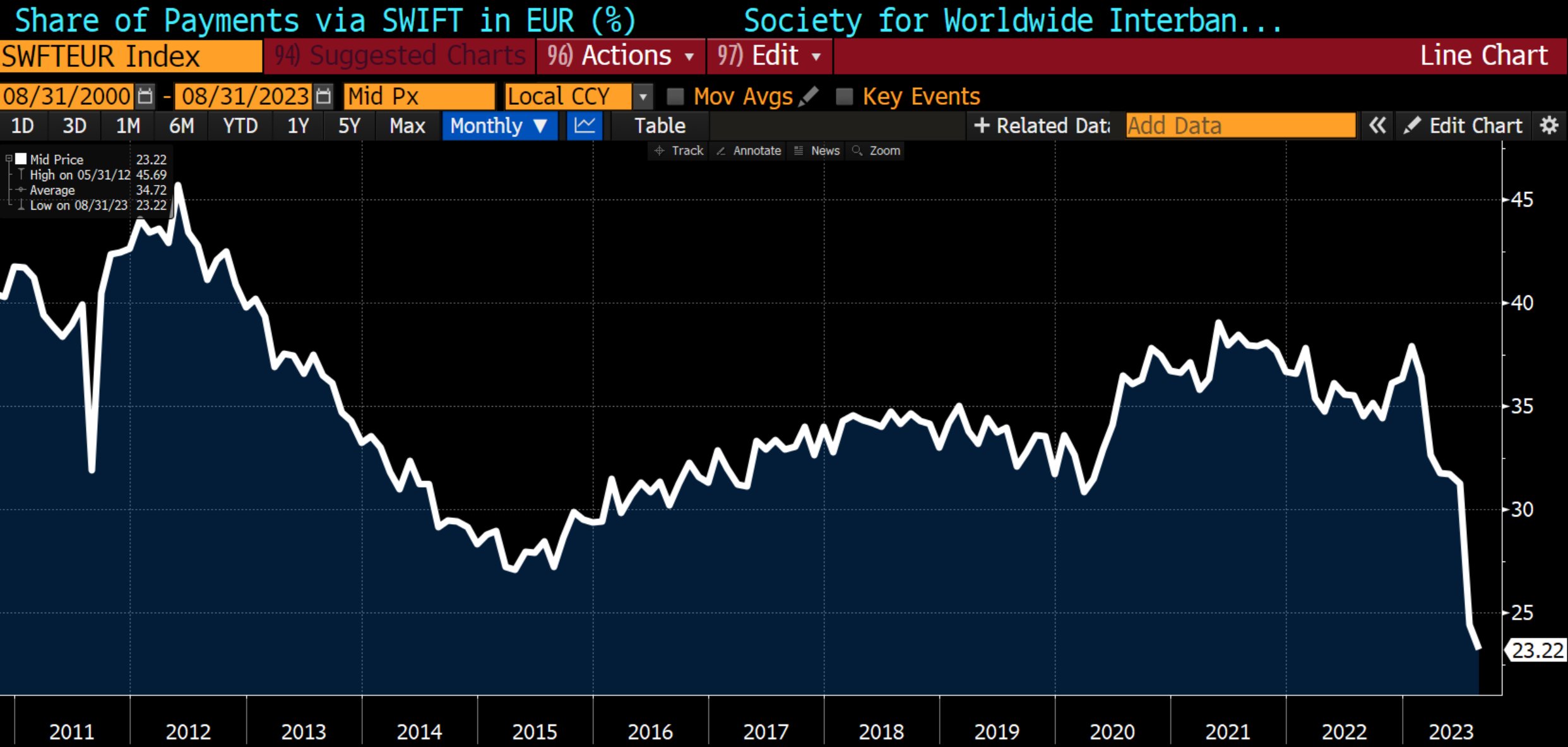
Not everything is necessarily what it seems here. I’ve been assured by multiple sources that the rapid decline of euro SWIFT transactions is related to the Eurosystem’s switch from Target2 to T2. Target2 exclusively went through Swift, while T2 messages don’t have to. — IK
GOLD MARKETS. Economist Philip Pilkington highlighted gold had become uncorrelated with real yields in the context of the recent China premium for the yellow metal. 
BLACKROCK CEO Larry Fink predicted that US 10-year yields would top 5 percent, though he claimed a repeat of the hyperinflation of the 70s was unlikely. That 5 percent prediction was echoed by Ray Dalio the week that US 10-year bond yields peaked at 4.8 percent, their highest level in 16 years amid choppy market conditions on the back of US government shutdown uncertainty and the ousting of Kevin McCarthy as speaker of the House. [Chart below via Socgen] 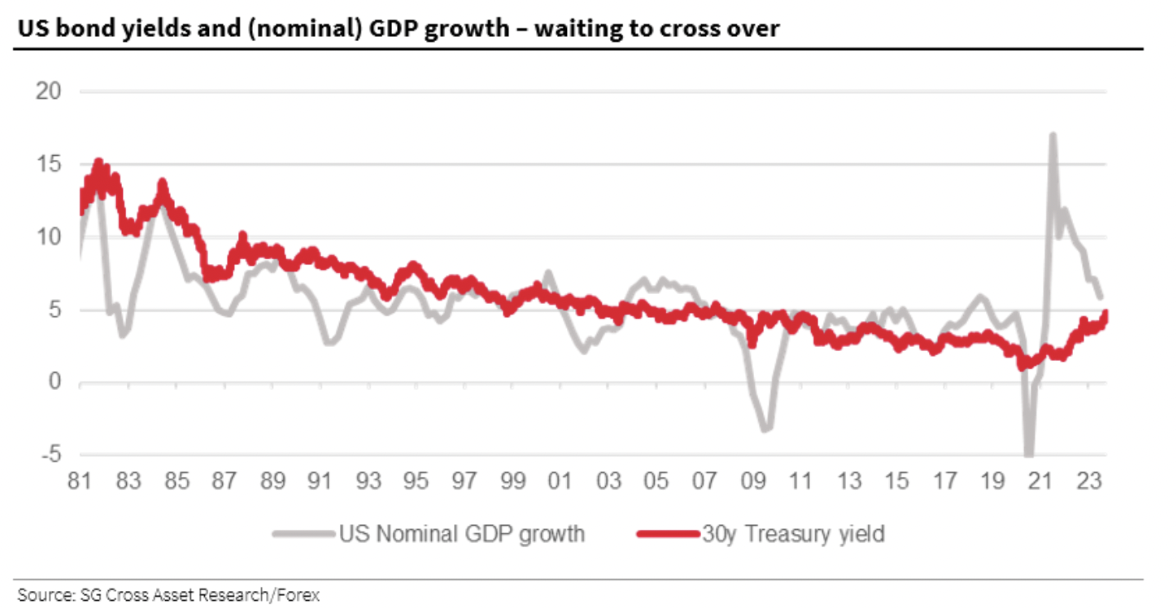 RETURN OF THE BOND VIGILANTES: “The worry is that the escalating federal budget deficit will create more supply of bonds than demand can meet, requiring higher yields to clear the market,” said Ed Yardeni, the president of Yardeni Research Inc., in a research note published Tuesday. “That worry has been the Bond Vigilantes’ entrance cue.”
YELLEN’s OPTIMISM: US Treasury Secretary Janet Yellen noted that US debt servicing costs should be 1 percent of GDP for the next decade, in the event of deficit reduction. When asked about the return of the bond vigilantes, she said she first heard that term in the early 1990s when inflation was high and nominal 10-year yields kept rising higher and higher suggesting the Fed wasn’t doing enough and the concern was that the bond markets were driving the Fed’s behavior. “I don’t honestly think that’s the case now. I think the markets are trying to figure out what the Fed and other central banks have to do to make sure inflation stays low,” she countered.
LIZ TRUSS’s ‘GROWTH COMMISSION’ released its latest report which revealed a hidden £143bn pounds of regulatory costs to businesses in the UK and argued that growth is stagnating because there isn’t really a free market anymore.
The former British Prime Minister made a rip-roaring comeback at last week’s Tory party conference in Manchester, taking to a packed out auditorium to once again lay out her low-tax vision for the U.K. “We need to be hungry to attract business to our country and we need to make the Conservative Party the party of business again,” she told attendees while calling for policies that would make “Britain grow again”.
She also doubled down on the need to cut corporation tax, unleash U.K. natural gas reserves and to build new homes to drive growth. “Over the last 25 years, we’ve had relatively low economic growth and relative economic stagnation and the only thing that’s going to break through that is businesses and entrepreneurs being able to do things differently,” she said.
Current PM Rishi Sunak’s decision to delay the ban on boilers and combustion-engine cars as part of a net-zero u-turn she said was “progress”, but the solution to Britain’s ills was liberating the free market and stimulating supply, not doubling down on rent caps or price controls.
Free market illusion? “Some people have been claiming that we live in some kind of free market paradise in Britain, that somehow the problems we have are a result of too much neo-liberalism, but look at the facts, government spending as a share of GDP is now 46 percent and hasn’t been higher since the 1970s,” Truss said.
FREE MARKET REALISM. The penny finally dropped for The Economist that the West might find it hard to lecture the rest of the world about the virtues of market liberalism given its own turn towards state-supported markets, in the process proving Truss’ sort of right. 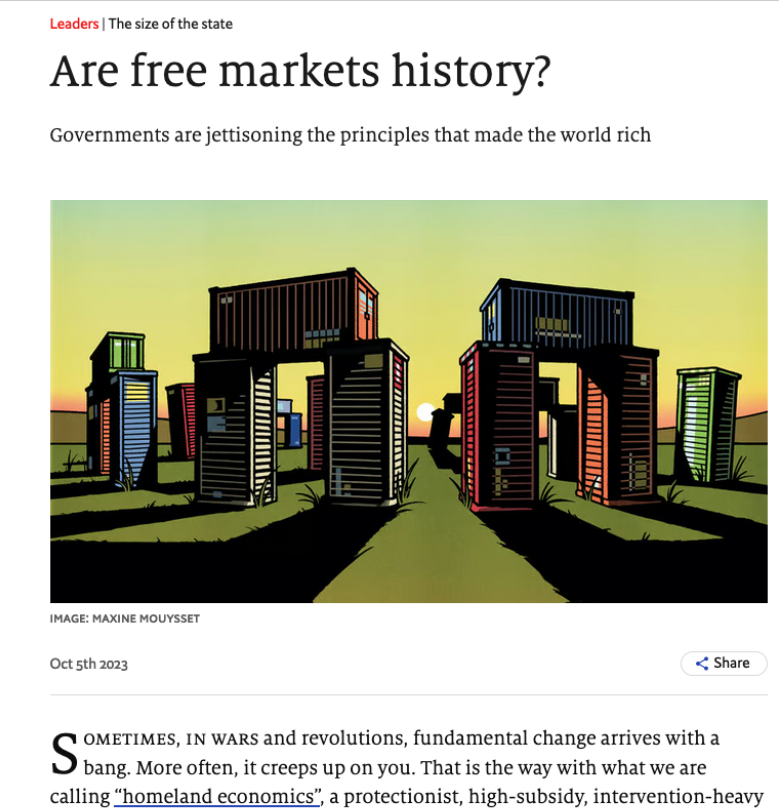
It’s a point I have been arguing since at least early last year, with a piece out in Politico about it in May: 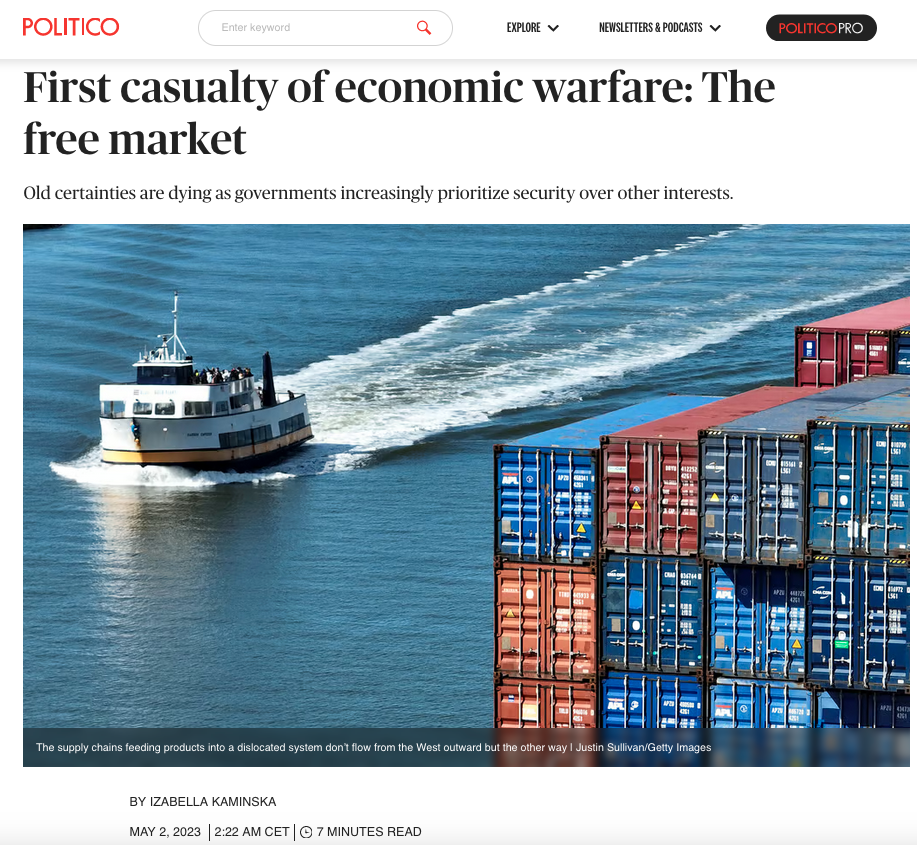
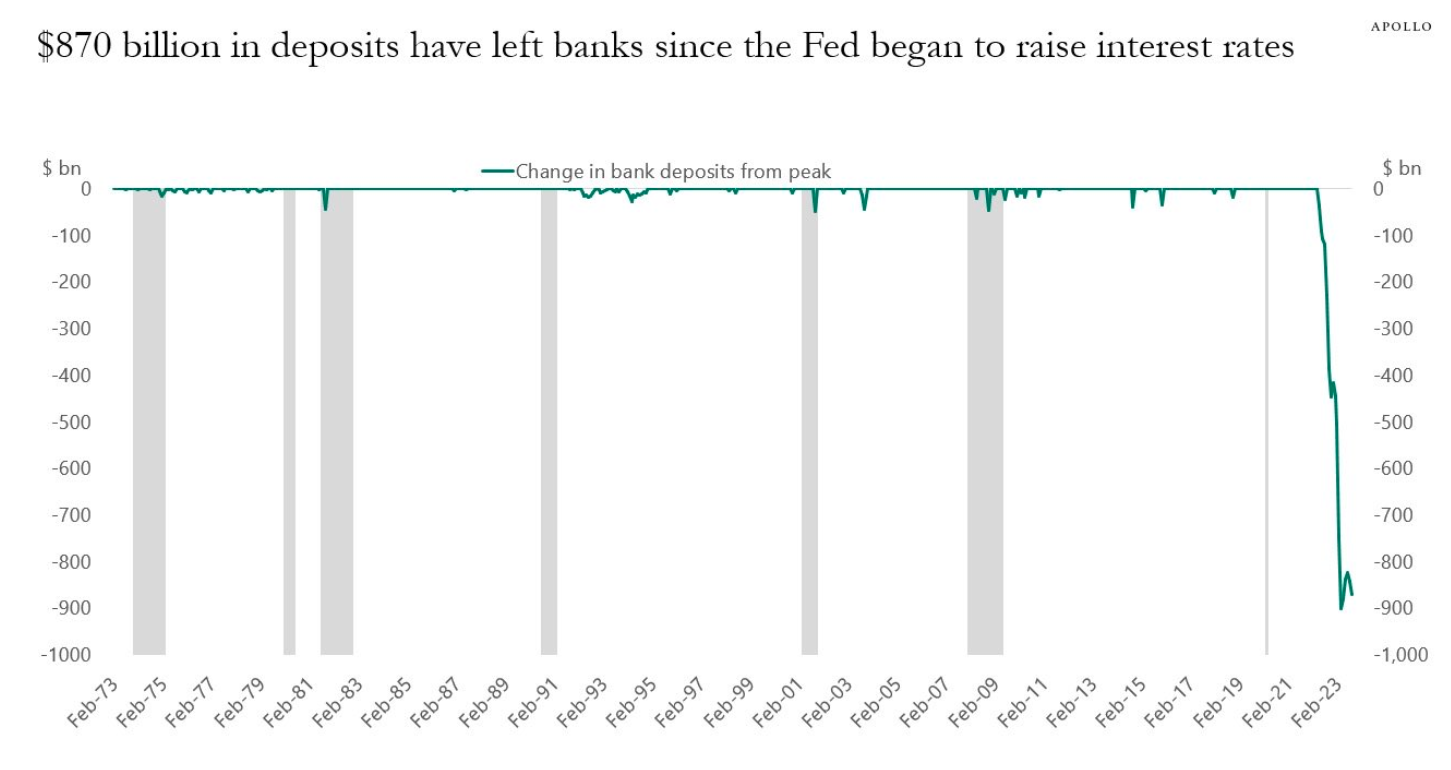
ALIPAY and the Saudi Tourism Authority partnered up to introduce AliPay+ to Saudi Arabia.
For those who read my piece about the Czech Tesla, it’s worth noting that the owners of the trademark, who get to extract annual rents from Elon Musk’s Tesla for use of the brand, had wanted to launch a similar service in the Czech Republic just before the pandemic struck. The idea was to integrate Alipay and Wechat for Chinese tourists on a system that they were going to call TeslaPay. The pandemic, however, killed off Chinese tourism and with that the business. — IK
BANKRUPTCIES SURGING: Socgen’s Albert Edwards warned in a note that bankruptcies appear to be surging and despite being proven wrong so far about a recession incoming, he believed the soft landing phase was coming to an end. He added he agreed with the FT’s Robert Armstrong and the WSJ’s John Authers that the yield premium is currently being driven less by the real economy and inflation expectations, and more because of uncertainty. 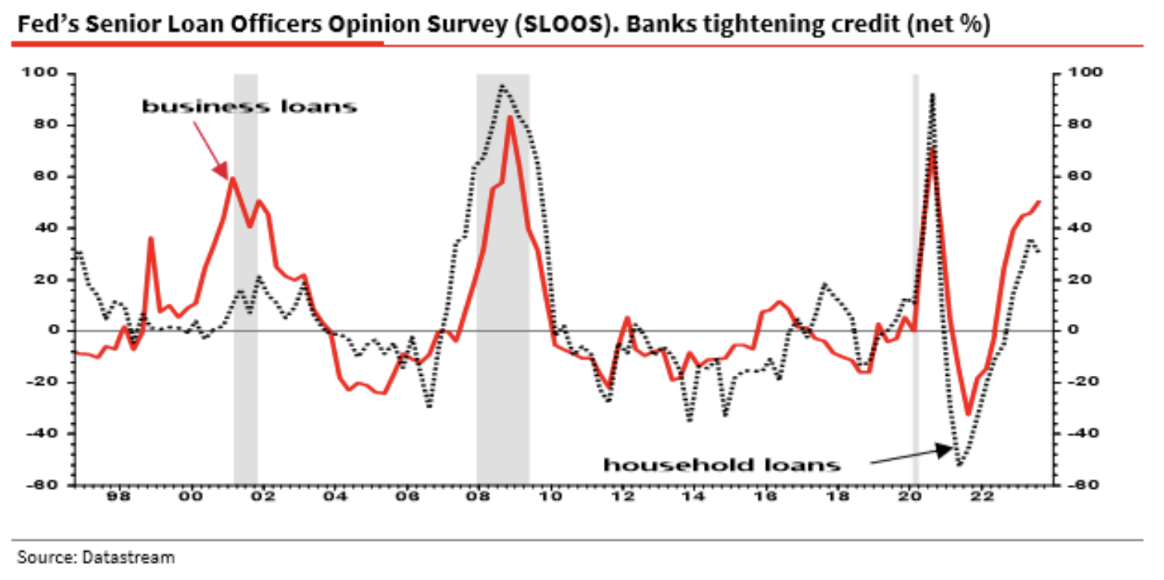
One other factor to consider in the great debate over what is driving yields higher is the general scale of compensation needed by investors to be persuaded to give up their capital to invest in long-term supply-oriented projects.
With renewable returns in the pits, and little to no appetite to invest in fresh manufacturing capacity that’s still fueled by conventional fossil power, what we have here may be the yield equivalent of the great “covered interest rate parity” breakdown of the post-GFC regulatory era.
What we learned from that episode is that regulatory balance-sheet costs factor impose on the market’s capacity to close otherwise seemingly lucrative arbitrages. The arbs therefore have to get to an outsized level (compensating for the related regulatory costs) before banks even consider moving in.
Something similar may be happening here. It’s impossible to close the supply crunch that’s fueling inflation in an environment where current net zero policy makes industrial investment untenable. Any investment needs to more than compensate for the risk that either:Since supply is the prevailing factor driving inflation, it seems clear that cost has to feed into the “risk free” rate itself. — IK
- Government net zero policy will stay firm meaning any fossil fuel investment engaged in today will either be short lived (requiring a much larger return on investment in the short term) or run the risk of being written off after five to 10 years.
- That the cost of the transition proves so unpopular with the public that it will eventually be undone, putting any long term investment in renewables at risk of being outcompeted by fossil alternatives.
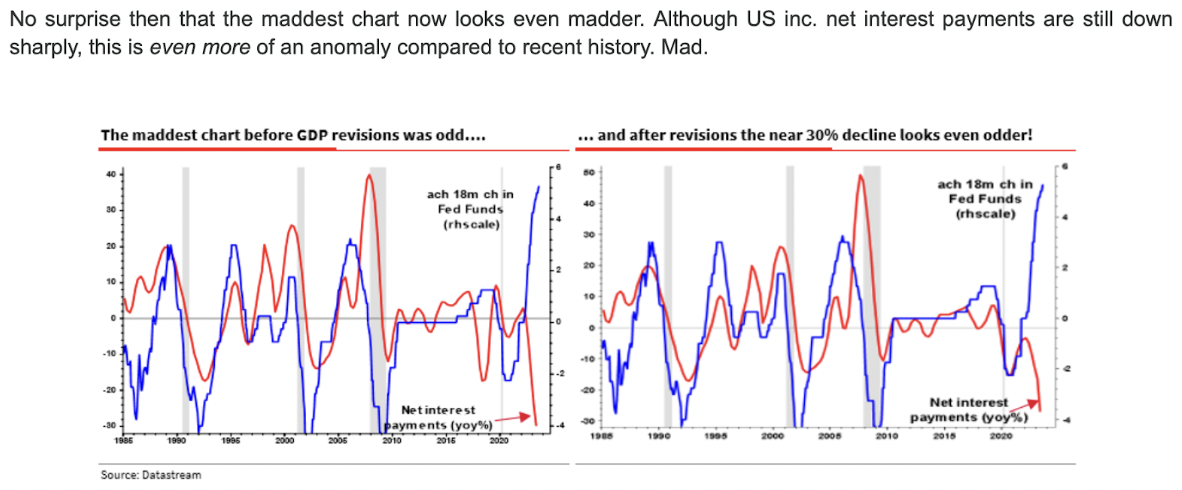
CORPORATE NIMS: Socgen’s Edwards also highlighted the insane interest rate arbitrage that is currently being handed to non-financial “mega corps” that had the foresight to borrow long in 2020/2021.
These entities now have the incentive to keep the funding on deposit earning interest returns rather than deploy it in business investment. This effect has to be adjusted into the long-end of the curve because if not, the incentive to keep borrowing long and reinvesting short will continue to inhibit actual investment in supply or business. According to Edwards this is helping craft “the maddest chart of all” — IK
SPEAKING OF DEBT ROLLOVER: Here’s the current shape of the US debt maturity profile:

| THE ROAD TO HELL IS PAVED WITH GOOD INTENTIONS |
FRANCE sought to subsidise its large nuclear power generators, amid growing tensions about the us of state aid in EU market reform talks. Germany and other EU members are against such moves arguing subsidies distort competition and would give French power producers an unfair advantage.
A BATTERY factory for electrical vehicles in Kansas will require so much energy that a nearby coal plant scheduled for closure is now set to stay open (and even be enlarged) for at least several years, reported the conservative media website Blaze.
CORPORATE VIRTUE SIGNALLING: City AM clocked that Burger King was still operating in Russia, despite having vowed to exit the country 18 months ago.
THE ROYAL SOCIETY found that current estimates for the number of batteries needed for efficient renewable energy storage were seriously underestimated due to long-term intermittences found in such energy harvesting methods. It estimates the UK will likely need 100TWh of grid-scale energy storage in 2050, meaning hydrogen is likely to offer the cheapest scalable option. [It also suggests the grid will have to make use of private EV car capacity.]
HIGHER INTEREST RATES demolished renewable energy stocks, with a sector-wide fall of over 20 percent in the last two months.
ESG SHIFTS: Socgen ESG analysts noted that the investment trend was encountering three key shifts: 
What it means:
Shift 1: Seems to confirm the Blind Spot’s longstanding argument that the investment case for ESG mostly mirrored that of the crypto markets, benefiting mostly from zero-sum pump style flows on the hope that “number goes up”. Now that the underlying investments are failing to deliver and in some cases facing bankruptcy despite all that cheap funding this is becoming more obvious.
Shift 2: Given the above, it makes perfect sense that if you have environmental mandates to achieve you’re going to shy away from equity and over to securities that offer greater creditor rights.
Shift 3: Now that the ESG pump in developing markets is tapped out, the obvious ESG investment opportunity is to rinse and repeat shift 1 but in emerging markets.
| CRYPTO EVANGELISM |
BITCOIN MONEY MARKETS: Axiom BTC, a bitcoin native financing firm, floated the idea of bitcoin money market funds that can provide international capital markets with another source of emergency liquidity when the price is right. Crypto investors would be able to derive yield from positioning themselves in bitcoin covered shorts:
From the report: “Hedge Bitcoin against the dollar, and the dynamics flip — now, you receive a payout for hedging. This phenomenon boils down to opportunity cost. Selling Bitcoin exposure for USD exposure essentially means relinquishing returns that, on average, remain positive. As Bitcoin is still in its monetization phase, it remains very volatile and thus makes a poor cash instrument in a fiat world. But one can still benefit from Bitcoin’s superiority even by selling back exposure, given the likely and average result of a stable balance in dollars plus a positive yield.”
“As long as there are daring traders seeking Bitcoin leverage, a promising avenue arises: selling exposure to Bitcoin and reaping substantial premiums atop dollar-pegged stability. The nascence of the market for Bitcoin derivatives contributes to the current premium’s volatility, but over time, prices and yields should come to mirror underlying differences in monetary policies, greatly favoring Bitcoin holders.”
The report is a bit convoluted, but somewhere in there is an interesting idea about using crypto as a storage vehicle for intermittent global market liquidity imbalances, much the way the Net Zero mob wants to use private EV cars as a mechanism to help balance intermittent supply and demand imbalances from renewables. — IK
SOMETHING ODD happened at nChain, home of Satoshi claimant Craig Steven Wright (CSW), as some of the company’s top staff have been scrubbed from the website.
Recently removed CEO, Christen Ager-Hanssen, claims to be a whistleblower and has been leaking all sorts of internal material that he says exposes that CSW is not Satoshi. Others, however, contend that Ager-Hanssen is himself a known troublemaker that’s not to be trusted. A scammer scamming another scammer is also another possibility. — IK
| MEDIA MATTERS |
TECHCRUNCH argued the new EU Media Freedom Act, which would force online social media groups to keep content from self-declared independent media accounts online for up to 24 hours, is highly problematic as it would allow for the vetted spread of government-backed disinformation.
CANADA’S LINK TAX went live ensuring news watchers could no longer access media content from online social media networks such as Meta. Under the Online News Act, social media platforms are charged when third parties post links to news articles in a bid to get “fair compensation when their news content is made available by dominant digital news intermediaries and generates economic gain.”
AXEL SPRINGER formally expressed an interest in buying out the UK’s Telegraph Group and has joined a growing list of multinational conglomerates vying for the troubled British media venture.
CBANK COMMS POLISH STYLE: National Bank of Poland Governor Adam Glapiński had some thoughts about the state of the media: “Pluralism is important, we need to save this. A variety of press is needed. I’m from Communist times when every paper you bought was the same. Protect yourselves against this…My family and I know where to find the true information …. but you have to be very smart on the Internet to know where the right information is,” he said at his regular press conference on Thursday, riffing on grievances against hostile journalism.
| TORY PARTY CONFERENCE |
AYAAN HIRSI ALI, a.k.a Mrs Niall Ferguson, outlined why she supported Suella Braverman’s suggestion for the United Kingdom to leave the European Court of Human Rights, arguing the court incentivised human trafficking and the general misery of asylum seekers landing on European shores.
The sorry state of European migrants is clear evidence that Europe has turned a corner since the penal reforms enacted during the Enlightenment. Beautiful, humane, and moral they may be de jure — but our treatises on migration have become a de facto engine for human trafficking, crime, and political instability. Cesare Beccaria, the forefather of Western criminal justice, sought laws to preserve the social contract.
For instance, retributive punishments (eye for an eye) — so common in those days — arguably did the opposite; entrenching violence, injustice and inequality. Beccaria rightly argued that needless violence unwove a polity’s social fabric. And above all, laws must be practical and reflect reality.
European human rights legislation may be one of the more ironic legal texts in existence. Beccaria would surely have jumped for joy reading these pages of humane, Enlightenment-inspired laws. But he no doubt would have been dismayed by how they have also almost single-handedly created a European market of human trafficking. One such example is the prohibition on member states to refuse asylum seekers at European borders.
Tragically, this has led Frontex, Europe’s border and coast guard agency, to ally itself with questionable Libyan militants, according to several media reports. Why? Well, it’s simple enough. Member states can’t return migrants who enter their waters. But, practically speaking, they can turn around migrants who haven’t yet entered. Thus, signatories of the ECHR are incentivised to engage in “hot returns”, where the boats are turned around at sea. But it gets worse — because hot returns are both illegal and unconstitutional in ECHR signatory countries. So European agencies — the paragon of global human rights — are forced to outsource these “hot returns” to entities not subject to the ECHR, like Khalifa Haftar’s militiamen in the so-called Libyan Coast Guard.
It’s a type of legislative laundering, using [in many cases very questionable] allies. Haftar’s militiamen have been tied to the very same human traffickers that con migrants into paying fortunes to sail on dangerous ships to unwelcoming ports. No upstanding officer of Frontex, we can imagine, would ever be proud of dealing with such low-standing people.
But in a brutal twist of irony, this immoral treatment is forced upon them — and the migrants — by the ECHR. And yet, it also goes beyond the ECHR. The European project is chock-full of Enlightenment-inspired regulation that is entirely counterproductive. Look at the uphill battle any asylum seeker or migrant has to fight in order to legally work, for instance.
The very same laws which protect a European workers’ dignity to a fair wage, social security, and legal protection, ensure unfair wages, social and legal insecurity for migrants. Most migrants cannot compete with European workers at the minimum salary range — their edge is that, living communally and with low fixed costs, they can earn far less.
Contrariwise, there are huge labour shortages in Europe in low paid manual labour — like seasonal farm workers, where many employers cannot turn a profit paying the expected minimum wage. So in another ironic twist, the humanitarian straitjacket of European worker protections incentivises employers to draw migrants to Europe, paying them under the table, without paying taxes, and affording the workers no protections.
To anyone but the most ardent and reality-detached European bureaucrat, our European legislation needs a total overhaul. Perhaps something like a two-speed workers’ rights legislation, allowing sub-minimum salaries to be paid within a legal framework for a limited time frame. European human rights laws need to come back to reality. Reality will bend around them otherwise — in more unpredictable, dark, and violent ways. — DGG
ROB HOLDEN, CEO of Crossrail and Chairman of HS1, declared the key to remaining on budget for public projects was to leave budgets undisclosed. Despite his ample experience in public railway projects and being told his advice would be sought out, Holden claimed he was never contacted for such a meeting by the leadership of HS2 or the Department of Transport.
LIZ TRUSS claimed the country needed “more GB News” and more economic journalism.
| GEOPOLITICAL HOT SPOTS |
ALERT PARANOIA: The Federal Emergency Management Agency conducted an emergency alert system test nationwide this Wednesday, just as Russia has conducted emergency tests to prepare for nuclear blasts driving paranoia among right-wing commentators. This was before the trouble in the Middle East broke out at the weekend.
FRANCAFRIQUE’s next coup may be in Africa’s oldest autocracy Togo, according to a long read on the independent Elephant website media.
ANTI-UKRAINE politician Robert Fico, the former Slovakian Prime Minister, won the largest share of votes in the country’s latest elections.
COULD FRANCE be vying for Armenian uranium? France was set to open a consulate in Armenia’s uranium-rich province of Syunik.
| POLITICO’S FINEST |
MARKUS ZIENER had an excellent take on the general bewilderment in German mainstream politics regarding the slow but steady rise of the Alternative for Germany (AfD) party.
Mainstream German politics and media are caught in an AfD Catch-22. If they choose to ignore the AfD, its radical policy platform and voice, they legitimise the AfD’s claim to be the voice of the politically dispossessed.
If, on the other hand, they choose to pool their moderate political values together and position themselves against the AfD, its radical policies and voice, they legitimise the AfD’s claim to be the voice of the politically dispossesed. As Ziener stated: “It seems the more that parties to the left of the AfD join forces, the less they can be distinguished.
And this, in turn, feeds the AfD’s narrative that it is the only genuine opposition, and that voters should turn away from the old, long-established parties.” Is there anything the German mainstream could do? Distilling the panic helps distinguish at least three core elements:I would argue that only one of these points need instill panic in the mainstream — point 2. The AfD, unlike most populist parties in Europe, does not have a charismatic leader. Its only firebrand — Bjorn Hocke — is so obviously extreme one struggles to see his brand of AfD stewardship (unabashedly hard-right) gain mainstream acceptance anywhere outside of Thuringia. Furthermore — a crucial point for a populist — the man’s facial appearance is less than favourable for anyone outside the extremes. There’s a reason the West’s most succesful hard-right parties are led by Meloni and Le Pen, affable appearances matter.
- Fear of the AfD party
- Fear of the AfD’s positions
- The Hitler factor

The Hitler factor is another red herring. Knee-jerk comparisons among the historically disinterested are far too easy. Whatever you make of the AfD’s extremism, it is clearly un-Hitlerian. And not just because it lacks a young, silver-tongued leader. The AfD does not have a grand vision for German society, thankfully, other than trashing the current grand vision. They also have a terrible sense of fashion.
In many ways, the real AfD Catch-22 adds another twist of irony: the party may be the only movement standing in the way of a succesful hard-right German party. Where leaders should be shaking with worry is the seeming legitimacy — and normalcy — of many of the AfD’s positions. For instance, the AfD positioned itself against sanctions on Russia over the Ukraine conflict and in favour of peace negotiations.
While it’s become normal to see European populists align more with Putin’s Russia, this stance could be judged non-ideological. After all, Germany’s industrial capacity relied on cheap Russian gas. The better question, then, could be to ask why the AfD is the only German party adopting such a logical pro-German (and pro-peace) stance. The same goes for the AfD’s anti-Green agenda, positioning itself against wind power, net zero, etc.
In Germany, the wind power, anti-nuclear craze has led to more coal being burned and more expensive power, while an increasingly comparatively empoverished population is being forced to replace their cheap fossil fuel boilers. Germany does have an extremism problem – in both the AfD *and* the mainstream.
And as long as this mainstream continues with elite-focused policies that are increasingly dissonant with the mainstream voter, these will seek a common sense alternative – no matter how barmy or mediocre. — DGG
MICHELLE DONELAN, British Secretary of State for Science, spoke about “creeping wokeism” in scientific studies. Donelan decried that researchers, for instance, aren’t allowed to ask questions about biological sex.
WASHINGTON’S CONCERNS regarding Ukrainian corruption were outlined in a leaked summary. The document suggested Biden’s Presidency is far more concerned about the country’s graft problem than they publicly admit.
Speaking of, as worldwide luxury car sales lie flat or drop, Ukrainian luxury car sales are up. — DGG
| POLISH POT POURRI |
OPPOSITION LEADER DONALD TUSK was accused of stoking a revolt in Poland. Tusk recently led a protest in Warsaw and the incumbent government says he is setting the stage to argue the Polish election results will only be legitimate if the opposition wins.
GLAPINSKI VINDICTAED (OR NOT?): The National Bank of Poland put through another 25 basis point cut after Polish inflation came in at 8.2 percent in September last week.
But the opposition wasn’t having any of it, claiming all the moves were unjustified or the result of market manipulation by the 49 percent-state-owned energy giant.
The reaction saw NBP’s head, Adam Glapinski, lash out against perceived conspiracy theorists and inflation truthers, among them journalists, bank analysts and other pundits who, he said, were engaged in disinflation denial in another characteristically bombastic press conference.
Denialism: Those who couldn’t accept what was in front of their eyes were blinkered by ideological and political bias, and were not patriots, he noted. “There are those who will say night is day,” he said, with respect to arguments that the real inflation rate was much higher than the 8.2 percent registered in September. This he said was a brazen lie, encouraged by a biased and politicized press corps.
The context: The NBP delivered its second rate cut in two months on Wednesday, cutting rates by 25 basis points to 5.75 percent, having cut by an even heftier 75 basis point cut in September amid claims that the moves were politically motivated. Glapiński is an appointee of the ruling Law & Justice (PiS) party which heads to the polls on October 15. “Inflation is coming down, sorry,” Glapiński said. “It’s not my fault there happens to be an election now. I left politics long ago.”
Inflation should keep falling every month until reaching 4 percent at the beginning of January, he added. Those claiming the government had manipulated fuel prices to reach its inflation goal, meanwhile, were clutching at straws. “The price at the pump is the price, you either get the price or you don’t. No one is being asked to pay an additional fee,” he said.
He also had time for a sideswipe at France (where the government isn’t hiding the pressure it’s putting on fuel retailers to keep prices down), saying Poland will have overtaken France’s current living standards by 2032. Glapiński further stressed how lucky Poland was to have its own currency, unlike (cries of “No, don’t go there, Adam!”) low growth Italy. By contrast, Poland’s GDP had grown by as much as a third since he became NBP president in 2016.
Nor was Poland burdened by “colonial guilt”, like some other eurozone countries. “We didn’t have colonies; on the contrary, we were a colony,” he said, with a nod to a series of partitions over the years by Germany, Russia and Austria. He added for good measure that PiS’s anti-immigration stance was saving Poland from expensive expenditures on immigration camps and other related support. All in all, not your average dry monpol conference, yet again. But then, you weren’t expecting one, were you? — IK
| AMERICAN DRAMA |
BAY AREA residents in San Francisco have started confronting dinghy-riding pirates, as the city’s endemic homelessness problem continued to grow.
BARI WEISS’s FREE PRESS dug into the concept of “luxury beliefs”, do-gooder ideals held by the upper echelons of society that result from their distance from danger, and which invariably harm the lower classes.
| COVID COLLATERAL DAMAGE |
ROBERT MALONE, the self-identifying creator of MRNA vaccines, was not recognised for any role in developing the technology when the Nobel committee awarded the prize in Physiology or Medicine to Professors Katalin Kariko and Drew Weissman for their MRNA work last week. He instead focused on pointing out that the FDA had failed to assess how the key substance the duo contributed to, ‘pseudouridine’ — which allows the tech to be accepted by human systems — was a key driver of adverse effects.
