

This week’s Blind Spot Wrap was compiled by Izabella Kaminska and Dario Garcia Giner, but sadly suffered an unscheduled delivery failure. Apologies for the delay!
Business, econ, finance etc:
- The Reserve Bank of Australia said it would split its board into two panels: one to handle interest rates and another to handle currency issuance. The split follows the central bank’s first formal review since the 1990s, bringing its structure more in line with the central banks of Canada and the United Kingdom.
. - More than 100 Polish companies, including dozens of startups, failed to receive €175m in EU grants, due to a corruption scandal at the institution in charge of paying them. This has brought many of them to the brink of bankruptcy.
. - One of Japan’s most prominent life insurers, Fukoku Mutual Life Insurance, with assets worth ¥8.8tn ($65bn), said it intended to offload all its currency-hedged foreign debt holdings. The move could foreshadow a “renewed wave of selling by some of the biggest investors in global bond markets”, according to The Japan Times.
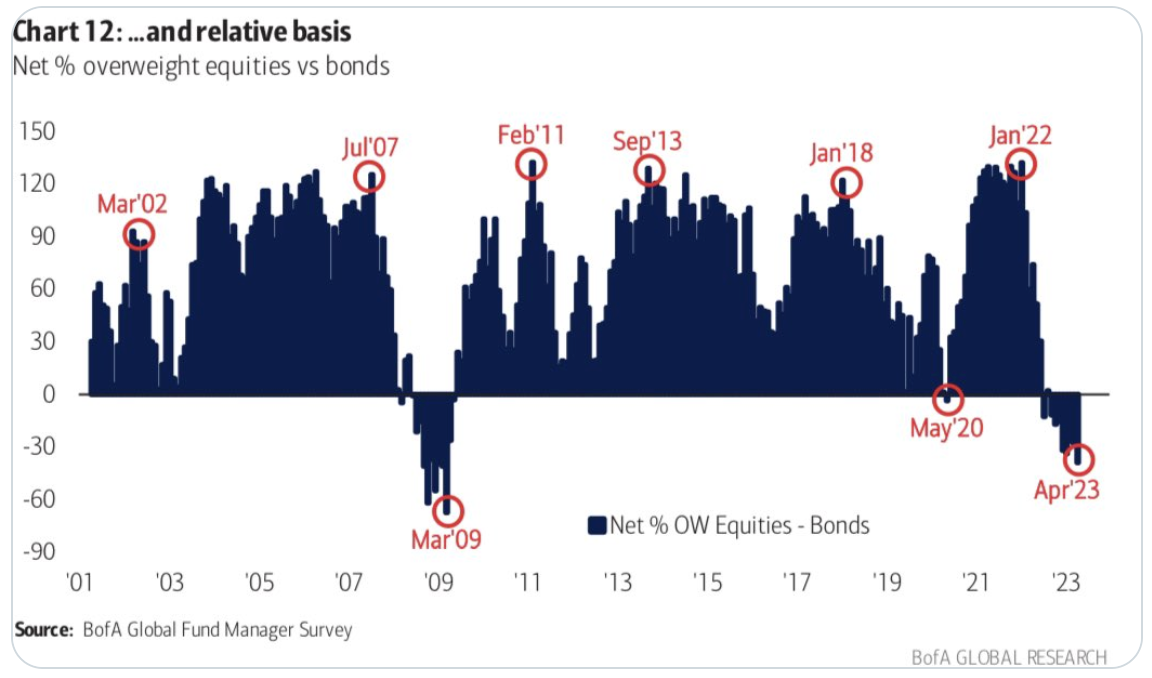
. - The latest BofA global fund manager survey showed that investor allocation to equities relative to bonds had dropped to its lowest level since the global financial crisis:
- Large US banks, including JP Morgan Chase, reported bumper profits for the first quarter of 2023 as the SVB collapse drove billions of deposits from new customers escaping small lenders. The Fed’s interest rate rises have also been used by lenders to bolster their bottom lines, rather than to be passed on to depositors.
.. - Goldman Sachs was the outlier that reported an 18 per cent slump in its first-quarter profits on lacklustre performance at its fixed-income trading unit. The decline follows the bank’s pullback from its ill-fated entry into consumer banking and the culling of over 3,000 positions since January.
. - International money transfer company Wise posted a 33 per cent increase in customer growth and a 73 per cent growth in total income, but fourth-quarter volumes missed estimates, seeing shares fall 11 per cent.
Markets may also have been spooked by how much interest Wise was planning to pay on client balances: “We charge our customers what it costs us to offer our service, plus a small margin, rather than what we can get away with,” it confirmed in its update. – IK.
- Exports of Russian oil were back above pre-Ukraine war levels as China and India stepped up to purchase up to 90 percent of their crude, buying as much as 1.5 million barrels a day.
. - Ride-hailing app Lyft said it planned to significantly reduce its workforce.
. - HSBC’s biggest shareholder, Chinese asset manager Ping An, revived calls to spin off the UK-based banks Asia business on the basis the bank “has failed to fundamentally address key business model challenges including weak localisation, excessive cost base, capital inefficiencies, and elevated geopolitical tensions“.
What’s going on is kind of like ESG in reverse. Ping An argues that a spin off would be value-creating but that HSBC management, which is mostly British, refuse to countenance any benefits and have, instead, exaggerated many of the costs and risks. Under Ping An’s proposals, however, HSBC Group would remain the controlling shareholder of a separately listed bank headquartered in Asia, giving it “great influence” over “commercial arrangements”. You can read the full statement here. – IK
- In a reversal of how credit markets are supposed to work, the Biden administration put into force a rule that will see good-credit home buyers pay more for their mortgages to subsidise loans for high-risk borrowers. Analysts said borrowers with a credit score of 680 would pay $40 more on a $400k mortgage under these rules, which come into effect May 1.
There will be unintended consequences. – IK
- Credit Default Swap rates insuring against a default on United States debt surpassed 100bps, taking the levels beyond previous highs set during the debt ceiling stalemate of 2011 and the global financial crisis of 2008.

- The Norwegian sovereign wealth fund said it would be re-evaluating its investment process to root out “rotten apple” stocks after losing millions in the collapse of Silicon Valley Bank.
The fund’s representative confirmed that as of 15 March it had 1 699 million kroner in equities and 1 103 million kroner in bonds in SVB. On the plus side, they reduced their holding in Credit Suisse to a stake of around 1 per cent at year end – IK.
- German 10-yields continued to disconnect from wider European periphery debt. (Chart courtesy of JP Morgan.)

Twitter threads that make you go hmm…
- China vlogger Daniel Dumbril explained how Britain’s rapid retreat from Hong Kong handed power to an oligarchic power structure made up of companies controlled by four main families, which now control most of the province’s economy and real-estate. The companies in question are Henderson Land Group, SHK Properties, CK Asset Holdings and New World Development. “In some ways, the British didn’t hand Hong Kong back to China, but instead sold it to these families,” he noted.
Crypto evangelism:
- The BoE’s Sir Jon Cunliffe set out his vision for the future of money and the role of tokenised assets.
I had the opportunity to engage with some central banking experts working on real-time gross settlement systems (RTGS) renewal this week and found it interesting that efforts around wholesale CBDCs seem to be accelerating relative to those of retail CBDCs.
At the same time, however, I was struck by the ongoing lack of clarity surrounding the benefits a CDBC is supposed to deliver over and above a conventional RTGS system. A common retort is that a CBDC infrastructure will help central banks support the rise of tokenised assets. Little consideration, however, is given to whether the tokenisation of assets is desirable in its own right.
As it stands, tokenisation aims to transform deposits into their own fully transferable value unit which can exist in and outside of any central bank-based clearing system. This is achieved by unbundling deposits from the overall pooled infrastructure of the current system, and turning them into micro assets in their own right — so that value originated by different banks can be clearly marked out in a deposit account. The architects basically envisage a world where it’s desirable for a customer to open their non-bank provided wallet and view their fortune not as a single balance of cash, but as a compendium of various balances of monies — all linked to par — but marked out by originating institutions.
But as Cunliffe himself noted, deconstructing deposits in this way invites questions about financial stability and deposit insurance. As he noted (my emphasis):
“Currently, money issued by a commercial bank can only be held by someone that has an account at that bank. It is not directly transferable from one holder to another unless both parties have an account at the same bank. In order to transfer money from the holder of an account at one bank to the holder of an account at another bank, there needs to be a transaction between the two banks which ultimately settles in Bank of England money across our books.
“New ledger technology developed in the crypto world could allow tokenised bank deposits to circulate freely as ‘tokenised deposit money’, in what might be thought of as a digital banknote issued by a private bank’. They would constitute claims on the issuing bank that could be held, for example in a wallet, without the holder having to have an account at the issuing bank.
“This raises some difficult issues about how deposit insurance would operate in the event of failure of the issuing bank. Could a bank maintain a single customer view of those who held its liabilities? It also raises questions about the operation of anti-money laundering and other regulations to prevent illicit finance.”
It’s the highlighted point that’s most important. If the answer to that question is yes, then it seems wrong to assume that the future fungibility of privately-issued money can be guaranteed under the framework in the event of a liquidity or credit crisis. Just like during the Eurozone sovereign crisis, there would be a risk that deposit holders might discriminate against certain flavours of private money, introducing fragmentation risk.
This in turn would introduce market-risk to the management and settlement of balances — potentially inhibiting economic activity and trade.
What’s more, the distortions wouldn’t just be cross border ones as they were in the Eurozone crisis, but domestic ones. Much the way people suddenly started paying attention to whether a euronote featured a German or Greek serial number in 2011, they might begin to focus on the name of the issuing bank on a domestic level. At this point one has to ask whether this complexity really is necessary. And more to the point, whether the system-wide cost benefits (especially with respect to financial stability) have really been thought through.
The alternative, Cunliffe says, “Would be to require transactions on new forms of ledger to be settled ultimately by the adjustment of bank ledgers as happens now.” But this is largely how things operate today – so cui bono from any regime change (apart from the legions of blockchain, DLT and digital advisors)?
A final consideration is they lack little clarity about who would fund a digital settlement system that resides both in and out of the central bank system. Consultants seem convinced cost savings are guaranteed just because of the digitisation, but sources close to renewal programmes told me this week they wouldn’t bet on it. Digital infrastructure project costs more commonly mushroom, rather than contract, over the course of implementation.
The age old adage of Chesterton’s fence does come to mind. – IK
- Ripple’s claims that its cryptocurrency XRP is improving cross-border payments were challenged by corporate filings of Tranglo, Ripple’s Asian partner, which showed XRP adoption is lagging behind. And yet, the lack of adoption has done little to thwart the acceleration of XRP sales.
. - Federal Reserve Governor Michelle W. Bowman claimed this Tuesday that the risks of implementing CBDCs will likely outweigh their benefits.
“When it comes to some of the broader design and policy issues, particularly those around consumer privacy and impacts on the banking system, it is difficult to imagine a world where the trade-offs between benefits and unintended consequences could justify a direct access CBDC for uses beyond interbank and wholesale transactions,” Bowman claimed.
- The bankruptcy filings of BlockFi and Celsiu revealed hat the quiet Himalayan kingdom of Bhutan has been quietly hoarding millions in Bitcoin and other cryptocurrencies.
Multipolar realities:
- Stephen Jen, CEO of SLJ Capital Ltd., claimed the dollar’s status as the global reserve currency was being lost at a faster pace than most analysts would have predicted. Jen explained these misestimations occurred due to a failure to account for the wild moves in exchange rates last year.

- CIA Director William Burns claimed the United States can no longer guarantee its top spot in the global geopolitical order. The US’s position as global hegemon will come under strain in light of Beijing and Moscow’s growing relationship, posing a “formidable challenge” for intelligence services, the CIA chief stated during an address at the Baker Institute.
. - ECB President Christine Lagarde signalled dollar primacy was facing some of its biggest challenges yet in a speech to the Council on Foreign Relations in Washington, noting, “We are witnessing a fragmentation of the global economy into competing blocs, with each bloc trying to pull as much of the rest of the world closer to its respective strategic interests and shared values. And this fragmentation may well coalesce around two blocs led respectively by the two largest economies in the world.”
. - Harvard economist Larry Summers weighed in on geopolitical affairs by noting that “as right and just as we feel we are, there are just a large number of countries that are not aligned with us or that are only weakly aligned with us.” One of the reasons being that when they engage with the Chinese, they at least get an airport.
The insinuation is that Belt and Road projects don’t just compete with Western development loan programmes but with Western foreign aid more directly.
Zambian economist Dambisa Moyo has long argued that Western foreign aid challenges African state sovereignty and the pathway to an effective tax regime. Western states’ developments and our establishment of liberal rights came about by virtue of conflicts around taxation in exchange for state services and representation, in both France, the United Kingdom and the United States. But how are African countries supposed to develop a liberal model if the state is not expected to provide basic necessities in exchange for extracting taxation, she has asked? If states can simply rely on Western NGOs to provide foodstuffs and necessities in their least developed regions, this stunts the incentive to extend their sovereign envelope beyond key cities and strategic areas.
But the problems with development aid go further still. The high-profile scandals provoked by the mismanagement of development funds and investments in the late 90s and 2000s by corrupt states and organisations prompted the development of target-based aid and investment. Aiming to stem corruption and foster genuine advancement, development and investment packages were tied to specific objectives the donor country would want to achieve – such as more employment for women or improved literacy rates.
But target-oriented development aid is politicised aid, and therefore comes with consequences — especially now that the Russians and Chinese are offering alternative terms and conditions.
As explained in meme format:
 In order to properly compete with Russian and Chinese investments in Africa, the lesson is clear. Aid must be politically neutralised. The chances of that happening, however, are zilch. – DGG
- Manila told the United States that it could not use its country to store arms that might be used to defend Taiwan, in the latest example of the Philippines trying to maintain neutrality and a ‘friends to all’ policy.
Media matters:.
- The cyber warfare magazine of America’s West Point military academy published an article that outlined the necessity of co-opting meme accounts for information warfare. Titled the “Dr. House Approach to Information Warfare“, after Hugh Laurie’s portrayal of the “fascinatingly unsympathetic” Dr. House, this method aims to replicate Dr. House’s “dark, provocative and unconventional wisdom, and apply it to information warfare.”
Don’t be fooled: American intelligence may already be on top of ‘meme-warfare’.
Memes first came to political and national security prominence in the 2015 US election, when images of “Pepe the frog” were deployed by MAGA activists to propel Trumpian propaganda with a comedic twist. The innovative usage of meme-magic was correctly identified as one of the most successful aspects of Trumps’ campaign – not least because it was seen as being organic and grassroots-powered.
 The American military behemoth has been attempting to harness meme-magic ever since then. We recounted last year how psychological operations specialist Hailey Lujan openly poses as an insincere online honeytrap seeking to draw men into the battlefields. But there are many more active meme pages linked to American intelligence units — even if they officially deny any official backing.
For instance, there is “She_wants_the.isrd”, a twist to the popular Gen-X saying, “she wants the (intelligence, surveillance, and reconnaissance) d _k”. These accounts post various memes exalting American military prowess. But, unlike old-fashioned propaganda or YouTube trailers, they do so with comedic self-awareness:


West Point’s analysis clarifies at least at least two things: The first is that the American military is ready to come clean on the importance of memes as a psychological operations tool in modern warfare — and most likely is using these tools unofficially already. More importantly, it grants us a window into the current ideological mindset influencing the American military.As you can see above, any Cold War relic of the “good guy” mission seems to have disappeared, being instead replaced with the self-affirming confidence of the strongest kid on the block. Or, as Nietzche would say, the American military has progressed from the “slave” to the “master” morality. – DGG
- In an appearance on Fox News’s Tucker Carlson, Elon Musk stated that the U.S. government had had “full access” to Twitter users’ private messages. As Musk pointed out during the interview, this significant failure in customer privacy could have resulted in negative consequences for the large number of journalists who use the service to relay information to their protected sources.
.. - More classics were censored to protect delicate modern sensibilities. This time, it was the “Jeeves and Wooster” stories of PG Wodehouse, where prose deemed “unacceptable” by publishers has been removed from the books.
. - The Biden administration said it was “looking at expanding how it monitors social media sites and chatrooms” after the failure of American intelligence services to understand classified Pentagon documents had circulated for weeks without their knowledge.
Defending the realm:
- A leaked document stated that Trudeau’s government had privately told NATO officials that Canada will not meet its 2 per cent NATO defence target.
. - Leaked US intelligence documents also pointed to Ukraine’s military intelligence agency having been offered to train the militant Kurdish group YPG/SDF in Syria on anti-air systems in return for undertaking covert attacks on Russian bases in the country. The plans were encouraged by Turkey, who hoped to spark a Russian-Kurdish confrontation but were apparently halted by Zelensky on December 29. All parties involved in these alleged operations deny them.
. - A group of Republican lawmakers presented a bill to President Biden requesting that “unrestrained U.S. aid for #Ukraine must come to an end, and we will adamantly oppose all future aid packages unless they are linked to a clear diplomatic strategy designed to bring this war to a rapid conclusion”.
From the fake news zone:
- Scott Ritter, the arms inspector who questioned the validity of the weapons of mass destruction narrative during the Gulf War and who many have labelled a Russia sympathiser due to his critical stance on Nato’s Ukrainian engagements, compared the Russians’ arrest of WSJ reporter Evan Gershkovich to the case of Nicholas Daniloff in 1986.
Daniloff was the US News and World Report bureau chief who was arrested by the KGB on grounds that he had become the CIA’s most highly prized source on the Soviet nuclear weapons program. “The fact is the Soviets were on extremely solid ground in charging [Daniloff] with espionage, because frankly speaking there is no other way to describe what Daniloff was doing,” Ritter noted, implying the same could be true of Gershkovich.
- The Arizona House of Representatives expelled a Republican lawmaker that organised a presentation which made unsubstantiated accusations that a wide range of politicians, judges, and public officials on both sides of the aisle took bribes from the Sinaloa drug cartel.
.
- Robert Kennedy Jr. kicked off his candidacy for the 2024 Democratic primaries even as his detractors, among them Hollywood actor William Baldwin, pointed out how his womanising past may have contributed to the suicide of his second wife.
Military-Civilian Fusion and the new Space Race:
- SpaceX’s flagship rocket ship, the Starship, launched its inaugural test flight on the eve of 4/20. The smoky ascent of the ship’s 33 raptor engines to the high heavens was interrupted by a dramatic explosion triggered by the failure to separate the first-phase rocket booster from the second.
. - Jeremy Hunt disagreed with Elon Musk’s desire to slow down the development of AI, claiming that Britain must go “full steam ahead” in AI research. “I don’t believe it’s possible in the world we’re in, where there are countries that don’t share our values that are investing massively in AI, to opt out of this race”, the Chancellor stated.
. - Niall Ferguson threw his hat in the AI debate ring, as the British public historian stated the “Cassandras” who claim that AI will be the end of mankind aren’t entirely wrong. An alien race is already here on earth, Ferguson claimed, and we are the ones who created them.
Politico’s finest:
- BuzzFeed News is set to shut down according to the company’s CEO, Jonah Peretti, as part of a BuzzFeed-wide workforce reduction of about 15 per cent, or 180 employees.
. - President Joe Biden was set to launch his re-election campaign next week. Analysts expect Biden to follow a more passive “Rose Garden” strategy in 2023, where official and political events will be mixed to tout his administration’s accomplishments.
. - Amidst the spiralling security situation in Sudan, American troops were readying their embassy for evacuation. This followed reports that an American diplomatic convoy was fired on while moving through the streets of Khartoum.
. - Shannon van Sant‘s piece on the final months of James Le Mesurier, ex-British soldier and founder of the controversial Syrian White Helmets. Titled “The untold story behind Syria’s White Helmets”, van Sant describes the mysterious events and spooky allegations levelled against Le Mesurier, both alleged and perhaps real, based on the time she spent with Le Mesurier prior to his suspicious death.
Movie recommendation: Tetris
- Fall of communism, Robert Maxwell, early gaming, an 80’s “final countdown” soundtrack and KGB corruption. What’s not to like? Seriously. It’s available on Apple. Go watch it. And if you find the Elorg storyline fascinating, just wait until you hear the story of Czechoslovakia’s equivalent, the Tesla Electronics organisation.
