
You may have woken up on Tuesday to the surprising news that “Britcoin”, the UK’s stab at a digital pound, will be with us by the latter half of this decade.
Here’s a small selection of the Britcoin news of the day, all mysteriously published at 10.30pm last night (i.e. about 33 mins before I started writing this post).

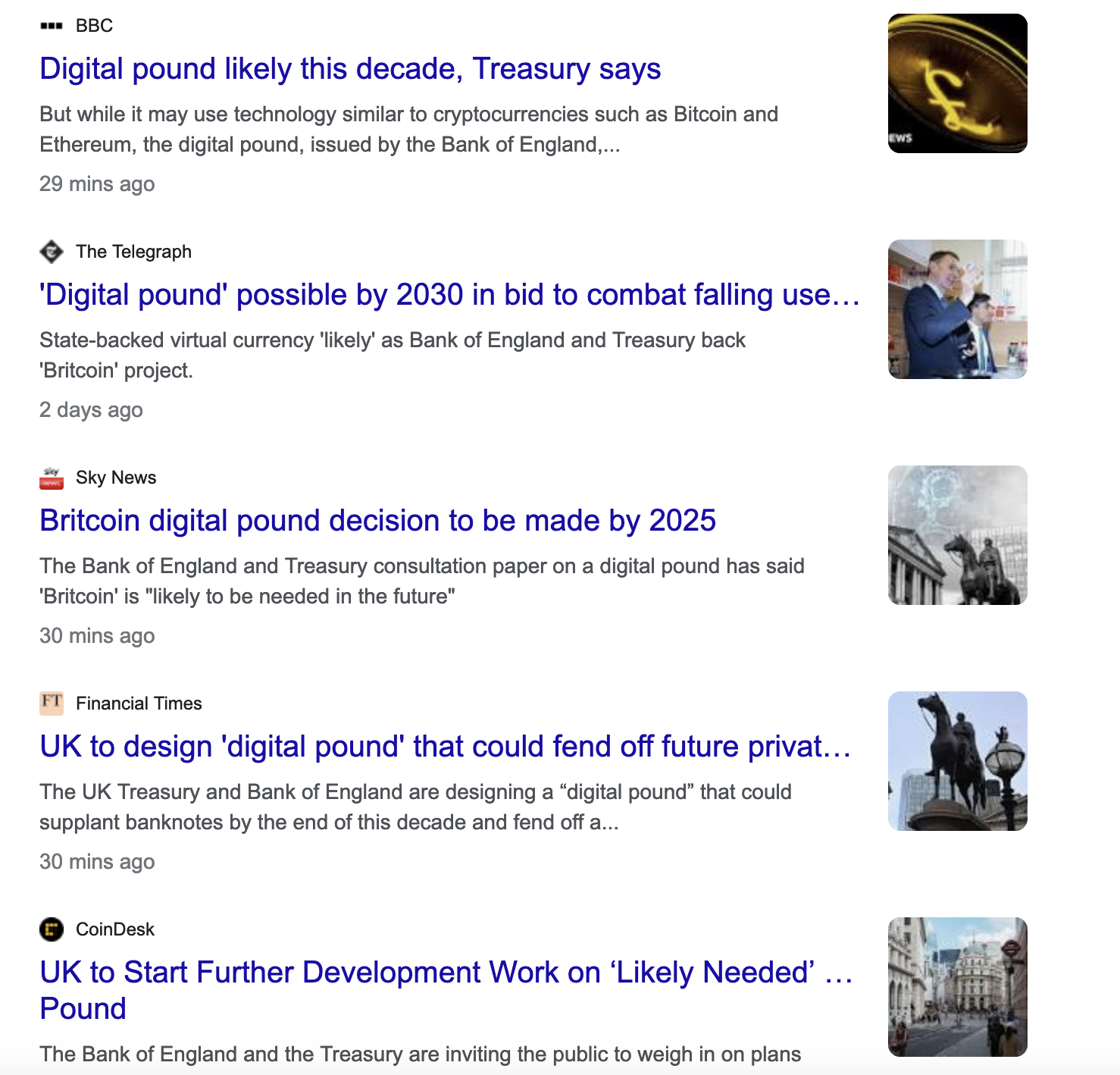
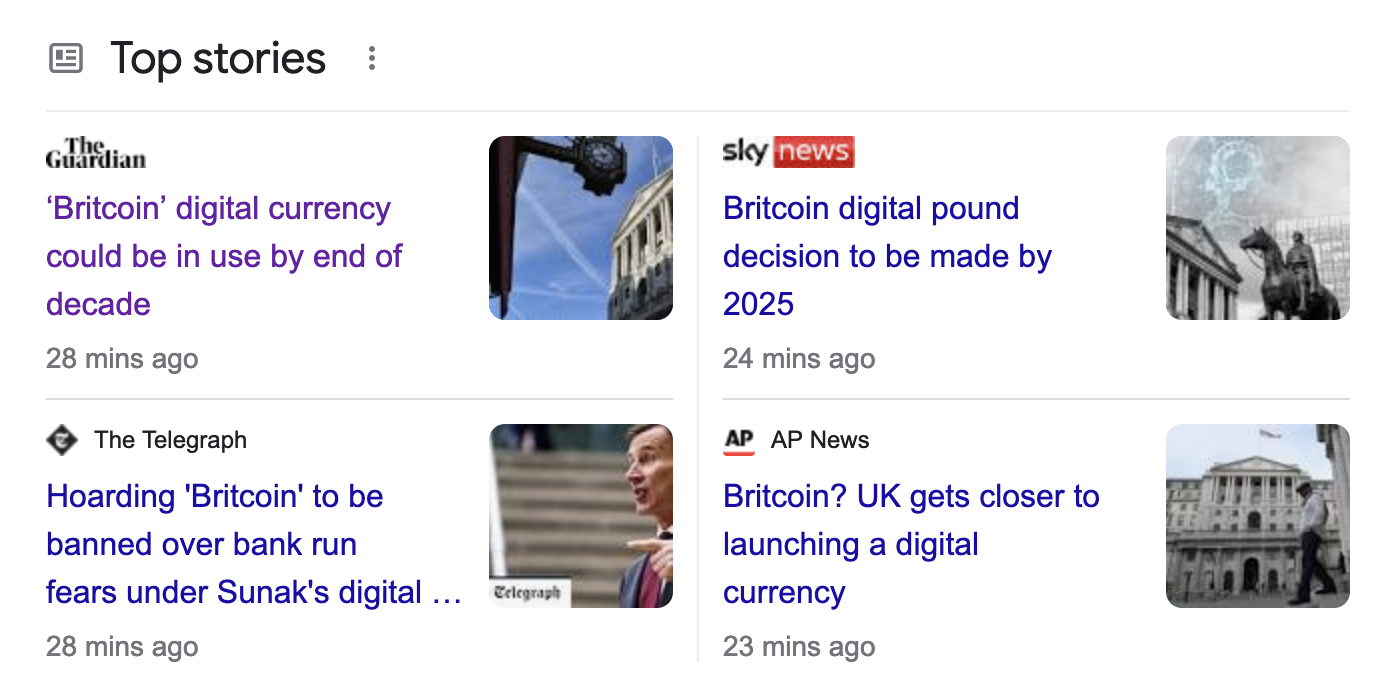
So how did a message about a mere consultation (which is yet to decide anything concrete) manage to get so amplified?
And how is that every single media outlet is largely singing from the same hymn sheet about it?
Well, as ever, it’s all down to the secret media formula that runs the world. X institution has a message it wants to impart on the world, so X institution offers an exclusive off-the-record briefing to all the publications it wants to influence. The condition for the access is that the participants all agree they won’t release the story until the time the institution determines is best. At the briefing, reporters are given guidance on the topic from authoritative sources “on background” – which means they can’t quote anyone directly. But because all the participants also get to hear each other’s questions, any prospect of a non-consensus take is largely extinguished.
So what’s really going on?
Sources close to the Bank (but not present at such OTR meetings) tell The Blind Spot that even up until a few weeks ago there was still little appetite for a digital pound at the higher echelons of the BoE, with top BoE officials briefing they didn’t feel there was a compelling case for a central bank digital currency at all. This came on the back of disastrous flops like the Bahamian Sand Dollar and Nigeria’s eNaira — all of which have struggled with adoption.
But then came this speech from the ECB’s Fabio Panetta, where the cbanker promised that “a digital euro would never be programmable money” (easing what I like to call Russell Brand concerns), adding that “the ECB would not set any limitations on where, when or to whom people can pay with a digital euro. That would be tantamount to a voucher. And central banks issue money, not vouchers.”
He also reassured those who had concerns that a digital euro could harm the confidentiality of their payment data, stressing the central bank would not have access to personal data.
As we understand it, that left HMT and the Bank of England afraid of a CBDC gap:
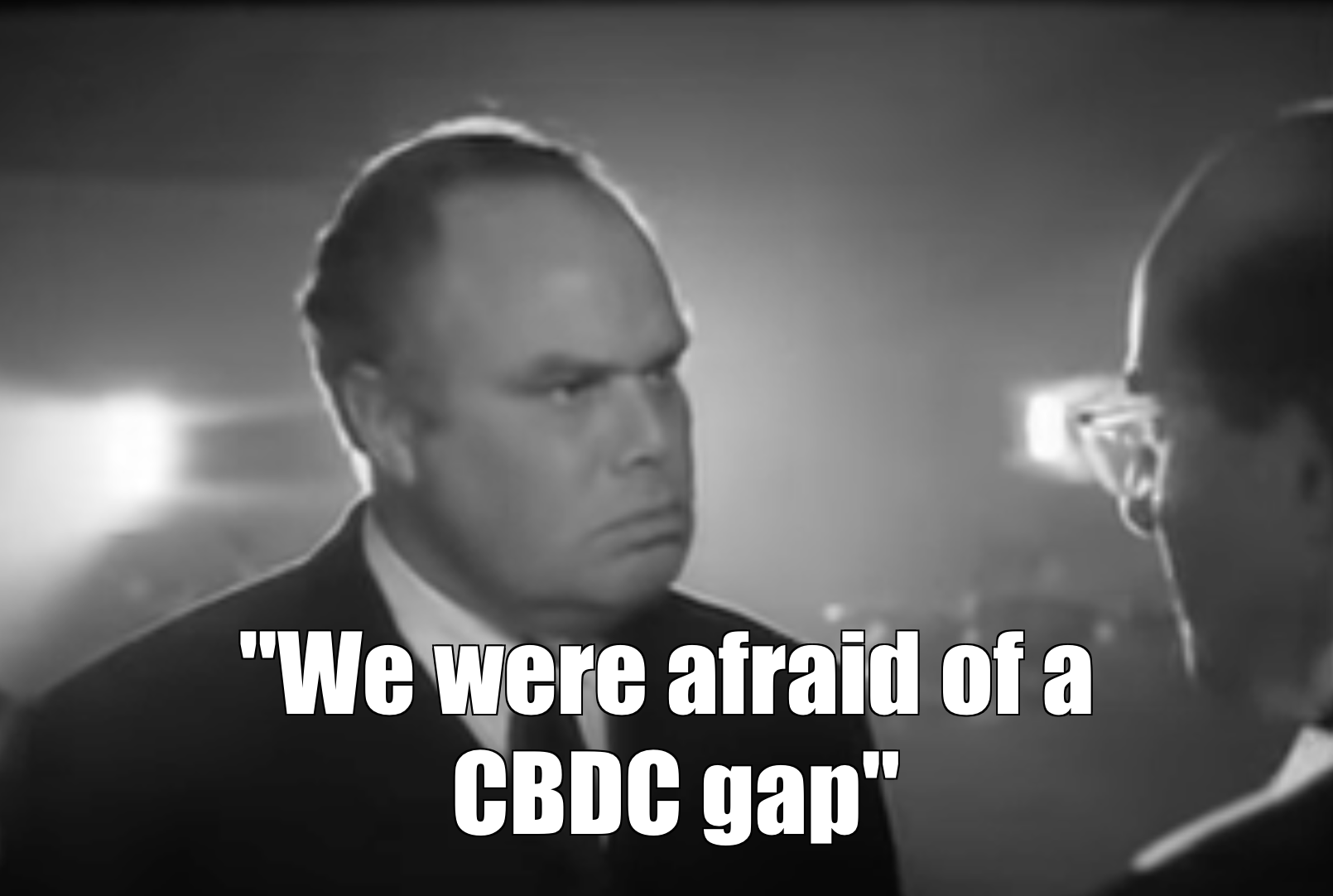
Britain is now rising to the challenge by delivering a joint HMT/BoE CBDC consultation, that almost entirely emulates what the ECB is already doing.
But does any of it make sense?
On the whole, no. A central digital bank currency is still a solution looking for a problem, and even where the CBDC solution might conceivably solve some sort of problem, the risks don’t necessarily outweigh the benefits.
Most cbanker reassurances about privacy, financial stability and programmability fall flat under closer scrutiny, too.
Let’s start with privacy.
For a lot of people, one of the biggest concerns they have about CBDCs is the risk they might be used by malevolent governments to snoop on people’s private affairs. And indeed, in places like Nigeria, where trust in local institutions and government is low, the CBDC proposition doesn’t really sound too great compared to more trustworthy foreign options like Mastercard or US-Treasury-issued dollars.
In theory, we in the West don’t have the same trust issues with government (even though our politicians seem to be doing their darnest to change that recently). But the flip side of that is that our governments are also supposed to trust us. Privacy is a major concern for good reason.
The cbanks address this by saying that CBDCs, while they won’t be anonymous, will remain private. They will achieve this by outsourcing all customer-facing activities to wallet-providing financial institutions. These institutions will still be obliged to follow KYC and AML rules, however, which means they will have to hand over data to authorities investigating wrongdoing and fraud when asked. But, as the central banks note, this will be no greater a privacy infringement than what we are already used to. [Though, it’s also the case that KYC/AML compliance will undermine the prospect of CBDCs ever being the all-inclusive public goods they claim to be.]
No central bank, however, has ever properly explained how or why financial institutions will be incentivised to offer these amazing wallet services to customers, especially given none of the central banks are planning to pass on any interest margin to anyone. As it stands, all the CBDCs are slated to be zero-yielding. So what’s in it for the banks?
Nor will banks be able to cover the expenses of issuing digital wallets by re-lending the underlying funds at their own discretion, a la the conventional bank business model, since the whole point of a CBDC is that the underlying funding is ring-fenced in the style of a fully-reserved asset at the central bank.
As far as we can make out, the banks are expected to offer these wallet services pro bono because it will allow them to plug into an “open loop” central-bank settlement system at will.
Except even this doesn’t necessarily make sense since banks, by definition, are already plugged into the Real Time Gross Settlement (RTGS) system provided by the central bank. Why would they need an additional or exclusive retail layer?
Full-Reserve Banking in Disguise?
The only reason we can think of that this offers an improvement (if we really struggle to give cbanks the benefit of the doubt) is that, currently, the underlying float which helps to settle the payment system is funded on a fractional basis vis-a-vis total outstanding liabilities by government bond collateral (i.e. QE balances), and is, thus, open-ended. In the CBDC model, however, retail payments that run through it will always be fully funded directly by customer deposits (i.e. savings), and thus limited to available public funding at the time.
That can be extrapolated to mean that, currently, the size of float needed to keep the system ticking over is based on a fluctuating metric that is hard for central bankers to predict. This introduces financial instability risk if and when it ever proves to be insufficient. The ambiguity also ensures that, more often than not, the system is probably over-reserved relative to its needs, equating to an inefficient use of capital.
Given the above, the best argument for CBDCs may be their ability to reduce run-risk in the financial system by segregating a special part of the central bank balance sheet (on a full-reserve basis) for the exclusive purpose of processing payments only.
Alas, whatever risk is removed in this area is likely offset by the crowding out of private sector banks that rely on retail deposits.
Which brings us to programmability.
The cbanks say that a digital currency will allow the economy to benefit in weird and unexpected ways from financial innovation, which could include the ability to programme instructions into one’s wallet. They promise they themselves won’t be doing the innovating or programming. Users will instead be able to determine independently which services to provide data to, or which rules and programmes to run on their money.
In theory that all sounds very liberating and empowering but, in practice, even if the government isn’t the one doing the programming, the concern remains that the poor will be the ones most impacted and pressured to give up data and liberties. They, after all, will be the ones most tempted to sell their data in return for cheaper access to services or products, or to limit their consumption when called upon. If the system as a whole has the capacity to programme in restrictions on subjective grounds, we can be sure it will find a way — regardless of whether the government is guiding that practice or not. As we learned from Covid, society doesn’t necessarily need government mandates to discriminate against minorities.
Nor is there any guarantee that just because central banks are currently committed to not programming the money, that they won’t potentially change their minds in the future if a crisis arises. The temptation to tinker with programmable features to better conduct monetary policy may one day prove too great.
This is why to bring out the best of CBDCs, policymakers will have to think long and hard about how to constrain their worst features and dystopic tendencies — ideally by applying strong constitutional checks and balances throughout.
The public, meanwhile, needs to supervise this process and be consulted throughout for any such system to gain trust.
While the technocrats and officials are at it, they should also make sure that companies like Infosys don’t get first dibs on any IT contracting work associated with the consultations. 😜
If you like what you read at The Blind Spot, do consider spreading the word about us.