
And Why There Are Risks with Fintechs Cashing In on Higher Rates
The fintech sector has been having a tough time of late. But, as I noted in my last Blind Spot wrap, even those fintechs that looked like they were at death’s door in mid-2022, i.e. Monzo and Klarna, came out at the end of last year with optimistic outlooks about 2023. This, of course, was all due to the expected boost they were going to get from improved net interest margins.
But it’s not just the banks that are going to benefit from the higher interest rate environment. Any payment company that sits on large customer balances from PayPal to Tether to Wise is going to benefit too.
On Tuesday we had confirmation of this amazing transfer of wealth via Wise’s Q3 trading update, which flagged that it would be upgrading its full-year guidance on the back of higher rates. As the release noted (my emphasis):
As a result of continued revenue growth this quarter, supported by higher interest income in recent months, we are upgrading our FY23 total income growth guidance to 68-72%, from 55-60% previously.
Kristo Käärmann, CEO and co-founder said:
“Our mission is clear – to make moving and managing money faster, easier, cheaper and more transparent for people and businesses around the world. As interest rates increase, our customers expect a return on the balances they hold with us, and we intend to share much of the benefit of higher rates with customers.
Also, key to this outlook was the launch of Wise’s new interest-rate product which will give “cash back” [lol at the terminology] to customers (following in the footsteps of Gemini’s “Earn”).
This quarter we launched ‘Interest’ within our Assets product in the UK; a whole new way for our customers to hold their money and earn a return.”
To be clear, Wise does not hold a banking license in the UK.
Käärmann, however, also noted this:
I’m also pleased that for the third consecutive quarter, more than 50% of cross-border payments were completed instantly. The investments we’ve made to deliver a superior infrastructure and product are resonating, and in this quarter more customers than ever used Wise. This underpins our conviction in the outlook for 2023 and beyond.”
That means some share of transactions, close to 50 per cent was not instant. And in many cases, just because the transaction is processed immediately doesn’t mean it is settled immediately.
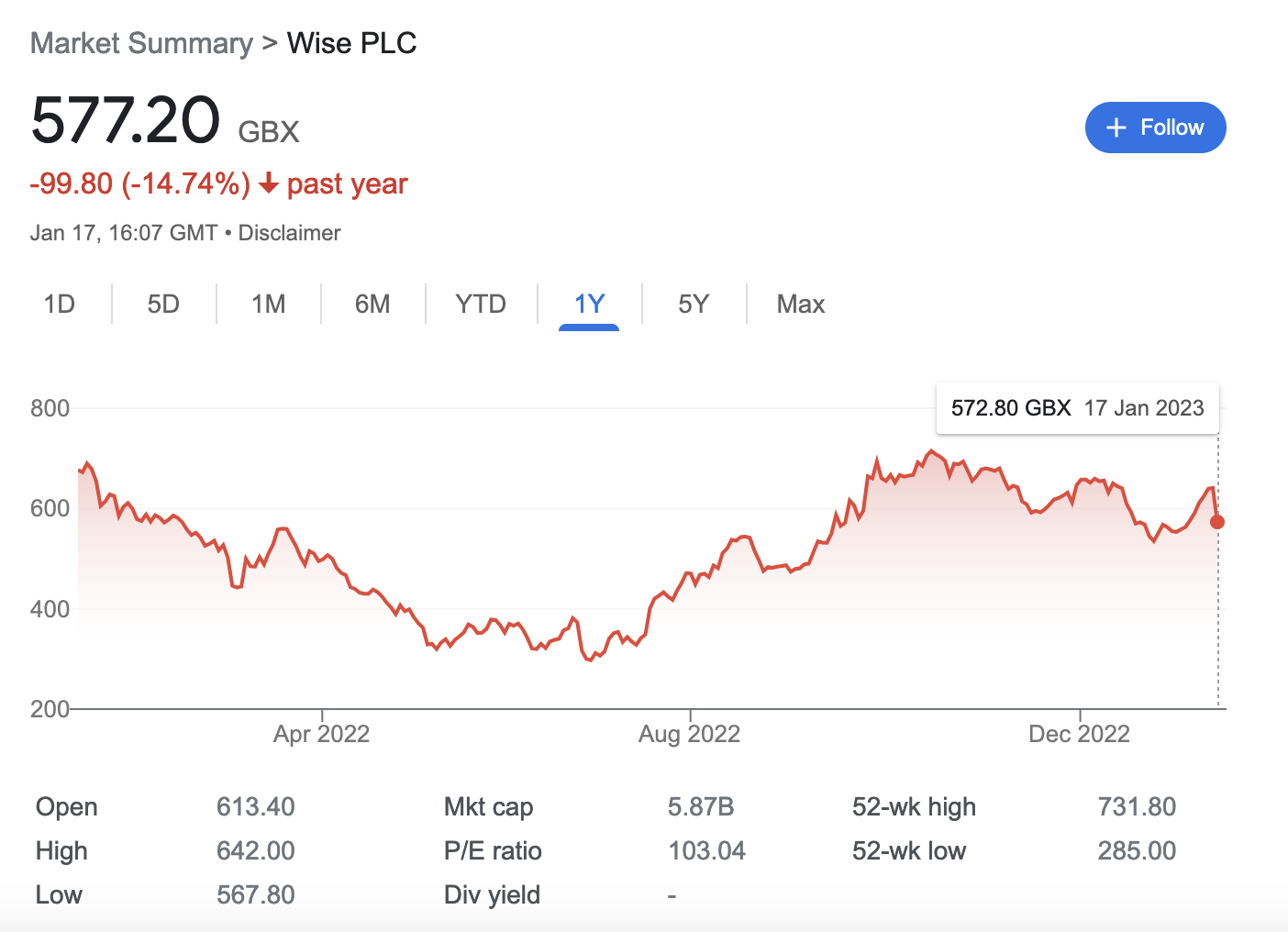
Meanwhile, Wise’s share price didn’t respond too enthusiastically to the outlook upgrade, mostly because of the slowdown in volumes, which Wise blamed on increased FX volatility (not on the fact it has been raising prices, because they’re still committed to “charging what they need to, not what they can get away with”):
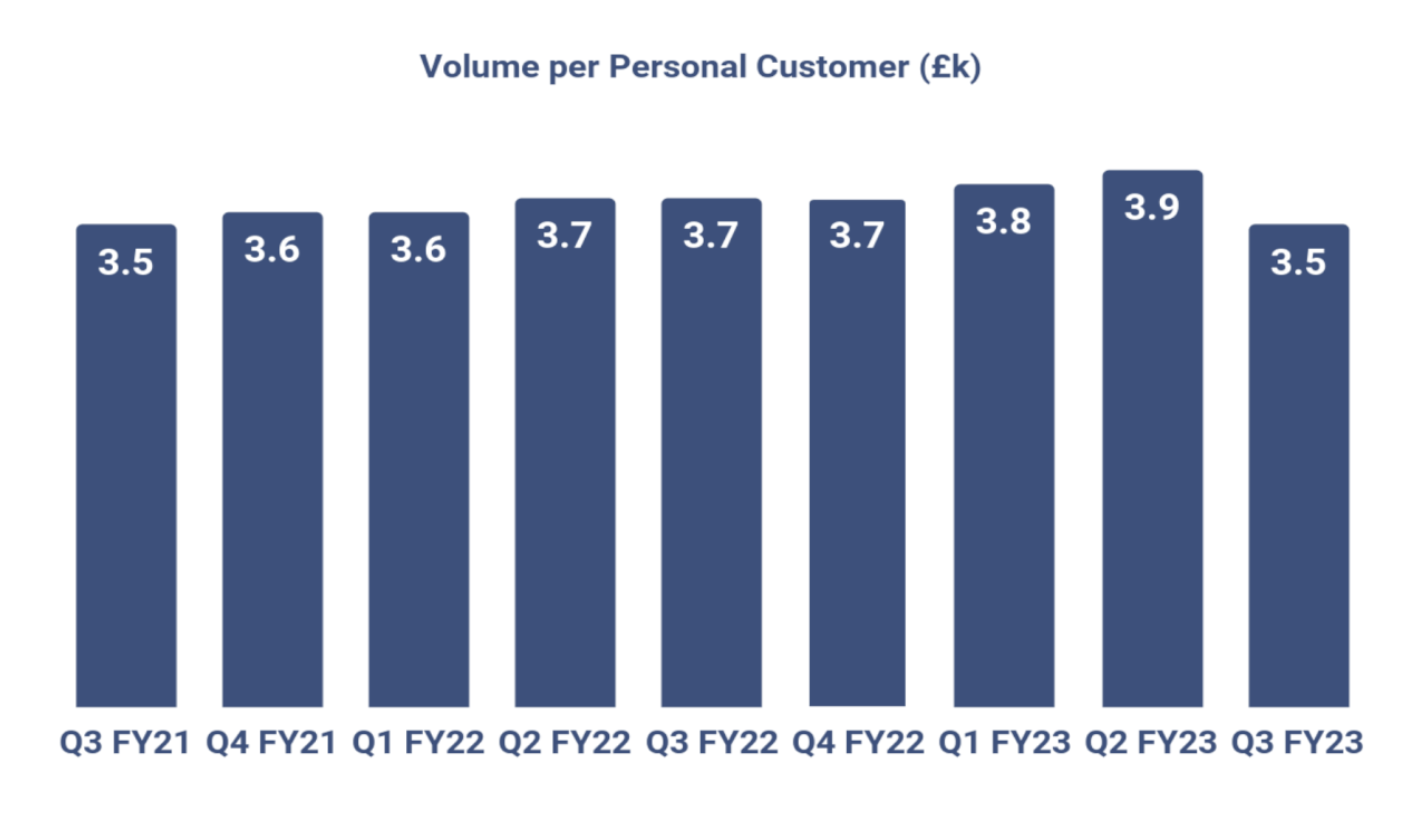
On the analyst call, CFO, Matt Briers blamed the volume slowdown in Q3 on FX volatility which impacted personal transactions, specifically in terms of people sending dollars.
But what I was looking for in the trading update was evidence Wise’s success is down to its treasury team taking speculative positions around its FX positioning and that this is the main way they are able to achieve profitability while offering low costs to customers.
And there is a little bit.
Wise confirms, for example, that the prices it charges FX customers are rising, not going down. The exception it cites is in its Mexico cross – where they are keen to point out prices have fallen 10 per cent.
From its trading update:
Core to our mission is sustainably lowering prices for customers over time. To do this, changes in the average customer price reflect the changes in the cost to deliver payments. But during this quarter the average price increased to 0.66% compared to 0.64% in Q2 FY23 and 0.60% in Q3 FY22, as previously announced price changes, which were a result of higher FX costs, came into effect. We were, however, able to lower fees for some currency routes, including a 50% price reduction for sending money to Mexico and a 10% reduction for sending and converting Brazilian Reais.
On the other hand, Wise are now proudly offering interest on balances, and an opportunity to invest in a government bond-style return. Rate-sensitive customers will supposedly be able to click through to get exposure to the government bond return ( in the style of a fiat-based style Tether).
So why are they more interested in returning money to de facto depositors via interest-rate margin returns, than absorbing that NIM to keep subsidising the rates they provide to FX customers?
The answer, I suspect, is because sticky depositors and large balances are more cash-generative on an overall risk basis than having to take risky hedging positions in their Treasury ops. If that’s true, this implies Wise is now on an entirely predictable path to transform itself from a payments company into a conventional bank. And once that journey starts, the incentive to keep building customer balances will outweigh the incentive to compete on FX, because it’s generally an easier and lower-risk business.
The slowdown in “volume per customers” fits that story.
Where this eventually ends up is a situation where, as with all the other banks, the FX business will subsidise the hunt to woo ever greater numbers of depositors, usually by subsidising the cost of operating their accounts.
What we have in Wise, therefore, is a shadow-banking operation that is still taking risk on its FX business while moving ever deeper into core banking.
Evidence of that came in the analyst call when Matt Briers, Wise’s CFO, told analysts that Wise was now focused on becoming “a pretty compelling place” for customers to keep their money. In terms of the model they would operate, Briers said that in some cases (i.e. certain jurisdictions) Wise would focus on passing the NIM onto customers. In others they would simply earn a fee from customers who want exposure to the government bond return — effectively charging for the privilege of operating depositor accounts in the style of a money market fund or an asset manager.
Meanwhile, when one analyst asked if Wise would consider getting a banking license, the response was that there’s no need for one because they’re not looking to lend customer balances.
All of these factors will make Wise an interesting company to watch this year.