
Well looky here.
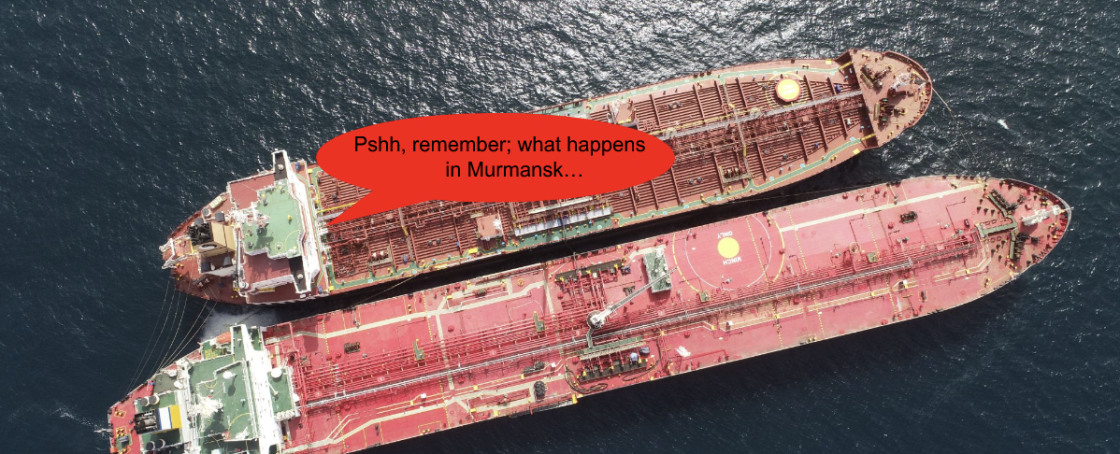
The United Kingdom imported around £200mn worth of Russian oil since March, according to the Sunday Times.
Much of that sanctions-circumventing oil was transferred into British ports as a result of Russian ships carrying out ship-to-ship transfers at sea to conceal their port of origin. The cargoes were then declared as originating from other European countries.
Meanwhile in Europe, Bloomberg reported on Tuesday that the EU had softened its stance on an outright Russian oil price-cap plan from December 5 onwards, moving to add a 45-day grace period to its original cut off point.
We all feared, of course, that Russian sanctions would encourage the fragmentation of the world into allied economic spheres via ‘friendshoring’. But the reality seems to suggest that where there are needs there are ways.
The sanctions as they exist certainly present an obstacle for Russian capital, assets, and products in the West. But the example of Iran already proves such blocks are not insurmountable in the short or medium term. And in the case of Russia it’s becoming clear several loopholes and exemptions impede their maximum effect.
Sanctions Barrage
When the conflict started in February, the European Union, the United States, Australia and Japan loudly and proudly combined to enforce sanction after sanction on Russia to cripple its economic and warfighting capabilities.
The most important salvos came from the EU and the US, which prohibited Russian crude and oil product imports from December of this year to February 2023. But the decision also stretched beyond oil and sanctions against Kremlin-connected elites to banning the export of tech, industrial machinery, luxury goods and dual-use goods like drones to Russia. The import of staple Russian goods like coal, steel, gold, cement, seafood and cigarettes was also prohibited.
Another salvo are the proposed price caps already referred to above. Despite the fanfare about their implementation, the details of the proposal to price control Russian oil remain to be determined. Prices are expected to oscillate around $60 a barrel. But the move faces opposition from several stakeholders. Hungary is the only openly anti-sanctions country in the EU, while Qatar and India are among other non-EU voices have also balked at such restrictions.
Among other clues that Western resolve for sanctions may be weakening was US Treasury Secretary Janet Yellen claiming on November 14 that the US was happy for India to buy Russian oil above any predicted price cap level providing they kept Western firms out of the equation.
This points to the strategic ascent of non-aligned or third-party countries, as they become neutral go-betweens in the emergent power blocks of China-aligned versus United States-aligned nations. These countries may in turn ‘hyperglobalise’, as they become the new silk roads of a fragmented global economy. It’s precisely what happened in WW2 to Portugal and Switzlerland.
Enter Exemptions
Humanitarian missions, food and agricultural products were always going to continue to be let through American and EU borders. No surprises there. But did you know that EU bans on Russian transports and exports also do not extend to nuclear fuel?
This exemption perhaps isn’t that surprising when you consider you can’t un-make a quarter century of integration with a year’s worth of legislation.
This is particularly true in the European East, where nuclear plant construction under the Soviet Union means many plants are directly reliant on Russian equipment and technicians. The Soviets constructed Hungary’s nuclear plant, Paks, and it contributes almost 50 per cent to the country’s national energy production. Construction plans for an extension of Paks are also ongoing, 80 per cent financed by a Russian loan and constructed with Russia’s Rosatom.
Russian nuclear fuel, uranium, in particular, is still heavily relied upon by plants across the West in both the United States and the Western countries of the European Union. The European bloc imports almost $200mn a year from Russia in nuclear fuel. A further $245mn is imported from Kazakhstan, where uranium sourcing is controlled by Rosatom. Almost 20 per cent of Europe’s uranium all in all. And Russia has around 17 further nuclear reactors across Europe. Russian nuclear’s central role in European energy grids means they’ve braved the sanctions affecting other energy sources, for now.
Some exemptions are also granted to nations without apparent choices in supply. Temporary exceptions are granted where countries are dependent on Russian pipeline oil, like Bulgaria and Croatia.
But it’s not these exemptions that are most surprising. More surprising is the degree the small print in European sanctions outlines the capacity of its states to grant derogations for certain selected goods particularly of agricultural, humanitarian or diplomatic characteristics.
And some countries are pushing the brief a tad further than expected. The Netherlands raised eyebrows last October when it revealed that it had granted 91 waivers, which allowed the continued import of aluminium into Dutch ports and 25 special permissions to continue importing from Gazprom subsidiaries in the Netherlands. More curiously, transactions with a Russian-owned bank have been exempted under the ‘diplomatic traffic’ label.
A Change of Media Narrative?
Naked Capitalism’s Yves Smith reported on November 1 she had heard on the grapevine from FT sources that the Japanese owners of the paper, Nikkei, had pushed hard for a change in the editorial position on sanctions because of Japan’s outsized exposure to sanctions. This she claimed had led to the FT publishing a piece, co-authored by editor-in-chief Roula Khalaf herself, prominently platforming the views of Masahiro Okafuji, chief executive of Itochu, that “Japan’s near total dependence on imported energy means it cannot ‘survive’ without continuing to buy oil and gas from Russia.”
Unlike American or European companies like Exxon or Shell which have left Russia, the Japanese government has counseled its domestic energy champions to stay put, petitioning to exclude oil sales from the forecast G7 oil price cap for a key project – the Russia-based Sakhalin-1 oil and gas project. Labelled as crucial for Japan’s energy security, Tokyo-based Sakhalin Oil and Gas Development has maintained its 30 per cent ownership of Sakhalin alongside other Japanese firms.
A seasoned anonymous FT journalist told Naked Capitalism the subtext of this article could be anything from Japanese concern at how price caps will make oil prices skyrocket, to “we’ll cheat if we have to so don’t go looking too hard.”
Legal Loopholes
Exemptions are one thing. Generally reasonable, they showcase the limits of geopolitical ambitions when faced with immediate national security issues related to energy supply. Legal loopholes are something else entirely. They are an economy’s “don’t ask – don’t tell” equivalent of busting through sanctions. Remember that Russian oil imports to Europe stood at 2.5mn bpd in January 2022 and were expected to drop to an expected 1.4mn bpd by October, before eventually nearly being totally banned by December 2022 and January 2023. Despite this schedule, at the last count, some 44 per cent of Europe’s total diesel imports still being sourced from Russia in November.
The first loopholes may have been quickly detected and disbanded. In April, for instance, the Wall Street Journal reported that Royal Dutch Shell had been transporting blended petroleum that contained 49.99 per cent of Russian oil, meaning the whole product wasn’t technically of Russian origin. When this was discovered, Shell — facing an uproar — promised to phase out Russian crude and hydrocarbons from all their products blended or not.
Since then, unsurprisingly, the mixing of Russian diesel with non-Russian diesel has been clarified as a legal no-no.
But loopholes linked to the role played by more neutral countries as intermediaries persist.
For example, despite bans on direct seaborne imports of crude and refined petroleum, it’s still legal for Russian oil molecules to enter the European Union in other ways. One just has to be creative.
Bloomberg published a piece on November 11 outlining how European firms are still able to buy, ship, and insure Russian crude purchases so long as they’re refined by a third-party country and if they remain under the agreed-upon price cap.
This is how Russian oil has been arriving at American shores since March – through a Lukoil refinery in Sicily. Technically counted as Italian oil, this loophole will however be shut after the sanctions deadline this December, as the Lukoil refinery will no longer be able to import Russian crude.
For loopholes that may prove longer lasting we can look no further than Turkey.
Anatolia has always been positioned as the gate between East and West. It should come as no surprise therefore that its strategic position has enabled it — despite it being a member of NATO — to double its Russian oil imports since the war, with no sign of stopping:
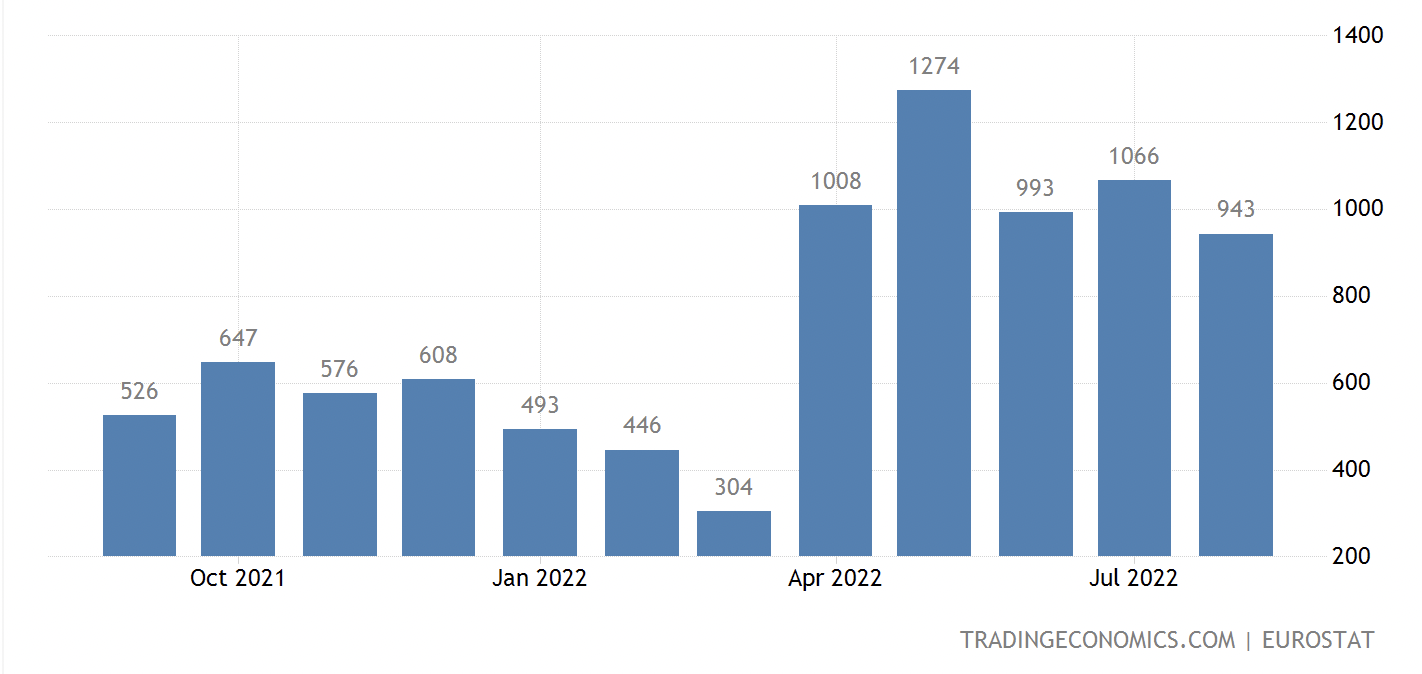
Relatedly, the EU and US collectively saw an 85 per cent increase in the imports of refined oil products from Turkey between September to October as compared to July-August.
Turkey has also backed Putin’s plan to provide a local base for the exports of Russian LNG supplies. The Turkish Energy Ministry has reportedly started working on building a hub following talks between Erdogan and Putin on October 14, following the wrecking of the Nord Stream pipelines.
No doubt therefore that Turkey benefits from playing both sides. Coming amidst claims of discrimination levelled by Russian Foreign Minister Sergei Lavrov against maritime insurers, Turkey recently demanded that ships passing through the Dardanelles straits show proof of adequate insurance for their vessels’ content.
It remains to be seen what other non-EU or countries that remain tertiary to the conflict will emerge as key legal go-betweens with Russia. But the role of third-party neutral countries is unlikely to stop at what is legally permissible.
The Illicit Barrels
There’s a reason why all the hubbub on front pages regarding Russian supply limits after sanctions are limited to two key things;
- Russian oil
- Russian oligarchs
These are relatively easy to locate and leave significant footprints, meaning price caps or sanctions can be readily used.
What’s not mentioned in the articles is how effective Western sanctions will be in crippling Russian technology imports like machinery, luxury goods, or dual-use goods or Russian exports in things like seafood, cigarettes, gold, or steel.
That could be because sanctions on these very fungible articles can be readily avoided.
One need only look to Iran to see how this is done. Sanctioned for almost a decade, the Iranian import/export machine has managed to chug along by concealing the origin and destination of shipments in both friendly and non-friendly countries.
Meanwhile, on November 15 US authorities listed sanctions against a network of French real estate companies, groups of Swiss nationals and Taiwanese micro electricity purchasers that stand accused of ‘enabling Russia’s supply chain’.
Now, you can’t exactly stick oil barrels under a fleet of surrogates’ dresses to sneak through customs. European sanctions regulations outline measures against such disguises. Even if a Russian ship changes its name or flag, it can still be identified through their original International Maritime Organisation number.
But the recent news of British imports of Russian oil, and the historic case of Iran’s sanctions evasions, have proven that the origins of more relatively easy-to-trace goods like petroleum can be properly concealed. Ship-to-ship transfers at sea mean outbound, Iran-designated ships can unload their petroleum into a ship registered with a lax third-party neutral country, with a complex ownership structure run through secrecy-friendly corporate jurisdictions. Turning off the ships’ transponders and sailing erratically mean these can be carried out covertly. Then it’s as simple as having a fake origin-destination for your goods on the bill of lading.
As for the money – don’t sweat it. Iran has been wiping their earnings under the noses of Commerzbank, Deutsche Bank, or Citigroup and back into their home country. An executive at one of these banks told Politico; “It’s difficult to know when we’re being abused… the people that do this professionally know the jurisdictions that don’t cooperate with US authorities”.
Cash is Still King
The last leg of these operations often involves wads of cash stuck in briefcases. Final or first-leg money transfers can also be obscured through trusted hawala networks, an ancient trust-based financial transfer that doesn’t use promissory notes or leave paper trails.
And – beyond recent news of the Russian imports to the UK – experts are already seeing Russia take these steps. Sanctioned since 2014, they’ve already had time to adapt. For instance, the Russian state-owned shipping firm Sovcomflot declined to supply location information for one-third of its maritime fleet in April. The Wall Street Journal claims Russian oil tankers shipping without a reported destination and perhaps carrying out ship-to-ship transfers carried some 11.1mn barrels of oil in April.
What the above tells us, of course, is that as the West’s list of enemies expands, poorer nations or those who are well-placed as go-betweens, may increasingly opt-out from global alliances in favour of the more politically unprotected but economically strong position of neutrality. These could be countries like Turkey, Qatar or the other Gulf countries.
This will only accelerate the building of economic ties between such countries, meaning as the geopolitically aligned world de-globalises at speed, the rest of the world’s linkages might intensify.

One Response