

Another year, another Israeli election.
This time, everyone’s favourite Israeli hard-right security freak Benjamin Netanyahu, a.k.a Bibi, is back. His Likud party and allied coalition members gained a solid majority of 64 in the most recent elections. Understandably, with Bibi’s election, much is at stake.
But some say it’s the survival of the Israel-Lebanon gas deal, also known as the maritime border deal, which was initially struck October 27, that is most at risk.
The deal primarily covers agreements between two contested gas fields, the Israeli Karish field and the Lebanese Qana prospect, and was to settle ongoing Israeli claims on Lebanon’s Qana prospect.
Under the recent friend-shoring trend, Eastern Mediterranean gas is emerging as a key supply route for European gas importers. This deal was critical because it stood to enhance Israel’s ability to continue growing as an exporter to the European gas market – and grant Lebanon the opportunity to begin consolidating its gas-exporting potential. Considering the technical state of war between Lebanon and Israel, this deal shows European and Americans that these Levantine players are serious about getting their gas act together – securing politically safer alternatives to Russian gas.
And with Bibi making a ruckus about the way the negotiations were handled by outgoing Israeli Prime Minister Yair Lapid, local and international media have begun nervously musing about the deal’s imperilled future.
Shifting Maritime Borders
On October 27, both Israel and Lebanon signed a maritime border deal that is now winding its way through the Israeli labyrinth of approvals. It’s allowing both sides to get on with gas extraction plans – and Energean, operating in Israel’s previously contested Karish gas field, completed the first delivery last month.
Netanyahu has outlined his opposition to this state of affairs with typical chutzpah. The stinging point was some meagre Israeli concessions to Lebanese positions, particularly the Lebanese Qana gas prospect that is crisscrossed by an Israeli maritime claim. Bibi claimed there existed “no mandate to give sovereign territory and sovereign assets that belong to all of us to an enemy state,” pointing in particular to Hezbollah, and its de-facto position atop the Lebanese state.
Biden’s administration has tried to strengthen Israeli commitment to the deal. They backed a resolution ensuring 17 per cent of future revenues at Qana would be shared with Israel – and a guarantee that funds won’t flow back to Hezbollah.
Now, local and international media have played down fears about the deal, noting that Bibi’s loud opposition is likely down to the election campaign. After all, it was his government that began negotiations in 2020. Furthermore, with the European Union desperate for gas supplies, and the Americans breathing down Israel and Lebanon’s necks, if Netanyahu broke up the deal he would be shooting himself in the geopolitical foot. It also wouldn’t be the first time Netanyahu, once in government, would be forced to work with a deal he campaigned against. One prime example was the 1996 Oslo accords, the historic agreement between the PLO and Israeli government brokered by Bill Clinton.
But is it really down to campaign bluster, or does Netanyahu’s criticism have a point? If it does, the media may be underplaying the risk posed by Netanyahu to the finalising of the Lebanon-Israel deal.
Lapid certainly had an incentive to conclude this deal prior to elections to notch a political victory. It’s not surprising that Lebanese negotiators probably clocked this desire, leading to the increased size of its territorial claim in June 2022, and last-minute changes to their positions this October.
By moving the Lebanese maritime claim further south, the Karish field fell into a conflicted zone of maritime sovereignty between the two nations. As pictured below, Karish was formerly well-within Israel’s maritime claim, and not disputed by Lebanon’s.
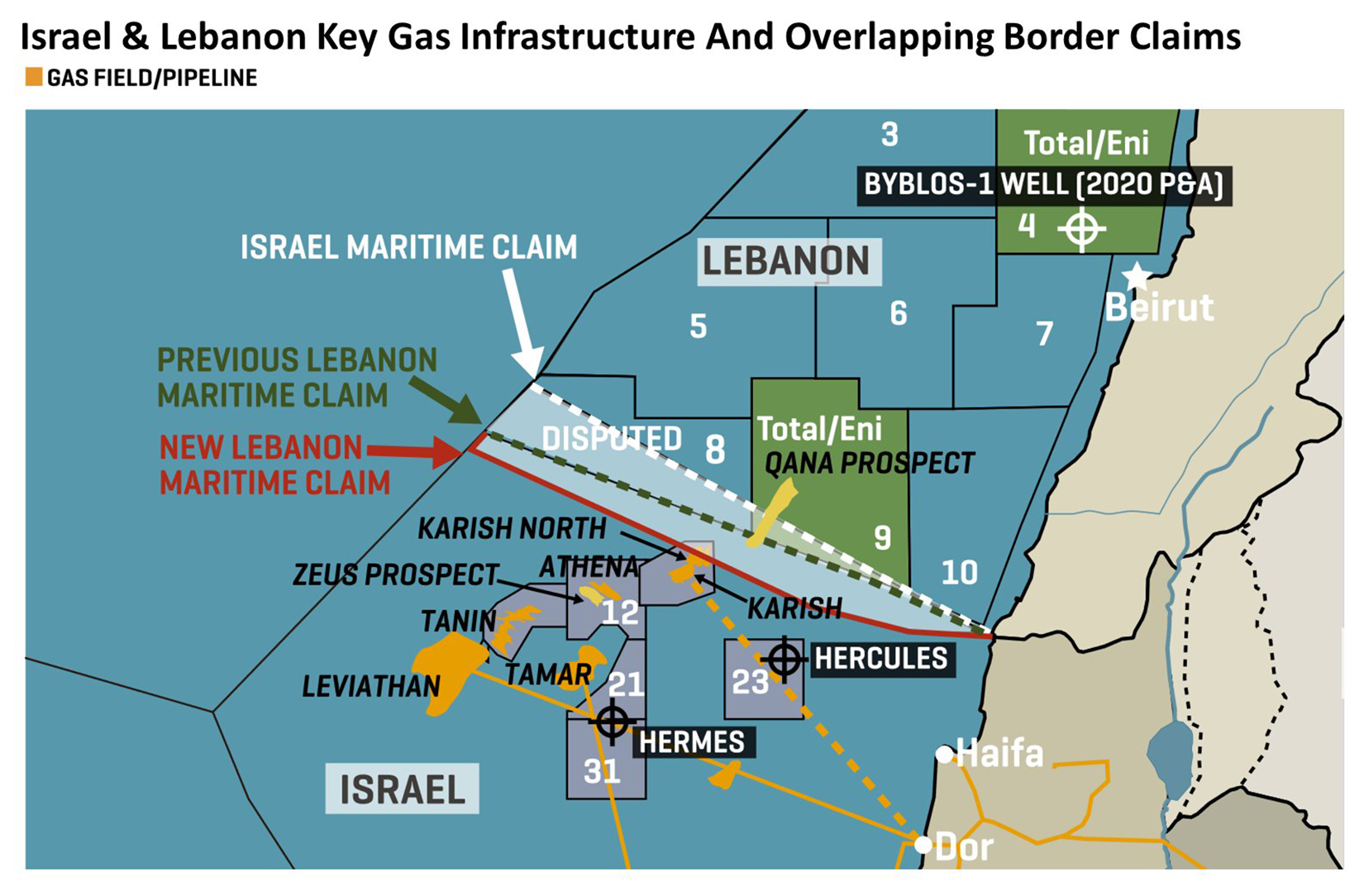
(Credit to MEES)
Facing Lebanon’s push, and hoping for a political victory, Lapid acquiesced by effectively renouncing most claims over the contested Qana prospect – agreeing to the small revenue-sharing scheme described above. But since Israel’s territorial claim extends into Qana, this acquiescence de-facto cedes sovereign Israeli territory. It means Netanyahu is not entirely wrong in saying that Lapid’s legal authority in approving the deal is thrown into question.
This all means that Bibi, despite hopeful media noise to the contrary, has an understandable mandate to legitimately contest parts of the deal.
With Republicans’ takeover of the House, the stage gets more complicated still.
A Rocky Levantine Lullaby
The first factor in the deal’s survivability is its winding through the Israeli approval maze. The first challenge is whether the agreement will need a 2/3rds majority in the Knesset, as the current Israeli opposition claim. Lapid’s side apparently hopes to treat the deal as Israeli and Lebanese ratification of a US proposal, which wouldn’t require passing by the Knesset.
Signatures must be obtained. But if the signatures aren’t in place when Netanyahu joins office he will simply delegitimise, modify, or ignore whatever portion he disagrees with – just like he did with the Oslo accords.
And Lebanon, a state as pitted as a country-sized chunk of Swiss cheese. Let’s be real: any supposed American guarantee that Hezbollah won’t receive income from findings in Qana is essentially ‘wet paper’.
One way or another, Hezbollah, as Lebanon’s in-country regents, had to be brought on-side. It’s not unreasonable to imagine some pressure and inducements are being offered to the Islamic group. Let’s not forget that Hassan Nasrallah, leader of Hezbollah, outlined his forces would stand down just prior to the deal being signed.
It doesn’t mean the Biden administration, or Lapid, is bribing Hezbollah. It’s probably more politically correct and nuanced than that.
But it doesn’t make the optics any less of a juicy target. Senator Ted Cruz has already criticised the deal, claiming undue American pressure on Israel forced them to bend to Hezbollah’s demands; “another topic for the next Republican Congress to investigate.”
And why would Republicans not take the chance to sit Biden next to Nasrallah in their electorates’ imagination?
Furthermore, the deal also finds itself at mercy from Hezbollah’s main backer, Iran. The Israeli tanker recently struck in the Gulf of Oman is a reminder that Iran-Israel flare-ups are always around the corner. Despite the pressing need for gas revenues that will indirectly benefit Iran, their leverage over the deal via Hezbollah means they are a belligerent party to watch out for.
More critically still, Lebanon’s President Michel Aoun has just resigned from office. Requiring a 75 per cent approval rate from the fragmented Lebanese parliament, a lack of a replacement in the short term will be a headache for Lebanese negotiators if talks are back on the table. If Israeli negotiators under Bibi wanted to aggressively pursue for more concessions at the Qana gas prospect, for instance, now would be a good time to do so.
And the primary issue with Middle Eastern negotiation tables is they’re typically contested with rifles and explosives.
Israel and Lebanon are still technically at war. Despite Lapid pointing out that Lebanon implicitly recognised Israel by signing the deal, Lebanon refuted any change in its official position towards the Jewish state.
The non-permanent state of Israeli equipment on Karish encourages conflict as well. These floating storage and refinery vessels present a target, unlike the under-water gas extraction equipment on other Israeli fields near the Lebanese border. Hezbollah attacked the facility in July 2022 with some drones, three of which were shot down by Israel.
Lets All Calm Down
But gas is becoming ever more precious. And with Western sanctions against Russia, it’s likely that some Mediterranean gas developments will eventually see a return. No matter the complications. This includes those at the Israeli-Lebanon border.
It’s simple economics.
The Europeans and Lebanese need it. The Israelis want it. And Hezbollah wants it too.
But more critically, so do the Americans.
In fact, there are unconfirmed suggestions that the United States foresees Eastern Mediterranean gas resources as critical to its modern Middle Eastern policy. It concerns the elephant in the room; the new American Embassy in Beirut.
But it’s more than just a diplomatic building. The new Embassy complex is literally a fortress. And we’re not being hyperbolic.
Positioned atop a hill, it will be the second-largest US Embassy in the world. Its 43 acres of micro-suburbia are surrounded by tall, fortified walls. The largest US Embassy in the world, that of Iraq, of 104 acres, was built with approximately $750mn. But over $1.2bn has already been earmarked for the Beirut Embassy.
You could be forgiven for wondering whether all this expense is really necessary. One can make an embassy secure without making it the most expensive and fortified embassy ever. And it’s not like Americans are in want of regional military assets. The new base will be a quick 40-minute helicopter hop from the American military base in Latakia. It’s even less distant from their bases in Israel.
At the breaking ground ceremony in 2017, the US Ambassador to Lebanon claimed; “Breaking ground today on our New Embassy Compound is a strong message to the Lebanese people that we are with you for the long term.”
Long-term indeed.

But local sources are devoid of answers. During my time in Lebanon, I only found confusion by local Lebanese at the Embassy’s insane cost. For a region awash in conspiracies, this was surprising.
Some speculative theories arose, ranging from supposed American plans to fragment Lebanon into sect-dominated influence zones, or plans to finally quash Hezbollah in an enforced Pax Americana. A more solid assumption is that Americans expect violent flare-ups in the country to continue in the long term – why else construct a permanent, defensive fortification?
But we needn’t speculate that far. Let’s pause to consider the current American energy objective overseas; to support friend-shoring among its European and global allies, away from Russian gas and towards suppliers within their sphere of influence.
And what’s the only recognised country in the Eastern Mediterranean shore without a solid, friendly government for the US? One with murmurs concerning potentially promising gas supplies? Lebanon.
Invoking Occam’s razor clarifies this embassy certainly means one thing; long-term American interest in influencing Eastern Mediterranean gas supply arrangements – and the ones around Lebanon in particular.
Red Herrings
Aoun’s resignation turns the Lebanese state into a headless chicken. Or rather: a permanently handicapped and temporarily headless chicken, considering the Lebanese state’s near-permanent ills. But this has its advantages. If the deal goes ahead regardless, without extra negotiations, this may be due to secret Hezbollah-Israel agreements.
Both Hezbollah and Israel have leverage on each other which they can negotiate away bilaterally. Fewer rocket flights, fewer airstrikes, fewer drone attacks, for instance. These are military matters that can be settled secretly and effectively, without needing to crack open the negotiation books again.
Another red herring may be the Israeli and international media-raised possibility that Turkey may reverse their recent softening towards Israel with Bibi’s return.
Turkey and Israel had just restored ties since their breakdown over the Gaza conflict in 2015 this August. And Turkish vying for Islamic leadership of the region could always put the deal in jeopardy. Especially if it becomes politically convenient to bash Israel for any gaffe or right-wing-led aggression put forward or defended by Netanyahu.
The official state of war between the two countries, and their repeated flare-ups over the years, widens the possibility of accidental escalation. Especially considering the increasing number of incentives that are beginning to stack up against a quick resolution to the deal, considering Bibi’s return and the American mid-terms.
Furthermore, Turkey has been muscling into Lebanese politics, particularly in the Sunni north, over the past decade. Opponents of Turkish influence in Lebanon claim local Muslim Brotherhood groups are affiliated with Turkish intelligence, as is Bahaa Hariri – Saad Hariri’s brother, the former Lebanese PM.
However, these fears are probably overblown. Turkish influence in Lebanon through support for local Sunnite political movements has been largely ineffective. This is mostly due to Hezbollah’s iron-clad grip on Sunnite radicals in the country through their influence in Lebanese state security services. For instance, supporters of Ahmed al-Asir, a Salafist cleric, were routinely arrested by Lebanese state security in 2014 and 2015.
Grassroots Sunni movements in the northern city of Tripoli still exist, but their influence was curtailed following a failed uprising and clashes with the Lebanese army since 2012. Furthermore, the performance of the allegedly Turkish-aligned party by Bahaa Hariri in recent elections were disappointing.
Therefore, any Turkish flare-ups with Netanyahu will likely remain secondary to the signing of the Lebanon-Israel gas deal.
Europe Takes The L
Essentially, the entire gas deal could now at risk of being dissolved. Even if none of the local actors wish that to be the case, Bibi’s success places regional incentive chips in favour of some bickering.
But if it does, the Americans will step in sooner or later. And eventually, regional players will get their desired gas monies.
The only certain outcome is one we’ve grown used to. European gas supplies for the near future are once again in danger of being delayed.
