The outcome of Wednesday’s FOMC decision could possibly end up being one of the most important in recent history.
Thanks to some tactically positioned media guidance, the market is, as of Monday, expecting the Fed to go as far as a 75 basis points hike when It concludes its June FOMC meeting. The up-turn in expectations has hit the market hard.
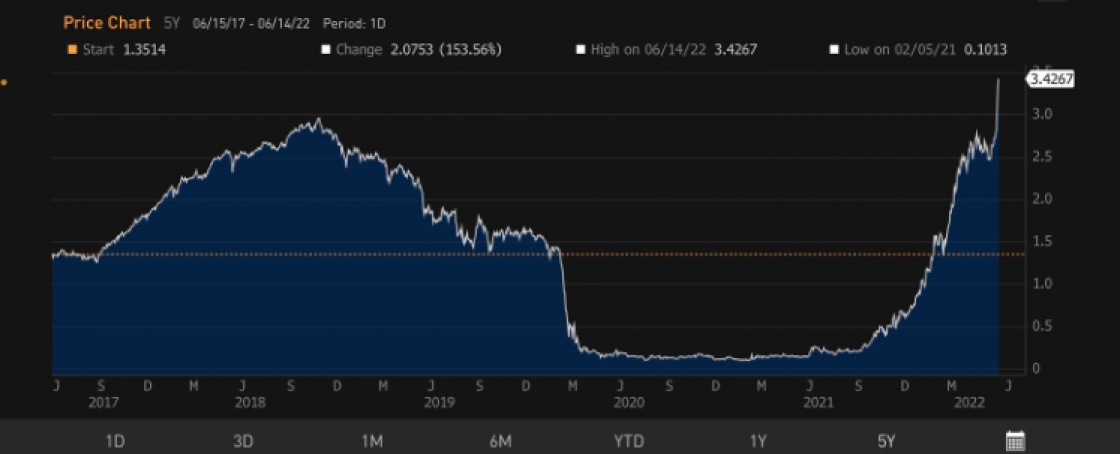
Bond charts haven’t looked this exciting in years:

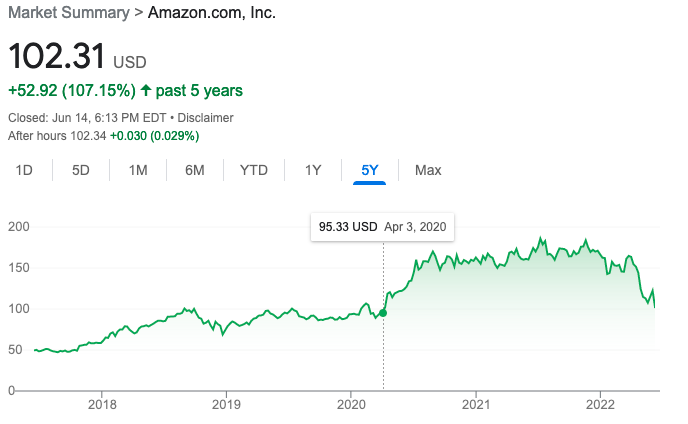
The 2-year UST looks like a direct inversion of the Amazon share price, it has to be noted:
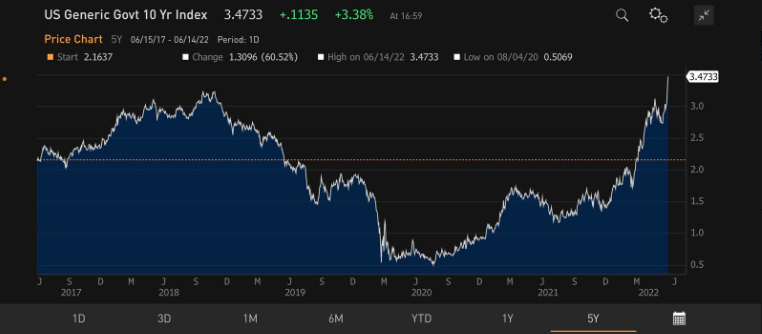
And the 10-year UST isn’t far behind in the yield action:
Steven Englander at Standard Chartered sees the market pricing in subsequent hikes at 70 basis points for July and another 60 basis points for September.
As his curtain-raiser notes (TBS emphasis):
We still see some risk that markets take a less benign view of the Fed’s increased hawkishness than they have to date. For the hawkish shift to be visibly working, inflation and inflation expectations need to come down faster, and lower yields need to emerge earlier in the rates curve. There is no new information on activity, only on inflation and the Fed’s reaction function. So far, the market is pricing in the peak of the fed funds target rate sooner (May 2023) and higher (4.05%). It also expects elevated rates to last longer (at 3.54%, Dec 26 eurodollar yields are 47bps higher than a week ago). The market seems convinced that the Fed will be tough, but not yet that it will be successful.
What we want to know is, what if the Fed goes one further? After all, if it had a secret plan to stamp out the crypto markets once and for all, doing so could do the trick.
The one and only time I met the late Paul Volcker, the former Fed chairman who shocked 1970s inflation into submission, I asked him what he thought of bitcoin. He was tickled by the inquiry but mainly mused that he “didn’t really get it”. I remember being disappointed that he wasn’t more critical of it all.
Nonetheless, I do find myself wondering today what Volcker would have made of all the stablecoins. There is an important analogue to his own days. The Volcker Shock, as it became known, was prompted as much by the expansion of the eurodollar markets as it was by other stagflationary forces.
As the FT’s Samuel Brittan noted on November 5, 1979 (and do keep Tether and the DeFi lenders in mind when you read the paragraph):
The euromarkets do not manufacture dollars, sterling or marks with no reserves at all. But the reserves are chosen by the banks themselves and not laid down by authority. This enables them to pay more for deposits and charge less for loans than their domestic competitors.
Celsius, btw, was marketing an 18 per cent yield until it had to suspend withdrawals this week, rocking the wider crypto market.
Brittan continues:
They are in fact like those US domestic banks which are not members of the Fed system and whose numbers have been increasing recently. That is why Mr. Paul Volcker once described the eurodollar market as “a giant non-member bank.”
Adding:
This whole giant leak in monetary control will have to be tackled from both sides. Not only will euromarkets have to be made more like the domestic markets but the domestic markets will have to take on more of the characteristics of the euro ones.
This will mean in the case of the US paying interest on reserves with the Fed; and in the case of most countries adjusting officially prescribed reserve ratios to something nearer the levels that the banks themselves would choose for prudential reasons. The whole euro phenomenon is but one example of the tendency of markets to find a way round official controls; and monetarists who usually proclaim that they are market economists will have to find ways of working with the financial markets rather than against them.
As it was, the eurodollar markets were never really properly constrained until post-2008 regulatory reforms set in. But then, soon enough, we got the crypto markets.