

This is a guest post by “the Data Artist”, an author who hails from the fintech world and is a believer in beautiful rather than big data.
The esteemed editor of The Blind Spot and I were both enthusiastic viewers of the Top Gun sequel, “Top Gun- Maverick”.
But while I was keen to absorb interesting data points about demographics, economics and military technology, Ms Kaminska was searching for deeper meanings in the narrative.
Since it soon became apparent we were not going to agree on the main epistemological thrust of the movie (clashing significantly on whether the film was really a story of decline or cyclical rebirth), she instructed me to “write something interesting about the planes for people who don’t know about this stuff.”
Well, she’s the top gun around here, so here goes.
The real protagonist of Top Gun II is not the ageing Cruise but the almost as elderly F/A 18 Super Hornet.
Even though the F/A 18 was presented as the more modern successor to the awesome F14 of the original movie, it too is a fairly old plane having first entered service 37 years ago.
To put that into context, imagine a wood and fabric WW1 biplane taking on Soviet jets in the Korean war.
The main reason the only slightly older F14 was replaced with the F/A 18 was because it was cheaper and more versatile i.e., it could drop bombs as well as shoot down other aeroplanes. (For reference for future Top Gun sequels, “F” stands for fighter and “A” stands for attack).
Picking the F/A 18 for the mission, however, was a curious choice. A far better choice would have been the truly awesome 15-year-old F-35 Lightning II (not itself a sequel, just the second US aircraft of that name).
The F35 is one of the most modern and effective combat aircraft around and its stealth technology would have made it much easier to avoid radar and anti-aircraft missiles than the F/A 18.
That said, if we are to pick holes in the narrative, even a drone or a Tomahawk cruise missile would probably have been a safer bet at completing the mission than Maverick and his reckless gang of top guns in a bunch of F/A 18s.
The only reason I can imagine (based on data obviously) for not using the F35, is that at a cost of over $100m each, the last thing you would want to do is risk such an asset in the hands of a system-challenging Maverick.
Spare a dime for the hard-up military complex, guvnor?
Another possible reason for not using the F35, however, is to invoke some pity for the inadequate resources of the US military and persuade Congress to pay for some more F35s.
How can you let America’s heroic naval aviators go up underprepared against the “Fifth Generation” fighters of an unnamed enemy because there are not enough F35s to go around? So far, a measly $400bn dollars has been spent on the F35 programme. Surely Congress can afford to fund planes for everyone? Including for elderly aces that need assistance getting into the cockpit?
What I found more interesting was what the bad guys were flying. “They were Iranians, weren’t they?” asked Ms Kaminska. If you go by one key data point, the list of acquirers of the F14, then it’s hard to conclude otherwise.
Only the US Navy and the Imperial Iranian Airforce (now the Airforce of the Islamic Republic of Iran) count as current operators of the plane.
The 5th generation of fighter planes is usually defined as aircraft developed over the last two decades that include features such as “stealth” (degrees of invisibility to radar), computer systems that network with other weapons on the battlefield and high levels of manoeuvrability.
The fifth-generation fighters in the film, however, were clearly Sukhoi Su-57s. Since only a handful of Su-57s has ever been built by the Russians, one of which has crashed and others have had mechanical problems, it is highly unlikely the Iranians would have any in service at all.
The problems the Russians have faced with getting the Su-57 into full-scale production mirror similar issues they have found with their other advanced weapon systems.
For example, the Russian-made T-14 Armata has been described as one of the most powerful tanks in the world. It even has a system for shooting down anti-tank missiles, which includes a fully automated unmanned turret. Both of these features should be useful given the unfortunate tendency of current Russian tank turrets to detach and fly up into the air when hit by missiles – whether ‘cope cage‘ equipped or not.
Production of the T14 has taken place at a snail’s pace since they were first revealed to the world in a 2015 parade, where one of them appeared to inauspiciously break down. Cost overruns and unfortunate dependencies on western components mean the Russians barely seem to have enough for small parades. Two thousand should have been in service by now, and yet the Russian government appears to be de-emphasising the tank’s publicity, having paraded seven T-14s in 2015 and 2016, five in 2017 and 2018, and four in 2019 and 2020, with only three being paraded in 2022.
One of the great data-driven conclusions of “Top Gun Maverick” is that the power of the US military-industrial complex to create demand remains undimmed by economic reality. The other is that Russia’s inability to mass-produce advanced weapons systems is yet another sign of its malaise, indicating that the country’s growing dependency on natural resources is in compensation for the hollowing out of the Russian industrial base.
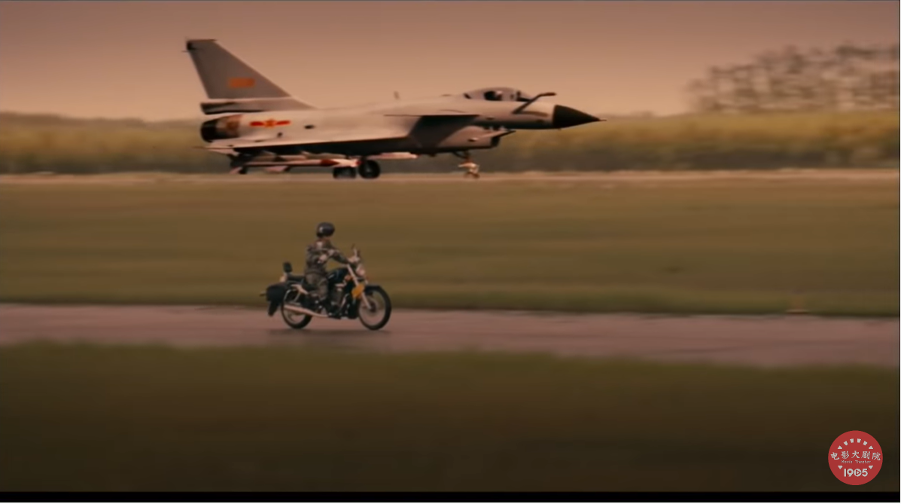
Fortunately for Putin, his close neighbour to the East is actively searching for purchasers for its fifth-generation fighter, the Chengdu J-20. The Chinese may even be able to throw in some cameo options for Russian pilots if they make a sequel to their awful “Top Gun” rip-off, “Sky Fighters”.
The scene in the movie where the motorbike chases Chinese fighters at 20 miles an hour is particularly unenthralling.
Though of course the ultimate plane for the mission at the heart of the Top Gun sequel, at least if it really did exist in reality, would be the X-Wing fighter from Star Wars, which performed essentially the same manoeuvres in both “Star Wars – A New Hope” and “Return of the Jedi”. Though some might argue the A-wing, used by Obi-Wan and Anakin — which is more of a multi-role fighter — might have worked even better.
