

Apologies for light content this week. I have been doing a lot of ‘old school’ news gathering (i.e. face-to-face).
In that capacity I recently met with Elena Neroba, a Ukrainian agricultural commodity analyst, usually based in Kyiv, who gave me a fascinating overview of the state of the market. She arrived in London a few weeks ago after what sounded like an absolutely horrific emergency exit through Poland.
Ms Neroba, unlike many pundits, is in regular contact with Ukrainian farmers. She continues to evaluate the market from London for her current employer, Maxigrain.
She told me the biggest constraint on farmers at this point is being able to get last year’s harvested grains out of silos and over to export markets. Since the primary export routes via the Black Sea are cut off, grain is now being transported via rail through Poland and/or Romania. On the Polish side it usually heads to Gdansk, Gdynia or Szczecin, to be shipped onwards via the Baltic sea. On the Romanian side it is going to Constanta and over to international markets via the Black Sea.
Grains are also heading to Izmail in the south-west of Ukraine to be transported via the Danube to western Europe.
The problem with the land routes, however, is that since the rails are not standardised, railcars have to be switched for cargoes to be moved onwards. Due to the scale of the traffic this has now caused a major pile-up at the switching points as cargoes wait for railcar capacity to unload into.
According to Neroba, the wait times in some cross-sections are approaching an unprecedented 30 days. Many of the ports are also limited in how many containers they can absorb. Here’s a chart she shared with me:
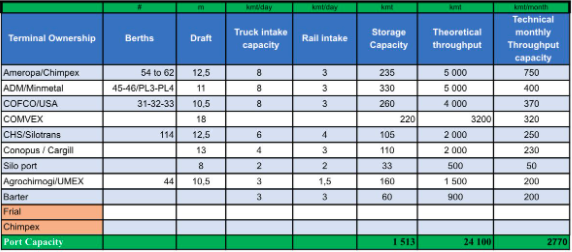
Most of these ports are limited to handling about 3,000 tonnes of grain a day, which she says would mean a Panamax would take up to 20 days to load.
Neroba adds that right now it is the low season for European grain exports. In about 2-3 months, however, Romanian harvests will also feed into these routes, putting even more pressure on export capacity.
Neroba estimates there are about 2mmt worth of grains trapped in occupied terrorities, and another 1.2mmt on vessels awaiting export. The quality of grain, meanwhile, is of a standard that usually ends up in MENA markets.
If these grains do not get out, those markets will suffer most — with Egypt and other poorer African states bearing the brunt of it. Other markets usually serviced by Ukraine, such as Bangladesh and Indonesia, are likely to receive supplies from India and Australia respectively. The risk further down is if India, which is already suffering from a very bad season, is forced to give up exports to meet domestic demand.
As Reuters reported on Thursday:
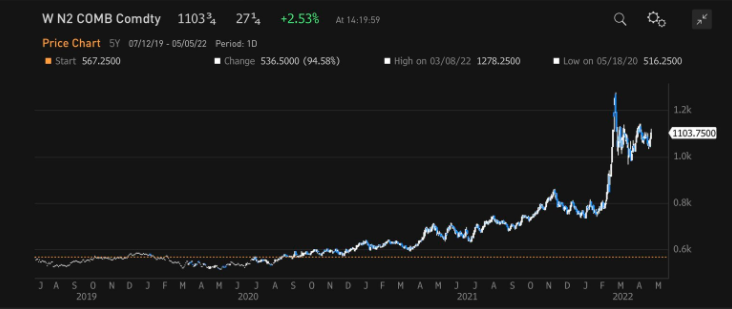
India, which has seen five consecutive years of record harvests, has cut its wheat output forecast to 105 million tonnes from a February estimate of 111.3 tonnes as a sudden sharp rise in temperatures in mid-March cut crop yields.
Wheat futures rallied on the news:
Neroba’s prediction is that if and when grain shortages really begin to cause famines, the international community will be forced to act. Most likely this will take the shape of a militarised UN convoy to protect grain export routes out of Ukraine in the name of humanitarian relief.
As for the state of current planting, Neroba says Ukrainian farmers in annexed territories are being allowed to continue farming but at a huge cost.
She speaks of one farmer whose land and house was seized by Russian forces and who was then told he would have to give up to 50 per cent of grain to Russian hands to continue farming. These grains are mostly being trucked over to Crimea, she says.
Occupied Melitopol. Grain trucks with Z mark, accompanied by orcs, going to Crimea.
Russia steals Ukrainian grain. Once upon a time, Soviet did same.https://t.co/QzOF660Exv pic.twitter.com/bvKFbiQA2Q
— Elena Faige Neroba (@ElenaNeroba) April 28, 2022
Russians stole farm equipment from Ukraine
Accompanied by police
So it’s not small looting – official authorities know what they do pic.twitter.com/Jr0HR2V5Y4— Elena Faige Neroba (@ElenaNeroba) May 1, 2022
Other farmers have told her that as much as 70 per cent can be seized and confiscated when Russian soldiers takeover farming territory.
For now, the biggest choke point on the Ukrainian side remains fuel scarcity for tractors. The good news is that for the most part the fuel is getting to farmers at the cost of other industries. Favourable weather in Ukraine also means yields are likely to be good.
You can follow Neroba’s market updates on her Twitter feed on @elenaneroba.

One Response
This article points out why this War supply shock is such a big deal. Unlike major oil supply shocks in the past, OPEC of 1974, the Iranian Revolution, the Iran/Iraq War, and the Gulf War, this supply shock is not only bigger (the others represented 6-9% of world oil output, this is 13%) but much broader. From agriculture to neon to energy, as the Blindspot has illustrated, the world’s inputs are stressed.
In economic terms, the world’s aggregate supply curve has shifted left and we have a new equilibrium with higher prices and lower output. Do Central Banks recognize the lower potential output and realize that even a very modest stimulus could lead to more inflation? Or will it be like the 70s when full output was overestimated?