The PayPal share price just keeps going down:

And here’s the stock compared to the performance of the Nasdaq:
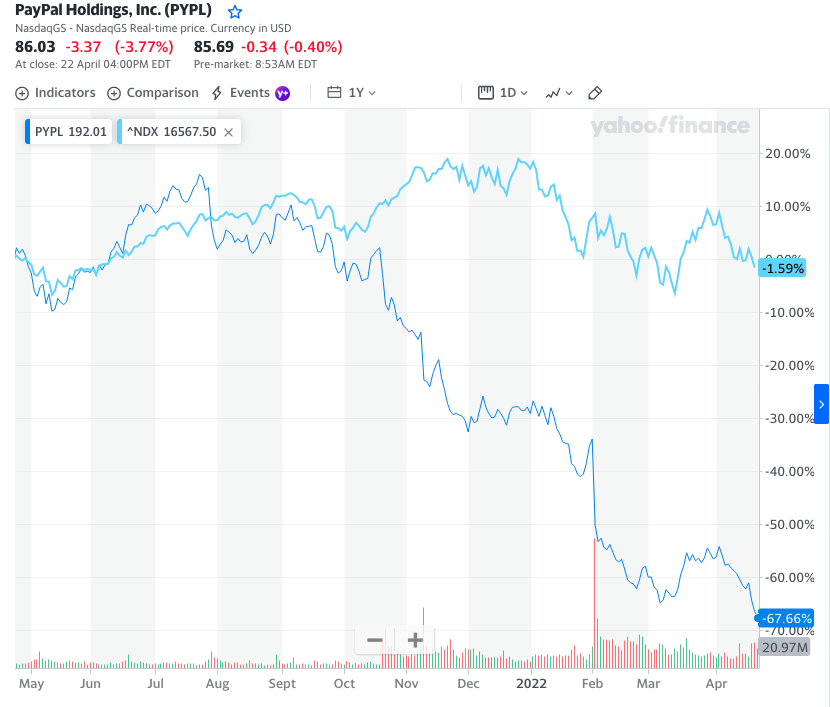
The usual pundits are at a loss. They think the stock should stage a comeback soon. As Bloomberg’s Subrat Patnaik noted on Monday:
“Wall Street sees the company’s shares jumping 90% over the next year, according to data compiled by Bloomberg.”
It could be that the world is misunderstanding how PayPal’s business model really works.
The US based digital payment giant was created by the merger of Peter Thiel’s Confinity and Elon Musk’s X.com in 2000.
The company’s disruptive approach to payments unnerved more vanilla competitors from its earliest days.
Many argued the way PayPal handled customer deposits was bank-like but that its practices had been given a regulatory light touch because financial regulators had failed to understand how internet payments intersect with real finance. Some even dubbed it “the one that got away”.
The PayPal brand in many minds was so enmeshed in the fabric of early e-commerce, there was simply too much pressure to ignore the group’s more bank-like activities. Nobody wanted to be accused of stifling innovation in what was at the time a hyped-up sector.
With the arrival of stablecoins in the 2020s it has become easier to frame PayPal in its proper context. The structure is far more like a money market fund or stablecoin than a conventional money transmitter.
Funnily enough, it’s crypto pioneers who have always understood this.
In 2017, when I spoke to Phil Potter, a former Bitfinex executive and co-founder of Tether, the original stablecoin, he described the Tether business model thusly:
The origin of Tether; .. in 2013/2014 banking was getting difficult and nobody knew how to regulate an exchange, so we thought from a regulatory persective, if we separated the fucntion of banking to bitfinex, crypto only vs tether/banking it would then break apart the regulatory uncertainty into two things that make sense.
One of the thoughts was to create tether as a way for us and other exchanges to use a dollar surrgogate to bypass traditoinal channels.
It’s a very simple business model, we get dollars and we give them tethers, and we have never broken a buck. We have $6m of assets. It’s effectively a Paypal model.
It was to be the PayPal of the crypto world.
But other sources tipped me off that the business model wasn’t all that profitable. (Possibly why the company was increasingly attracted to rehypothecating its customer balances.)
Tether’s intimate “related party” connection with the BitFinex exchange for crypto currencies, also emulated that of PayPal’s close relationship with the eBay marketplace, which acquired the group in 2002 later spinning it out again in 2015. Both Tether and PayPal in this way have benefited from preferential access to dominant online marketplaces.
To this day PayPal mostly operates under standard money transmission licenses, preferring to partner with banks for the provision of credit services. In certain jurisdictions, however, it has also acquired banking licenses directly.
In all cases its model is focused not just on charging fees but also on interest rate arbitrage. This involves taking customer balances up front and absorbing the interest generated from them directly — largely because customers don’t always realise they are waiving it.
PayPal’s outgoing CFO John Rainey noted the following about the practice during the company’s Q4 analyst call in February when asked about how rising interest rates might impact the company (my emphasis):
But as you think about interest rates and sort of the response of higher inflation, where we benefit from higher interest rates is on the interest that we earn on our customer balances. And that continues to grow year–on–year as we become larger, scale more and more relevant with our customers.
And so, we’ve had a headwind to the tune of several hundred million dollars over the last few years as interest rates have gone down. If we get into an environment where we see several rate increases and, of course, this is assuming kind of everything else being equal, that could stand to benefit. And again, that’s
other value–added services in our P&L where we recognize that interest income.
This is an important acknowledgement for two reasons. First, it indicates that the arbitrage is very important to PayPal’s business model. Second, it reflects how much of a drag negative interest rates have been in the recent past.
As a money transmitter, PayPal is supposed to house customer balances in licensed bank accounts. But doing so is expensive, especially in a negative interest rate environment.
By its own admission, PayPal appears to have mitigated some of that negative interest effect by investing customer balances in assets that could generate interest even in a negative interest rate environment. A.k.a riskier assets.
From its 10k:
Revenues from other value added services: Net revenues derived primarily from revenue earned through partnerships, referral fees, subscription fees, gateway fees, and other services we provide to our merchants and consumers. We also earn revenues from interest and fees earned on our portfolio of loans receivable, and interest earned on certain assets underlying customer balances.
A Luxembourg banking license (which PayPal acquired in 2008) explicitly allows the company to transform customer balances into a loan book as follows:
In June 2018, the Luxembourg Commission de Surveillance du Secteur Financier (the “CSSF”) agreed that PayPal’s management may designate up to 35% of European customer balances held in our Luxembourg banking subsidiary to be used for European and U.S. credit activities. During the first quarter of 2021, an additional $700 million was approved to fund such credit activities. As of December 31, 2021, the cumulative amount approved by management to be designated for credit activities aggregated to $2.7 billion and represented approximately 27% of European customer balances that have been made available for our corporate use at that date as determined by applying financial regulations maintained by the CSSF.
We may periodically seek to designate additional amounts of customer balances, if necessary, based on utilization of the approved funds and anticipated credit funding requirements. While our objective is to expand the availability of our credit products with capital from external sources, there can be no assurance that we will be successful in achieving that goal. Under certain exceptional circumstances, corporate liquidity could be called upon to meet our obligations related to our European customer balances.
That means PayPal is operating much more like a bank than a money transmitter in Europe.
But the background to the Luxembourg license is worth flagging too. PayPal began working with Luxembourg authorities (some of the most open minded towards financial innovation in the world) in 2007 with the intent of striking a deal that would create a unique banking license structure. The deal arrived at would give PayPal the right to engage in maturity transformation without being subject to the full scope of European banking regulation.
In exchange for the light touch treatment, PayPal would be prohibited from accessing the ECB’s lender of last resort guarantee. Instead, in the event of a crisis, it was agreed the company would draw liquidity from a mysterious overcollateralised entity in Singapore called PayPal Pte. Ltd. As long as this entity remained fully funded, PayPal would be free to manage customer deposits in ways other money transmission agents in Europe could not.
In the post crypto world, however, the similarity of that arrangement to that of stablecoins is hard to ignore.
It’s true that those defending stablecoins frequently argue the risks for customers are negligible due to how well collateralised these instruments are.
But critics need only point to the stresses experienced by money market funds like Primary Reserve during the global financial crisis to argue this does not guarantee that the entities in question are managing liquidity risk properly. This is especially the case if the entities are opting to hold deposits in “cash equivalents” or their own investment portfolios rather than in third-party banking accounts.
Given the above, Rainey is dead right that an increasingly positive interest rate environment should benefit PayPal. What he could shed more light on is the degree to which PayPal’s legacy portfolio of fixed income assets — marked as available for sale — could be hurt by fair value accounting if it were ever forced to liquidate.
As the interest rate risk section from the 10k notes:
We are exposed to interest rate risk relating to our investment portfolio and from interest-rate sensitive assets underlying the customer balances we hold on our consolidated balance sheets as customer accounts.
As of December 31, 2021 and 2020, approximately 40% and 30%, respectively, of our total cash, cash equivalents, and investment portfolio (excluding restricted cash and strategic investments) was held in cash and cash equivalents. The assets underlying the customer balances that we hold on our consolidated balance sheets as customer accounts are maintained in interest and non-interest bearing bank deposits, time deposits, and available-for-sale debt securities. We seek to preserve principal while holding eligible liquid assets, as defined by applicable regulatory requirements and commercial law in certain jurisdictions where we operate, equal to at least 100% of the aggregate amount of all customer balances. We do not pay interest on amounts due to customersIf interest rates increased by 100 basis points, the fair value of our available-for-sale debt securities investment portfolio would have decreased by approximately $272 million and $173 million at December 31, 2021 and 2020, respectively.
PayPal goes on to state:
As of December 31, 2021, we had $9.0 billion in fixed rate debt with varying maturity dates. Since these notes bear interest at fixed rates, they do not result in any financial statement risk associated with changes in interest rates. However, the fair value of these notes fluctuates when interest rates change.
Translation: if these notes were held to maturity they would not result in any financial statement risk associated with changes in interest rates. But if they weren’t they would need to be marked at today’s fair value.
Meanwhile:
As of December 31, 2021, we also had revolving credit facilities of approximately $5.2 billion available to us. We are obligated to pay interest on borrowings under these facilities as well as other customary fees, including an upfront fee and an unused commitment fee based on our debt rating. Borrowings under these facilities, if any, bear interest at floating rates. As a result, we are exposed to the risk related to fluctuations in interest rate to the extent of our borrowings.
As of December 31, 2021, we had approximately $98 million outstanding under these credit facilities. No amounts were outstanding as of December 31, 2020.
Crypto’s stigma made accessing banking services not just expensive but impossible for anyone touching crypto assets. Few banks wanted to partner with Tether as a result. Nor did anyone trust Tether’s reserve declarations, because the stigma also ensured that no top tier auditor wanted to work with them either. This forced Tether to get creative about how it invested the huge fiat cash-flows that kept heading its way. Much of that cash now famously sits in commercial paper of questionable quality and liquidity, worrying regulators even more.
PayPal, however, has never suffered from any such stigma. It has always had an open pathway to banking arrangements. If anything what it has done it has done for purely economic reasons.
How things evolve will depend entirely on the interest rate climate and customers’ ongoing happiness to waive interest on their PayPal deposits.
PayPal’s Q1 earnings will be released on April 27. Analysts are expecting earnings of $0.89 per share, reflecting a year-over-year decrease of 27.05 per cent.
PayPal announced on April 12 that Rainey would be moving on to join Walmart as CFO. He had been at PayPal for seven years.