I am in Greenland working on a magazine piece that will come out once the Davos dust settles. It will provide more insight into what has been happening, but not just yet.


In the meantime, I thought I would provide readers with some unstructured observations.
I’m here because I wanted to see with my own eyes what is true and what is being manufactured as a “media reality” on the back of an opportunity to meet with some Arctic Circle leaders.
I don’t have time to download everything I’ve learned right now. But I am going to give readers some quick pointers and relevant context that I feel are being missed more broadly. The aim is to help those with partial bits and pieces of the bigger picture to better ground themselves. A lot of you will quibble with my assessments. Others will simply consider them bonkers. But you’re just going to have to trust me that these counter-narratives and alternative perspectives are the only way to overcome the current firehose of noise and distraction.
Having only spent three days here, I am by no means an expert in the culture of Greenland. But, I daresay, I have a much better sense of reality about what’s going on over here than people opining on X. Just going somewhere as remote as Greenland during a pivotal moment in its history can add a lot of strategic insight.
So here are the key points. First, the observational stuff.
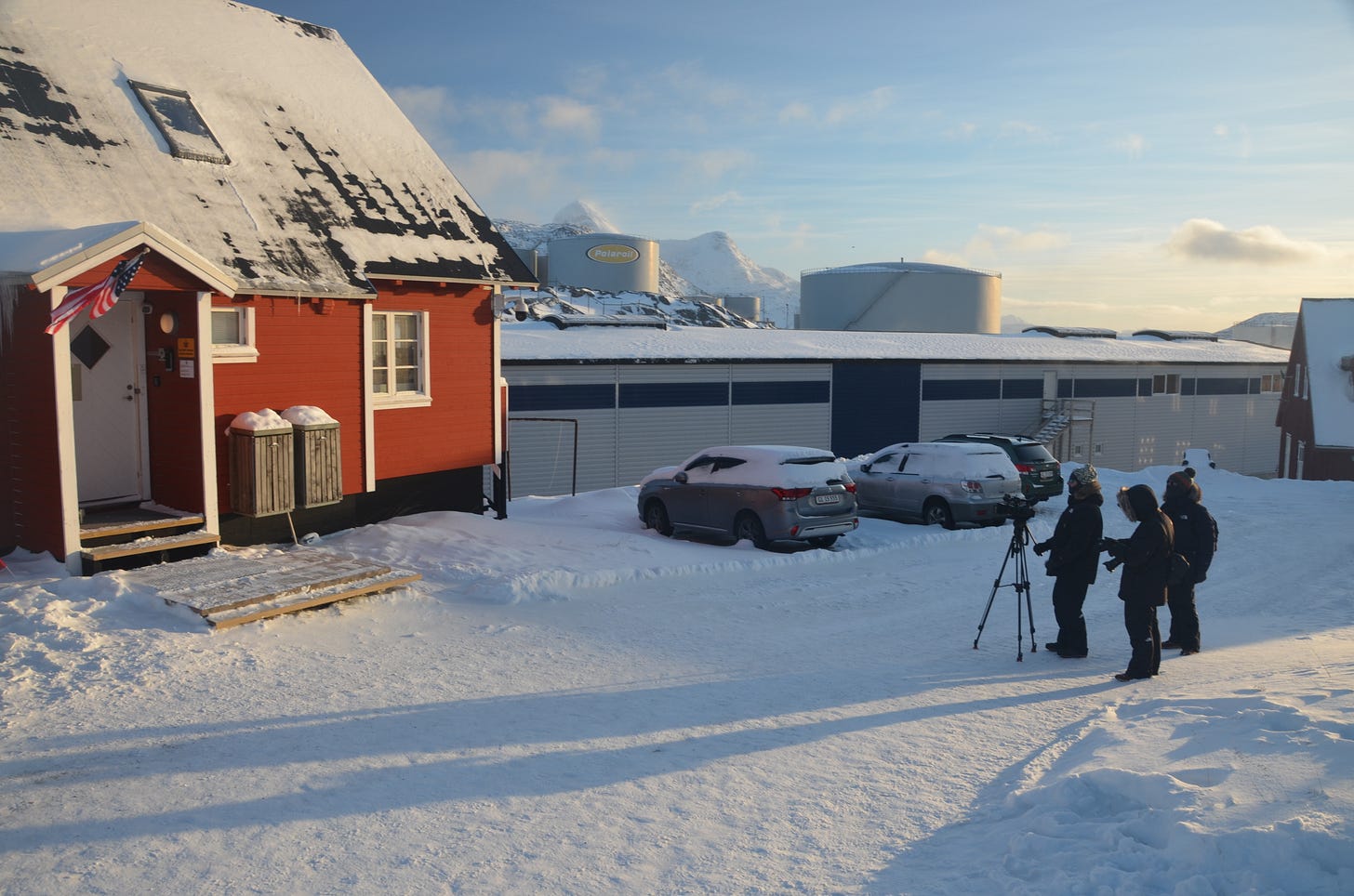
- The place is currently inundated with journalists doing superficial and reactionary pieces to the camera. It is like a media circus in the middle of the Arctic. This is the scene almost everywhere:

- My sense is that most journalists are here for pretty backdrop reasons. I know how this works because I used to be a CNBC producer. This is not real reporting. It mostly involves regurgitating what the wires — informed by leadership in Europe or America — are already saying, just on air.
- On top of that, there is classic “parachute journalism” going on. See the FT as an example of what I mean. Case in point, arriving in Nuuk one immediately notices that there is a large contingent of Filipino workers. This is the sort of low-hanging fruit that makes for an easy news story. Fair game for a reporter who needs to file something unique, and certainly not uninteresting. But it distracts from the real story, which is being buried in the media storm. This is usually only unravelled once everyone leaves.
- Locals are a tight-knit community and understandably suspicious of outsiders. I would be too. No surprise there. I am mostly telling people I am a tourist because identifying as a journalist is frankly embarrassing.
- Locals perceive the journalistic outsiders, quite reasonably, as an annoyance. They are obviously interested in the Trump story, but they really don’t want it to define them. The only people watching Wednesday’s Trump speech in public spaces, for example, were journalists.
- The local leadership figures have been harassed to high heaven by journalistic requests and leading questions. They appear overwhelmed. To respect people’s privacy and space, I am speaking to most people on a deep background. This way they can speak freely.
- Greenlanders are unflappable realists. They are a complex little society, and I would say it is wrong to assign any broad political labels to the country as a whole. Much like Britain or America, they are firmly divided on many things. I think it’s fair to say that most of all, they are proud to be Greenlanders, and that autonomy is very important to them.
- Danish history is complicated and marred by colonial overreach. A lot of that overreach occurred in recent decades, and certainly in the living memory of most Greenlanders. Most famous is the Spiral scandal. This saw young female Greenlanders sterilized against their choice by Danish health providers, supposedly strategically. Greenland is still fighting for recognition of the harms done and for potential compensation. Not everyone agrees on the extent of the harm done. Some Danish Greenlanders I spoke with said that the Inuits were not specifically targeted. They say the policy — introduced to facilitate the expansion of Denmark’s welfare state — was applied equally to Danes back home. It is a sensitive topic. Nobody, for example, appreciates that Bjork has waded in on the issue. The general perspective is that the case is for Greenlanders to resolve. Outsiders should mind their own business.
- This is not the only colonial misstep by Denmark, however. According to senior Arctic leadership sources, the Danes were very heavy-handed in terms of imposing Danish customs, education, and language norms on Greenlanders — to the detriment of local Inuit culture. It is the same colonialist story you see the world over. The same source said Danes took significant efforts to freeze out Greenlandic representatives from official meetings about the territory in Denmark and abroad. They’ve also prevented foreign heads of state from visiting Greenland by insisting that royal protocol is strictly followed. This insists that no head of state can be accepted in Greenland without the presence of a Danish royal. The effect: no visits from any heads of state at all. The former Icelandic President, Olafur Grimsson, is the only one who managed to hack this constaint, via a roundabout unofficial visit.
- The general view is that Greenland is 50:50 split between wanting to leave or remain in Denmark. Nobody, however, is keen on a Trumpian American takeover.
- Local culture is firmly Danish/European/Inuit. Even so, there is also a distinct American footprint. American music plays in most restaurants. I even heard Wind of Change blasting over the airwaves on my first morning. Yes really. At the Tapas Bar in town, the waiters wear red MAGA-style hats. Except the inscription reads: Nu Det NUUK. Supposedly, this means “Make America go away”. But in reality, it faithfully translates as “Now it’s Nuuk”, less anti-American than implied.
- Senior leadership is realistic about the need to work with the Americans. Greenland may not be for sale, but most leaders agree that they do not want to sit outside the American security umbrella.
- The American consulate is totally unstaffed. There is a constant stream of reporters taking pictures outside of the building. I have been asked many times to pose for photos or videos, as “filler”, for other journalists’ reporting. I point out that this is media manipulation. But since I then photograph them photographing me, I can’t really say no. But it is a bit absurd.
- Donnie Jr and Charlie Kirk famously arrived in Nuuk a year ago to test the waters. See the video here. What I learned about this trip from locals is very interesting. Supposedly, the duo arrived on the invitation of Jorgen Boassen, an exceptional and solitary Donald Trump fan. Locals described him as the local “village idiot”.
In response to the Trumpian outreach, Boassen assembled a small, supposedly fake cohort of Greenlandic supporters, many of whom may or may not have been paid off. Since then, Boassen has allegedly been run out of town. Locally, the whole thing is deemed an inorganic PR op that misrepresented Greenland on the world stage. Those I spoke with did not know how the Trumps and Boassen made contact. - On the surface, Nuuk appears to be a very high-functioning little town. Great Western-quality food is available everywhere. Supermarkets are stocked to the brim with fresh produce from across the world. Retailers have access to very high quality western goods. Matcha tea lattes are on many menus. For leisure, there is a large public swimming pool and even a ski slope. Internet and telecom services are of good quality and freely available. But it is also true that prices are high. Equal or higher to European levels. Moreover, it is also clear that Greenland needs a lot of investment if it is to sustain itself.
- The political situation reflects this uneasy economic reality. There appears to be a large wealth inequality gap. Elite Greenlanders can seemingly afford to shop regularly at the more prestigious shops. Many drive high-quality Western Cars: Mercedes, Toyotas, Teslas. I even saw a Porsche Cayenne. At the same time, there is a good 20 percent of the population who are clearly part of the left behind. In that group, social problems run rampant. That includes alcohol and substance abuse, and domestic violence. As in Britain, America, and France, the least fortunate are the most enthusiastic backers of Greenlandic independence. Naleraq is the populist party, and has been described to me as Greenland’s “MAGA” party. (Not pro America. More pro making Greenland great in the first place).
- Arguably, an even stronger and more powerful political group on the world stage is the Inuit Circumpolar Council, a cross-border body, which represents the Inuit people of Greenland, Canada, Alaska, and Russia. As I heard it stated, the movement elevates the idea that the currently partitioned Inuit People are a force of their own. The Inuits seek recognition as a transnational force who see borders as a modern construct.
- In terms of a payoff for joining forces with America, most Greenlanders appear to be pragmatists. As a collective force, they’re vocally “hands off Greenland”. Privately, most seem happy to consider offers. In most cases, $100k would probably do the trick.
- Regarding the Silicon Valley “network state” claims that suggest the architects of initiatives like Praxis are plotting to start tax havens here. These have been greatly overstated. Nobody takes these seriously. Regarding the attempts, one senior Arctic leader told me, “we’ll see how they long they last if they try”.
- Crypto was a bit of a thing here around 2016, but those who made money from crypto allegedly emigrated pretty quickly (or so I was told).
- For the most part, Greenland reminds me of Poland in the interwar period: a country that has achieved independence (or in Greenland’s case, fragile home rule) by playing larger powers off against each other. It knows it has leverage, and it will use it to get the best deal it can possibly get for itself.
- At the same time, Greenland’s fledgling democracy, political and social systems are suffering from a collective lack of governance experience. The judicial systems are especially chaotic and “incompetent”. Not corrupt, necessarily, but prone to nepotism. Increasing health care investment is a key priority for most Greenlanders as current services are very much under strain.
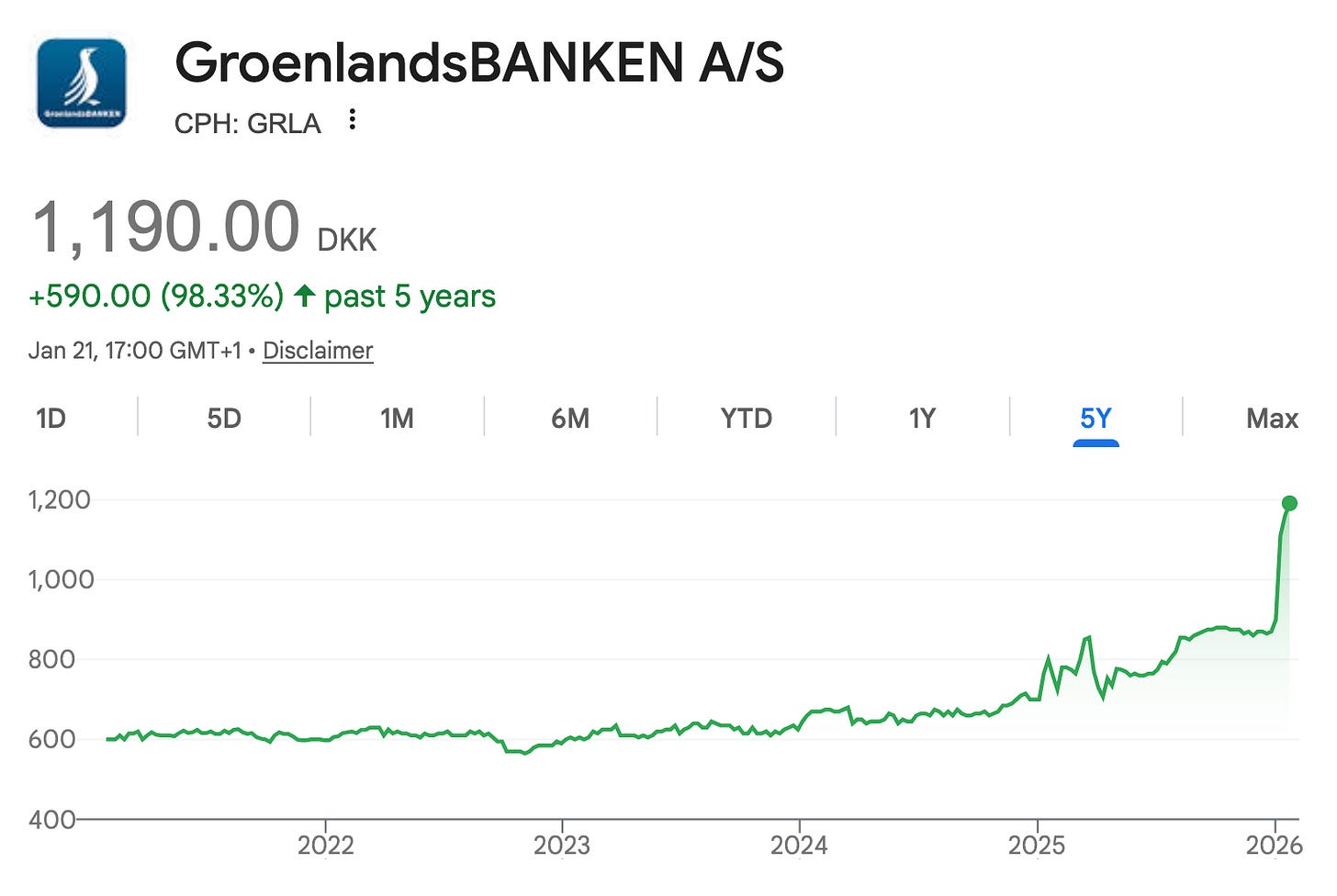
- A good indicator of Greenlandic strength is the share price of GroenlandsBANKEN:


Greenland Geopolitics
- More interesting in terms of American agendas in Greenland is the country’s connection to Kevin Warsh. Yes. That Kevin Warsh (currently trading on Polymarket as 48 percent likely to become the next Fed Chair).
- Kevin Warsh is married to Jane Lauder (since 2002), making him the son-in-law of Ronald Lauder (Jane’s father) and part of the broader Estée Lauder family through marriage. Lauder, who is a longtime friend of Trump, is described by John Bolton as the “prominent businessman” whose suggestion put Greenland on Trump’s radar during Trump’s first term. Bolton says Trump called him to the Oval Office in 2018 and said that this businessman had just suggested the United States buy Greenland — hat tip to Pippa Malmgren for pointing this out.
- In the years since, reporting has tied Lauder’s advocacy to a growing set of private commercial bets on the island: Greenlandic and Danish reporting describes him as part of an American investor group (reported as “Greenland Development Partners LLC”) that bought into two Greenland-based companies, Greenland Water Bank and Greenland Investment Group. Greenland Water Bank has been described in international reporting as a venture exporting “luxury” spring water from Greenland, and Greenland Investment Group has been linked to ambitions around big-ticket infrastructure and energy.
- A lot is said about Greenland’s rare earth assets, but I think this is a bit of a red herring. As is the Lauder connection. Yes, there are opportunities here as the ice melts away, but they are unlikely to be realized any time soon. Not unless there is a dramatic shift in the weather. More relevant, possibly, is that Lauder was Ronald Reagan’s ambassador to Austria, and before that Deputy Assistant Secretary of Defense for European and NATO Affairs. If anyone knows about the strategic importance of Greenland in a new Cold War situation, it’s likely Lauder.
Why Greenland?
- Being here on the ground, it seems the more significant strategic importance of Greenland relates to its capacity to host a ground station to service the U.S. satellite network somewhere in the north. This would probably happen somewhere near America’s current military base in Thule.
- As an aside, that base is subject to a lot of interesting speculation about missing nuclear warheads.
- The ground link in Svalbard is critically important because it sits at a unique geographic sweet spot for satellites in polar orbit, making it one of the most strategically valuable satellite ground stations on Earth.
- The problem is that Svalbard is controlled by the Norwegians. Yes, the same Norwegians who hand out Nobel prizes.
- There’s a treaty that recognizes full Norwegian sovereignty over Svalbard while simultaneously guaranteeing equal and non-discriminatory rights for all treaty parties to conduct civilian and commercial activities on the archipelago. The treaty has 46 signatory states, including all major spacefaring nations, which is why foreign space agencies and companies can lawfully operate satellite ground infrastructure there under Norwegian regulation. A key provision of the treaty is the demilitarization clause, which prohibits permanent military installations or overtly military use, but this has been consistently interpreted to allow dual-use activities — such as Earth-observation, weather, navigation, and scientific satellites that may also have security or defense relevance — so long as the infrastructure is formally civilian and not used for direct military operations.
- To understand the bigger picture, it’s important to channel Brzezinski’s grand chessboard thinking. Based on such logic, Russia needs access to Ukraine if it is to have enough independence to ever reassert power. International powers know this, which is why the post-USSR agreement between the West and Russia created a middle ground compromise that promised Ukraine would remain militarily neutral and out of NATO, while benefiting economically from integration into the Russian economy. Without Ukraine, the Russian economy is seriously hindered. The neutral Ukraine arrangement was fine for as long as Russia felt the international system respected its cultural autonomy in that arrangement.
- When EU/Western “woke” norms started seeping into Russia’s machismo culture, and Brussels separately began to solicit Ukraine to join the EU empire, Russia was cornered into a do-or-die moment. To defend itself against what it felt was cultural oppression by the Western regime, it moved to control Ukraine. Without such a move, Russian cultural norms would be deemed illiberal and oppressive.
- The reason Putin cannot agree to a peace deal over Ukraine that gives up territory is precisely because he needs the land to guarantee Russian autonomy in a scenario where Russia’s way of life is deemed a threat to the Western system. To compensate for the loss of Ukraine, Russia is currently positioned in an uncomfortable marriage of convenience with China. But China is not a natural ally of Russia. China needs Russia’s oil. And Russia needs access to the residual goods and markets it cannot access while at war with NATO.
- Without Ukraine, Russia is forced into a narrower, defensive posture with NATO directly on its borders, reduced leverage over Europe, weaker access to warm-water maritime routes, and far fewer options to balance between the West and Asia, which is why thinkers like Zbigniew Brzezinski argued that Ukraine is not valuable as a resource to be extracted but as a pivot space whose alignment decides whether Russia can maneuver freely across Eurasia or is strategically boxed in.
- If Russia is to give up access to Ukraine, and break away from its uneasy alliance with China — China, after all, is eating up Russian territory on the east, which it is not comfortable about — the only possible compensation is access to American markets and strategic defense systems and technology.
New alignments
- In that scenario: Russia + US can defend against EU + China. And that is seemingly the new power alliance on the table. Yes, that sounds crazy right now. But it wouldn’t be the first time in history that Russia switched sides.
- Trump knows a China-backed EU will not let go of Ukraine, because Ukraine is the keystone that turns European control from temporary influence into defensible dominance.
- On the other hand, control (or denial of control) over Greenland and Iceland locks the GIUK gap, the narrow maritime and air corridor that all large-scale movement between the North Atlantic and the Arctic must traverse; whoever dominates it can interdict shipping, submarines, air transit, undersea cables, space-tracking links, and reinforcement flows between North America and Europe.
- Thus, due to the unpredictability of what may happen with China in Europe and on the world stage, America must retain access to Greenland (at a minimum) if Russia is to give up Ukraine. This is especially the case if hostilities build up between America and Europe. In that scenario, Norway could reasonably argue that the dual-use capabilities of the Svalbard ground station are being used in a military-oriented rather than civilian way by America. If that were to happen, the U.S. would need to rebuild a ground station in the area quickly.
- Greenland is the only obvious alternative location. This is because 1) America already has a historical presence in the region, 2) it has already significantly invested in the region, 3) a ground station has to be positioned as near to Svalbard as possible to maintain efficiency, 4) without such access, U.S. defense capabilities would be seriously undermined, and an independent Greenland itself would become unfeasible.
- Thus, the ball is currently in Norwegian hands. America cannot start rebuilding a ground station in Greenland without it becoming obvious that it views the EU increasingly as a China-assisted enemy. Nor can it do so under the current treaties, since U.S. rights in Greenland are not unilateral. They depend on Denmark remaining a member of NATO. Thus, the U.S. needs to explicitly own Greenland to begin construction of another ground station, or else Denmark can reasonably seize anything it builds in the event of a rupture.
- Most importantly, if it becomes clear that America is building a ground station in Greenland for defensive purposes against a China-assisted Europe, then Norway can reasonably cut off America from satellite access almost immediately. The contingencies are low-earth-orbit satellite networks, like Starlink’s, but they are not enough. The move would immediately expose the U.S. system and give Russia superiority, allowing Moscow to do something crazy like invade Canada.
- To maintain equilibrium, the EU is best off letting America build a backup ground station on sovereign territory in Greenland, while compensating Greenlanders and Denmark for the loss of territory. The dollar flows could be used by the Danes to keep the war effort going in Ukraine.
- The alternative option is to partition Greenland between the north and the south, with the U.S. acquiring the largely uninhabited areas. This would achieve a similar equilibrium, but provide less funding for Ukraine.
- No deal on Greenland, however, means America will be forced to pull funding and support from Ukraine, since it needs to concentrate resources in its immediate sphere of influence. Without American support, however, the EU will face a very public Suez moment. This will likely see it capitulate to Russia. Russia taking Ukraine, however, would bankrupt the EU because of the accumulated Ukrainian war debt that now won’t be repaid to EU institutions. The respective balance sheet hole would then pose an existential threat to the euro. To avoid total fragmentation and euro collapse, Brussels + Starmerian Britain would feel compelled to align with China as effective junior vassals who take orders from Beijing.
We will be back as soon as possible with more.
Update: Looks like “art of the deal” prevailed. As usual, Trump was asking for way more than he actually needed, and walked most of his demands back at the final hurdle. What he needed was just enough of a sovereign base to establish a backup ground station in the event that the Norwegians kick the U.S. out of Svalbard. If the deal terms doing the rounds are accurate, then Trump will have achieved that objective. As outlined above, it’s the minimum he could have accepted.
I suspect it will have been plainly explained to Canada that anything less would have made the entire northern American territory vulnerable to Russian attack. But, at the same time, the smaller the U.S. sovereign base established, the less money the deal raises for Ukraine. That suggests a peace deal is coming, which could be ugly for Europe’s finances.