
The core insight behind the Monroe Doctrine is not ideological but structural: order only exists where it can be enforced.
The original Doctrine did not promise universal freedom, free trade, or moral liberalism. It asserted something more modest: that within a defined sphere, rules would be enforced, and outside that sphere, the United States would not pretend to guarantee outcomes it could not control. Sovereignty, protection, and enforcement would be aligned.
Today, the same logic should extend to finance. Money, like law, only works when backed by enforceable authority. This will be familiar to anyone who has ever fallen victim to push payment fraud. Once money crosses over jurisdictional boundaries that recognize Western legal norms, the chances of redress collapse rapidly. Scope for recovery usually depends on the generosity of domestic insurance or bank compensation schemes. That is a problem for a dollar-backstopped financial system that is supposed to draw credibility from its capacity to guarantee settlement no matter what.
The history of American power can, however, be read as a long oscillation between periods when monetary order was tightly coupled to enforceable sovereignty and periods when it was not.
In that respect, Bretton Woods represented the high-water mark of alignment. Under the postwar system, the dollar was embedded in a framework of capital controls, fixed exchange rates, productive dominance, and institutional responsibility.
The United States could credibly underwrite global stability because it ran trade surpluses, produced the world’s industrial goods, and maintained enforcement capacity commensurate with its ambitions. Protectionism at home and investment in development abroad were not contradictions; they were complementary. Empire paid for itself by reinforcing domestic prosperity and security.
Enter the eurodollar
That all stopped with the collapse of Bretton Woods in the early 1970s. The costs of managing a tightly-knit American empire abroad had finally come home to roost, forcing the dollar to float. Capital became mobile, and enforcement began to lag behind monetary reach. In practice, this was the moment Washington surrendered direct command of the dollar system to the faceless forces of international capital. The move would later be compounded by the repeal of Regulation Q — the last serious effort to control the price and terms of access to the backstopped dollar system.
Despite the capitulation, the newly reconfigured “eurodollar” system continued to draw down on the credibility and trust associated with the Pax Americana regime. In other words, the scope of U.S. obligations — ranging from security guarantees and sea-lane protection to the Federal Reserve’s role as lender of last resort — continued on as before. What changed were the terms of access, which would now be determined by third parties. The result, much to Washington’s chagrin, was not genuine free trade but a system where superior American financial norms began to underwrite inferior systems across borders, without equal global responsibility.
In practice, this meant dollar liabilities could now be synthesized by foreign banks, shadow institutions, and financial intermediaries operating outside U.S. jurisdiction, yet still rely on the credibility of the U.S. state in moments of crisis. The dollar became both sovereign money and a freely replicable global instrument, violating the core logic of the Monroe Doctrine, that rules without enforceable boundaries are bad policy.
This seismic monetary shift coincided with the rise of neoliberalism, a political ideology that preached universal openness while berating political restraint of any kind.
Under the neoliberal mantra, capital mobility, free trade, and financial liberalization were framed as expressions of freedom rather than as failures of enforcement. The costs of the system — deindustrialization, asset inflation, systemic fragility — were seen as painful but necessary adjustments for the greater good. In reality, the burdens fell disproportionately on domestic working classes, and the benefits accrued mostly to multinational corporations, financial elites, and export-led foreign states.
During this era, those who could pivot into finance and technology prospered; those tied to industrial labor and local production lost. To compensate for the sharp rise in the relative costs of domestic labor and production once capital was no longer structurally anchored at home, American power became increasingly extractive.
Whereas American corporates were once willing — indeed encouraged — to undertake large-scale, public-good–oriented projects abroad, such as building dams, irrigation systems, roads, and power infrastructure as part of Cold War developmental strategies (from the Helmand Valley irrigation works in Afghanistan to port and energy projects across Asia and Latin America), the collapse of Bretton Woods and the rise of financialization fundamentally altered their incentives.
As capital mobility increased and shareholder value became paramount, U.S. firms retreated from long-horizon developmental investments toward activities that enabled faster, more extractable returns, while responsibility for public goods provision was progressively outsourced to state aid agencies, multilateral institutions, and NGOs. Greed became good, in the famous words of Gordon Gekko, the chief protagonist in Oliver Stone’s Wall Street.
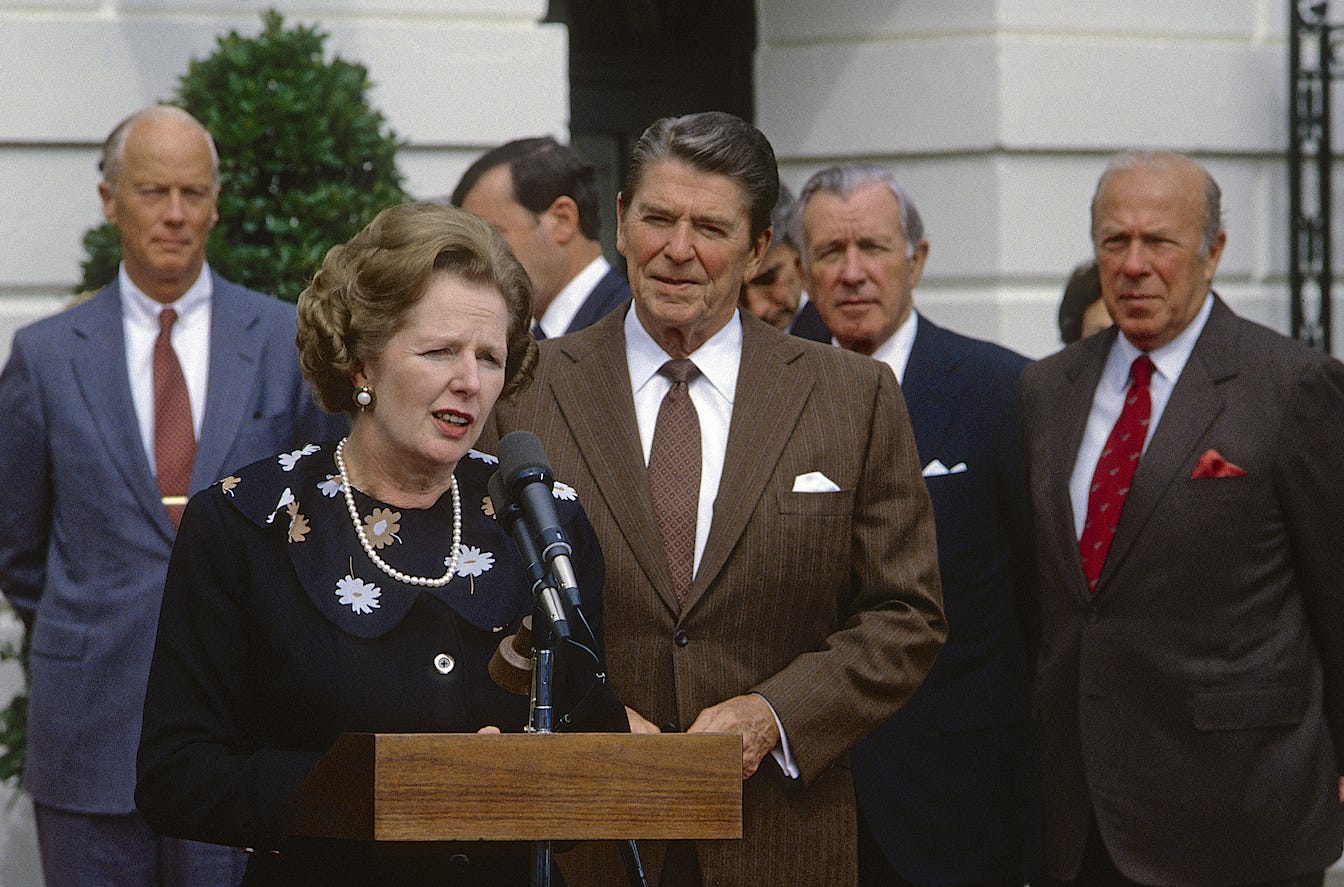
Reagan and Thatcher’s fatal miscalculation
Reagan and Thatcher are often portrayed as the architects of this great capital market realignment. But that historical framing is incomplete. For one, it assumes the duo’s liberal agenda was devised to enrich themselves or other pre-existing elite networks. In reality, both Thatcher and Reagan were anti-establishment figures who yearned to dismantle entrenched and stagnant elites by handing power to individuals and unleashing the creative forces of risk-taking entrepreneurs. In their eyes, the elites had failed in their role as custodians of social cohesion and domestic prosperity because their old paternalistic methods, which prioritized risk-averse protectionism, nationalism, and development, were no longer capable of delivering sustained growth or prosperity.
Both became persuaded — incorrectly — that financialization and liberalization could reliably replace and improve on the “responsible paternalism” doctrine. Their logic was simple. The old system had drifted too far towards social planning and a managed state. In so doing, it had become complacent and corrupt, and detached from the will of the people. Only by granting individuals the power to make their own economic and lifestyle choices and opening up the entire economy to competition could the pathway to prosperity be reopened. It was a very seductive proposition.
In pushing for radical individual sovereignty, however, both Reagan and Thatcher overlooked a critical reality: not all citizens are equally equipped to defend themselves against parasitic or extractive forces. They also neglected that, in a globalized system in which states continued to maintain protectionist barriers, open economies too often end up importing the standards of external states that weren’t always democratically aligned.
The resulting erosion of protective elites thus did not have the intended effect. Instead of introducing a level playing field, it decimated local industry while creating a governance and enforcement vacuum that sent a signal to corporates that they could operate as ruthlessly as they pleased. Into that void stepped a new breed of elites — financial, global, and mercantilistic — whose legitimacy derived not from stewardship but from shareholder value and egregious self-enrichment.
The regime prospered over the course of the 80s, 90s, and 00s largely because the story Reagan and Thatcher told the world was very alluring. It preached that by putting their own interests above everyone else’s, both people and corporations would also be doing what was best for society. It helped too that the message was conveyed with conviction.
Not everyone was convinced. According to the film Shifty, a documentary by Adam Curtis, one such critic was songwriter Peter Sinfield. He was among those who distrusted the idea that there were no negative consequences to unbounded freedom. He set out his critique in the 1980s hit Land of Make Believe by Bucks Fizz.
In the end, Thatcher’s and Reagan’s anti-elitist drive did indeed unhinge elites from social responsibility.
A predictable populist backlash ensued. In short course, countries most exposed to multinational exploitation began to gravitate toward socialist or interventionist governments in the hope they would protect them against the unchecked and destabilizing forces of international finance.
As sentiment toward the United States soured, two of neoliberalism’s most ardent champions — Jeffrey Sachs and James Goldsmith — slowly began to recognize the folly of the system they had long celebrated. Each would later perform a striking U-turn on their earlier views.
The divergent ways they would seek to address the system’s shortcomings, however, would prove as revealing as their sudden disillusionment.
Goldsmith, a former corporate raider who had for years exploited exactly the kind of capital mobility, deregulation, and shareholder primacy that neoliberalism encouraged, concluded that globalization without borders or clear spheres of national influence was not a fixable design flaw but a category error. Capital mobility, he argued, had become structurally dominant over democracy, which was a problem because markets, when divorced from the political power of nation-states, inevitably always became predatory.
His proposed remedy was, in several respects, proto-Trumpian rather than conventionally conservative. In the Trap he argued that the survival of Western liberal-democratic societies depended on a return to soft protectionism, national preference, and democratic economic sovereignty, on the grounds that social cohesion could only be preserved by re-embedding markets within politically bounded and enforceable communities.
Sachs’ response was different. Capitalism didn’t have to revert to the old nationalistic model to gain a conscience. It just had to find a way to inject a sense of corporate responsibility into the prevailing multinational structure.
He accordingly aligned himself with a newly enlightened global elite who, like him, had come to recognize that some accommodation was necessary if their authority and influence were to be preserved. Unlike Goldsmith, this contingent believed the best way to placate disaffected capitalist client states while keeping the profits of so-called globalization flowing was to woo them into their own ranks.
The strategy in effect was to neutralize dissent through incorporation, offering disaffected states the promise of influence from within by granting them a seat at the virtual global corporate table.
The Davos ‘non-system’
The Sachsian vision ultimately prevailed, ushering in what would become the Davos consensus. Under the stewardship of Klaus Schwab — who had been shaped intellectually by Henry Kissinger’s elite diplomatic realism and John Kenneth Galbraith’s managerial critique of market fundamentalism — neoliberalism began, quietly and without any clear democratic mandate, to be reconfigured into something new.
Publicly, the system being championed was described as “stakeholder capitalism” — a nod to the Rooseveltian corporatist era, in which capitalist power had been domesticated through democratic authorization, national regulation, and enforceable political sovereignty. In practice, however, the Schwabian system represented a far more radical departure: an attempt to transpose stakeholder capitalism onto a global scale, beyond the reach of electoral consent and outside the institutional constraints of the nation-state.
Every year, global political leaders, NGOs, and other designated “stakeholder” groups were invited to “parley” with the global capital-owning elite at the World Economic Forum, in Davos, Switzerland, to discuss terms and de facto accommodations. As the forum’s unelected convener and institutional gatekeeper, Schwab exercised disproportionate influence over this process — most notably through his authority to determine who received access, which agendas were legitimized, and which voices remained excluded.
From the public perspective, the get-together came across as an overly indulgent and elitist talking shop, completely detached from the realities of the world. The deflection was partly intentional. In reality, the Davos conversations amounted to unofficial negotiations over what industry needed to do to address the concerns of the non-capital-owning classes, as conveyed to them by their respective elites and representatives. At least if they wished to maintain influence and avoid popular revolutions or war in their home systems.
This mode of governance was not without historical precedent. Long before Davos, the Italian fascist model had pursued a comparable ambition: the replacement of adversarial mass politics with continuous, managed negotiation between corporations and designated “stakeholders,” conducted under elite supervision rather than through open democratic contestation.
Sachs, shaped by his experience in post-communist transitions and debt crises, was initially an enthusiastic evangelist for this type of technocratic international coordination and mediation. He drew on the system to lobby elites to become more open to sustainable development, debt relief, global health, and later ESG-style governance, hoping that better global institutions could substitute for the enforcement capacity that sovereign states had relinquished.
The emerging consensus, however, bore no allegiance to any sovereign. Global in orientation and insulated from democratic accountability, it naturally prioritized the management of transnational and systemic risks — such as climate change, financial instability, and supply-chain disruption — over locally rooted economic and social concerns. Whether representing constituencies in the developed or developing world, those invited were frequently incentivized to compromise local interests or were gradually absorbed into a corporatist consensus.
Lacking any formal enforcement mandate, this model of governance, however, needed innovative ways of imposing its will on populations. It predictably gravitated toward technological solutionism. This was not merely attractive but structurally necessary: coordination problems that could no longer be resolved politically had to be reframed as technocratic engineering challenges. Moreover, this shift was neither incidental nor concealed. Schwab himself articulated a vision in which technological integration would function as a substitute for political control, accountability, and consent — most explicitly in The Fourth Industrial Revolution, where governance is reimagined as a matter of managing complex systems rather than adjudicating competing social interests.
The result was the emergence of a technocratically managed global digital order in which key governance functions were effectively outsourced to transnational platform monopolies, powered by data and surveillance tech. Critically, its enforcement didn’t require public mandates. The system, Schwab realized, could be implemented through the steady advancement of individuals who had been recruited into — and socialized within — the WEF’s vision, as they rose through global corporations and institutions.
Unsurprisingly, the system did not command universal acceptance. Many questioned the legitimacy of governance by cherry-picked “young global leaders,” selected by opaque criteria and insulated from democratic accountability. Critics described the emerging order as a pseudo-fascistic corporatist arrangement, premised on the belief that corporate and technocratic elites understood popular needs better than voting publics.
As accusations of moral hypocrisy among the “Davos elite” gained traction, elites responded not by addressing the underlying sources of discontent but by doubling down on virtue signalling as a strategy of pacification.
This culminated in the rise of ESG-driven corporate posturing and a formal drive to shift democratic and shareholder influence over local resources and capital allocation, toward a model in which business leaders began to take guidance from NGOs and other social groups on how best to allocate resources in society.
The enforcement deficit
After the 2008 Global Financial Crisis, banking reforms had implicitly acknowledged the danger of unconstrained eurodollar expansion.
But the way regulators addressed these risks was blunt. Rather than reasserting direct monetary control, the United States responded by tightening capital, leverage, and compliance requirements at the system’s choke points. This throttled non-compliant offshore dollar creation through exclusion rather than governance.
The practical effect was to transform U.S. and globally active banks into de facto enforcers of American law far beyond U.S. borders.
There was, however, a fundamental problem. These institutions possessed no explicit judicial or policing mandate, nor any commercial incentive to bear the costs of due diligence and risk management in low-profitability jurisdictions.
Predictably, compliance was achieved through retrenchment rather than engagement, a type of self-imposed financial Monroe Doctrine. Correspondent banking relationships were severed, judgment was delegated to automated risk systems, and institutions erred systematically on the side of exclusion.
As large parts of the developing world lost access to stable funding, dependence deepened on whatever capital flows could still be accessed through Davos-mediated channels.
In parallel, global elites increasingly came to view those flows as requiring ever more explicit conditionality and concessions of authority.
The outcome was the rise of the ESG and “responsible investing” agenda. On the surface, this “shared mission” appeared to operationalize the World Economic Forum’s promise to “improve the state of the world,” by translating lofty rhetoric into concrete action. In practice, however, it reflected a paternalistic revival that, in key respects, bordered on soft colonialism — assuming that Western regulatory and environmental priorities could be transplanted wholesale into developing societies, regardless of social cost.
As part of this new social contract, corporations pledged to police lawful and ethical behavior across their supply chains — overseeing suppliers, distributors, and intermediaries while enforcing environmental and governance standards. In return, marginalized populations were symbolically “invited” into boardrooms, elite universities, and forums, with a growing share of corporate profits assigned to funding public goods, essential infrastructure, and development.
But the concord failed for three reasons. First, the new system was delivering weaker global growth than the older one: after 2008, world GDP slowed markedly, particularly when measured against energy use. Second, elites failed to grasp that domestic populations were neither willing to forfeit material expectations nor to be “integrated” into a new grand bargain negotiated without their consent. And third, the rise of cryptocurrencies and stablecoins was beginning to undermine post-2008 financial controls.
Goldsmith’s last laugh
The candidacy of Donald Trump and the rise of other Western populists eventually gave disaffected domestic Western populations the opportunity to push back with political power.
In the process, James Goldsmith’s old viewpoints — largely unwittingly — began to gain traction all once again.
What followed is now familiar. Trump’s election marked the return of a more openly protectionist United States, committed to rebuilding domestic industrial and productive capacity after decades of overextension. Rather than attempting to manage global capitalism through technocratic consensus, under Trump Washington sought to lead by example — asserting a version of capitalism with distinctly American characteristics, to be enforced only where U.S. power could credibly reach. That meant adopting a European-style logic: encouraging dynamic market capitalism and competition, but only within a protected perimeter where legal norms could be enforced and compliance compelled.
In this sense, Trump assumed the role of a political “Godfather”: a centralizing patriarch prepared to confront entrenched elites by doing what diffuse, technocratic systems no longer could: exercise coercive authority directly in defense of domestic interests.
In important respects, this development echoed the social logic that had once underpinned the rise of the mafia in Italy. There, local enforcement networks had emerged precisely because a newly unified Italian state lacked both the capacity and the credibility to enforce contracts, protect property, or dispense justice in much of the countryside.
The Trumpian prescription, naturally, conflicted with the globalist assumption that an ESG framework — conceived as a kind of permanent, technocratic parley — was more than capable of substituting for the loss of earlier forms of stewardship. Worse than that, it threatened to derail everything that had been achieved under that order.
Had the story ESG succeeded in bringing about financial stability, economic growth, and environmental stewardship, especially in the U.S., then arguably, Trump’s second term might never have been.
But it didn’t.
This is where, finally, stablecoins — enter the story.
The ring-fencing of America
Since returning to office in 2025, the Donald has, as promised, thrown the full weight of the American state behind a renegotiation of the global bargain in its favor and into consolidating power in areas America can explicitly control.
But his administration has also recognized that simply abandoning the rest of the world to fend for itself with insecure and unstable mechanisms poses security risks of its own to America.
In that context, the export of USD stablecoins allows America to exercise Donroe Doctrine and “nation-building” expansionism at the same time, without any need to capitulate to the norms of other systems.
In this emerging architecture, the “dollar system” starts to resemble the eurosystem, but with different value sets.
Stablecoins in effect become a staging ground for states, or even communities, that seek access to the benefits of a stable U.S. system but which do not yet have the political or institutional maturity to shape or influence it. In this respect, the system mirrors the euro’s accession logic, wherein prospective Eurozone members are first bound by currency pegs before being granted entry. Except that, in the dollar version, onboarding is done in an informal, market-led way.
Under the emerging regime, full participation in the dollar system — comprising influence over the Federal Reserve, access to wholesale dollar liquidity, and discretionary financial privileges — is to be reserved for fully federated members of the U.S. legal and enforcement infrastructure.
But actors who are prepared to meet the explicit standards of regulatory alignment, fiscal discipline, transparency, and political obligation will be enthusiastically allowed in if they prove themselves trustworthy.
That means those outside the net — both firms, and individuals — can use dollar-denominated stablecoins for trade, savings, and settlement, but they cannot create dollar liabilities at will, leverage opaque balance sheets, or export risk back into the core system, unless they are prepared to bend the knee. Dollar usage instead becomes transparent, ring-fenced, and programmable. Compliance is embedded at the instrument level and at the external system’s own risk.
Belief in something
Today’s resulting stablecoin architecture resolves a contradiction that neoliberalism never could, since it preserves the dollar’s role as a global stabilizer while reasserting sovereign control over its issuance and risk. Moreover, it restores developmental access that post-GFC regulation unintentionally destroyed, without reopening the door to destabilizing arbitrage. Most importantly, it re-aligns monetary privilege with enforceable obligation.
This is why Donald Trump’s anti-elitism differs fundamentally from that of Ronald Reagan and Margaret Thatcher. Reagan and Thatcher sought to empower individuals by dismantling protectionist systems that had become sclerotic and unresponsive. Trump’s critique is not a rejection of elites as such, but of elites who ceded political power to technocracy because they could not envision a world in which freedom and order could coexist. Their fixation instead was on keeping the system stable at any cost, largely because, as Adam Curtis would say, they believed in nothing.
Trump’s supporters, on the other hand, are not prepared to let go of the dream of American exceptionalism. They treat power as something to be exercised in pursuit of a bolder vision of tomorrow, whether that’s colonizing space or taking over Greenland.
Seen this way, the turn to stablecoins is not a technocratic tweak but a civilizational adjustment. It marks the end of the illusion that money, law, and freedom can be universalized without enforcement. In its place emerges a federated order in which access, protection, and obligation are once again aligned, without encumbering individuals’ freedom to determine their own path.
Thus, if asked, choose your stablecoin staging ground wisely — it may define the order you’re entering and what values you’re buying into.