Industry news:
Flow news: Ethereum saw a massive $1.6B inflow into its stablecoin supply, more than all other chains combined. Commentators argued this should reinforce Ethereum’s role as the backbone of on-chain finance — though some pointed out that velocity, not just supply, is the more telling metric of real adoption.
— Tether is seeking a $500 bn valuation in major raise (Bloomberg)
Summary: Bloomberg revealed that Tether is seeking $20 billion in fresh funding at a $500 billion valuation. If successful, it would mark one of the largest private valuations in financial history. Analysts warn that while Tether has become the backbone of crypto liquidity, its size makes it a systemic risk — transforming from “crypto’s biggest single point of failure” into a global one.
Summary: Backed by Arthur Hayes, Plasma describes itself as a purpose-built blockchain for stablecoins. Promising fee-free, near-instant payments with institutional-grade security, it aims to be a settlement layer for global stablecoin adoption.
Delphi Digital published research positioning Plasma as an ambitious attempt to capture the fast-growing stablecoin payments market. The report highlighted its potential role in remittances and as a neobank-style financial layer.
— Latin America’s largest digital bank Nubank is eyeing dollar-pegged stablecoins (via Crypto News)
Summary: Nubank, the biggest digital bank in Latin America, is preparing to integrate dollar-pegged stablecoins into its payment ecosystem, starting with credit card transactions.
TradFi:
— Nine major EU banks launch euro stablecoin (Politico)
Summary: Nine leading European banks — including ING, UniCredit, Danske Bank, CaixaBank, and SEB — have teamed up to mint a euro-backed stablecoin, headquartered in the Netherlands and fully compliant with the EU’s crypto regulations. The project is being pitched as a “real European alternative” to the U.S.-dominated stablecoin market, aiming to boost Europe’s strategic autonomy in payments.
— CFTC initiative to allow stablecoins as collateral in derivatives markets (via CoinTelegraph)
Key graf: “If implemented, stablecoins like USDC and Tether would be treated similarly to traditional collateral like cash or US Treasurys in regulated derivatives trading. Congress passed laws earlier this year regulating stablecoins, which have seen their adoption grow among financial institutions.”
Tetherization:
— Toyota, Yamaha, BYD accept Tether in Bolivia as USD reserves shrink (CoinTelegraph)
Key graf: “Tether is now being accepted for payments at Toyota, Yamaha and BYD in Bolivia as businesses increasingly turn to stablecoins to navigate the country’s US dollar shortage. Bolivian businesses that import products have also been using USDT to work around US dollar shortages, TowerBank’s head of digital assets, Gabriel Campa, told Bitfinex last Tuesday. They buy stablecoins locally or via offshore bank accounts, convert them to US dollars, and pay overseas suppliers. Some of these products are then listed in USDT, enabling a stablecoin circular economy to keep trade and operations running, he said.”
— Tether’s newest exec Bo Hines claims all its tokens will be Genius compliant (Yahoo News)
Key grafs: “Hines predicted that USDT will also comply with the GENIUS Act, citing the law’s reciprocity clause. He stated, “We expect the US to apply reciprocity to Tether International.” Article 18 of the GENIUS Act includes a reciprocity clause, which allows stablecoin issuers from countries with regulatory frameworks similar to the US to distribute stablecoins within the United States.”
KYC/AML
— An Anti-Money Laundering Stablecoin Proposal (via CoinTelegraph)
Summary: This is an oped from compliance expert Debanjan Chatterjee reporting on new policy discussions around embedding anti-money laundering (AML) requirements directly into stablecoin frameworks.
— SARS tightens oversight on crypto traders (via Bitcoinke)
Summary: South Africa’s revenue service (SARS) has opened a consultation on implementing the OECD’s Crypto-Asset Reporting Framework (CARF). This would require service providers to disclose user activity, with penalties reaching 200 percent for non-compliance. The move signals a shift from education to enforcement in Africa’s largest crypto market — hitting stablecoin remittances in particular.
CBDCs:
— ECB’s Cipollone says digital euro won’t launch till mid-2029 (via CoinTelegraph)
Contrary to earlier rumors of an imminent launch, ECB board member Piero Cipollone clarified that the digital euro is unlikely before mid-2029. The bottleneck lies in legislative approval from the European Parliament. The report underscores both political resistance and the slow pace of building trust in government-backed digital currencies.
— Petition Against CBDC Identity Rules Passes 1M Signatures (26 Sept, UK Parliament)
A UK petition opposing digital currencies tied to mandatory identity verification hit over 2.3 million signatures. The surge reflected strong public unease about CBDCs becoming surveillance instruments, particularly under anti-money laundering and counter-terror financing justifications.
Izzy’s take on the situation is here.
— The State Bank of Pakistan (SBP) confirmed that its central bank digital currency (CBDC) project has officially entered the trial phase.
The move represents a significant step in Pakistan’s journey toward modernizing its financial system and reducing reliance on traditional cash transactions.
— China launched its digital yuan operations center (SCMP)
Summary: The People’s Bank of China highlighted three platforms designed to accelerate the internationalisation of the digital Chinese currency. 1) A cross-border digital payment platform that will explore the use of the central bank-backed digital currency — also known as e-CNY — to improve the efficiency of international transactions. 2) A blockchain service platform that will enable on-chain payments and provide standardised cross-chain transaction information transfers. 3) A digital asset platform that will help existing financial infrastructure expand onto the blockchain by providing standardised, ready-to-use digital asset services.
Sceptics:
— Oped: Stablecoins are an invention looking for a problem (via Naked Capitalism)
Summary: Veteran analyst Satyajit Das argued stablecoins solve few real-world problems while introducing systemic vulnerabilities. He critiques the narrative that stablecoins democratize finance, instead suggesting they amplify risks without providing clear economic benefits. The piece resonated with skeptics in the community.
Key graf: “Stablecoins are an attempt by privateers, using high-minded technological arguments, to capture a lucrative essential function for profit not social advancement. While existing arrangements are far from perfect, replacing a system which is tried and tested risks undermining trust especially when improving settlement times and reducing costs in traditional payments is easily achievable.”
Analysts:
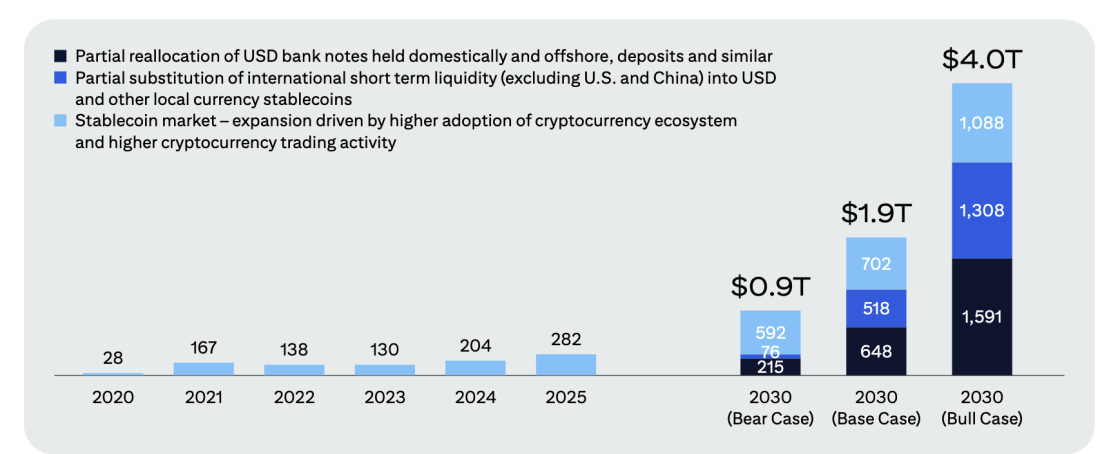
— Citi Revises Stablecoin Outlook Up to $1.9T (Citi GPS Report)
Summary: Citigroup raised its projection for the stablecoin market in 2030 from $1.6 trillion to $1.9 trillion. The report predicts coexistence between stablecoins, bank-issued tokens, and tokenized deposits, highlighting rapid adoption but also fragmentation in digital money infrastructure.
Key charts:


— Boston Consulting Group’s 2025 Global Payments Report highlights stablecoins as dollarization tools (BCG)
Summary: One of the most interesting and uniquely provocative observations in the report about stablecoins is how they are evolving into geopolitical instruments of dollarization and monetary competition, rather than merely financial innovations.
In particular, BCG notes that while stablecoins are still dominated by U.S. dollar–denominated coins (e.g. USDC, USDT), their adoption in volatile economies is rapidly becoming a de facto channel of dollarization — especially in corridors with weak currencies, high inflation, or limited access to dollar banking. The report highlights that flows of stablecoins into countries like Nigeria and Turkey far outpace their general use in “real-world payments,” illustrating that their appeal is less about convenience and more about access to a more stable currency.
Moreover, BCG flags a macro risk: if stablecoins begin to displace traditional bank deposits at scale, this could destabilize national banking systems, impact credit creation, and create tension between capital mobility and domestic monetary control. In other words, stablecoins are straddling the line between private rails and monetary sovereignty — making them a battleground of statecraft as much as fintech.
Key graf: “Near-term dollarization is likely to persist in retail payments across Turkey, Nigeria, Bolivia, and other areas that are experiencing high inflation and currency volatility. In parallel, governments may introduce measures such as US dollar (USD) stablecoin limits, local-currency stablecoins, or CBDCs to manage these risks. Fintechs and startups in the Global South are well positioned to drive adoption of BaaS 2.0 models, given their need for USD access and more efficient cross-border capabilities.”
Regulation:
— European asset managers want to hold stablecoins in portfolios (Politco)
Summary: Politico reported that asset managers were urging Brussels to tweak the EU’s gold standard for funds so that they can include stablecoins in their portfolios. The European Fund and Asset Management Association (EFAMA) recommended the tweak in a memo connected with a larger push of modernizing the financial industry’s plumbing with crypto technology.
— Reform’s Nigel Farage slammed BoE’s proposal to apply strict holding limits to stablecoins (LBC)
Summary: Nigel Farage attacked the Bank of England as “out of touch” over its proposal to limit how much stablecoin retail investors can hold (reportedly £10,000). He called the idea archaic and questioned why the Bank was “behaving like a dinosaur,” urging it to “get with the 21st century” on new technologies. He also raised broader objections to the BoE’s quantitative easing and bond-selling strategy, accusing it of locking in “massive losses” for taxpayers and calling for greater parliamentary oversight.
— Hong Kong’s Monetary Authority quashed rumors of official yuan-denominated stablecoins (Yahoo News)
Key graf: “The HKMA reiterated that under the Stablecoin Ordinance, which formally took effect on August 1, any company seeking to issue a stablecoin in Hong Kong—or promote related activities to the local public—must secure an official license from the regulator. The law requires issuers of “referenced stablecoins” to demonstrate compliance with strict operational and transparency standards before offering products to the market.”
Stablecoin statecraft:
— Arthur Hayes wonders if the US is promoting stablecoins only to resolve its debt (Youtube interview)
Summary: Bitmex founder Arthur Hayes suggests that the U.S. is encouraging global stablecoin adoption not for innovation, but to create new demand for Treasury bills. By unlocking access to dollars in inflation-hit regions, stablecoins effectively funnel global savings into U.S. debt markets. Hayes estimated potential market size at $34 trillion, reframing stablecoins as geopolitical tools.
— Eric Trump predicts stablecoins will save the U.S. dollar (New York Post)
Events:
— Token2049 Singapore begins on October 1. Agenda here. (Anyone who is anyone in the stablecoin world will be there.)