
| SNEAK PEEK |
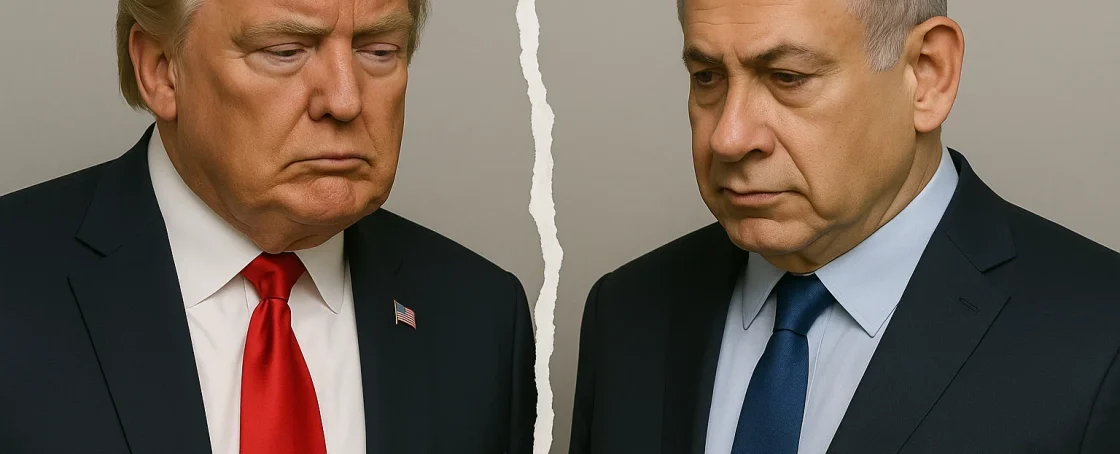
— The Trump-Bibi relationship seems broken, but is it truly broken if it never existed?
— Pakistan and India fight in possibly the largest air-to-air dogfight the world has seen since the Second World War.
— Is Romania considering canceling their elections yet again?
Dear subscribers,
Dario here. After several weeks of quiet geopolitical events, things are heating up ahead of Trump’s Middle East trip.
Let’s tuck in.
But there’s something I’m even more excited about: our classified not-so-secret gathering under the auspices of “Bruce’s 50th Birthday” in Berlin on July 17. What’s gonna be there? You’ll have to see for yourselves. And remember your chance of grabbing a discounted spot shrinks by the day.
Without further ado:
| THE BIG GEOPOLITICS BLIND SPOT |
TRUMP NO LONGER SPEAKS TO NETANYAHU according to Israeli sources. Yanir Cozin, a correspondent for Israeli Army radio, claimed that close Trump associates told Israeli Strategic Affairs Minister Ron Derme that Trump cut Bibi off because he believed Netanyahu was “manipulating him”, adding that Trump was also displeased by Dermer’s tone.
“There is nothing Trump hates more than being portrayed as a fool or someone being played. That’s why he decided to cut contact with Netanyahu,” the official added.
Israel’s exclusion from Trump’s negotiations with Yemen’s Houthis seemed to confirm these rumors.
Facing questions as to why America’s closest ally in the region was not consulted on this peace negotiation, the U.S. Ambassador to Israel, Mike Huckabee, claimed: “The United States isn’t required to get permission from Israel”.
More suggestions for a breakdown are implied by the travel itinerary of Donald Trump and U.S. Defense Secretary Pete Hegseth, neither of whom will be visiting Israel despite an upcoming official United States visit to the region. While Trump was never planning to stop in Israel, Hegseth’s planned visit was officially canceled, ostensibly so that the Defense Secretary could join the U.S. President in Saudi Arabia.
Gulf sources are circling rumors that Trump may go as far as recognizing the State of Palestine, which could strengthen the diplomatic impetus to rekindle the two-state solution.
DARIO’S COMMENT: But how can something break which didn’t exist in the first place? In many ways, the rift between Trump and Netanyahu may be a symptom rather than the cause of an emerging rift between Israel and the United States. One that is suggestive of a significant geopolitical realignment in the Middle East that we’ve long suspected.
Let’s unpack what this could mean. The first is the timing of the Bibi-Trump breakdown news has a lot to do with internal Israeli tensions.
The information reaches us through sources close to the Israeli Army, many factions of which are currently in a life-or-death proto-civil war with Netanyahu’s cabinet. The incentives are aligned for these Israeli insiders to enhance the perception of a breakdown in relations between Netanyahu and Trump to damage Bibi’s diplomacy (long viewed as Bibi’s strongest talent), or even to foster such a breakdown.
But you shouldn’t buy that explanation. Because, even if it’s true, I don’t think there was much of a relationship left to break between the two men. As we’ve stated, Netanyahu was the first major foreign leader to congratulate Biden on his win in the controversial 2020 election season. It would be difficult to see Trump looking past that blemish. And there are reasons to think it goes both ways.
Trump’s first geopolitical move before he took office was forcing a humiliating ceasefire on the Israeli cabinet in Gaza — one which Netanyahu broke as soon as he could. And remember Bibi’s ‘gift’ of a golden pager to Trump (and later, Senator John Fetterman)? It’s just my opinion, but considering it was an explicit commemoration of the Mossad’s pager-detonation operation, could it have been an implicit threat?
The next is that this potential breakdown in the relationship could be the symptom of a wider Middle Eastern realignment than the cause. Currently, the news cycle is putting two and two together — Trump is pissed off at Bibi, ergo, Trump is excluding Israel. But what if Trump’s exclusion of Bibi stems from a broader strategy to distance the U.S. from Israel altogether?
It sounds counter-intuitive. Especially because Trump has worked hard to cultivate a radically pro-Israeli persona in public, and most of Israel’s diplomatic successes occurred thanks to Trump’s normalization efforts in his first term.
But the facts continue to stack up in favour of this wild-seeming, radical geopolitical theory. The theory’s logic isn’t far-fetched. Trump’s geopolitical ideology is remarkably straightforward and consistent: America should stop paying for other nations’ defenses. This means that Trump — and American diplomacy going forward — are going to increasingly cut off those countries and regions which depend on American largesse. From this perspective, Israel — not Europe — is the biggest piece of American aid fat to trim.
Significant geopolitical consequences await if this abandonment were to happen since it would radically shift the Middle East’s center of gravity further towards the Gulf.
If this theory holds water, it could also last longer than Trump’s term. While there will always be an internationalist wing in American politics, eye-watering levels of debt suggest America will revert to its isolationist baseline. Just like the English Channel granted Britain its long-standing tendency towards diplomatic perfidy and double-mindedness, the safety and size of the Atlantic and Pacific mean the United States will always gravitate towards isolationism. In hindsight, America’s internationalism may be seen as a historical anomaly.
This is little more than speculation. But remember, speculation is the first building block of any hypothesis. Especially when discerning the true intentions of states and global elites, which any player in the great game of geopolitics is incentivised to conceal.
And sometimes, concealment means putting out the wrong signals. One example is Trump’s seemingly obvious pro-Israeli slant. Not just in rhetoric, but in moving the American embassy to Jerusalem and proposing the Gaza plan.
But let’s assume this eccentric theory is correct. From this perspective, most of Trump’s pro-Israeli actions are largely symbolic. They amount to little more than an over-the-top treatment of Netanyahu in the White House and moving a building from one city to another.
Let’s consider the Gaza plan. It could have ceased Israeli security woes in Gaza and thus strengthened Trump’s hands to cut support for Israel. The same can be said for the normalization deals. Why fund Israel’s defense if Israel no longer has nation-states to defend against?
If this perspective discerns Trump’s incentives correctly, he may be hard-pressed to signal this strategy publicly. If Trump publicly outlined this intention to abandon Israel he’d likely lose support from AIPAC, the evangelists, and large parts of the Republican base. Some comments in the Jerusalem Post echo our perspective: Former Israeli National Security Advisor, Giora Eiland, stated: “I think that in our relations with the US, we are at a low point that is hidden from the public: The US does not count us, or even worse, is working behind our back.”
Regardless of the truth behind these machinations, it seems like the Middle East is headed towards a peace settlement. Whether it’s long-lasting or not is still in the air.
But if we’re really flirting with a new Middle Eastern golden age, I can see the obvious epicenter. The weather precludes either Dubai or Riyadh from truly becoming its cosmopolitan center — no matter how much money they pour in.
If peace takes hold, it is Lebanon’s temperate climate and Beirut’s urban beauty and effortless cool that will naturally attract creative talent and youth. If I could invest there, I would. And rising Beirut house prices indicate the locals seem to know.
| THE OTHER GEOPOLITICS BLIND SPOTS |
A BILL REPEALING THE PATRIOT ACT was introduced by U.S. Congresswoman Anna Paulina Luna titled the “American Privacy Restoration Act”. This legislation would fully repeal the American Patriot Act, the infamous sweeping post-9/11 law that enabled unprecedented government surveillance.
It also includes provisions highlighting privacy rights, and strengthening individuals’ rights against government storage of their data.
ARE ROMANIAN ELECTIONS REPEATING THEMSELVES? After the Romanian Constitutional Court barred Calin Georgescu from the re-run of the already canceled Romanian election, George Simion, member of Georgescu’s party, won Romania’s first round of its presidential election by 40.67 percent against opponent Nikushor Dan at 20.94 percent. Simion’s first campaign promise is “Justice for Calin Georgescu”, having claimed that if he won the Presidency he would fight to get Georgescu appointed as the country’s prime minister. The Romanian Constitutional Court also rejected a request filed by an opposition candidate, Sebastian Popescu, who requested to have the first round of these elections cancelled once more.
CONFLICT FLARES UP BETWEEN PAKISTAN AND INDIA including what could be the world’s largest ever modern dogfight.
This news comes after a source reported that over 120 Indian and Pakistani jets engaged each other at large distances with air-to-air missiles.
It started after India launched Operation Sindoor, which targeted nine sites in Pakistan and Pakistan-administered Jammu and Kashmir. India alleged that these sites were being used by terrorists to plan attacks on Indian soil. Pakistan reported that at least 31 civilians were killed in the Indian raids and ensuing artillery duels.
Islamabad claimed to have shot down at least five Indian jets, of which only three have been confirmed destroyed by Indian sources.
Pakistan retaliated against India, launching coordinated drone and missile strikes on Indian military bases near the Line of Contact near Jammu. Pakistan’s military, which entitled this action “Operation Bunyan Marsus” (Iron Wall), claims it targeted multiple military sites in India.
Saudi diplomacy: A Saudi minister arrived in Islamabad amid these India-Pakistan tensions following a visit to New Delhi, suggesting Saudi Arabia is continuing its attempts to strengthen its role as peacemaker after it hosted talks and mediated prisoner exchanges between Russia and Ukraine.
A tentative ceasefire appears to have taken hold after U.S. and Saudi diplomatic efforts as of Sunday, despite repeated violations by the ceasefire on either side. Let’s see if this holds.
As usual, the facts are difficult to verify since truth is, as ever, the first casualty of war.
Glory to Spain,
Dario
