

| SNEAK PEEK |
— US-Iran nuclear talks appear to be progressing adequately, with fascinating consequences.
— The Serbian/Srpskan kerfuffle is plodding along mysteriously.
— The discovery of a potentially life-supporting exoplanet is typically misguided.
Dear subscribers,
It feels like it’s been ages. That’s because it’s been relatively quiet in pure geopolitics land.
All the attention has been stolen by Trump’s tarriffs and the wealth of information in USTs, swap lines, and stablecoins that Izabella has gifted you with.
As always, I’ll try to round up the overlooked and most relevant pure geopolitics events regardless.
Do give me tips at [email protected] if there are any obvious geopolitical blindspots I’m missing.
Without further ado:
| THE BIG GEOPOLITICS BLIND SPOT |
US-IRAN NUCLEAR TALKS ARE PROMISING, according to several informed sources, as talks between the United States and Iran continue after last week’s surprisingly productive first meeting in Oman.
We predicted the American buildup in Diego Garcia two weeks ago likely indicated interest in negotiations between Iran and Washington.
While Iran is open to getting rid of its nuclear weapons program, its red line is the maintenance of its civilian nuclear program. Contrariwise, the Trump administration has outlined its requirement to rid Iran of its nuclear weapons program, while making only a few complaints about its civilian nuclear program.
But we note that White House special envoy Steve Witkoff’s recent declaration that Iran must dismantle its enrichment program — which would also affect its civilian nuclear program — is purely focused on weaponization. This suggests the United States will likely be satisfied by increasing international observation of Iran’s enrichment.
Positive musings around the deal were increased yet further when a leaked document showed that Trump had recently blocked a US-Israeli strike on Iranian nuclear capabilities.
Sunni outlook on negotiations: Friday saw increasingly positive tunes shared between Saudi Arabia and Iran, as the Saudi Defense Minister was in Iran on an official visit.
And unconfirmed reports emerged on Telegram that Iranian officials had privately expressed willigness to engage with Saudi Arabia’s civilian nuclear program, which was diplomatically greenlit by the United States two days ago.
But the doubt Israel: Israeli papers have outlined heightened preoccupation in government circles at the flurry of positive news about US-Iranian-Saudi negotiations. That could have something to do with Iran’s complaint that Israel is seeking to “undermine and disrupt the diplomatic process” that could ease current tensions between the United States and Iran.
DARIO’S COMMENT: Counterintuitively, this may be one of the best deals Israel can get. It could overturn almost three decades of toxic, violence-rewarding incentives in Israeli politics. With that in mind, the only real question is how far Israel’s current government, an outgrowth of these toxic incentives, will go to prevent its passing.
At first glance, the claim that Iran’s nuclear program could help Israel defies decades of conventional wisdom in pro-Israel policy circles, and more so if it’s under the auspices of Saudi-Iranian normalization.
The idea that Iran will ever stop enriching its uranium for military purposes is naive at best, especially if it were allowed the extensive cover of a legitimized civilian program. Any US-Iran deal just means Iran gets nukes faster — nukes that would probably be used to threaten Israel.
Furthermore, one of Israel’s strategic pillars in the 21st century has been its policy of ‘divide and conquer’ between Sunni and Shiite Muslims. It has allowed Israel to maintain a securitization policy against Iran and its proxies (like Hezbollah and Hamas) alongside a normalization drive with Sunni countries like the UAE and Saudi Arabia.
These points seem sound — in many ways, they are. Until you realize this dangerous short-termism imperils Israel’s primary, overriding goal: the survival and safety of the Jewish people in Israel.
On the one hand, a non-nuclear Iran allows Israel to freely conduct strikes in the country. The precision of Israel’s iron dome means Iran can only respond with massive, escalatory strikes — which can’t be too large since Israel has nukes of its own. Both grant Israel ample freedom of violent action.
On the other, a divided Sunni-Shiite Middle East allows Israel to conduct these strikes on Iran and its proxy allies without endangering their relationships with key American (and, by proxy, Israeli) Sunni allies like Saudi Arabia or Egypt.
Cheap violence: The cheapening cost of violent action incentivizes more violent actions in reprisal. What has followed is a violence glut, a more dangerous region, and a more insecure and hated Israel.
This has led 21st century Israeli politics to shift towards violence-centered solutions, explaining their rapid radicalization. Once highly marginal policies, like the ethnically cleansing positions of Ben-Gvir or Smotrich, have been normalized in little over a decade.
As Milton Friedman famously said, politicians are in the business of buying votes. It’s not about voting in the right people, but making the right policies politically profitable. In Israel, the opposite happened: the wrong policies became the most profitable.
As a result, the country is increasingly locked into a lose-lose scenario with an embittered Palestinian population, the international Muslim community and, gradually, the world.
An Iranian normalization would ensure an end to the subsidization of violence in Israeli politics. Violent incentives won’t finish overnight. But it would start to make peace politically viable.
However, old habits die hard. Israel’s current government will try anything to disrupt the normalization process with Iran. This was evidenced by Trump’s refusal to back an Israeli joint strike on Iran.
Let’s hope — for Israel’s sake — that it fails to do so.
ADDENDUM. Middle East Peace: Whether the United States and Iran manage to seal a comprehensive nuclear deal is yet to be seen.
If they do, it would continue to validate a long-rumored de-militarizing detente across the Middle East, with American approval.
These rumors — expounded on X by some mysteriously well-informed accounts like @EvanWritesOnX — seem almost barmy.
They go like this: nations of the Middle East have secretly united under the Gulf Cooperation Council or GCC, and seek to replace the profits from war and conflict to those from peaceful stability.
They claim:
• The China-mediated normalization between Iran and Saudi Arabia in March of 2023 paved the road for this secretive unification.
• Assad’s relatively peaceful fall from power was the first clear signal that an agreement between Sunni and Shia powers had been agreed upon in the Middle East.
• These agreements are paving the way for a generational shift towards a Middle Eastern peace.
It sounds too good to be true. That’s what every middle easterner I’ve spoken with since Trump’s inauguration has said.
Until you consider the facts. And history.
Imagine if this plan had been presented to Trump before his inauguration. Love him or hate him, Trump is anything but inconsistent. And a Middle Eastern peace would dramatically slice American military budgets in the Middle East.
That means that if this plan exists, and that’s a big if, it would likely have Trump’s approval.
The next problem is the notion the Middle East can be peaceful. This is far from impossible. Imagine telling a European in 1946 that his region (Western Europe) would go almost 80 years without a single conflict — large or small. He’d say the same thing: sounds too good to be true.
Contrariwise, the Middle East was not particularly warlike for much of its history. While there was periodic butchery and military adventurism, as is the norm, the violent exception was Europe. Increased cash influxes and state centralization after the discovery of the Americas (among many other factors) meant European wars flouted the norm and became bloodier and longer. That’s the liberal paradox of war in a nutshell – the same enriching processes that made Europe more liberal also made its wars uniquely terrible.
This shift from traditional to centrally-organized and eventually industrialized warfare never happened in the Middle East — especially due to its long-running Pax Ottomana.
It was only after the Second World War that the region became known as a center for long-running conflicts. From the numerous wars with Israel, to the Iran-Iraq wars, the American invasions of Iraq and Afghanistan, and the civil wars of Syria and Yemen.
So whether the plan is real or a figment of the imagination, it’s no longer just plausible. Positive music from the region’s top players makes it seems increasingly likely.
A NEW SERBIAN PRIME MINISTER WAS APPOINTED by the Serbian parliament on April 16. Prime Minister Djuro Macut is a politically inexperienced medical professor whose government will continue to be led by President Aleksandar Vucic, comprised of a cabinet broadly identical to the previous one under ex-PM Milos Vucevic, who resigned on March 19 following the collapse of a railway station canopy in Novi Sad which killed 14 people in November.
Unsurprisingly, this did little to ease existing tensions. Particularly because Vucic’s supporters also started mobilizing against the student protesters last week.
The massive student protests have started diversifying. Serbian students have cycled from Novi Sad to Strasbourg in the hopes of winning the European Union’s attention, which has so far remained surprisingly muted.
But they didn’t get what they asked for: A week after they arrived in Strasbourg, Marta Kos, the European Union’s Commissioner for Enlargement, only called for calm in Serbia.
Rather than denounce Vucic, Kos outlined a series of broad reforms yet to be undertaken in Serbia, including legal reforms and changes to guarantee Serbian media’s pluralism.
DARIO’S COMMENT: The black box of Balkan politics remains mysterious and elusive — at least to me. Many obscure political motives seem concealed underneath the student protest-led tensions inside Serbia and the Republica Srpska, the Serbian self-governing entity in Bosnia.
And we have one new contestant adding to the mystery: Rio Tinto’s controversial lithium mining project in the Serbian region of Jadar.
Casting an eye on Serbia would suggest the obvious. While any Serbian political movement is pro-Serbia first and foremost, it’s easy to see the protesters are more pro-EU, Vucic is more pro-Russia, and the EU desperately wants Vucic’s minerals so they’re staying quiet.
But that simple perspective doesn’t explain the facts. While the European Union has remained consistently quiet on the goings-on in Serbia, Vucic seems to be siding up to it: the only notable change in Vucic’s new cabinet is the expulsion of Deputy Prime MInister Aleksandar Vulin, a longtime pro-Russian who had been in the Serbian government since 2013.
And yet there are clear signs of oblique, indirect Western pressure in the tacit or official recognition of Kosovo by third countries.
For instance, Sudan’s military government, which recently retook Khartoum, recognized Kosovo last Saturday. Only four days later, on Tuesday 15th of April, the United Kingdom and the EU pledged almost €500 million for reconstruction efforts in the country. And the President of Syria, who has been on the receiving end of much European goodwill of late, called Kosovo a “Republic” last week: a tacit admission of sovereignty, even if Syria has not yet officially recognized the Balkan country.
Both of these come after Kenya’s surprise recognition of Kosovo in March 26, only two days after the IMF canceled a final review under its IMF Extended Fund Facility and Extended Credit Facility program on March 24.
Signs of regional pressure continue to build — at least in appearance. In response to Croatia, Albania and Kosovo’s signing of a military alliance last month, Serbian media reported on the formation of a military alliance with Hungary.
But Vucic quickly backtracked, now claiming the agreement was only a series of military cooperation projects under a framework agreement of 2023, but that the “goal is a military alliance”.
Elephant in the room: Rio Tinto’s project in Serbia’s Jadar lithium deposits consistently emerges as a key factor behind the protests. Some limited browsing of Serbian student forums online show a convergence with anti-Jadar mining: “we won’t dig!” being the most common slogan.
While previous mining projects from China, for instance, have already gone ahead, the lithium mines are described as “the straw that will break the camels back” in terms of environmental damage. But there’s good reason for the EU to be interested — the Jadar Valley’s lithium could cover 90 percent of European lithium needs.
Some suggest this mineral wealth has attracted undue attention from the usual suspects: a pro-Jadar lithium mining documentary that came out of the KU Leuven Institute in the Netherlands allege the protests against the mining project arose because of Russian misinformation.
But it can’t be as simple as that.
Politico’s latest piece on Jadar signaled that “intense resistance to the project from Serbs (…) threatens to undermine support for EU membership that runs at around 40 percent.”
This creates a confusing situation in which European — and Russian — interests seem to run both counter to and in favour of the Jadar project. On the one hand, the Jadar project helps the EU economically while hurting its political popularity on the other.
Srpskan affairs: Over in Bosnia, Bosnian authorities continue to be unable to arrest Milorad Dodic, the problematic long-running head of the semi-autonomous Republica Srpska.
Dodic has been slowly escalating conflict with the central authorities of Bosnia by claiming they hold no legal power over the Srpskan Republic, threatening to re-ignite sectarian conflict in the country.
These actions mean Bosnian authorities emitted an internal arrest warrant, after which Dodic started globetrotting — travelling first to Israel and then to Moscow.
But while Dodic’s flight triggered Bosnian authorities’ publication of an international arrest warrant — this was promptly denied by Interpol. The reasons for Interpol’s decision have not been disclosed.
And Bosnian frustrations don’t end there. Bosnian authorities have leaked internal frustrations at the lack of actions by EUFOR — the force of European troops inside Bosnia — to support Bosnian efforts to arrest the renegade Srpskan leader. That is despite the “temporary increase” in EUFOR troops stationed in Bosnia as a result of Bosnian-Srpskan tensions.
Balkan black box: As in the case of Serbia, these actions suggest a delicate balancing act is taking place behind the scenes by European authorities.
Everything should suggest that European authorities would both strongly back the Bosnian authorities and vigorously denounce Vucic’s actions against the protesters.
But in the Balkans, everything is more complicated than it seems.
IS A YEMENI INVASION IMMINENT? Plans which suggested the Emirates were planning an invasion of Houthi-held Yemeni areasusing loyal Yemeni militias and American air support were leaked on April 17.
DARIO’S COMMENT: If you want to knock the Houthis — this is how you do it. Manually rooting them out of their strongholds. It’ll be costly and bloody, but it would work. There’s just one problem: I don’t think it’s real.
Or so I speculate.
Because the United Arab Emirates are what gamers call a glass cannon — extremely powerful but incredibly fragile.
And the UAE immediately dropped its backing to key militias that were succesfully attacking Yemeni positions in 2022 after the Houthis succesfully struck Emirati territory with drones and missiles.
It’s no wonder: much of Dubai’s brand (one of two key Emirates) is the promise of safety — one that won’t last if rockets start landing nearby.
I don’t doubt there are serious plans to invade Yemen’s Houthi-controlled areas. That’s what the Saudi-led coalition with the UAE and the United States has been trying — and failing — to do for almost a decade.
But if the leaks don’t indicate strong internal Emirati opposition to the plan, they’re functioning as another nuclear negotiating signal to the Houthi’s backers: Iran.
| THE OTHER BLIND SPOT |
4CHAN IS DEAD – LONG LIVE 4CHAN: The world’s most controversial image board was hacked by a rival website, exposing user and admin data.
| EXOPOLITICAL BLIND SPOTS |
STRONGEST EVIDENCE OF EXTRATERRESTRIAL LIFE FOUND on a distant planet that certain calculations suggest could be teeming with microbial acticity.
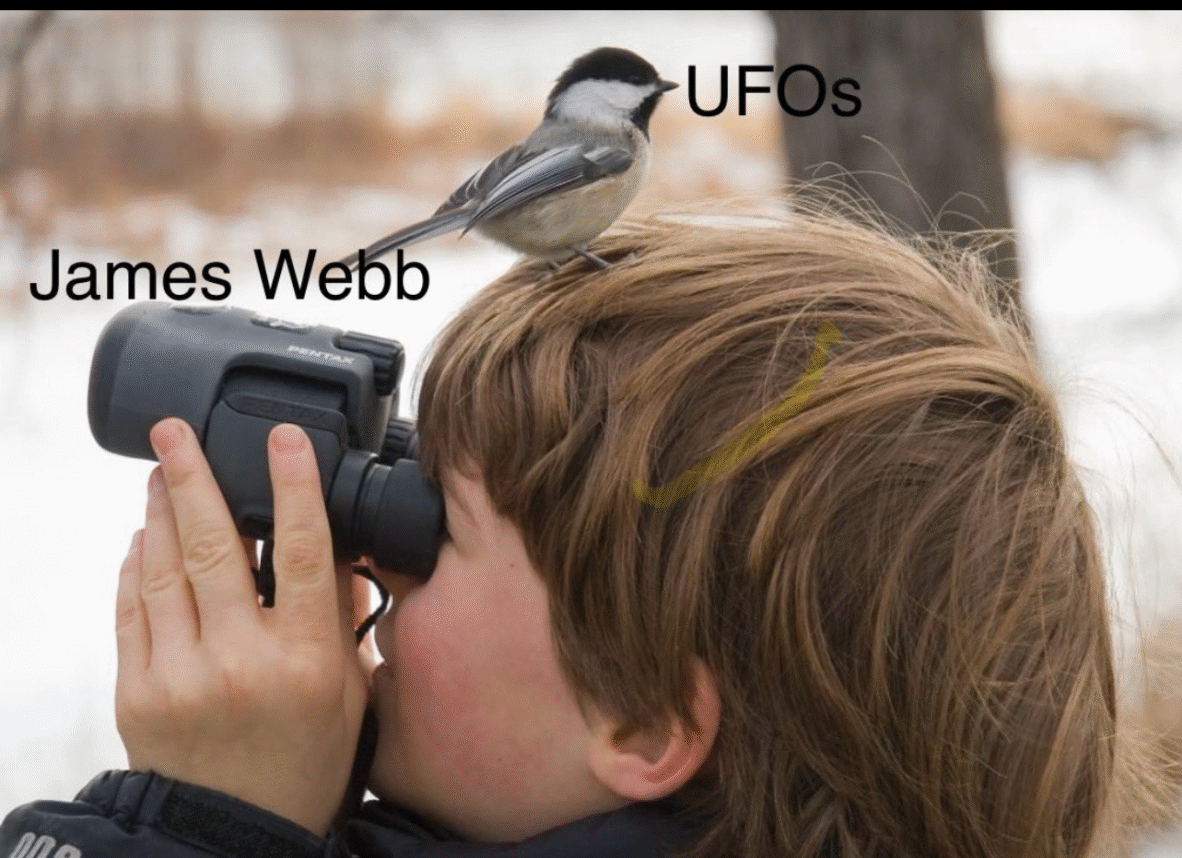
DARIO’S COMMENT: The obsession with mainstream scientists to consume public budgets to look everywhere but Earth in the search for non-human intelligence is ill-guided at best and intentionally distracting at worst.
And it reminds me of the accuracy of this meme:
But there was a more interesting revelation this week for those of you who are interested in the exopolitical beyond bland and superficial mainstream takes.
That is the late Dr. Harald Malmgren’s interview with YouTube podcaster Jesse Michels. Dr. Harald Malmgren was a senior aide to JFK, Lyndon B. Johnson, Richard Nixon, and Gerald Ford. He was also deeply involved in the Cuban Missile Crisis, witnessing events in a White House on the verge of all-out nuclear war.
But as Jesse Michels explained in the introduction – that is the least interesting thing about Dr. Malmgren. In the interview — which I’ve yet to finish — Harald explains JFK’s knowledge of UFOs, his handling of flying saucer debris, and the existence of ‘tagalongs’ — small spheres that ‘tagged along’ American nuclear missiles, among other fascinating subjects.
This is a fascinating interview. Particularly since Dr. Harald Malmgren’s iron-clad credibility combined with his work in America’s most legendary administrations furnishes this conversation with something truly rare: a first-hand account of history.
Glory to Spain,
Dario
