
Greetings subscribers,
I’m actually off on Easter school hoildays this week, but before I turn to family matters I thought I would jot down a few things to be mindful of. This is based on a mix of personal analysis and source-based insight.
— As Rabobank’s Michael Every has been saying for a while, we are now in the world of economic statecraft where conventional economic goals like higher GDP or lower inflation are a secondary objective relative to economic statecraft goals related to sovereignty and economic control of resources. If you need to spunk a bit of GDP to achieve that greater priority, so be it.
— The world’s capital markets still don’t get this and hence are applying conventional valuation logic to what is in fact a WW3 scenario in global markets.
— To ride this market you have to recognize what the end objective is. That, we think, is pretty self-explanatory. It’s a new economic order, defined by a sort of inverse Nixon shock. In this order, the US will no longer be prepared to act as a consumer of last resort. Instead it wants to take back control to engineer a distributed manufacturing norm where citizens will be empowered through the rise of an American Mittelstand. (This as opposed to all of us being dependent on the state or mega international conglomerates.) The secondary objective is recalibrating the system around a new Bretton Woods-style agreement that reins in money printing and global imbalances in general. The dawn of a new narrow banking system.
— As we’ve written before, however, to get to that world via a Mar-a-Lago agreement Trump has to get everyone around the table at Mar-a-Lago to bash out terms first. To do that, he needs leverage. This global shock therapy is the leverage.
— I had expected that, to avoid a Liz Truss moment, Bessent would have engaged in a lot of forward guidance to reduce the market impact of the tariff announcement. However, in his interview with Tucker Carlson at the weekend, he gave an important clue that this strategy had been trumped by pressure to “escalate to de-escalate”.
— This outcome leaves three possibilities in terms of what’s happening now. 1) They bungled the comms and really did replicate a Liz Truss moment [Ouch]. 2) The administration purposefully misguided the markets because their real agenda was indeed to manufacture a shock and awe moment to achieve some sort of secondary warfare objective, which is shadowy in nature. 3) They genuinely underestimated the market impact, perhaps because they didn’t appreciate the “enemy’s” readiness to engage in weaponized shorting as a strategy to try and force tariff capitulation through national embarrassment.
— If we are indeed in sneak sovereign-funded market intervention territory (whether that’s through official Treasury or cbank open market ops, dual-use hedge funds black ops or the deployment of stealth facilities like the exchange stabilization facility (ESF) or support from friendly sovereign wealth funds) then it’s a whole new type of market dynamic we are about to experience.
— Questions we might want to ponder: What are the ethics of the US front-running its own tariff announcement in a bid to accumulate a war chest of its own? Does anything go when it’s a question of economic warfare? Might pre-shorting alongside “enemy” shorts (in a green shoe style way) be a legitimate way to gain influence over the timing of any short-covering or related squeeze?
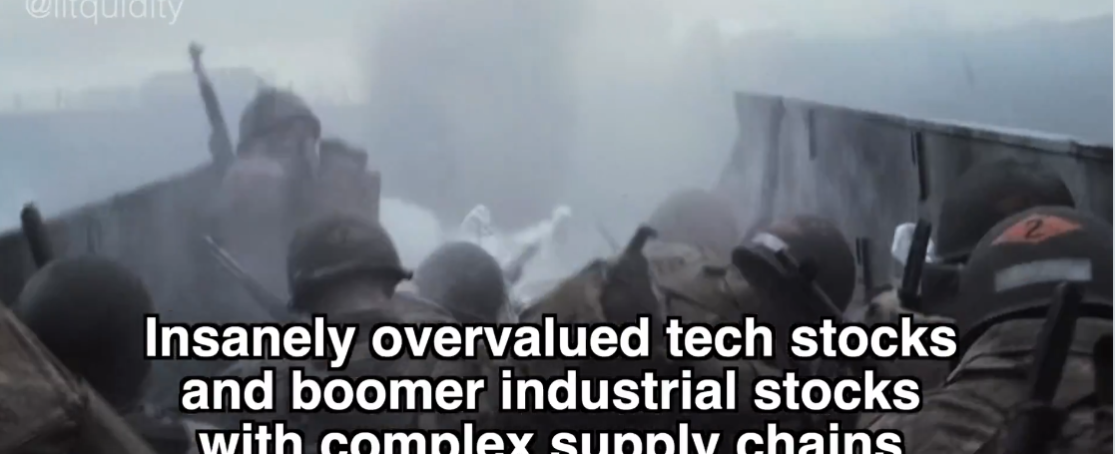
— Other questions we should be asking: What is the primary objective of T-day? Why all the “Liberation Day” wartalk? Maybe it’s a clue to look to actual D-day? This meme is already doing the rounds.

Going with this logic: the primary objective of D-day was to open a Western front on enemy territory. Could the primary objective of T-day be establishing a similar Western front in Chinese capital markets? What would that look like?
— Other things to consider: As and when the stock market war becomes a currency war in the days to come, we need to start thinking about who you would want as your General Eisenhower in evaluating if China really has the strategic reserve muscle to defend its corner?
— If the objective really is breaking the People’s Bank of China and proving the emperor has no clothes… how would the U.S. go about that?
— The trilemma says that a country cannot simultaneously maintain capital controls, manage the exchange rate and keep monetary policy independent. If the real objective is forcing Beijing into a trilemma, then by enforcing mega tariffs against China, the U.S. is forcing a reckoning. China will have to choose which of these to defend. There may be no good choices.
— More questions to ask: Has Bessent and their ilk evaluated the Chinese reserve situation vs its economic conditions and the country’s private sector dollar short position and concluded they don’t have enough muscle to defend the peg? Is he really trying to break the PBOC?
— If so, the strategy may really be all about creating enough of a shock to force China into a situation where it faces an impossible dilemma:
1) Defend the peg to prevent mass Chinese corporate defaults but sacrifice control of the reserves in the process, allowing companies to allocate the dollars as they see fit (in the first instance, paying back the dollar leverage, but eventually opening the door to an open capital account?)
2) Maintain control with a shock devaluation, but one that will cause a massive dollar squeeze that forces mass Chinese corporate defaults in the market, leading to loss of faith in the regime and/or forces the Chinese completely out of the dollar system.
If that really is the case, the real action markets should be paying attention to is not in Wall Street or Europe, it’s in China. And in this capacity which CCP faction is likely to influence matters more decisively than the other?
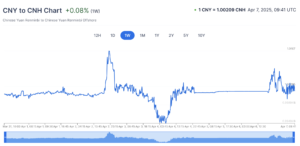
In any case, if that’s the real objective, the indicators to watch will be volatility in the CNY-CNH exchange rate:
But also indicators like this:
Digital Yuan Used for First Cross-border Oil Deal, as China’s CBDC Adoption Advances – Coinmarketcap
China Will Launch an Invasion of Taiwan In Next Few Months: Intel Sources – 1945
Charlie Gasparino says:
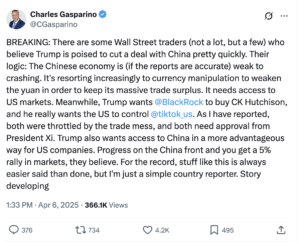 Yuan devaluation chatter grows — Bloomberg
China restricts companies from investing in U.S. — Bloomberg
Separately, if there is a dollar squeeze in China, don’t expect Beijing to be given access to a Fed swap line unless they come to Mar-a-Lago. Allies (and anyone else who is prepared to strike a deal), on the other hand, will be given plenty of access, possibly even on a term basis. Real allies might even be asked to park that liquidity in zero-coupon century bonds, meanwhile, while the Fed returns the favor by accumulating bunds to help keep the dollar weak.
That’s all from us today.

One Response