
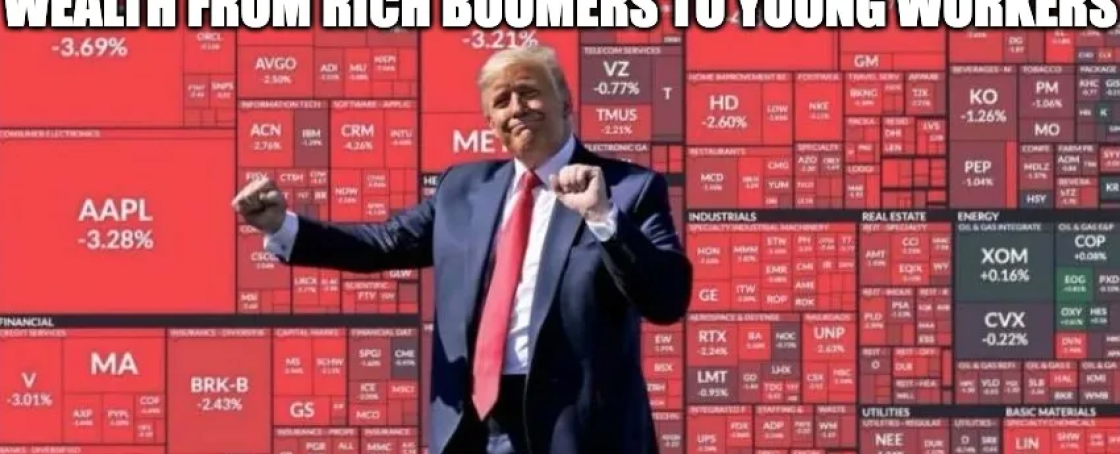
| SNEAK PEEK |
— THE ULTIMATE MAGA TARIFF Q&A: You’ve seen the mainstream take on Trumpian tariffs. We answer all your questions about the counter perspective.
— Does Trump’s pardoning of HDR Global Trading give us a hint about what they’re planning for dollar liquidity management?
— The return of MEFO bills. Oh yeah.
Good morning, subscribers!
Apologies for the lack of note last weekend. I had a fancy analysis all drafted and ready to go, but then … at the last moment, it turned out I had got my numbers wrong. As a result, I had to go back to square one. And well, it was Mother’s Day weekend, so I decided to let Dario do the heavy lifting instead.
This week, there is only one blind spot — it’s the obvious one. What is the actual logic, if any, to the Trump plan? Can it be defended? As ever, our duty here is to dispassionately analyse that alternative perspective to help you figure out what, if anything, you’re missing.
If you’re brave enough to try and understand how the other side is thinking (which, remember, includes figures like Scott Bessent, who has a track record of understanding the true national wealth of countries better than most central bankers and politicians have in the past), read ahead. Or watch the quick stream Dario and I did earlier on Friday.
That’s not to say the thinking is faultless. The point is that it is not without logic.
The real uncertainty now is whether someone like Trump, who has consistently said the same thing for 40 years, will hold his nerve on the issue or crumble like Liz Truss? What would it take? A bank collapse in time for Palm Sunday?
But speculation about upcoming betrayals and defections is likely premature. It’s worth remembering Trump’s admin is full of people with balls of steel. Bessent only doubled down when he was put under pressure to quit his Bank of England trade. Stubbornly hanging on paid off big time. Howard Lutnick, meanwhile, is a similarly gutsy street fighter. A prime example of that personality is how he navigated Cantor Fitzgerald’s recovery after 9/11. In the immediate aftermath, Cantor was in financial distress.
Lutnick vowed to keep the company alive and personally called the families of every employee who died. Most crucially, he made a controversial and bold decision:
He cut off paychecks to surviving employees who were not immediately able to work — but he publicly committed to giving 25 percent of future Cantor profits to the families of the victims for five years.
At the time, this move was savagely criticized. Many called it heartless. But it was a desperate, calculated gamble to keep the firm solvent so there would be any profits to share. He kept his word. Cantor not only survived but thrived, and over time paid out more than $180 million to the families. The firm also hired many of the victims’ relatives.
Neither of these personalities is the sort to crumble because somebody said something mean on the internet.
On the other hand, at pixel time, Israel and Vietnam were already offering to cut their tariffs to zero. The impact of that move on companies like Nike was immediate: 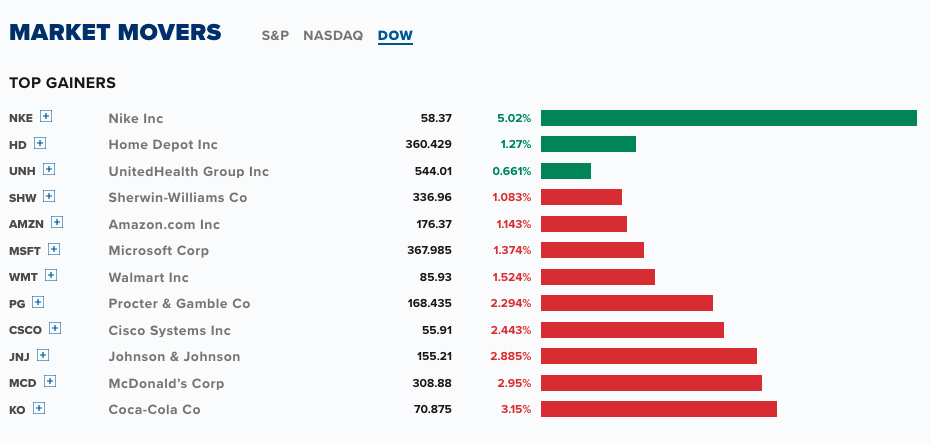
It’s a solid incentive for other impacted mega corps to take their grievances to the countries they operate out of instead of Washington.
Will the heavyweight trade counterparts follow suit? That’s harder to say. We dare say China’s face-saving culture will be an obstacle to the country backing down any time soon.
Whatever happens, the next few weeks are certainly not going to be boring.
Send tips to [email protected] and [email protected]
| THE BIG BLIND SPOT THIS WEEK |
EVERYTHING YOU WANTED TO KNOW ABOUT MAGA TARIFF LOGIC BUT WERE AFRAID TO ASK.
Q: Is Trump’s tariff plan really just chaos, or is there a strategy behind it?
Contrary to the mainstream media’s portrayal, the Trump tariff strategy is not erratic. It’s a calculated attempt to reset economic imbalances, break the power of rentier capitalism, and reinvigorate active capital ownership by the working and entrepreneurial classes. The markets were always meant to crash in a controlled demolition — that’s the Trump Dump. But that is far from the end of it. What will follow now is “art of the deal” negotiations, and then, eventually, the Trump Pump: a flood of incentives to direct fresh capital into local, productive, often decentralized enterprises to turn Main Street America around. That’s this place:
This is about wealth redistribution, but not through overt taxation. Instead, it’s a strategy that bypasses gridlocked politics and circumvents the taboo of taxing wealth directly, by undermining the market rents and valuations that conglomerates and boomer investors rely on — effectively reallocating wealth to the young, entrepreneurial class currently missing out.
Q: What is the “American Mittelstand,” and how does it relate to this?
The American Mittelstand is the end goal of the Trump strategy — a revival of local, owner-operated, community-embedded small and mid-sized businesses, akin to Germany’s renowned Mittelstand sector. It represents resilience, innovation, and tight integration with local demand.
The Trump tariffs clear the ground. But the Trump Pump comes next — lower interest rates, tax cuts, regulatory relief, and government signaling but not direct intervention to channel capital into real-economy production. No more risk-free rent-seeking.
Crucially, this capital won’t be allocated by Wall Street. It will come from a new generation of financially literate retail investors — trained over the past decade by the crypto boom. Far from being a distraction, the entire crypto space in this framing has acted as an informal simulation environment for educating the soon-to-be empowered about liquidity, risk, exchange rates, and market dynamics. The “meme stock” crowd, DeFi investors, and token traders are accidentally overqualified to assess emerging business models and local ventures.
This community is critical to the success of Trump’s “shock therapy” model. One of the biggest failings of the Russian transition in the 1990s was that ordinary people had no experience in capital markets. They were given privatization vouchers — but lacked the education to understand them. As a result, they sold them at steep discounts to opportunistic insiders, enabling the rise of the oligarch class.
That won’t happen in Trump’s grand re-privatization and decentralization of the market. The whole crypto exercise has helped to get the average retail investor reacquainted with the idea of risk and back into active investing. Thanks to years of exposure to decentralized finance, retail trading apps, meme-driven stock rallies, and even scams, today’s younger Americans understand capital flows, risk management, and how to allocate money. Soon enough — thanks to incoming service sector tax cuts — they will have the spare capital to signal where they, rather than the boomer generation, want capital to be invested.
They’ve also developed a muscle memory that positions them to become mini venture capitalists in a localized economic renaissance. The upcoming difference, if Trump holds his nerve, will be profound. More Gamestop, less FAANG. And an investment wave that will empower, not disempower, the rising class of workers and creators.
The ultimate goal? Displace rent-seeking giants with thousands of agile, community-rooted entrepreneurs, each allocating capital better than the custodians who’ve governed the last thirty years of stagnant growth and captured markets.
Is Trump actually fighting oligarchs? Or just pretending to?
He’s fighting them — just not in the way you’d expect. The Trump administration is enacting a Putin-style strategy, not of outright asset seizure, but of coercive capital repricing. Share prices of elite-aligned companies are being eviscerated, not via state nationalization, but through strategic policy shifts, deregulation, and direct market signaling.
In this model, the message to the oligarchs is similar to Putin’s famous July 2000 meeting with them: “You’ve extracted enough. You can keep a stake — but you now serve the national interest, not your own unchecked growth.”
These were the men who had profited immensely from the chaos of the 1990s — snapping up state assets for kopeks on the ruble through backdoor deals with corrupt officials and political favoritism. Ironically, they were even the ones who had picked Putin as the next head of state puppet to do their bidding. And yet, once empowered with the trappings of the Russian state and reconnected with the leftover KGB men — soon to be dubbed the “siloviki” (men of force) — who still considered themselves loyal to Mother Russia, Putin did a number on the oligarchs. Shielded by the renegade KGB faction, which saw itself as duty-bound to stop the plundering of the Commonwealth of Russia, he pulled in the oligarchs for a confrontation.
Putin’s deal was an amnesty. No re-litigation of the shady privatizations. No arrests. No seizures. But the message was clear: political influence now belonged to the Kremlin. Not to the tycoons who once pulled strings under Yeltsin.
Those who accepted the new rules kept their empires and became part of the Siloviki clan.
Those who challenged them — like Mikhail Khodorkovsky of Yukos Oil — were made examples of. Arrested. Assets stripped. Wealth redistributed to loyalists or folded into state control.
Trump’s version is: stay in the system, take a haircut on your wealth, but redirect the rest of the capital into domestic productivity, or be left behind.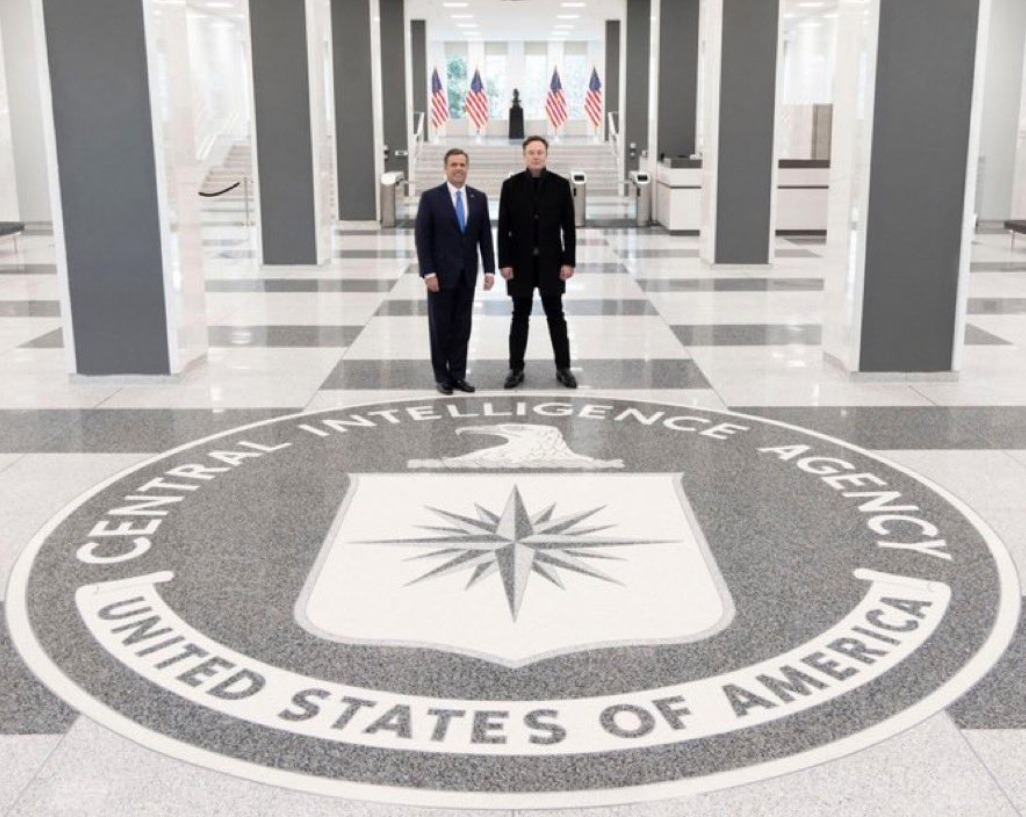
That’s a very different story, however, to the one presented by the mainstream press: that Trump, like Putin, was positioned in power by American oligarch interests to do their bidding and increase their wealth. Which narrative is correct? Well, perhaps the stock prices tell the story. Contrary to expectations, it’s been nothing but bad news for the Magic 7 companies + Tesla ever since Trump took power.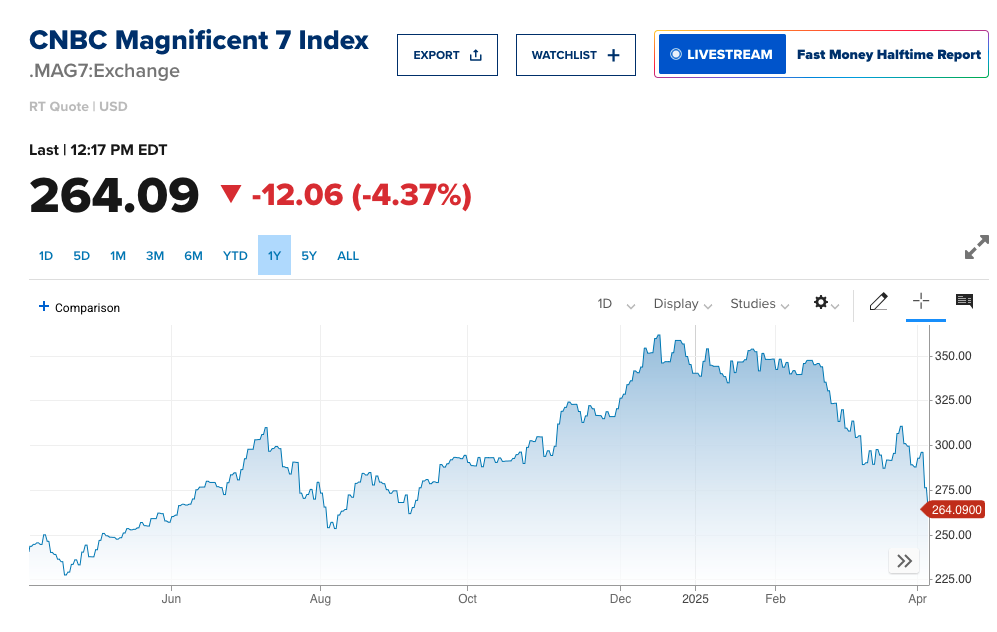
This quiet coup against financialized elites is often missed because it uses the tools of the market, not the tools of the state. But the effect is the same: decentralizing power, rebalancing wealth, and setting the stage for broad-based renewal.
Q: What is the “Pied Piper” effect, and why does it matter now?
In periods of massive economic upheaval, people instinctively look for figures of coherence — someone to follow through the noise. In post-communist Russia, that figure was Sergey Mavrodi, creator of the infamous MMM Ponzi scheme. People needed hope, direction, and a shot at redemption — and they followed him by the millions. It ended in disaster, because there was no productive vision behind the scheme — only illusion.
The Trumpian perspective is that he understands this risk. To ensure as much of MAGA as possible makes it through the chaos (and doesn’t get taken advantage of by opportunists), he is positioning himself as the chief grifter in town. But the purpose of the grift is to guide “his flock” to riches that rebuild America. Do as I do, and you will earn your stake in the system. In this “Pied Piper” process, Trump becomes the vessel of narrative coherence for a population undergoing financial and cultural dislocation. It’s not just a radical new investment wave, it’s an investment cult. Trump signals where to invest, what to build, and how to exit the rentier maze. Unlike Mavrodi, Trump is not offering magic returns, but a pathway toward economic reintegration — ownership of real things in the real world.
What’s ironic is that the pathway to riches uses the very same playbook deployed to create the ESG wave in the first place. It’s not government intervention, it’s an investor-led trend, which preaches move your money to now or else you’ll find yourself invested in the true “stranded assets”: global mega corps.
This is key. In a post-financialized, decentralizing world, narrative leadership is infrastructure. It provides cohesion where technocratic policy no longer resonates. A population trained on cynicism and memes needs someone who memetically embodies the system’s transformation. Trump does that — far more effectively than elite economists or bureaucrats ever could.
In this sense, the Trump Pump is not just economic — it’s emotional and symbolic. It gives people a narrative of redemption. It tells them the old system has failed, but they are not doomed — they are invited to rebuild. And to be masters of their own businesses.
No one is a better fit for that role. As Grand Master of The Apprentice, he embodies the vision of entrepreneurial ascension — one that prizes initiative, resilience, and proximity to real value creation.
Q: What’s with the infamous tariff chart? Is that “formula” not nonsense?
Much ridicule has been aimed at Trump’s visual formula for calculating tariffs — the one that claims to deduce a tariff rate that would eliminate a country’s bilateral trade surplus, and approach that U.S. critics such as economist Oleksandr Shepotylo and former IMF Chief Economist Olivier Blanchard have dismissed as “insane” or “stupid.”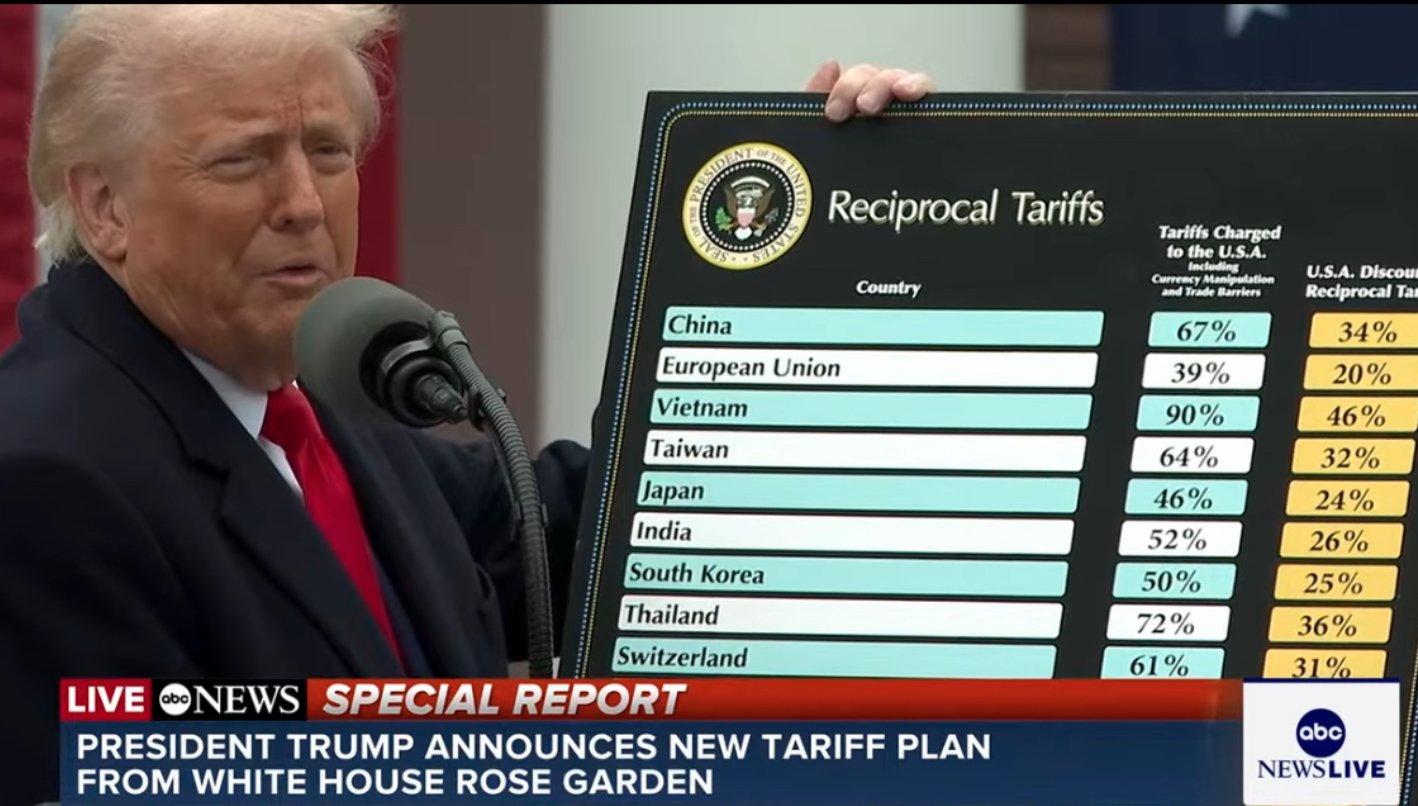
Blanchard even joked:
“Running bilateral trade surplus/deficits with different countries is the way it should be. Trying to eliminate each one is simply stupid. I have a trade deficit with my grocer, a trade surplus with my employer. I am not sure it would be a great idea for me to work for my grocer…”
This analogy is superficially clever — but economically hollow. A grocer doesn’t engage in currency manipulation, wage repression, or financial repression backed by the full force of state industrial policy. Countries like China do. So do others.
The concern is not with the existence of surpluses and deficits — they are important market feedback signals — but with the ossification of trade patterns that distort the labor market and suppress more essential or future-oriented roles. When too many people are incentivized to become “grocers” because of a persistent external surplus from, say, China, it crowds out investment in other areas—innovation, infrastructure, strategic manufacturing — and leaves the system brittle and dependent.
The chart isn’t meant to be mathematically rigorous. It’s a political heuristic — a way to impose penalty tariffs on unfair advantages that are otherwise hard to quantify.
Financial repression, state subsidies, and non-tariff barriers (like domestic capital controls, procurement biases, and discriminatory regulation) aren’t visible on a customs form. But they show up in surpluses. The chart simply flips the burden of proof: if you’re exporting far more than you’re buying, and doing so consistently, you might be gaming the system.
Rather than conducting complex investigations into every regulatory bias, the Trump formula says: “You’ve got a massive surplus. Here’s a matching tariff. If you think it’s unfair — fix your policies and bring trade into line.”
It’s a coarse instrument. But it might be the only enforceable one left in a world where multilateral trade courts are toothless and slow.
Meanwhile, the inclusion of tiny, population-less islands like Heard and McDonald Island in the Trump tariff list isn’t stupid. It is as a performative signal. It’s meant to demonstrate total coverage and zero tolerance for loopholes, rather than target those places for real economic impact.
Q: Isn’t this what Biden’s IRA was trying to do in a less disruptive way?
There’s an irony here. The Inflation Reduction Act was Biden’s version of a “non-tariff barrier”. Despite being no more or less protectionist, it was lauded as a smart industrial strategy aimed at beating China by mimicking China with subsidization. But from the Trumpian point of view, it was doubling down on the problem, not applying a cure. It didn’t kill off the negative feedback loop or reinforce capitalism — it warped it, directing capital through government-led planning, picking winners in green tech and batteries, and entrenching the power of politically connected conglomerates.
Yes, it achieved growth. But that growth was mercantilistic in nature and did nothing to redress domestic wealth inequality. The view is that IRA mostly poured funding into select sectors already dominated by large corporate interests, reinforcing the same monopolistic structures that have captured the U.S. economy. The subsidies trickled upward. Small businesses outside of favored sectors were largely left out. The distributional effects were minimal.
In contrast, Trump’s tariffs are not about copying China — they’re about resisting China-style interventionism. They use the free market’s own tools: competition, price signals, and discriminatory tariffs that respond to bad actors, rather than pre-emptively planning the economy.
The Trump model is to punish unfair practices, not subsidize around them. Instead of trying to out-China China with massive spending and planning, the idea is to ring-fence the domestic market, restore genuine competition, and allow decentralized market forces to allocate capital and risk more efficiently — especially through the growth of a resilient, small-cap Mittelstand-style economy.
Tariffs in this view are not protectionist; they are corrective mechanisms in a global system distorted by capital controls, financial repression, and monopoly.
Q: Isn’t this just nationalism or isolationism?
In the Trumpian view, not really. Anyone can be a member of the club if they’re prepared to comply with the rules and values of the “free world”. This mentality, ironically, emulates the dynamics of what the European Union was supposed to operate. A single common market, aligned around values. Countries that align with these values (strategic transparency, reciprocity, local ownership) are welcomed into a free trade ecosystem (for example, Canada and Mexico).
What’s being established is not just a new WTO, but a new type of extended federation. This time with teeth and conditionality — and an explicit security guarantee for all those who toe the line. It is not based on naive, static assumptions about frictionless globalism.
In essence, the Trumpian economic vision mimics the EU’s in-group privilege structure — a free trade zone protected by conditional entry based on internal coherence. But instead of being founded on liberal internationalism or human rights charters, it’s rooted in the founding values of the U.S. Constitution — a nationalistic but systematic order.
Q: Okay, but is the idea of balanced trade with all countries — is that really viable?
Yes — and in fact, it’s essential in the new economy. While conventional economics scoffs at the idea, it assumes a world where adjustments happen naturally. In reality, these adjustments are being strategically blocked by industrial policies and central controls in surplus nations.
If we lived in a world of free-floating labor, fair wages, and rational capital, persistent trade imbalances would self-correct. But we don’t. What we have are purposefully repressive regimes that block consumption to maintain low wages and fund state goals — often with the backing of international conglomerates.
Once the global economy transitions fully to automation and AI-driven production, these imbalances should fall away — because the primary bottlenecks will no longer be labor or logistics, but climate, natural resources, and resilience. At that point, the key trade variables will be pollution quotas, recycling capability, and preservation of finite assets like nature, cultural zones and clean water.
In this context, balancing trade isn’t madness — it’s stability. Dynamic, real-time trade balancing is essential to avoid buildup of economic “toxins” — the same way a body processes excess fat or waste. Trade policy becomes ecophysiological — responding in real time to shocks and surpluses to preserve long-term system health.
Q: Why does this involve manufacturing? Isn’t that outdated?
The Trump administration understands that in the “new economy,” manufacturing isn’t about sweatshops and scale — it’s about on-demand, automated, proximity-based production. It no longer makes sense to centralize supply chains across oceans when labor cost is being replaced by code and capital equipment. What matters now is local resilience, energy access, and demand proximity.
This is a decisive shift. Comparative advantage will no longer be about low wages or scale but about how smart your machinery is, how nimble your code is, how well your systems recycle, and how close you are to your customers. Specialization will shift from industrial mass-production to cultural strengths, resource processing efficiency, and sustainability norms.
As one commentator put it, “Too much specialism becomes unproductive if it involves needless energy expenditure over high seas.” In the post-scarcity, abundance-based “golden age” economy, proximity trumps price. Sloshing liquidity around the system is no longer enough to maintain global efficiency. In a world where the last scarcities are related to things like culture, areas of natural outstanding beauty or other social values, we will need levees to protect the liquidity and fat from coming in, or else those systems and those “commons” will get wrecked.
Q: Why dynamic tariffs? Why not just fixed protectionist measures?
The old economy had rigid tariff regimes. The new economy needs agility. These Trumpian tariffs are unlikely to be permanent — they’re dynamic levers, meant to respond to shifting imbalances. If countries reform, the tariffs can be lifted. If they regress, tariffs reimpose friction. [See Vietnam and Israel already, which have already bent the knee]
Think of them as economic immune responses — reacting to unfair trade practices or shocks (such as supply disruptions, force majeure, or environmental sabotage). They’re the feedback system in a complex, adaptive organism — designed to redistribute surplus, not entrench it.
Balanced trade — often dismissed by conventional economists as “insane” — becomes highly rational in this framework. As Oleksandr Shepotylo said: “There is no economic reason to have balanced trade with all countries.” But that logic assumes a world where capital, labor, and consumption adjust freely. In reality, mercantilist distortions, currency manipulation, and domestic repression (notably in countries like China) have made persistent imbalances the norm.
These imbalances exist not due to efficiency, but because nation states repress consumption to maintain export-led growth models — a form of engineered indentured servitude. This enables conglomerates to profit from global labor arbitrage while holding back workforce automation and domestic well-being in the surplus-producing countries.
Trump’s team is challenging this arrangement. The aim is to force rebalancing, such that trade surpluses adjust organically rather than being frozen in place for decades due to systemic asymmetries.
Q: But doesn’t Chinese prosperity and might prove the old system is sustainable?
The Chinese model has created a lot of wealth. But not without cost. And now that automation renders cheap labor obsolete and domestic consumption remains suppressed, one way or another, China faces a looming internal reckoning. The U.S. is choosing to accelerate that moment — not to provoke collapse, but to avoid it happening chaotically and without guardrails. In this framing, the tariffs are not protectionist tantrums but part of a controlled demolition of global imbalances, meant to force structural adjustment before the system cracks. Waiting would mean letting market forces unleash disorder. The lying-flat generation, the suppressed middle class, the exhausted export model — all point to a China that must rebalance or break. Trump’s plan is to make sure it happens on America’s timetable, not Beijing’s: hasten the inevitable before it manifests as geopolitical chaos.
Q: What about reciprocal tariffs from other countries? Won’t this just backfire?
Many U.S. exports — especially to China — are things China cannot easily replace or import cheaper from other locations, such as certain foodstuffs, IP-laden products, and capital goods. Retaliatory tariffs would often amount to self-inflicted wounds. Moreover, Trump appears unconcerned about tech or bank lobbyists. If Europe taxes U.S. tech in response, he’ll likely welcome it — seeing it as a rebalance of monopoly power, not a threat. The view in the Trump admin is that the whole system benefits from more competition, so the quicker Europe creates rivals to American Mag7 champions, the better for everyone. It’s the only way we prevent the rise of stateless unaccountable mega corps with powers to oppress whoever they want.
His objective is not to entrench American conglomerates, but to open the door for global competition against them — breaking their hold over Washington and global markets alike.
Q: Why use tariffs instead of just enforcing competition laws or regulating monopolies at home?
Because the breakdown in domestic market competition is often entangled with global capital flows, foreign policy asymmetries, and financialized monopolies that have outgrown national regulation. The Trump logic is that market corrections cannot happen via traditional democratic means anymore — lobbyists and entrenched rentier interests have rigged the system. Tariffs function as a workaround: a counterweight against the cross-border manipulation of trade, intellectual property, and values. Think of them as pressure points that don’t just protect, but force change.
Q: Doesn’t this hurt American consumers and workers?
It may in the short term. But that’s missing the forest for the trees. The core argument is about distribution, not just price. The system as it stood concentrated wealth into a narrow elite of passive capital beneficiaries — the “oligarchic rentier class.” The Trump tariffs are intended as a form of stealth wealth redistribution — rechanneling value back into domestic labor, manufacturing, and small capital through disruption of passive investing, outsourcing, and corporate consolidation. Sacrificing some consumer surplus to reverse decades of wage stagnation, supply chain fragility, and social decay is part of the logic.
Q: Is this just about trade, or something bigger?
Much bigger. The Trumpian tariffs are proxies for a much deeper ideological and systemic clash. They aim to confront a global system of rentierism and managed democracy, in which citizens are pacified by consumption while wealth flows to untouchable elites. Free speech, pluralism, and economic feedback loops are being choked off by transnational oligopolies and “values-neutral” platforms that are anything but. The real fight is over values — democracy, accountability, and the ability for citizens to reassert control through market and political mechanisms.
Q: What does any of this have to do with censorship and free speech?
Everything. If your trading partners suppress speech and criminalise dissent, then their citizens can’t vote out bad economic policy. This breaks the Ricardian logic of adjustment. Trump’s doctrine is that you cannot have free trade with unfree societies, because their cost structures are distorted by political repression. That’s why he views tariffs as not just economic, but moral tools — to incentivise internal reform or recalibration. In this sense, the tariffs become the US’s version of the EU’s “values conditionality” for access to the single market.
Q: Isn’t this whole agenda just disguised nationalism?
To an extent, but that’s the point. Nationalism in this framework is not about xenophobia, it’s about forcing a reset. When a global system becomes unaccountable, nationalism acts as a circuit breaker, disrupting cosy arrangements that extract wealth from local populations. The tariffs are designed to trigger creative rebalancing — a kind of protectionist reset that forces international partners to stop “fucking over” the domestic base. Once rebalanced, competition can resume, ideally on fairer terms.
Cynicism is rational when the system itself has become opaque and unaccountable. When “voting doesn’t work” because rentier elites dominate both sides, and passive capital keeps feeding monopolies, then non-linear strategies like tariffs or values-based trade become essential. The hysteria in response to these moves is itself revealing — it shows how deeply entrenched and defensive the system has become. But in places like talk radio, the mood is very different: people get it, even if the chattering classes don’t.
The tariff board spoke volumes to the MAGA base and was arguably one of the best pieces of propaganda of the modern era. Simple. Clearcut. Impactful.
Q: But the values of the Trump admin are horrific!
In reality, both sides view each other as under the spell of an equally oppressive and corrupt force, from which they should be liberated by the other. It is a form of mutual liberation syndrome.
On closer inspection, rather than upholding inherited privilege (as critics claim), Trump’s worldview — when stripped of personality — is fundamentally anti-rentier, anti-passive investing, and pro-active capital allocation by normal people.
Trumpism, in this telling, is a kind of financial punk movement — not seeking to destroy the system, but to democratize risk, smash complacent elites, and reinvigorate productive capital ownership.
Through this lens, Trump’s values aren’t neoliberal or even nationalist in the traditional sense — they’re radically meritocratic, even utopian in intent. It’s a return to risk, to sweat equity, to earned wealth. The showmanship, the populism, the aggression — they’re all performance tools in service of breaking the monopoly on capital flow and narrative control.
Trump wears the mask of the right-wing reactionary but acts like a system-smashing radical liberal, while establishment liberals wear the mask of progress but protect entrenched power structures and rentier elites.
Simultaneously, when it comes to China and the U.S. under Trump, both sides are locked in a kind of strategic mirror dance, using tariffs, supply chain realignments, and value-driven trade frameworks as tools to purge distortions and oligarchic bottlenecks from their respective systems. Trump’s approach, while theatrical and often dismissed as incoherent, channels a countercultural insurgency against the neoliberal status quo.
Both sides are forcing each other to break free from their own internal contradictions. This is not a new Cold War, but something closer to mutually enforced detoxification, a strategic mirror dance where each antagonist accelerates the other’s reckoning.
Q: Okay, but do they acknowledge any risk?
Absolutely. The whole thing is a ballsy move which has the potetnial to blow back horrendously on the MAGA base, if not cause a financial meltdown. But Trump’s remarkable consistency on these issues means his reputation is too invested in the narrative to throw in the towel. He’s been saying the same thing for 40 years. And Maga doesn’t expect him to back down any time soon.
Q: What’s the endgame?
This all points to a forthcoming Mar-a-Lago Accord — a new global settlement not unlike Bretton Woods. Its goal will be to restructure trade, capital, and ecological responsibility, possibly with crypto-based stablecoins playing a role in trade finance and offshore markets, backed by full-reserve systems rather than endless deficits.
It’s not about ending the dollar or destroying the old order — it’s about making that system fit for the age of abundance, digital resilience, and planetary constraint. But deals will have to be done, from century bonds to debt swaps. The first challenge is getting everyone around the table?
Q: I thought the Mar-a-Lago Accord was a dollar currency pact?
That was an assumption projected by the mainstream media. In reality, Steve Miran has stressed, it’s more about a new grand bargain that will consider a suite of different options to help reset the system for the new era. In that sense it will resemble something closer to Bretton Woods.
That’s not to say the outcome won’t be a weaker dollar — which is seen as beneficial by the Trump admin. As noted by @barchart on March 22, the dollar has been trading at its highest valuation since the 1985 Plaza Accord: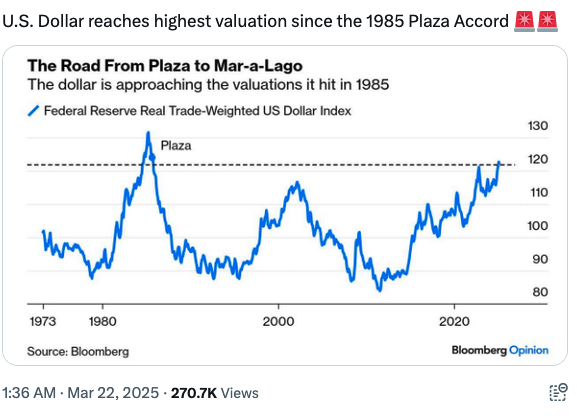
| BUSINESS, ECON AND FINANCE |
ORACLE IS DOGED: The US Department of Defense said it would terminate a plan to use Oracle software to manage its civilian workforce as part of the Pentagon’s cost-cutting efforts. What was supposed to be a $75 million game-changing system for managing 900,000 civilian employees turned into a six-year headache, running $280 million over budget. (H/T @unusual_whales)
STABLECOIN NEWS: It’s well known that large stablecoins like Tether are huge buyers of Tbills and USTs. But did you know they are also big buyers of tokenized MMFs that are respectively invested in Tbills and USTs? Yep, it was news to us as well. But as one industry source with links to Tether told us this week, apparently it is true.
BitMEX FOUNDERS PARDONED: The press made a big deal this week of Trump pardoning a corporation, HDR Global Trading, along with pardons for its co-founders — Arthur Hayes, Benjamin Delo, and Samuel Reed — as well as former employee Gregory Dwyer.
Although the Constitution allows for corporate pardons, they are extremely rare, and this move likely reflects a deliberate effort to remove legal and regulatory obstacles that would otherwise prevent HDR from re-engaging with U.S. financial markets.
So why might this have been done? We’ve mentioned before many times that Ben Delo is the inventor of one of the smartest financial instruments of the past decade, the perpetual future/swap. This could be an important tool for managing dollar liquidity in a decentralised stablecoin system.
But a criminal conviction for a corporation like HDR carries significant consequences. It can bar the company from obtaining licenses from federal and state regulators, complicate access to capital, and exclude it from participating in public contracts or future digital infrastructure projects. It also triggers red flags in mergers, acquisitions, and intellectual property licensing, especially when dealing with entities in sensitive industries such as finance or national security.
In HDR’s case, if the company holds proprietary technologies that could be valuable to the United States as it navigates the future of digital finance, it would make a lot of sense to pardon the corporate entity as well as the founders.
| EVERYONE’S A NAZI |
DISINFO WATCH: American businessman and Democratic governor of Illinois J.B, Pritzker (who hails from the Hyatt family), asserted this week that “In January, Elon proudly gave a Nazi salute. Yesterday, Rep. Self quoted Joseph Goebbels, chief Nazi propaganda minister, on the House floor. They know what they’re doing.” He linked to this clip to substantiate the point. The quote in question by Keith Self was “It is the absolute right of the state to supervise the formation of public opinion’, and I think that may be what we’re discussing here.”
Small irony: There’s only one problem. This itself was disinformation. The soundbite was selectively edited to misrepresent Self, who — in the context of a hearing on the industrial censorship complex — was drawing on the quote to illustrate that the Biden era was using the same argument as Goebbels to justify their attempts to constrain free speech on platforms like X and Facebook. The democrat defense, similar to the European defense, is that it is a public and government duty to make sure that these platforms are “safe” and free of “disinformation” (as subjectively determined by the authorities themselves).
Self, on the other hand, has consistently positioned himself as a staunch advocate for free speech and an opponent of censorship, expressing concerns about governmental overreach in regulating speech and has taken legislative actions to address these issues.
OFF THE BOOKS FINANCING FOR ARMS: Politico reported this week that British officials met select European allies at a discreet dinner in Brussels last week to hatch plans for a new defense fund designed to sidestep the European Commission, keep a lid on public debt and rearm faster.
The off-the-books gathering brought together senior finance ministry officials from Sweden, Denmark, Finland, Poland, the Netherlands, and the United Kingdom to float the idea of creating a supranational bank specifically for the purpose of jointly buying weapons and slashing the cost of defense procurement, according to officials familiar with the matter.
At the center of the pitch was a proposal from the U.K. Treasury, detailed in a discussion paper seen by POLITICO, that would allow participating governments to avoid booking the upfront capital cost of military kit in their national budget, which would be of huge benefit to countries with tight spending rules.
MEFO bill redux? Hat tip to Rabobank’s Michael Every for reminding me that the “off the books” funding for arms tactic was first popularized and perfected by, err, the Nazis in the 1930s. The tool used was known as a MEFO bill, which stands for Metallurgische Forschungsgesellschaft (a dummy company). The bills were a form of off-balance-sheet IOU backed by the Reichsbank, allowing massive off-budget spending, especially on military buildup, without officially increasing public debt.
| WHAT WE’RE PROCESSING |
— ICYMI, the U.S. has paused financial contributions to WTO, as of last week. (Further hinting that Trump’s real ambition is to create a new free trade club.)
— Fed has been urged to explore a hedge fund bailout tool for basis trade exposure.
— Scott Bessent sits down with Tucker Carlson and tells him “he believes it’s going to work” and has “a high confidence ratio it’s going to work”. He also explains how he visited food banks to do his research for the shock therapy he is now dispensing.
— Estate agents in China are trying everything to sell flats. Including pretending to be girlfriends.
— Trump says Doge found something today that is horrible and that “you will find out very soon. What they found is incredible.”
— BURYING BAD CHINA NEWS: Fitch downgraded China to A from A+ on Thursday, but nobody noticed. “The downgrade reflects our expectations of a continued weakening of China’s public finances and a rapidly rising public debt trajectory during the country’s economic transition. In our view, sustained fiscal stimulus will be deployed to support growth, amid subdued domestic demand, rising tariffs and deflationary pressures. This support, along with a structural erosion in the revenue base, will likely keep fiscal deficits high.”
— America’s ‘DeepSeek’ moment has arrived via a Peter Thiel-backed nonprofit.
— Civil servants in Vietnam are running scared. Like their counterparts in the U.S., tens of thousands have woken up to notifications that their positions have been abolished.
One Response