

| SNEAK PEEK |
— Still struggling to understand what the great Trumpian economic restructuring is all about? Think reverse ESG.
— It’s not a tariff on money. It’s Regulation Q in reverse.
— We ask what role private military contractors will play in a Ukraine peace deal
Happy Saturday subscribers!
We’ve spent some time this week explaining why the growing refrain that Europe is engaging in military Keynesianism is not accurate. While a secret economic agenda may indeed be influencing Europe’s turn towards warhawkism, it has much more to do with suppressing rather than stimulating demand to generate growth.
We think the better moniker is “military Thatcherism” in ode to the cunning way Britain’s first female Prime Minister exploited a skirmish over the Falklands to distract from a radical restructuring agenda at home, centered on brutal cuts to the welfare state and an aggressive deregulation agenda.
The weak point in the argument, of course, is that while Thatcher’s restructuring was aimed at liberalizing the economy and unleashing financialized globalization, the current wave of militarized restructuring — what U.K. Chancellor Rachel Reeves long ago dubbed “securonomics” — has the effect of deglobalizing and definancializing the economy thanks to its strategic autonomy objectives. In its place it asserts industrial policy and financial repression. So maybe the better name is “Thatcherism in reverse”.
Either way, last September we warned that the securonomics climate would soon pave the way for Western capital controls more broadly. Now the FT’s Gillian Tett is making a similar argument, albeit in the context of a tax potentially being imposed on capital inflows into the U.S. to curb the excessive hollowing out of America’s industrial base.
Such a tax would amount to the imposition of a two-tier interest rate return for U.S. debt, one for domestic holders and another discriminatory one for foreign holders. What Gillian misses is that if this were to happen it would be an echo of the two-tier rate system that fanned the great Eurodollar explosion of the 60s and 70s, which drove the internationalization of the dollar in the first place. The difference is that the original “regulation Q” capped interest rates for domestic bearers, pushing capital abroad, whereas this — by taxing foreign holders — would presumably have the opposite effect.
Though what Gillian calls Trump’s assault on free trade we still feel is a mischaracterization. As we’ve argued before, the strategy is more akin to shielding America from predatory and mercantilistic counterparties that currently do not respect a common trade rulebook, while the administration does what it has to do to re-liberlize the domestic economy. The intention isn’t to stifle free trade. It’s to ensure the necessary shock therapy isn’t exploited by opportunists who then quit the country — taking their wealth with them — much like what happened in Russia in the 1990s.
Once restructured, however, these tariff walls will come down and America will once again be open for business with anyone prepared to operate according to the new “positive sum” rules of the game it asserts. Notably, we think those rules will be established via the Mar-a-Lago Accord, and will target both a weak dollar rule and a new collective clearing mechanism around bitcoin to keep everyone in check.
Food for thought in any case. That’s all for now. Enjoy the rest of the newsletter.
Izzy.
Send tips to [email protected] and [email protected].
| THE BIG BLIND SPOT THIS WEEK |
THE GREAT STOCK ROTATION: FROM FAANG TO MAGA STOCKS. Last week we warned of an incoming stock-market correction as President Trump and Treasury Secretary Scott Bessent moved to implement the first part of their grand strategy to restructure the U.S. economy. This involved sending a strong signal, by way of tariff talk, that it no longer pays to invest in stocks that don’t put “America First”.
We also warned it wouldn’t be worth panicking over, as the point of the exercise was to send the message that “Tariff talk” now trumps “Fed talk” when it comes to rentier return expectations.
That prediction held up pretty well. By the close of business on Friday, global stock markets had largely recovered from a bruising week — albeit with the S&P index down more than 10 percent from its 19 February peak.
But that grander correction, again, is part of the plan — something the dorks that occupy the darkest corners of the internet seem to understand better than most of the so-called finance professionals who occupy mainstream media. Below is one particularly well articulated explainer for the benefit of “the retards in the back” by the aforementioned dorks.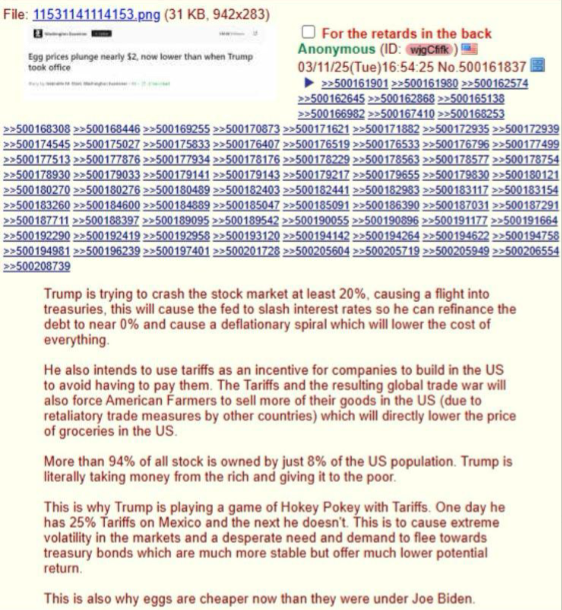
A debate can certainly be had over whether the strategy will work, and we’re not necessarily arguing that it will. But that’s not the same as pronouncing there is no strategy at all or that what the administration is doing is totally nuts. There is a strategy, many just choose not to see it.
COMMENT — Still struggling? Consider it reverse ESG: A popular refrain from those who finally come to understand the “common prosperity” objective at play is that this means Trump’s plan is even worse than they thought. “It’s not just crazy, it’s communism,” as one commenter told me.
But while we agree that targeting a wealth transfer can be construed as interventionist, we think it’s disingenuous to call it communism — not least because the intervention didn’t start with Trump. It started with American secret industrial policy and ESG. The Trump administration, if anything, sees its current policy as an attempt to return the wealth unceremoniously stolen from working Americans via the pernicious mind-hacking of the investment managers who were supposed to be responsible for protecting America’s social wealth. And there is logic to this argument.
For years, capital markets have been subjected to a quiet but profound transformation under the guise of Environmental, Social, and Governance investing. This shift, driven by institutional mandates, corporate activism, and regulatory pressure, systematically altered the flow of capital, privileging certain industries while quietly sidelining others — something that most investment managers went along with without question because of it being “the done thing”.
Even though ESG, as a form of economic interventionism, was supposedly “market led” and not government directed, in practice it was not. In practice, it was an exercise in social engineering by supranational global organizations like the UN and civil society organizations — utilizing lobbying and pressure groups — to direct investment away from legacy industries and towards sectors deemed aligned with broader ideological goals. Fossil fuel companies, for instance, were reclassified as stranded assets, their valuations undermined by a financial ecosystem determined to reshape the economy according to a particular vision of the future.
The result was a highly sophisticated manipulation of global markets to serve the agendas of supranational and international institutions, manifesting in one of the most coordinated and sophisticated market pumps of all time. The resulting bubble even fed on itself thanks to the propagation of an ingenious argument: that investors couldn’t afford to stay invested in fossil fuel and other strategic assets because they would soon become “stranded”. That the narrative often didn’t square with fundamental reality mattered not. Nor did it go observed that the ESG agenda was inadvertently transferring power and wealth away from the West and over to challenger markets like China, whose own investment houses remained committed to “common prosperity” more so than ESG.
The pension system, which plays an outsized role in directing investment, largely followed this logic, prioritizing short-term gains over long-term national prosperity. Yet, in doing so, it soon exposed itself to a fundamental contradiction: returns on investment ultimately depend on a thriving domestic economy, one that supports consumer demand, generates stable employment, and sustains public services. A financial system that exclusively rewards capital while suppressing labor’s share of economic returns is, in the long run, self-defeating.
The current effort to reorient American capital flows therefore isn’t nuts or even coercive. It’s an attempt to unwind these forces by promoting a different narrative to investment managers.
Rather than engineering a financial system that penalizes domestic production while rewarding firms that outsource labor to low-wage economies, the objective this time round is to unwind the distortions that have entrenched dependency on foreign supply chains and eroded the industrial base. This is not a new form of state control over markets but rather a necessary correction to a system that has, for decades, been subtly skewed in favor of financial interests that extract value rather than build it.
Not that there won’t be outrage about the policy.
No more boomer privilege: The notion that pensioners and passive index-fund investors are entitled to uninterrupted gains, regardless of whether their capital supports sustainable economic structures, is a strongly held view in many quarters. In reality, this presumption is erroneous. Returns are not guaranteed in a system that is unsustainable. In this light, the emerging policy shift should not be seen as radical. If anything, it is a pragmatic attempt to reorient financial markets toward long-term national interest — much in the same way ESG sought to enforce a vision of corporate responsibility (but failed!). And if pension managers read the signals well, and respond quickly to the rotation, there’s no reason why pensioners should lose out in the long term.
Globalist conglomerates as stranded assets: If we consider that over the past two decades investment managers have wilfully engaged in a self-serving market manipulation, that — via shrewd lobbying, marketing and propaganda — purposefully cultivated a hysterical mania over ESG stocks we can see why the Trump administration may be keen to engineer an equally audacious “pump” to draw the lost capital back.
Therefore, if ESG saw capital funneled into corporations that optimize profit through labor arbitrage, moving production offshore to exploit cheaper workforces while leaving domestic labor markets hollowed out, expect the MAGA pump to do the opposite.
Aiming for “common prosperity”: American pension funds and institutional investors are thus being given a choice: continue directing capital towards companies that outsource production and rely on cheap foreign labor, or reallocate towards firms that contribute to the rebuilding of domestic industry. Those that persist in the former will face financial headwinds, much as ESG policies have imposed similar constraints on companies deemed misaligned with progressive corporate governance objectives. Those that pick up on the trend, will profit from recalibrating capital markets to favor domestic production, and reshoring, with the end goal of ensuring that investment decisions reinforce rather than undermine national economic health.
Despite the breathless criticism, the irony is that the exact same trend is being picked up in most Western economies, albeit using different narrative structures.
But this is not an attack on free markets. It is a recognition that markets have never operated in a vacuum. The rules of capital allocation have always been shaped by external forces — be it regulatory regimes, tax incentives, or the political priorities of those who set investment standards. For decades, Western financial institutions have willingly subjected themselves to the economic statecraft of foreign nations, allowing access to cheap manufacturing bases while failing to secure the long-term sustainability of their own economies. The resulting system has been one in which pensioners and investors have benefited from the short-term returns of globalization, while domestic workers — many of whom lack retirement savings or healthcare — have borne the costs.
Now, the imbalance is being addressed. Capital must serve broader national objectives, not just quarterly earnings reports. In America, under Trump, that won’t mean confiscation, overt financial repression nor an abandonment of market principles. Rather, it will result in an ESG-style propaganda effort to convince investors to voluntarily subscribe to the “new agenda” by shamelessly doing what the President and his family do with their stock portfolios. They will be America’s guides. Voluntary engagement will be key to the formula. [Not necessarily the case in Europe, due to the lack of a similarly engaged retail investing market.]
Even so, a backlash to Bessent’s policies is predictable, as any challenge to entrenched financial interests always provokes resistance.
The retort, nonetheless, will be clear: no economy can function indefinitely if it systematically disadvantages its own workers while enriching a narrow class of financial intermediaries. The age of capital supremacy over labor is ending. The question is not whether this transition will happen, but how smoothly it can be managed. The alternative—continued capital flight, social instability, and a system that relies on increasingly fragile global supply chains—is far less sustainable.
WHY IT MATTERS? If you want to make money from the upcoming restructuring, follow the US president’s son. It’s arguably the most straightforward “copy trade” in town. As the FT noted this week, Don Jr. has very conspicuously aligned himself with a small but well-connected group of financiers who are not just betting on the success of Trump’s America but actively shaping it. Their investments span industries that stand to benefit most from the president’s vision — finance, media, pharmaceuticals, firearms, crypto, betting, and alcohol — all sectors poised to ride the MAGA wave.
The profit-making buy signal couldn’t be clearer. Even the FT gets it. “This means companies that promote environmental, social and governance (ESG) or diversity, equity and inclusion (DEI) are out, and investments based on “entrepreneurship, innovation and growth are in,” as the pink ‘un noted.
Critics will call it a shameless grift. But defenders will increasingly argue that the “Trump pump” is the ultimate skin-in-the-game maneuver for the CEO of America Inc — no different to CEOs and VCs holding stakes in the companies they operate and back.
Remember, in venture capital, carried interest ensures that fund managers have real “skin in the game.” They only make substantial profits if their portfolio companies succeed, aligning their incentives with those of their investors and the startups they back. This structure is meant to discourage short-term profit-seeking in favor of long-term value creation.
In a system where political actors often use their legislative foreknowledge to quietly trade for personal gain — think Nancy Pelosi’s well-timed portfolio moves — at least the Trump family’s financial stakes are transparently aligned with their political agenda.
Their wealth is now tied directly to the policies they promote, not just backroom deals or regulatory arbitrage. If their vision for America fails, their investments suffer too. In a weird way, this is a more honest form of political capitalism, where the ruling family isn’t just cashing in on private whispers from Capitol Hill but putting their own money behind the policies they claim will drive national prosperity.
Love it or hate it, that’s a rare kind of accountability in American politics. It’s a high-risk, high-reward VC play where the success of the political project determines financial returns.
| BUSINESS, ECON AND FINANCE |
LITTLE APPRECIATED FACTS ABOUT U.S. TREASURY SECRETARY SCOTT BESSENT: When a young portfolio manager at Soros Fund Management, Bessent played a significant role in the fund’s infamous 1992 “breaking the Bank of England” trade. According to reports, this included conducting critical research into the British housing market and identifying a vulnerability due to widespread variable-rate mortgages. This insight eventually helped convince Stanley Druckenmiller, Soros’s top deputy, to pursue the trade.
In the end, Soros’s fund amassed a $10 billion short position against the pound, betting it was overvalued within the European Exchange Rate Mechanism (ERM). When the Bank of England failed to sustain the currency — despite raising interest rates to 15 percent and spending billions in reserves — the pound crashed, exiting the ERM. The trade netted Soros’s fund over $1 billion in profits, with Bessent’s analysis and advocacy being key to its success.
While Soros is widely credited as the mastermind and public face of the operation, Bessent’s involvement is well-documented by former colleagues and financial historians. For instance, Robert Johnson, a managing director at Soros Fund Management at the time, has highlighted Bessent’s role alongside Soros and Druckenmiller in acting decisively on the macroeconomic opportunity. Bessent’s contribution was not just analytical; during the trade’s climax, he reportedly pushed the team to increase their position, amplifying the impact.
Something those claiming Bessent’s policies are idiotic should bear in mind. If anyone knows how to defend a currency regime, it’s someone who broke one already.
GDPR ON SIMPLIFICATION HIT LIST: The great “simplifcation” deregulation drive continues in Europe. Politico’s cyber team reports that data protection Commissioner Michael McGrath has confirmed that the EU’s General Data Protection Regulation is in line for a pruning, and will be simplified to ease reporting burdens on small businesses. The bloc’s data protection rules are hailed as one of the best examples of the Brussels effect, that raised the bar for privacy globally — but the reporting burden that the GDPR creates for smaller companies is something that people on all sides of the debate agree needs changing.
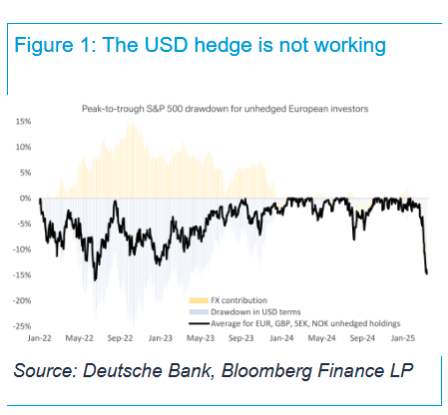
THE USD HEDGE IS NOT WORKING: Deutsche Bank’s George Saravelos drew attention on Friday to the fact that European investors are currently losing as much money on their S&P 500 holdings as they did during the 30 percent inflation-driven sell-off in 2022. This, he says, is because despite the drop in equities, the dollar has failed to rally. But as Blind Spot readers now know, this is all part of the Bessent strategy.
| POLITICS |
LOVE IS IN THE AIR: NATO Secretary-General Mark Rutte is turning into quite the peace-maker and antidote to anti-Americanism in Europe. In an interview with Bloomberg on Friday, Rutte said Europe and the United States should eventually normalize relations with Russia once the fighting in Ukraine ends. “It’s normal if the war would have stopped for Europe somehow, step by step, and also for the U.S., step by step, to restore normal relations with Russia,” Rutte said.
However, the defense chief added that the alliance must keep up the pressure on Moscow to ensure they engage seriously in ongoing ceasefire negotiations, according to POLITICO.
“We are absolutely not there yet,” he said, referring to any normalization of relations. “That’s why we have the sanctions. Let’s not be naive about the Russians. But in the longer term, Russia is there, and Russia will not go away.” Rutte’s statement comes a day after he met with U.S. President Donald Trump at the White House, where the two discussed the U.S.’s plan for a ceasefire in Ukraine, more than three years since Russia launched its full-scale invasion.
Nonetheless, it’s as strong a signal as you can get that not everyone within the NATO alliance thinks that America should be considered an enemy just because it’s trying to normalize Russian relations.
SECURITY CLEARANCE REVENGE: Trump’s bid to dispossess law firm Perkins Coie of its security clearances has hit a judicial block. On March 12, U.S. District Judge Beryl Howell banned the Trump administration from enforcing the executive order targeting Perkins Coie. Howell said the “retaliatory animus” of Trump’s order is “clear on its face” and appears to violate constitutional restrictions on “viewpoint discrimination,” according to POLITICO.
His vendetta against the firm stems from the fact that Perkins Coie is said to have played a key role in facilitating the infamous “Steele Dossier” which helped fan the “Russiagate” narrative, which undermined President Donald Trump’s original term in office. Specifically, the firm hired Fusion GPS, a research outfit, which in turn commissioned former British intelligence officer Christopher Steele to compile what became known as the Steele Dossier.
On March 6, 2025, Trump signed an executive order titled “Addressing Risks from Perkins Coie LLP” explicitly targeting the firm’s security clearances as a punitive measure as a result, arguing the suspension was within the president’s broad authority to control access to classified information.
These clearances are particularly vital for the firm’s work with aerospace and defense companies, as well as in cases involving cybersecurity or foreign influence — areas where classified briefings or documents are often required. According to Perkins Coie’s lawsuit filed on March 11, 2025, roughly 25 percent of its business relies on government-related engagements, much of which hinges on attorneys maintaining active clearances to perform their duties effectively.
Everything to fight for: Without clearances, Perkins Coie attorneys cannot participate in legal proceedings involving classified evidence, advise clients on compliance with national security regulations, or represent individuals or entities in investigations where sensitive information is at play.
On March 12, however, U.S. District Judge Beryl Howell blocked the Trump administration from enforcing the executive order targeting Perkins Coie. Howell said the “retaliatory animus” of Trump’s order is “clear on its face” and appears to violate constitutional restrictions on “viewpoint discrimination,” according to POLITICO.
Why it matters: Losing security clearances doesn’t just hinder Perkins Coie’s government-related practice; it signals to other firms and clients that opposing Trump could jeopardize their own access to classified work, creating a deterrent effect. For Perkins Coie, the clearances are a practical necessity — without them, entire practice areas could collapse, as the firm detailed in its lawsuit with examples of canceled meetings and client losses. The administration, meanwhile, uses the clearances as leverage to portray the firm as untrustworthy, aligning with Trump’s narrative of punishing “deep state” actors.
| GEOPOLITICS |
WHAT’S THE MINERAL DEAL REALLY ABOUT? A couple of weeks ago we highlighted Javier Blas’ work at Bloomberg arguing that America’s pursuit of a $300 billion mineral deal with Ukraine makes no sense because even though U.S. President Donald Trump seems convinced Ukraine boasts a rich supply of rare earths, in reality there aren’t any minerals there at all. Certainly not $300 billion worth.
So what could be behind Trump’s compulsion to secure access to Ukraine’s rare earth minerals and other critical resources as a condition for continued U.S. support? The official explanation is that the deal provides America with Ukrainian business interests which offset the substantial aid that has been delivered to the country by the U.S. thus far, and provides Washington with a form of “security”, ensuring that American investment in Ukraine yields tangible returns. But perhaps there’s another overlooked element to the deal too?
**Speculation alert** There’s something uncannily familiar about purposefully overvalued commodity assets and potentially fake business interests tied to U.S. Presidents in Ukraine.
Remember Burisma? That’s the Ukrainian natural gas company founded by oligarch Mykola Zlochevsky, which became a focal point due to Hunter Biden’s appointment to its board in April 2014 shortly after the revolution.
Readers might be familiar with the allegation that Burisma, rather than being a viable natgas company, was really more of a vehicle for American interests to secure influence in Ukraine post-regime change. Joe Biden’s push for the firing of Ukrainian Prosecutor General Viktor Shokin in 2015, who was investigating Burisma, is often cited as evidence of a quid pro quo to protect American (and Biden family) interests affiliated with the company. The whole affair led to the first attempt to impeach Trump.
But some narratives propose that Burisma was really backed by U.S. entities engaged in a broader strategy of economic warfare against Russia. While the theory lacks direct evidence, it ties into U.S. support at the time for Ukraine’s pivot away from Russian energy reliance. Some also speculate that Chinese cash flowed into Ukraine to secure resources or influence, possibly via oligarchs or companies like Burisma.
So what sort of influence might $300 billion of interests secure this time round?
Well, while European allies have been planning for the possibility of raising a coalition of the willing to defend and guarantee the peace in Ukraine if a ceasefire deal with Russia is reached, thus far, Russia has consistently opposed any NATO-affiliated force. At the time of publication, there was no official agreement on whether European peace-keeping troops, if any, would be deployed to Ukraine to secure a potential cease-fire agreement. However, even if Moscow would agree, many European countries have indicated that they would only send troops to Ukraine if there was an “American backstop”, reports Radio Free Europe.
Trump has so far been reluctant to provide that. Is that because he knows Putin’s real preference is for the peace to be secured not by official U.S. troops, with loyalties to NATO, but by U.S. private military contractors like Blackwater whose loyalties can be bought?
Perhaps this is where the focus on mineral rights comes into play. The deal could serve as a convenient pretext for deploying contractors whom Putin trusts, operating under the guise of business ventures exploiting Ukraine’s natural resources — especially since most of the alleged deposits are to be found in the contested eastern regions.
Two key developments lend credence to this theory. First, Erik Prince, the world’s most notorious soldier of fortune and founder of Blackwater, launched a rare earth metals investment fund in 2019, as if poised for operations in rare-earth rich geographies.
Second, Prince was hatching plans as early as 2021 to hire Ukraine’s combat veterans of the war in Eastern Ukraine for a private military company, with a view to creating a vertically integrated aviation defense consortium that could bring $10 billion in revenues and investment. Notably, reports suggest he was working alongside two individuals with ties to Russia to advance this initiative.
Adding another layer to the intrigue, Prince revealed in a 2022 interview on The Shawn Ryan Show that the Russian Federation had invited him to Moscow in 2011, requesting that he help establish “a Blackwater capability” inside Russia.
| CRYPTO |
TETHER IN THE U.S.A. The Bitcoin Policy Institute’s gathering last week drew none other than Tether CEO Paolo Ardoino to the U.S. This, he said, was his first time in the United States. Given the stablecoin provider has been treated with regulatory scrutiny over concerns about its reserves and a lack of transparency up until now, his presence in America definitely signals a regulatory mood shift.
TRUMP’S BINANCE PLAY: The WSJ reported this week that representatives of President Trump’s family have held talks to take a financial stake in the U.S. arm of crypto exchange Binance, a move that would put Trump in business with the firm that pleaded guilty in 2023 to violating anti-money-laundering requirements. Binance’s billionaire founder, Changpeng Zhao — who served four months in prison after pleading guilty to violating anti-money-laundering requirements, is apparently simultaneously pushing the Trump administration for a pardon.
Shameless grift or something else? The WSJ says “a stake in Binance.US would also be a striking expansion of the family’s cryptocurrency endeavors as Trump signs a series of executive orders that benefit the industry”. Our crypto sources say the new Trump mafia is merely establishing dominance over Asian mafia franchises and sending a signal because all global statecraft is now based on Sopranos doctrine.
| WHAT WE’RE PROCESSING |
— Canada’s government moved to bolster its foreign reserves by issuing a $13.5 billion U.S. dollar global bond.
— Boomers living off of an inflated stock market, completely untethered from the real economy, for the last 15 years.
— Canadian governments fail to stop money laundering because they want the cash, says law prof.
— France is preparing for a future where America is the enemy by parking a nuclear-armed submarine off the coast of Halifax.
— Crispin Odey made a courtroom visit to Staley case over Epstein ties.
— Crisis in the art market.
— The return of Erik Prince: How a notorious military contractor maneuvered his way back inside Trump’s orbit.
— German spy agency ‘believed Covid likely started in lab’ as far back as 2020. But then Chancellor, Angela Merkel, supposedly ‘buried the findings’.
— Niall Ferguson’s speech to the ARC Conference, where he invokes his “we are the soviets” piece and argues any great power that spends more on its interest payments than its defense will not be great for long. 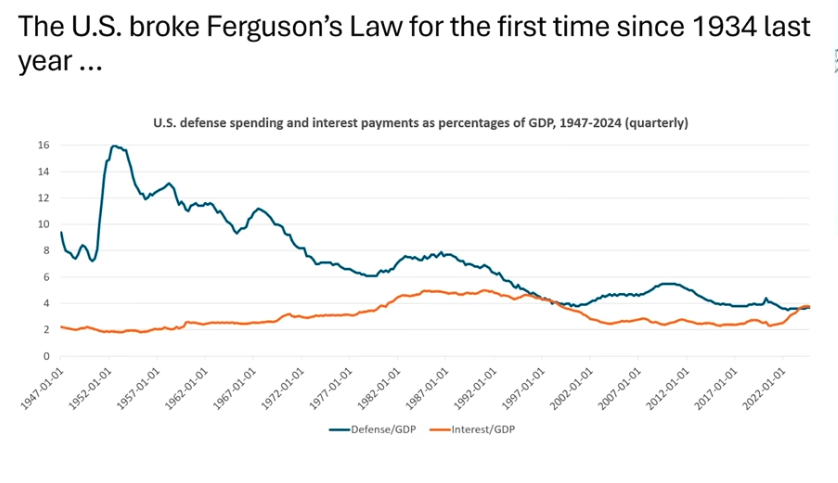

2 Responses
I was hoping you might be more specific as to what stocks the Trumps are actually buying rather than just posting a link to the FT.
Otherwise interesting
Well, I think generally defensive cyclicals with vertical supply chains. It’s not quite yet clear. I think some of these companies will be spearheaded from scratch to be honest.