
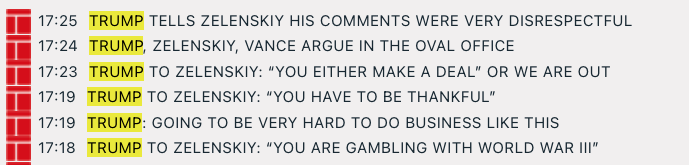
RUSSIAN ASSET SEIZURE REDUX, BILL BROWDER EDITION. At the time of writing, Trump’s meeting with Zelensky was generating a quick-fire blast of news flashes resembling a crudely executed 80s TV drama:
A few hours later … Well, it looks like a Trump-brokered peace deal with Putin is fully off the table. As is any deal encompassing access to Ukrainian rare earths (which, fascinatingly, according to Bloomberg’s Javier Blas, don’t even exist).
One man who should definitely be pleased with the outcome is the world’s most vocal Russia critic, Bill Browder. The fallout inadvertently emboldens his renewed bid to seize €300 billion of frozen Russian assets for Ukraine via a cunning new scheme that addresses many previous credit and financial stability-related risk factors.
It’s worth noting that Zelensky referenced the potential seizure of €300 billion of Russian assets during his Oval office meeting with Trump on Friday, emphasizing it could be used for renovation and to buy military support from the United States. Hitherto now, the international community, including top dog central banking bods like Christine Lagarde, have explicitly ruled out seizure due to legal and credit sensitivities that risk significant financial instability blowback for the West.
But now, a coalition of deep thinking lawyers, investors and journalists (including my former FT colleague Martin Sandbu) think they’ve figured out how to get around such constraints. Gossip picked up at a well-attended Polish City Club event this week suggested their plan is now being heavily shopped around by Bill Browder et al in London, Brussels, and Ottawa.
You can read the full details of the scheme here.
The proponents claim what’s different today is that most of the Russian assets, which originally took the shape of government bonds and securities at Euroclear, have matured into cash. That cash is mostly stored as deposits at central banks and correspondent banks in various currencies across multiple jurisdictions, including the EU, U.S., U.K., Canada, Japan, and others.
While we’ve always known the securities would mature and generate cash proceeds, the new insight from the report is that our assumption that Euroclear would apply standard cash management protocols to the proceeds (which see them reinvested in like for like bonds) may have been wrong. According to the authors, even basic reinvestment or cash management risks contravening restrictions on moving money tied or linked to sanctioned Russian wealth. As a result, rather than reinvesting the funds into like-for-like bonds or securities, Euroclear has been keeping the funds as deposits at central banks or correspondent banks.
The outcome is that the Russian funds have inadvertently been commingled in the base money of the financial system at large. Browder and co. believe this provides regulators with an excuse to enforce formal segregation of the funds for systemic reasons. (Though this is the one part of the plan that we’re not sure makes sense, since it probably contravenes Uniform Commercial Code, which rules that money is not unique, so once it is mixed with other funds — like in a bank account — it loses its identity. You can’t track specific bills or coins, making liens or claims against the “exact” money difficult.)
But Browder and co. think a case for segregation can be made on systemic grounds by the relevant regulators. Ideally, the funds would be transferred into a separate legal entity owned by Euroclear, opening the door to a resolution play. The thinking here is that once segregated, reinvestment becomes challenging because of the risk that it is deemed a sanctions violation. Yet, if the sums are not reinvested, the principal will only decay relative to inflation as interest returns are foregone. As the report notes:
“If the accumulated cash is not being managed, the effect is that the principal, which could go to Russia’s victims, is gradually depreciating in value, dissipated by steady inflation. If, on the other hand, it is being managed, then questions arise: Under what authority is it reinvested?
What countries’ laws govern the reinvestment and do they provide an opportunity to maximize profits? On the one hand, Euroclear is able to reinvest CBR assets and generate profits that are notionally Euroclear’s own and taxed as such in Belgium; on the other hand, it is unclear whether all immobilized CBR assets are being reinvested and, if so, what legal frameworks have been put in place to enable this while minimizing the risks of undermining sanctions.”
Martin Sandbu goes one step further. He argues the new entity’s inability to maximize profits would render it a liability for its owners. He suggests, at this point, a consortium of governments (the G7, or the entire sanctioning coalition) could offer to take the new entity off Euroclear’s hands for €1 plus an indemnity for Euroclear’s associated legal risks.
As he noted when he first explained the idea:
Let the new owners (western governments) rename the bank they have bought as the “Bank for the Reconstruction of Ukraine”. And at this point, the owners could tell the BRU to reinvest its assets in either a loan to Ukraine secured with limited recourse to the country’s claims on compensation from Russia (as DBS suggest) or an outright purchase of those claims. Either way, Ukraine would get an advance today on the compensation it is incontrovertibly owed by Russia, up to the amount of Russia’s reserves held in the west.
The beauty of the structure is that it doesn’t require too much political buy-in and could in the worst case scenario be set up by the regulators themselves as an answer to the legal risks related to deploying the underlying funding.
The coalition also argues that deploying the scheme would act as a deterrent to China moving in on Taiwan, since its assets could be seized in a similar way. At the very least, the arrangement gives Ukraine more leverage in any upcoming negotiations and could explain why Zelensky wasn’t going to just take the shaming ritual he was being exposed to in Washington lightly. He may think he still has one card up his sleeve. €300 billion of frozen Russian assets isn’t enough to help Ukraine win the war, he told Trump on Thursday, but it clearly gives Ukraine a lot more leverage at the negotiating table.
| POLITICS |
A NATO THOUGHT EXPERIMENT. Zelensky’s bulldozing of Trump’s peace plan in the Oval office hints of a new breaking point in the U.S. and European relationship.
Within moments of the affair, almost every European leader had come forward to pledge their ongoing support for the Ukrainian leader, essentially snubbing the U.S. in the process. The one exception was the U.K’s Keir Starmer, who had just a day earlier fawned all over Donald Trump while trumpeting his own contribution to the peace deal that never happened.
But indications that a major fracture between the U.S. and Europe is incoming started earlier this week when the FT’s Martin Wolf took it upon himself to declare that the U.S. was now the enemy of the West. Economist Paul Krugman seconded the sentiment when he argued on his Substack that Europe was a “potential superpower realizing that it can’t rely on America”.
That Europe’s elites lapped up the rhetoric is hardly surprising. One need only look to the European reaction to JD Vance’s speech in Munich to see that the two sides simply cannot compute each other’s positions. The consensus view in the corridors of power in Europe remains unchanged since 2016. Trump is the threat to liberalism, not them.
The fact that the exact opposite view is held by Americans is not just failing to resonate in Brussels, London, and Berlin, it’s being consciously ignored. Even on the occasions it is acknowledged, it is usually dismissed as fantasy and delusion without any deeper consideration for where (if anywhere) the Americans might have a point. As a result, there is little to no appetite for either side to meet the other in the middle, let alone to make concessions on issues Americans think are central to the breakdown of liberalism in Europe — the most important of these being the collapse in free speech.
Europeans refuse to engage with this line of thinking entirely. Their view is that the restrictions they are imposing on speech are much needed “firewalls” to protect freedom and democracy in their spheres of influence. A key point of contention, for example, is whether Europeans are right to obstruct Romanian presidential candidate Calin Georgescu’s campaign because he espouses the wrong values and threatens the Brussels status quo.
But it’s the presence of these very firewalls that also makes Europeans blind to the reality that Trump’s agenda is as much focused on “restoring liberalism” as theirs is. Indeed, suggesting as much in European polite society is still something that would get you laughed right out of the room.
To be clear, we’re not making a judgment regarding whose interpretation of liberalism is correct and whose is wrong.
What we are saying is that it is self-evident that the big geopolitical blind spot that is preventing Europeans from analysing the tectonic shifts of the current era is their inability to fathom that Trumpian America is adamant they too are defending liberalism from fascism.
Not just that, that America believes it is up to them (once again) to bring Europe back from its wayward totalitarian path — in the process saving the West from certain bankruptcy by reviving free market norms that restore prosperity and growth.
The failure to understand America’s true motivation is what continuously renders Europeans shell-shocked by news events that they just don’t see coming. It’s why everything Trump does seems unexplainable and crazy to them.
And yet, once you calibrate a prediction model around this interpretation of American motivations, everything suddenly starts to make sense. The model too becomes very effective.
Orange man in the high castle: To help expound on what we mean, let’s engage in a thought experiment related to the standard European assumption about Trump’s NATO position.
The standard view, accepted by almost all sides, is that Trump is threatening to pull America out of NATO because Europeans haven’t been paying their way. If Europe wants security guarantees, they must pay up.
While the elite acknowledge that Trump is not wrong about the historical under-payment, they contend the criticism is based on a flawed premise that misjudges the alliance’s dynamics. They believe Trump’s position ignores Germany’s troop hosting or France’s African counterterrorism missions — vital to Western security. His approach, they say, treats allies as freeloaders rather than partners, risking unity for a narrow financial point. Elites like Macron argue this shortsightedness weakens deterrence — Putin gains if NATO splinters — while pushing Europe toward costlier autonomy, not burden-sharing. They frame Trump’s stance as less about fairness and more about leverage, misaligned with the alliance’s collective survival logic.
But, perhaps it’s not just about burden sharing and freeloading? When we frame the NATO dispute through the prism of “America wishes to restore liberalism in Europe” a far more satisfying insight is unlocked.
NATO may have been created in 1949 to help Europe defend itself from the communist threat of the USSR, but when the USSR fell in 1991, it endured, morphing into a broader security pact — Balkans peacekeeping, eastward expansion, a hedge against a humbled Russia.
This expansion was celebrated: communism had not only been vanquished, but liberalism was now ascendant.
But consider the counter perspective. What if, despite NATO’s persistence, the alliance didn’t really win but suffered its greatest loss? What if its prowess was circumvented, not with tanks, but with tools to capture hearts and minds — cultural Marxism, leftist academia, Soviet whispers seeding bureaucracy.In this rendering (the perspective of the Americans now in power) it is the European Union, with its unelected commissioners and supranational edicts that has reinvented the Politburo and cloaked it in democracy’s garb. The EU’s penchant for centralized power, sprawling welfare, and speech “firewalls” aren’t progress in their minds — they’re all echoes of the old red hymn, sung in a softer key.
In this retelling, NATO, the very institution that was meant to guard against this, has now become a key enabler of a Europe that is incubating not just communism, but the totalitarianism it was supposed to stand against. Worse than that, it is exporting its wayward ways to the U.S. homeland.
According to this narrative, by 2016, American liberalism was already teetering on the brink of collapse, diluted by the very ally it swore to protect. Trump’s solution when he came to power was an “America First” doctrine. This was largely interpreted as isolationist in nature. But its alternate motivation was a desire to ring fence itself from European and global “illiberal” influences.
Don’t feed the beast: If we run with this hypothetical, Trump’s NATO threats aren’t really about burden-sharing. They’re about refusing to fund an enemy system that seeks to undermine America’s own values. Why pour $850 billion into a Europe that’s already fallen, its liberalism a facade masking totalitarian drift?
Those 70,000 troops, 150 nukes, sprawling bases — they’re not defending allies but propping up a rival ideology. The rational move isn’t negotiation — it’s retreat. Pull the plug, redirect the cash to America’s own revival: borders, deregulation, a cultural counteroffensive to reclaim its soul.
Europe’s elites are likely to scoff at this diagnosis, seeing only a madman’s tantrum. But even if they are right, disregarding what the mad man himself believes goes against key Sun Tzu wisdoms such as that you will never win against an enemy whose motivations you have never bothered to study or understand.
Duda’s idioticism or a rare insight?
Clues that this framing provides a better prediction model are mounting up.
On February 25, 2025, Polish President Andrzej Duda addressed Germany’s stance on U.S. troops in an interview with Polsat News. Responding to Friedrich Merz, Germany’s election winner, who suggested Europe must prepare for a reduced U.S. role and possibly replace NATO, Duda took a different view.
He stated that if Germany does not want American troops or a partnership with the United States, Poland would gladly accept them. “If Germany does not want American troops, does not want partnership with the United States, we will very willingly accept partnership with the United States,” the Polish president said. “I am interested in transferring all the cooperation that Germany has with the United States to Poland,” he added. Duda also questioned the feasibility of a NATO without America, calling its security guarantees “illusory” without U.S. power. He pointed to history, noting America’s decisive interventions in World War I and World War II as proof of its reliability.
The insight here is Duda’s framing: He sees Germany as pushing away the U.S., not the U.S. quitting Europe.
Elite Europhile poles, of course, dismiss this perspective. They say it reflects Duda’s crude diplomacy and substandard faculties. But if Duda’s comments were to be processed through our “America believes it is fighting the good fight” filter, it suggests America isn’t really withdrawing from but rather issuing an ultimatum: recommit to our enlightenment and freedom-loving values, up defense spending, and the security umbrella will stay. It is your choice.
On that front Poland has made its choice clear. Spending over 4 percent of GDP on defense and hosting 10,000 U.S. troops, it has signaled clearly it takes its security responsibilities seriously. Contrast that with Germany 2 percent GDP spend and apparent ambivalence to the U.S. despite hosting 35,000 American troops. It’s almost like it can’t wait for them to leave — somewhat corroborating the leftist view Berlin has always considered American troops on its territory an occupying force rather than an ally.
All this makes further sense when you consider Duda’s Law and Justice (PiS) party shares the same skepticism of European elites that Trump’s camp does, viewing the EU’s centralized tendencies as a threat to its sovereignty as well as that of fellow member states. Trump emphasizing that he held Poland in particularly high regard and that “the Polish people are one of the finest groups of people he’s ever known” during Thursday’s Zelensky press conference only adds substance to the theory.
This is why Poland’s presidential election on May 18, 2025 could prove a game changer. If Trumpian allies in Poland prevail, we wouldn’t be surprised if Britain’s nuclear deterrent could soon become Poland’s — all the more so if Britain fails to toe the Trumpian line.
Duda’s term ends in August, and PiS has backed Karol Nawrocki, a historian who is running as an independent, to succeed him. Prime Minister Donald Tusk’s Civic Coalition, meanwhile, has backed the progressive Warsaw mayor Rafał Trzaskowski, who is currently leading in the polls.
But things could change significantly between now and May, especially now that Polish right wing press are jumping on the story that USAID funds from the Biden era may have supported Tusk’s 2023 parliamentary campaign in 2023, aiding his coalition’s rise. With that funding now cut off due to U.S. policy shifts under Trump, there’s every chance the right wing in Poland may still gain an edge.
The race is currently split in three, with two right-wing candidates comfortably ahead of Trzaskowski on a combined basis in a scenario where fragmentation increases the chances of a runoff, which helps Nowrocki overall.
If Nawrocki wins, the presidential veto — requiring 276 votes to override, which Tusk’s fragile coalition lacks — would block Tusk’s agenda for another five years, halting moves toward deregulation and social liberalism that some see as illiberal in their execution. In that scenario Poland would join Hungary as a Trumpian bulwark in Europe, resisting EU centralization and aligning with American values of sovereignty and security.
To conclude: If America sees itself as saving Europe from a totalitarian drift — one NATO failed to prevent — current events align logically. Under the framing totalitarianism was never vanquished in Europe; it adapted, infiltrating Europe’s systems and, via NATO, America’s institutions too. Trump’s agenda isn’t about penny-pinching — it’s about breaking away from the enemy. In that framing, countries prepared to commit to American principles retain U.S. support in the shape of troops, trade access and security. Those that don’t, as Duda notes of Germany’s “choice,” lose out.
Europe’s leaders view Trump’s moves as chaotic because they miss framing, even though it explains everything from the snubs and the threats to the current realignments. In this lens, the transatlantic rift isn’t a breakup — it’s a reckoning, with Europe’s future hinging on its own decisions.
Martin Wolf may espouse that America is now the West’s enemy, but from the perspective of the new order in America — as this video from Elon Musk ally and free speech campaigner Michael Shellenberger makes clear — it is Europe that abandoned America long ago. America just isn’t prepared to take it anymore.
For those navigating the market, understanding this is essential. One need not endorse Trump’s brand of liberalism to acknowledge that these forces are shaping everything at this moment.
The Zelensky spat in the Oval Office not only underscores this reality but also serves as a key catalyst for a further breakdown in relations — if not an outright war — between both sides.
In such a scenario, Europe would have little choice but to adopt a war economy of its own. Given its financial constraints, this would likely entail severe domestic financial repression to channel investment into the development of a broader homegrown nuclear deterrent.
| WHAT We’VE BEEN PROCESSING |
— The ECB’s Target 2 outage suffered a major breakdown on Thursday. Izzy provided some context on X.
— Poland is undertaking a major deregulation drive.
— Sahra Wagenknecht’s party is threatening a legal challenge to the German election result. They believe votes were manipulated to prevent her party achieving 35 seats (enough to block a CDU/SPD coalition) by a margin of 13,400 votes. X
— Palantir Alex Karp’s book is now available.
| SNEAK PEEK |
— A renewed bid to help Ukraine get its hands on €300 billion of frozen Russian assets may embolden Zelensky to go it alone with only EU support.
— When both sides think they’re saving the other. The skeleton key to understanding global markets is that nobody can agree on who is saving whom from illiberalism anymore.
Greetings, subscribers!
I’m back. And apologies for the interruption in service; it was beyond my control. Comparing notes with colleagues and financial professionals, however, I don’t think my brain is alone in facing “blue screen of death” pressure due to the relentless newsflow of the past few months. There is just too much info to process and not enough time to pause and reflect. It’s particularly hard on those of us whose job it is to make sense of bigger trends.
A quick thank you to Dario for holding the fort in the meantime.
In a bid to avoid a repeat occurrence, we’re going to cut straight to the chase and keep things as tight (and original) as possible. Nobody needs to be processing more word count than they need to these days.
Send tips to [email protected] and [email protected].
| THE BIG BLIND SPOT THIS WEEK |
RUSSIAN ASSET SEIZURE REDUX, BILL BROWDER EDITION. At the time of writing, Trump’s meeting with Zelensky was generating a quick-fire blast of news flashes resembling a crudely executed 80s TV drama:
A few hours later … Well, it looks like a Trump-brokered peace deal with Putin is fully off the table. As is any deal encompassing access to Ukrainian rare earths (which, fascinatingly, according to Bloomberg’s Javier Blas, don’t even exist).
One man who should definitely be pleased with the outcome is the world’s most vocal Russia critic, Bill Browder. The fallout inadvertently emboldens his renewed bid to seize €300 billion of frozen Russian assets for Ukraine via a cunning new scheme that addresses many previous credit and financial stability-related risk factors.
It’s worth noting that Zelensky referenced the potential seizure of €300 billion of Russian assets during his Oval office meeting with Trump on Friday, emphasizing it could be used for renovation and to buy military support from the United States. Hitherto now, the international community, including top dog central banking bods like Christine Lagarde, have explicitly ruled out seizure due to legal and credit sensitivities that risk significant financial instability blowback for the West.
But now, a coalition of deep thinking lawyers, investors and journalists (including my former FT colleague Martin Sandbu) think they’ve figured out how to get around such constraints. Gossip picked up at a well-attended Polish City Club event this week suggested their plan is now being heavily shopped around by Bill Browder et al in London, Brussels, and Ottawa.
You can read the full details of the scheme here.
The proponents claim what’s different today is that most of the Russian assets, which originally took the shape of government bonds and securities at Euroclear, have matured into cash. That cash is mostly stored as deposits at central banks and correspondent banks in various currencies across multiple jurisdictions, including the EU, U.S., U.K., Canada, Japan, and others.
While we’ve always known the securities would mature and generate cash proceeds, the new insight from the report is that our assumption that Euroclear would apply standard cash management protocols to the proceeds (which see them reinvested in like for like bonds) may have been wrong. According to the authors, even basic reinvestment or cash management risks contravening restrictions on moving money tied or linked to sanctioned Russian wealth. As a result, rather than reinvesting the funds into like-for-like bonds or securities, Euroclear has been keeping the funds as deposits at central banks or correspondent banks.
The outcome is that the Russian funds have inadvertently been commingled in the base money of the financial system at large. Browder and co. believe this provides regulators with an excuse to enforce formal segregation of the funds for systemic reasons. (Though this is the one part of the plan that we’re not sure makes sense, since it probably contravenes Uniform Commercial Code, which rules that money is not unique, so once it is mixed with other funds — like in a bank account — it loses its identity. You can’t track specific bills or coins, making liens or claims against the “exact” money difficult.)
But Browder and co. think a case for segregation can be made on systemic grounds by the relevant regulators. Ideally, the funds would be transferred into a separate legal entity owned by Euroclear, opening the door to a resolution play. The thinking here is that once segregated, reinvestment becomes challenging because of the risk that it is deemed a sanctions violation. Yet, if the sums are not reinvested, the principal will only decay relative to inflation as interest returns are foregone. As the report notes:
“If the accumulated cash is not being managed, the effect is that the principal, which could go to Russia’s victims, is gradually depreciating in value, dissipated by steady inflation. If, on the other hand, it is being managed, then questions arise: Under what authority is it reinvested?
What countries’ laws govern the reinvestment and do they provide an opportunity to maximize profits? On the one hand, Euroclear is able to reinvest CBR assets and generate profits that are notionally Euroclear’s own and taxed as such in Belgium; on the other hand, it is unclear whether all immobilized CBR assets are being reinvested and, if so, what legal frameworks have been put in place to enable this while minimizing the risks of undermining sanctions.”
Martin Sandbu goes one step further. He argues the new entity’s inability to maximize profits would render it a liability for its owners. He suggests, at this point, a consortium of governments (the G7, or the entire sanctioning coalition) could offer to take the new entity off Euroclear’s hands for €1 plus an indemnity for Euroclear’s associated legal risks.
As he noted when he first explained the idea:
Let the new owners (western governments) rename the bank they have bought as the “Bank for the Reconstruction of Ukraine”. And at this point, the owners could tell the BRU to reinvest its assets in either a loan to Ukraine secured with limited recourse to the country’s claims on compensation from Russia (as DBS suggest) or an outright purchase of those claims. Either way, Ukraine would get an advance today on the compensation it is incontrovertibly owed by Russia, up to the amount of Russia’s reserves held in the west.
The beauty of the structure is that it doesn’t require too much political buy-in and could in the worst case scenario be set up by the regulators themselves as an answer to the legal risks related to deploying the underlying funding.
The coalition also argues that deploying the scheme would act as a deterrent to China moving in on Taiwan, since its assets could be seized in a similar way. At the very least, the arrangement gives Ukraine more leverage in any upcoming negotiations and could explain why Zelensky wasn’t going to just take the shaming ritual he was being exposed to in Washington lightly. He may think he still has one card up his sleeve. €300 billion of frozen Russian assets isn’t enough to help Ukraine win the war, he told Trump on Thursday, but it clearly gives Ukraine a lot more leverage at the negotiating table.
| POLITICS |
A NATO THOUGHT EXPERIMENT. Zelensky’s bulldozing of Trump’s peace plan in the Oval office hints of a new breaking point in the U.S. and European relationship.
Within moments of the affair, almost every European leader had come forward to pledge their ongoing support for the Ukrainian leader, essentially snubbing the U.S. in the process. The one exception was the U.K’s Keir Starmer, who had just a day earlier fawned all over Donald Trump while trumpeting his own contribution to the peace deal that never happened.
But indications that a major fracture between the U.S. and Europe is incoming started earlier this week when the FT’s Martin Wolf took it upon himself to declare that the U.S. was now the enemy of the West. Economist Paul Krugman seconded the sentiment when he argued on his Substack that Europe was a “potential superpower realizing that it can’t rely on America”.
That Europe’s elites lapped up the rhetoric is hardly surprising. One need only look to the European reaction to JD Vance’s speech in Munich to see that the two sides simply cannot compute each other’s positions. The consensus view in the corridors of power in Europe remains unchanged since 2016. Trump is the threat to liberalism, not them.
The fact that the exact opposite view is held by Americans is not just failing to resonate in Brussels, London, and Berlin, it’s being consciously ignored. Even on the occasions it is acknowledged, it is usually dismissed as fantasy and delusion without any deeper consideration for where (if anywhere) the Americans might have a point. As a result, there is little to no appetite for either side to meet the other in the middle, let alone to make concessions on issues Americans think are central to the breakdown of liberalism in Europe — the most important of these being the collapse in free speech.
Europeans refuse to engage with this line of thinking entirely. Their view is that the restrictions they are imposing on speech are much needed “firewalls” to protect freedom and democracy in their spheres of influence. A key point of contention, for example, is whether Europeans are right to obstruct Romanian presidential candidate Calin Georgescu’s campaign because he espouses the wrong values and threatens the Brussels status quo.
But it’s the presence of these very firewalls that also makes Europeans blind to the reality that Trump’s agenda is as much focused on “restoring liberalism” as theirs is. Indeed, suggesting as much in European polite society is still something that would get you laughed right out of the room.
To be clear, we’re not making a judgment regarding whose interpretation of liberalism is correct and whose is wrong.
What we are saying is that it is self-evident that the big geopolitical blind spot that is preventing Europeans from analysing the tectonic shifts of the current era is their inability to fathom that Trumpian America is adamant they too are defending liberalism from fascism.
Not just that, that America believes it is up to them (once again) to bring Europe back from its wayward totalitarian path — in the process saving the West from certain bankruptcy by reviving free market norms that restore prosperity and growth.
The failure to understand America’s true motivation is what continuously renders Europeans shell-shocked by news events that they just don’t see coming. It’s why everything Trump does seems unexplainable and crazy to them.
And yet, once you calibrate a prediction model around this interpretation of American motivations, everything suddenly starts to make sense. The model too becomes very effective.
Orange man in the high castle: To help expound on what we mean, let’s engage in a thought experiment related to the standard European assumption about Trump’s NATO position.
The standard view, accepted by almost all sides, is that Trump is threatening to pull America out of NATO because Europeans haven’t been paying their way. If Europe wants security guarantees, they must pay up.
While the elite acknowledge that Trump is not wrong about the historical under-payment, they contend the criticism is based on a flawed premise that misjudges the alliance’s dynamics. They believe Trump’s position ignores Germany’s troop hosting or France’s African counterterrorism missions — vital to Western security. His approach, they say, treats allies as freeloaders rather than partners, risking unity for a narrow financial point. Elites like Macron argue this shortsightedness weakens deterrence — Putin gains if NATO splinters — while pushing Europe toward costlier autonomy, not burden-sharing. They frame Trump’s stance as less about fairness and more about leverage, misaligned with the alliance’s collective survival logic.
But, perhaps it’s not just about burden sharing and freeloading? When we frame the NATO dispute through the prism of “America wishes to restore liberalism in Europe” a far more satisfying insight is unlocked.
NATO may have been created in 1949 to help Europe defend itself from the communist threat of the USSR, but when the USSR fell in 1991, it endured, morphing into a broader security pact — Balkans peacekeeping, eastward expansion, a hedge against a humbled Russia.
This expansion was celebrated: communism had not only been vanquished, but liberalism was now ascendant.
But consider the counter perspective. What if, despite NATO’s persistence, the alliance didn’t really win but suffered its greatest loss? What if its prowess was circumvented, not with tanks, but with tools to capture hearts and minds — cultural Marxism, leftist academia, Soviet whispers seeding bureaucracy.In this rendering (the perspective of the Americans now in power) it is the European Union, with its unelected commissioners and supranational edicts that has reinvented the Politburo and cloaked it in democracy’s garb. The EU’s penchant for centralized power, sprawling welfare, and speech “firewalls” aren’t progress in their minds — they’re all echoes of the old red hymn, sung in a softer key.
In this retelling, NATO, the very institution that was meant to guard against this, has now become a key enabler of a Europe that is incubating not just communism, but the totalitarianism it was supposed to stand against. Worse than that, it is exporting its wayward ways to the U.S. homeland.
According to this narrative, by 2016, American liberalism was already teetering on the brink of collapse, diluted by the very ally it swore to protect. Trump’s solution when he came to power was an “America First” doctrine. This was largely interpreted as isolationist in nature. But its alternate motivation was a desire to ring fence itself from European and global “illiberal” influences.
Don’t feed the beast: If we run with this hypothetical, Trump’s NATO threats aren’t really about burden-sharing. They’re about refusing to fund an enemy system that seeks to undermine America’s own values. Why pour $850 billion into a Europe that’s already fallen, its liberalism a facade masking totalitarian drift?
Those 70,000 troops, 150 nukes, sprawling bases — they’re not defending allies but propping up a rival ideology. The rational move isn’t negotiation — it’s retreat. Pull the plug, redirect the cash to America’s own revival: borders, deregulation, a cultural counteroffensive to reclaim its soul.
Europe’s elites are likely to scoff at this diagnosis, seeing only a madman’s tantrum. But even if they are right, disregarding what the mad man himself believes goes against key Sun Tzu wisdoms such as that you will never win against an enemy whose motivations you have never bothered to study or understand.
Duda’s idioticism or a rare insight?
Clues that this framing provides a better prediction model are mounting up.
On February 25, 2025, Polish President Andrzej Duda addressed Germany’s stance on U.S. troops in an interview with Polsat News. Responding to Friedrich Merz, Germany’s election winner, who suggested Europe must prepare for a reduced U.S. role and possibly replace NATO, Duda took a different view.
He stated that if Germany does not want American troops or a partnership with the United States, Poland would gladly accept them. “If Germany does not want American troops, does not want partnership with the United States, we will very willingly accept partnership with the United States,” the Polish president said. “I am interested in transferring all the cooperation that Germany has with the United States to Poland,” he added. Duda also questioned the feasibility of a NATO without America, calling its security guarantees “illusory” without U.S. power. He pointed to history, noting America’s decisive interventions in World War I and World War II as proof of its reliability.
The insight here is Duda’s framing: He sees Germany as pushing away the U.S., not the U.S. quitting Europe.
Elite Europhile poles, of course, dismiss this perspective. They say it reflects Duda’s crude diplomacy and substandard faculties. But if Duda’s comments were to be processed through our “America believes it is fighting the good fight” filter, it suggests America isn’t really withdrawing from but rather issuing an ultimatum: recommit to our enlightenment and freedom-loving values, up defense spending, and the security umbrella will stay. It is your choice.
On that front Poland has made its choice clear. Spending over 4 percent of GDP on defense and hosting 10,000 U.S. troops, it has signaled clearly it takes its security responsibilities seriously. Contrast that with Germany 2 percent GDP spend and apparent ambivalence to the U.S. despite hosting 35,000 American troops. It’s almost like it can’t wait for them to leave — somewhat corroborating the leftist view Berlin has always considered American troops on its territory an occupying force rather than an ally.
All this makes further sense when you consider Duda’s Law and Justice (PiS) party shares the same skepticism of European elites that Trump’s camp does, viewing the EU’s centralized tendencies as a threat to its sovereignty as well as that of fellow member states. Trump emphasizing that he held Poland in particularly high regard and that “the Polish people are one of the finest groups of people he’s ever known” during Thursday’s Zelensky press conference only adds substance to the theory.
This is why Poland’s presidential election on May 18, 2025 could prove a game changer. If Trumpian allies in Poland prevail, we wouldn’t be surprised if Britain’s nuclear deterrent could soon become Poland’s — all the more so if Britain fails to toe the Trumpian line.
Duda’s term ends in August, and PiS has backed Karol Nawrocki, a historian who is running as an independent, to succeed him. Prime Minister Donald Tusk’s Civic Coalition, meanwhile, has backed the progressive Warsaw mayor Rafał Trzaskowski, who is currently leading in the polls.
But things could change significantly between now and May, especially now that Polish right wing press are jumping on the story that USAID funds from the Biden era may have supported Tusk’s 2023 parliamentary campaign in 2023, aiding his coalition’s rise. With that funding now cut off due to U.S. policy shifts under Trump, there’s every chance the right wing in Poland may still gain an edge.
The race is currently split in three, with two right-wing candidates comfortably ahead of Trzaskowski on a combined basis in a scenario where fragmentation increases the chances of a runoff, which helps Nowrocki overall.
If Nawrocki wins, the presidential veto — requiring 276 votes to override, which Tusk’s fragile coalition lacks — would block Tusk’s agenda for another five years, halting moves toward deregulation and social liberalism that some see as illiberal in their execution. In that scenario Poland would join Hungary as a Trumpian bulwark in Europe, resisting EU centralization and aligning with American values of sovereignty and security.
To conclude: If America sees itself as saving Europe from a totalitarian drift — one NATO failed to prevent — current events align logically. Under the framing totalitarianism was never vanquished in Europe; it adapted, infiltrating Europe’s systems and, via NATO, America’s institutions too. Trump’s agenda isn’t about penny-pinching — it’s about breaking away from the enemy. In that framing, countries prepared to commit to American principles retain U.S. support in the shape of troops, trade access and security. Those that don’t, as Duda notes of Germany’s “choice,” lose out.
Europe’s leaders view Trump’s moves as chaotic because they miss framing, even though it explains everything from the snubs and the threats to the current realignments. In this lens, the transatlantic rift isn’t a breakup — it’s a reckoning, with Europe’s future hinging on its own decisions.
Martin Wolf may espouse that America is now the West’s enemy, but from the perspective of the new order in America — as this video from Elon Musk ally and free speech campaigner Michael Shellenberger makes clear — it is Europe that abandoned America long ago. America just isn’t prepared to take it anymore.
For those navigating the market, understanding this is essential. One need not endorse Trump’s brand of liberalism to acknowledge that these forces are shaping everything at this moment.
The Zelensky spat in the Oval Office not only underscores this reality but also serves as a key catalyst for a further breakdown in relations — if not an outright war — between both sides.
In such a scenario, Europe would have little choice but to adopt a war economy of its own. Given its financial constraints, this would likely entail severe domestic financial repression to channel investment into the development of a broader homegrown nuclear deterrent.
| WHAT We’VE BEEN PROCESSING |
— The ECB’s Target 2 outage suffered a major breakdown on Thursday. Izzy provided some context on X.
— Poland is undertaking a major deregulation drive.
— Sahra Wagenknecht’s party is threatening a legal challenge to the German election result. They believe votes were manipulated to prevent her party achieving 35 seats (enough to block a CDU/SPD coalition) by a margin of 13,400 votes. X
— Palantir Alex Karp’s book is now available.

One Response