

| SNEAK PEEK |
— The great migration reverse ferret: U.K. PM Keir Starmer whips out the Donald Tusk playbook on migration, but the real story is visa outsourcing.
— Why the V in VC stands for Vassal: Silicon Valley is having an epiphany about how it’s been doing the bidding of the state all this time. But could they really have been so naive?
— It’s time to talk about UAPs. Yes, really. They’re bloody everywhere.
Dear subscribers,
This Thanksgiving, Silicon Valley power players sat down to reflect on everything they had to be grateful for and concluded, hmm, the American capitalist system operates an awful lot like the Chinese system these days. How come we never noticed?
As one insider described the current reassessment of the Valley’s dealings with government to the Blind Spot, this is like a mass awakening that the real structure of the relationship was always more like: “Hey, nice $2 trillion company you have there. By the way, did you know we control the U.S. Dollar, Prosecutorial Offices, and Nuclear Arsenal? Let’s “parlay”.”
The spark for the epiphany was Netscape founder Marc Andreessen’s interview with Joe Rogan last week.
But based on the subsequent and significant chatter on X between many tech tycoons, we’re now supposed to believe most of them were completely oblivious to how this power play worked. And ignorant too about the role they themselves were playing in helping an increasingly extended state subvert democracy by rolling out the surveillance state.
That is certainly not an easy ask!
Could they really have been so naive? Some of our contacts in that world insist the answer is yes. “These were people who saw 2008 as something external to their world, something totally irrelevant to enlightened people who solved things with tech, not grubby traders who finagled a few bucks here and there on wall street,” as one of them said.
A summary of our own path to the very same realization can be found here.
Many in the Valley, however, still don’t get it. See David Marcus of PayPal/Libra fame here and my response here. TLDR, many still think the solution to government totalitarianism is private totalitarianism.
As usual, this newsletter is brought to you by me, Izabella Kaminska, and Dario Garcia Giner. Beware typos and garbles. We’ve had to rush this edition.
Send tips to [email protected] or [email protected], or anonymously via our Haya link.
| THE BIG BLIND SPOT THIS WEEK |
LABOUR’S MIGRATION REVERSE FERRET: Keir Starmer’s emergency address on immigration last Thursday marked a striking shift in Labour’s tone as the beleaguered British PM, whose approval ratings have been tanking in recent weeks, sought to deflect attention by blaming everything on the Tories and coming out (unconvincingly) as anti-immigration all alone. The speech, deployed in Starmer’s signature schoolmaster tone, centered on newly released figures from the Office for National Statistics (ONS) showing that nearly one million people legally migrated to Britain in the year ending June 2023 — a staggering fourfold increase since 2019 and much higher than initially estimated.
The numbers are indeed glaring: The ONS revised the exact net migration figure for the year ending last June to a record high of 906,000 versus 740,000 a year earlier. This surpasses previous estimates of the record high of 764,000 for the year ending December 2022, though the trend is now decelerating. The Guardian knocked up this chart in response: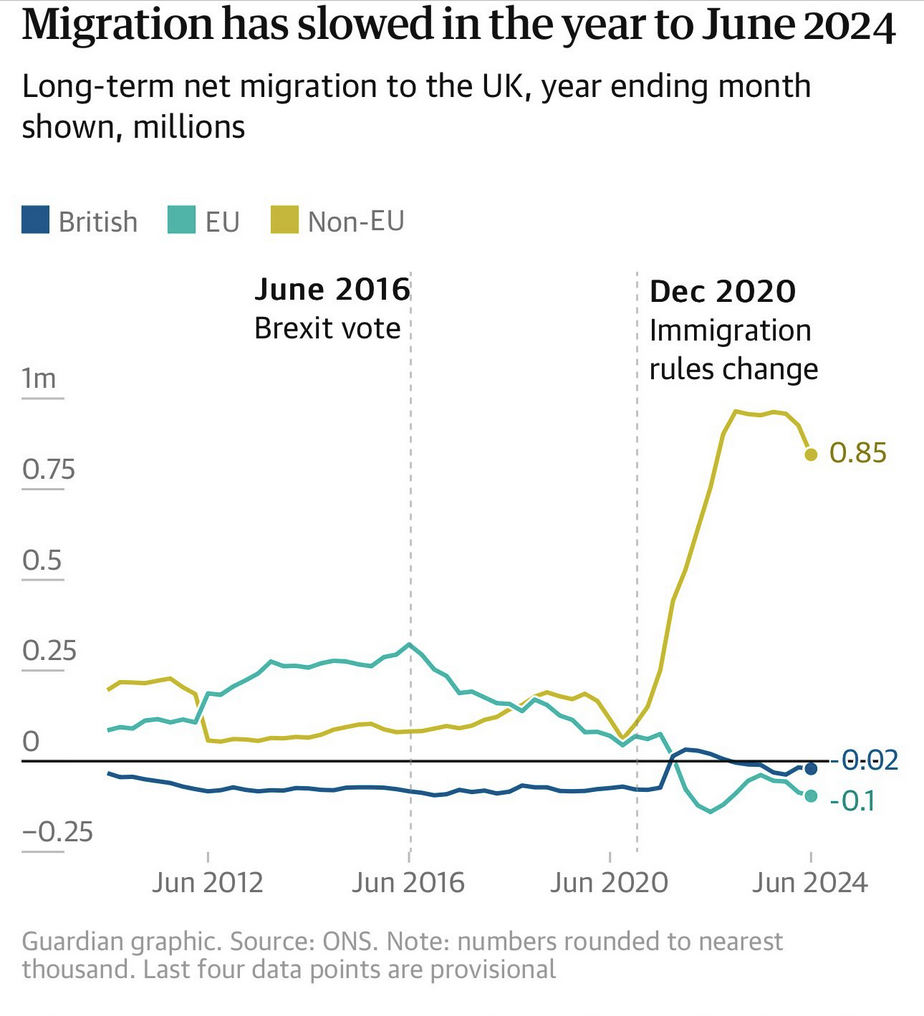
Shifting the focus to legal migration: As compelling as the narrative is, it is difficult to ignore the inconsistencies in Starmer’s positioning and the strategic parallels to the playbook deployed by Polish prime minister and former eurocrat Donald Tusk when his leftist government took power in January 2024.
Go on, tell me more… The elephant in the room is the Tory Rwanda deal and the treatment of those pointing out that lecturing the Tories on migration failure is a bit rich from a party that sought to obstruct the implementation of their key deterrent idea at every opportunity. Anyone suggesting this on social media was mostly met with cries that these figures apply to legal migration, not illegal.
This defense, however, does not cut the mustard. Rwanda would have acted as a deterrent for both, not least because legal migration turns into illegal migration when migrants tactically overstay their permitted periods. Such illegal migrants would qualify for Rwanda-style deportations.
Why did Rwanda fail? Deportations were blocked by an endless wave of Judicial Reviews by left-leaning civil rights organizations arguing the deal breached the European Convention of Human Rights, historically championed by Starmer in his previous life as an attorney.
In a parliamentary debate on December 13, 2022, Starmer, then Leader of the Opposition, highlighted his sympathy for such efforts noting, “money is being wasted on the unworkable, unethical plan to deport people to Rwanda: £140 million has been wasted already, with not a single deportation.”
The left-wing press in the U.K. too continuously objected to Rwanda on similar grounds.
And yet, though controversial, unlike Starmer’s solution, the plan was designed to be a non-militarized solution focused on deterrence.
Starmer’s preference ironically is for a militarized solution: Starmer’s big reveal at the conference was a security agreement with Iraq to crackdown on gangs at the source. This, however, shifts the focus to repatriation and introduces ethical dilemmas of its own by potentially returning asylum seekers to unsafe countries, contravening human rights principles he has previously championed. More concerning is the deal’s militarized nature, likely involving arms transfers and financial aid to bolster foreign power bases — an approach that risks deepening local instability and perpetuating dependency on Western influence, while also lining the pockets of Western defense contractors.
Taking the human rights abuses to the conflict zone: Even more ironically, the deal echoes recommendations from private U.S. military contractor Erik Prince in 2017 to create a “public-private partnership”. Under Prince’s plans, local forces would ‘be armed and have agreed-upon rules of engagement and migrant detention and repatriation policy”.
What does that mean in practice? Bluntly: bribing local forces and local authorities to be loyal to the West, while migrating the theater of war away from the sight of the British public and over to the periphery. Once again, the Rwanda plan, despite its controversies, would have provided for a non-militarized solution.
Okay, but what about the Polish playbook? The similarities here really are uncanny. In the run-up to Poland’s October 2023 election, the opposition party, headed by Donald Tusk, now in power, launched an equally sanctimonious attack on the right-wing ruling PiS party’s failings on migration. The purpose of the rhetoric was to highlight PiS hypocrisy, given the party’s famous anti-migration stance.
The shape-shifters among us: Donald Tusk’s rhetoric on migration has undergone similar shifts to Starmer’s, reflecting both Poland’s evolving political landscape and his own changing roles. As Prime Minister from 2007 to 2014 and later as President of the European Council (2014–2019), Tusk initially advocated for European solidarity in addressing migration challenges. However, upon returning to Polish politics and assuming the premiership again in 2024, his stance hardened considerably.
In October 2024, Tusk announced a controversial migration strategy that included the temporary suspension of the right to asylum, citing security concerns and the instrumentalization of migration by Russia and Belarus. The liberals became the hardliners.
Hypocrisy everywhere: Critics immediately argued that Tusk’s current policies were mirroring the stringent approaches he once opposed, suggesting a politically motivated transformation aimed at appeasing right-leaning voters and countering nationalist opposition. Human rights organizations also condemned the suspension of asylum rights as a violation of international law, further highlighting the inconsistency between Tusk’s past advocacy for human rights and his present actions.
So what’s the Blind Spot? In Poland, the pivot was accompanied with allegations centered on the misuse of visa outsourcing systems, with private firms like VFS Global implicated in irregularities. While these systems were brought in under Radek Sikorski’s oversight — Tusk’s Minister of Foreign Affairs under the former admin — the spotlight fell on PiS’s dependency on them.
The opposition campaign claimed hundreds of thousands of visas were issued improperly. In the end, official statistics refuted these numbers, showing only a fraction of the alleged visas were actually issued. But by then the PR damage had been done.
Tusk used the scandal to galvanize voter anger over migration, and just like in the case of the U.K. now, used it to justify the militarization of Poland’s eastern borders and to backtrack on human rights.
Attention to shift to outsourcing? Over the last 10 years governments across Europe, including the U.K., have turned to one specific company to help process the tsunami of legal visa applications they’ve had to contend with since digitizing their systems. That company, VFS Global, now dominates the market.
What’s become clear in the process, is that automated and outsourced visa systems have made it easier to game the system while shifting responsibility not just to VFS for other third-party agencies that VFS itself depends on and is obliged to vet. In Poland, the company’s involvement was part of a broader scandal where visa applications — routed through intermediaries — led to irregularities and allegations of corruption.
Why it’s a friction story: It looks increasingly that the surge in legal migration since 2020 across Europe is not just a policy failure, but a failure to appreciate how the automation of application systems and consulate appointment queuing systems could be gamed. Just like with banking, email or other mechanisms, automation comes with the downside that frictionless systems can and are routinely hacked.
This has been compounded by the proliferation of third-party scammers who claim to be able to be able to fast-forward applicants through the queue system. There is an equally burgeoning black market in companies that connect prospective visa applicants with Westerners prepared to write fake invitation letters for cash.
In the UK, Brexit’s end to EU freedom of movement compounded this by shifting reliance to non-EU migrants, particularly from Commonwealth nations.
But it’s not just a Brexit issue. All of Europe is suffering from similar trends, many of them exacerbated by labor shortages generated by the the draconian lockdown policies of 2020-2021 (which Labour championed and wanted more of), and which saw British companies were forced to fill with migrants. The abundant availability of related work invitations, especially in Poland, then provided the means for long-term gamification.
IZZY’s COMMENT: Starmer’s pearl-clutching over Tory migration failures is transparently disingenuous, ignoring key facts that most of the population can see through.
For over a decade, people have been voicing their concerns about the scale of legal and illegal migration hitting British shores, and fears the system was being gamed on purpose. Yet their concerns about “losing control” were routinely dismissed or stigmatized by centrist Conservatives and Labour factions, including Starmer’s. Across Europe, similar voices were demonized as far-right bigots. People will not forget this.
Even within Labour, where there was sympathy for anti-immigration sentiment it was confined mostly to the Corbynite wing, which itself was derided for its pro-Brexit stance. Now, Starmer pretends none of this happened, insulting the public’s intelligence and embracing hypocrisy as policy.
What remains missing from the story is how the surge in migration since 2020 has been exacerbated by administrative outsourcing. Decision-making over visa eligibility became a box-ticking exercise, devoid of human assessments and beholden to equality and human rights laws that made preemptive rejection subject to discrimination accusations. Deportations stalled under endless judicial reviews, largely fanned by leftist movements and championed by the media.
Labour’s promise to solve migration “at source” and stimulate domestic growth to reduce dependence on migrants, however, is wishful thinking.
The real issue is demographic: British companies have no choice but to turn to migrants because there aren’t enough Brits to do the jobs that need to be done. But this problem cannot be addressed or solved without seriously addressing why British women are not having kids, or the values we’ve encouraged to inhibit procreation. Key among them is that in our modern society women who do not aspire to work full-time are largely stigmatized or villified.
Current DEI policies — which are enthusiastically championed by Labour — amplify this, pressuring women into roles that delay or deter childbirth, shrinking the workforce and creating reliance on illegal labor. To deal with the pressure or depression of having no family support structures many turn to self-medication, including with illegal narcotics, creating the very demand that creates business for the human traffickers who become expert at gaming the system.
Only by reversing such policies and empowering women to choose motherhood without stigma can the cycle be broken. Labour’s unwillingness to address this ensures the crisis will persist no matter what Starmer says.
Ultimately, this crisis is as much of Labour’s making as it is the Tories’, and blaming the Conservatives exclusively smacks of hypocrisy. The Liberal Democrats, too, share the blame, contributing to what can only be described as a collective failure of the political establishment. Not just in Europe, but all of the West.
ADDENDUM: VFS’ media contact informs us that the committee investigating Poland’s visa scandal submitted a draft report of its final findings on Wednesday.
The conclusions, as reported by media which is generally hostile to the former government, include that the Ministry of Foreign Affairs under the oversight of former Secretary of State Piotr Wawrzyk was culpable in facilitating corrupt visa issuance. The media reports do not mention VFS.
They do, however, accuse a third-party agency called HR Motives Group of having filed over 4,7000 visa applications between 2019 and 2023, with an 80 percent success rate, which they suggest was down to unlawful practices.
According to the reports, many visas were issued for employment in non-existent companies or for jobs the applicants were unqualified for. The commission also uncovered systemic abuse, including undue preferential treatment and illegal pressure on consular officials. Student visas also became a mechanism for illegal immigration.
| BUSINESS, ECON AND FINANCE |
CONSUMPTION RESISTANCE: Michael Pettis explained why countries like South Korea only have two ways to react to policies designed to cut the U.S. trade deficit — one good and one bad.
The good way, he notes, is by implementing policies that boost domestic demand. He’s not very hopeful these will be adopted, however, because weak domestic demand is “the result of the very same transfers that subsidize their global competitiveness”. This means that policies designed to boost domestic consumption will “undermine politically powerful manufacturing sectors and be strongly resisted”.
The bad way they can respond, he adds, is by “implementing policies that further subsidize the competitiveness of their manufacturing sectors at the expense of households”. While these policies don’t resolve internal imbalances, they “work” by creating a beggar thy neighbor trade war. But that’s exactly why they’re bad. They just make everyone poorer, and reduce global trade in the process.
China, for one, is already opting for the bad way.
PATRIOTIC INVESTMENT: We missed this when it first came out, but now is probably as good a time as any to familiarize yourself with Senator Marco Rubio’s and House China Committee Chairman John Moolenaar’s so-called “Patriotic Investment Act”. The little noticed bill, which was introduced in September, proposes to add a new tool to the United States’ investment screening arsenal: taxes.
Specifically, the bill aims to make sure that “capital gains and dividends made from investing in the PRC are not taxed at a lower rate than American workers’ salaries.”
COMMIE AMERICA? In his sit down interview with Joe Rogan this week, Netscape founder Marc Andreessen landed some mega “truth bombs” on the public about how Big Tech really works. The big reveal was that those who really control big tech aren’t necessarily founders or shareholders. It’s the U.S. government via backdoor coercion.
How the control mechanism works: According to Andreessen, the main way the control system is contrived is through regulatory capture. This results from a deal with the devil with the government to help protect their market share and not be broken up. In exchange for regulatory moats, and the ability to become monopolists, they essentially agree to do the government’s bidding.
Soft totalitarianism: The result, Andreessen says, is a form of soft totalitarianism which coerces the public through the arbitrary application of rules and power. He contends the system was perfected in the banking system. “Big banks, facing the threat of disruption, lobby the government for regulations that create a high barrier to entry for new competitors” he said.
“These regulations are often complex and require significant resources to comply with, which large incumbents can afford but startups cannot. The result is a concentration of power in the hands of a few large companies, stifling innovation and competition.”
Andreessen contends in the interview that this same dynamic is playing out in other industries, including social media and AI. “Large tech companies are increasingly intertwined with the government, creating a system where they are effectively compelled to comply with government demands, including censorship and the suppression of political opponents,” he said.
The AI factor: Most alarmingly, Andreessen says, the USG now has the same playbook in mind to control AI — which, if developed liberally, stands to empower people in ways that could destablize USG control.
But he warned, if AI falls prey to regulatory capture, “the consequences could be far more severe than those seen with social media, as AI has the potential to become the ‘control layer on everything.’”
What’s the problem? As Elon Musk has repeatedly stressed, a censored or politcized AI, may be the fastest path to a Hal9000 break-down moment. The techies believe that to serve humanity, an AI must ultimately be truth-seeking to avoid distortions or unintended side-effects. Hence the existential nature of the last election. If AI is to replace bureaucrats over the next four years to lower the burden of the administrative state, it must be a truth-seeking AI that is applied, not one skewed toward serving bureaucratic self-interest.
That the US government is trying to control AI much the way China is should not be a surprise, however. Readers may remember the original OpenAI drama which briefly deposed Sam Altman in November 2022. At the time, we were first to report the USG was the true force behind the related board shuffles, motivated by a desire to influence Altman’s chip dealmaking in the UAE with companies G42.
The role of civil society: Andreessen further confirmed the Blind Spot’s stance that NGOs play a significant role in the censorship complex that helps the USG maintain control. As he put it they “act as a conduit for government funding to exert pressure on social media companies and suppress information.”
Off the books coercion: He added that the term “non-governmental organization” was misleading, as many NGOs receive substantial government funding, blurring the line between private and public entities. This funding is what allows the government to outsource activities it may not legally be able to perform directly, such as censorship, violating First Amendment rights, he said.
Andreessen also likened the tactics to “hiring a hitman” – because the government achieves its goal of censorship without direct involvement, maintaining plausible deniability.
Blind Spot thought bubble: That plausible deniability, of course, came into play in spades with the Twitter Files revelations. Media drew on it extensively to dismiss the censorship practices revealed by Matt Taibbi & co as a “nothing burger” on the grounds that private companies can withhold services from whoever they want, and that the former security state operatives embedded in the company were merely acting as free agents.
Enlightened mind or turn coat? The dual-use corporate mechanism described by Andreessen won’t be news to readers of The Blind Spot. But it is still nice to hear Andreessen admit it, not least because he mostly blocked anyone who tried to point out that the Valley might not be as virtuous as it thinks it is for years.
Useful idiots: To be fair to Andreessen, his argument today seems to be that tech execs did not necessarily understand how they were contributing to the creation of the “control system” in their regulatory relations. Most were merely following the path of least resistance. Useless idiots at best; turning a blind eye at worst. Now that they’ve recognized how they were played, many of them are coming clean and doing their best to correct course. Or so they say.
But is this believable? Andreessen sits at the center of the venture capital ecosystem in America. That he was not aware of how regulatory capture worked beggars belief. What we are essentially being asked to believe is that nerds that excel at business and tech innovation are clueless about how politics and the real world work. Ironically, that’s kinda what Jack Ma in China claimed too when the state came after him.
Cassandra complex: Izzy attempted to point some of these things out c. 2015. See this old Alphaville post. Or this post. And countless others about how tech, especially fintech, replicated cartel mechanisms. And also this one about bad incentives.
IZZY’s COMMENT: BACK IN THE USSR. Last week, we highlighted Russell Napier’s and Diana Choyleva’s argument that by stoking major global imbalances, globalization, under the WTO framework, allowed the errors of collectivist command economies to be exported into Western systems, rather than the benefits of capitalism be injected into China.
China expert Michael Pettis, further expanded on the point noting that “In a globalized world, shifts in one economy must be matched by the opposite shifts among its trade partners, one consequence is that more open economies automatically import industrial policy from more interventionist economies.”
“We are all soviets”: The Blind Spot’s argument, however, goes further. China and the U.S. have been engaged in the same distortive capitalism with socialistic characteristics game for decades. They are a mirror of each other.
Former Andreessen Horowitz VC, Balaji Srinivasan — and friend of the Blind Spot — for example, highlighted in this X post what happens if a CEO “resists” the deep state. You would expect no different in China.
The problem is, that symbiotic structure between America and China is now failing to generate the global growth needed to feed the subsidies the system depends on. Reform is inevitable.
With Trump in the White House, however, Western restructuring has been split in two pathways. While European “perestroika” is doubling down on more centralization, more state-directed capitalism and more subsidization/repression — essentially becoming more like China to beat China at its own game — the U.S. is now going the opposite way.
Trumpian perestroika, in that sense — at least based on current indicators — looks more akin to the real Perestroika deal. Evidence of this is the administration’s focus on privatization, government downsizing and the end of subsidization.
Media attention on Trumpian protectionism rather than the above distracts from this reality. Tariffs, if anything, are a response to the failures associated with Russia’s own shock therapy and a bid to not make the same mistake in the U.S. Back then, the Russian response allowed too much of the country’s organic wealth to be drained abroad at the same time as allowing too many Western interests to corner local markets — limiting wealth creation options for the domestic population.
All this contributed to the drastic inequality of the 90s — an outcome that suppressed domestic innovation and entrepreneurialism while giving people the impression they had also lost their sovereignty — a state of affairs that eventually opened the door to the rise of Putin.
Trumpian perestroika, however, looks set to resemble more of a private equity takeover that aims to ward off the destabilizing effects of shock therapy by refusing access to external opportunists while reforms are underway.
During the turnaround time, the drawbridge — in the form of protectionist tariffs — will effectively be raised to ensure America’s crown jewels can be ring-fenced and cultivated, while costly liabilities that add no overall value are purged. But this won’t be forever. Eventually, if the restructuring works, America will revert to trading with all those prepared to operate on the same capitalist terms, marking the way for a new WTO body.
If the restructuring really does succeed — though, of course, there’s no guarantee that it will — American capitalist practices centered on key principles like that inefficient businesses must be allowed to fail, will once again be exported to the world.
| POLITICS, POLITICS, POLITICS |
AFD’s EU EXIT MANIFESTO: Alternative für Deutschland (AfD) once again called for leaving the EU and the euro in the final draft of its latest manifesto for election to the Bundestag. This was broadly misreported as a new stance.
GEORGIA IN FLAMES: Protests erupted in the Georgian capital of Tbilisi this week as the Georgia Dream ruling party announced it would suspend talks on EU accession until 2028.
The turmoil, which resulted in the arrest of 43 protestors, comes amid ongoing questions by the opposition liberal and pro-EU opposition about the legitimacy of the last Parliamentary election, in which Georgia Dream maintained power.
The country’s outgoing pro-EU President, Salome Zourabichvili, who joined the protests, claimed the elections resulted in “a constitutional coup that has been unfolding for several weeks”, calling the elected Georgian government a “nonexistent and illegitimate” government.
Salome referred to herself as the country’s “sole legitimate representative”, despite having lost the previous elections on grounds the vote was fixed.
The Georgian Dream government, meanwhile, has accused the European Union of using accession talks as “blackmail”, and that it was trying to foster “a revolution in the country”.
| GEOPOLITICAL HOT SPOTS |
SYRIA ON FIRE: Two weeks ago, we warned that Trump’s election was likely to spark a new round of conflict in Syria. When we prepped this blurb on Friday, tensions in Syria were already brewing.
Not 48 hours after the Hezbollah-Israel agreement was signed, al-Qaeda-tied insurgents Tahrir al-Sham or HTS launched a successful offensive on the Syrian Regime’s positions in the western countryside of Aleppo. Reports were forthcoming that the Syrian jihadist organization that emerged from al-Qaeda’s Al-Nusra militia was entering Syria’s largest city.
Syrian president, Bashar al-Assad’s whereabouts, meanwhile, were unconfirmed — but speculation was ripe he had fled for Moscow.
On Saturday, the Syrian military announced a temporary withdrawal of its troops in the northwestern city of Aleppo to prepare for a counteroffensive, after rebel groups launched a surprise attack against the government’s forces for the first time in years.
What’s the blind spot? This successful jihadist assault comes alongside increased activity among the Turkish-backed militias of northern Syria, with rumours that Turkish-backed contingents may seek to take a Kurdish stronghold in the north-western Syrian city of Tel-Rifaat. All in all, the Syrian countryside is boiling with war again, almost 13 years after it started.
MUSK HAS BEEF WITH THE F-35: America’s premier stealthy all-rounder fighter jet attracted the ire of Elon Musk, soon to be co-head of the Department of Governmental Efficiency. Musk’s positive views on the warfighting potential of drone swarms and his highlighting of the exorbitant costs of the F-35 program suggest the program may be under real threat of axing.
DARIO’s COMMENT: But Musk wouldn’t be the first outspoken critic of the F-35. Instead, he joins a long list of military-associated designers and warfighters who have long clamoured against the philosophical principles at the heart of the F35 program. While these critics’ aren’t incorrect in pointing out the F35’s numerous flaws, it’s questionable that any alternative solution, like drone swarms, would offer a better solution.
At the core of the American military-industrial complex lies a flawed philosophical premise: that sophistication inherently trumps simplicity.
Until this mindset shifts, the U.S. will likely continue to produce prohibitively expensive systems that risk obsolescence on tomorrow’s battlefield—whether those systems are F-35s or drone swarms.
One of the earliest and most vocal critics of the F-35 was Pierre Sprey, an American defense analyst and designer, who gained prominence in 2013 through a series of viral videos titled “The F35 is a Lemon” These videos offered a rare glimpse into the simmering discontent within the American military establishment regarding the program.
The criticisms, wide-ranging and largely accurate, focused on a fundamental flaw: as Musk later echoed, the F-35 tries to be a jack of all trades but ends up mastering none. Lockheed Martin, adept at navigating the political and bureaucratic landscape, designed the aircraft to satisfy the competing demands of various military branches and political stakeholders. The result was design by consensus and three slightly different variants tailored for the Air Force, Navy, and Marines.
Lockheed’s strategy didn’t stop there. The F-35 program involves production and maintenance contributions from nearly 48 U.S. states, ensuring broad Congressional backing and making it politically untouchable. This alignment of military and political interests solidified the program’s position despite its flaws.
The F-35’s “placate everyone” strategy has resulted in a notoriously complex and frequently malfunctioning piece of equipment. Just days before Musk’s criticisms, Bloomberg highlighted declassified Pentagon memos that raised alarms about the aircraft’s extreme reliability issues. Among its many flaws: patchy stealth coatings, Air Force gun mounts that still can’t shoot straight after 18 years of development, and maintenance times that are twice as long as originally anticipated.
Faced with this mounting pile of costs and technical problems, Musk’s advocacy for drone swarms seems like an obvious alternative. Drones have emerged as the most fearsome weapon on the Russian-Ukrainian battlefield, combining unmatched cost-effectiveness with devastating utility. Their importance has now eclipsed nearly every other tool of warfare, making it clear to even the casual observer that drones represent the future of combat.
Man and Drone: The debate isn’t as simple as “drone swarms good, fighter jets bad.” Nations will always require some form of manned combat aircraft, as drones perform best in tandem with piloted jets. The enduring relevance of the F-35 is evident in NATO allies scrambling to acquire it, while China’s J-35 — a direct imitation of the F-35 — underscores its strategic significance. At the Paris Air Show last year, American F-35 pilots enthusiastically praised the aircraft, expressing a clear preference for it over even the vaunted F-22 Raptor.
The real concern lies in the design and philosophical flaws that plagued the F-35 program. These issues — skyrocketing costs, inefficiency, and over-complexity — are likely to spill over into drone development if the underlying mindset remains unchallenged.
Since World War 2, the U.S. has arguably internalized the wrong lesson about large-scale, peer-to-peer warfare. Ironically, this lesson stems from Nazi Germany: that sophisticated, expensive technology is inherently superior to simpler, cheaper alternatives.
Yet history tells a different story. The U.S. and the Soviet Union won the Second World War not by fielding superior equipment, but by deploying vastly larger quantities of reliable, if less advanced, hardware. American tanks, rifles, and aircraft often lagged in quality compared to their German counterparts, but they were easier to produce and far more abundant. As Stalin famously remarked, “Quantity has a quality all its own.” During the war, the U.S. embraced this philosophy — but postwar admiration for German engineering, from the StG 44 automatic rifle to jet-powered fighters and heavy tanks, marked a shift that has shaped American military strategy ever since.
What followed was an obsession with advanced capabilities and industrial sophistication, perfectly lampooned in the movie Pentagon Wars. The film satirizes how Pentagon “good idea fairies” turned the straightforward quest for a light infantry scouting vehicle into the bloated, multi-role Bradley Infantry Fighting Vehicle — a heavy, over complicated monstrosity. This fixation is further fueled by military giants like Lockheed Martin, who profit handsomely from equipment that is costly to produce and maintain.
When Musk suggests replacing much of the U.S. military’s costly reliance on manned fighter jets with drone swarms, he is likely to find widespread support within the defense establishment. However, this applause will almost inevitably lead to the creation of an exceptionally sophisticated, highly expensive, and logistically burdensome suite of drone swarms — a solution that risks replicating the same inefficiencies seen in the F-35 and the Bradley.
That isn’t to say such advanced drone swarms, laden with capabilities designed to satisfy every Pentagon demand, wouldn’t be effective. Like the F-35 and the Bradley, they would undoubtedly be formidable on paper. Yet war is not won by paper specifications alone. The true challenge lies in logistics — getting weapons to the frontline, maintaining them, and replenishing them under the stress of sustained combat.
Until the Americans learn that true military leverage comes with building a lot quickly and cheaply, rather than building the best slowly, they risk encountering a sobering battlefield reality. Fortunately for the Americans, most other militaries — including Russia, China, and many others (with the notable exception of Iran) — seem to be making the same strategic misstep.
| DATA LEAKS |
AMERICAN SOLDIER’S DATA FOR SALE: A new Wired investigation found that over 3 billion phone coordinates collected by a U.S. data broker exposed the ostensibly secretive movements of U.S. military and intelligence workers in Germany, and that there’s nothing the Pentagon can do about it. These companies, who legally collect this digital advertising data, are also allowed to sell it onwards to clients on the cheap, permitting adversaries to easily track and locate critical elements of the United States’ military and logistics footprint in foreign countries.
| WEIRD TECH |
UK BASES SWARMED BY DRONES: Several mysterious unmanned aerial vehicles have been spotted flying over American and British military bases in Britain, with several aircraft being scrambled in the middle of Wednesday night to intercept them. The Blind Spot even knows an eye witness, who testifies to the fact.
While the origin of the drones is currently unknown, one security source told Sky News that the drone activity was “awfully coordinated”, while another claimed it was “odd” and “very weird”. At the same time another unnamed U.S. official said these drones were not the work of hobbyists, and the incidents were under formal investigation.
Exorbitant costs of the F-35 program suggest the program may be under real threat of axing.
DARIO’s COMMENT: Is this the UFO disclosure everyone’s been waiting for? Perhaps.
Except, much like last year’s Chinese balloon incidents, these unidentified objects aren’t currently being explicitly labeled as UFOs.
Instead, the media narrative is treating the sudden abundance of sightings from the U.K. to Moscow to America, as “unmanned aerial vehicles,” or conventional drones.
Some images doing the rounds on X tell a different story. While media speculation leans toward a foreign adversary — most notably Russia — the most plausible culprit may lie closer to home. Or, as the internet loves to quip, “the call is coming from inside the house.” For the anointed: let’s unpack what’s going on.
In recent weeks, swarms of drones have been spotted mysteriously flying over British and American military bases, prompting authorities to declare large sections of British airspace as drone-restricted zones in an attempt to regain control.
Adding to the intrigue, the drones haven’t exhibited overtly hostile behavior, and their origin remains shrouded in mystery. Some, like the alleged image of an orb-like object on the tarmac of a British airfield, bear an uncanny resemblance to classic UFO sightings, further deepening the enigma.

We’re not ruling out the possibility that Russia could be behind this drone surveillance activity. Russia has a well-documented history of attempting to sabotage and spy on its Western adversaries. However, the United States has an equally established track record of surveilling and exerting influence over its NATO allies. The key distinctions are that the U.S. possesses far superior technology and is significantly more skilled—and subtle—when it comes to monitoring and managing its allies than Russia is in targeting its enemies.
The case for the United States being behind these mysterious drone flights gains traction when considered in light of recent revelations from American whistleblowers during the UAP/UFO hearings. These hearings, which are too extensive to summarize fully here, focused on three key points. The first two were familiar: UAPs (Unidentified Aerial Phenomena) are real, and they pose a potential threat to national security. The third, however, is both startling and deeply concerning.
Former intelligence officer Dave Grusch, whose claims were deemed “urgent and credible” by the Intelligence Community Inspector General, testified that private military contractors have been working on ‘reverse-engineered’ craft within highly classified Special Access Programs. These programs, he alleged, operate with such secrecy that even the highest echelons of the Pentagon are often denied oversight. For more context, the leaked Wilson-Davis memo provides valuable insight into these allegations and the shadowy workings of these programs.
While the ‘reverse-engineered’ craft are of unknown nature and origin, Grusch claimed he’d seen evidence that the history of these reverse-engineered crafts grew from Nazi research into crashed UFO remnants in 1933 in Magenta, Italy.
Thus, what the UAP Congressional hearings are directly stating is that technology funded by the United States may be responsible for some of the UAP sightings and that private American companies may hold technology that allows some of the ‘impossible’ aerial manoeuvres these UAP can perform, and that they may have drawn this technology from some original source of exotic technology — which the mainstream takes to be ‘aliens.’
Having studied this topic for nearly half a decade, I remain unconvinced by the “aliens” label. If these supposed aliens exist, if they are interested in humans but haven’t overtaken our world, if witnesses describe them as “humanoids,” and if their technology can be understood within the framework of ours — what exactly makes them “alien”? A more fitting term might be “distant relatives”.
That’s not to say the Russians or Chinese couldn’t have developed such technology. We simply don’t know. However, given the poor performance of their advanced military platforms — such as stealth fighters that lag significantly behind even the flawed F-35 — it’s reasonable to assume that whatever technology they possess, the Americans likely have a more advanced version. Remember they like to over-engineer whenever possible, while losing track of billions and never passing audits.
The final point in our argument concerns the United States’ historical tendency to conduct dangerous and sometimes deadly operations on its own allies to test their readiness. The proof — brace yourselves — is in GLADIO. As documented in the BBC Timewatch episode on Belgium’s GLADIO units, one witness described how American special forces, alongside Belgian troops, parachuted into the Belgian countryside and staged attacks on police barracks using live ammunition. Several gendarmes were killed.
The military logic behind such actions is clear. These operations not only test offensive capabilities but also expose defensive weaknesses. And if you can shift the blame to communist terrorists, tarnishing the left’s credibility at the ballot box, so much the better.
Thus, the United States may not just have the capabilities to be behind the drone sightings occurring over British airspace. They also have a history of role-playing as covert ‘Opfor’ (opposing force) against allied units. This naturally makes them the most obvious suspects.
| CENTRAL BANKS |
BEWARE FRENCH BUDGET FALLOUT: The ECB should keep all options opened for its next meeting, including that of a larger interest rate cut, Bank of France chief François Villeroy de Galhau said at the Euro50 forum in Paris. “Optionality should remain open on the size of the cut, depending on incoming data, economic projections and our risk assessment,” he said.
| WHAT WE’RE PROCESSING |
— Dave Rubin explains what Elon Musk found when he opened Twitter’s hood: “the entire system was built to shadow ban”.
— The ruble has had a very bad time and it’s all because the U.S. imposed a new round of sanctions on Gazprombank, which until then had been allowed to process payments for what remains of Russia’s gas export business to Europe.
— Jemima Kelly at the FT has spotted the vibe shift that’s occurring with Trump.
— Unherd’s Thomas Fazi reviews Angela Merkel’s memoirs.
— We need to talk about what’s really going on with NBFIs. It may be the banking story of the era.
— Everything you need to know about how the collapse of the Barnier government in France could plunge the eurozone into turmoil.
— An extended thread about why the FATF is the real coercive force in the global economy.

One Response