

Of all the cryptos, in all the world, XRP — the brainchild of Ripple Labs — has always seemed the most redundant and pointless to this author. One of the reasons for this is that the structure seems purposefully designed to make gazillionaires out of its key holders. That includes people like Chris Larsen, a Ripple Labs co-founder, Brad Garlinghouse, the organisation’s current CEO, and a multitude of other early adopters and/or cofounders — all of whom own a disproportionate amount of tokens relative to the remaining free-float.
The theatrics surrounding the true relationship between Ripple Labs and XRP are also ludicrous. For a long time now the former has been trying to convince the world they don’t really control the latter (because if they did that would make them potentially guilty of selling unregistered securities).
That spin may have worked on Ashton Kutcher but it did little to convince the Securities and Exchange Commission. The regulator initiated action against Ripple Labs in December 2020, accusing both Larsen and Garlinghouse of selling the XRP token to enrich themselves despite knowing it had little actual use. The case is ongoing.
The regulatory move, however, wasn’t sufficiently radical to permanently crater the valuation of XRP (which has in the past notched up values so far-fetched they’ve periodically made Larsen the richest man in the world on paper). Like most cryptos, XRP bounced back during the Covid-induced crypto and meme-stock hype cycle, only to fall back again during the crypto crash of 2022.
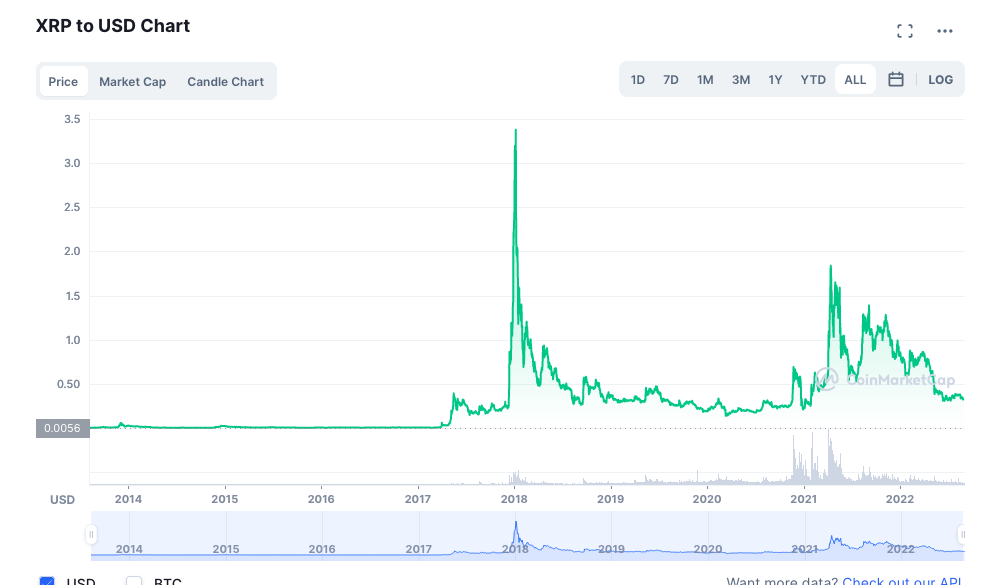
Since then — much to everyone’s ongoing confusion and bemusement — the price has remained relatively stable.
So what’s behind the support?
Of all the Cryptos in all the Blockchains in all the World, Q walks into XRP’s
One underappreciated explanation, believe it or not, lies in the cult-inspired mythology and ideology that continues to be propagated online to support the buying case for XRP. This especially applies to a Qanon-entangled narrative that XRP is part of a clandestine mission by “white hat” crusaders to reset the financial system in a way that benefits everyone. Yes really.
To get the full lowdown on the “financial reset” to come (as well as XRP’s role in it) one need only google XRP, NESARA and GESARA. Doing so reveals a convoluted plan to transfer all the world’s assets onto an XRP-based system that is debt-free and commodity-backed. To get the full Qanon effect, however, be sure to google Jennifer Arcuri (Boris Johnson’s old flame) and XRP while you are it. The full scale of XRP’s role in the counter-revolution against the deep state then becomes clearer. Why it makes sense to replace Elon Musk or Bill Gates with Chris Larsen as the richest man in the world, however, is never properly explained.
The community’s reaction to news that XRP hit a ridiculous $352 trillion valuation for a brief moment of time on August 27 has been particularly priceless. As explained in this video, XRP’s staunchest supporters, rather than erring to the more obvious explanation that an errant overvaluation in one corner of the market had inadvertently priced all the outstanding stock, quickly became convinced the price anomaly must be evidence of XRP being “test run” for the much-awaited global financial reset.
In so doing they fell for one of the oldest tricks in the book: a narrative construction that purposefully radicalises people, usually by tapping into political insecurities and frustrations, for the sake of better parting them from their money. (Scientology, ahem.)
Military-Grade Influence Operations?
The power of that radicalised XRP cult is now having a direct impact on the SEC’s case against Ripple Labs. Recent developments, for example, have centred on whether the regulator has a right to shield the identities of its key expert witnesses in the action. According to Reuters, this is a somewhat unprecedented move in legal circles. Ripple, on its part, claims the attempt to protect such identities goes against the public’s “right to access substantial legal arguments in a case of broad public interest.”
But Ripple’s stance fails to acknowledge that in today’s weaponised online information system, such rights can be easily exploited by online brigades to disproportionately attack and ruin the reputations of those who criticise the systems such groups are vested in.
That the SEC would want to protect the identities of those testifying in its favour given the scale of brigading and harassment that goes on online in the name of XRP seems understandable. In XRP’s case, such tactics have included everything from the deployment of highly sophisticated bot armies, more colloquially known as the “XRP army” to gaslighting brigades made up of real people operating in the mode of loyal XRP lieutenants. (The latter are apparently happy to rent out their profiles and online reputations to lobby everyone and anyone about XRP.)
In the old days mafia types would intimidate witnesses who snitched on them by threatening to kill them. These days, it seems, all one needs to get a witness to back off is access to a radicalised online mob happy to do your bidding. In the event such action fails to knock the criticism back, professional hacker hitmen can always be hired to unearth or plant embarrassing details until the credibility of those being targeted has been entirely destroyed.
Any doubt that such tactics are now being deployed on a systemic level should be addressed to the FT’s Dan McCrum who famously had to endure the full whammy of smearing, gaslighting and harassment while reporting on German fintech fraud Wirecard. (Worth noting, similar tactics are used on those who threaten to leave and expose Scientology.)
In that light, the SEC’s move to protect expert witnesses’ identities can be seen as indicative of the military-grade propaganda tactics the XRP movement has been using to support its valuation since its earliest days.
I know of this first hand because I too have been a target of them. After writing a piece critical about XRP at the FT a few years back, one of my editors was immediately bombarded with an inauthentic slew of outraged emails demanding my resignation and/or some disciplinary action for unfair reporting treatment. Luckily the editor they targeted was Paul Murphy, who knew better.
Off-Balance Sheet Influence Ops
The genius part of these sorts of influence ops is the ease with which they can be dismissed as being organically driven.
Whatever role corporate executives really play in initiating the tactics, mutually aligned incentive structures to get on board with the spin remain community-wide. This creates a cover of plausible deniability for all involved, including for any “creative intelligence” type agencies that may actually have been strategically recruited to build the momentum in the first place, but never officially paid for the work through any on-the-books means.
At first sight, off-balance-sheet reward structures for influence operations sound fantastical. But consider the following tidbit I came across while reporting on the Cambridge Analytica (CA) story in 2019.
That tale pertains to Brittany Kaiser, the notorious Cambridge Analytica whistleblower on whom the documentary film The Great Hack is based. Around 2018-ish Kaiser struck a deal with the architects of an initial coin offering (ICO) called Dragon Coin linked to a Macau-based outfit hoping to raise money to create a floating casino. The deal centred on CA doing some digital marketing work for the ICO, which was aiming to position the Dragon tokens as a replacement for “stake loans” in the casinos. Things came to a head internally, however, when senior colleagues at CA realised Kaiser had failed to disclose the exact scope of the arrangement she had struck with Dragon Coin, including the exact amount of coin she was personally being paid off the books for the work being done.
As an informed source at Cambridge Analytica told me at the time:
“Brittany got a ‘sizeable’ chunk of dragon tokens for helping them get their ICO away which should probably have gone to CA or SCL. That’s pretty much when she left the company. Her leaving the company involved her not turning up for work any more and not returning her laptop.”
While the CA deal with Dragon Coin was exclusively for digital marketing work, it’s worth noting that around the same time that the ICO was kicking off, a branded promotional bus was seen outside the Financial Times’ old headquarters at One Southwark Bridge. The photo below was taken by a former colleague who, upon showing interest in the parked-up bus, was swiftly invited onboard. Once inside, a glamorous team of attractive young females proceeded to offer my colleague champagne refreshments alongside all sorts of promotional materials.

While the above publicity stunt had nothing to do with Cambridge Analytica, or so I am told, it still speaks of what can be achieved these days by offering tokens to marketeers who stand to benefit financially from the very marketing operations they are being employed to deploy.
It’s worth noting that Brittany has since reinvented herself as a digital rights and privacy campaigner, with a strong record for boosting crypto projects. At pixel time, Brittany had not replied to an email from The Blind Spot asking for her take on the story. We will update the post if she does.
One Response