
Hot off the presses from the UK’s ONS on Wednesday:
The Consumer Prices Index (CPI) rose by 9.0% in the 12 months to April 2022, up from 7.0% in March.
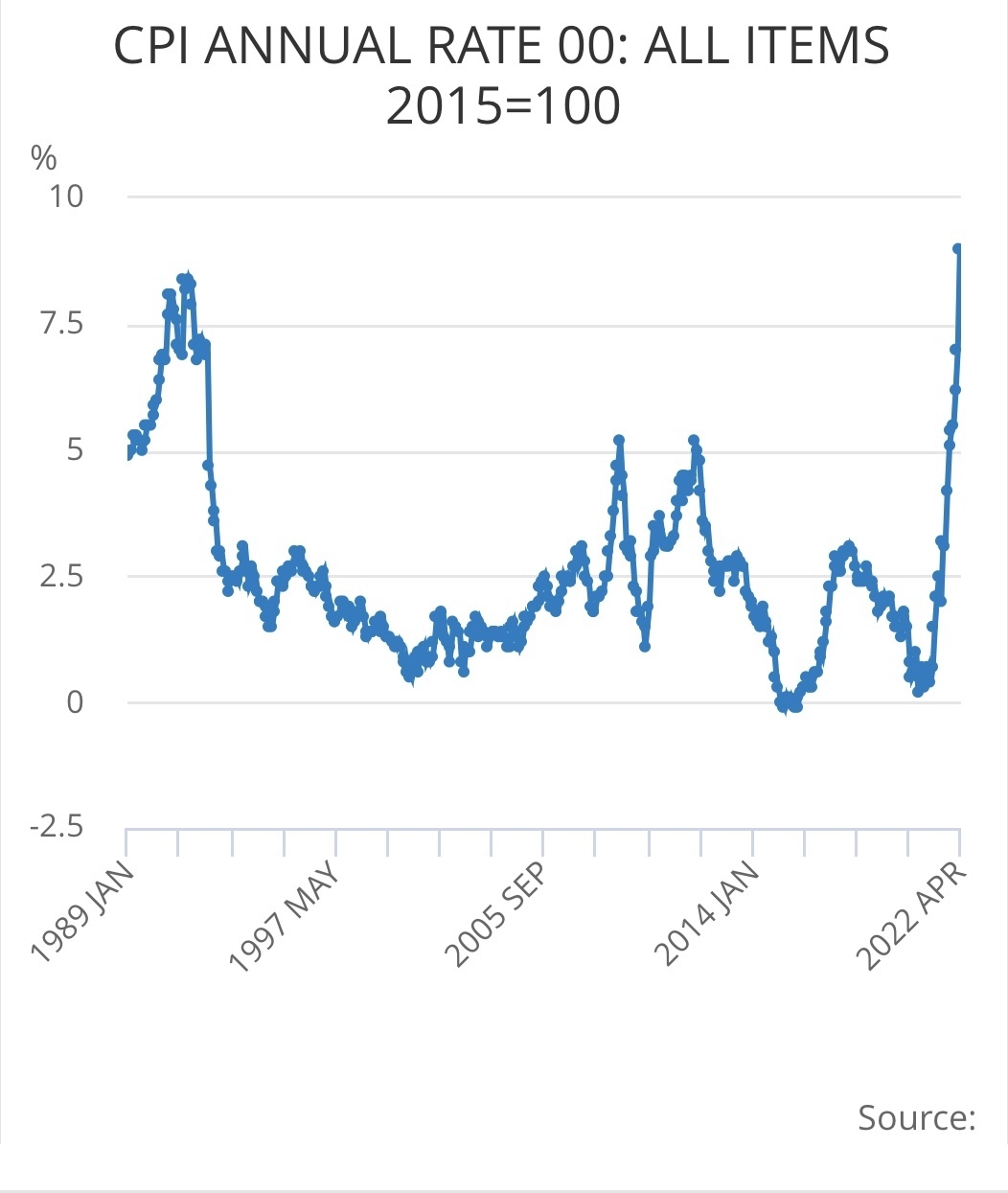
I hope team transitory is taking note.
So what does this sorry state of affairs tell us about the Bank of England’s ability to forecast or guide inflation expectations?
Sadly, just when I thought BoE Governor Andrew Bailey’s communication skills couldn’t get any worse, they did. And I feel this is indicative of where we are now.
What’s more the comms disaster came on two fronts.
First, there was the poorly thought-out language from the Governor as directed to members of the Treasury Select Committee on Monday, which projected everything from BoE helplessness to apocalyptic panic.
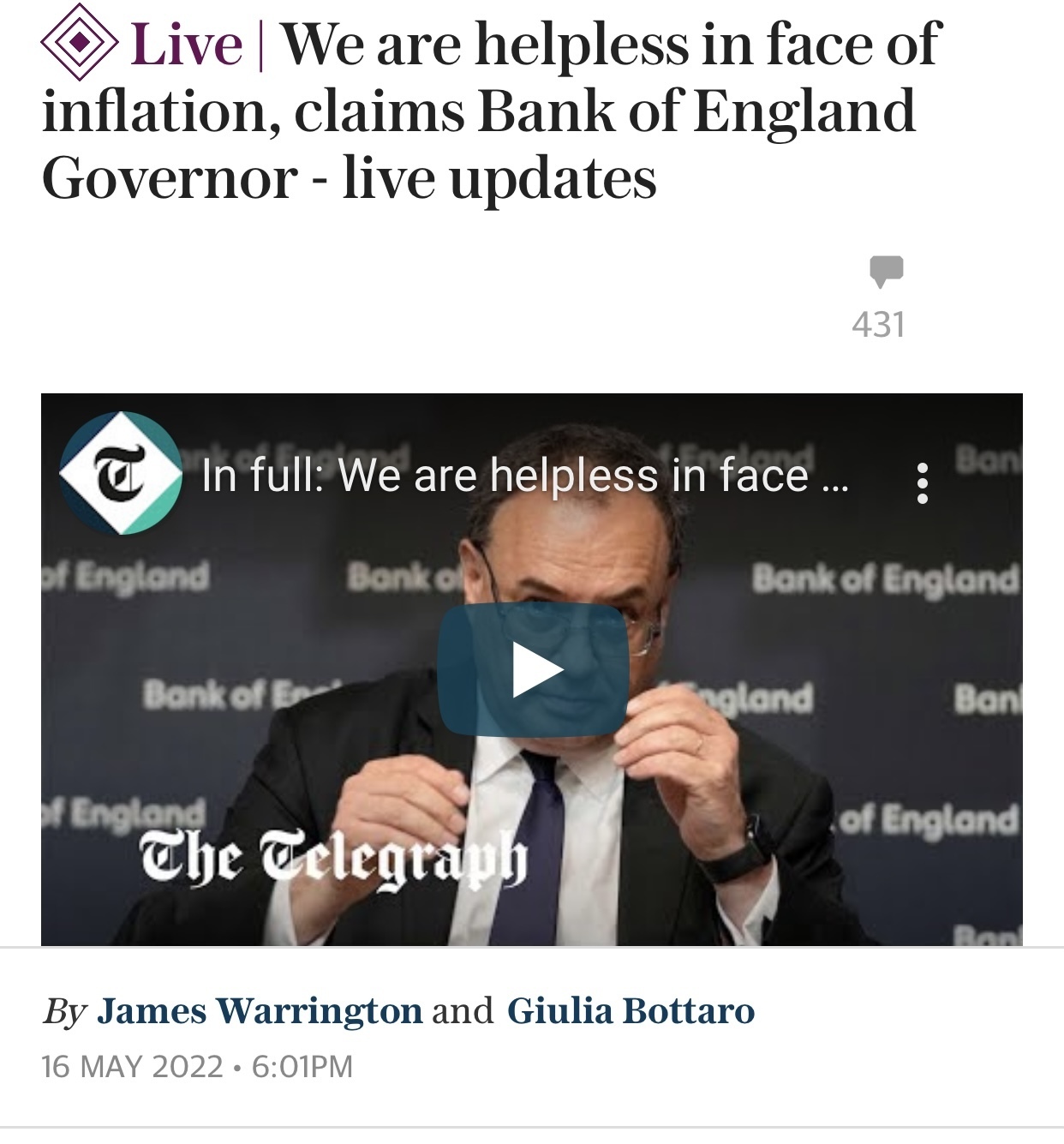
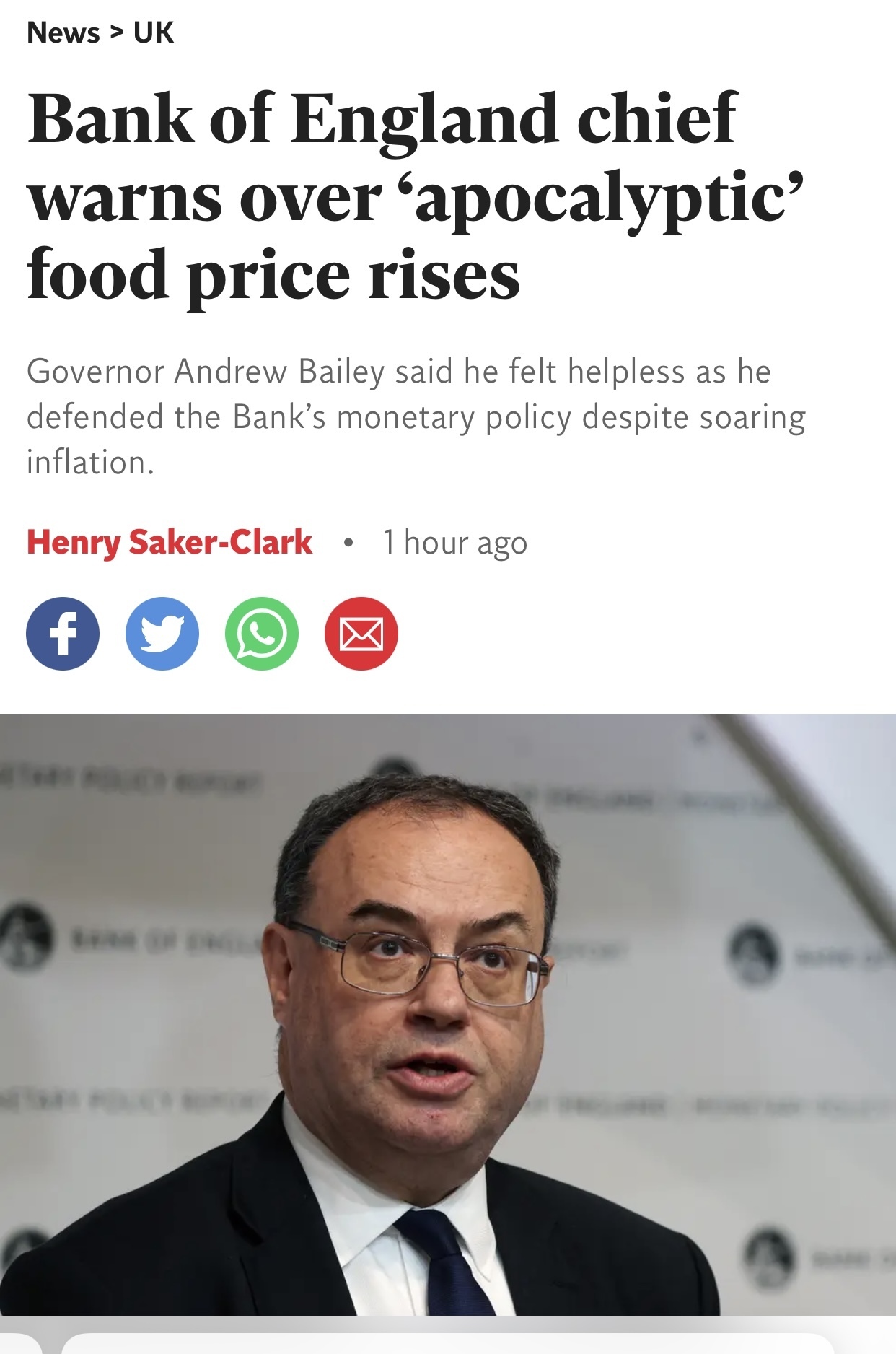
All of the above being suboptimal if you want to talk down inflation expectations and build confidence.
Second, there was the even worse crime of treating commodity futures curves as potential forecasting curves. This came in the official remarks that were pre-submitted to the select committee ahead of Bailey’s testimony.
Of specific note were the two following extracts:
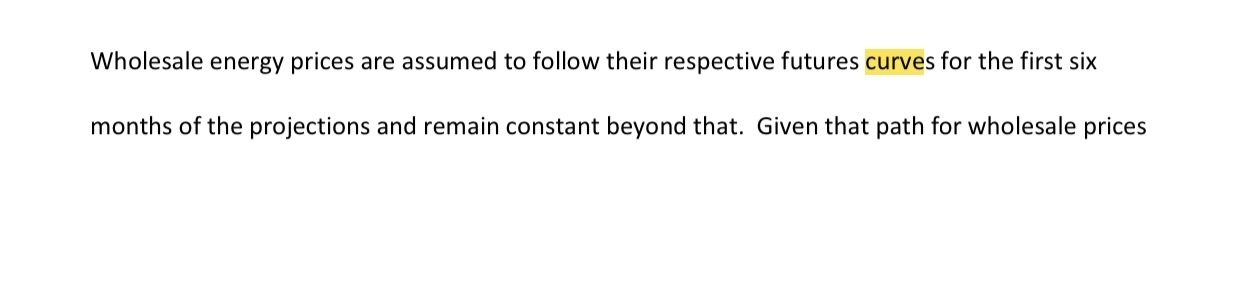
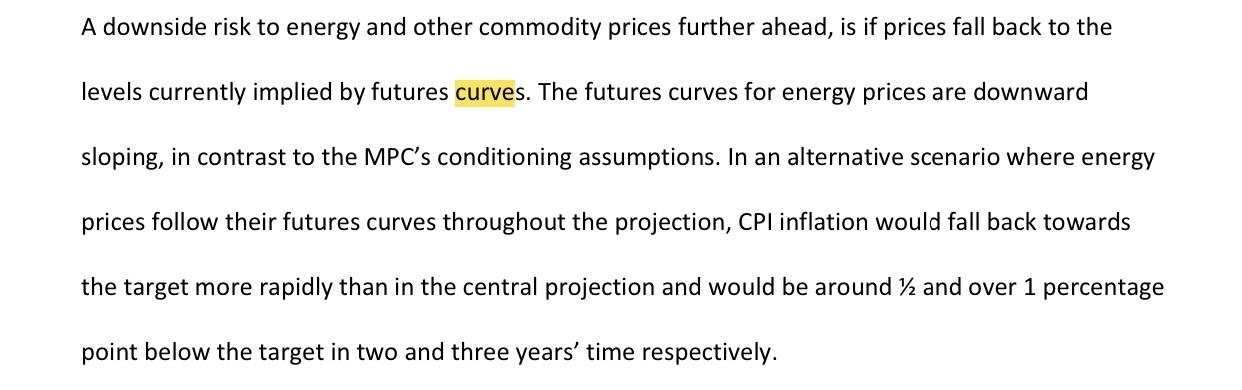
This is such a heinous crime because it is literally the first thing anyone learns when they get a job in the sector: commodity futures curves should never be relied on to forecast commodity prices.
The reason these curves aren’t forecasts is because commodity derivatives are influenced by so much more than just pure demand/supply.
As I previously noted in an FT Alphaville piece in 2011, among those factors are:
1) Interest rates, storage costs and insurance — also known as the ‘cost of carry’.
2) Tightness in the physical market — also known as the ‘convenience yield’.
3) Physical characteristics of the commodity (whether it is easy to store, whether there are ample inventories etc.)
4) The effect of John Maynard Keynes’ ‘normal backwardation’ theory — which suggests forward prices will always tend to be discounted to the market’s expected future spot price to give investors an incentive to take on risk from producer hedgers. Which means even if the price is estimated correctly, the traded price will tend to under-state the market’s real price forecast.
5) Market liquidity — imperfect liquidity being able to substantially hinder anyone’s ability to buy or sell at the price they believe prices may eventually end up.
6) And finally, the curve fails to account for the ‘real’ inflation-adjusted value.
John Kemp of Reuters noted at the time that despite this being common knowledge in commodity markets, policymakers for some reason never got the memo and passionately clung on to using these curves for forecasting commodity prices in their broader models. Probably, one has to assume, because it made life easier for them. As he stated at the time:
Policymakers and some commentators continue to display worrying ignorance about how futures prices are formed and what they imply. In response to questions about the recent surge in oil prices, an IMF spokesman said last week “current market pricing suggests this will be mostly a temporary price shock”. If prices continue to rise due to further supply disruptions the impact on growth could become appreciable “but that is not our or the markets’ expectation”
Forward prices have been used extensively in macroeconomic models used by central banks and other official agencies. But even a cursory review of the forward curve’s behaviour in recent years shows forward prices have been very poor predictors of realised spot values.
More recently, Bloomberg’s Javier Blas and Marcus Ashworth drew yet more attention to this policymaking blind spot.
As their Feb 2022 piece noted about policymakers’ inability to properly account for commodity prices and the harm this was doing to modeling:
Worst is their mechanical use of the futures curve for inflation forecasting.
The futures curve is not a forecast of where commodity prices are heading but rather a snapshot of what the market is willing to pay today for delivery in the future. That’s one of the reasons that the U.S. Federal Reserve, the European Central Bank and others got inflation wrong last year. They assumed, looking at the shape of the price curves, that the worst of the commodity-price increases were behind them. Inflation, therefore, was “transitory.” Wrong.
Central banks themselves are aware of the shortcoming. In 2012, the Bank of England published a paper about its troubles incorporating oil prices into its inflation modeling: “Despite the theoretical link between the futures curve and expected spot prices, the futures curve has not been a very good guide to predicting future spot prices, failing to predict the upwards trend in prices between 2003 and 2008 as well as the collapse and recovery in oil prices since then.” And yet, in the very same study, the authors argued that the bank should continue using the futures curve for its forecasts. One reason? It’s easier. 1 Today, the Bank of England assumes that, for the first six months of 2022, energy prices will follow the futures curve, and after that stay constant.
The piece starts off with an anecdote about how there is a weather vane in the Monetary Policy Committee board room for the purpose of giving guidance to central bankers about commodity demand and supply.
The vane dates back to the days when how the wind was blowing would determine how much liquidity was needed to lubricate trade and commerce in London. If the wind was blowing hard and in an inland direction then the market could expect a large inflow of commodities from ships arriving via the Thames, requiring more liquidity. If the wind was light, there would be less demand – requiring less — and so on.
It’s an anecdote I too have personally relied on to explain the important link between commodity availability and broader liquidity in the system. I first learned about it years ago when Andy Haldane* took me on an impromptu tour of some of the more curious areas of the Bank.
The vane (which I got to see first hand) was a highlight of the tour — and I’m pretty sure every central banker who has ever sat in the MPC room will be familiar with the story.
Hence the strangeness of the BoE being so reluctant to look to commodity market practice in their modeling of such things. There is such a long history of commodity influence on inflation, you would think they would want to get it right.
What’s more, I have it on good authority that there are at least two commodity market experts with direct commercial experience in commodity trading firms in the BoE staff responsible for risk analysis — and neither had any input into the commodity forecasting affair.
Which leaves me thinking there are only two possible explanations for the gross incompetence we are witnessing from Bailey at the moment.
- It’s just plain old incompetence.
-
It’s tactical incompetence for appearances’ sake. A.k.a a bluff.
What would be the benefit of leaning into blind panic, bad forecast assumptions and other poorly thought out communications intentionally?
Well, one theory might be that the actual manifestation of double digit inflation makes poker faced central bank communications or those focused on gaslighting the public into lower inflation expectations via amplified “transitory” talk much less persuasive.
In that scenario, the public will soon become wise to the possible confidence trick at hand. Not only that, the confidence trick itself will have failed miserably to prevent inflation. Any central banker continuing on with the strategy at this stage would thus risk looking not just a fool and/or a liar, but totally detached from reality.
And that risks undermining any remaining credibility that the central bank still holds in the market.
In which case, better the appearance of great incompetence, which may at least allow the Bank to set up a Kobayashi Maru situation — a situation where no matter what the Bank does from now on it will always win (and those criticising the Bank will only lose), than to keep talking up the market.
This strategy essentially involves front-running your own uncertainty by projecting the absolutely worst case scenario to the market (effectively airing your dirty laundry “intelligence” to the public) to ensure that reality can only surprise to the upside.
It’s akin to forecasting the absolutely worse case Covid scenario and then having the death rates undershoot massively — thus cloaking the scale of potential government incompetence and making sure that whatever policies it enacted, no matter how ineffective, look successful retrospectively. This is on the grounds that you can’t easily prove a negative, which means you can never be sure it wasn’t government policy that made the difference.
Indeed, by exaggerating the threat, the BoE creates a scenario where the data can eventually prove it wrong by clocking in much better than expected. This then creates a series of positive market reactions and feedback loops which will hopefully jolt the system back into confidence mode.
From the perspective of the BoE it’s a win win. If the inflation data is better than expected nobody will care about the forecast being wrong. The cost of living will have gone down and Bailey will be given credit for having curbed the inflationary dragon.
If things follow in line with forecasts, however, people will be pissed off but at least the BoE’s forecasts will have been proven right, building confidence in the institution.
Those who have been following the Russia/Ukraine story will recognise the strategy. It’s recently been deployed with huge enthusiasm by Western intelligence agencies to narrow enemy optionality. Irrespective of whether intelligence agencies are certain about the quality of the intelligence they have or not they share it with the public. Just by predicting that x unexpected very bad thing could happen they hedge themselves against blame that they didn’t see it coming. And since x is always a very bad thing, if they get the forecast wrong, nobody cares.
The question is: is the BoE really that sophisticated a psyops entity?
The commodity curve fiasco sadly suggests otherwise since it undermines the doomcasting by implying energy prices are sloping downwards into the future.
In which case we may all be doomed and it’s time to prepare for this:

*I don’t think Andy Haldane will mind me saying that our discussion that day touched on exactly the sort of problems I’ve been discussing here but as applied to forecasting existential planetary risks. I recall in that context we touched on the old Fermi paradox issue as well as the great filter argument. Though I can’t remember the exact details of the conversation. 🙁