

Here’s an uncomfortable truth for a Thursday morning.
The Great British Krona and the gilt market are going to be just fine.
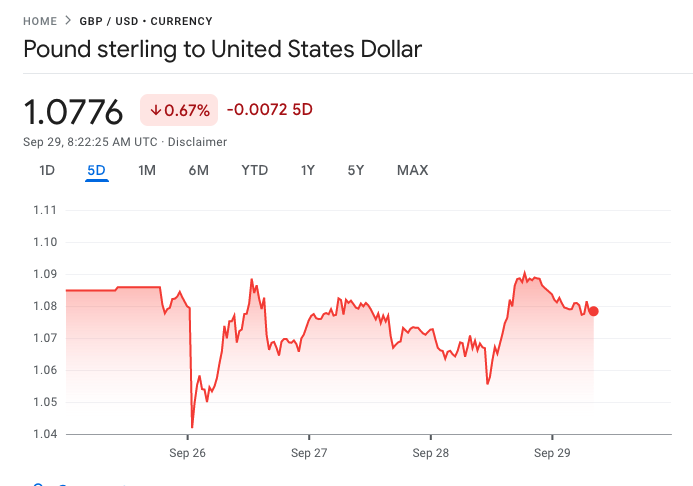
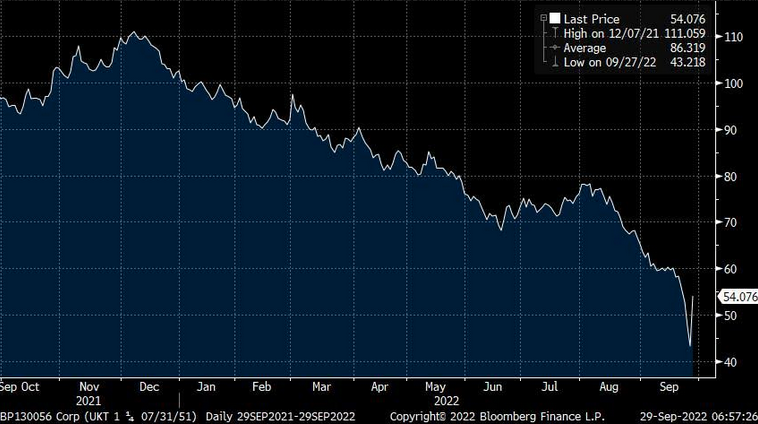
If you’re British and your immediate reaction to this assertion is rage and a compulsion to tell the author they’re an idiot… we have to break it to you. You may be suffering from permanent British self-deprecating bordering on self-loathing syndrome. This syndrome displays most acutely when a British person is positioned next to an American, given the latter’s own tendency to suffer from permanent over-confidence syndrome.
If you’re not British and thinking similar things about Britain right now, we have to break something even more uncomfortable to you. Your existence is proof of Britain’s ongoing softpower in the world.
We could be wrong. But let’s look at the evidence.
When you step out of Heathrow, London, what you’re presented with (despite the self-hating British media trying to assert the opposite) is this:

The epitome of order and quirky Black Cab Britishness.
When you step out of Mogadishu airport, on the other hand, you get something more like this:

Over in Britain, as FT Alphaville found when it tried to bribe people to sell their places in the longest queue of all time, people didn’t even want to hear about monetising their grief. Many even considered queuing a national sport.
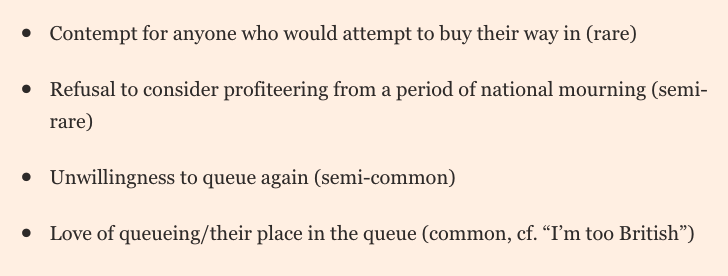
Over in Italy, meanwhile, the word queuing hasn’t even been invented:

As for corruption, not saying we are perfect but how do we compare to the cosa nostra?
The Blind Spot makes a point of trying to stay as apolitical as possible with its analysis. Being too political blurs your thinking. Whatever one’s personal leanings are, when investing you have to be dispassionate. If in the past you’ve interpreted us as leaning to the right, you’ll be interested to know that just the other day this author was accused of being a communist. A good example is this.
In fact, we’ve been accused of almost everything in our time. Which is precisely how we like it. Like the Queen (and Putin until 2022) we prefer our politics to be ambiguous. Our principles on the other hand will always be overt. These principles are dominated by a commitment to free-speech, critical thinking, objectivity and standing up for those who can’t stand up for themselves.
So yes, the markets have had a major wobble and freaked out. And yes the BoE has rushed to provide QE aid in a rate hiking cycle…which makes no sense at all.
Over in the liability-driven investing (LDI) world there’s been a huge rebalancing. And everyone has been panicking about failures. Probably rightly.
But no, LDI isn’t the mousetrap that nearly broke Britain. As far as we know there have been no defaults. Rebalancing may have been chaotically managed, but the risk seems to have been well flagged and anticipated. (For a good explainer of the whole LDI thing see Toby Nangle’s latest piece.)
*Even if there are defaults that doesn’t immediately equate to the end of Britain, just another step to the war economy conservatorship economy.
As for the IMF butting in and talking down Britain, is that really the responsible thing to do?
My former colleague Mehreen Khan over at the Times offers this unnerving snippet:
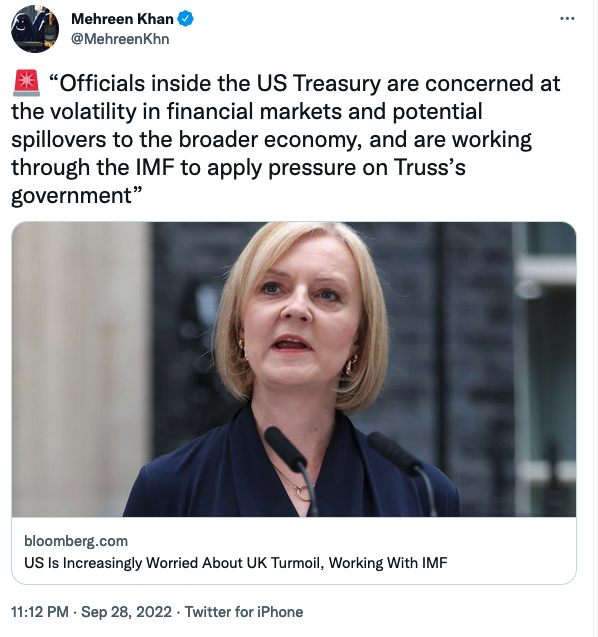
… which sounds awfully like the US butting into the democratic affairs of other nations. How would that be perceived the other way around?
So, yeah, when we see things like the below arrive in our inbox from the rent-a-quote brigade of permanently available analysts, we know there’s an informational advantage out there to be had:

You can be sure that when the rent-a-quote brigade all sings from the same hymn sheet, it’s the best indicator yet that what they’re saying is wrong. As our Spot Markets Live guest Neil Collins said in yesterday’s session, seasoned investors (and crypto enthusiasts) would have known to buy in a bloodbath.
Even Paul Krugman agrees there’s no real evidence that Britain is a basketcase, just yet.
That’s not to say there aren’t crazy things going on in Britain.
We’re clearly in an economically stressed position. The budget is genuinely crap. And we’re moving to an economic model based around public-private partnerships and increasing government intervention in free markets.
But the crapness is much more about the ongoing fallout of lockdown policy and economic sanctions against Russia than it is about anything specifically British. Britain is just the first domino to fall. Equal amounts of pain are coming to all of Europe. Exactly when I don’t know.
The way Britain conducts itself right now will probably set the benchmark for the rest of the EU. Much the way Italian lockdowns inspired European and later global policy about Covid.
I was not a fan of Liz Truss going into the leadership battle. But I now see her growth plan as analogous to the UK’s contrarian move on herd immunity. The plan’s not perfect, but it doesn’t seem nuts. If truth be told, all the alternative options are equally crap, if not crapper. As with Covid, there are no good options on the table.
Moving towards austerity to fund the crisis is equally mad. A devalued currency and tax cut, on the other hand (like herd immunity) looks to the longer term. Making British workers cost competitive, especially in work-from-home settings, is not insane. And it also allows for a bit Ponzifinance to come to the funding rescue.
No, it doesn’t solve the truck driver or menial industry staffing problems. But it will encourage investment and innovation. Perhaps.
If I were a bond investor, I would be more worried about the repricing to come in the European debt markets when it finally becomes self-evident that without access to cheap Russian gas Germany’s entire industrial model is bust.
So all in all, I hope Truss doesn’t bottle it. I hope she and Kwasi stick to their guns. Because the worst thing for the nation right now is a leader that bends willy-nilly to the will of an outraged public mob. That is mob-rule, not democracy.
And if you feel outraged by any of the above, remember, it’s only a single opinion. You don’t have to agree with any of it. Going out on a limb against a braying mob is always scary and hard. But someone has to present the counterargument. I may very well be wrong.
On that basis, I’m always interested in hearing the alternative view. But please, while you have the right to disagree, if you feel passionately that I’m wrong, just don’t be a jerk about it. You’re more likely to convince me of your take on the world by being nice. 🙂
#standwithGBP
A nation that enjoys queuing can never be a basket case.

One Response
A lot of fair points, esp around herd mentality and comparisons to COVID response (“no good options”). However, I am not quite sure how tax cuts fit into the logic of your narrative.
As noted by Tim Congdon in his latest commentary:
“Public expenditure is of two kinds, interest on the public debt and all other expenditure. Debt interest serves hardly any useful purpose. It merely redistributes between taxpayers and bondholders, and the taxation needed to pay for it has the same disincentive and distortive effects as taxation in general. Whereas most public expenditure is worthwhile, debt interest provides no obvious net benefit to any nation. It could be deemed futile and pointless.
Let us suppose that, in a nation with a budget deficit, the ratio of worthwhile non-interest public expenditure to gross domestic product is given. Let us also suppose that its finance minister (or Chancellor of the Exchequer, in the UK) decides to cut taxes by, say, 2% of gross domestic product in a particular year. That increases the budget deficit, and clearly means that future national debt and debt interest are higher than they would otherwise have been. Total public expenditure – which is of course the sum of non-interest and interest expenditure – is also higher, again relative to GDP. The tax cuts in one year therefore expand the size of the state and increase the future burden of public expenditure.
But another adverse effect has to be noticed. Rightly or wrongly, the tax cuts are likely to upset investors in government debt, who may fear that monetary policy will be subordinated to the need to finance the deficit (leading to so-called “fiscal dominance”). They may sell their existing holdings of the debt, pushing down the price and raising the yield. For example, on the afternoon of Friday, 23rd September, when Mr. Kwarteng announced tax cuts of about 2% of UK GDP, the yield on 10-year UK Treasury securities rose in a few hours from 3.5% to 3.8%. As I write (on the morning of 27th September), that yield has risen further to 4.1%. Suppose – unrealistically in the present context – that the public debt were equal to GDP and stable relative to it. Then, over time the replacement of old debt by new would result – merely because of a yield shift that has occurred in less than a week – in an increase in debt interest and public expenditure permanently of 0.6% of GDP. This would – with current GDP – be a little matter of approaching £15b. a year. (The figurework is unrealistic, because the context is clearly one in which public debt is rising relative to GDP. A more realistic discussion would be more complicated, but also more disturbing.)”