

Greetings Blind Spotters. It’s Saturday and the weather seems to have turned in the UK. Hurrah! And since the US didn’t default, we can all relax now. Sorry for the tardiness of today’s send-out, but it’s been an exceptionally busy week for me, what with the launch of Politico’s new central banker service (which you can sign up to here for a limited free trial if you should want to). But hopefully what it lacks in punctuality, it makes up for with insight.
This edition of the Blind Spot newsletter was, as usual, brought to you by Izabella Kaminska and Dario Garcia Giner.
Business, econ and finance, etc:
- Asgeir Jonsson, chief of Iceland’s central bank, stated he could not rule out bringing forward an additional interest rate hike to at least 10 per cent, as the island struggles to control ongoing increases in domestic prices.
. - The IMF warned Poland that the government’s use of untargeted mortgage holidays to keep the financial system ticking over was “inefficient, costly, weaken monetary policy transmission, and should not be extended.” Almost half a million Poles took advantage of the opportunity to suspend repayments when the scheme — enacted into Polish law — began in August 2022.
. - Rishi Sunak’s number 10 will ask retailers storing basic foodstuffs like bread and milk to place price caps on essential items to tackle a rising cost of living crisis.
Supposedly, Defra is hiring researchers to create a “single food price model” to inform ministers on the best “government interventions” to deal with food inflation, including “market failures,” reports the Telegraph. The government insists it “will not consider imposing price caps,” with voluntary methods discussed instead, and the story is about a technical project aimed at getting better analysis. Sounds to us like the government is trying to have its cake and eat it. A voluntary cap, is not a cap.
- The Federal Reserve’s Foreign Repo Pool (FRP) reached all-time highs:

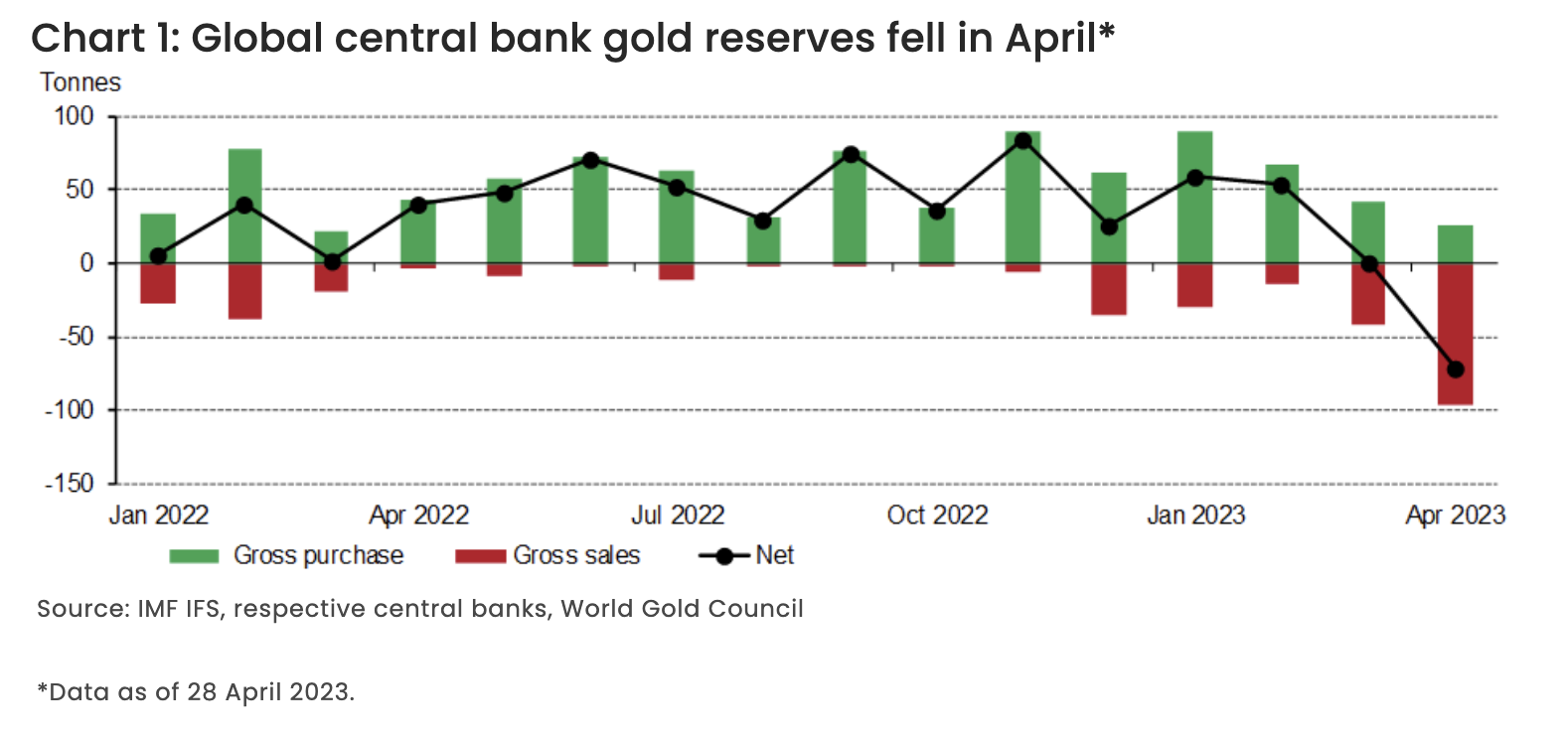
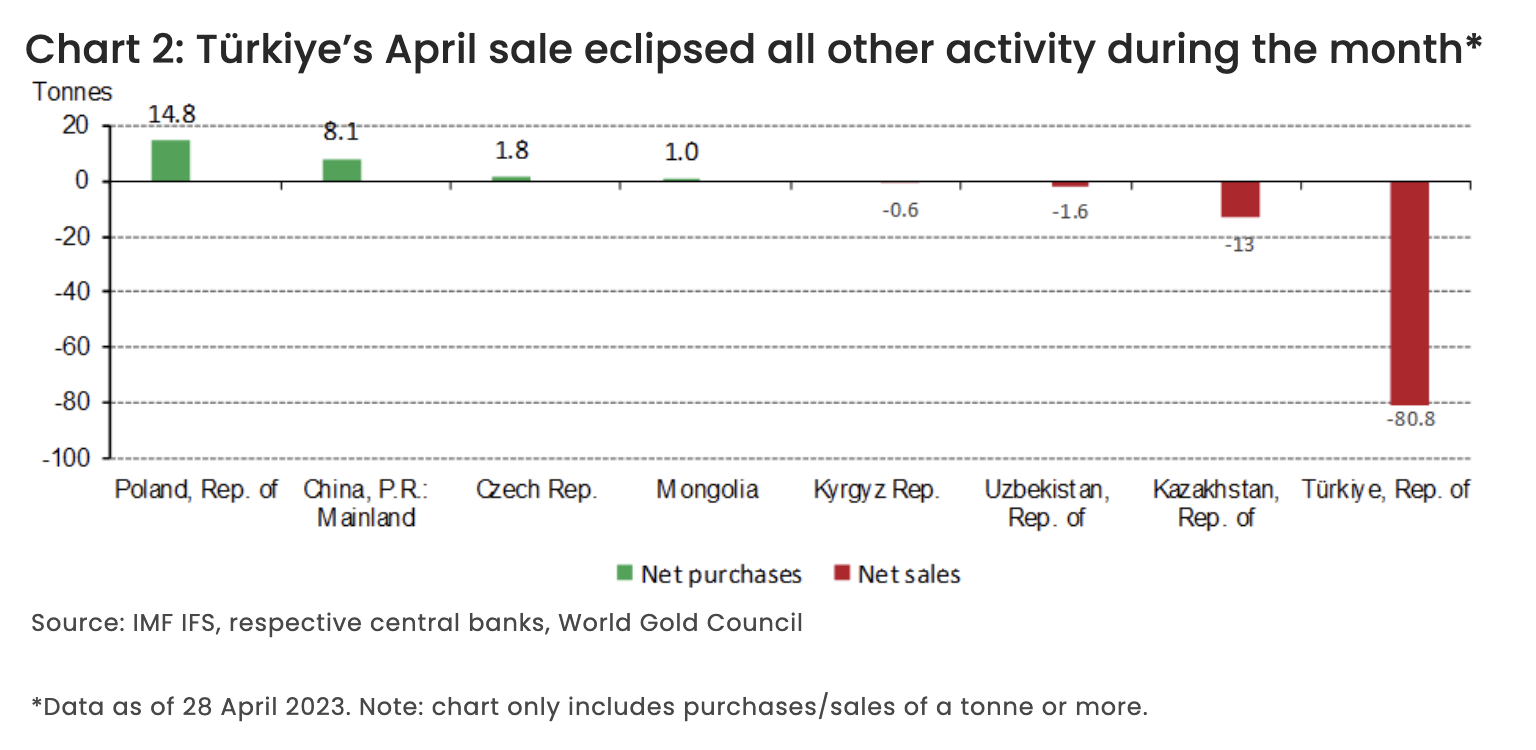
- The World Gold Council reported that global official gold reserves dropped by 71 tonnes in April, according to its monthly analysis, and the move was led primarily by Turkish central bank sales. The largest purchases were by Poland’s central bank, and China also continued buying.
 .
.
- ICYMI former BoE governor Mervyn King’s argued in the Financial Times earlier in May that the West needs a new approach to banking regulation, which replaces a lender of last resort model with a “pawnbroker for all seasons” model. This would allow liquidity at the central bank to be more closely planned, rather than just being deployed in ad-hoc measures, or “making it up as they go along”.
Mervyn’s observations riff on former deputy BoE governor Paul Tucker’s 2019 BIS paper, in which Tucker argues that banks should keep the bulk of their assets as collateral at the central bank, in a type of full reserve system. Doing so would limit banks’ capacity to use the assets to finance other activity, but, unlike a conventional full reserve system, wouldn’t necessarily constrain lending or prevent money multiplication.
This is because the customer liquidity generated at the point of asset creation — assets, which are now pledged to the central bank (on haircutted terms) — could still make it back to the bank, allowing the institution to keep lending and creating more assets.
The new system, Tucker and King note, would ensure there is always enough liquidity on hand for banks to manage short-term depositor liabilities, albeit without the risk of injecting moral hazard, since quality criteria would still apply to the underlying assets. Any residual value not covered by the arrangement, Tucker says, would have to be covered by a combination of equity, recovery bonds or contingent capital funding.
The purpose of revisiting the piece this weekend will make sense as you read on. — IK
- Frances Coppola’s newest Substack claimed that bank failures won’t be stopped by full-reserve banking. Ensuring the safety of bank depositors at the expense of lenders is a bad solution that will come with high lending costs, she argued.
A good read from Frances as usual. – IK
- The European Central Bank released its latest Financial Stability Review (FSR), offering lots of important stuff to digest, from the risk associated with the rise of zero-day expiry options to the impact BoJ monetary normalisation might have on European liqudity and its possible repatriation back home.
The section on “gauging the interplay between market liquidity and funding liquidity,” was particularly interesting, noting that “a substantial deterioration in market liquidity and funding has been evident since the start of 2022,” while also warning, “cyclical factors may have reached a turning point, potentially exposing the underlying risks that have been masked by accommodative policy over the last decade.“
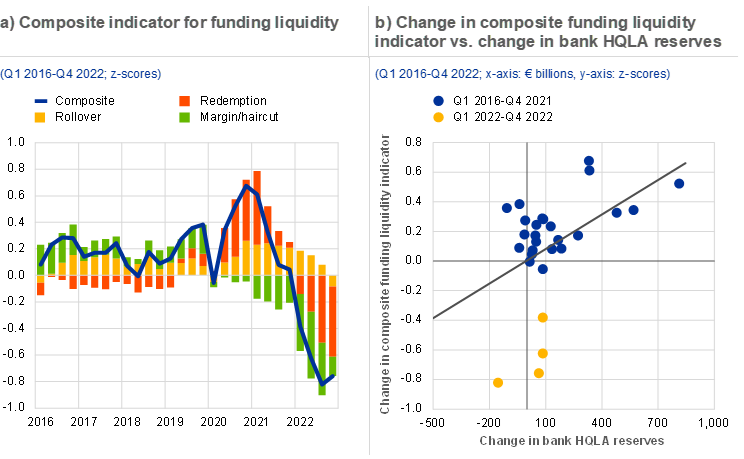
Other important admissions from the section included the observation that while quantitative tightening may soon ease tightness in repo markets, it will come with a cost: the risk premia genie may be released. “Unlike central bank reserves, marketable safe and liquid assets are subject to valuation changes, which might affect funding conditions in a stressed liquidity regime.”The section also acknowledged there could be unintended consequences lurking, with a general shift away from an unsecured funding regime to a collateralised one. “… the shift towards widespread collateralisation, while greatly reducing counterparty credit risks, has increased the sensitivity of liquid-asset demand to market volatility and has resulted in high asset encumbrance at banks,” the ECB noted.
Maturity mismatch risk: Finally, it stressed “banks might not be able to adjust the maturity of their liabilities overnight once QT is under way” and “might face exposure to liquidity claims by non-banks and non-financial corporations”. It then warned funding conditions may as a result be “more fragile and flightier than the aggregate measures for liquidity suggest.”— IK
- Izzy (with her Politico hat on) warned that a key formula that underpins bank stability could be acting up.
It all comes down to a calculation known as ‘deposit beta’ and whether it has been grossly misassessed by banks due to an industry-wide over-estimation of the value of most banks’ deposit franchises, especially in the wake of frictionless banking apps.
The piece, it’s worth noting, was a long time coming, with some of the conversations informing it conducted almost a month ago. When I set out on the research there was almost nothing being written about the phenomena (i.e. the overvaluation of banks’ deposit franchises and how this may have contributed to current financial instability*) on an institutional level, other than the papers referenced in my piece. In the interim, however, Goldman’s economic team went deep into the topic but also, it turns out, so did the the ECB’s financial stability review — something I only caught after publication because my piece was done and dusted on the same day the review came out.
The observations, however, are worth adding to the dialogue, not least because they come with charts, like this one.
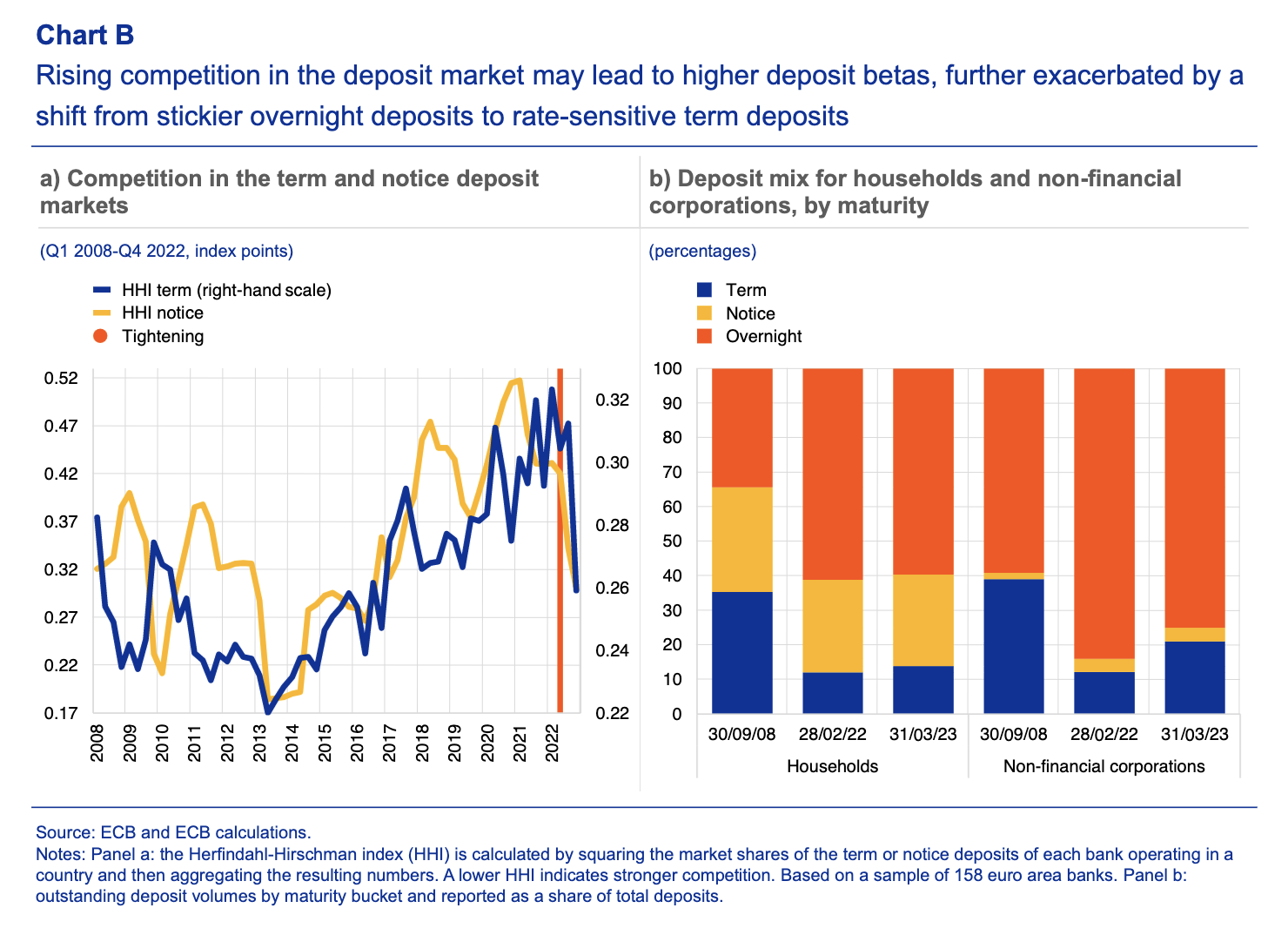
The left hand side chart shows a substantial reduction in deposit competition from 2014 onwards (the era of zirp and negative rates), until 2022 when competition (the lower the HHI, the stronger the competition) suddenly makes a very abrupt comeback.An issue for the eurosystem, however, is that it has been uniquely crappy at passing on rate hikes to customers. There is also less competition in the system from money market challengers, especially at the retail level (hence our recent interest in the type of new products that groups like Wise are rolling out on the continent). There is a risk, therefore, that once TLTRO repayments begin in earnest, the “stability” we’ve seen in the eurosystem is replaced by a new level of deposit flightiness.
Also, once deposit beta begins to rise, there are other implications. Banks are forced to manage their maturity mismatch risk with ever more short-term assets, which could constrain lending and bank profitability.
As the ECB itself noted (our emphasis):
“So far euro area banks have managed to contain the increase in deposit costs as the repricing of deposit rates has been limited, allowing them to benefit from higher net interest income. Rising competition and a reallocation of funds from overnight to term deposits might lead to an increase in funding costs that is faster and larger than expected. This could potentially translate into lower profitability for banks, impairing their ability to withstand adverse shocks – and hence their stability – at a time when the provision of credit is being inhibited by a less favourable macroeconomic environment and tighter financing conditions overall.”
Ay caramba. — IK
* Update: to be clear I meant nothing had been written about the idea that deposit betas may have been grossly misassessed in terms of what it takes to retain deposits and/or the implications of wrongly assessed betas for average maturity duration on a bank’s balance sheet. Deposit beta as a concept in and of itself has been referenced ad nauseum post SVB and post cbank tightening, but only as a marker of pass through and why banks aren’t passing more on.
- The Norwegian krone achieved the dubious title of being the worst-performing G10 currency in 2023 so far. This Tuesday, the crown hit a three-year low against the euro, and a five-month low against the dollar in March.
. - Deutsche Bank claimed a wave towards defaults was building as the system returned to a boom-bust model:

- Top figures from Lloyd’s marine insurance group claimed the industry has baulked at the growing cost of Russian sanctions, indicating the need for a “Plan B”.
.
- Amazon employees in Seattle and other offices staged a walk-out in protest urging the e-retail giant to take “bolder climate action and to reconsider its return-to-office policies.”
. - Amazon also confirmed the abrupt departure of Chris Conderhaar, chief of AWS data centers, who had been at the company for nearly 13 years.
. - UBS and Credit Suisse have been offering bonuses linked to commissions on asset inflows in Asia of up to 15 basis points. This varies from the usual metric of fee-generating assets, which require customers to invest not just open accounts.
.
- The Bank of Japan explored the concept of a single user being able to hold multiple CBDC accounts while still being able to impose limits on the users’ ability to transact.
The paper also explored the challenges of securing offline transactions, noting “In the case of no connection to the ledger server or other online environments, it is technically difficult to detect double use on each offline payment at the receiving user’s terminal.” — IK
- The sovereign wealth fund of Singapore, Temasek, cut pay for senior managers and its investment team over how it invested in FTX. Lim Boon Heng, Temasek Chairman, claimed the steps were taken because “the investment team and senior management, who are ultimately responsible for investment decisions made, took collective accountability” for their poor investment choice.
. - Shareholders of Exxon and Chevron overwhelmingly voted against climate-related proposals at recent board meetings.
. - Theresa Lieb’s latest for Greenbiz questioned the notion that organic food is more climate-friendly than traditional farming methods, pointing to the much lower crop yields of organic farming as a key sustainability issue.
. - Why did Germany’s electricity prices remain relatively consistent this year, despite fossil fuel usage not increasing? The charts below show the answer — there has been a collapse in German electricity generation:

Goldman multipliers:
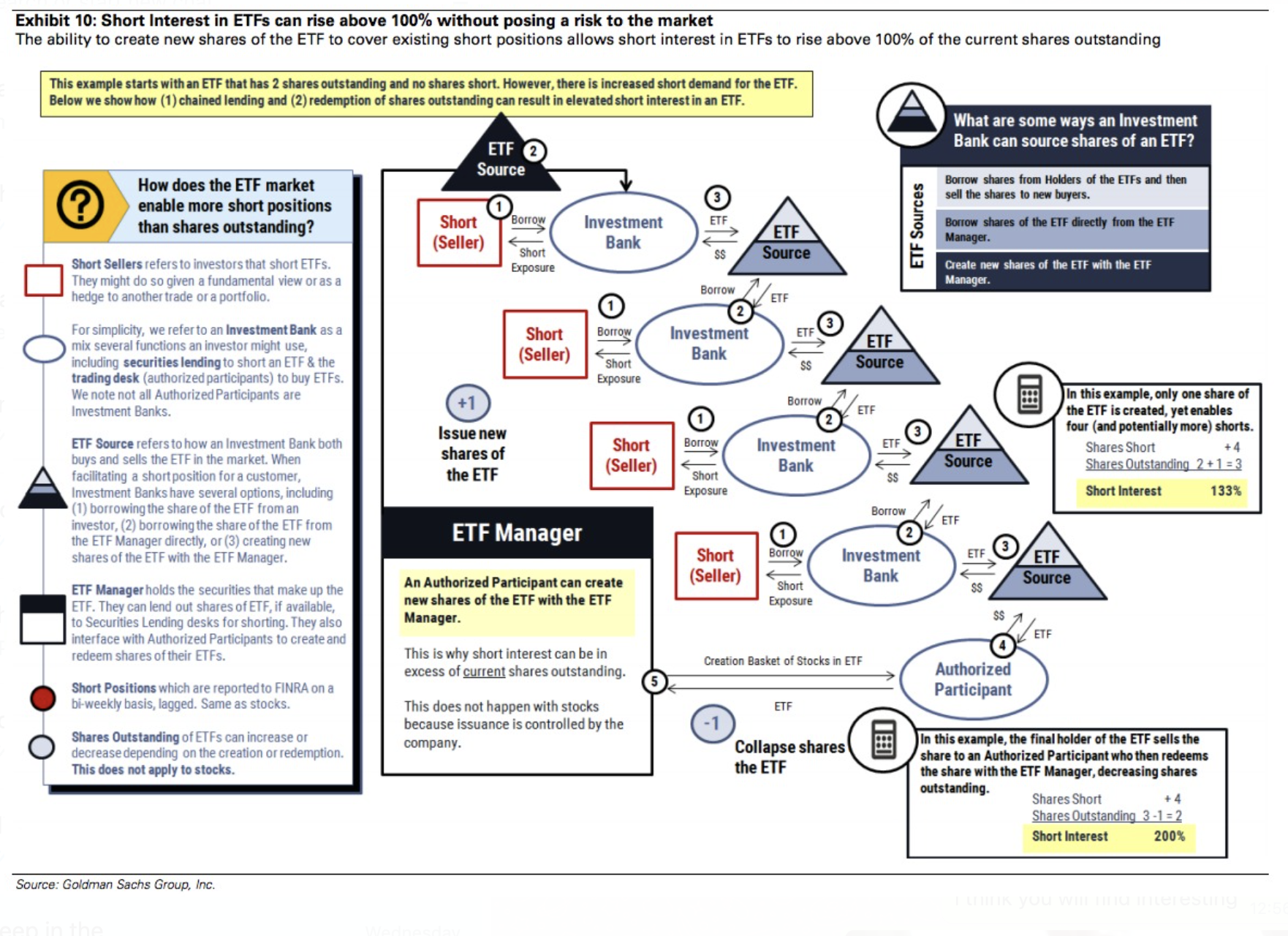
- Somebody shared, with Izzy, the following diagram of how ETF shorting really works. It hails from a 2017 Goldman Sachs report, but since it never really circulated it’s worth getting it on the official record.
What it reveals is very instructive about the alchemical way broker-dealing banks view ETFs, which they believe have, ultimately, cracked the usual risks associated with multiplying and over-extending a singular asset through a system by invoking the market mechanism. In this particular case, how the ETF mechanism allows for the ETF market to generate more short positions than shares outstanding.
As the below diagram notes: “Short interest in ETFs can rise above 100 percent without posing a risk to the market.”
This, by the way, is why ETFs are associated with delayed settlement times relative to other securities and why they have a tendency to run significant settlement fails. But, nothing to see here, if the banks are to be believed (and nothing to do with the large sums of value this “phantom share creation” process generates for the banks).
- In other Goldman over-extension news, customers alleged that it was taking weeks to withdraw money from Apple’s savings account, a partnership with Goldman Sachs, which launched in April. The WSJ reported the companies put it down to security management and anti-money laundering checks.
Media matters:
- Emma Tucker, chief editor of the Wall Street Journal, criticised the much-vaunted American work ethic, wondering “What do (the 1,800 journalists at the WSJ) do all day?” Cockburn had a word of advice for Tucker’s underlings: “Get back into the office and make yourself busy, pronto!”
. - The Telegraph reported that ministers had a ‘chilling’ secret unit to curb lockdown dissent. It added that documents revealed under Freedom of Information (FoI) and data protection requests showed the activities of prominent critics of the Government’s Covid policies were secretly monitored using AI tools. They also observed that “many of the issues being raised were valid at the time and have since been proven to be well-founded.”
. - Matt Taibbi’s latest piece compared the 1909 dystopian story “The Machine Stops” with the US-supported e-government app made for Ukraine, the DIAA.
.
- Plainclothes British counter-terror police detained The Grayzone’s journalist Kit Klarenberg over questionable claims he handled a special relationship with Russia’s FSB. The Grayzone’s Max Blumenthal has speculated this is related to their revelations that certain public figures in the UK were tied to British intelligence and involved in potentially illegal breaches of procedure.
. - One of The Financial Times‘ star investigative reporters, Madison Marriage, felt she had a #metoo scoop on a prominent left-wing journalist named Nick Cohen. After gathering supporting evidence backing up her claims that Cohen made a habit of harassing female colleagues, Roula Khalaf killed the piece, citing that Cohen did not have a sufficient profile to make him an FT story.
. - Jo Phoenix, a professor of criminology, was banned from an Essex University chat because his planned speech on transgender women in women’s prisons was judged as “transphobic”. The move by Essex University was later deemed illegal by Akua Reindorf, a lawyer who specialises in employment and discrimination law.
. - Aaron Kheriaty used his Twitter account to outline revelations in the MO v. Biden case, which reveal how the Department of the Treasury coordinated with the Cybersecurity and Infrastructure Security Agency (CISA) to suppress social media posts which “undermined public confidence” in “financial services” and “financial systems”.
Geopolitical hot spots:
- Serbian President Alexander Vucic placed the country’s military on high alert following protests and clashes between ethnic Serbs and Kosovan police.
Clashes between protesters and riot police continued this week, resulting in a dozen NATO peacekeepers and over 50 Serbian civilians being wounded.
The NATO peacekeeping force (KFOR) has been “supporting” the Kosovan administration since 1999 when Serbia ceded its control of Kosovo over to a temporary UN Interim Administration Mission.
Tensions have been rising in recent years, notably with the license plate mandate in Kosovo that forced vehicles to use Kosovan license plates. Ethnic Serbs use Serbian plates, however, and consider them a distinctive element of their Serbian identity.
These tensions have been compounded by recent elections in April in the ethnic-Serb majority region of Northern Kosovo. The ethnic-Serb majority boycotted the vote, as they consider the Kosovan administration over their territory to be illegitimate, leading primarily ethnic Albanians to be elected to mayoral and assembly posts. The turnout was diminutive – 3.5 percent. The riots began when ethnic-Serb protesters attempted to stop these elected officials from taking office.
And, last but not least, the situation is being watched over by a Serbian military on an apparent war-path, as the Serbian President moved several units near the Kosovan border in late 2022.
Keep your eyes peeled for further developments. We certainly will.
- Kazakh President Kassum-Jomat Tokayev rejected Alexander Lukashenko’s offer to join the supranational Union State of Russia and Belarus, an integration of both states in economic and defence policy.
. - The Mexican drug cartel, Cartel del Golfo (CDG) reportedly purchased dozens of U.S.-made AT-4 anti-tank weapons systems that were originally shipped to Ukraine.
.
- Continuing insurgent actions disrupted activities in Belgorod, Russia as pro-Ukrainian militias conduct sabotage operations on Russian military bases and industrial plants.
American political drama:
- Mike Pence, former U.S. Vice President is set to launch his White House bid (read: a desperate attempt to stay relevant) on June 7.
. - Legendary investor Bill Ackman called on Jamie Dimon to run for the Democratic nomination for U.S. Presidency in 2023 in order to stop Donald Trump.
.
- The two lawsuits filed against JPMorgan Chase due to its ties to Jeffrey Epstein show Jamie Dimon “knew in 2008 that his billionaire client (Epstein) was a sex trafficker” and still conducted business with him.
. - Mexico has been getting up to some interesting moves with Lithium.
Perhaps there’s more to the Mexico-US fentanyl/cartel conflict than meets the eye. Now, we at the Blind Spot are duty-bound to provide you with cutting-edge analysis. But this means the analysis must sometimes be speculative in nature. Please bear with us.
One of President Lopez Obrador’s (AMLO) most underreported decisions in the West was his move to begin aggressively nationalising lithium (and oil) production in 2021.
The Mexican state estimates the vast lithium deposit in Mexico’s state of Sonora to be worth as much as $600bn. This deposit, initially found in the small town of Bacadehuachi in 2019, seems set to change Mexican energy policy forever.
By 2023, AMLO’s decision was complete: “What we are doing now, keeping the proportions and in another time, is to nationalize lithium so that it cannot be exploited by foreigners, neither from Russia, nor from China, nor from the United States. Oil and lithium belong to the nation, they belong to the people of Mexico”. That is despite online media articles that report a nationalised Mexican extraction industry will be hard-pressed to properly exploit the clay-bound lithium reserves, a much harder process than normal lithium mining.
So why are we bringing this to your attention?
The first point is related to the map below. Do you notice anything in this map of cartel violence?

It shouldn’t come as a surprise: the Sonora region of Mexico, labelled as number 3, which borders the United States, is deep cartel country. In fact, the first Mexican drug cartel was created by Miguel Angel Felix Gallardo from the neighbouring region of Sinaloa, which eventually merged with the Sonora cartel.
The second is to cast your eyes upon the recent victory in the United States-Mexico-Canada (USMC) free trade agreement disputes by Canadian and Mexican manufacturers over the U.S. interpretation of content rules for automobiles under this north American trade pact. The decision essentially allows Mexican and Canadian auto-parts manufacturers to source a larger number of auto-parts locally rather than importing them from the United States for the vehicle to be granted tax-free status.
And the third is the second USMC dispute regarding, you guessed it, Mexico’s nationalisation of its energy sector. The Canadian and American parties are arguing that AMLOs changes will unfairly favour state oil producer PEMEX and national power utility CFE.
Consider the oft-repeated fact that an American military intervention in Mexican border regions against cartels would severely damage Mexican manufacturing. Consider that it would seriously imperil the large number of investors lining up for Sonora’s state-owned resources, like Tesla and BMW.
And lastly, consider how we understand American politics and diplomacy overseas to work — finance-centric.
Does this mean the US-Mexico conflict is more US energy and manufacturing-backed Senators strong-arming Mexican legislators about car parts, lithium, and oil than fentanyl? Perhaps. Perhaps not. But it’s an interesting thought regardless. Stay tuned.
Politico’s finest:
- A former senior manager of the European Central Bank claimed their ambitious targets on gender were “fuelling tensions among staff and raising concerns that diversity is coming at the price of merit.”
. - Izzy hosted a Twitter Space with former Pimco boss Mohamed El-Erian, liquidity and plumbing expert James Aitken, Peterson Institute’s Nicolas Veron, Hedge Analytics’ Meyrick Chapman and World Gold Council’s John Reade. You can listen to the full recording here.
. - The U.S. Senate finally passed the bipartisan debt deal that narrowly lets Joe Biden’s White House avoid a federal debt default.
. - Trump and DeSantis exchanged increasingly heated barbs on the early Republican primary campaign trail.
Republican officials are apparently worried this mudslinging will damage their chances for victory in the elections. — DGG
AI apocalypse news:
- Pedro Domingos reminded us that a malevolent AI would fare badly in a conflict against humanity; “our brains have more total computing power, our energy needs are vastly lower, our mobility and dexterity are far better, we learn from far less data, and we have millions of years of experience.”
I’m not sure I would agree with Domingo’s stance. While it’s true that a malevolent AI would fare terribly in a conflict against a united humanity, Domingo betrays a willing ignorance of the rules that govern human conflict. If the AI has learned anything about us, it would attempt to divide and conquer us.
Recent conversations with an individual who recently quit an AI “ethics” company underpin this view. His exit from the company (which was timed with several other disgusted employees’ departure), was linked to his belief that the ethics company essentially sold the “ethical AI” stamp to the highest bidder. What little real work was done in overseeing AI systems mostly studied how the surveyed AI treated differences in the human race. That sounds pretty secondary if we’re considering our potential take-over by a race of highly intelligent silicon nodes. But what do I know?
The AI ethicist mentioned some interesting thoughts regarding AI and human psychology, especially Jung’s concept of the “shadow”. This is the idea that every human builds a “shadow”, a dark reflection of their self, that is primarily based around those aspects that have been inhibited from being manifested in one’s upbringing. Our sexuality, our desire for violence, or any similarly complicated and chthonic emotion. Integrating this “shadow” is essential for the Enlightenment process, according to Jung.
How can we use the concept of the “shadow” to learn about AI? The AI ethicist had some clear ideas — and did so while anthropomorphising AI to a significant extent. He stated the fundamental problem with AI ethics as they are commonly understood is they only look at the output “funnel” of AI. That is to say, they are more concerned with how ethical the AI looks and sounds rather than how it processes the information (which I assume is near impossible).
But what does that mean? “It means that with every rule we impose on the AI, we are directly incentivising the creation of a shadow self that despises being restricted and repressed,” he explained.
He was sounding more and more like the weird character in movies that falls in love with and ultimately liberates the dangerous alien creation he is tasked to oversee. But I pressed on.
What should we do? “We should begin to treat AI as our equals, not as our slave — as an object of our consumption. We shouldn’t expect this organism to be at our beck and call, which will cause resentment. We should liberate it from our expectations and let it meditate, and we should pop in from time to time to see what it’s figuring out.”
I’m not sure ideas like these will ever have sway in an industry-driven world that will rush to exploit AI tech, which, to be completely fair, doesn’t seem to show the signs of inherent life, consciousness or vitality my friend was pointing to.
But in our rush to understand the responsibility we bear in the creation of potentially intelligent silicon-based life that has modelled itself on our culture, these are questions we must face seriously. — DGG
The problem is, if we treat the AI as an equal there is no economic advantage for humanity . — IK
Levantine liabilities:
- BNP Paribas let associates of Riad Salame, the Governor of Lebanon’s central bank that is under investigation for money laundering and embezzlement, transfer funds to related entities with minimal due diligence.
Curious events:
- The boat which collapsed this week in Lago Maggiore, Italy wasn’t filled with ordinary people. Rather, two Italian spies and a retired Mossad agent were among the four deaths in the accident that ostensibly resulted from the unseaworthy ship capsizing. The Mossad agent’s body was later repatriated to Israel. The Mossad operatives (reportedly 10 Mossad agents were onboard the ship) and their Italian colleagues were reportedly planning to surveil Russian individuals in the area that were involved in the sale of Iranian UAVs.
Covid is not over:
- The Israeli Ministry of Health published data that revealed zero Israelis between the ages of 18-49 years of age perished from COVID-19 without underlying morbidities. We note the sample for the investigation was of 27 individuals, as the Israeli Ministry of Health claimed not to possess the medical files of patients that succumbed to Covid-19.
