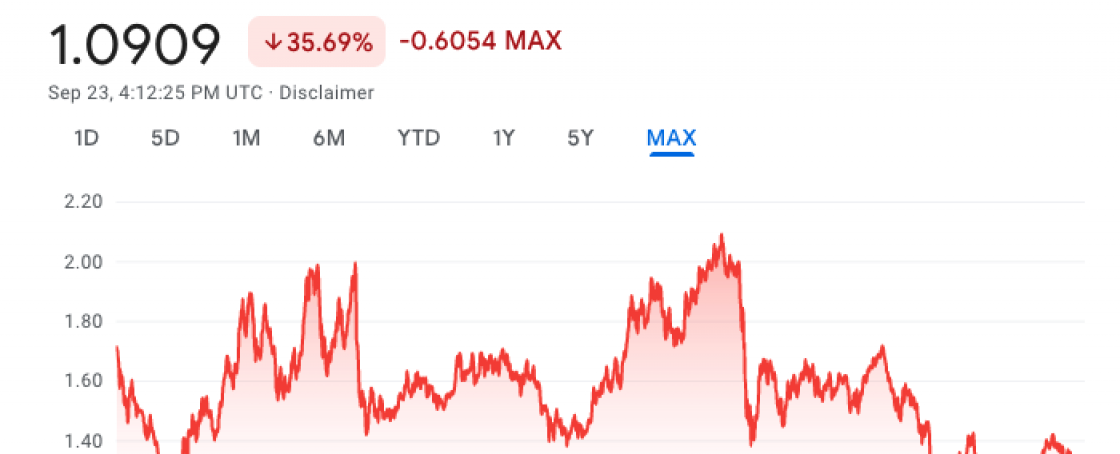
There were many ways to commemorate the 30-year anniversary of Black Wednesday this week, the day the UK crashed out of the European Exchange Rate Mechanism and sparked a sterling crisis. Neil Collins and Jonathan Ford, hosts of the A Long Time in Finance podcast, chose to do it in a three-part series that ran through the week (transcripts available on the Blind Spot)
But we have to hand it to Liz Truss and Kwaski Kwarteng for going that extra step and delivering a commemorative revival experience that even the metaverse couldn’t compete with.

A thousand financial writers will now be penning their thoughts on what this all means.
Here at the Blind Spot, we’re more interested in revisiting the details of the £40bn Energy Markets Financing Scheme – (EQE – aka Energy QE). Because that’s where the weakness stems from. And what’s happening in the details is mighty important.
From today’s ̶F̶i̶v̶e̶-̶y̶e̶a̶rgrowth plan:
The £40 billion Energy Markets Financing Scheme, delivered with the Bank of England, will help to address extraordinary liquidity requirements faced by energy firms from high and volatile energy prices. The scheme will provide a backstop source of additional liquidity to energy firms in otherwise sound financial health to meet extraordinary variation margin calls. It will be limited to those making a material contribution to the liquidity of UK energy markets and who are thereby systematically important to the UK economy. The scheme will provide liquidity to firms through a 100% guarantee, delivered via commercial banks and will open to applications from 17 October. HM Treasury will convene an advisory committee as part of standing up a robust assessment process. Firms will have to agree to a wider set of conditions before accessing the scheme.
As noted further in the document, the scheme is set to open on October 17 and will provide a backstop source of additional liquidity to energy firms in otherwise sound financial health to meet extraordinary variation margin calls. Energy firms will get a 100 per cent energy guarantee, delivered via commercial banks.
But what does this really mean? We still have scant detail.
Back on September 8 the BoE offered some clues. But not many.
What did catch our eye in that bundle was this:
The scheme will be designed to be used as a last resort and will be structured and priced accordingly. It will be open to firms that can prove that they are otherwise in sound financial health, have a UK presence, and play a significant role in UK electricity or gas markets.
An update today from the BoE, meanwhile, tells us:
Firms will need to undergo solvency checks.
HMT will convene an advisory committee as part of standing up a robust assessment process.
Pair that with the following from the Growth Plan:
A new Energy Supply Taskforce will seek to negotiate long-term agreements with major gas producers. The government is also working with electricity generators to reform the outdated market structure where gas sets the price for all electricity – instead, the government will move to a system where electricity prices better reflect the UK’s home-grown, cheaper and low-carbon energy sources, which will bring down consumer bills. Successful action should smooth the price of wholesale gas and electricity and increase security of supply over time, reducing the likelihood of similar energy price crises in the future.
Which is to say the energy system isn’t just getting overhauled, it’s being de facto Mussolini-ed. We are, it seems, entering into the domain of the corporate fascist state. I don’t say that lightly. I know it sounds ridiculous. And some could argue it’s more war economy-esque than fascist. But the similarities are glaring and worth pondering.
As former FT columnist Paul Einzig noted in his 1933 book, The Economic Foundations of Fascism, part of the trick in managing an efficient fascist economy is engendering the cooperation of the corporate world in the system:
Although politically the Corporate State in Italy is based on dictatorship, economically it is based to an increasing degree on voluntary co-operation between various economic interests. On the other hand, while the attempt to introduce economic planning in a country without preliminary creation of a Corporate system might be carried out on the basis of the existing system, the laws regulating economic activity would have to be imposed upon a grudging population.
The moment we begin to discuss the consequences of our actions upon others than those directly concerned we depart from pure laissez-faire and enter the field of economic planning.
The clue, in other words, was always in the name Growth Plan.

It turns out 2022 didn’t even need a Lehman moment to initiate the world’s most extraordinary energy bailout, which brings with it the dissolution of conventional market mechanics. This time, in the style of the Chinese government bailouts, European governments are taking very clear pre-emptive action.
The reason why the market isn’t too convinced by energy QE though, however, is because neither the Bank of England nor The Treasury, unless we’ve been mistaken all these years, have access to a special last resort reserve of energy.
That means the success of the plan rests entirely on the only power they do have: the ability to facilitate consumer repression. That’s why conditionality is important. We need to start asking how this energy liquidity will be dispensed? To whom and on what basis? Who will be prioritised and who will not? What does solvency even mean?
Only a fool would believe the above is not rationing by another name.
Back to Einzig on fascist Italy in 1933:
It may well be asked, however, whether the suppression of the freedom of consumers to choose their own goods is not an excessively high price to pay for the smooth working of distribution. It certainly deprives mankind of some of its most valued pleasures, and reduces life to a monotony which, in the long run, is bound to produce a degenerating effect upon imagination.
A solution will be found sooner or later through the scientific management of wages, prices, working hours and the cost of living. Even if this solution is less efficient than the one chosen by Communism, the maintenance of the freedom of consumption will amply compensate consumers for the defects of distribution.
Inquiring minds and conspiracy theorists want to know if that sort of scientific management is coming this time too, albeit in the shape of the corporate system’s favorite fad du jour: central bank digital currencies and digital identities?
The Blind Spot was lucky enough to sit in on an off-the-record meeting this Monday with those that have some idea about such things. We really mean that. We asked specifically about the potential of these tools being used for rationing.
The blunt and very personal answer was:
I wouldn’t introduce CBDCs for rationing, it would be a way to burn a very good idea. I mean, if everybody will associate CBDCs with the potential of rationing, that will be the end of the whole system. It has never been discussed in the circles we operate in. I would say pretty much all would disassociate themselves with this idea.
The central bankers say if CBDCs are hijacked for rationing purposes it will be by governments. The fact that they may have laid the path is entirely incidental.
We will be back shortly with some further thoughts on how financing for extraordinary variation margins ties in with intraday liquidity developments and an Uber surge pricing model for the entire Western liquidity system.
This is a long series that we have done extensive work on. We keep flagging it and failing to deliver, we know, but its scope and breadth just keeps growing.