

| SNEAK PEEK |
— The BoE is edging towards a new liquidity management regime to preserve money singleness — it could have big consequences for repo markets.
— Why are Argentina and Spain consumed by an unexpected diplomatic rift? Is it all about Sanchez’s wife, or is it about maintaining internal popularity?
— Dario tries to get to the bottom of what’s been going on in New Caledonia, and the French state’s declaration of emergency there.
Happy Bank Holiday Monday!
Apologies for the lateness of this newsletter. Work trips to Belgrade, an intensive filming schedule and a UK Bank holiday have all conspired against me this weekend. We’ll be back in a more timely fashion this coming weekend (we hope). And if not, we’ll make it up to readers some other way, we promise!
As usual, this newsletter was penned by me, Izabella Kaminska, with the help of Dario Garcia Giner.
Send tips to [email protected] and [email protected]
| THE BIG BLIND SPOT THIS WEEK |
A NEW BOE REGIME? Andrew Bailey, governor of the BoE, made two notable appearances last week. The first was an unlikely namecheck in the internet’s premier gossip newsletter, Popbitch, which highlighted his reputation for falling asleep in meetings and, even, midway through interviews. The second, came in the shape of his address to the LSE, which provided a crystal clear signal that change was coming to the BoE in terms of its reserve management framework.
Pre-positioning for pre-positioning: We’ve been flagging for a while now that the Tucker/King “pawnbrowker for all seasons” — aka a pre-positioning framework – is gaining traction in central banking circles. This speech made it clear the BoE is seriously considering such changes.
What’s on the table? The speech began with a long pre-amble about the importance of central bank reserves and the role they play in securing the singleness of money via the real-time gross settlement system (RTGS), and through that financial stability. That in itself was curious.
Thresholds are key: As our readers will be aware, central banks around the world are grappling with how best to determine the lowest comfortable level of reserves (or the Preferred Minimum Range of Reserves, PMRR, as the BoE calls it), beyond which financial markets face stability issues and the prospect of settlement failure due to a sudden and violent lack of liquidity. The problem, as has been recounted many times, is that that threshold is hard to calculate. It might even be a moving target, which needs a new and highly dynamic mechanism assigned to it, capable of constantly adjusting around it.
RTGS factor: It is no accident, we think, that the speech highlights RTGS. It is this area of the financial system that is most vulnerable if central bankers get that level wrong. Nor do we think it’s a coincidence that the FPC appointed Liz Oakes, a payments specialist with many years of experience at Mastercard, to its committee last week. Understanding the esoteric interactions between payments, liquidity and bank funding demands exactly such expertise if it’s to be managed appropriately.
Who funds the float? What is becoming abundantly clear is that for markets to continue being able to benefit from the singleness of money and guaranteed settlement, and to avoid monetary Balkanisation — the system needs the capacity to draw down on a large amount of standby funding whenever it might need it. Who provides or funds that standby facility when it’s not in use is the question. QE has played that role thus far. Since that portfolio was largely underpinned by government bond collateral, we now appreciate — due to the losses being incurred on the BoE balance sheet — how exposed it was to interest rate risk. We also appreciate – via the indemnity provided to the BoE by the Treasury – how it was ultimately backstopped by the taxpayer, due to the way the government absorbed the interest rate risk. Even if, as the BoE maintains, it’s largely a temporal accounting issue.
A new mix of assets: But, as Bailey recounts, if a permanent portfolio of assets is to be kept on the books of the cbank to ensure there is just enough liquidity sloshing through the system to ensure RTGS never goes down, it pays to consider what flavour those assets should be. Tweaking the composition, frequency and duration of the underlying, and also how the cashflows (both profits and losses) flow and to whom and when, will be key to ensuring the new system’s acceptance by the government and taxpayer.
Repo fine-tuning: Ideally, fluctuations around the PMMR level should be managed via repo, Bailey highlights. In this way, the additional temporary liquidity needed can be sourced not from the public balance sheet but rather from the market itself.
As Bailey noted: “… financial risk is best managed and distributed by the financial sector unless there is a strong policy case for the public sector to take on the risk (as was the case with QE). So from this perspective, providing central bank reserves through repo-operations has much appeal. In fact, repos score very well against all of our principles. Notably on delivering our core mandate, and on transparency and accountability, repos provide a lot of flexibility around monetary control choices.”
He added: “Say if Bank Rate were ever to return to its effective lower bound, a repo portfolio could quickly be displaced by asset purchases, or a funding scheme, for monetary policy purposes. By contrast, outright gilt holding are less straightforward to unwind.”
Repo markets should prepare: The key point from Bailey being: “…we would expect a significant increase in our repo operations as we look ahead to the future, and the market should continue to ready itself for this.
But there are risks: As Bailey concludes, even if the BoE eventually settles on an approach based on repos, the endogeneity of reserves demand needs to be factored in. “Should we, for example, incentivise firms to hold higher levels of reserves in normal time through generous terms of supply – or should we incentivise more active liquidity managements by firms and greater ‘recycling’ of a smaller overall level of reserves in money markets?” he noted. “The former increases the Bank’s footprint in markets. The latter places greater reliance on the active use of our facilities in stress to allow reserves to expand rapidly and at scale.”
Pre-positioning could help here: As Bailey notes, the PFAS model would ensure that the system can expand rapidly and at scale when it needs to through secured lending. However, the trade-off would be large-scale asset encumbrance and it is “not clear what level of asset encumbrance is sensible or feasible, especially to allow for sufficient emergency liquidity support,” Bailey said.
| GEOPOLITICAL HOT SPOTS |
MACRON VISITS THE EMBATTLED FRENCH ISLANDS OF NEW CALEDONIA as the state of emergency in the small island Chain in the Pacific continues to blaze. Macron has gathered together leaders of the independent and loyalist parties and proposed a “way of hope”, whereby both groups should find an agreement before the end of June that would mollify the most difficult aspects of the recent legal reform, which would allow non-Kanak natives (such as French emigres) to vote in local elections after living in New Caledonia for 10 years.
The source of the conflict is obvious: Typical tensions between an empowered native group and a privileged French settler community. But the way in which these tensions have flared up, the resources at play, and how it fits into a broader geopolitical picture, aren’t so clear. Let’s try to explain it.
New Caledonia was annexed by the French on September of 1853, and by 1953 all its inhabitants had been granted French citizenship.
But things got off to a rocky period in the mid-20th century. A growing Kanak socialist independence movement, with ties to the Soviet Union, broiled with repressive French control over the territory in what locals deem “Les Evenements” (the Events) of the 1970s and 80s.
A de-facto civil war, roadblocks, gun battles and widespread destruction of property culminated in a disastrous hostage-taking operation, where 27 French policemen were taken captive. The ensuing military assault to rescue the hostages allegedly ended with summary executions of the hostage-takers by French special forces. This led to the Noumea Accords of 1998, which set a 20-year transition period that gradually transferred centralised French competencies of state to the local government, as well as establishing a series of independence votes from France.
And while the first referendum in 2018 led to 56.7 percent of voters choosing to stay with France, the second referendum in 2020 was much tighter, with only 53.4 percent choosing to remain. The battle to maintain influence, it seems, was quickly being lost by French authorities. The following 2021 referendum was troubled. Held during the ongoing Covid-19 pandemic, the vote was boycotted by Kanak independence groups and barely had any Kanak participation, leading to a 96 percent pro-French result — but over two-thirds of voters abstained or returned null ballots.
So you can see why the Kanaks have an issue with the novel law, whose electoral reform grants equal voting rights to French settlers. The entire point of the Noumea Accords was to grant a degree of self-government by gradually allowing locals to rule over themselves. But the recent law would allow the French state to continue ruling by extension of its settlers, simply passing the potato of governance from the French state to a French-dominated Kanak state.
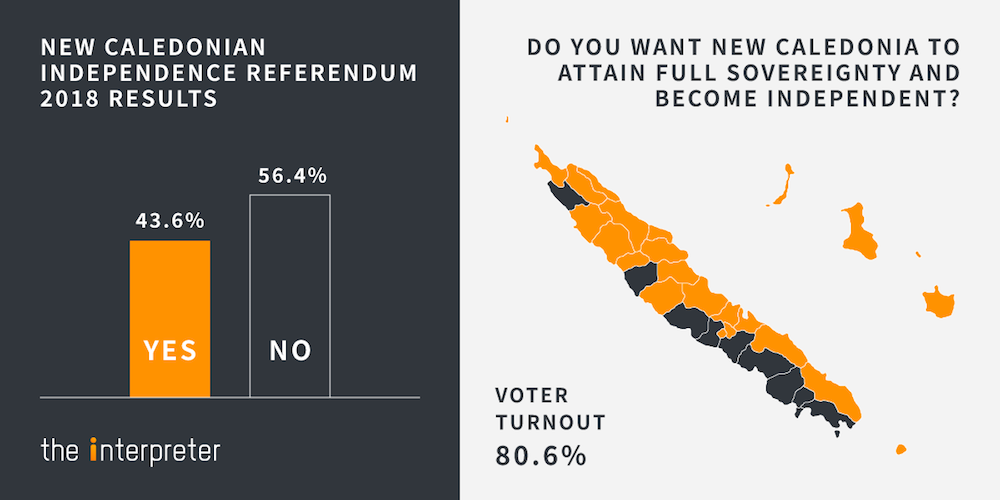
The French are similarly worried about New Caledonia’s pro-independence party, the Kanak and Socialist Liberation Front, which is part of a regional “Melanesian Spearhead Group” whose headquarters in Vanatu were recently donated by China.
But other claims may have more grounding, even if they may be less salient. These include France’s claims that Azerbaijan has been meddling in the conflict.
SERBIAN TENSIONS BREW: The president of Bosnia’s Serb-controlled Republica Sprska, Milorad Dodik, repeated his threat to withdraw from the Bosnian Republic last week. This threat comes ahead of a United Nations General Assembly vote on Thursday to establish an annual day to commemorate the 1995 genocide of over 8,000 Bosniaks in Srebrenica. This has now passed, much to the upset of many Serbians. Vucic later highlighted that only 84 countries voted in favour, while 19 voted against and another 68 abstained.
Dodik had railed against the resolution, alongside Aleksandar Vucic, President of Serbia, claiming the resolution would brand “all Serbs as genocidal”. In response, Dodik has promised to table a motion to secede from Bosnia in the regional parliament should the UN vote go ahead.
Patriotic sentiment: The Blind Spot happened to be in Belgrade this week, so we witnessed some of the reactionary patriotism directly, with a multitude of flags and cavalcades on display throughout the city on Wednesday and Thursday.
Frontpage affair: In terms of how the Serbs see it, here’s the front page of one Serbian daily on May 23 that we snapped in the kiosk (accompanied with the Google translate):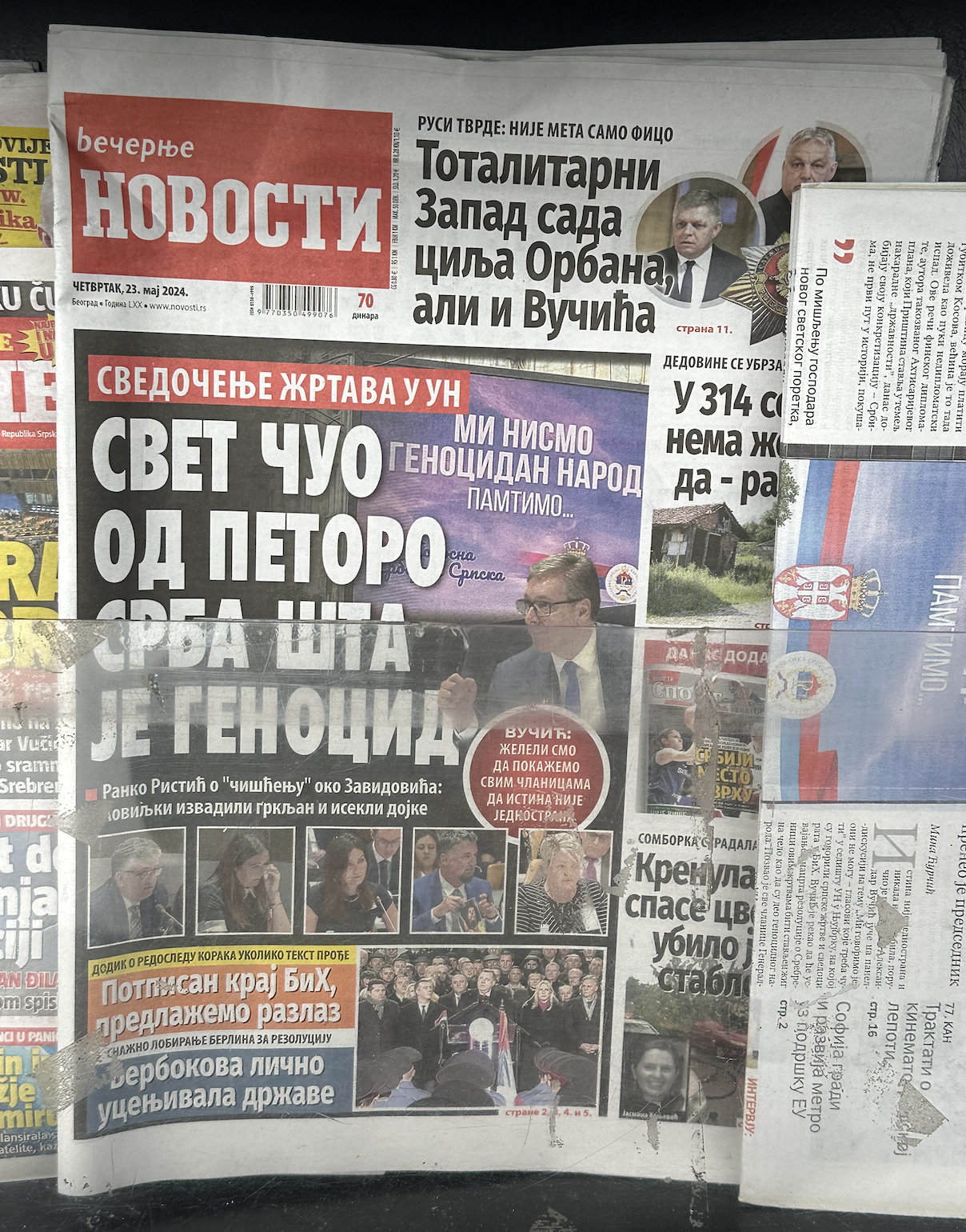

Not really friends of Russia: The Serbs we got to hang around with (admittedly mostly a pro-EU and pro-West professional intelligentsia) took umbrage at being described as living in a Russia-friendly country. They highlighted that Serbia had quickly condemned Russia’s aggression in Ukraine, calling for international respect for its borders. Given Belgrade had to contend with its own separatist Kosovo movement it is not surprising it would back Ukraine’s border integrity.
But sanctions are a different matter: The Serbs have famously refused to join in with broader Western sanctions against Russia, and are acutely aware that this is the stance that has landed them with the “friends of Russia” label. But the view on the ground is very nuanced. Having endured sanctions themselves as a result of Nato intervention in the Balkans in the 90s, the Serbs say they know not only that sanctions don’t work; but that they hurt the poorest and most innocent in society without scratching the power echelons. Second, since Serbia is not in the European Union, they don’t have the luxury of being able to alienate themselves from critical markets they depend on. Last and not least, it’s hard for them to ignore that Russia is among only a few states that have diplomatically never recognised Kosovo’s independence.
WIDER TENSIONS? To what degree are tensions rekindling in the region? On the ground, based on our totally superficial touristic perspective, Belgrade feels remarkably safe and stable. But it also feels underegulated. Coming from the EU or Britain, you’ll notice the totally wild nature of the taxi market, the plastic straws, the ashtrays and the uncladded and unrenovated communist structures. For the most part, the vibe is very Warsaw 1992. At the same time, you’ll notice a very well-dressed, sophisticated and seemingly prosperous middle class, equipped with all the mod cons they’d ever need. That business-oriented demographic appears keen to woo foreign investment and speaks disparagingly of an older generation that can’t give up on old grudges and politics.
KOSOVO BANK RAID: But there are other notable signs of rising tensions. Earlier in February, the Kosovo government decided to ban the use of the Serbian dinar currency in its territory, opting to Euro-ize its economy entirely (it has been using the euro since 2002). This sparked protests due to the number of Serbians receiving pensions and salaries in Serbian-run institutions, such as hospitals and schools. Inflaming matters this past week, the Kosovo authorities closed six Serbian bank branches which they claimed were continuing to transact in dinars despite the February ban. The Serbians we spoke to found this very provocative.
ISRAEL IS IN DEEP TROUBLE, claimed international relations realist John Mearsheimer, in his latest speech at the Centre for Independent Studies. In a provocative address, Mearsheimer – often dubbed a Russian stooge by Western media due to his measured stance on the Ukraine conflict — presented Israel as faced with an unsolvable conundrum. According to Mearsheimer, October 7 has killed off any chance of implementing a viable two-state solution, and likely forced Israel’s hand into now pursuing an ethnic cleansing of Palestinians in what he terms “Greater Israel” — or the territories of Israel, the West Bank, and the Gaza Strip. His arguments accurately portray the dilemma facing Israeli leaders — moral bankruptcy in quasi-genocidal actions to achieve security, or facing a perennially unstable internal security situation under its current de-facto apartheid, with an increasingly oppressed and violent Palestinian majority.
SPAIN AND ARGENTINA FACE AN UNPRECEDENTED DIPLOMATIC RIFT over Argentinian President Milei’s comments towards Pedro Sanchez’s wife last week. At an event with Spain’s hard-right party Vox, Mileo claimed Sanchez’s wife, Begoña Gómez, was corrupt. In response, Sanchez demanded Milei offer an apology, which Milei refused to do. As a result, Spain has since removed its ambassador from Argentina.
The diplomatic rift has come as a shock to onlookers — it’s not uncommon for politicians to use publicly known rumours to launch at others. What’s rare is for them to become full-blown diplomatic calamities.
The reasons why Milei didn’t offer an apology to the Spanish premier seem obvious, at least to Milei. He pointed to an instance in which members of Sanchez’s ruling Socialist party leadership alleged Milei ingested drugs during party rallies. Argentinian Presidential appointees also claimed, rather disingenuously, that Milei never explicitly named Sanchez’s wife.
And while Sanchez has escalated the crisis, insisting he will sue Milei through official channels and by removing the Spanish ambassador, the Argentinians are taking a different route. They claim the conflict is ‘personal’, and the Presidential Office announced they were ‘surprised’ that Sanchez had taken the comments as seriously as he had.
But the reality of the matter is that this is all a non-event. Not only do Sanchez and Milei represent two opposing sides of the political spectrum, and don’t compete for votes, it’s akin to two ducks loudly quacking at each other while keeping an eye on their ducklings behind: the use of this conflict by both leaders’ is purely internal.
The Argentinian President returned to Buenos Aires “surfing on a wave of socialist tears”, as reported by his Presidential Office, and engaged in a ferocious tweet-a-thon where he claimed Sanchez was, in typical woke fashion, attempting to restrict speech and exploiting false victim-status. On the other hand, Sanchez used the event to further tarnish anyone who criticises his wife’s shenanigans: Milei’s comments are typical of his brand of hard-right politics and discrimination towards women.
Both Presidents have much to gain from exploiting this crisis: Sanchez’s outrage, and Milei’s unabashed fun during the ordeal as evidenced on X/Twitter, will both prove useful to these premiers who are undergoing hardship in maintaining control over their internal policies due to their weak hold on government legislatures. Remember, both Milei and Sanchez’s parties failed to reach a majority in their respective legislative chambers.
So while we may look at this conflict and laugh, I hope nobody takes it too seriously. It’s little more than panem et circenses.
| SPOOKSVILLE |
DEADLY SPYCRAFT: A former British Royal marine, Matthew Trickett, who had been charged with spying on Hong Kong activists in the United Kingdom for China in 2023, has been found dead. Court documents revealed the man had attempted to end his life while in custody. While details regarding his death have not been released, it is currently being treated as “unexplained”, with a post-mortem to follow in due course. The death came just a week after Trickett appeared in court to face two charges under the National Security Act of 2023.
MARSALEK AND THE AUSTRIAN SECRET SERVICE: The fallout from the Wirecard drama never seems to stop. The latest developments come by way of Politico’s Matthew Karnitschnig, who has got the low down on how the world’s most wanted runaway payments executive came to infiltrate the Austrian secret service. It’s an epic read, and well, just read it.
| MEDIA MATTERS |
THE WOMEN OF THE CIA AND THEIR GLOBAL CENSORSHIP PRISON… Zerohedge featured a piece by Elizabeth Nickson, former MSM journalist turned Substacker, unveiling a list of women who head influential media operations such as NPR and the Global Disinformation Index. Interestingly, before heading into the media, the women typically held long stints at NGOs, with Nickson specifically calling out, Clare Melford, Chief of the GDI, a “non-profit authoritarian,” for her lack of true news credentials. Nickson ties these women’s roles and interesting CVs into a wider discussion on the disturbing history of intelligence agents being embedded into the media profession, and the increasing turn towards “safety” and “censorship” that has come along with it. But, of course, this is Zerohedge.
| AMERICAN POLITICAL DRAMA |
WASHINGTON IS GIVING BIRTH TO A NEW POLITICAL FORCE: New centrism. David Leonhardt’s latest piece for The New York Times, argued that a rising neopopulism is opening the door to a bipartisan attitude that mistrusts the free market in a number of key areas, notably on China, and security. He points to the last few years’ impressive period of productive bipartisanship in Congress and the Senate as an example of its influence. As opposed to neoliberalism, which craved for lowering trade barriers, neopopulism is bringing all the barriers back.
