| SNEAK PEEK |
— Izzy gives an update from Hay on Wye’s Weekend of Mistakes.
— This week’s big blind spot argues CBDCs won’t be able to handle authorised push payment fraud.
— Dario takes a deep dive into what exactly the UAE’s land deal with Egypt means for the region.
Good morning subscribers!
Greetings from Hay on Wye in Wales where I am attending the Weekend of Mistakes festival, organised by Anatomy of the Bear author and all-round investment guru Russell Napier, and EM investment specialist Paul Greatbatch. Getting to Hay took much longer than expected on Friday, hence the delay of this newsletter. The trip, however, was more than worth it even if it means a shorter newsletter this week (and apologies for typos as written on the go).
Among the learnings I have picked up so far (not exhaustive):
Ian Fraser’s contempt for Natwest is impressively unchallengeable in the public sphere. The author of Shredded took us through a detailed walkthrough of the role Fred Goodwin’s largesse (not to mention his private jets) played in the bank’s 2008 downfall. According to Fraser, Fred has been a public recluse ever since, though he is occasionally seen playing golf at a £30,000 membership club near Edinburgh or at locally organised pheasant shoots. But the story doesn’t end there. Last year’s Nigel Farage unbanking scandal exposed that the bank’s management practices still leave much to be desired. Panelists agreed the bank’s decision to centre itself around ESG proved to be nothing more than a smoke screen for actual improvement. The part government-owned bank is now on the verge of a “Tell Sid” style campaign re-privatisation campaign, apparently by June, but whether it will prove popular with retail investors in the wake of Alison Rose losing the trust of every high net worth customer is another question entirely.
Some bank analysts in the room, nonetheless, argued that now is the best time to own UK banks — and that’s not just because they’re undervalued. It’s because their capacity for risk-taking has been constrained check, which makes them much safer bets for investors and the only way is up. He added there’s even more justification once you realise that profits this year, which were still substantial in post-2008 historic terms due to the return of robust net interest margins, were constrained by outstanding interest-rate hedges.
Jared Bibler, author of Iceland’s Secret, ran us through the fascinating story of how the Icelandic banks actually collapsed in 2008. Their key ploy was using shell companies to buy their own shares with, unsurprisingly, their own financing. But this truth, Bibler noted, is being lost to history as the popular narrative in Iceland is being twisted into one focused on the idea that US subprime took a toll on the sector rather than actual fraud.
Russell Napier focused on his specialist topic of how governments will turn to financial repression to save their economies, though this will be much harder for the EU than for other countries to engage in, due to the conflicting forces of ongoing ECB centralisation in the midst of political decentralisation and rising efforts to achieve national strategic autonomy.
Merryn Somerset Webb argued that a little bit of repression is no bad thing because it should be the case that the country’s outsized pension assets, thanks to our defined benefit pension schemes, should be put to work in our own country.
Former IMF deputy director Tamim Bayoumi argued the reason the IMF has a favourable disposition to Javier Millei in Argentina is largely because it’s the only chance they have to get a return on their capital. However, in reality, Millei is limited in what he can really do because he lacks power over Congress or regional authorities.
Meanwhile, on the ground, there was some speculation (okay, more of a conspiracy theory) that Credit Suisse may have been a controlled demolition sparked by the US in a bid to bring down Switzerland’s financial power and make it overly concentrated in just one bank by design (all the easier to hold the government hostage to the banking sector now, you see). It’s not that the Americans were responsible for the bank run per se, it’s more that Janet Yellen looks to have been the one who persuaded Swiss regulators to give up on bank resolution and opt for the UBS shot-gun marriage instead. It increasingly looks, however, like the action plan was long in the making at the rival institution, rather than being the hastily put-together deal everyone thought it to be.
Helen Thompson and Nick Butler ran through everything that’s wrong with the current approach to energy transition, with Butler arguing more focus needs to be put on adaptation than self-constraint because we are all in denial about how much longer we will need fossil fuels for. The arguments raised won’t be new ones for Blind Spot readers, but it was interesting to see them becoming more mainstream. Thompson also articulated the limitations of depending on Chinese solar prowess, and both reminded the audience that electricity generation is only a small amount of the picture. Meanwhile the capital costs of nuclear continue to put off investment in the space.
Reminder, the Swiss government’s review of what exactly happened last year is due out sometime in March, and we have it on good authority there will be a sizable contribution from a high profile deputy BoE governor in it.
Send tips to [email protected] and [email protected]
| THE BIG BLIND SPOT THIS WEEK |
CBDC KILLER THOUGHT BUBBLE: This week’s big blind spot (due to our Welsh-based constraints) is more of a personal revelation about why CBDCs may never make commercial sense for anyone. And a point that has thus far been missed by absolutely everyone pushing the concept in the central banking space.
What’s the skinny? As readers may remember, my father was subject to an authorised push payment fraud a few weeks ago. The good news is, he was finally refunded under the Contingent Reimbursement Model. Many banks partake in this voluntary refunding code for reputational reasons, but also (we can presume) to keep on the good side of the government. However, there’s no doubt it’s a big and questionable liability for them. Are banks really the ones that should be responsible for scammers preying on open systems?
Shifting liabilities: Efforts are unsurprisingly underway to try and shift some of the liability to tech companies, which are used for disseminating the frauds in the first place. In Europe, Marek Belka MEP is leading the charge to make big tech at least partially liable, while in the UK, bank lobbying group Finance UK has picked up a similar campaign.
The numbers: According to the latest report by Finance UK criminals stole £580 million through unauthorised and authorised fraud in the first half of 2023, a two percent decrease compared with the same period in 2022, while banks supposedly prevented £651 million in the UK alone. So it’s not an insignificant number. And the bigger problem is, it’s only getting larger every year.
The CBDC factor: But in a CBDC instant payment world (where even foreigners abroad get access to digital pounds and euros) who exactly would be responsible for making victims of authorised push payments fraud via CBDCs whole? Were it to be the banks, that would be yet another reason for them to oppose the shift to a CBDC regime. Banks already have little incentive to provide wallet services for digital pounds, since they cannot mobilise the underlying funding for credit purposes. But, under the regime, they would still bear all the risks and costs for managing client services. What’s more, the UK is not China which has the capacity to force banks to engage in unprofitable CBDC business for patriotic purposes. Were it to be the tech platforms, that would greenlight even more surveillance, which is already a sensitive issue for CBDC rollout, and would undermine any claims that CBDCs are really private.
It would have to be the central banks! This, however, is totally inconsistent with their current position that they should have little direct involvement with customers. Would you want the central bank to be the one to make judgments on your cognitive capacity to recognise potential scammers on their networks? Or to figure out if you really are authentic victim of crime? Meanwhile, have central banks even factored in the cost of such liabilities into their cost-benefit analysis for CBDCs? Consider, when it comes to the costs, how much easier and more prolific APPF fraud would be on a CBDC system which is fully inclusive and available all around the world, even in jurisdictions where British authorities have no capacity to influence or police? Finally, why is nobody raising this issue anywhere in the CBDC consultations or in design process?
Bottom line: This could, in our opinion, be the ultimate killer of CBDCs. We think.
| GEOPOLITICAL HOTSPOTS |
SOVEREIGNTY FOR SALE IN THE MIDDLE EAST? Bloomberg reported that Egypt received the first transfers from the $35 billion in funds pledged by the United Arab Emirates as part of a massive package of financing in exchange for Abu Dhabi wealth fund purchasing the development rights to a premium area on Egypt’s Mediterranean coast known as Ras El-Hekma for $24 billion.
Ras el-Hikma is a beautiful Egyptian town on the Mediterranean Sea. Last week, the Egyptian government sold it to the United Arab Emirates — along with 42,000 acres around it. The deal has already bulged Egypt’s pockets with $15 billion, with another $20 billion contracted to be paid within two months.
Concerned onlookers may be appeased by this apparent relief for Egypt’s foreign currency crisis. Besides funding extraordinarily expensive architectural megaprojects, which the Egyptians have always favoured, the Egyptian state notoriously relies on imports, particularly wheat, to feed its population.
Furthermore, the deal will not involve Egypt relinquishing its sovereignty over the town. While a large area has been sold to the UAE, including an international airport, the area will remain under Egyptian control, and the state will also receive around 35 percent of the profits derived from the Ras El-Hekma project.
Despite this, for Egyptians the deal is anything but uncontroversial. Critics of Sisi particularly bemoaned the sale of one of Egypt’s most pristine beaches to a foreign developer.
We beg to differ. After all, beggars can’t be choosers. And the UAE’s seemingly endless pockets seem to have appeared at just the right time for the stability of the Egyptian state.
It’s not the first time the UAE’s land-buying moves have been critical to the outcomes of countries in the Horn. In 2018, the UAE’s DP World was the second major investor in Somaliland’s Berbera port – and created the Berbera Economic Zone.
The UAE’s investment in Somaliland was the key precursor — with DP World the big commercial winner — of Ethiopia’s land-swap arrangement, which also includes the so-called Berbera Corridor. Being developed by DP World, the deal comprised an investment of up to $1bn into supply chain infrastructure connecting Addis Ababa and Berbera in 2021. It’s presumed this corridor will form the main route that Ethiopian exports and imports will take from their new concessions in Somaliland.
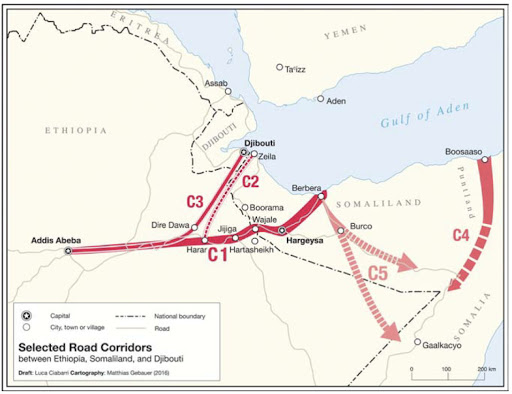
Curiously enough, the deal was also backed by British taxpayers, who provided $23m through the UK’s sovereign wealth fund CDC, now renamed British International Investment, as part of an African investment package with DP World in 2021.
Similarly, Somaliland and Egypt aren’t the only ones benefitting from foreign remittances in exchange for land concessions in the Horn. The greatest beneficiary is arguably the small country of Djibouti.
The tiny state is often remarked as an oasis of calm in a tempestuous region, and is host to five foreign military bases. China, Japan, Italy, France, the United States and Saudi Arabia have, or are developing, bases in the country. Their presence in Djibouti was a first for Italy, China, and Japan, as they constituted these countries’ first foray into large overseas bases far outside their national soil.
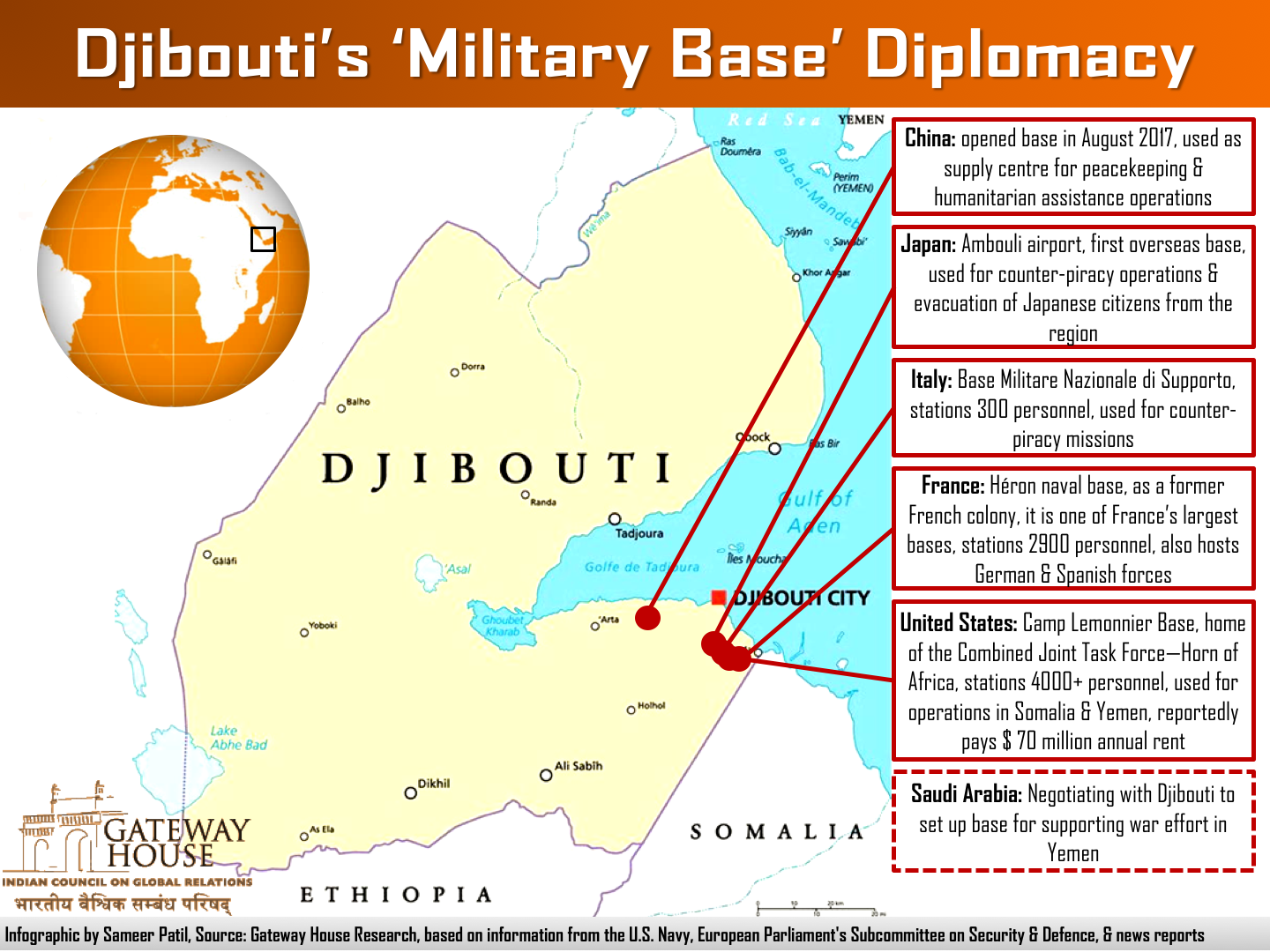
Foreign observers have remarked on the curious nature of Djibouti’s military bases, with America’s and China’s outposts nervously eyeing each other separated by only 20 km.
But they weren’t the Horn’s oddest bedfellows. In October 2023, news emerged of a supposed Houthi attack on a secret Israeli intelligence outpost on Eritrea’s Dahlak islands. While the news was quickly branded as “fake news” by the Eritrean Minister of Information, more information online attests to some kind of Israeli presence in Eritrea since at least 1995. These comprise listening stations on the island of Al Hunaish, and port facilities for Israeli submarines in the Dahlak archipelago, both of which are strategically situated in the Bab el-Mandab Strait. And a quick look at the rebutters of the Israeli military base claim also reveals most of them have links to either Israel or the Eritrean government.
Stranger still, a 2012 Stratfor report claimed that Iran and Israel’s bases were only a few kilometres apart in Eritrea. These Iranian bases, which existed since 2008, were supposedly key nodes in the transfer of equipment bound for Hamas and Hezbollah from Iran. The goods were supposedly shipped into Eritrea, transited through Sudan, and were then smuggled into Gaza, Lebanon and Syria through Egypt. Contrariwise, the Israeli bases in the same country seemed to be used as part of a covert war against this smuggling network. It appears that, since 2014, Saudi pressure on Eritrea resulted in the Iranians being kicked out. Eritrea now hosts the Saudis instead.
Beyond these intriguing tidbits of the Horn’s land-based concession politics, what becomes evident is the vast opportunities available for countries to earn foreign remittances in the sale of strategically relevant terrain. While they can sometimes turn into calamitous mistakes, such as Russia’s sale of Alaska and its untapped oil wealth to the United States in 1867 for today’s equivalent of $125m, we shouldn’t be surprised to see more cash-strapped countries selling off as-yet undeveloped parts of themselves to cash-rich, geographically isolated (or distant) countries.
The first cash-strapped country that comes to mind is, of course, Spain. Beyond the little-known enclaves of Ceuta and Melilla in North Africa, Spain is the not-so-proud owner of numerous islands and crags dotted around the north Moroccan coastline:
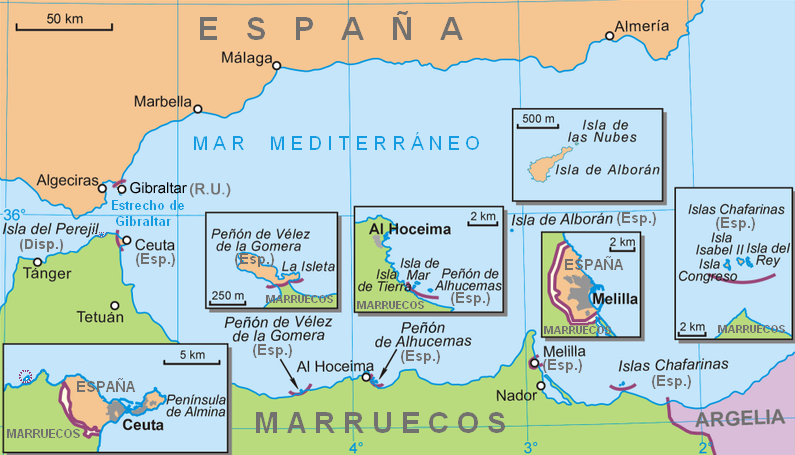
Any foreign country that would wish to supervise and track commercial and military vessels across the Straits of Gibraltar would be well-placed to pay outsized sums for islands and rocks, most of which lay completely unused by Spain.
And, beyond Spain, other lucky occupiers of tight-fitting waterways, such as Malaysia and Singapore’s Strait of Malacca, may be placed to benefit from this growing land-concession trend. More interestingly still, I would bet this could eventually lead to the concession of territories to companies independent of sovereign backing — and pave the way for the emergence of truly old-fashioned commercial republics.
THE DRONE WARS: Rand argued that amid fighting in the Red Sea, Israel-Gaza, and Ukraine, focus is intensifying on the threat presented by the proliferation of drones, missiles, and rockets and their potentially devastating use against both military and civilian targets.
DARIO COMMENT: This week, we were regaled with news that the West’s best chances to redress the many ills we often spot in Western warfighting economics are unlikely to develop. While Direct Energy Weapons — a.k.a DEWs (fancy-speak for lasers) — offer the West its best chance at a cost-effective anti-air solution, it turns out the solution is too cheap for us to develop.

It’s often better to lay quietly and look like a clown than to open your mouth and dispel the doubt. Western military strikes against Houthi militants in Yemen have done much the same. Whereas the Houthi’s cheaply refitted Soviet-era missiles and $20,000 Shaheed drones are capable of flying across the Bab el-Mandab straits and more-or-less accurately strike moving commercial vessels, Western vessels have acquired a dismal track record.
Western missiles shot from British and American ships can easily track down and shoot the Houthi’s ad-hoc arsenal; however, they’re doing so with a minimum cost of $2m per shot. And, as the latest German naval debacle shows — in which a German ship mistakenly fired two missiles at an American MQ-9 Reaper drone, only for both missiles to fail — the dubious economics of Western weapons are just the tip of the high-cost, high-maintenance, mediocre-functionality iceberg.
DEWs offer Western militaries the way out of this dilemma. They can fire accurate shots kilometres away at lightspeed for around $12 a pop. While the internet has been ablaze with rumours that such weapons have existed since at least the Reagan Star Wars program, I’ve always wondered why these weapon systems haven’t been more prevalent. A careful reading of (often dubious) accounts of Nazi German engineering feats show they had already been testing high-power lasers in underground bunkers with much the same intention. Considering the advancement of German laser technology, whose laser primers would prove crucial in advancing America’s atomic program after the war, this would seem plausible. So where are the DEWs?
Last week, I finally received my answer. A brilliant RAND article outlined precisely the problems with DEWs:
“(The) potential challenge is that, while DEW platforms can rebalance asymmetry in conflict by cheaply and quickly neutralising low-cost threats, this could inflict collateral damage on the long-term revenue surety of the defence companies needed for their development.”
Western missiles and artillery systems necessitate large amounts of maintenance for parts and software upgrades in order to remain functional, which according to this RAND piece, forms the largest part of Western defence makers’ income. We’ve already been seeing the consequences of this: about a third of Ukraine’s American-made howitzers are consistently out of action due to chronic maintenance issues, or Ukrainian soldiers’ headaches with the otherwise brilliant Javelin anti-tank missile’s extremely complex handling.
So, in other words, the problem with Direct Energy Weapons is that they don’t have enough problems.
This fits into wider issues with product delivery in Western militaries that were also summed up by a RAND paper on problems with British MOD equipment orders:
“Overly prescriptive or ambitious capability requirements can set the scene for poor performance delivery down the track (…)
A culture of optimism permeates defence equipment programme decision-making, distorting assumptions and planning outcomes.”
This goes right to the heart of the issue. Western defence leaders in private and public sectors are obsessed with fielding the best possible equipment. From this perspective, fielding the most expensive equipment is necessary to overcome your opponent. But are these the right lessons from the last major war?
Most of the equipment often pointed to as World War II’s “best” — the ME-262 fighter jet, the V-1 and V-2 guided missiles, or the Panther and Tiger tanks — were production and maintenance nightmares that arguably handicapped the German war effort. On the other hand, the Soviet T-34, though mostly outgunned by the later stages of the war, and the oft-maligned American Sherman tank, were delightful creatures: mediocrity on the field, but with minimal time spent in the factory and maintenance shop.
The correct lesson from the World Wars was arguably far simpler — the side with the most men and the most guns inevitably wins. And that means prioritising the cost-per-bang factor, rather than focusing on the technological and capability bling. It’s a lesson that Russia learned well. And it’s one that Iran – faced with no possibility of outmatching Western militaries’ technological prowess — has been forced to adapt to (with much success).
What results is a total lose-lose for Western defence and the Western taxpayer: Our taxation money is going towards developing complex systems that don’t work, cost far too much to upkeep, and have created a defence industry dependent on developing overly complex weapons requiring considerable maintenance to survive. This means any potential solution to our quandary, such as DEWs, become too cheap to survive. Don’t be surprised if we only see the rise of DEWs that “need” some ridiculous overkill capability, like shooting down satellites orbiting the Moon, when what the West really needs is an overpowered mosquito zapper.
Meanwhile, the West’s opponents have been engaging in developing mediocre weapons cheaply, and their no-frills defence industries can bear the cost of developing simple weapons that, simply, work.