

Dear Blind Spotters,
It’s Remembrance Sunday so I’m going to keep today’s intro short. My main value-add of the week is that I had the opportunity to interview City Minister/Economic Secretary to the Treasury Andrew Griffith at Politico’s first-ever UK Financial Services summit on Thursday. He told me that the reason pensions reform was missing from the King’s speech this week is because it is unlikely to require legislative change to achieve. There’s no greater mystery than that. More info will be made available at the Autumn statement.
The expected reforms are a part of UK Chancellor Jeremy Hunt’s plan to mobilise pension capital so that it can be better allocated to UK growth companies. Under the reforms, pension plans will be encouraged to “re-equitize” their holdings and allowed to allocate funds into less liquid investments such as private equity.
Separately, it has come to my attention that Dark Enlightenment poster child, Curtis Yarvin — who goes by the pen name Mencius Moldbug — was seen circulating in the crowd of last week’s ARC conference.
While I did not spot him myself, I thought his presence was worth referencing as it speaks to the sort of views that are being entertained in the ARC universe.
For those who don’t know, Moldbug writes in favour of a return to a benevolent monarchic system and has become popular with Silicon Valley types who advocate rule by a technocratic, corporate tech monopoly. Among those following his work include artists like Grimes, now better known as Elon Musk’s ex-wife. Her interest in his work, I’d argue, offers a bit of a clue to who the technocrats might be looking to anoint as their ultimate Philosopher King. The answer, disturbingly, is that it might not necessarily be a human at all but, rather, an artificial intelligence programmed to bring about a utopian Gosplan 2.0 planned economy. Yes, really. The question worth asking in that context is what underlying values are the technocrats keen to programme into the AI? And can they be trusted to do so fairly for all humanity?
If you think all of this is farfetched you haven’t spent enough time looking into Elon’s links to the technocracy movement, notably this New Yorker piece from September, which recounts the tale of his technocratic grandfather, J. N. Haldeman.
Moldbug’s writing is part of the accelerationist genre, and if you want to know more about it, do read Tim Ferguson’s extended piece about what it all means and how it differs to anacyclosis.
This week’s Blind Spot newsletter was compiled as usual by me Izabella Kaminska with the help of Dario Garcia Giner.
| ECONOMICS, BUSINESS, FINANCE ETC… |
BLAST FROM THE PAST: Economist Charles Goodhart told a Select Committee on Economic Affairs in March 2021 that (our emphasis):
“We are in a very weird world where we are actually undertaking helicopter money; we are following exactly the precepts of modern monetary theory, otherwise known as the magic money tree; and at the same time we are claiming that we are not doing it. We are doing what we claim we are not doing. I find this situation absolutely weird.”
Adair Turner responded in the same committee:
“What Milton Friedman meant by “helicopter money” was money financed by the central bank creation of money—but I absolutely agree with Charles that we are denying things that we are doing. This has become the case in the Bank of England and Federal Reserve, but I have believed for over 10 years that the Bank of Japan is doing permanent monetary finance. There are no believable circumstances in which the Bank of Japan will ever sell back the totality of this massive accumulation of JGBs—over 100% of Japanese GDP. There is none in which it will sell them back.”
Then Charles Goodhart added:
“I do not think that the commercial bank deposits at the Bank of England will go down all that much. It will be politically extraordinarily difficult should interest rates start to go up to have large payments out of the central bank to commercial banks. It would possibly even have the effect of driving the central bank into a loss that would have to be made up every year. If you have something of an indefinite period with a zero interest rate, it has no fiscal cost whatever. It is not only QE; it is the combination of QE and the payment of interest on excess reserves that makes the whole process so sensitive to any increase in interest rates. My view is that, should interest rates start to go up, it will become almost politically inevitable to return to paying zero interest on commercial bank deposits.”
It’s worth reflecting on those comments because we are indeed coming to a point where cbanks are being pressured to contain the losses their own policies created and where implicit monetisation (thanks to the poor 30-year US Treasury auction last week) is seemingly becoming explicit. At the ECB, as we’ve noted before, there are now serious discussions about raising the minimum reserve requirement (MRR) – now zero remunerated – to as much as 10 percent. Further afield there appears to be growing appreciation for moving to a “pre-positioning” framework, as central banks realise that other frameworks might be necessary.
If you missed it earlier this year it’s worth revisiting Paul De Grauwe’s lecture on the “role of central bank reserves in monetary policy” where he argued the ECB could hike the MRR to as much as 15 percent without losing control of interest rate policy. The speech was flagged to us by former cbanker Robert McCauley, who sees the move (just as we do) as mostly analogous to a bank tax. As we noted in last weekend’s Blind Spot Newsletter, McCauley would rather have central banks and treasuries engage in a bond swap so that losses are contained at current levels. The move would simultaneously reduce the central bank balance sheet, albeit without soaking up the related liquidity which would now be permanently entrenched in the system. That might not sound good, but since the bond swap would come with an associated reduction in public debt the overall effect might balance out. Though to keep its budget funded the government would have to return to the gilt market at a much higher cost of funding.
McCauley has since penned an oped for FT Alphaville outlining why the ECB should be motivated to act: not acting risks reviving the same dynamics that helped to turn London into the premier international location for eurodollar trading.
“Depositors with more money would be more likely to evade the tax by shifting their euro deposits offshore. Those promoting a tax on banks’ shareholders might instead succeed in imposing a regressive tax on smaller depositors,” McCauley wrote.That may be the case, but judging by what’s already happening with eurodollar derivative clearing, the Eurozone would likely respond with more explicit capital and FX controls.
In September, the European Central Bank determined that European banks and investors should be forced to shift derivatives trades out of UK dominant clearinghouses and over to Europe in the name of better oversight and financial stability. It’s not inconceivable that with the launch of the Digital Euro, there will be some serious consideration given to who can and can’t hold euros related to their geographic location and/or at what rate. The ECB would be foolish to restrict digital euro holdings to onshore wallets only, since this would inhibit access to tourist and remittance flows. But, if the digital euro really got off the ground, there’s no reason why it couldn’t penalise holders of offshore euros more than holders of onshore euros via higher entry/exit fees to its system.
Offshore euros in this framework, of course, would amount to a type of euro-denominated stablecoin, making my prediction from 2017 finally come to pass: — IK
SYSTEMIC STABLECOINS operating in the UK would get access to the Bank of England’s reserves under draft rules that the central bank unveiled Monday. But there’s a catch. “No interest would be paid on these deposits,” the BoE said in its discussion paper, which the industry can comment on by February 6. A second consultation on the final rules is scheduled for the second half of 2024.
As my colleagues at POLITICO pointed out this week, the BoE’s terms and conditions for the largest stablecoins is bittersweet. Central bank reserves are very safe, but denying stablecoin-issuers interest on their deposits would be to deprive them of their main source of income.
It’s important to remember that the world’s largest money transmitters such as PayPal, AliPay and WeChat, have for a long time operated as de facto stablecoins, meaning they’ve frequently been tempted to hold some share of their deposits outside of the licensed banking system so as to generate interest-rate arbitrage (notably, by paying out zero in interest to depositors while using depositor funding to invest in higher yielding securities). If we understand this, we also understand that none of this policy is really new.
The UK’s proposed guidelines emulate almost exactly the PBOC’s move in 2018 to force AliPay and WeChat to hold all their deposits on a full-reserve zero-remunerated basis in a specially created pocket of its balance sheet, dubbed “NetsUnion”. Readers may recall that Ant Financial’s Jack Ma (owner of AliPay and an Alibaba-linked company) wasn’t too pleased about it, and expressed as much in a speech in 2020 which famously landed him in hot water with the authorities, prompting his longer term disappearance and eventual relinquishment of AliPay.
Ma particularly criticised regulators’ pawnshop mentality, which could be interpreted as criticism of the full-reserve terms now being applied to AliPay. I should stress the importance of this move was flagged to me by BIS officials at the time.
Here’s the relevant bit of the speech:
“Today’s banks continue to have a pawnshop mentality. Collaterals and warranties are pawnshops. This was very advanced once upon a time. Without innovations like collaterals and warranties, there would be no today’s financial institutions, and the development of the Chinese economy over the past 40 years could not have continued until now….
Collateralization with a pawnshop mentality is not going to support the financial needs of the world’s development over the next 30 years. We must replace this pawnshop mentality with a credit-based system rooted in big data using today’s technological capabilities. This credit-based system is not built on traditional IT, not based on a personal relationship-driven society, but must be built on big data, in order to truly make credit equal wealth. Even the beggar must have some credit, without credit, you can’t even beg for food. I think every beggar is (can be) creditworthy.”Jack’s vision, ultimately, was to replace collateral with data. Ironically, this is now what the BIS is also hinting could be the way forward. It noted in its 2023 annual report series that “data can obviate the need for collateral and improve credit scoring models.”
— IK
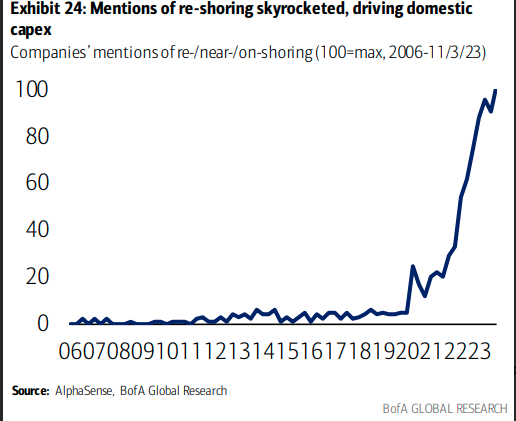
RESHORING IS DEFINITELY A THING: Bank of America analysts tracked the number of mentions of “re-shoring” in the latest round of corporate earnings filings:
A PROCESSING ISSUE AT THE FED, specifically at EPN, the private sector ACH operator, resulted in a number of obscured data elements on November 3. The Clearing House claimed the error impacted less than 1 percent of daily ACH, and had noted it was not aware of any more ongoing issues.
THE US 30-YEAR YIELD SPIKED after the sale of $24bn in bonds received less investor demand than expected, meaning primary dealers were obliged to step in and finance the repurchased portions of the Treasury auctions; almost a quarter of the issuance.

A RANSOMWARE ATTACK on the financial services arm, ICBC Financial Services, of China’s largest bank disrupted the US Treasury market by forcing the banks’ clients to reroute trades. This coincided with the surprisingly poor US Treasury 30-year auction outlined above prompting questions whether the hack was purposefully coordinated.
HIPGNOSIS SHOULD FAST FORWARD towards a sale or die, amid news that the Hipgnosis Songs Fund will skip dividends until at least its next financial year to preserve cash. A reshuffle has so far taken out much of its management team, with Robert Naylor being appointed as the company chairman, while Francis Keeling has taken up a role as non-executive director.
ANDREW EVANS-PRITCHARD at the Telegraph argued that Europe was slowly destroying itself and heading for a lost decade.
CHINESE AUTHORITIES asked Ping An Insurance Group to take out a controlling take in beleaguered private property developer Country Garden, the country’s largest.
WHAT WAS THE SECRET TO RAY DALIO’s MONEYMAKING asked Rob Copeland, author of the book on Ray Dalio and Bridgewater named ‘The Firm’. An extract published in the New York Times, last week revealed the secret was that there was no secret. Much of Dalio’s edge is supposedly generated via information gleaned from meetings with central bankers and government officials and other corporate access events. Bearish China positions, meanwhile, are carefully obscured.
RAY DALIO took to Linkedin to respond to the book, noting it was “one of those sensational and inaccurate tabloid books written to sell books to people who like gossip.” He added: “As for what I expect to happen, I expect that the author will promote his book by saying outlandish things, people will make what they make of it, and I will keep doing what I’m doing without being distracted by it.” So that’s that.
MEANWHILE, TURNS OUT JAMES COMEY WORKED FOR BRIDGEWATER Vanity Fair explored how the future FBI director worked for years at Ray Dalio’s Bridgewater. Comey’s responsibilities included oversight of Bridgewater security giving him the opportunity to poke around almost anywhere in the firm.
A NEW ‘NEWS HEDGE FUND’ is set to be launched by two 27-year-olds Nathaniel Brooks Horwitz and Sam Koppelman. The venture would combine a newsroom with a hedge fund, writing stories neglected by the mainstream pack, funded thanks to proceeds earned by the business’ hedge fund arm.
This is a bonkers idea. Not only would it be very hard to keep on the right side of the law, from a journalistic perspective who on earth would trust an news outfit to write about companies it has positions in? — IK
MONEY LAUNDERING EXPERTS were looking at the wrong place for money laundering in Gaza, argued Isabel Oakeshott in POLITICO. Much of the financing for Gaza came from an unlikely source, the U.N. Relief and Works Agency (UNRWA).
CITADEL’s KEN GRIFFIN said American legislators should focus their attention on banks not hedge funds if they’re looking to lower the risks of US Treasury basis trades.
THE STREETWISE PROFESSOR, aka Craig Pirrong, provided some context on why the basis trade exists at all, arguing that it provides asset managers with a discreet way to get around regulatory curbs on leverage.
MOODY’S CUT ITS US OUTLOOK to “negative” from “stable” on expectations that fiscal deficits will remain very large, significantly weakening debt affordability.
MARKS & SPENCER cautioned investors on its outlook going forward after its profits in the first half of 2023 beat expectations.
INDIAN EXPORT LIMITS ON RICE have caused a worldwide artificial shortage of the much-needed foodstuff, threatening worldwide food security in developing nations.
INTRODUCING ‘SYNTHETIC RISK TRANSFERS’: Big banks have found new ways to unload risk to hedge funds and private equity firms via “synthetic risk transfers”, according to the WSJ. “In most of these risk transfers, investors pay cash for credit-linked notes or credit derivatives issued by the banks. The notes and derivatives amount to roughly 10% of the loan portfolios being de-risked. Investors collect interest in exchange for shouldering losses if borrowers of up to about 10% of the pooled loans default,” the piece noted.
SWITZERLAND WILL TAX EVs as normal vehicles next year, after lawmakers claimed the incentive to purchase EVs was no longer needed for consumers to switch.
NBP’S GLAPINSKI WARNS OF ANTI-ZLOTY PLOT: The NBP left rates unchanged at 5.75 percent and announced plans to acquire enough gold to represent 20 percent of its reserves, amid a mounting spat between key monetary policy council members. The latest debacle is centred around a pay disagreement between NBP boss, Adam Glapinski — a PiS appointee and Kaczynski loyalist — and council member Pawel Mucha, also a PiS appointee but one appointed by President Andrzej Duda and led to the NBP posting a disparaging statement about Mucha on its website.
But that’s far from the end of the drama. Following significant media coverage of the spat, Glapinski convened an emergency press conference on Friday to lay out his view that much of the media fallout was part of a contrived attack on the independence of the NBP. Glapinski said it was unheard of to threaten central bankers with prison. The comments come in response to media speculation that Poland’s new coalition government will look to eject Glapinski from power, possibly by making him criminally accountable for the country’s double-digit inflation.
Glapinski also used the press conference to air the view that the attacks on the NBP were part of a strategic plan by Germany to force Poland into the euro, notably by discrediting the zloty monetary framework and making a mockery of the central bank.
| MEDIA MATTERS |
CONGRESSMAN JIM JORDAN FLAGGED A ‘BOMBSHELL REPORT’ ON THE CENSORSHIP-INDUSTRIAL COMPLEX which he said revealed the extent to which American security agencies have coordinated to censor Americans since before the 2020 election.
FREE SPEECH IS WORTH FIGHTING FOR: Former Justice of the Supreme Court, John Sumption, claimed the greatest challenge to free speech will be self-censorship by venues, publishers, the media, and academic institutions.
| GEOPOLITICAL PIVOTS |
THE UNITED STATES AND GUYANA announced an agreement to augment their military cooperation as Venezuela’s referendum on annexing the newly oil-rich looms closer.
PUTIN SECURED new bases in Libya for Russia, creating a brand new regional headache for the United States.
A SYRIAN REFUGEE was shot by a Polish soldier after crossing the Belarus border in an “unfortunate accident”.
| POLITICS, POLITICS, POLITICS |
PORTUGAL’S PM RESIGNED amid a corruption probe regarding several infrastructure and energy development projects, after police raided his official residence and the country’s attorney general confirmed the former PM Antonio Costa was under investigation for corruption. The affair pertains to the concession of lithium mining projects in the north of the country, a green hydrogen mega-project, and a data center in Sines. POLITICO reported that Costa said he felt betrayed when he learned that authorities had found tens of thousands of euros in envelopes in the office of his chief of staff, Vítor Escária, during a police raid of the prime minister’s official residence on Tuesday.
POLAND’S INDEPENDENCE IN DANGER: Western media may have been focused on the pro-Middleast ceasefire protests on Armistice Day but over in Poland, leftwing criticism of the country’s Independence Day celebrations, which have in recent years been linked to nationalist sentiment and large-scale rallies in Warsaw, provided further fuel for right-wing existential paranoia.
Jarosław Kaczyński, the chairman of Poland’s ruling party, used the day to warn that the European Union was seeking to introduce a “German plan” that would result in “the annihilation of the Polish state”.
“A specific plan is already being prepared, the implementation of which would lead not only to the deprivation of our independence and sovereignty, but even to the annihilation of the Polish state,” he continued. “We would become an area inhabited by Poles, ruled from the outside,” he was reported as saying.
RON DESANTIS’ BIGGEST DONOR, real-estate mogul and paranormal investigations funder Robert Bigelow, outlined that he is considering backing the presidential campaign of Donald Trump.
Come for the politics but stay for the pictures of Bigelow (a UFO-believer) in “one of his” personal caves in Las Vegas. (H/T the FT’s Rob Smith).
HILLARY CLINTON compared Donald Trump to Adolf Hitler on The View, while claiming that re-electing the former Dorito-in-Chief would “lead to the end of our country as we know it.”
BRUSSELS ASKED FOR CLARIFICATION on Spanish PM Pedro Sánchez’s decision to provide amnesty to leaders of the Catalan secessionist referendum in exchange for investiture votes. Huge protests have since broken out across Spain, including in Malaga. Luckily the Blind Spot has its in-house Spaniard, Dario, to turn to for an explanation for what’s going on.
Please beware — the following is my own biased (and admittedly extreme) opinion as a Spaniard on our country’s tragic present circumstances.
Spain’s slow descent into an ungovernable nation of squabbling parties and regions seems to be on track.
But glancing at history, it somewhat makes sense that this should be happening. I’ve been receiving video after video, link after link from friends who can’t believe what is happening.
Our socialist Prime Minister, Pedro Sánchez, who leads the Spanish Socialist Party (PSOE), is explicitly entering into an alliance with an explicitly anti-constitutional group that primarily seeks the breakup of the Spanish nation.
Unlike so many right-wing voters, I fail to see why Sanchez is the only individual at fault.
If Feijoo — the leader of the right-wing PP and head of the largest voting bloc — had exercised some of the patriotism he so often claims to represent, he would have pushed his party to abstain in an investiture in favour for PSOE — as the Rubalcaba’s PSOE did to Rajoy’s PP in 2016, allowing a minority PSOE government in power that wouldn’t be forced to rely on separatist votes.
Unfortunately, the calamitous situation this has thrust Spain into benefits Feijoo’s political objectives as much as it does Sanchez’s.
Personally, I’m not surprised. If a Roman citizen were teleported to our modern day, he wouldn’t be either. He would instead be confused by Spaniards who claim that they are still a sovereign nation.
Especially if he discovered our country hosts 8,000 American troops, and that individuals who head unconstitutional and illegal referendums to secede from the country can escape and be protected by Spain’s supra-national organism — the European Union (where Puidgemont has held court since his escape from the law) — he would be puzzled. “You’re a protectorate, no?” he might say. Because this would be true in every period of history — and it is true now.
Franco’s embrace of NATO, of course, was initiated out of desperation in 1947 and echoes till today.
The rapid evolution of NATO from an organisation designed to protect European interests from Soviet tanks into an institution that fomented the strategy of tension to head off internal opposition quickly took a strong hold of Spain.
For those unaware: “A strategy of tension (Italian: strategia della tensione) is a political policy wherein violent struggle is encouraged rather than suppressed. The purpose is to create a general feeling of insecurity in the population and make people seek security in a strong government.”
All of this, naturally, was to delegitimise and suppress non-approved alternatives in government — like communists.
It’s a strategy that is common beyond just Spain.
An Italian masonic lodge led by Lucio Gelli (and which Berlusconi was a member of) consistently organised terrorist attacks against civilians. The killers would either masquerade as communist guerillas, or be described as such by military or police sources. Google Propaganda Due and Gladio.
Much the same happened in Belgium — albeit with a darker twist. The Brabant killers, for instance, slaughtered women and children in supermarkets they robbed while wearing colourful masks and outfits, often mysteriously dumping all stolen proceeds in nearby rivers.
There’s an excellent and eery BBC Timewatch documentary on both of these dark events of European history.
While Italy’s Gladio networks made the dark underbelly of NATO famous, Spain’s dark networks were even more exalted — and secretive.
Without a need to shield institutions from the possibility of an internal communist takeover by democracy due to the Franquist dictatorship, Gladio-like networks quickly crystallised within the Spanish military, intelligence and political hierarchy.
It was said that if in Italy Gladio held the government, in Spain Gladio was the government.
And just as in Italy, the collapse of Spain as a far-right safe haven with Franco’s death was quickly followed by the rise of all sorts of oddly-well-armed communist guerillas like ETA or GRAPO.
Anti-terrorist laws enacted in response quickly and quietly re-legalised many Franco-era authoritarian policing measures which had been discarded by our new constitutional order — to much controversy at the time.
This paved the way to our own 9/11, the 11-M train bombings. Special highlights of the event include a small cast of of former ETA guerillas and Civil Guard policemen, who were seen in places linked to the carriage explosions.
And many of the carriages that originated the explosions were mysteriously concealed and only found years later (and then demolished).
I’d wager that had probably something to do with severe weaknesses in the official story; that TNT from an Asturias mine created the explosion, countering the testimony of a French explosives expert who argued the large explosion was much more like military C-4.
On the surface, the use of extremists to carry out this secret policy of tension continues. Spanish anti-amnesty protests this weekend saw a series of violent ultranationalist groups which cropped up at the protests and began throwing molotov cocktails and rocks at policemen.
The use of these networks of violent individuals, often connected to the police and military, to masquerade as and tarnish political opposition is straight out of the Gladio playbook. Ask the question — cui bono?
The rise in disorder and regionalism will do much to enhance the power of existing foreign and national surveillance networks in Spain, and continue to extend the tendrils of the Western military-industrial state into Spanish society. — DGG
GIORGIA MELONI tabled a vote to reform the Italian constitution. Echoing Donald Trump’s Project 2025 somewhat in its empowerment of the executive, the motion aimed to solve Italy’s chronic crisis of governance by letting Italians directly elect a PM that would automatically hold 55 percent of the country’s elected seats.
Europeans are forever caught in a precarious balance between seeking democratic checks on state power and maintaining an effective executive branch. Of all European countries we can point a finger to and go HA HA a la Nelson from the Simpsons, Italy surely tops the list, a close second behind Belgium and, perhaps, Spain.
While I’m not convinced that Meloni’s (and Trump’s) attempts will amount to much, their instinct is right on: Executive empowerment may be the only way forward for the West.
This Italian mother-of-all-reforms would pass with two-thirds of the legislative chamber’s approval – requiring a pact with opposition parties. Failing that, the motion would go to a referendum.
I wouldn’t be surprised that Italian voters, exhausted of the charade of in-and-out leaders that Italian politics have become, would favour such a proposal.
And ex-Chief Dorito, Sheikh Donald al-Trump, thinks much the same.
Called Project 2025, it would:
“Seek to recruit thousands of conservatives to Washington, D.C. to replace existing federal civil service workers it characterises as the “deep state” to further the agenda and policies of Donald Trump.[3] The plan would perform a swift takeover of the entire executive branch under a maximalist version of the unitary executive theory – a theory proposing the president of the United States has absolute power of the executive branch – upon inauguration.”
Though one is tempted to view Trump’s (and Meloni’s) plan from a partisan perspective — that’s certainly the most straightforward view — I’d wager the significance of Project 2025 and Meloni’s plan goes much further than anti-Democrat/anti-RINO, or anti-Leftist Trumpista-esque politics.
Politics in the West as they currently stand can find much comparison in the politics of the Late Roman Republic. Individuals seeking to accrue state power and overtly place their allies in key positions cast a long Caesarian shadow. And Caesar, like Trump or Meloni, rose in part because overpowering oligarchic interests dismissed Rome’s ever-growing poor in favour of a narrow and short-sighted defence of their own privileges, eroding trust in Republican institutions and encouraging lawlessness.
Caesar’s power grab ended with a stabbing. I don’t see how Trump’s aggravating and populist politics could ever forge a broad enough consensus to make his brand of politics a permanent force in the United States.
But what Trump and Meloni’s policies rightly target is a loss of democratic leverage by the Wests’ lower and middle classes due in part to the perceived loss of direct power wielded by the elected classes — the President, Congressmen, and Senators — to entrenched interests at the top of Western society.
Growing mistrust in government combined with an ever-increasing tax and surveilance burden, facilitates the evasion of these burdens by making anti-governmental behaviour a societally respected position. Whether through cash, crypto, or TOR browsers. “I identify as a non-taxable person” and “I respect people who made money. But I respect those who made money and didn’t pay taxes a lot more” are two variants of quotes I recently heard that stuck with me. I couldn’t say I disagreed.
I’m not sure our Western states, based on the principle of legitimacy through consent of the governed, can survive this loss of legitimacy in the long run.
And a big part of restoring such legitimacy is handing more power to the most visibly elected represenative — so they may rule their government, rather than be ruled by their government.
These are gaps that — at least for their electorates — Meloni and Trump are filling adequately. I doubt they will gain converts beyond their voters. But beyond these polarising figures hopefully lies a non-polarising Augustus, a Restitutor Orbis that will ostensibly restore the institutions of our Republics while quietly hollowing out their power to rest squarely in his or her hands.
The worst part is, as far as Western governmental legitimacy is concerned, is that I (and many Zoomers I know) think that would be a good thing. — DGG
BARI WEISS SET OUT THE CASE AGAINST DEI: “It is time to end DEI for good. No more standing by as people are encouraged to segregate themselves. No more forced declarations that you will prioritize identity over excellence. No more compelled speech. No more going along with little lies for the sake of being polite,” she wrote at her website the Free Press.
ALBANIAN MIGRANT CENTRES: Albanian Prime Minister Edi Rama signed an agreement in Rome pledging to host centers that will process the claims of thousands of migrants rescued by Italy at sea, in an emulation of the British Rwanda model.
ET TU GERMANY? German Chancellor Olaf Scholz pledged to “examine” whether asylum applications could be processed abroad in another sign the government’s position on illegal migration is hardening.
The idea again is reminiscent of the UK’s deal with Rwanda. So, who knows, maybe the idea wasn’t that bonkers? — IK
| POLITICO’S FINEST |
PRESIDENT JOE BIDEN’S TESTIMONY and denials on his business affairs were contradicted by Politico’s review of recent developments.
A KINDERGARTEN NAMED AFTER ANNE FRANK has sought to change its name to a less politically charged alternative, sparking backlash amongst Jewish community members.
| TECHNO TECHNOCRACY NOW |
WHY IS EVERYTHING IN CHINA exploding? YouTuber Laowhy86 explored the bitter reality of China’s development — a far cry from the clean city centres promoted on Chinese propaganda reels.
ELON MUSK HEALTH CHECK: A new book called Breaking Twitter alleged Musk needed a wellness check after experiencing a ‘breakdown’ after he was booed at the Dave Chappelle show. “He got to a point where he locked himself in his office, was so upset’ that Twitter employees feared he would hurt himself, the author of a new book says about the billionaire.”
A FAKE DOCUMENTARY which alleged there was corruption at the heart of the International Olympic Committee and featured Tom Cruise had just one problem: it was entirely fake. The series of videos were shared on Russian telegram channels but were removed from YouTube at the IOC’s request.
The video and the particular allegations in this fake documentary (fakeumentary? fokumentary?) may be fabricated. But I would be highly surprised if the IOC is a clean organisation. Considering the rampant corruption in every other international sporting organisation, it’s only a matter of time before a scandal erupts there. — DGG
| ANCIENT HISTORY |
A PREHISTORIC PYRAMID has “re-written” human history, scientists claimed, as the pyramid of Gunung Padang in Indonesia has been estimated to have been built roughly 16,000 years ago.
Now that a section of official archaeology has finally acknowledged at least part of Graham Hancock’s thesis that some ancient civilisation existed on Earth only to be wiped out by the Younger Dryas period perhaps he could get an apology?
Titled “the most dangerous documentary” by some, Graham Hancock’s Ancient Apocalypse ultimately put forward a straight-forward and historically sensical thesis: That every single ancient civilisation with written records, from the Babylonians and Sumerians to the Egyptians, which claimed it as an inheritor of a far grander civilisation that existed before a global catastrophe, wasn’t necessarily wrong.
The aggressive conservatism of academia, especially present in fields which rely more on much-vaunted “consensus” rather than hard facts (like archaeology), only works to their detriment.
While turn of the century archaeologists captured the imagination of countless children, creatives, and ordinary people, modern archaeology has failed to do so entirely.
Occam’s razor dictates the most simple explanation is often true. Perhaps it’s time to cast off the overcomplicated notion that our legends are based on fanciful collective dreaming and allegory, oftentimes replicated exactly by civilisations on the other side of the world, rather than simple fact. — DGG
| COVID COLLATERAL DAMAGE |
THE SPECTATOR uploaded a brilliant series of charts that underscore the comical extent to which British institutions’ estimations of Covid-related deaths and hospitalisations may have been exaggerated. This comes as media coverage of the Covid Inquiry focuses on the whimsical elements contributing to political fallout, rather than the total disregard by the inqury for any testimonies critical of lockdown policy.
NOT SAFE AND EFFECTIVE? Sir David Spiegelhalter, who became a household stats name during the pandemic thanks to his no-nonsense assessment of Covid mortality rates admitted he was now cautious about calling vaccines “safe and effective” because there will always be medical exceptions that need to be taken into account.
The comments come as AstraZeneca is being sued in the High Court in a test case by Jamie Scott, a father of two, who suffered permanent brain injury as a result of a blood clot after receiving the jab in April 2021.
