

Good noon-ish, Blind Spot readers.
Apologies for another Sunday send-out. It’s been a busy week, involving travel to Warsaw and sleep deprivation.
Closer to home, I’m getting a foreboding sense that central bankers are about to up the ante on experimental thinking to stave off fiscal creep in their day-to-day operations.
Austria’s Robert Holzmann let the cat out of the bag last week when he let slip that his big plan to raise the minimum reserve requirement — at zero remuneration — to 10 percent, was as much about cutting losses for eurozone central banks as it was about reining in liquidity. (Which slightly undermines all those cerebral thought pieces about how the financial system doesn’t need to worry about loss-making central banks because, you know, they’re different and the usual rules don’t apply.)
This has cemented the view in some quarters that central banks are treading far too close to fiscal territory. Governor of the Bank of Belgium, Pierre Wunsch, for one, told my Politico colleague, Johanna Treeck, that lifting reserve requirements with the aim of generating central bank profits equates to “exercising quasi-fiscal powers”, since it amounts to a tax on depositors.
The logic here seems to be that when central banks repress bank profits, via interest rate tweaks, in the name of price stability, this sits firmly within a central bank’s mandate. But when they impose operational tweaks that largely have the same effect but are actually designed to bolster their own balance sheets (to avoid having to go cap in hand to their respective Treasuries), this intrudes into fiscal affairs. In such circumstances it is fairer for governments to impose windfall taxes directly, says Wunsch, as they are elected and have a broad mandate.
But others, such as Solid Ground Newsletter author Russell Napier, have told TBS they think the overreach feeds the other way. Governments may themselves be intruding into central bank turf. Either way, it boils down to a discussion about the acceptable face of financial repression.
In that context, it’s worth keeping an eye on the prospective return of Willem Buiter’s favoured plan to save the eurozone: having the ECB issue its own bills to help fund itself.
Meanwhile, largely missed by everyone (apart from TBS readers, since we wrote about this last week) is the sneaky manoeuvre the Bank of England pulled off to shore up its own hard-up funding model. The Bank confirmed a couple of weeks ago that, thanks to the implementation of the Financial Services and Markets Act, it was now free to scrap its “cash ratio deposit” formula for raising funding from banks, and replace it with a levy framework. The old system — which required banks to hold just enough deposits as “non interest” bearing reserves to allow the BoE to generate income through interest rate arbitrage — came under review in June 2022.
According to the BoE, the new “levy-based arrangement” (tax, cough-cough) will deliver a more reliable and stable funding scheme for the Bank’s policy functions while adding certainty to banks over the size of their annual contribution, which they will be notified of annually.
It’s a nifty hack for as long as parliamentarians don’t notice that it mightily resembles a self-imposed windfall tax, of which they don’t control the proceeds. Although, we can see why the BoE might like it.
In theory, it allows the Bank to avoid the drama of cutting non-interest-bearing chunks into its key policy tool, the Bank rate (a deposit rate), while at the same time, allowing commercial banks to keep mobilising liquidity as they see fit.
As usual, this week’s Blind Spot newsletter was compiled by me, Izabella Kaminska, with the help of Dario Garcia Giner.
And a quick programming note: Dario will be partnering with Julian Rimmer on Spot Markets Live every day at 10:30 am next week. Do join them!
We’re also planning a Christmas meet-up.
| ECONOMICS, BUSINESS, FINANCE ETC… |
MITSUBISHI UFJ FINANCIAL GROUP (MUFG), the Japanese bank, said it planned to sell dollar-denominated AT1 Bonds in a first for the Japanese banking sector in a bid to lower foreign exchange risk in their capital ratios. This follows MUFG selling 570 billion yen of bonds, including AT1, in May, which was according to Bloomberg “one of the biggest offerings in the local market by a domestic financial institution”.
Foreign exchange risk emerging out of Japan is the standout known unknown risk for the financial system at the moment. And I know I keep banging on about this, but how well the system will be able to handle it may come down to how robust the intraday liquidity arrangements backing our real-time gross settlement systems really are.
The possibility of Herstatt risk making an unwelcome comeback has supposedly been nipped in the bud via the introduction of both RTGS in most jurisdictions, as well as a Continuous Linked Settlement (CLS) system. This worked very well in 2008 — the last time the system was severely tested. Problem is, since then, there’s not only been stealth reintroduction of Deferred Net Settlement into the system — because it turns out RTGS systems are expensive and engender liquidity savings mechanisms — but we’re now in an inflationary period, which impedes how much intraday liquidity can be freely dished out without undermining monetary policy.
No surprise there’s more and more talk about moving the framework to a “pawnbroker of last resort model.” Cbanker code for this will be any discussion about the virtues or not of “pre-positioning”. More on that below. — IK
TO PRE-POSITION OR NOT TO PRE-POSITION: The Bank of England’s deputy governor for prudential regulation, Sam Woods, provided further clues that a serious debate about pre-positioning was now being had at the Bank.
BoE governor Andrew Bailey’s comments in Marrakech earlier this month offered the first real hint (at least that we’ve seen) of the Bank beginning to acknowledge the limitations of regulatory responses to bank liquidity troubles under the existing central banking framework. Bailey was expanding on how the system can better protect itself from liquidity crises like the ones that gripped Silicon Valley Bank and Credit Suisse earlier this year.
The sort of liquidity buffers the system would need to deal with a bank losing almost 30 percent of its depositor base in one morning, as SVB had, would in Bailey’s opinion “change the model of banking”, making more like a “narrow banking” system. A better option, Bailey noted, might be adopting his predecessor Mervyn King’s idea of getting banks to pre-position all their assets at the central bank and then using risk-weightings to steer monetary policy. It was, he said, the Bank’s best shot at approaching this question of liquidity resilience. That debate now seems to be happening.
In a speech about bank failures, Sam Woods said central banks should indeed have close regard to firms’ ability to access central bank liquidity, including via pre-positioned collateral at the central bank. But at the same time, he added: “while some commentators have suggested that such pre-positioning could obviate the need for most prudential regulation” he himself was very skeptical of the proposition. Woods, however, echoed Bailey on the point that a zero-failure regime was probably unfeasible in a free market system. “Fundamentally, a zero failure regime is incompatible with having a private banking system,” Woods said. “The magic of a capitalist economy lies in competition – which drives down costs for customers, spurs innovation, and brings the best ideas to the top. But it’s not much of a competition if the game is rigged so that nobody (except the taxpayer) ever loses.” — IK
HEAD OF JAPAN’s banking lobby warned that rising yields pose a significant risk to the economy.
ZENGIN-NET UPDATE: The company that manages the Japanese retail payments system finally offered a public explanation about what led to a two-day suspension in October impacting millions of transactions.
Committed readers of TBS may remember we previously dared to speculate that the Zengin Net outage — which disrupted some 5 million transactions from Oct 10-11 — was likely linked to the recent adoption of the new 24/7 “More Time System” and its integration with the core system.
We also speculated that the incident could have been triggered by challenges integrating updates between the now extended deferred net settlement system with the BoJ’s broader real-time gross settlement. On Wednesday, we got a little more sense of what happened thanks to a Zengin-Net press conference (Japanese only we’re afraid).
Seems like we were on the right track. According to an accompanying slide-deck (translated with the help of Google Translate), the issue was triggered by a botched update by 14 institutions on Oct 7-9 to the relays that connect the More Time System with the Core Time system. According to the slide deck, things were further complicated by JP Morgan Bank, a major international intraday liquidity provider, going live at the time with an update to its own “More Time” system.Exact details of what went wrong remain fuzzy even now, as does the scale of the financial losses caused by the incident. Nor do we know what role the (if any) gridlock emerging from settlement failure between mismatched timezones may have played in the incident. Was there a spillover into liquidity markets? We just don’t know. Zengin says it plans to keep investigating and, in the meantime, will compensate all customers for losses. Most worrying, perhaps, is that the slide-deck implies the system is only ticking over thanks to “provisional measures” put in place last week. — IK
THE BOE’S UPDATED ON AUGUST’S RTGS FAIL: It may not have been anything as disruptive as last week’s Zengin-Net outage in Japan, but the Bank of England suffered its own embarrassing real-time gross settlement fail on August 14. The failure comes amid a multi-billion-pound RTGS renewal program that the Bank is engaged in (the costs of which, we understand, are definitely not going down).
But, hey, at least it wasn’t as bad as in 2014: The Bank’s 2022/2023 RTGS annual report, published Thursday, finally gave some more insight into what went wrong, putting the outage down to “a rare bug within third-party software” and noting “it was not related to any security compromise.”
The Bank added it was “disappointed” that the incident had occurred, and apologised to anyone impacted. “The last material outage to RTGS was an approximately nine-hour outage in October 2014. As was the case after the 2014 outage, we are focusing on the lessons learned and continuously improving the service provided by this core infrastructure,” the BoE noted. — IK
THE UNITED STATES government’s interest payments per day have doubled from $1bn a day before the pandemic to almost $2bn per day in 2023. 
LIZ TRUSS said she would unveil an ‘alternative budget’ just days before Jeremy Hunt unveils No.10’s, The National reported.
Oh, how the trolled has become the troll. And good on Truss, IMHO. The most maligned economic plan of recent British times, is finally proving itself as the only viable slingshot manoeuvre for Britain. She was right. End of. Yes, she didn’t communicate herself well, but what the debacle really tells us is that our modern political era is beset by an obsession with appearances and underpinned by short-term thinking influenced by those who shout loudest and are “in vogue”. This is no way to run an economy.
And in further evidence that Truss was actually right, we learned on Sunday that Downing Street is now considering a tax cut for 5.6 million high earners next year “to gee up Tory voters”. The political editor of the Daily Telegraph adds that raising the threshold on the 40p higher income tax band is being seriously looked at. — IK
BANK OF AMERICA’s unrealised losses on held-to-maturity securities exceeded $130bn. 
The opposition (now on the verge of forging a ruling coalition government) is now obviously making a bid deal of this. But, in actual fact, it’s another non-story.
As I’ve said before, I see myself as genuinely objective on the matter of Polish politics. I can see things from all sides. And in this case, the opposition is doing itself no favours in the long term because this is self-evidently an egregious example of correlation not being causation, and is, thus, fake news. As we explained before, the cut in prices in September was entirely in line with a fall in wholesale prices across the continent (mostly the product of the annual switch from summer to winter grade).
That the Polish election coincided with the unfortunate outbreak of a new Middle Eastern war, which had a widespread effect on fuel prices across the board, was certainly beyond the control of even the Kaczynski government. Suggesting the price rises have been driven by entirely domestically factors is entirely disingenuous. But as a taxi ride from Warsaw airport to my panel event last week proved, this is exactly the popular perception on the ground. Which is unfortunate. — IK
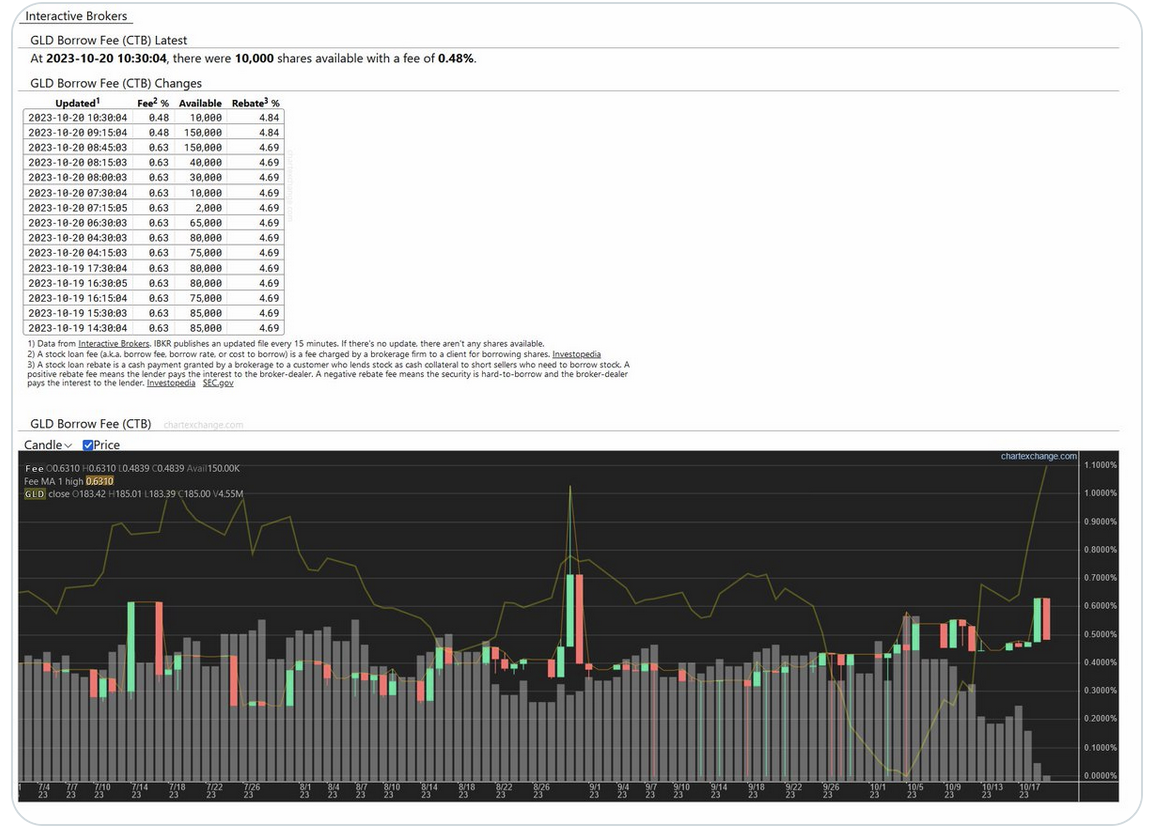
GLD WEIRDNESS: Something very strange was happening with short availability in the world’s most well known gold ETF, according to Bob Coleman, a precious metals voice on X. “This is perplexing… almost no shares available to borrow for GLD. Normally 3 to 4 million shares, yet fee is not rising,” he posted on X.
STATE FUEL-PRICE MANIPULATION, LIBERAL EDITION. A reminder, to contextualise the above: Back in September, California’s governor, Gavin Newsom, ordered the state to conduct its annual switch from summer to winter grade one month early to curb the political fallout from spiralling gas prices. The direct effect of this would have been more pollution in the state of California. The switch occurs when it does, not just because cleaner fuels don’t gel well with colder weather, but because higher temperatures exasperate the pollution effects of the winter fuels. So, with this move, Newsom was arguably putting political popularity ahead of environmental factors. Not that this story made its way to Poland.
THE RESOLUTION FOUNDATION, a British think tank, called on future British governments to consider raising the Bank of England’s inflation target from 2 to 3 percent. This move should provide the BoE more “room for manoeuvre” during economic downturns, and ease the burden on public finances.
ELON ENDORSES TREASURIES AS SAVINGS: “Crazy not to buy treasury bills. Bank savings account interest rates are ridiculously bad by comparison and T-bills are more secure,” Elon Musk posted n X.
| CRYTPOCURRENCY EVANGELISM |
THE MOST COMPREHENSIVE SURVEY of bankers and the global investment industries yet on central bank digital currencies showed, according to the CFA Institute, a widespread lack of understanding of how digital currencies would work, as well as limited support for such measures.
Don’t agree. But more on that next week. — IK
HUMAN RIGHTS IN FINANCE.EU, an organisation which advocates for the protection of fundamental rights in finance, has petitioned the Dutch government to retract an “unlawful” AML legislation via the EU infringement procedure. The group has alleged the Dutch AML rules for crypto-companies exceeded the EU’s AMLD5 registration model.
This is all connected to the wider “FATF taking over the financial world” story. But don’t have time to expand on why it’s important this week. If I have time, it will hopefully be the subject of the next Blind Spot Spotlight. In the meantime, you can check out the “Suspicious Transaction Report” podcast I did for RUSI about the topic.
UNCLE SAM has accumulated over $5bn in Bitcoin from darknet and cybercriminals seizures. But the crypto, primarily held in offline encrypted wallets controlled by the Justice Department and the IRS, is largely frozen — technically making the United States one of the biggest bitcoin ‘hodlers’ in the system.
| MEDIA MATTERS |
MSNBC took three of their Muslim broadcasters off the anchor’s chair following Hamas’ attack on Israel last Saturday. Similarly, six BBC reporters have been taken off air as an internal probe was launched over pro-Palestine tweets that could threaten the ostensible impartiality of the publicly-owned media company.
DOZENS OF ISRAELIS were arrested by Israeli police after uploading posts sympathetic to the Palestinian plight in Gaza, or for critical analyses of recent IDF operations in the region in an unprecedented crackdown against freedom of speech in the country.
| GEOPOLITICAL HOT SPOTS |
AZERI military vehicles were seen sporting new identification symbols. Analysts have speculated this could be related to rumours the country plans to invade southern Armenia.
AZERBAIJAN’S PRESIDENT Ilham Aliyev claimed on October 8 that should a new conflict be triggered between Azerbaijan and Armenia, it would be France’s fault.
*Record scratch*… what? Secretary of State Antony Blinken last week called out the continuous escalation on the Armenian-Azerbaijani border in the wake of this absurd statement.
How could France, a country that is not a military ally of Armenia, and which is thousands of miles away, be blamed for a renewed conflict in the Southern Caucasus? This wasn’t a one-off comment.
Azeri sources claimed that France intentionally sabotaged Armenian-Azeri peace talks in Granada two weeks ago by stating it would sell arms to Armenia. And Azerbaijan is currently holding an international conference themed “Neocolonialism: Violation of Human Rights and Justice”.
Bizzarely, the entire conference seems aimed squarely at France. At the conference, Azerbaijan’s Human Rights Commissioner claimed that “France, in a gross violation of international law, keeps pursuing a neocolonial policy”. This claim doesn’t hit far off the mark.
We’ve previously addressed how France’s treatment of its former colonies in Africa through military occupation and direct exploitation of their monetary and mineral resources more closely resembles colonialism ‘tout juste’ rather than neocolonialism. But what the heck does Armenia have to do with this? The country was never a French colony.
Besides, Armenia’s strongest traditional allies in the region are Russia and Iran — two of France’s ostensible geopolitical rivals. Well, France *has* been a consistent supporter of Armenia’s foreign policy objectives since 1991. The country was the first to officially acknowledge the Armenian genocide in 2021. And it has been providing humanitarian and monetary aid to Armenia since for a long time. France is also the second-largest foreign investor in Armenia, just behind Russia.
Most significantly, France openly discussed selling weapons to Armenia since the peace talks in Granada. Official details on the weapons has been elusive — but French officials have stated they would be purely defensive in nature. Some sources have claimed more concrete knowledge allegedly stemming from Ukraine’s secret service that France is supposedly providing Mistral anti-aircraft missile systems, armoured personnel carriers, and self-propelled “Trajan” artillery guns produced in India under license from France’s Nexter Systems.
But, to be honest, none of this makes much sense.
France has sent the majority of its dated military equipment to Ukraine already — and Armenia doesn’t have the funding capacity to purchase from France’s top-shelf arms export industry. Or at least, not enough for these weapons to make a strategic difference in an upcoming Caucasus flareup.
It gets weirder when you actually look at the numbers.
France *is* Armenia’s second-largest foreign investor… at a mere €50mn per annum. Paris has also only provided a paltry €12.5mn in humanitarian aid to Armenia since the beginning of the year. These numbers strike one as more “sympathy geopolitics” than “strategic geopolitics”.
And this would track: the half a million or so Armenian residents in France are a powerful voting bloc which motivated French presidents to adopt such an openly pro-Armenian stance. And, besides, France has also sold weapons to Azerbaijan in 2018 at least.
So why the kerfuffle? An American journalist with suspiciously consistent pro-Azeri opinions, Irina Tsukerman, gives us a hint: “France’s position is inextricably linked to Armenia’s significant and influential diaspora in France, as well as its current interests in the South Caucasus following its displacement from West Africa.
The country is considering the possibility of displacing Russia as a regional power and benefiting economically from this scenario.”
As we have previously observed on the Blind Spot, Armenia — in particular its now-highly exposed southern region of Syunik, sandwiched between Azerbaijani territory, is extraordinarily rich in minerals. And particularly, Uranium — which France has been more desperate for since the Niger military junta dramatically upped its prices for export to France.
Though realities on the ground do not directly point at an outsized French support for Armenia, nor that this French support can in any way be decisive in an upcoming conflict, the dramatic reaction from the Azerbaijani government certainly suggests there is more going on behind the scenes. Watch this space. — DGG
ISRAELI MILITARY AID continued to be shipped into Azerbaijan from Israel, with continuous flights from “Silk Way Airlines”, a company known for transporting weapons from Israel to Azerbaijan. This has continued to ramp up speculation as to an incoming Azerbaijani invasion.
SEXY IDF GIRLS have gone viral across TikTok and Twitter, proving the continually heightened relevance of influencers in any modern military’s PR arsenal.
Much is made of the “Sexy IDF girl” trope — Israel certainly led the way in contemporary sexual marketing for its armed forces on social media. But just one American influencer has taken its crown. Sexual marketing in the armed forces is nothing new.
“Pin up” girls allowed GI’s from WW2 to fully express their artistic hands by drawing lewd women on their bombers.
And everyone knows just how great a Marine can look in his dress blues. The IDF’s clear advantage in this remit is its conscription-based recruitment, which pushes women into (mostly non-combat roles) in its armed forces.
But I have contended that, despite having led the pack for a good decade, Israel’s sexualised influencers have lost out to an all-American phenomenon: Psychological Operations Specialist Hailey Lujan.
One “Psyop Girl” cannot dethrone legions of Israeli bikini-wielders. But she can lead the way. Hailey’s MO is to explicitely outline her devious role — to join and die for the United States’s most heinous objectives. It’s not about democracy, or serving your country.
Lujan’s image is one that transmits power, converting the would-be recruit into a useless “simp” that has no choice but to bend before her Psyop.
As we explained in our article on Hailey, this recruitment strategy symbolised the positive narrative collapse in the West.
Stories of defending freedom, democracy, and liberalism don’t track in a developed world so increasingly devoid of freedom, democracy, and liberalism. The grand march towards progress and universalism no more —we’re reverting to our roots.
Tribal sentiment, nationalism, and religious devotion are thriving instead. We believe this is tied to the American propaganda complex’s increasing adoption of “dark” tones. Just see this video for the 4th Psyop Unit of the US Army — Ghosts in the Machine: “ever wondered who’s pulling the strings? You’ll find us in the shadows.” Or just look at the Dark Brandon meme, so enthusiastically embraced by Biden’s White House:
So much so, they recently made it their profile picture on Trump’s social media platform Truth Social:
As Machiavelli said, it’s better to be both feared and loved. But if you have to choose, being feared is the more reliable choice. Keep an eye on influencers. They are the representative cutting edge of contemporary information warfare. — DGG
GEN-Z WON’T GET DRAFTED (APPARENTLY): This video of a Gen-Zer explaining why he can’t get drafted because he’s on too many meds went viral sparking a debate about whether this will mean the draft, if it were to happen, would extend to the 40+ generation.
HAMAS INFILTRATORS knew the exact hiding place of an Israeli intelligence hub, where they could access the top-secret building thanks to a colour-coded map.
ISRAEL’S AMBASSADOR to the UK defended Israel’s bombing of Gaza by stating that bombing Dresden was “the only way to beat the Nazis”.
A FORMER ZELENSKY ADVISOR claimed that Ukraine’s counter-offensive is a ‘disaster.’ Oleksiy Arestovych blamed Zelensky and his military commanders for “making strategic mistakes and failing to break Russian lines.”
THE AMERICAN ARMY began to make contingencies for a potential conflict with China — including shoring up the military’s blood supply.
| TECHNO MATTERS |
QATAR AIRWAYS partnered with SpaceX’s Starlink to provide their customers high-speed complimentary WiFi onboard their flights.
ISRAELI MERKAVA TANKS were spotted featuring roof screens — colloquially known as “cope cages” — first spotted on Russian tanks as they rolled into Ukraine.
DEEPFAKE INFLUENCERS in China are now live streaming 24/7, allowing brands to keep selling their products, even when their favourite influencers are snoring calmly.
JEWISH (non)SPACE LASERS appeared to take out two Hamas rockets in this leaked and alleged footage of Israel’s new Direct Energy Weapon (DEW) — the “Iron Beam.”
The release of Israel’s Iron Beam represented the culmination of several years of conspiracy talk on “Direct Energy Weapons” — “big muh-fucking lasers” in common parlance, or the inimitable “jewish space lasers” of Marjorie Taylor Greene.
Just a few short years ago, any talk of DEWs was relegated to the darkmost corners of the internet.
To claim the United States was in possession of such weapons, and that these formed part of the United States’ secret array in space, would put you in the same kooky basket as those claiming the US possessed reverse engineered technology from aliens. The September 2020 California (and Oregon) wildfires were one such example.
It’s easy to forget the incredible drama that surrounded these tragic incidents. Appearing during the crazy run-up to the election of President Joe Biden, wildfires tore through peaceful suburbs, while armed militias created roadblocks that forced civilians fleeing the fire to identify themselves.
The conspiracy internet went wild with satellite footage that allegedly showed unidentified beams creating certain wildfires.
The conspiracists, naturally, blamed American equipment. Kook-town central, amirite? Snopes, Reuters, and all the fact-checking militiamen took to their keyboards to type such absurd notions away. Few, if any, of these arbiters of truth noticed a few dead giveaways. The first was a January 2020 piece from the National Defence University Press titled “Direct Energy Weapons are Real… and Disruptive.”
This informed piece outlined all the major developments of DEWs by the United States armed forces. The second — and far more significant — event was Dept of Defence Secretary Mark Esper coming online 10 days after the wildfires to confirm that China and Russia were in possession of Direct Energy Weapons in space. Looking back at this event — isn’t it entirely plausible that China or Russia were interested in creating a polarising national emergency just prior to those incredibly significant elections? But all of this talk passed well under the mainstream radar (yeah, sorry, intentional pun).
That’s until a curious incident with a dog in the day-time: a Direct Energy Weapon reportedly struck a White House official while walking her dog in Washington D.C. in 2021.
This story was one of the first which started the trail of the mysterious “Havana Syndrome” anecdotes that have publicly affected American military and diplomatic personnel around the world since.
The wider relevance of this story, therefore, is an instruction: sometimes it pays to pay attention to the fringes of the internet. Smearing legit information as conspiracy theory is, these days, a legitimate form of information camouflage. — DGG
| POLITICO’S FINEST |
A EUROPEAN UNION TRAIN to Strasbourg accidentally carried hundreds of MEPs and European Parliament officials to Disneyland this Monday, attracting derision from those who call the institution as a “Mickey Mouse Parliament”
| POLSKA |
POLAND’S GERMAN MINORITY lost representation in the Polish parliament for the first time since modern Polish elections began in 1991.
PAVEL SLUNKIN, a Belarusian exile in Poland, reminded Polish citizens on the good fortune that stemmed from a working democracy: “FIRST time in my life I will see a peaceful transition of power. To opposition. After democratic elections. With 73 percent turnout.”
Could still be proven wrong, but for now at least, it certainly looks like the supposedly anti-democratic authoritarian would-be dictator that is Jaroslaw Kaczynski is, err, respecting the democratic process and preparing to lead an active opposition. Talk in Poland nevertheless is now focused on the upcoming “purge” of Kaczynski loyalists. The opposition (soon to become ruling coalition) friendly-media are currently pushing stories about how the PiS is currently engaged in evidence destruction of all its terrible misdeeds — IK
