

Dear Subscribers,
I want to start this weekend’s newsletter with a historic tale of sour financial grapes that has had a huge bearing on how the City is regulated and how it will continue to be regulated in the near future.
It starts like this. Earlier this year I sat down with the inimitable Andrew Hilton, former director of the Centre for the Study of Financial Innovation (CSFI) and all-round legend, at a hotel restaurant in Bloomsbury, London, to probe him on his life story and what it was like working in, and writing about, the City of London during its heyday. The conversation was supposed to go out as a Leaked Lunch podcast. Unfortunately, we ballsed up the recording, which turned out pretty much inaudible. (This is especially embarrassing because Andrew’s son is a professional podcast producer.)
But I didn’t want the whole thing to go to waste, and I thought this was a worthwhile snippet of insight to share with readers.
Andrew’s tale is a long and fascinating one, which I hope to revisit one day in greater detail. We talked, among other things, about his Polish roots, how he fell into finance, his frustration with the way financial reporting has evolved, but also about how he inadvertently became the touch point for almost every notable figure in the City through his work at the CSFI.
Among those colourful characters, it turns out, was the late, great Greek financier Minos Zombanakis, with whom Andrew had had the pleasure of working during his time as an investment banker.
Zombanakis, however, was no mere financier. He, along with Stanislas Yassukovich and Michael Von Clemm, was responsible for propelling London to its top standing as the world’s leading financial centre from the 1970s/1980s onwards — a feat they achieved by convincing UK regulatory authorities to allow London to become the central hub for eurodollar trading and clearing.
While you wouldn’t know it based on today’s chatter on Bloomberg or CNBC, but eurodollar markets — the jargon term for offshore global capital markets — touch almost everything in finance. It’s a strange oversight because the market’s story is hardly a new one. In literary circles, it’s been told many times — most recently and colourfully by Oliver Bullough in MoneyLand. The author touches upon how the market connected both to the global financial crisis as well as Britain’s status as a destination for illicit finances. I, myself, have written extensively about how cryptocurrency markets represent another iteration of the eurodollar phenomenon.
But it’s in the context of the growing turf war over London’s trillion-dollar derivative markets that the oversight becomes much more glaring. We continuously hear about how European, American and more recently, Middle Eastern and Asian interests, are all clamouring for a share of London’s financial pie. What we hear about much less is why the market was based out of London in the first place: Zombanakis et al were snubbed by almost every other jurisdiction when they first came calling.
Europe’s loss, as we now all know, soon became London’s gain. But the mass sums of money created came, at least in the eyes of the Europeans, at the cost of financial stability for the whole continent.
The dynamics soon enough fuelled an unhealthy and bitter European obsession with crushing London’s global dominance – not just by wooing the market over to European shores, but also by making it operate on EU terms.
At first, that rivalry made itself known through developments like the euro project, then through compulsory European financial regulatory harmonisation and finally, post-Brexit, by requiring regulatory equivalence in exchange for access.
But with divergence looming on the back of the recently struck Windsor Framework (which does not promise equivalence) and Rishi Sunak wooing crypto very publicly, European authorities are once again panicking that they might not be able to keep London’s outsized derivative markets in check. Their new big idea on how to regulate it, however, amounts to a type of capital and foreign exchange control.
Just this month the European Central Bank determined that European banks and investors should be forced to shift derivatives trades out of UK dominant clearinghouses and over to Europe in the name of better oversight and financial stability. By most objective measures that’s a move away from liberalisation or freedom of movement of capital.
As my colleague Hannah Brenton at Politico has reported, not everyone (unsurprisingly) is on board with the idea.
Indeed, the derivatives industry as a whole is not keen on any forced measures.
France and the Netherlands, meanwhile, have been most vocal in opposing the measures, arguing that banks and investors should only open accounts at European clearinghouses as a backup option not as a primary location.
That hasn’t stopped the ECB from circulating a document this month outlining that it believes “forced measures” are needed to shift business to protect the stability of the EU’s financial system in a crisis. According to the paperwork, the intent is “to reduce the reliance of EU market participants on clearing at CCPs that are of substantial systemic importance to the Union, but are located in third countries.”
What that means in plain English, however, is that the era of Brussels tolerating London’s disregard for European regulatory norms to keep international investment banks and traders (as well as their taxes) invested on their shores is over. And while they can’t control what London does with capital originating from outside of the EU, they can make it impossibly hard for their own corporate citizens to do business in London.
For now, it is Germany, that has signed up most to the vision with German officials saying they are prepared to put hard thresholds on the amount of euro clearing that has to move over. The current figure they’re floating is a minimum requirement of 10 percent of total volumes.
Will that be enough to kill off the City? I wouldn’t bet on it — even if it puts London closer to that possibility.
The irony is, as Andrew Hilton divulged over the course of our conversation, Minos Zombanakis never intended for euro clearing to be based out of London at all. His first choice, believe it or not, was Brussels.
“He [Zombanakis] said that the original idea of banks like MannyHanny (Manufacturers Hanover) and First Boston was to go to Brussels because Brussels was where Nato was and as far as they were concerned this was Europe,” Hilton told me. The problem is, when they attempted the move the Central Bank of Belgium said, “No way are we having all these big banks here”, and declined them access.”
It was only after also being rejected by Paris that Zombanakis eventually turned to London. And while the Bank of England wasn’t exactly over the moon about it, Hilton says, “they didn’t put any obstacles in his way either.”
The rest, as they say, is history.
In no time Stanley Yassukovich (at the time representing investment bank White Weld), as well as a number of other American banks, were given the okay to set up euromarket operations.
Whether eurodollar clearing would have become the trillion-dollar phenomenon it became had it been based out of Brussels not London, is not clear. It’s very plausible that it might not have. But whether that would have been better for the world remains debatable.
With that story told, here are the stories and perspectives you may have missed this week. As usual this newsletter was compiled by myself and Dario Garcia Giner.
Economics, business, finance, and more:
- Clorox said it was reeling from the consequences of a cyber attack it experienced in August, which was now leading to shortages of its products on the market. In an SEC filing it noted that it had “identified unauthorised activity on some of its information technology systems“, and was working to remedy the situation but the situation had impacted Clorox’ performance in Q1, due to severe order processing delays and higher levels of product outages.
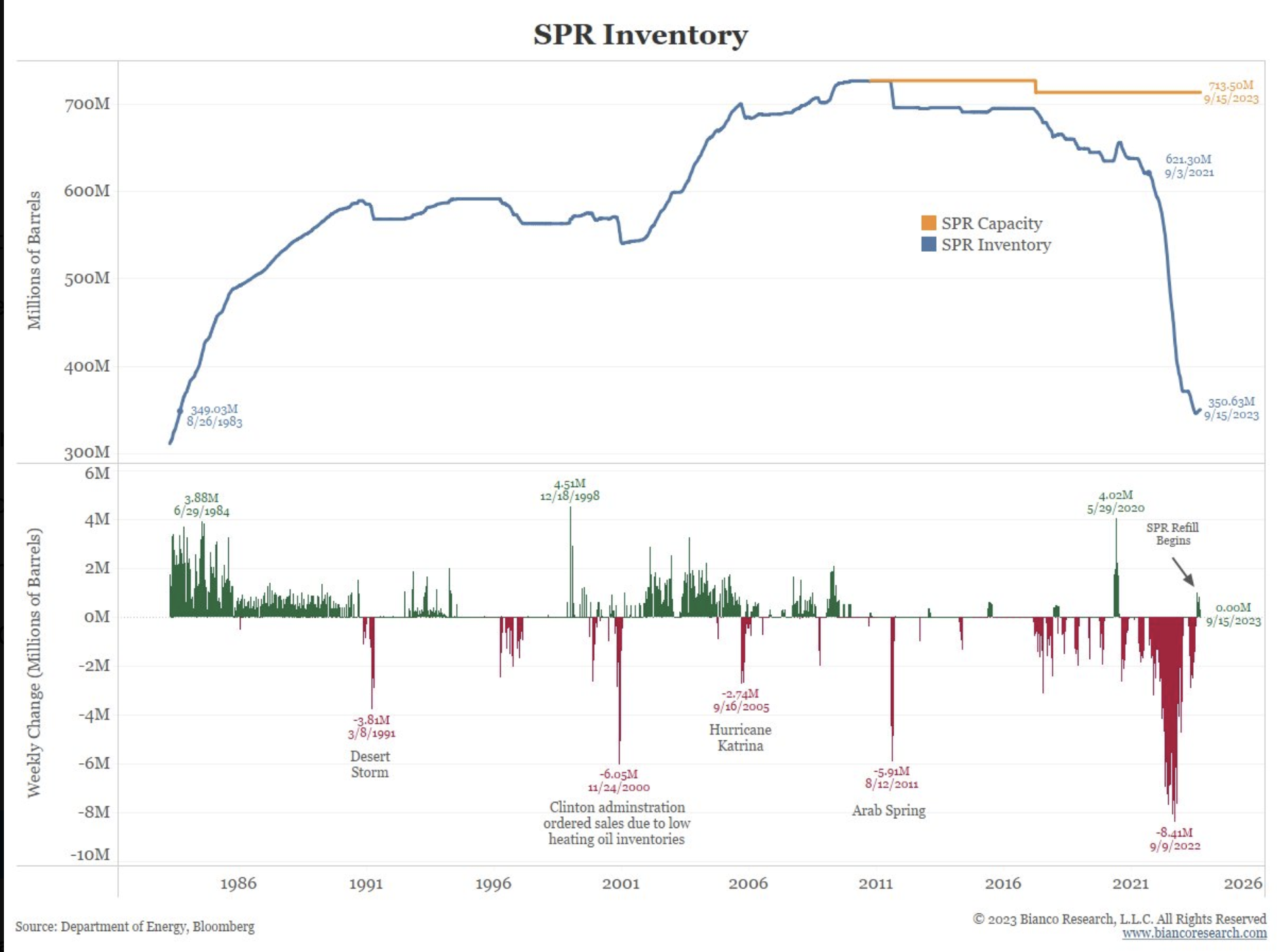
. - Jim Bianco flagged a WSJ flash that President Biden had announced he was ready to deplete the United States’ Strategic Petroleum Reserve (SPR), which was created in the 1970s to prevent oil shortages from wreaking havoc in American society. The WSJ report has since been questioned, but there’s no doubt that the status of the reserve remains at historic and vulnerable lows.
. - Newly appointed Banca d’Italia boss Fabio Panetta once again argued that the eurozone should withdraw fiscal energy support measures and coordinate eurozone fiscal policy; “it is an illusion that EMU can function smoothly without a centralised fiscal capacity”. Panetta further added that a common fiscal tool is necessary for a raft of investments to further European strategic autonomy, among them common European defence.
. - In a desperate bid to keep prices low and keep inflation in check France decided to overturn a rule that previously banned retailers from selling petrol and diesel at a loss. It’s also a sign of tough times ahead for Finance Minister Bruno Le Maire‘s 2024 budget.
. - The Securities and Exchange Commission adopted a new rule to crack down on “greenwashing” by American investment funds and required that 80 percent of a fund’s portfolio match the asset advertised by its name.
. - Rishi Sunak confirmed that he would delay a planned ban on fossil fuel cars by five years, announcing that while the British government is still committed to net zero by 2050, the transition can be done “in a fairer and better way.”
. - Allister Heath, however, explained why Rishi’s move could still be tested by the extremely powerful quango, the Climate Change Committee, which the government created to “advise” it on where to set budgets to meet the targets. Apparently “politicians have some room for manoeuvre, but not much.”
Prince Charles then unsubtly undermined Rishi’s move politically by banging on about the environment during his trip to France to meet Macron, while also flying around on a private jet and enjoying a sumptuous state dinner at Versailles that probably featured some cake. — IK
- Wall Street’s big bet on the used car loans market looked increasingly shaky as increasing numbers of borrowers are left unable to keep up with payments. Regulators claimed that some auto lenders intentionally “set up consumers to fail“.
. - Mark Carney accused ex-PM Liz Truss of creating an “Argentina on the Channel” after her disastrous mini-budget.
. - But Liz Truss defended her economic legacy, arguing the reason why her mini-budget failed was the reaction from the “political and economic establishment”, as her economic ideas “just weren’t fashionable on the London dinner party circuit.” You can watch the speech here.
On Mark Carney specifically, she said he was just bitter because much of today’s economic carnage was a function of decisions made on his watch. — IK
- The Financial Conduct Authority said it would release a report commissioned after the Farage debanking row, which found “no evidence” of other politicians being debanked for their political views.
There is absolutely no way the FCA could have conducted a proper review of the issues in the duration of time available to it. Nor would it necessarily have the competency to make the judgment. — IK
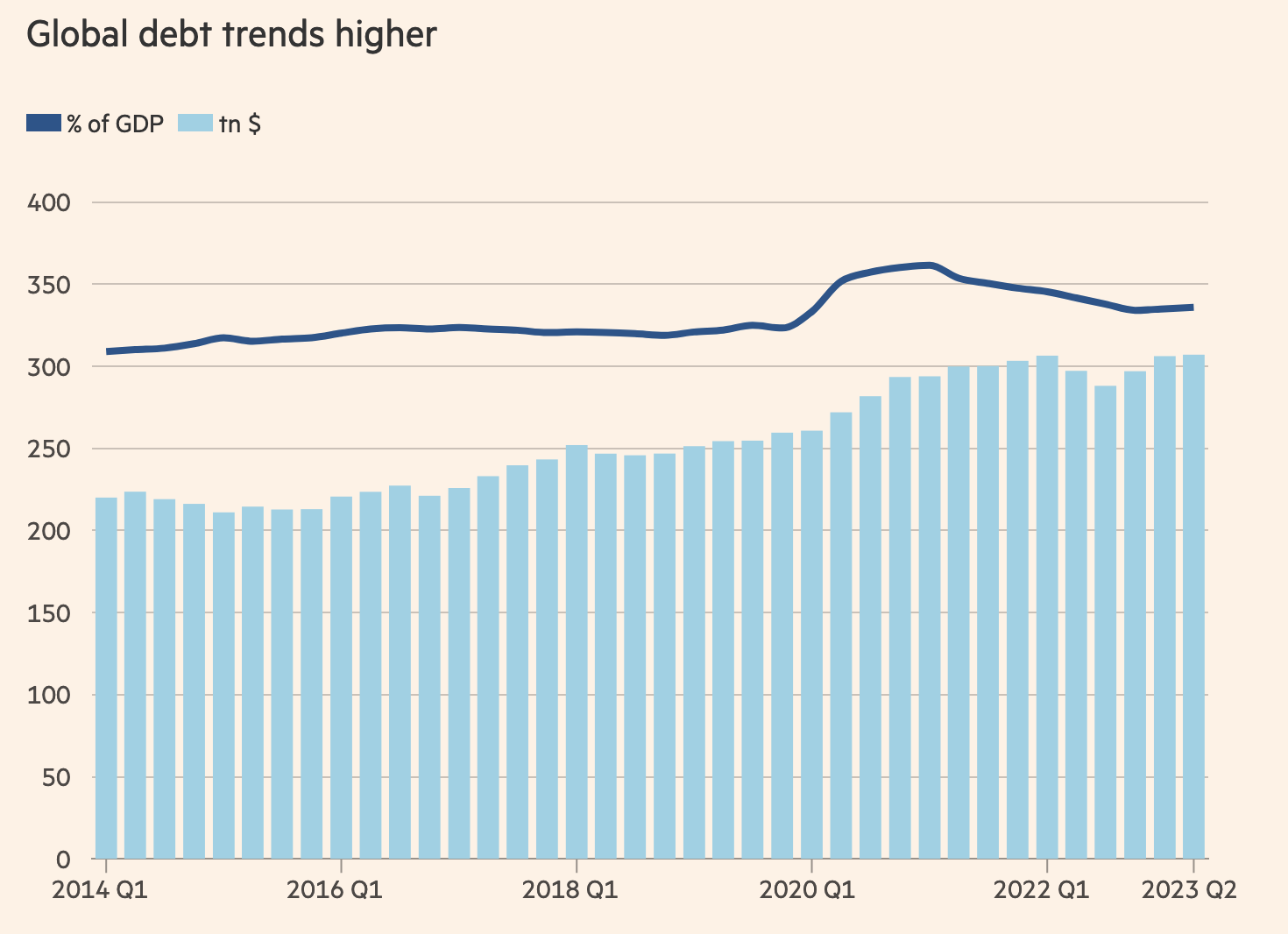
- World economic debt hit a fresh all-time high in the first half of the year, with total debt rising by $10tn to reach $307tn in the months leading up to June 2023. As per the below FT chart, however, what’s really interesting is the degree to which global inflation helped to flatten that curve over 2022.
. - The price of orange juice continued to skyrocket, as it closed this week at a new all-time high.
. - The gold price on the Shanghai index fell over 6 percent on September 15. John Reade claimed this decline may have been caused by a “relaxation on Chinese import restrictions“, and noted the price is still at extreme levels.
. - The ECB posted Christine Lagarde‘s response to MEP Engin Eroglu addressing the increasing diversification of currencies for international trade. The letter highlighted the need for European policymakers to strengthen the euro’s resilience for a more “fragmented international monetary system.”
I got in touch with the MEP to ask to see the original letter. You can see it here. The reason it’s noteworthy is because the ultimate concern driving the letter is whether the euro will ever be up to scratch to challenge the dollar. The feeling is that what continues to hold it back are the fiscal limitations. — IK
- A former comms chief at the Beijing-based Asian Infrastructure Investment Bank urged the United Kingdom to leave the lender, as Western officials at the bank were “being used by the bank for the Chinese Communist party’s propaganda purposes.”
. - The final recommendations by the Taskforce on Nature-related Financial Disclosures have been published, which include provisions for “nature-related” business issues that corporates and financial institutions will begin adopting.
The rise of international taskforces in general deserves more scrutiny because these bodies are very hard to keep to account. Their wish washy status makes them hard to pursue legally, even if they are creating norms that undermine human rights conventions. We’ll revisit this topic soon. — IK.
- German exports to Kyrgyzstan have skyrocketed since March 2022:

- Wolfgang Munchau, former co-editor of FT Deutschland outlined his view that the era of Germany as a beacon of centrist political stability is over, due in part to Germany’s reliance on Russian gas and the meteoric rise of the AfD.
. - Did you know China stopped releasing youth unemployment data in August?
Apparently it’s because analysts used the data (which was coming increasingly bad) as a key indication of the country’s slowdown. — IK
- Amazon said it would roll out adverts on its Prime Video platform next year, and users who prefer the ad-free experience will have to pay extra.
Everything reverts to mean in the end. — IK
Crypto fallout:
- Joseph Bankman, Sam Bankman-Fried‘s father, emailed his son to complain about his $200,000 yearly salary from FTX. Joseph Bankman claimed he was “supposed to be getting $1mn/yr, starting in December” instead. He is currently being sued by the FTX Group for misuse of company funds.
Media Matters:
- Elon Musk claimed that X/Twitter may go behind a paywall for a “small monthly payment”, arguably in an effort to keep “bots off the platform”.
. - CEO of Axel Springer Mathias Dopfner promo-ed his new book at the Council on Foreign Relations, where he discussed global trade, political polarisation, and lessons learned as Chairman and CEO of Axel Springer (which owns Politico).
. - Yoel Roth, the former head of trust and safety at Twitter, penned an op-ed decrying the online hate he received for overseeing the decision to cancel then-sitting American President Donald Trump‘s Twitter account.
. - Jim Waterson wrote on the litany of allegations levelled against Russell Brand.
. - A viral tweet showed a greeting message for Zelensky in New York had misspelled Ukraine, and read “Glory to Urine” instead. But it turns out the post was entirely fake — and probably created by Russian agitators.
. - Matt Hancock continued his TV appearances by appearing on Celebrity SAS: Who Dares Wins, where he was grilled by former SAS operatives over his lockdown affair, and his mishandling of the pandemic
Geopolitical hot spots:
- China’s Foreign Minister Qin Gang was reportedly fired after a sex scandal. An internal investigation by the CCP found that Gang had an extramarital affair that resulted in a child in the United States while he was Chinese ambassador in Washington D.C.
. - A reminder in the context of Azerbaijan’s flash invasion of Nagorno-Karabakh that the Caspian state is among the most creative producers of morale-boosting war propaganda: check out Nərmin Kərimbəyova.
. - Justin Trudeau claimed there were “credible allegations” which link India to the killing of a critical Sikh leader on Canadian soil, a claim rejected by India as “absurd.” As the diplomatic crisis deepens, India has suspended its visa services in Canada, as both countries expelled certain top diplomats from their soil.
Khalistan, assassinations, and troubled India-Canada relations, oh my! And another mirror Spiderman meme in the making.

Read the Canadian press, and you’ll see a raft of Canadian public figures fiercely decrying the violence imparted upon a Canadian Sikh community leader, ostensibly at the hands of India.Not so the Indian press who, together with Indian public figures, have decried Canada’s harbouring of an alleged terrorist, and claimed that the Trudeau government’s actions reflect “the interference of Canadian diplomats in India’s internal matters and their involvement in anti-India activities”, and that Canada has given space to “a range of illegal activities including murders, human trafficking and organised crime” linked to the Khalistani movement.
Why does it matter? Newcomers to the topic are excused for underestimating the extremely controversial and heated nature of the Khalistani topic, and how this movement’s murky ties to the West have been a source of Indian-Western controversy for decades.
The Khalistan movement is a separatist Sikh movement in the Indian region of Punjab. While calls for a separate Sikh state have existed since the 30s, the movement as it is known today only began flourishing during and after the Indian-Pakistan war of 1971. While the movements’ zenith passed in the 1980s, after which its continuous use of violence drained its support among moderate Sikhs in India, Khalistani groups continue to obtain some sympathy among Western activists, Western-based Indian citizens, and capitals to this day owing to continued repressive actions by the Indian army and police against Sikh groups.
As can be expected, the nature of the violence in the Punjab region is truly complicated. It’s not merely a matter that pits Hindus against Sikhs. For instance, a sizeable chunk of the Indian soldiers who participated in the brutal Operation Blue Star crackdown — when the Indian army assaulted the Sikh’s most venerated temple as it was hosting an armed Khalistani liberation group — were Sikh.
And despite being granted permission to voluntarily opt out of the mission, none did. Furthermore, most of the Khalistani movement is Jat-dominated, a majority subset of the Sikh religion. While, unsurprisingly, most non-Jat Sikhs do not wish to live in a Khalistani “Jatistan”, most of the violence effected against real or imagined Khalistani supporters was conducted by the Jat-majority Punjab police – leading the conflict to be called “Jat against Jat” by the Punjab Police Chief.
This conflict has a long history as a damaging thorn in Western-Indian ties. The Soviet Union used multiple allegations of Western support for Khalistan to drive a wedge between the United States, Canada, and India. A Soviet media penetration operation successfully planted over 3,000 propaganda articles in leading English daily’s like the Hindustan Times to encourage anti-American sentiments in India. One of these claims, for example, claimed a Khalistani militant training camp existed in Canada, or that Sikh separatist leaders were on the payroll of the American Defence Intelligence Agency.
But the “Russian disinformation” angle only gets us so far. First, all of the information relating to Soviet propaganda comes to us via the CIA. Second, many of the initial actions that began the modern Khalistani movement were started by a Sikh activist called Jagjit Singh Chohan in the United Kingdom and the United States during the 70s. Operating from a London building termed “Khalistan House”, Chohan started issuing Khalistani passports and dollars. And we needn’t remind our readers that the Pakistani ISI, forever closely linked to the United States, had a key and unsurprising role in arming and aiding Khalistani separatists.
What’s really confusing, however, is the extent to which the issue — and allegations of Western collaboration — are credibly ongoing — despite the fact that we’re well past the Khalistani heyday. For instance, Jaspal Atwal is a member of the International Sikh Youth Federation, a pro-Khalistani independence group. Atwal viciously beat up a Sikh lawyer named Ujjal Dosanjh in 1985, was freed on a technicality, and then shot a Punjab Cabinet Minister in Vancouver Island in 1986. So what the heck was he doing with the official Canadian delegation when Trudeau visited India in 2018? The Former Chief Minister of Punjab, Captain Amarinder Singh, also recently claimed that Khalistani extremists are getting aid from Canada, the UK, and curiously, Italy – as well as the Pakistani ISI.
All about the votes?
But there is a relatively simple answer that cuts through the murkiness — Canadian voter demographics. Canada hosts the largest emigre Sikh population in the world — by a long shot. And though the original Khalistani militant movement’s violence has made it drop in popularity, the Sikh plight in India and its repression by Mumbai’s strong centralising arm is unsurprisingly very popular among them.
Why would any reasonable Canadian politician risk alienating this sizeable electorate by taking on a controversial, pro-Mumbai stance? Trudeau’s position is further weakened by his minority government which relies heavily on the left-wing NDP headed by Jagmeet Singh, who Indian papers accuse of open Khalistani sympathies. This may explain why Trudeau had been slowly inching away from denouncements of Sikh extremism since 2018/19, as he became increasingly dependent on the Sikh vote.
Now, however, the issue cannot simply boil down to a question on Canadian party politics. The horse, as they say, has bolted. Western leaders are intent on making sure this diplomatic kerfuffle doesn’t bleed into other international matters — such as support against Russia in the war on Ukraine. That this also comes at a time when India is increasingly critical internationally, especially in terms of support for BRICS, means that whatever the truth about the killing of the Sikh/Khalistani activist in Canada, the timing couldn’t be worse. — DGG
- Throwback to April 2020, when the F-35 Joint Program Office declared that an issue that risks damage to the F-35’s tail section when the aircraft maintains supersonic speeds was “not worth fixing” and will instead be addressed by “changing the operating parameters” of the jet’s use.
. - Also, if you listen to the ejected F-35 pilot’s 911 call, you realise life really is imitating art.
American political drama:
- President Biden failed to report over $5mn in income on his sworn financial disclosures for 2017-2019, when large Chinese inflows were found to have entered several Biden family members’ bank accounts.
. - An ex-official at the FBI claimed the agency lost count of how many paid informants were in the Capitol on January 6, and had to undertake an audit after the events to assess how many FBI “Confidential Human Sources” were present that day.
Polish potpourri:
- Polish film Director Agnieszka Holland’s movie on the mistreatment of migrants at Poland’s borders sparked controversy after comments from Poland’s Justice Minister, Zbigniew Ziobro. Despite Holland’s threat to sue the Minister, Zibro stated he would not withdraw remarks that compared the film director to a Nazi propagandist.
. - Poland will extend its mortgage payment holiday through 2024 for people who meet the low-income threshold criteria.
. - Poland’s largest opposition group has outlined an interest in creating an office responsible for “overseeing the interests of the Polish diaspora”, which amounted to an estimated 20 million people living overseas.
. - Project Syndicate probed the roots of Polish populism and how it is that Poland’s ruling populist party has continued to win elections over the last eight years despite attacking the country’s liberal institutions and individual rights.
. - Poland’s Supreme Court opened up a legal way to hold communist-era judges legally accountable for ‘judicial crimes‘ against opponents of the former Soviet-backed regime.
Politico’s finest:
- Bethany Dawson wrote on how conspiracy theories have “infected” British politics, with formerly fringe theories quickly moving into the mainstream.
. - A Politico investigation revealed the slipshod methods officials are using to determine who should or shouldn’t be subject to financial sanctions — sometimes depending on Wikipedia articles and even paid for advertisements to make decisions that can change people’s lives.
Military author Edward Luttwak had some sympathy for those unfairly targeted arguing in Unherd, what next? As he noted on X “Am disturbed by the ease with which the Rule of Law was thrown out of the window to go after the billionaires in the Forbes list that had Russian names. That was enough: as Oligarchs they lost all rights to their property without any trial.” — IK
Covid collateral damage:
- A Department of Health and Human Services letter confirmed that the National Institute of Health funded gain-of-function research on SARS viruses and spelled out how this research violated biosafety protocols that “possibly did lead to unacceptable outcomes.”
Mo mummies mo problems
- What’s going on with the so-called ‘alien‘ mummies unveiled in the Mexican Congress?
The unveiling of two Peru-originating mummified ‘specimens’ in the Mexican Congress by Mexican ‘ufologist’ Jaime Maussan took world media by storm.
But, unsurprisingly, the story was immediately buried in allegations of fakery and fraud.
Chief among them were very real allegations that Maussan has a history of being either gullible or intentionally deceiving — depending on your sympathies for the ufologist — and latching on to several bonkers stories in the past.
Secondly were the raft of scientists and experts from departments and universities around the world who have repeatedly discredited the mummies as fakes. This includes the Peruvian Institute of Legal Medicine and Forensic Sciences, who began an investigation several years ago when the bodies were found, and concluded they were ‘recently manufactured.’
Yours truly was ready to ditch the story as one of a long list of hoaxes. That is until this week.
It turns out that Jose de Jesus Zalce Benitez, the Director of the Mexican Navy’s Scientific Institute of Health, conducted three studies to check the skeletal structure of the bodies. Confusingly, and in direct contradiction to the majority of expert testimonies around the world (who, to be fair, never had access to the full bodies), Benitez announced “there is no evidence of any assembly or manipulation of the skulls” or of the bodies – and that these belonged to a single skeleton.
Most of those associated with Maussan’s announcement — including pilot Ryan Graves (whom we had the pleasure of speaking with some months ago) — have since distanced themselves from the mummified remains.
But with the Mexican Navy Institute’s announcement, the issue has plunged straight back into an exciting “what if” territory.
We’ll keep you posted. — DGG
