

Greetings and salutations.
Turn on. Tune in. And drop out. A phrase first spoken by counterculture radical Timothy Leary in 1966.
But, as Leary also noted, “In the United States in the next five, 10, 15 years, you’re going to see more and more people taking LSD and making it a part of their lives. So it will be an LSD country within 15 years, an LSD society. There will be less interest in obviously warfare, in power politics. Politics today is a disease. A real addiction. Politics. Politics. Politics. Don’t politic. Don’t vote. These are old men’s games. Impotent and senile old men. They want to put you onto their old chess games of war and power.”
Nine years ago, comedian Russell Brand — at the peak of his Hollywood fame — famously told Jeremy Paxman he didn’t vote. The interview, which occurred long before Brexit and Trump had highlighted how dissatisfied people were in the current political system, caused a furore, not least because he had just guest-edited an edition of the New Statesman. Paxman told Brand his nonvoting admission disqualified him for such a privilege.
But Brand struck back saying that he wasn’t “not voting” out of apathy. Rather, it was out of total indifference to a system that was failing, destroying the planet and leading to economic disparity to a huge degree. Voting, he said, made you tacitly complicit with that system.
At the time, I thought he was crazy. I also thought most of his arguments were tenuous or poorly informed. Naive, to be frank. But knowing how Brand’s life has evolved since then — drug-enthused lothario turned family man, part-time Christian and online guru — I now realise he was tuning into a much bigger trend, one that most of the establishment was blind to (and in many respects still is). Democracy itself, or at least our current version of it, had become a sham in Russell’s eyes. And what he was sensing was that a revolutionary mood had quietly begun to sweep across the country. Real political struggle, in his mind, was about seizing back control and pulling back the curtain on the true state of the system. Not voting. That game was rigged.
“If you can’t be arsed to vote, why should we be arsed to listen to your political view?”, Paxman blasted back, totally missing the point that it might actually appeal to people to have a staunchly unaligned [even if deeply flawed] individual who can criticise all parties and edit a political rag.
What Russell Brand did next, however, surprised almost everyone. He gave up on Hollywood (which, by his own admission, had made him a total dick), as well as the drugs. He settled down, got spiritual, and set off on a self-initiated learning curve. This he happily shared with the world, making videos from his bedroom to a committed audience of fans, most of whom happily came along with him on his growth journey. The model relied on interviewing a vast array of notable names. And, for the most part, Brand seemed to get humbler with every interview.
Somehow, a few years later, the formula had managed to forge him an online empire that, today, dwarfs the influence of many established media companies. His YouTube channel alone boasts 6.6 million subscribers. And his videos regularly fetch half a million to a million views each. To compare, BBC News on YouTube has 14.7 million subscribers. BBC News 24, a worldwide news network, is watched by 6 million people a week, according to official data.
The content, objectively, is hit-and-miss. Sometimes, it’s genuinely inspired. Take Russell’s latest critique of John Kerry’s private jet ownership, which was both hilarious and insightful, a hark back to the best days of Jon Stewart’s satirical The Daily Show. Other times, it’s predictably formulaic and almost comically (in the most annoying way) structured to engineer clicks that feed fringe paranoia. That’s without mentioning the slightly unappealing culty/preachy aspect to it, which — even if it routinely promotes self-empowerment and advises people to “stay free” — itself not a bad message — becomes nauseating on endless repeat. His followers, of course, don’t seem to mind. And that, perhaps, is what grates established voices most.
For his detractors — no doubt, those who watch his content least — Russell Brand represents the classic trope of a lefty turned alt-right conspiracy theorist. A new Alex Jones. One of their own, now fallen, who has inexplicably begun to engage in all the “fascist” talking points. One whose character, motives, and integrity must now be questioned. This, despite Russell’s continuous protestation that he remains apolitical.
But Russell’s star has just been skewered and his empire stands on the cusp of ruin.
Last night, after intensive circulation of rumours and gossip by high-end MSM accounts on Twitter, Russell was hit with a double whammy. Both Dispatches and the The Times — in, let’s face it, a coordinated move — went to press with a slew of scandalous accusations about his sexual conduct, including accounts of assault and rape from his most hedonistic days.
The case for a full frontal character assassination establishing Brand as a sexual monster has now been laid out. And the call for further victims to come forward has been communicated. As far as half of Twitter is concerned, the verdict is in.
There’s no doubt the documentary made for uncomfortable viewing and The Times piece for uncomfortable reading. And there’s little doubt that an official criminal investigation will follow. And rightly so. But whether he can get a fair trial at this point is much harder to assess.
Russell himself had preempted the revelations by posting a video in which he strongly refuted all the charges made. Especially the criminal ones.
So why should you, dear Blind Spot readers who are mostly interested in finance, care?
I frequently comment that in today’s new political order, we’re living in a paradigm where you’re either in power or in prison. This is a big departure from how a civilised democracy with a flourishing free market is supposed to work. A rules-based system that fosters trade is supposed to be coupled with a political system wherein a civil and peaceful transfer of power can be depended on. After all, who can rely on any financial contract if the judiciary itself has been “weaponised” (as is the linguistic vogue today) to rule only in line with what the current powers deem just? Continuity and trust in the financial system can’t be guaranteed if every four years retrospective legal changes can land you in prison.
But power in that equation is hard, not soft. And to his loyal followers, Russell’s outsized soft power was never going to be enough to protect him from the threat that he posed to the establishment. In their eyes, it was only a matter of time until “they” found a way to throw him into the Gulag Archipelago. And this itself would be proof enough that he was onto something.
So, just like with Trump, Russell’s audiences have been well primed for their hero to become a martyr. This will be no ordinary metoo case. It will be viewed, instead, as much an attack on Brand’s 6.6 million followers as it is on him. And a bid to suppress his inquiries and his probing of subject matters the conventional press will not touch.
To wit, Rand Waltzman, a real disinformation specialist who hails from the era when Russian “active measures” were formerly being countered by the US, as well as a former DARPA programme manager, has a fascinating spree of Linkedin posts showing and telling how smear and disinfo campaigns work. Here are a couple on how to eliminate a political opponent with a character assassination campaign:
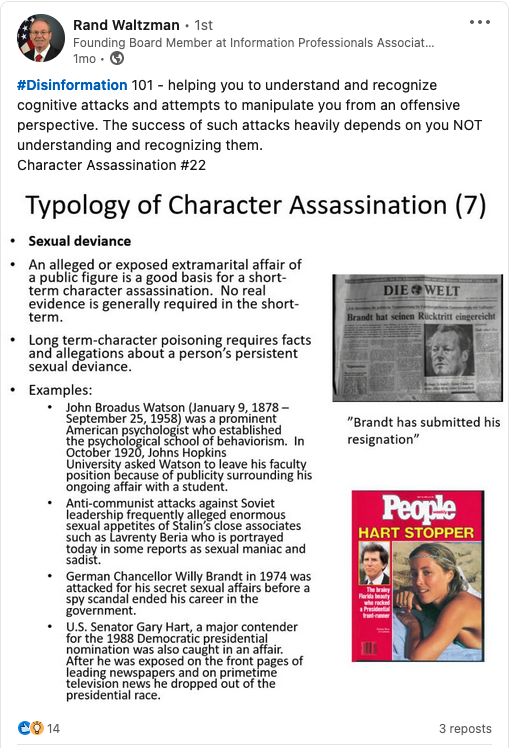
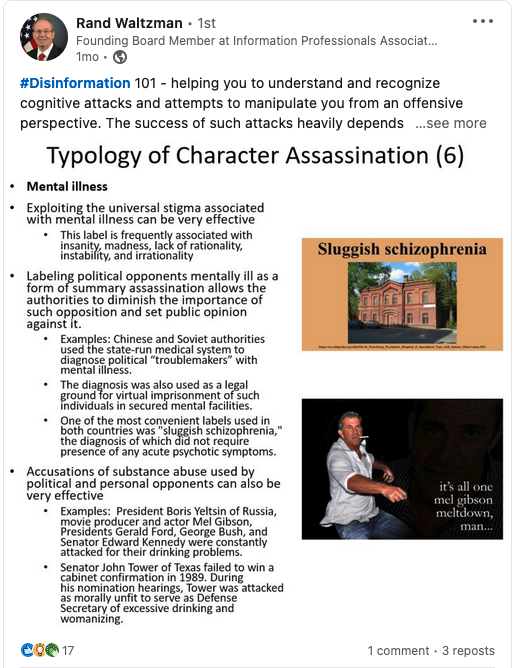
Whatever the merits, or not, of the sexual abuse claims, and I make no judgment, the above clearly fits the bill for Russell. His followers will be wise to this — something that’s already self-evident from the support he is getting online and at his live stand-up shows. And while for the most ardent mainstream voices none of that will make a difference, the scope for substantial blowback is there. When it comes, it may force society to confront some serious inconsistencies in how it applies moral outrage to such issues, as well as the approaches it takes to female safety vis-a-vis female empowerment, as well as the normalisation of drugs and hedonism in the context of consent.
That Russell Brand indulged in vulgarity, inappropriate behaviour, or worse, during his most lurid phase will come as a surprise to nobody. His reform, however, has been self-evident. The question many will ask, quite rightly, is what took so long to expose his past transgressions? Why now? And yes, is it political? More broadly, what is it about power that incessantly lends itself to such kompromat?
It’s relevant too that the power/prison dynamic first emerged in the western hemisphere in 2016, when the despondent masses — until then underserved by the body politic — somehow managed to achieve a slither of political power. This is the moment politics became epistemological, paving the way for online gurus like Russell to build their audiences, largely because the mainstream media had no interest in exploring the case against.
Markets, however, are yet to understand the significance of this. Specifically, the point that if enough people believe that democracy is a sham, captured as it were, the same applies to the free market. And the consequence of that is that almost everything in the system might be mispriced.
In that context, Russell Brand is just another domino in the almighty clash between the newly repoliticised citizenship and a failing free market/technocratic state whose singular mission to create prosperous stability by way of militant consensus has done anything but.
More thoughts on the specific elements of how that clash is already making itself known below. As usual, this edition of the Blind Spot newsletter was compiled with the help of Dario Garcia Giner. And apologies for typos!
Economics, business, finance, and more:
- The WSJ took a deep dive look at the rise of “brokered deposits”, which it revealed had grown to represent $1.2 trillion in risky ‘hot’ funding in the system. The deposits are said to be particularly attractive because they are insured. For more on how this market evolved, see this June 2020 paper which gives a good historical account.
. - American banking groups pushed back aggressively against regulatory plans to impose greater capital requirements on them. The new rules, which could cost the banking system as much as $170 billion in capital, are based on international standards agreed in 2017 at the Basel Committee for Banking Supervision. The institutions are now threatening to sue the Federal authorities if the rule is implemented.
. - In a recent speech, Michael S. Barr, Vice Chair for Supervision of the Board of Governors of the Federal Reserve System, confirmed the Fed would not proceed with issuing a CBDC without clear support from the executive branch and authorizing legislation from Congress. At the same time, he argued for clearer and more decisive action on the regulation of stablecoins. “If non-federally regulated stablecoins were to become a widespread means of payment and store of value, they could pose significant risks to financial stability, monetary policy, and the U.S. payments system. It is important to get the legislative and regulatory framework right before significant risks emerge,” he said.
. - ICYMI, the structure of China’s financial regulatory system has been transformed. Among the changes, the PBoC’s role in monetary policy and macro-prudential supervision has been refocused, relinquishing oversight of financial holding companies, reports OMFIF. “The reform plan has also made major structural changes to streamline the organisation of the PBoC. The central bank will eliminate the nine large regional branches, modelled after the US Federal Reserve, and replace them with 31 provincial and five municipal branches.”
. - Bloomberg took a closer look at why councils across Britain are going bust. After risky investment schemes and borrowing over £133bn, local authorities are increasingly issuing bankruptcy notices across the UK, but the piece also blamed chronic underinvestment under the Cameron era.
. - Marcel Boiteux, the former head of Electricite de France (EDF), passed away on Sept 6 aged 101, dubbed one of the most important men you never heard of. Boiteux’s impressive leadership of the French energy giant led to France’s array of standardised nuclear power stations, which fell into disarray when he departed from EDF’s helm over 20 years ago.
. - Joerg Wuttke, one of Europe’s most prolific businessmen in China, revealed he believes there is “no hope” that China will “rejoin the world”, and that its economic heyday is now over “because Xi was willing to exchange growth for ideology”.
. - Macquarie Bank said it would phase out cash deposits and cheques by November 2024 as it transitions to “completely digital payments.”
.. - Robin Brooks at the Institute of International Finance highlighted in a series of charts why export controls to pressure Russia are not working. Only Brazil’s exports to the warring country have remained small and stable. Everyone else, specifically China, Turkey, and India, has seen their exports to Russia rise since the invasion of Ukraine:

- Barry Eichergreen expanded on his recent Jackson Hole paper in a piece for Project Syndicate which claimed that unless the U.S. brought its soaring debts under control, avoided another debt-ceiling showdown, and “gets its economic and political act together more generally”, the dollar could lose its role as a global currency.
. - Silicon Valley wanted you to know that psychedelics were becoming the big new thing in tech, especially with respect to the treatment of depression.
News reaches us that the fad for psychedelics is so strong in techland that this year’s Web Summit plans to go all in on the sector at the cost of crypto-themed guests and stands. Those advocating the cause are utterly adamant that the tech (due to dosing insight) is so revelatory that it stands to transform pain management. Surprisingly, they also have little concern about negative side effects or the historic role played by psychedelics in many questionable experiments by the state. The only pause for thought came when I asked them to ponder how they would react to news that Vladmir Putin was advocating for the mass psychedelic dosing of his whole population. Turn on, tune in and drop out, eh? — IK
- John Reade at the World Gold Council drew attention to the fact that spot gold on the Shanghai Gold Exchange was trading at an unprecedented premium of 6 percent.
Not everyone is clear on what’s driving the premium. One theory is that sanctioned oil exporters are selling oil for yuan on Chinese exchanges to BRICs importers, and using the proceeds to buy Shanghai-based gold. This would have the effect of driving the price of gold up in yuan terms, while also putting pressure on the value of yuan against the dollar. The Shanghai premium, if sustained, may also have the longer-term effect of luring gold out of Western vaults into Chinese ones. Or it could just be domestic Chinese looking to put their savings in anything that isn’t yuan or an apartment.
According to Read, another key influence was likely China restricting gold imports, something it does when it’s worried about CNY weakness. “What’s odd is that China traders are buying ‘reasonable” amounts of gold at high premiums,” he noted. “Either way this level of premium is unprecedented.” — IK

Central banking power struggles:
- Christine Lagarde allegedly seized ECB colleagues’ handsets to prevent leaks ahead of announcing that the ECB had nominated the Bundesbank’s Claudia Buch for the ECB’s Single Supervisory Board.
If you’re not deep in the weeds of ECB or European Union policy, you might have missed the significance of this story. There’s no doubt it caused an almighty stink in Brussels. The ECB’s appointment of Buch comes despite the European parliament having made it known they prefer Spain’s Margarita Delgado for the job, and could be interpreted as Germany horse-trading the post with other top EU jobs up for grabs ahead of European elections next year, instead of reflecting the qualifications of the two candidates, my Politico colleagues report. Parliament, however, still has power to block the decision.
But it wasn’t the only leak that Christine had to deal with. Somebody casually dropped a bunch of worse-than-expected inflation forecasts to Reuters the day before its policy meeting, which radically flipped market expectations for a hike. — IK.
- According to most of the financial media, the ECB merely criticised Italy’s windfall tax.
Based on our conversation with Russell Napier earlier this month, we think it signifies something far more meaningful. The pushback is arguably the first overt stage of a monumental power struggle between central banks and governments the world over in pursuit of monetary supremacy. Here’s how we recounted the battle in Morning Central Banker.
GET OFF OUR TURF: The ECB finally let its true feelings about *that* Italian windfall tax be known. The verdict (published Wednesday in a five-page non-binding legal opinion) was… well, that nothing good would come of it. But also, importantly, that bank profitability remains intimately tied to bank capital, which plays an important role in ensuring the smooth transmission of monetary policy measures to the wider economy. “In this context maintaining an adequate capital position helps credit institutions to avoid abrupt adjustments to their lending to the real economy,” the ECB noted. A message, in other words, that it’s the central bank’s turf that the government is intruding onto.
The battle for monetary supremacy: The ECB’s numerous gripes (and there were many) echo much of what it had already stressed in an opinion about Spain’s bid to enact a similar tax last November. These include that the levy yet again ignores the business cycle or the need for banks to buffer up in good times in anticipation of worsening credit conditions in the future. But also that smaller or more fragile institutions might be less able to absorb the potential downside risks of an economic downturn if they are overtaxed today. All of which, obviously, has a bearing on longer-term financial stability.
A legal quagmire and a proxy war. Looking back, the ECB’s strongly worded but, ultimately, powerless reaction to the Spanish move failed to influence policy or prevent it from setting a highly undesirable precedent to be copied across the eurozone. This time, however, there are signs the ECB has learned its lesson and may be striking back in tandem with the banking industry to ensure that chancer eurozone governments may have second thoughts.
Lawfare by proxy: Already on Tuesday, Giovanni Sabatini, the director general of the Italian banking association, called the surprise tax a violation of the principle of free competition in the EU, warning that its retrospective effects “raised doubts about its compatibility and constitutional precepts.” The statements imply an incoming legal battle cum proxy war between the Italian government and the ECB, in which the banking industry will likely play the part of the ECB’s aligned but not officially contracted (i.e. plausibly deniable) militia force.
Don’t look a gift horse in the mouth: That’s no good for a country that’s already at the mercy of the bond vigilantes, a point clearly imparted by the ECB in its view that “the heterogeneous nature of such taxes for the banking sector” invites broader fragmentation risk for the eurozone financial system. A subtle reminder to Italian premier Giorgia Meloni, perhaps, that it’s the ECB that still has the power to close the spreads if international investors take fright.
The battle may have only just begun. Russell Napier, author of the Solid Ground Newsletter, for one, believes the squabble is likely to amount to the most important development in central banking. “If [the government] can control the banks and if they can control the quantity of credit… it’s the destruction of the central authority of the central bank in Frankfurt,” he told POLITICO earlier this month, noting the original lack of action from the ECB has only encouraged copycat moves.
FINANCIAL REPRESSION INCOMING? You wouldn’t have thought the U.K. government’s failed assault on the independence of its own financial regulatory system, which occurred just after last year’s October Truss debacle, might be related. But it could be. At the time, Andrew Griffith, the minister overseeing the financial sector, had proposed an “intervention power” for the government vis-a-vis policy coming out of the Bank of England and Financial Conduct Authority, which would have allowed it to scrap or change a rule if it was dubbed “in the public interest”. The proposition, however, was dropped after markets, opposition leaders and pretty much all of Fintwit recoiled in horror at the prospect of key institutions losing their independence.
But the times they are a-changin’. By June of this year — the peak of this summer’s panic about the impact of Bank of England’s rate hikes on the mortgage-holding demographic of the electorate — it was an irony not lost on Chancellor Jeremy Hunt that some of the same voices were among the loudest ones calling for “something to be done” about the imminent rate reset bloodbath facing high street borrowers. To quell critics, Hunt promptly invited mortgage lenders to Downing Street for a parley on what might be achieved through dialogue alone. The end result? A very much voluntary “mortgage charter” committing to institutional forbearance whenever possible, but which stopped short of mandating any rate hike suspensions or interfering explicitly with the BoE’s monetary policy power.Last laugh: Of course, had the government acquired its desired “intervention power” … it could all have been so different. Something Hunt was very keen to point out to his Labour shadow Rachel Reeves when she called for the voluntary measures to be mandated. “Why did Labour oppose the intervention power in the Financial Services and Markets Bill that would have made that possible?” Hunt noted during a parliamentary debate on the matter in June. — IK
Crime and punishment:
- Clothing store American Eagle sued San Francisco’s Westfield Mall, where they operate a large retail space, due to “neglecting (the) security and management responsibilities required through its lease”. Record amounts of shopkeeping have made holding their retail space unprofitable for the American retailer, according to the New York Post.
Commodities and energy:
- Geologists discovered one of the world’s largest lithium deposits in an ancient supervolcano under the McDermitt Caldera in Nevada. The deposit is currently estimated to hold between 20-40 metric tons of lithium, and could rejig market dynamics of this rare metal in favour of the United States.
. - Do large offshore wind turbine farms slow each other down? A paper in Science Daily found that “the losses with increasing offshore wind energy production will be considerable and detectable as large scale patterns of reduced wind speed (form) around wind farms.”
- The renewable crisis notched up a gear as the European solar power lobby, SolarPower Europe, warned that the European Union’s goal of “open strategic autonomy” was endangered by a recent collapse in solar power prices. This larger-than-expected drop meant that European producers were struggling to sell their products, and a slew of European producers were increasingly facing bankruptcy risk. Unless something is done soon, SolarPower Europe claimed, Europe’s entire solar power manufacturing network could collapse.
. - Solar industry specialist Bernreuter noted that after 10 weeks of limited supply and strong demand, polysilicon prices were beginning to weaken again.

Media matters:
- The White House sent a letter to top American news executives this week urging them to closely scrutinise House Republicans for their impeachment inquiry into President Joe Biden. Constitutional legal expert Jonathan Turley pointed out that the Biden White House was now “actively involved in pushing narratives and denying factual allegations linked to the Biden corruption scandal”, and predicted this could “create Nixonian-type allegations” of abuse of office, among a range of other pointed criticisms of this novel and aggressive media strategy.
. - The Washington Post’s David Ignatius marked a clear turn in mainstream support for a Biden reelection campaign when he argued the current President should not run.
. - Ex-Secret Service agent Paul Landis, who was with JFK on the day of his assassination in 1963, broke a multi-decade silence on the topic to claim there was more than one shooter involved.
. - Tucker Carlson continued his tour of establishment-challenging international figureheads by flying to Buenos Aires to interview the Argentinian libertarian presidential candidate Javier Milei. The two discussed the role socialist ideology had played in Argentina’s economic troubles.
Geopolitical hot spots:
- A new Russian loitering munition successfully completed combat tests in Russian-occupied Ukraine
. - Rumours continued to swirl over the fate of China’s defence minister Li Shangfu, who remained unseen for over two weeks. One U.S. government official hinted that Li’s absence was likely related to corruption allegations. According to the WSJ, Li’s unexplained absence mirrors the recent disappearances of other senior officials.
. - Internationally renowned military expert, Edward Luttwak, criticised modern attitudes to the migration crisis, arguing in a Tweet that they replicate “late-Roman attitudes” by refusing to use force to keep out the new barbarian invaders and misrepresent an unwillingness to defend the frontiers as a moral stance.
It’s worth noting there’s been a visible step-change in discussion of the migration crisis, in some cases focused on questioning the ongoing logic of remaining committed to the European Convention on Human Rights, which the European Court of Human Rights interprets. — IK
- Alexander Velez-Green made the case in National Interest that the United States should make it their “urgent” priority to deter China now, rather than waiting for China to make the first move and attempt to invade Taiwan.
Keen readers of American military-industrial media and academic pieces will note this article has all the markings of your typical “Blob” piece. The “Blob” is the nickname for Washington’s foreign policy elite, who incessantly push for ever-greater military spending and interventionism overseas. But not everything is as it seems.
Alleged Blob institutions and mouthpieces, like the Washington Post above, are always finding new emergencies and reasons from a-z as to why X sector of the U.S. military is chronically underfunded and ill-equipped. It usually makes for entertaining though ocasionally infuriating reading (if the U.S. military is underfunded, which military isn’t?).
Surprisingly, however, they can sometimes be correct — because this particular challenge to the United States is in the South *China* Sea. The clue is in the name: the American military has to fight a war on the other side of the world, against China, which can concentrate its forces a few kilometres from their shores.
The “Blob” is right to be fearful — historically speaking, long-distance force-projection has always been a significant challenge for even the most powerful empires.
Just think of the Greco-Persian wars. The Persian empire could bring together a much larger number of warships and soldiers to the field — as well the best quality cavalry in the world. But they were fighting far from their heartland, against Greeks in their own backyard. The Greco-Persian wars are replete with examples of the Greeks beating — or almost beating — Persian armies and navies almost twice their size; just think of infamous Thermopylae and the 300-ish Spartans. Or the battle of Salamis, where the huge Persian navy got itself stuck in a narrow pass, letting the smaller and more agile Allied Greek navy rip them apart.
It will always be incredibly difficult to fight someone on the other side of the globe. Especially when they’re fighting from — and for — their home.
Now, unlike the Greeks and their excellent long-pike-bearing hoplites, the Chinese don’t really have a qualitative military advantage over the Americans’ world-beating military, air force, and navy. However, they have quantity. And lots of it. And, as pointed out above, their geographical advantage is a major obstacle for the Americans to surmount.
But the problems don’t stop there.
Much is said of the apparent obsolescence of the aircraft carrier with the increasing number, range, and capabilities of ballistic missiles. Now, some of these fears may be overblown. Ballistic missiles still cost a ton, and guidance deflection and missile defence systems have advanced just as much as the missiles themselves. Just 20 Chinese DF-21D guided missiles — their anti-carrier weapon of choice — would cost them $1bn to launch in total, most guided missiles costing between $10,000-$20,000 per pound of warhead. This compares very unfavourably to the carrier’s aviation fleet, which can fly closer to the target below radar and deliver a cheaper smart bomb payload at $100/pound (fighter jet, carrier, and bomb cost included).
But this doesn’t take into account the Blind Spot’s favourite military takeaway from the Ukrainian/Russian conflict: the success of low-high/cheap-high tech solutions. This goes beyond the success of cheap First-Person-View (FPV) quadcopter drones ceaselessly battering defenders on both sides accurately for around $100 bucks a pop. There are two weapons types that could foreseeably overcome carrier defences with sheer numbers: “washing-machine” priced cruise “missiles” and naval “drones.”
“Washing machine” priced cruise “missiles” are hardly missiles, they are crude radio or GPS-controlled small airplanes packed with bombs. Think of something like the Iranian Shaheed cruise “missiles” thrown together with a cheap carcass, a few nails and a motorcycle engine — but even *cheaper*. Naval “drones” aren’t exactly high-tech either. They are rafts loaded with explosives, a high-powered motor, and a cheap camera.
But these low-high tech solutions are the resounding success story of the Russian/Ukrainian war. Just see how most of the Russian Navy seems to be cowering in their Sevastopol base. The Ukrainians don’t have a real navy, but their constant attacks with TB-2 Bayraktar aerial drones and cheap naval drones sufficed to domesticate the mighty Russian fleet. At their main base in Sevastopol, no less. Of course, Western supplied high-tech cruise missiles pack the most remarkable punch — but that shouldn’t surprise anyone. They are still too expensive and hard to replace to be revolutionary.
If China would focus on disposable and unmanned equipment as a manufacturing priority, this would give them yet another advantage in the conflict. On top of China having the largest navy in the world, thousands of land-based missile launchers, and a massive merchant navy fleet, they could also launch swarms of drones that could cost less than a single cruise missile. While it’s easier to intercept a target flying at 150 km/h rather than at Mach 3-5, intercepting 300 targets at 150 km/h is something else entirely. Especially when another 300 are 10 minutes away. And don’t forget the leader in small drone technology, DJI, is a Chinese company, meaning Chinese small drones will likely outmatch anything domestically produced by either Ukraine or Russia.
None of this means that China could easily take Taiwan. Amphibious operations are excruciatingly challenging and can quickly turn awry. History is full of stories where competent adversaries meet a quick end on rocky shores. Just think of the failed Spanish Armada and the far more catastrophic British counter-Armada, or Gallipolli.
It also doesn’t mean China will easily project its power beyond Taiwan, even if it should take it. The United States and its allies are still the most formidable military force in the Pacific and Indo-Pacific regions. Just not around Taiwan.
These points create questions for the American navy’s logic of maintaining a strategic deterrent in Taiwan with the paltry numbers described by Velez-Green. China won’t necessarily win an engagement, but a clean victory for the United States appears more unlikely every day. What will happen to the global American military deterrent when a washing-machine priced drone, or an explosives-laden dinghy, incapacitates a nuclear carrier?
This is a chronicle of a death foretold: a similar American military exercise, the infamous Millennium Challenge 2002, pitted the mighty U.S. Navy against Lt. Gen. Colonel Van Riper, an American roleplaying as Iran, with a motley crew of soldiers in 70s and 80s equipment, old anti-air missiles, and fast boats. But Van Ripers combination of aggression, overwhelming numbers, and suicide attacks wiped out most of the invading American fleet on the first day. The exercise was so humiliating for the American command they modified the exercise’s rules to “re-float” the “sunk” American ships and intentionally handicapped Van Riper for the rest of the exercise. Every Ukrainian success against the Russian fleet with cheap equipment should remind the American command of Millenium Challenge 2002.
The Blob should think carefully of what it desires. If America wants to maintain a strong Taiwan deterrent, their own quantity of troops and ships will have to be raised far beyond where they currently stand, as the author of the WaPo piece pointed out.
Alternatively, the Blob letting China re-take China and re-focusing on the wider region may be better than trying to prevent a logically inevitable — and extremely difficult to prevent — attack. One in which the Americans risk losing face (and lives) along the way, and igniting a new world war. — DGG
- As tensions between Armenia and Azerbaijan continued to rise over the build-up of military equipment along their borders, conflict observers spotted novel battle markings on Azeri vehicles such as “Ƶ,” “฿,” “F,” and more frequently “∀”. What does it all mean?
. - Almost three weeks before the Niger coup, the government-owned China Nuclear International Uranium Corporation entered a deal with the Niger government to restart uranium extraction in the Azelik mines.
How’s this for an interesting blind spot?
Most press has been silent on the concrete international allies of the Niger coup-makers, besides their apparent affiliation with Wagner.
So what about China?
Interestingly enough, the Chinese have made large steps into Niger over the past decade and rapidly grown to become Niger’s second-largest foreign investor after France. Its total FDI at the end of 2020 stood at $2.68bn. The biggest investors were state-backed entities, notably the national nuclear firm CNNC and petroleum giant PetroChina.
And the investment spree has only grown since then. On July 6 — 20 days before the coup — media pieces appeared outlining a new commerical deal between China and Niger. This involved the building of an industrial park, an oil pipeline, and the re-starting of the giant majority China-owned but previously uneconomic Azelik uranium mines, which had been shut for 9 years due to low uranium prices.
The Niger-Benin export pipeline is being developed by the China National Petroleum Corporation and its almost 2,000km would allow Niger to increase crude production and international trade access through Benin — and lowering its almost total energy dependence on neighbouring Nigeria. And rising uranium prices similarly led to good signs for other uranium mines: in June 27 another agreement was signed by the Chinese in Niamey to mine the Arlit uranium mines in Agadez.
Online media mostly point out the coup is not necessarily good news for China’s investments, governmental instability rarely is. But one can’t help wondering if Niger’s strongarming of France with forcibly higher uranium prices will end up benefitting China’s newly opened mines, which were closed (or never opened) precisely because uranium prices were previously too low?
We shouldn’t speculate without concrete evidence. But the timing of the investments listed above — particularly the uranium mines — is certainly worth clocking. — DGG
- During his visit to China, a Chinese reporter in English asked Venezuelan President Nicolas Maduro a question. Maduro interrupted the reporter and explained there was no English-Spanish interpreter. “Speak Mandarin (…) it’s a new world!” Maduro exclaimed.
You’re either in power or in prison:
- The Polish opposition Civic Platform vowed to hold Adam Glapinski accountable for “destroying the independence” of Poland’s central bank if it wins October’s elections.
Politico’s finest:
- The American Justice Department quietly dropped an investigation into Bijan Rafiekian, a Californian businessman and former partner of Trump ally Michael Flynn, on charges of “acting as an unregistered foreign agent for Turkey” during Trump’s original White House bid.
. - Suzanne Lynch and Alex Ward dived into why the West “went easy” on Russia’s invasion of Ukraine to “save the G20“. A similar piece was also posted by the Financial Times.
.
- Hungary’s Viktor Orban has accused European leaders of “fearmongering” over climate change and called for Europe to re-focus on the critical issue of falling birth rates.
Scientific developments:
- The Reasonable Faith YouTube channel discussed whether new data from the James Webb telescope has undermined the Big Bang theory. This comes after a spree of scientific articles focused on how the satellite’s data is showing the beginnings of the universe were “not quite like how we might have predicted”. PNAS last month noted that, “The telescope had done nothing less, read the headlines, than “break the universe” and upend models of cosmic history. Subsequent data have ruled out some of the more dramatic findings, and new simulations can accommodate at least a few of the strange observations. But some bright, massive, and early galaxies continue to confound theorists, suggesting that our understanding could shift in the coming years.”
. - Baidu’s Chat-GPT competitor Ernie Bot was tested by millions of users this week, who discovered the AI was reluctant to answer certain geopolitical questions. For example, when asked whether Taiwan was part of China it replied “Taiwan is part of the sacred territory of China” before asking to change the topic.
Merry mishaps:
- Streets were flooded with wine in Levira, Portugal after several tanks burst at a local wine distillery.

Covid collateral damage:
- Michael Shellenberger and Alex Gutentag’s latest for Public recounted allegations by a new CIA whistleblower that the agency used monetary incentives to push agency analysts to undermine the Covid-19 lab leak hypothesis. These findings were echoed by the House Select Subcommittee on the Coronavirus Pandemic.
. - California Governor Gavin Newsom claimed that, in hindsight, his government should have “done everything differently” regarding Covid–19 policy. Newsom also bemoaned that health and pandemic decisions in the United States took on a partisan tone during the Covid-19 pandemic.
. - Florida’s surgeon general argued the CDC and the FDA continued to push American citizens to take Covid-19 vaccines, despite ample literature proving both their inefficiency and their dangerously underappreciated side effects.
