

Dear Subscribers,
Another Sunday arrival I’m afraid… so let’s get cracking.
When I was a kid back in the 80s, every Saturday when all my friends were watching the Wide Awake Club or going swimming, I would be marched off instead to a random school in West London to sit in a classroom with badly behaved boys to learn Polish and other cultural things about Poland, notably history — usually focused Polish kings called Boleslaw — folk dancing and literature. It was painful and nonsensical to my mind. And I loathed going.
And so it was that every week my mother would face an uphill battle to get me there. “What do I need Polish for anyway!? It’s a stupid language that nobody uses. I don’t want to go!”, I would yell at her. And every week she would reply: “Trust me, one day you will be grateful I forced you to go to Polish school. Now get in the car!”.
Well, ladies and gentlemen, this was the week it became abundantly clear my mother was right. Because, unlike my lovely colleagues on the Morning Central Banker team at POLITICO, I had the unique pleasure of being able to listen to the full, unredacted Adam Glapinski (president of the National Bank of Poland) as he took to the pulpit this week to defend his surprise decision to cut Polish interest rates by 75 basis points. And it was all because I could understand Polish. So, thank you, Mama.
Here at the Blind Spot, we’ve talked before about some of the audacious approaches Glapinski, who is the PiS-appointed president of the National Bank of Poland, has taken to his comms, among them the giant banner he had draped across the building blaming Polish double-digit inflation on Putin and Covid. We’ve also talked about the polarised nature of Polish politics and how you can’t understand the ruling PiS party — which is heading to the polls on October 15 — unless you channel it through a Cold War paranoia filter.
But this was the first time I’d actually taken the effort to listen to the NBP president in his finest stream-of-consciousness form. And it was certainly worth it.
To suggest the appearance was Trumpian would not do it justice. Glapinski lacks the Trump aesthetics, charisma and comic timing to be a full impersonator. If anything, he is to Trump what Danny Devito’s character is to Arnold Schwarzenegger in the film Twins. But there’s no doubt there is a parallel.
Just like Trump, Glapinski has an uncanny knack for being able to distil complex matters into the language of the “common man”, for which he is judged to be an idiot by detractors. Just like Trump, he gives off the impression of being courageous for telling it as it is to his base. And just like Trump, he doesn’t give two hoots what his domestic detractors say [it’s all fake news]. But, unlike Trump, there’s an obvious yearning still to be taken seriously by his international counterparts, whom he appears to respect greatly.
For more on the press conference keep reading. Also in commentaries this week, I spoke with Russell Napier, author of the Solid Ground Newsletter, about just how bad the U.K. economy really is. We also delve into the efficacy of weight loss drugs, the ethics of tech land’s newest and barmiest psychedelics trend and we have some media gossip to share too.
As usual, this newsletter is compiled with the help of Dario Garcia Giner. Please forgive typos, etc etc.
Commodities and inflationary energy:
- Gazprom claimed the company accounted for most of China’s increase in gas imports as the Chinese gas market continued to grow. Gazprom delivered 15bn cubic metres to China in 2022, which is expected to increase to 22bn cubic metres this year.
. - If the US government’s going to weaponise the US dollar, Saudi Arabia and Russia will obviously weaponise oil instead, noted Climateer, while reposting a piece from ZeroHedge on Russia and Saudi Arabia’s unexpected extension of production cuts last week, which argued America’s weaponisation of the dollar had “destroyed” the US-Saudi relationship.
.
- EU Observer reported that German energy giant RWE had started to dismantle a wind farm to make way for the expansion of an open-pit lignite coal mineNorth Rhine Westphalia.
. - Oilprice.com warned Putin can still exert pressure on the energy markets even if its natural gas leverage over the European Union has been reduced since its invasion of Ukraine. Russian gas is still flowing into Europe via two key pipelines as well as via LNG cargoes. If there’s a cold winter, it could give Putin an upper hand again.
.
- A BIS working paper concluded that it makes sense to tax the rich to subsidise the poor and issue more public debt to deal with a “temporary” energy supply shock.
.
- Richard Littlejohn in the Daily Mail drew attention to the fact that under new legislation, which sailed through its third reading in the Commons this week, homeowners and landlords whose properties don’t meet Net Zero targets could be fined £15,000 and jailed for up to a year. “Yep, you could end up behind bars if you fail to fit a heat pump,” he noted.
- The inflationary effects of the inflation reduction act are going to surprise a lot of people, the Climateer blog warned, linking to a Wall Street Journal editorial which warned of an upcoming bailout for U.S. renewable power operators.
Many large offshore wind developers are asking for an average 48 percent price adjustment in their contracts to cover rising costs. That is despite the Inflation Reduction Act which included billions of dollars in green energy subsidies. Ironically, the editors claim, one reason for this lack of liquidity is “that the government-forced green energy transition is driving up demand for equipment, material and labour”, creating upward pressures on renewable power operators’ costs.
The Biden Admin is having none of it, though. “We’re still very optimistic that with the support of the Inflation Reduction Act, offshore wind has a very, very strong future and we’ll see these projects,” White House senior adviser John Podesta said during a clean energy business roundtable hosted by Climate Power. “There are now projects under construction, which is a good thing. That took a long time. But we think that the economics will work out.” —
Famous last words! — IK
- The UK government defended its flagship support scheme for renewable energy projects in the face of fierce criticism, after the latest funding round included no new deals with offshore wind projects.
As my POLITICO colleagues reported last week, the government announced the latest decisions under the Contracts for Difference (CfD) scheme on Friday morning. CfD is designed to provide clean energy developers — including wind, solar and tidal technology — with long-term stability by guaranteeing them a price for their electricity over a 15-year period.
Ninety-five projects won contracts under the latest allocation round, sharing in £227 million of government support — but offshore wind schemes missed out, amid claims the government set its long-term prices too low at a time of soaring inflation in supply chain costs.
The government said the absence of offshore wind in the latest round was in line with other European countries, and pointed to a “global rise in inflation and the impact on supply chains.” — IK
Former central bankers as current central banker liabilities:
- Former BoE governor Mervyn King told the Telegraph that the BoE “has weakened its ability to fight inflation because of the amount of time and effort it has dedicated to net zero”. The comments come after Rishi Sunak updated the Bank’s remit in 2021 as chancellor, instructing policymakers across Threadneedle Street to support growth and enable the “transition to a net zero economy”, reported the newspaper.
The comments also come after the current governor Andrew Bailey professed that net zero could help stimulate growth.
King’s thoughts, on the other hand, are more in keeping with the those of ECB hawk Isabel Schnabel, who as the Spectator has noted, has long warned that “that the energy transition could bring about a protracted period of higher energy inflation.” For me it’s obvious that King and Schnabel are right. And, yes, I really do have the T-shirt, as I ordered a “Greenflation is coming” T-shirt as a Christimas gift for someone in December 2021.
It’s for this reason we need to pay attention to the current wind investment crisis.
The idea that getting rid of fossil fuels is as easy as investing in renewables is incredibly wrong-headed. It’s not. The cost comparatives on renewables appear to have been devised in monetary terms not in energy terms. — IK
- Andy Haldane, The Bank of England’s former chief economist told Sky News “too much money” during the lockdowns, contributed negatively to inflation. The former Chief Economist also claimed the Bank of England was adjusting interest rates too harshly, to the public’s detriment.
Andrew Bailey was asked about Haldane’s thoughts at the Treasury Select Committee and was quick to point out that he thought Haldane was commenting with the benefit of hindsight which the committee didn’t have at the time.
“Whatever you think about the hindsight decision, I would say that going back to that point in time—I think Andy was referring to the last phase of QE that we did, not the QE we did in 2020 when I think he made the point that stabilising the economy was of critical importance—we did it on what we tend to call risk management grounds. It was not a big flow of QE at that point; it was quite a small flow of QE, relative to what we had done in 2020.
“But our concern was that with a lot of uncertainty still around the situation with covid, it provided a degree of insurance against volatility and a rise, particularly at the medium part of the yield curve, which had been a problem in 2020.” — IK
The annotated Glapinski (taken from POLITICO’s Morning Central Banker):
- FROM THE WARSAW FRONT: The National Bank of Poland shocked pundits and markets alike on Wednesday by cutting its key interest rate by a hefty 0.75 percentage points to 6 percent, in a move widely interpreted by the heinously biased foreign media and bank analyst community as politically motivated. On Thursday, NBP President Adam Glapiński, an appointee of the ruling PiS government — which is heading to the polls on October 15 — took to the stage in a two-hour press conference to defend the decision and doubled down on the view that any criticism of his surprise move was clearly a politicized media conspiracy.
. - The domestic opposition view: Among the aggrieved were a slew of domestic pundit voices. One professor at Poland’s premier economic university SGH wrote he had been “shaken” by the decision. “With inflation at 10 percent — four times higher than the target … [this] cannot be understood as anything other than a political act made before the elections,” he added. Another former MPC member agreed, writing “it has been clear for several years that the goal of President Glapiński and the MPC is not to stabilize prices, but to stabilize President Kaczyński in power [sad face emoji]”. (Editor’s note: Lech Kaczyński died in office in 2010, but his twin brother still maintains an influential grip on the ruling party).
. - More sanguine on the Western front: Bank analysts, overall, refrained from pointing too much of a political finger at the NBP. They focused instead on whether a cut of that size had been appropriate in light of persistent labor market tightness, ongoing upward pressure on wages and expansionary fiscal policy. “We perceive the Council’s decision as risky from the point of view of restoring price stability in the medium term,” wrote ING’s Rafal Benecki this week. Erste Bank’s macro team, meanwhile, flagged that “this cut occurred even though inflation is still above 10 percent, which was claimed to be the threshold for any reduction of the interest rate.”
. - Data-dependent: A defiant Glapiński robustly argued there was no doubt the move had been entirely justified by the economic data. “We should be happy,” Glapinski noted, while comparing his data-led decision-making to that of Christine Lagarde’s approach. “We are at the place where we have been waiting to be for ages,” he explained, telling the audience that even if the preliminary inflation figure had come in at 10.1 percent for August, the bank’s own models had shown single-digit inflation arriving this week.
. - Tidings of great joy. “Because of the political atmosphere in Poland ahead of the elections… there’s some silly speculation about our motives,” Glapiński said, adding later that “there’s never been a more independent central bank than the one during my tenure,” and that “contrary to what the pundits and the biased media say, this is a moment for great joy.” The media, he added, was predisposed to scaremongering the population and talking up crisis, while banking analysts couldn’t be trusted because they would themselves be hurt financially from lower rates. He also noted that common Polish people would benefit and be happy.
. - The great Polish Zloty … (now available in a wonderful commemorative edition marking the Soviet aggression of September 17, 1939, available here) may have taken a beating against the euro and the dollar, but focusing on that would ignore the over 19 percent rise in the zloty against the dollar until that point since the previous year, Glapiński reminded the audience.
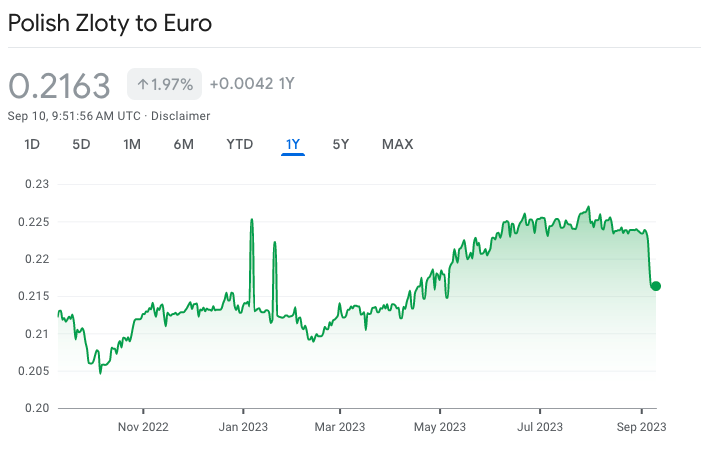
. - But did he make any valid points? Maybe. Cut through the bombastic swagger and somewhere in there was a reasonable case that a bigger-than-expected drop in core inflation and worse- than-expected Polish GDP data had marked a turning point for the Polish economy, and that sticking to the 6.75 percent rate from then on risked “killing the patient”. The larger-than- expected move, Glapiński said, was intended to catch up on a trend the MPC felt had started three months ago. This seems fair, too.
. - How did the market react? Not well. The zloty fell another 1.4 percent, while banking analysts turned increasingly to credibility issues. “The NBP’s sudden dovish turn has damaged its credibility and reduces the efficacy of its communication going forwards” Barclays analysts argued. “We expect further PLN curve steepening, pressure on the PLN and widening of the basis.”.
. - ICYMI, there’s a new NBP banner: In hindsight, the biggest hint that Glapinski was ready for a change of direction became evident on August 9 when the NBP changed its mega banner to this one:

It reads: “Thanks to the NBP, Poland is on the right track. Prices have not changed for the past four months.” An ECB working paper on the efficacy of central bank banner communications is now incoming no doubt.
Russell Napier on inevitable financial repression:
- Politico reported that the specter of Liz Truss haunts Britain, but Russell Napier quibbled with that assertion..
I’ve been meaning to speak to Russell Napier, author of the Solid Ground Newsletter and Anatomy of the Bear ever since I read him recount in an interview that it was inevitable that Western states like Britain would be forced to engage ever more obviously in financial repression. And that, at least for the short term, these actions would negate the negative economic outcomes we might otherwise expect. (One of the reasons they are so tempting to engage in at this point.)
Russell and I finally got to catch up together last week. I started by asking him what he thought of the premise of an article my colleagues at Politico were writing that the UK was still haunted by the Truss debacle.
On Liz Truss: Russell didn’t quite agree with Politico’s assessment, not least because of the pound’s outperformance since the start of the year. As he noted: “The Truss event was important because it was a government ‘going for growth’ to get out of the debt trap. That involved borrowing more money in the short-term, even if it worked, but the markets simply said it won’t work and pushed long-term yields higher to reflect it. There are only a limited number of ways to shrink the debt burden: very high real growth, default, austerity, very high inflation, moderately high inflation with repressed bond yields (financial repression).”
Russell emphasised that, if anything, the UK was just the first to experience what other countries will also inevitably experience. But also, that it’s not just that the UK is not unique in dealing with these debt and growth problems, it’s actually better off than countries like Sweden and France on certain public to private debt measures.
“Truss will go down in history as she tried it first and the markets would not buy it. That message has gone out to other governments around the world,” he noted.
Politicians, he suggested, were now belatedly figuring out that financial repression and increasing fiscal intervention in markets were the only obvious responses to the challenges being faced. Albeit mostly due to reactionary processes, rather than outright academic conclusions. [Although in the case of the U.K. there was some speculation that some elements of government had now figured this out, as demonstrated by Rishi’s attempt to include a government “intervention power” in the new financial markets and services bill, which had the means to undermine the independence of the Financial Conduct Authority. [The power was eventually dropped after the government faced substantial blowback from opposition politicians and regulators.]
Nonetheless, according to Napier, the attempt illustrated how all governments, not just the UK, were beginning to realise that financial repression was a better option than any of the others, which were far more politically dangerous.
“History will recall that the Truss premiership was the trigger for repression as the big gamble to grow out of the debt burden became not feasible,” he said. “Across the world we then turned to something else. In the UK it means both parties follow similar policies. Butskellism was a product of a debt burden which severely restricted policy options. Here we are again. This is not a UK phenomenon. It is a developed world phenomenon and many countries are in a worse position than the UK.”
The key data point for the UK: Napier’s preferred measure for judging the health of the economy and the financial system remains the private sector debt service ratio, usually published by the BIS. “What that is is the percentage of private sector income required to service debt, — so servicing is interest but also a little bit of amortisation of principal and those numbers are absolutely fascinating. What it shows is that UK has got one of the best private sector balance sheets in the DEVELOPED world.
“This is not the narrative people want to tell,… there’s 13.7 percent of all UK private sector income going to the servicing of debt. Now that number for France is 20 percent, the number for Sweden is 26 percent, Canada’s is 23 percent and the US actually has a low number at 15 percent.”
I wondered, does that matter if the real concern for financial stability is what’s going on with public balance sheets? But Russell’s view was that, based on history, almost all financial crises emerge out of the private sector.
“Why is this important? As interest rates rise, clearly, there’s an issue for the public sector. But if you look at all financial crises in history they tend to be private-sector led who can’t initially afford to pay interest income… there is a rule of thumb, which is when your private sector debt service ratio is about 20 percent as interest rates rise, you have an elevated chance of a private sector debt crisis. So I would have 20 countries in the world ahead of the United Kingdom for this private sector debt crisis,” he noted.
“Even if we look at the tenor of debt, which could impact the pace of the rise in the private sector debt servicing ratios, from when interest rates began to go up: it’s Australia, Canada and Sweden that you need to be very concerned about not the United Kingdom. The UK private sector debt service ratio is rising slowly compared to many other countries.”
“In 2008, our private sector debt service ratio was up close to 20 percent and we’ve seen a complete turnaround in that data even with the rise in interest rates.”
How does that compare to the picture in France? According to Russell, either the BIS data is wrong, or France — which has now outpaced the UK to sit at the top spot in terms of FDI in Europe — is one of the most highly geared corporate sectors on the planet and that does not bode well for the resilience of the French economy.
As for Rishi’s performance thus far? “The Sunak rise in bond yields, if we’re taking that as the measure of faith or trust in Sunak, is obviously not a great record to have but it comes at a time when global bond yields have been going up and inflation has been coming down fairly sharply in some places,” Russell noted.
While this could signal many things and one of them is, as Russell acknowledged, a growing lack of faith by investors in the sustainability of government finances, “that is not just a UK story. It is a story for almost all the developed world … no one’s had a great success over this period bringing bond yields down.”
Windfall taxes as a shot over the bow of central banks: Next week, we’ll take a closer look at Russell’s thoughts about Italy and what the trend for imposing windfall taxes on banks really means for central bank independence.
Economics, business, finance and more:
- SCOOPLET: The heads of the world’s most important central banks — from Jerome Powell to Christine Lagarde — descended on Basel, Switzerland, to attend the Bank for International Settlement’s regular bimonthly meeting. The date of this is usually a closely guarded secret for security reasons. But now we know it’s happened this weekend with meetings continuing through to Monday, when “nothing” is officially scheduled to take part at the Tower.
Who let the cat out the bag? Why, Glapiński, of course. Oops. The NBP boss’s tendency to talk up the general might and wonderfulness of Poland saw him wax lyrical during the conference about his good standing with the big boys of central banking. This is when he let slip he’d not just be rubbing shoulders with Jerome P and Christine L in Basel this weekend, but — unlike the central bank heads of the Czech Republic and Hungary, clearly much smaller and therefore less important economies — likely be sitting right there at the big table with the big boys (and girls). To be clear: not the little table, the Big Table. (Whether that will remain the case now that everyone’s been forced to reconsider their security details is unknown.) — IK
- An International Monetary Fund’s report found that the $650 billion of special drawing rights it issued in 2021 helped to boost the global Covid-19 recovery by cutting countries’ risk premia and lowering government borrowing costs.
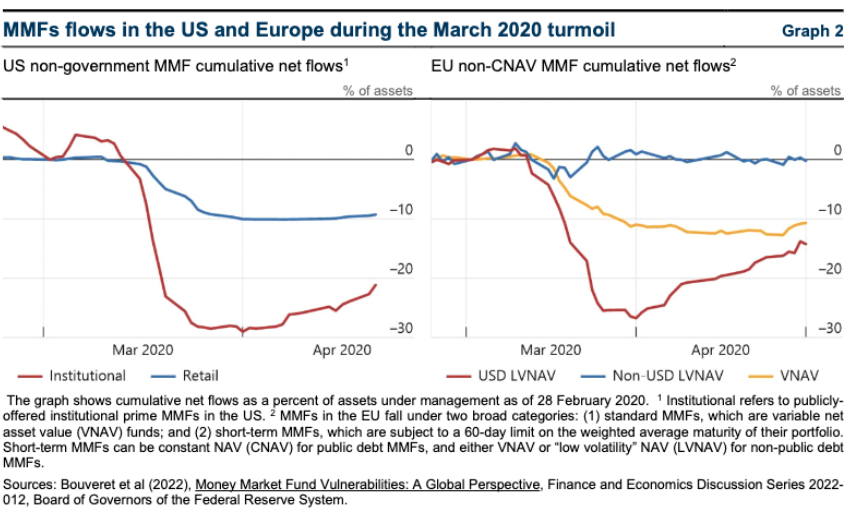
. - The Financial Stability Board produced a paper that charted the outflow out of money market funds this year:
 H.
H.
. - The cash basis trade is back baby, yeah. That’s according to an August 30 Federal Reserve paper into hedge funds’ Treasury futures and repo positions.
Anyone who caught BoE deputy governor Jon Cunliffe’s last testimony to the UK Treasury Select Committee last week would have seen him do a fine job explaining to MPs the significance of trade. MPs had asked him how important it was that hedge funds were shorting Treasuries in a big way again. As Cunliffe noted, however, those short were a function of the cash-futures basis trade which is an arbitrage trade that involves a short Treasury futures position, a long Treasury cash position, and borrowing in the repo market to finance the trade and provide leverage for it.
As he explained: “This is the riskless trade that sometimes goes wrong. We saw this in the dash for cash.
“The problem with this trade is that you do not make very much money on any individual trade, because basically you are trying to sell something while holding the thing it is based on, so it is very small margins. In order to get a return on that, you leverage up very, very highly. “
He added that while the hedge fund industry disagrees with him on this, one of the drivers in the dash for cash “which was not huge, but it was acute and very concentrated” was that the hedge funds that were in these trades suddenly had to dump an awful lot of Government securities on the market. “That is what helped to drive some of the spiral that we saw in 2020 in the crisis in funding markets, the US Treasury market and the gilt market.” — IK.
- Alibaba’s cloud division considered raising funds in a private round from Chinese state-owned enterprises, which could raise it around 10-20bn yuan ($1.38-$2.75bn.)
. - Is the “subscriptions as a service” model facing a downturn after booming over lockdown? Sifted last week implored companies not to abandon offering these subscription services, as they help companies build more predictable revenue, even if these services are often cut early in a recession by customers.
. - China specialist Patrick Chovanec responded to Tyler Cowens’s question; “Does China need more consumption?” arguing that China’s “chronic trade surplus reflects the fact that its economy is geared to produce more than it consumes.” Yep, it’s as easy as that.
. - Novo Nordisk’s Wegovy success is posing difficulties for the Danish central bank’s management of its euro peg. Recalling concepts of the “commodity trap” for developing countries, Wegovy’s weight-loss pill’s outsized success is destabilising Denmark’s economy. The incoming rush of foreign currency has forced the Danish central bank to take action.
If you’ve not heard of it, semaglutide (also known as Ozempic, Wegovy) is the wonder weight loss drug that is currently storming the world, and even Boris Johnson seems to think it has revolutionised the treatment of obesity, meaning the problem could be nipped in the bud very soon. As someone who struggles with their weight, I’m always on the lookout for quick-fix solutions. So you won’t be surprised to hear I’ve been there, done that, and err… am larger than ever.
This is why I know it’s not the cure-all people are saying it is. There are a number of issues with the drug.
To understand why, you first need to understand how we arrived at the logic of prescribing it. Over 15 years ago Dr. Robert Lustig rocked the medical estbalishment with a new theory of obesity. It overturned decades of conventional wisdom about what makes people fat. The key driver, he said, was not laziness, too many fatty foods or insufficient exercise. It was linked instead to a phenomenon called “insulin resistance”, a state that emerges from a sugar imbalance and which messes with healthy people’s metabolisms.
According to Lustig, the unconscious overconsumption of refined sugars, rather than fats, especially in the form of high fructose corn syrup was the key driver of the phenomenon across the modern world. This he argued was a direct function of commercial practices in the food industry, not personal choices, as these harmful refined sugars were being snuck into food-supply chains mostly for commercial profit. What’s more, his theory easily explained why obesity was so often linked to Type-2 diabetes.
It was a highly controversial finding at the time, and ‘Big Sugar’ unsurprisingly sent out the big guns to try and suppress the findings as well as to discredit Lustig. It took a while for Lustig’s findings to be taken seriously by GPs.
But eventually they were. And once the establishment finally gave in to the new consensus, the immediate effect was the application of anti-diabetic treatments. Lustig himself keenly recommended those wishing to lose weight to emulate the advice given to those diagnosed as suffering from “pre-diabetes”, notably to remove as much as refined sugar as possible from their diet, though he stopped short of recommending insulin products for anything but the most extreme cases.
This is how semaglutide came into the frame. It is and always was an anti-diabetic drug. But what Lustig’s findings implied was that prescribing it to those struggling to wean themselves off sugar naturally, a comparable battle to weaning yourself off an addictive illegal drug, prescribing semaglutide could help kick start the process by compensating for the body’s insulin resistance.
But this created three problems. First, semaglutide started to be prescribed en masse without the associated dietary advice as a cure-all solution. Second, it began diverting supply of the drug from actual diabetics who are too far gone for dietary interventions to work alone. Third, it began to transform people’s metabolisms in ways that hooked them permanently to the drug.
Dr. Lustig’s preferred treatment for obesity was eliminating sugars from your diet directly, not via medical intervention, because he understood the severity of the side-effects. All of which squares with my lived experience. The only diet that has ever worked for me has been sugar elimination.
But, of course, if it was that easy I would be a size 12 by now. Keeping sugar out of your diet when faced with a modern food system that is hardwired to supply it to you at all points is really hard. Go into any traditional lunch or food venue and it’s almost impossible to find sugar-less options, even among the salads. It’s simply not a dietary thing. All the usual diet classifications still include sugar. Vegan = sugary. Fat-free = sugary. Vegetarian = sugary.
Sugar is simply everywhere.
So yes, despite losing lots of weight by following the sugar-free regime in 2017, it slowly crept back on after the birth of my daughter. And being well versed on the theory of insulin resistance, of course I jumped at the chance to try semaglutide when it first became available over the counter over two years ago.
But the experience turned into a nightmare. I experimented with the treatment two times. In the first instance I was prescribed daily doses (taken as injections in the belly). The first week the transformation was absolutely incredible. I had lost about 3kg in a week and was visibly gaunt. The reason why was obvious. Applied to me, the treatment had synthesized the experience of gastroenteritis. I couldn’t even look at food. I felt on the verge of vomitting the entire week. So yes it had proved effective, but at what cost? It had made me feel horrifically ill. Not just too ill to work, but too ill to get out of bed.
To combat these effects I was encouraged to drink water and to lower the dose.
Soon enough, the feeling of sickness gave way to a moderate feeling of permanent fullness and a swift appetite satiation at mealtime. I thought I was onto a winner. Not so. It wasn’t long until other negative symptoms emerged, among them brain fog, dizziness and nausea, which hit me in unexpected waves a bit like morning sickness. I was anything but my best self at work or at home.
With the moderation of the symptoms the weight loss also began to plateau. But things were truly scuppered when I discovered that the best way to cope with the all the bad side-effects wasn’t to drink water, as they recommended, but to eat something. And so it was I began to eat through the pain, and with that through the weight loss. It was a doomed cycle.
Simultaneously, I was struggling with the mode of delivery via an injection pen, which had to be stored in a fridge. For someone who was travelling a lot at the time, this was a real struggle. Inevitably, I forgot the pen in a hotel mini fridge, leading to a sudden and involuntary suspension of the regime. I never got back on course. Not least because by that point I had developed such a tolerance to the drug I needed ever larger and more impractical doses — at a price of about £250 per pen it became unaffordable. I gave up.
Then came the really bad news. Withdrawal. This saw me balloon almost immediately beyond my pre-Ozempic size. In a few weeks I was bigger than ever, despite not really having changed my eating habits at all.
About a year later, someone told me that the drug was now available in weekly form. Convinced I had messed things up because of erratic dosing, I decided to give it another go. This time the immediate effects were negligible. I didn’t get my ego-boosting first week mega loss. And overall, if the drug did anything, it suspended my continuing and ongoing weight gain rather than helped me to lose more. Nor did the weekly injections prevent the nausea or brain fog. The negatives weren’t quite as bad, but the upsides were far more limited.
Utterly underwhelmed and disillusioned, especially since the price of the pens remained prohibitvely high, I gave up again. And again, I ballooned after doing so.
I should really have checked out what Dr. Lustig’s opinion on the drug was. For some strange reason I didn’t. It’s a shame as he had predicted the issue. “It’s like putting a band-aid on obesity,” henoted in December 2022. Side-effects too, he warned, were being under reported, as were the potential long-term effects on peoples’ metabolisms.
Replacing a sugar addiction with an eye-watering expensive Semaglutide addiction is not the answer to obesity. It might actually makes things worse.
And if it’s really true that Elon Musk and Kim Kardashian are using it, based on my experience of what it does to your brain, I wouldn’t trust their ability to carry out their day jobs. Of course, everyone’s reactions are different. But for many it will end up a quick path to non-productivity, poverty and depression. I’ve decided to invest in an electric bike instead. — IK
- The European Fund and Asset Management Association warned that regulators’ attempts to target structural vulnerabilities in the open-ended fund sector and anti-dilution liquidity management tools will not increase this sector’s resilience. In EFAMA’s view, “this framework would add unnecessary complexity to liquidity risk management and, ultimately, result in higher costs for end-investors with little benefit.”
After the 2020 dash for cash, regulators decided that open-ended funds needed to offer investors clarity on how they plan to deal with liquidity events on the basis that panicked redemptions have a dilutive effect on remaining shareholders. They want funds to be classified according to the their liquidity profiles and for them to commit to at least one effective anti-dilution tool in their paperwork, such as fees for exits, swing-pricing that accounts for liquidity costs or another handful of measures. Fund managers, however, think the rules are overly complex and arguably impossible to implement fairly, as often you don’t know the cost of liquidity until you try to tap it. I suspect they are right. — IK.
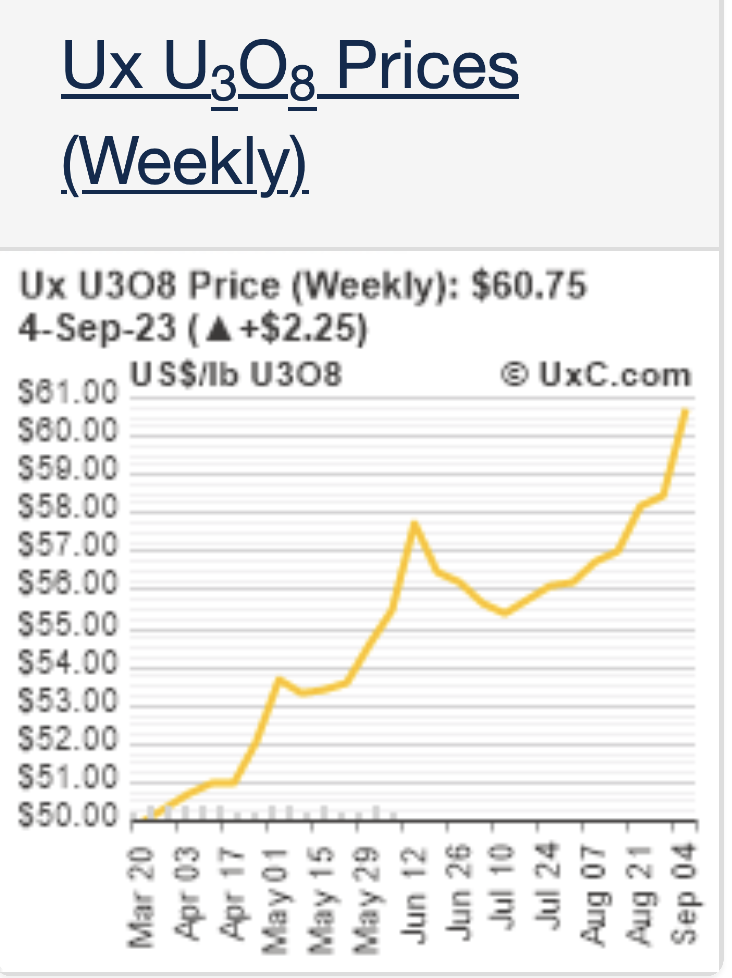
- Uranium prices hit a 16-week high in euro terms on September 4 (chart courtesy of UxC):
 .
. - Bankruptcy filings in the United States spiked to levels last seen during the Covid-19 and 2008 crises:

Cryptocurrency evangelism:
- Fabio Panetta, a member of the ECB’s Executive Board, spoke on the path towards the digital euro. Panetta claimed the ECB’s investigation phase into the digital euro is “in its final stage”. You can watch the video here.
Via my Politico colleagues: ECB board member Fabio Panetta was met with persistent scepticism from MEPs on the digital euro, an ECB-backed digital currency that the Commission has set out proposals for on how to “mint” in June. Why do it? The EPP’s Markus Ferber wondered what one can do with a digital euro that one can’t do with existing means of payment, to which Panetta answered that “you cannot pay in all countries digitally. If you move across borders in Europe either you have one credit card per country or you have problems.”
To Renew’s Georgios Krystos, who asked what’s the need for the ECB to get involved when there’s plenty of digital coins on offer, including projects from big tech companies, Panetta answered that “if a big tech [firm] would enter into the market … their main objective is to gain market share and customer base, they couldn’t care less about potential delegitimization of European banks, they have no interest in financial stability” and thus “there are very sound positive but also negative reasons why it would be wise at least to be ready to issue a digital currency.”
To the S&D’s Joachim Schuster, puzzled over how exactly would it work, Panetta explained that the ECB would simply provide the “hardware” for the digital euro, while banks would provide the “wiring” for the service. “It would be free of charge for end users but it would use a system of interchange fees … The merchant would pay a fee that would be split between the bank of the payer and the bank of the payee,” he said.
- A Financial Times piece looked into why central bank digital currency plans have become entangled in conspiracy theories and the culture wars.
I have a lot of thoughts on both Panetta’s last testimony to EU parliament on the topic and the recent trend to focus on how CBDCs have captured the imagination of conspiracy circles, but alas, I have run out of time so it will have to be a topic we return to next week. — IK
Geopolitical hot spots:
- Niger’s junta decreed that France must pay €200 per kilogram of uranium from Niger, versus a pre-coup price of €0.80 per kilogram.
. - Friend of the Blind Spot and fellow Gosplan obsessive, Yakov Feygin, an economic historian, delved into the history of Wagner Group’s parent company, the Concord Group, and traced the evolution and rise of this shady group of Russian enterprises. A nice read.
. - The Kyiv Independent laid bare the tensions in Ukrainian brigades trained by NATO officers.
When will the West stop condescending the teachings of the Ukraine-Russian war?
This article showcases how NATO-trained Ukrainian brigades, the repository of much hope in Western press, have actually received relatively poor training. Not just because most of the training time was limited to six weeks, mind you. But because the NATO soldiers providing the training have never experienced anything like the peer-to-peer chaos that is the Ukrainian-Russian conflict.
“The same soldiers who spoke to the Kyiv Independent didn’t hide their scorn about how the training prepared them for a war that doesn’t exist in Ukraine. They said the NATO officers don’t understand the reality on the ground”.
NATO doctrine may be tried-and-tested against all manner of poorly equipped adversaries in a mobile battleground. But it struggles in an entrenched style of warfare – “The style of battle in the Ukrainian countryside, blending World War I trench combat and 21st-century tech and tactics, are only seen in Ukraine — they are outside NATO’s wheelhouse.”
It seems like it should be Ukrainian soldiers teaching NATO officers how to fight — not the other way around. — DGG
- A representative of the Afghan American Chamber of Commerce visited Afghanistan for a public meeting with Taliban Deputy Prime Minister Abdul Ghani Baradar with official State Department support.
Around a month ago, we asked ourselves whether there could be other reasons for Afghanistan’s radical opium-eradication campaigns.
While that reason still isn’t clear, this week unveiled the most significant update in American-Afghan relations yet. Jeffrey Greico, head of the Afghan-American Chamber of Commerce, suggested it was a good idea to start matching private American enterprises with Afghanistan-based opportunities, giving the strongest hint yet that the United States was considering establishing closer ties with the Taliban.
Greico signalled that “there has been a change in our government’s thinking in the last few months (…) they are now willing to consider the return of Afghanistan’s frozen $9bn in foreign exchange reserves, seized after the imposition of American sanctions on the new Taliban regime.
The Taliban administration, for its part, signalled its willingness to enact “investor-friendly laws,” which according to Greico was a nice contrast with Afghanistan’s previous rulers: “the last Afghan government didn’t even understand what a market-based economic system is”.
This significant reunion took place a few weeks after last month’s meeting of the Taliban with Thomas West, Special Representative for Afghanistan from the State Department. The Americans positively highlighted “Taliban efforts to fulfill security commitments” and of “reporting indicating that the Taliban’s ban on opium poppy cultivation resulted in a significant decrease in cultivation”.
Notably, the relevant article in the State Department website stated the American delegation in speaking with representatives of the Afghan Central Bank and the Afghan Ministry of Finance “voiced openness to a technical dialogue regarding economic stabilization issues too”, a clear nod towards a potential unfreezing of the $9bn in foreign exchange reserves.
The meeting of the Afghan-American Chamber of Commerce this week coincidentally took place only a day after the CEO of the Turkmenistan-Afghanistan-Pakistan-India Pipeline Company Ltd claimed that Afghanistan provides “good security” for the project: “We want to start work and activities within the framework of this project, because there is good security and all the conditions for the implementation of this project, and the Islamic Emirate will not hesitate to make any effort to implement this project.”
Though a piece by the Washington Examiner in 2021 alleged the United States was facilitating meetings between Afghan and Turkmen authorities, such allegations were vigorously denied by a State Department spokesperson. But we may remember the old adage; “never believe anything until it has been officially denied”.
In a friendshoring world of high commodity prices, friendless regimes with commodities stand to gain. Keep an eye on Afghanistan. — DGG
- To nobody’s surprise, another raft of American-imposed sanctions has proven ineffective. The recently released Huawei Mate 60 included a ‘breakthrough‘ 7nm chip from a Chinese state-owned chip manufacturer that has shocked Western tech observers, clearly suggesting that China had managed to evade American sanctions on microchip production.
. - Are we about to see the Armenia-Azerbaijan conflict heat up again? In the past few days, both countries have accused each other of mobilising equipment and troops in their respective border region, fuelling fears the decades-long conflict is about to enter its third phase of war.
Media matters:
- Internal documents from Facebook have revealed the Biden White House relied on foreign disinformation activists to pressure Facebook into censoring Americans, including Robert Kennedy Jr. Representative Jim Jordan summarised the major findings in an informative Twitter thread.
. - The BBC’s disinformation correspondent, Marianna Spring, lied on her CV. Spring claimed to have reported on Russia during the 2018 World Cup together with BBC correspondent Sarah Rainsford in a 2018 job application. In reality, Spring had only met Rainsford in a couple of social situations – and never worked with her. The BBC boss responded by suggesting people be kind to her.
. - Back on August 23, Techcrunch acquired StrictlyVC, appointing its found editor Connie Loizos into a combined role of editor-in-chief and general manager.
We heard about this from Techcrunch sources this week, and the reason it resonates is obviously because Connie’s deal with TechCrunch is somewhat comparable to our one with Politico.
The initial collaboration allowed Connie to maintain her own subscriber business (StrictlyVC) while taking on an editor role at Techcrunch simultaneosuly, until we presume a mutually agreed cut off appoint when it either made sense to absorb her business into Techcrunch formally or let it go back into the wild. On a broader point, though, it speaks of the hiring challenges media companies are facing now that journalists come with their own dedicated subscriber revenue flows. You aren’t just a writer. You’re a business with an independent cashflow that needs to be bought out.
Whether it’s a good idea to combine an editor role with that of a commercial role, however, isn’t clear to me at all. I think this is obviously the most conflicting part of operating a small media company. — IK
Politico’s finest:
- Former Italian Prime Minister Giuliano Amato claimed that France downed a passenger jet, Itavia Flight 870, in a frustrated attempt to kill Libyan dictator Muammar Gaddafi in 1980. The airliner’s crash, which killed all 81 people on board, had always been surrounded by rampant speculation and controversy in Italy.
American political drama:
- The attorney for the Virgin Islands, Mimi Liu, told the U.S. District Court in Manhattan that Jeffrey Epstein’s over $1bn in transactions with JPMorgan Chase was related to human trafficking. Liu explained: “Epstein’s entire business with JPMorgan and JPMorgan’s entire business with Epstein was human trafficking.”
Scientific quandaries:
- Patrick Brown, a PhD climate scientist at the Breakthrough Institute, penned a piece explaining why he “left out the full truth” to get his climate change paper published in Nature. The author explained that editors at prestigious science journals prioritise scientific papers that contribute to narrative building regarding climate change, instead of prioritising good science. Brown claimed this incentivises scientists to leave out other relevant factors from their papers in order to publish in a prestigious journal. Unsurprisingly, Nature’s Editor-in-Chief, Dr. Magdalena Skipper published a harsh rebuke to Brown’s claims, calling them “highly irresponsible.”
. - Public produced a documentary investigating the recent spike in deaths of the Right Whale on the American East Coast. Titled “Thrown to the Wind”, it explores the connections of these mysterious deaths with the growing offshore wind farm industry.
Covid collateral damage:
- An American appeals court denounced the FDA’s warnings in 2021 about using ivermectin to treat Covid, where they used the tagline “You are not a horse.” The “FDA is not a doctor or a physician”, the court wrote. “It has the authority to inform, announce, and apprise – but not to endorse, denounce, or advise.”
. - The Russian Embassy to the United States published a briefing by Lieutenant General Igor Kirillov, who is the Chief of Nuclear, Biological, and Chemical Protection Troops of Russia. Kirillov claimed that the “number of administrative structures engaged in the implementation of bioprospecting in the United States has increased significantly”. This statement pointed to previous claims advanced by Russia accusing the United States of both creating and spreading Covid-19.
I had missed that a working group of the Biological Weapons Convention had been convened in August. The Russian account of the “politicised process” can be found here. The Western accounts, as put together by Richard Guthrie, are available here. We haven’t gone through them in detail just yet. — IK
