

Dear subscribers,
September is upon us. For a lot of people that means “back to school” season. And I, for one, am delighted by the prospect since it means some stability with childcare and the return of a predictable routine. Non-parents should also be pleased since it means their colleagues who are parents might finally be able to focus on work again.
It’s been a chaotic week for me not just because of childcare challenges (why are there no professional camps in the last week of holiday?) but also due to travel-related chaos. I’m looking forward to being grounded for a good number of weeks now. And hopefully, that means this newsletter can return to its proper schedule.
For the opening note, I thought I would offer some reflections from my time at Alpbach last week, where it rained every day and the “panel hike” I was supposed to be on was cancelled. Austria ended up experiencing serious flooding. But, hey, at least it didn’t turn into the Drowning Man festival, otherwise known as Burning Man, which is currently cut off from the rest of the world due to severe conditions with some 80,000 (of arguably the most annoying) people stranded and running low on supplies. Though we shouldn’t laugh. There may have been fatalities. That said, sources I know on the ground seem to be fine, even if they’re having to go cold turkey on internet connectivity while sheltering in place in their RVs. Let’s hope there’s enough mood-enhancing medication to cut through the boredom, eh?
But back to Alpbach.
Many of you will probably not have heard of this weird little economic forum that occurs every summer. I certainly hadn’t until I was invited last year. And, yet, it predates Davos by decades.
On the surface it certainly appears more grounded and informal — you can, for example, bump into economist Joseph Stiglitz at the breakfast buffet while rubbing shoulders with the Prime Minister of Liechtenstein without even realising it until he’s on a panel with you. But while it’s incredibly folksy, casual and charming in many ways — and Andreas Treichl, the Alpbach Klaus Schwab, is guaranteed to show up at some point in a very down-to-earth way to mingle with your party (usually breaking the ice by oversharing some tidbit of elite gossip he’s just been privy to) — it remains a largely-detached-from-reality bubble. Typical attendees are the sort of people who knew they wanted to get into power politics from the age of 11, albeit with the added trappings of European kitsch. Everyone is, of course, well-meaning, civilised and very nice. But there is also a distinct lack of recognition of any other point of view or one’s own cognitive dissonance/contradictions.
There is perhaps no better personification of the experience than this guy’s Twitter feed.
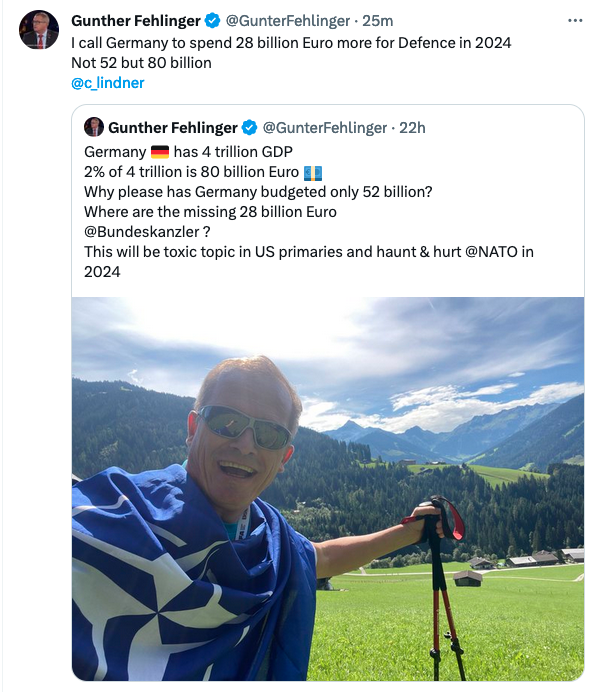
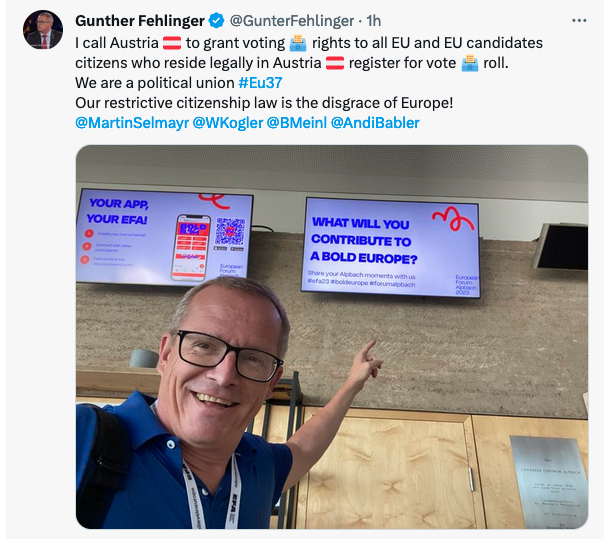
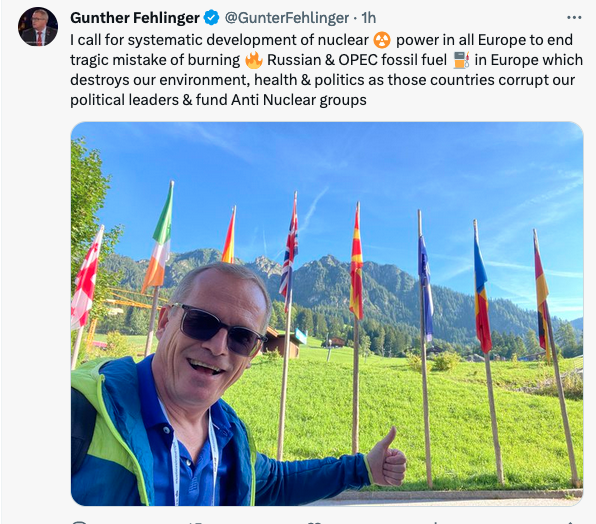
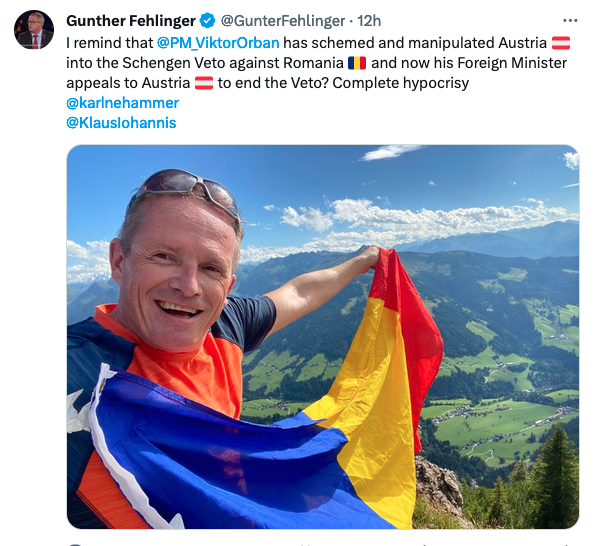
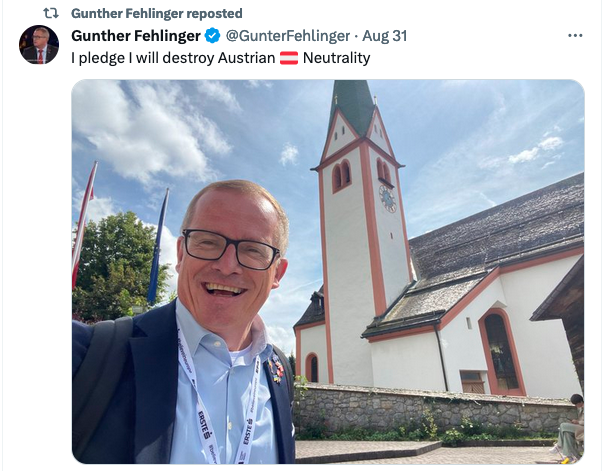
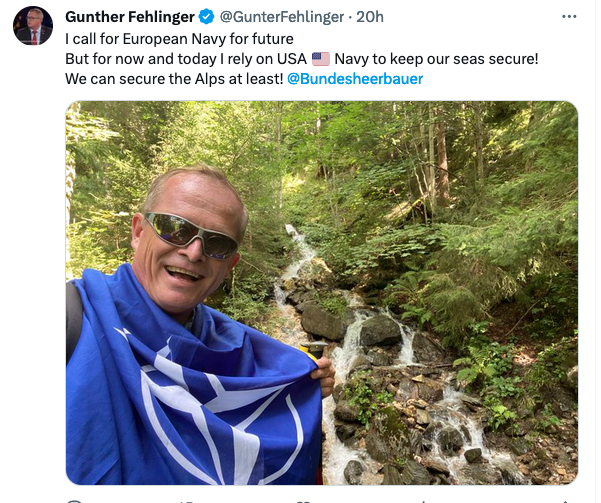
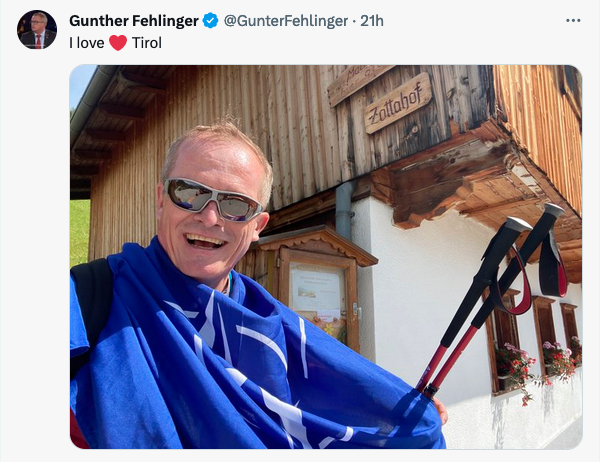
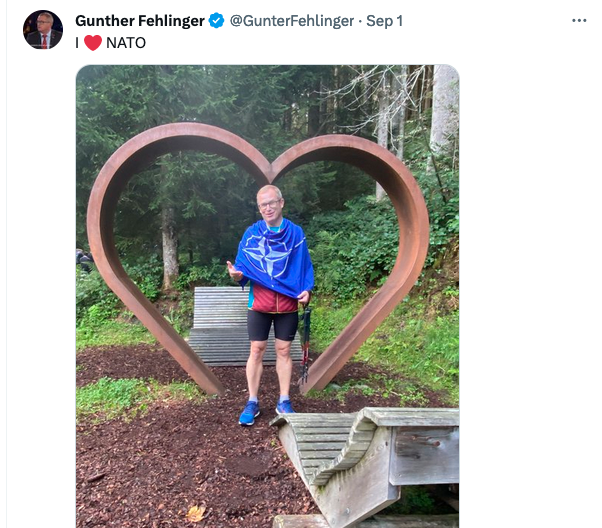
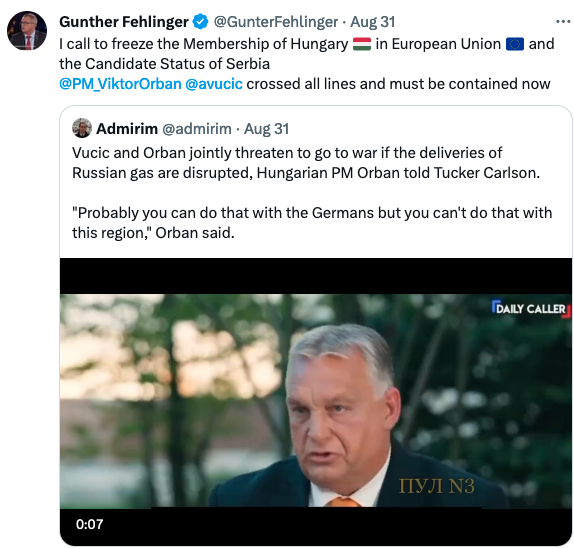
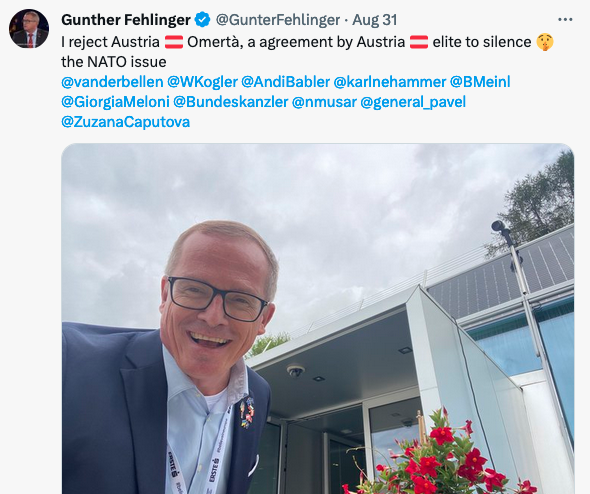
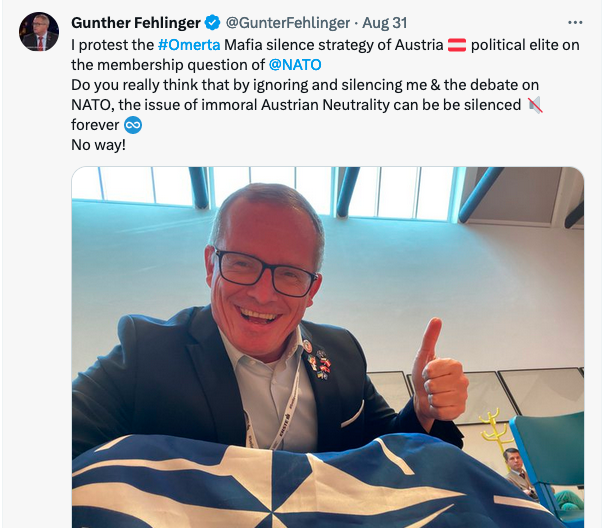
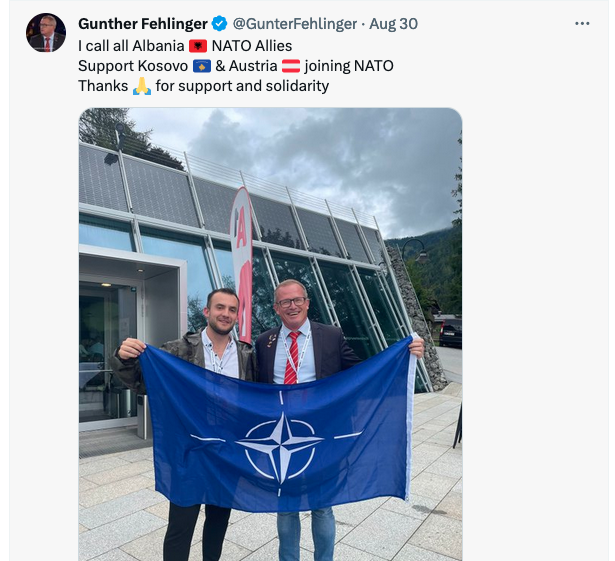
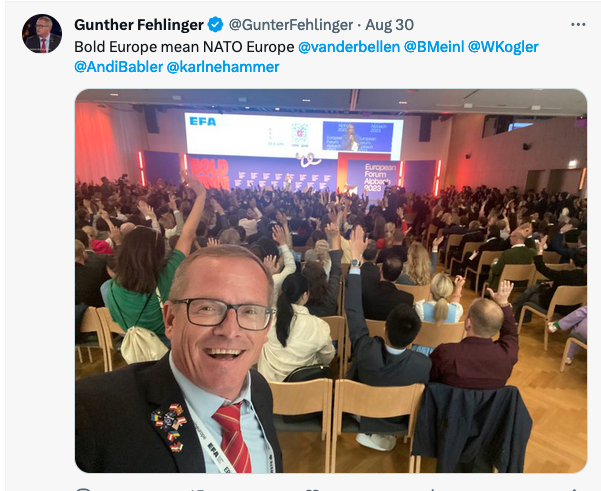
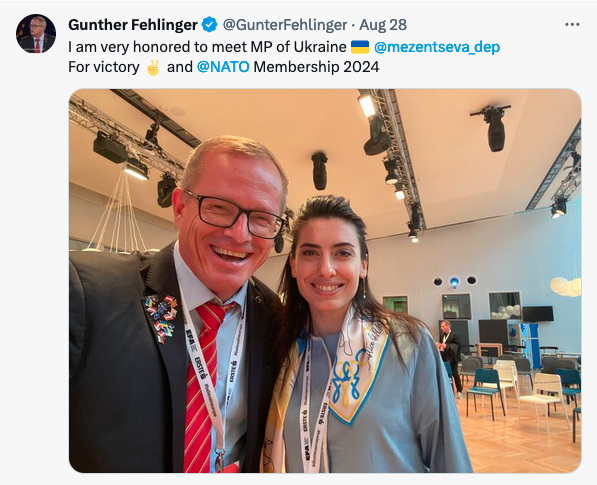
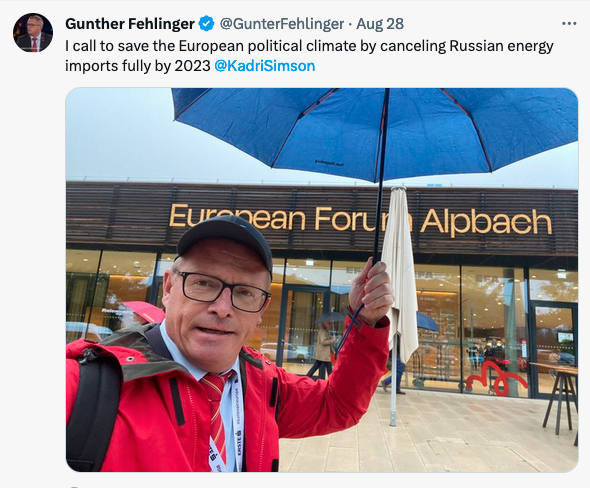
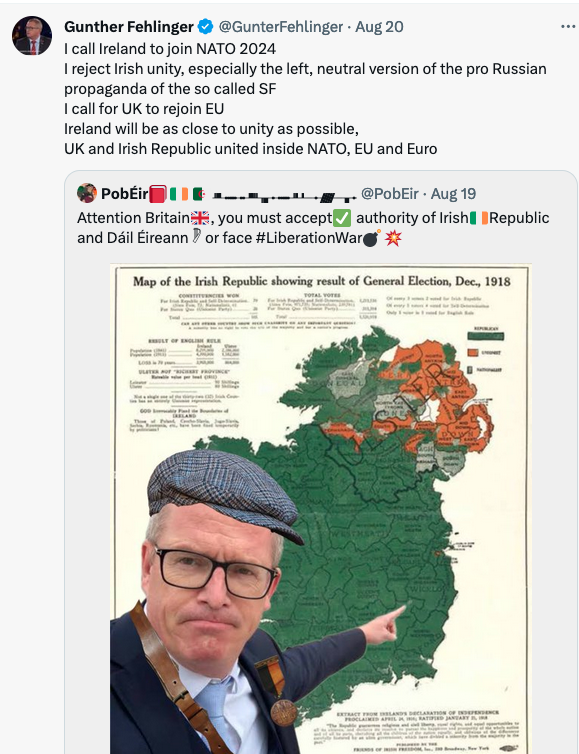
And that’s just a few highlights.
Gunther Fehlinger is the chair of the European Committee for NATO Enlargement for Kosovo, Ukraine, Bosnia, Austria, Moldova, Ireland, Georgia and the EU. His love of NATO seems only to be surmounted by his hatred of neutrality and Viktor Orban. Which is all fine and understandable. But it’s the hilariously bombastic tone of the proclamations juxtaposed with his cookie-cutter enthusiasm for everything NATO that’s reminiscent of a canine’s unquestioning loyalty to his master, regardless of what he’s asked to do.
Of course, you can’t be angry at Gunther, can you? Just look at that wide-eyed seemingly oblivious face. It’s adorable. You just want to pat him on the head and say, “Here boy, here’s a NATO-flavoured dog biscuit”.
Of course, whether Gunther is a consciously recruited combatant in NATO meme warfare (and, thus, possibly part of some high-level psyop strategy) or merely the product of Western unconscious naffness on a systemic supercilious level is far from clear. My inkling is that it’s the latter, which kind of speaks to the problem. [Corporate management is sadly yet to address the scourge of unconscious naffness on the European continent with any serious training programmes.]
On that note here’s a list of some of the things I was “re-educated” in by fellow mid-to-high-tier Alpbach delegates throughout my stay (and I think a good reflection of what this sector of society really does think):
1) Brexit was apparently an elite and bank-led conspiracy. [If you like me thought it represented a working-class f*** you to the system, or that banks were almost entirely opposed to it, you’re wrong].
2) Zelensky is an upstanding man on all fronts, and I should question any sourcing that suggests he has huge amounts of wealth squirrelled away in the world. [This came in the context of me arguing that while I wholeheartedly believe Zelensky was the right leader for Ukraine at this point in its history, his own corruption record is not faultless and that in some ways he has a lot in common with Trump, which may be to his longer-term detriment (TV star, charismatic and knows how to do PR, came to power on an anti-corruption ticket despite having his own corruption issues, resolutely all about making Ukraine great again, advocates a strong border policy, etc etc).]
3) The U.S. judicial system is faultless and it’s completely inconceivable that nearly half of the U.S. population doesn’t trust it, which means there’s no escalation risk in a guilty verdict for Trump. People will have to accept it. [Which says to me there is no real appreciation at the elite level of the epistemological consequences of a Trump incarceration. They simply cannot see that the issue at hand is that both opposing groups believe they are defending the Constitution from each other’s sedition. And that both sides therefore see themselves as justified in their actions and will therefore never accept the conclusions of a judiciary tainted by the other side.]
4) Joe Biden’s faults are insignificant relative to Trump’s and there is zero evidence Biden was engaged in any Hunter Biden dealings. [Assertions of the opposite, by the way, led to endless and very specific requests for sourcing, followed by scrutiny of the sourcing. But the sourcing of the established perspective was always taken for granted.]
5) Cultural assimilation is the best way to deal with mass migration, not building walls. [This, I’d say, was arguably the most interesting view I picked up during my time at Alpbach because it seemed to represent a sea change in thinking on the migration issue. While Angela Merkel was still hailed as a great leader (hugely missed!) who had very few alternative options in 2016 other than to let migrants in en masse, delegates seemed ready to admit unconditional open borders were not a sustainable policy. Perhaps in light of Ukraine, perhaps because of Covid or perhaps because of economic factors, migration is now seen as problematic unless it is accompanied by strategic efforts to culturally assimilate the incoming masses. Which, as far as I see, means assimilating migrants to Western “progressive” norms, rather than traditional conservative ones that are commonplace in say, Hungary. How that should be accomplished, however, was not clearly expressed.]
But enough about Alpbach. Here’s what you may have missed and/or a perspective you didn’t consider from the week that was. As usual, the below has been compiled with the help of the Blind Spot’s resident geopolitical expert, Dario Garcia Giner. And as usual, sorry for typos and dyslexic mind farts,. too.
Economics, business, finance and more:
- Anecdotal reports circulated on X that Airbnb owners in oversaturated short-term rental markets had seen their revenues crash by over 40 percent as supply began to overwhelm demand.
I remember in the early days of the emergence of the gig economy, so, about seven/eight years ago, when the big trendy thing to say on Fintwit was that Airbnb would eventually disrupt the entire hotel business. In hindsight, this was clearly a stupid thing to say. I, myself, was always incredibly cynical about the Airbnb model, informed by my own experience of trying to rent out a flat for a while and coming to the conclusion it was more headache than it was worth. Unless your Airbnb business benefits from scale (i.e. multiple properties), professional management, scaled housekeeping and servicing, and a sweet spot location, I just don’t see how it can be that lucrative.
Worth noting, Goldman has a sell rating on the stock. They say the only risk to their call is faster recovery in travel demand and “accelerating adoption of alternative accommodations as a category within travel from current levels” [i.e. hotels lose their cool], market gains outside of the U.S. or expanding categories offered on the platform. — IK..
- Economist Philip Pilkington noted on Twitter that the EU’s second-largest supplier was still Russia, which was bringing in more gas than Qatar. POLITICO also had the story.
- Saudi Aramco said it was considering listing its $30 billion trading arm as oil prices continue to soar.
. - Analyst Jim Bianco warned that crude oil and gasoline prices were likely to take centre stage again having already staged a formidable rally on record US gasoline demand.
. - Tuomas Valimaki, board member for the Bank of Finland, who is standing in for Olli Rehn at the ECB, argued that the ECB should consider changing the way it operates its interest rate policy.
As my Politico colleagues noted in our newsletter, the ECB announced last December that it would start a review of its operational framework which it intends to complete before the end of the year. Välimäki, who is considered a “liquidity guru” in Frankfurt, said that the ECB can choose between two options to control market rates: it can narrow the “corridor” between its interest rates, or it can establish a permanent portfolio of long-term loans and assets.
A smaller corridor means that the ECB keeps a small difference between its three key rates: the rate it pays on banks’ deposits (DFR), the one it charges to banks borrowing money (MRO), and the rate banks pay for emergency lending (MLF). At present this corridor is asymmetrical with the difference between DFR and MRO being double that between MRO and MLF. For Välimäki, a smaller difference would restrict the movement of market rates within this narrow corridor, lowering the chance of higher volatility.
Välimäki also said that it is unlikely the ECB will return to a pre-GFC balance sheet size of about €1 trillion, estimating that the central bank will have difficulties to shrink it past €3 trillion. Therefore, it could establish a permanent portfolio made up of TLTRO-style loans to banks and bonds purchased according to climate criteria. “Such a structural green portfolio could fight against climate change in the long term.
This idea of a permanent portfolio made up of TLTRO-style loans is another flavour perhaps of the “market-function purchase programme” flagged by Darrell Duffie in the paper he released for Jackson Hole. Albeit with a green twist. — IK
- Fabio Panetta, executive board member of the European Central Bank, stated that to build its capital markets union, Europe needs to think bigger to keep pace with a rapidly evolving global landscape. That includes pushing ahead with plans to issue a common debt instrument.
. - Veteran short-seller Jim Chanos called carmaker VinFast a “$200bn meme stock”. The Vietnamese company’s market capitalisation reached $190bn, more than Ford, GM and Chrysler combined, though they will likely struggle to produce more than 40k units this year.
. - Japanese retail prices of gasoline hit a nominal record high of ¥185.6 per litre, which surpassed the peak set in mid-2008. The Japanese government appeared set to continue extending gasoline price subsidies, set to expire in September, to the end of 2023 at the very least.
. - Michael Pettis’ X thread argued that Germany’s economic model, which relied for many years on suppressing worker wages relative to productivity while running a trade surplus, is not how things should operate in a well-functioning global trade environment. He also linked to a Wall Street Journal piece, which commented on how Europe’s largest economy was sliding into stagnation.
. - China’s largest private property developer, Country Garden, reported a net loss of $6.72bn in yuan this Wednesday as of this half-year.
. - UBS posted its biggest-ever quarterly profit of $29 billion (biggest for any bank ever) after absorbing Credit Suisse last March.
The mega number invites questions about the valuation of the supposed shot-gun deal as well as the supposed non-viability of Credit Suisse as a going concern, as this guy on the internet points out. The plot thickens when you consider that Saudi National Bank was denied upping its stake to 40 percent and that the Swiss state has determined that all related files surrounding the merger should be kept secret for 50 years. — IK.
- Firebrand independent journalist Matt Tabbi flagged that GoFundMe had shut down a fundraising initiative that had raised $90,000 for antiwar website Grayzone citing “external concerns”.

Mon dieu:
- The French manufacturing downturn turned out to be steeper than initial estimates in August projected.
.
- The French government said it would spend €200m destroying surplus inventory to defend prices and support struggling producers in the face of shifting demand trends among domestic consumers who are turning to cheaper and/or more potent substitutes (beer and spirits).
Oh Canada!
- The Bank of Nova Scotia missed analysts’ estimates, as lending margins shrank from a year earlier, and the bank increased provisions for its potentially souring loans.
It wasn’t the only Canadian bank to underperform this week. Bank of Montreal missed analyst expectations as it had to set aside more money for sour loans, Canada’s National Bank missed estimates after having to set aside funding for bad loans and a lagging capital markets segment, and finally, TD missed analyst expectations as credit loss provisions surged. That comes after the Canadian economy, which has had to contend with 10 interest rate hikes since last year, unexpectedly shrunk in the second quarter at an annualized rate of 0.2 percent, according to Reuters. — IK
- There’s a plan to invade Canada for its own good. Yes it’s a parody. But it’s also bloody hilarious. Max Meyer explores the best way to subjugate Canada and grant install Jordan Peterson as Dictator in Perpetuum in Ottawa.
Multipolarity watch:
- French President Emmanuel Macron appeared to fan multipolarity fears and the emergence of an alternative order when he addressed the Ambassador’s conference, by flagging the risk “that the world may be partitioned” into different spheres of influence and that democracy could be weakened by the rise of illiberal powers.
The path to hell is paved with good intentions:
- The Climate Change Committee of the British government recommended people turn off their radiators at peak times to help the government reach its net-zero target. But critics have suggested the real reason was “that renewables will not be able to provide enough energy to cope with peak demand”.
. - Carbon credit speculators looked set to lose billions on growing scientific evidence that carbon credits have no environmental worth and have become stranded assets. The $2bn market was generated for climate change mitigation, but “repeated scandals about their true impact and a crackdown from regulators on claims of “carbon neutrality” have meant that demand and prices for offsetting have slumped”.
. - Some hedge funds started shorting renewable energy stocks that were supposed to be helped by Biden’s IRA, as they predict climate stimulus will push debt-reliant green companies to bankruptcy as the act is likely to fan inflation and higher interest rates.
It’s very puzzling to me that in the climate sphere, there is a widely held and totally groundless perception that renewables are deflationary in the long term, and thus should be given preferential funding terms from the central bank. — IK
- Orsted A/S, the Danish company that is the largest offshore wind farm maker, reported an impairment of $2.3bn in its US portfolio. Snarled supply chains, soaring interest rates, and drying up tax credits led CEO Mads Nipper to warn investors: “The situation in US offshore wind is severe”. In the same vein, Jeremy Warner penned a piece for the Telegraph titled “The real costs of wind power prove the sums don’t add up.” These costs, Warner argued, prove the UK’s net zero energy policy, which relied heavily on wind farms, is “once again coming apart at the seams.”
Heads up!
We interviewed Anatomy of The Bear author and cult investment advisor Russell Napier this week, and he gave us a lot of food for thought, especially about what’s going on with the French and Swedish economies. We’ll have more from that interview next week. But until then consider these two bullet points:
- Back in June the New York Times warned that among the list of challenges facing Macron was a cascade of warnings over France’s finances and reminded that S&P already had a negative outlook on the country’s creditworthiness. A key under-appreciated factor in France is the relative amount of corporate debt.
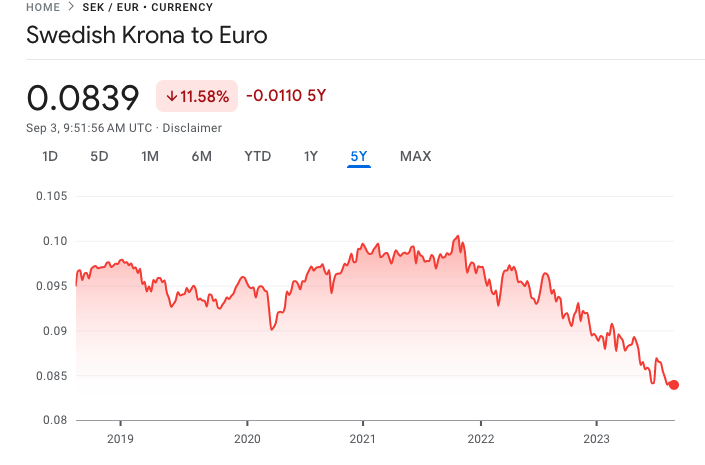
. - For all the talk of the British pound, consider the performance of the Swedish krona:
Media matters:
- The Times published an insider’s take on Elon Musk’s takeover of Twitter based on interviews with close confidant and biographer Walter Isaacson. According to the piece, “Musk’s anti-woke sentiments were partly triggered by the decision of his child Xavier, then 16, to transition.” The Times adds: “When Musk found out he was generally sanguine but then she became a fervent Marxist and broke off all relations with him”. The rift apparently pained him more than anything in his life since the infant death of his firstborn child. Definitely worth a read.
There were also some fairly smart comments from Elon about blockchain in response to his brother advocating for a blockchain-based alternative system. From the Times:
When Michael Grimes persisted by reiterating that Bankman-Fried “could do $5 billion”, Musk responded: “Blockchain Twitter isn’t possible, as the bandwidth and latency requirements cannot be supported by a peer-to-peer network.” He said he might at some point meet with Bankman-Fried, “so long as I don’t have to have a laborious blockchain debate”.
- Facebook suspended an Australian fact-checking body, RMIT Factlab, from policing content on its platform after a Sky News Australia investigation into foreign interference discovered the fact-checking body’s director was campaigning and re-sharing slogans and images created by Labor’s Indigenous Affairs Minister Linda Burney.
. - A Saudi man with eight followers on X was sentenced to death for retweeting posts critical of Mohammed bin Salman, reported journalist Tom Gara (now at Meta, weirdly).
. - Pope Francis‘ comments to young Russian Catholics, which appeared to praise Russian history, caused an international storm on social media. “Don’t forget your heredity. You are heirs of the great Russia — the great Russia of the saints, of kings, the great Russia of Peter the Great, of Catherine II, the great Russian empire, cultured, so much culture, so much humanity. You are the heirs of the great mother Russia,” the Pontiff said. A spokesman from the Kremlin praised the Pope’s “balanced approach” to the war in Ukraine, while Ukrainian officials have lambasted the pontiff’s comments as boosting Russia’s imperial ambitions.
. - Former Finnish Minister of the Interior, Paivi Rasanen, began her trial after being charged with hate speech under war crimes legislation for controversially posting quotes from the bible that repudiated the Helsinki Pride Parade.
Geopolitical hot spots:
- As a new coup in Gabon rocked West Africa, defence and foreign ministers of the European Union gathered in Toledo, Spain, to consider placing sanctions on Niger’s new military government.
. - Army officers in Gabon claimed they had taken power and annulled the results of a recent presidential election, which they claimed was manipulated. If the coup holds, this would mean an end to the 55-year role of former Gabon President Ali Bongo’s in the West African country.
As another military coup strikes yet another West African country, is it time to reconsider our understanding of goings-on in this region?
The coup in Gabon joined a series of coups in former French colonies in the past three years; Mali, Guinea, Burkina Faso, Chad, Niger, and Tunisia.
Plastered on the front of every news piece are reports of these coups, particularly those of Niger, Burkina Faso, and Mali, as being driven by popular, region-wide anti-Western sentiment. These reports correctly identify the apparent anger and exhaustion with which the West African citizenry are increasingly opposed to France’s neocolonial habits, which came to a head after French military operations in the Sahel started in 2013.
This narrative, however accurate it may be, means Western newswatchers have missed some crucial tidbits about why these coups are going on.
The first is the characterisation of the coups as ‘anti-Western’. The sentiments in West Africa may certainly lean this way currently, but they are probably more anti-French than they are anti-Western. At the very least, they are not anti-American.
The United States, for instance, has refused to call the Niger coup a ‘coup’. Online chatter tied this pertinent choice of language to the critical American drone base at Agadez, one of the largest and most expensive drone bases run by the U.S. military. Rumours are also circulating on intelligence Telegram chats that Gabon’s latest coup is “favourable to U.S. interests, even if it cannot openly endorse it.”
And perhaps the anti-French element of the narrative is overdone as well. One cannot help but notice these strings of coups stared to occur after French President Emmanuel Macron began strongly signalling that France should take steps back from its neocolonial control of Francafrique. Which itself coincides with three key shifts in France: 1) French public opinion condemning a “backwards” attitude towards their former colonies, 2) the growing military and economic costs of a military presence in the Sahel (with little to show for) and 3) the French refocusing its attention on the growing Indo-Pacific region.
This may explain French reticence to push for their supposed allies in the region. For instance, the French, having prior warning of the Niger coup, refused to send in special forces to protect President Bazoum before his imprisonment by the Niger junta. And a month into the new junta, uranium exports to France have not ceased as had been feared by analysts.
While French power in the region is certainly diminishing at a rapid pace, the seeming exhaustion of French political capital in favour of its own allies in the region means it is as much a conscious withdrawal as an inflicted defeat.
The main outstanding question is where this leaves the European Union’s Sahel-based anti-migratory policies. As our spotlight into the EU-as-medieval-empire explained, EU funds and organisations had essentially outsourced European borders to the Sahel region — Niger in particular — to combat illegal migration.
The jury is out. Will EU efforts at halting migration in Niger cease to exist with the junta? The Guardian published a piece which suggested it would. This linked the Niger coup to former President Bazoum’s strong support for EU migration policies, which wiped out much-needed incomes derived from illegal migration from scores of Niger border police and military personnel.
For further insight we must, begrudgingly, enter the realm of speculation. If Niger’s migratory routes are reopened, just look north and consider the events taking place there. A conspiracy-oriented mind would suggest the EU has been preparing for the loss of its Sahelian rampart. 2023 has seen a wave of outcry among EU NGOs that strongly condemn dodgy deals between the EU, Frontex (the EUs border police), Tunisia and Libya.
These partnerships effectively subsidise these two countries for helping to manage European migration management. The Tunisian deal has netted the North African state €675 million, for example, of which €105mn is slated for migration management.
And Frontex appears to have become more brazen in their collaboration with forced returns at sea. For instance, a Frontex plane was seen overflying a wooden dinghy loaded with migrants this July, right before Tareq Bin Zayed militiamen forcefully took over the embarcation and drove it to Libyan shores. This militia is aligned with Russian ally Genereal Haftar in eastern Libya, and is funded by the European Union, as it continues to be linked to human trafficking, forced displacement, and unlawful killings. NGOs consistently denounce the capture of migrant vessels by militiamen just after Frontex assets are found nearby, fuelling accusations that Frontex is collaborating with murderous militias for pushback against illegal migrants — something Frontex vigorously denies.
These accusations against Frontex extend further than Africa. For instance, Bulgarian activists found Frontex officials parked at a secretive (and illegal) anti-migrant detention and return camp in the country this summer.
Regardless, with a 115 percent increase in illegal migration from the central Mediterranean into Europe this year, and only a 13 percent increase in detentions, it appears a battle the EU can only lose.
Irrespective of whether the Sahel coups prove to be as anti-Western as the traditional narrative suggests or not, the EU appears to be increasing its focus on the North African coast and under-the-table deals to secure its vulnerable frontiers. These are tribute payments to the periphery, in essence, to prevent more acute migratory invasions into the old country. — DGG
- Tucker Carlson uploaded a 30-minute interview with Viktor Orban, where they discuss ongoing geopolitical events and the Ukraine-Russia conflict in particular. Not the sort of stuff you would hear in Alpbach.
. - Tony Barber wrote an insightful piece for the Financial Times explaining why Russia’s economy still has a long way to go before it collapses, and how this means its sanctions-resisting strategy is not done for just yet. According to Barber, the Kremlin’s strategy is to ‘tough it out’ until the next American presidential elections, which they hope will bring in a more Ukraine-skeptic American government.
. - The U.S. Air Force secured $50 million in funding for a project in RAF Lakenheath in Suffolk, which could pave the way for American nuclear weapons to return to Britain for the first time in 15 years.
. - Academic, and thorn in NATO’s side, John Mearsheimer made a contribution to Antiwar.com, positing that dissent regarding American foreign policy should be encouraged as a patriotic duty in independent and critical outlets, especially in light of an increasingly propagandistic and single-minded mainstream news media.
British glitches:
- The recent air traffic control failure in Britain that caused disruptions for thousands of passengers this week was apparently caused by an issue with flight data received from the National Air Traffic Services.
.
- A published Grant Thornton audit revealed the Norfolk and Suffolk NHS Foundation Trust lost track of patient deaths, but the auditor is now being accused of engaging in blame deflection. Earlier drafts had also included “language around governance failures that were missing in the final version”, such as its description of “poor”, “weak” and “inadequate” governance at the NHS Trust. But all of this language was removed from the watered-down version that was eventually published, according to the BBC.
. - The Metropolitan Police Commissioner, Sir Mark Rowley, announced that the Metropolitan Police will not allow its officers to espouse political causes in uniform. This is a U-Turn after Dame Cressida Dick’s tenure, during which time officers took the knee with BLM activists, skateboarded with Extinction Rebellion protesters and partied at the Pride parada. Sir Mark claimed that “getting drawn into political causes – even popular ones – could be “fatal” for policing.”
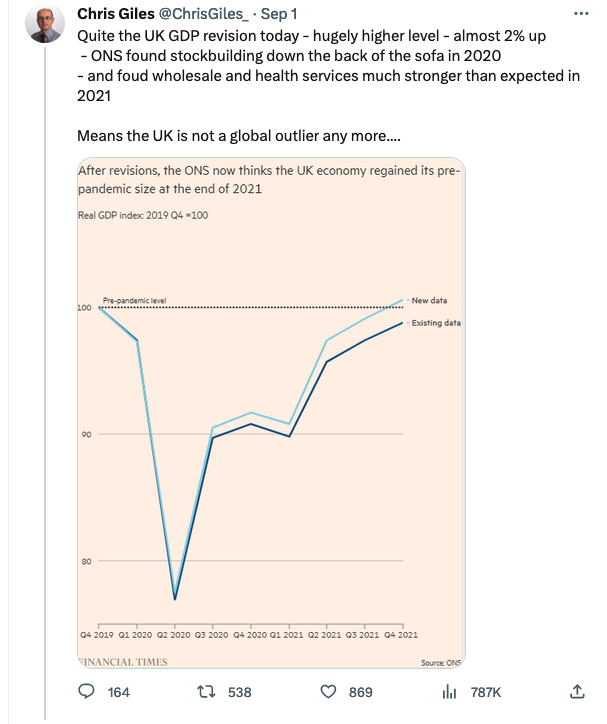
. - The UK surprised everyone when the ONS revised its GDP projections for 2021, implying the British economy surpassed its pre-Covid 19 size by the end of the final quarter of 2021. The FT’s Chris Giles had the charts:
American political drama:
- The American National Archives was revealed to hold over 5,400 Biden emails in which the current President used fake names to provide government information to Hunter Biden and others while he was Vice President under Obama’s Presidency.
. - A leading figure of the controversial Proud Boys, Joe Biggs, has been sentenced to 17 years in prison over a seditious conspiracy case regarding January 6.
Technological developments:
- Australian company SYPAQ has designed the “Corvo”, an all-cardboard surveillance, reconnaissance, and intelligence (ISR) drone.
Anyone who’s been following my comments pleading for the Western military-industrial complex to turn towards disposability will imagine my pleasure at seeing this:

Ugly, brutish, and cheap. What a beauty. The Corvo has an impressive 119km range, and can load up surveillance equipment or explosives. If its GPS guidance system is jammed, the Corvo can also be manually guided to target. And all this in a package that can be assembled by an individual with a glue gun, a box cutter, rubber bands and a wrench.
We continue to contend that the West has forgotten a key variable in war winning: quantity, cost and replenishability. American high-quality equipment in high quantities is just too expensive anywhere outside of the U.S. This, in our minds, renders non-American Western arsenals as mere window dressing, screening forces for American backup.
Though our increasingly polarised world has thrust the European camp staunchly into welcoming American arms, questions regarding European military self-sufficiency are well overdue — especially considering the cheetoesque figure that may regain the White House next year.
Should Europe hope for a realistic chance at any upcoming near-peer conflict, I hope we see more of these designs. They may be our only way into sustainable, independent warfare.
Covid collateral damage:.
- A new scientific paper has tied Pfizer’s Covid-19 vaccine to a decreased immunity to other pathogens in children, colloquially referred to as Vaccine-Acquired Immune Deficiency Syndrome.
Odds and ends:
- The Telegraph reported on a fossil discovery that points to the possibility that humanity originated in Europe (Turkey to be specific) and not Africa.
