Dear Subscribers,
My trusty lieutenant Dario Garcia Giner took a well deserved break last week with some exotic travels. That’s part of the reason there was no newsletter last week (the first absence since we started the weekly format). The other reason is that we had guests over and there was an unexpected foot injury. Oh, the drama. I’ll spare you the details. I didn’t send out a warning note because I had high hopes I could still get a note out by Sunday. But by Sunday those hopes had come crashing down and it seemed redundant to send a note out.
The good news is, Dario is back this week. And this week’s missive therefore combines missed elements from the last two weeks that still, in our opinion, deserve more thought and reflection.
A few opening thoughts for you first.
The cost of Alpine living
I’m currently working remotely from the French Alps — Chamonix to be specific — and, as is my habit, I like to keep an eye on local economic conditions. Chamonix is a good barometer for all sorts of trends. For one thing, it’s a mecca for middle class Frenchies who enjoy to staycation (and, frankly, who can blame them, having a country like they have). Second, it’s a micro economy, which can often be easier to assess than a more complex city economy. And third, it’s one of the more cosmopolitan Alpine resorts due to its proximity to Mont Blanc, meaning it attracts a very wide variety of tourists, while also appealing to the hard core skier/climber bum demographic. Unlike rivals Verbier and Megeve that means it’s also a lot less poncey, and hasn’t entirely priced out the lower-end rabble just yet (even though the proverbial Russian invasion of the early teen 2012-2014 period did threaten to do so at one point).
So what are the macro signals coming from an established mountain resort like Chamonix this season? Well, for one thing, there’s a shocking number of new build projects scattered across the valley. Cranes are up as far as the eye can see. The plot purchased by actor Orlando Bloom is among many that had previously laid undeveloped for years but which now boasts construction activity on its terroir. Can these all be second homes? No doubt a lot of them will be. But the neighborhood I’m most familiar with is mostly attracting full-time residents who have called it quits on city living. Local authorities, meanwhile, have been super busy pedestrianising and one-way flowing the whole town, bringing all sorts of city norms to mountain life. How well the chicanes cope in winter is another matter.
All of this has made it impossibly expensive to park, which is challenging for residents in a town like Chamonix where cars are essential due to the sprawl-like nature of the communities. Hiking and cycling is for fun, not for picking up groceries. For now, locals still get a discount or free access to car parks. But the emergence of two-tier pricing systems of this variety (one heavily discounted price for residents who can prove they live in town all year round and another for tourists and/or second homers) has something of the 15-minute city to it. The local economy seems to be organising itself quite organically around punishing or pricing out anyone who hasn’t a vested or permanent interest in the community.
But it’s also increasingly clear that the whole resort is down-marketing itself. The Russians are gone. And the Chinese and Middle Eastern tourists who have replaced them seem far more content to picnic. The Europeans too are increasingly opting for camping and low-end dining options. The mid-to-high end restaurants claim business is down 20 percent on last year, despite not raising prices. Instead, the biggest and most obvious price inflation is in the supermarkets.
Fascinatingly, even the gouge-happy mountain restaurants are holding steady on prices. Here’s the price list from the restaurant at the foot of the Bossons glacier, which you can only reach by chairlift — pricey no doubt, but within historic norms.
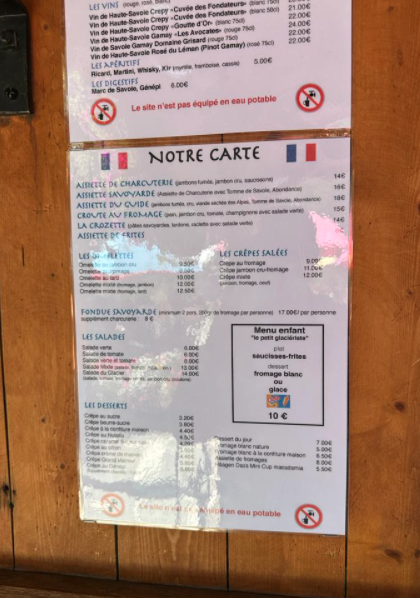
Compare and contrast that price list with the actual bum magnet that is the MBC diner, a favourite of season workers and chalet girls, positioned by the very easily accessible cross-country ski course in the middle of town:
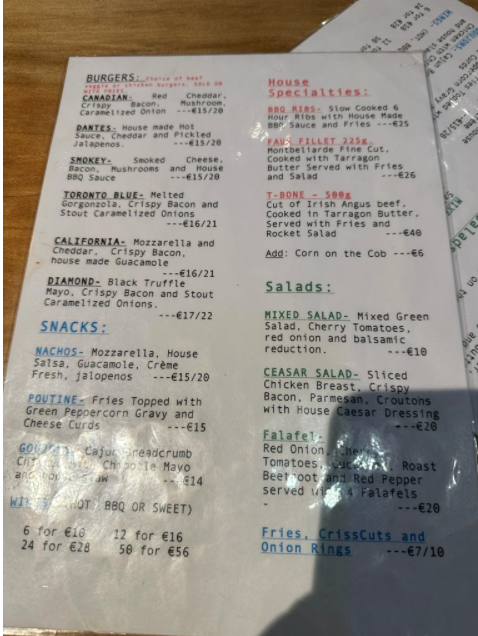
There’s almost no difference.
Overheard at the entrance of the latter this week, a group of young ski bums moaning about how expensive the bill was. The anecdotal evidence therefore points to serious margin compression at restaurants previously capable of carrying significant mark-ups, and the lower end busier than ever but marking up to the point that they’re freezing out their usual bum clientele. And with even the sandwich shops and supermarkets charging extortionate prices, there’s very little saving to be had with the picnic or self-catering option. What’s a bum to do in this environment, other than, err, head permanently to the Caucasus or some other undeveloped Alpine equivalent?
Work-life-parent-balance
The second “deep thought” relates to our new work-from-home and dual working-parent norms. I’m going to be honest. I’m not sure I’m all in on this new way of being. There’s something to be said for division of labour within the family unit. Kids need parents to be engaged, and if both parents are in full-time jobs that require continuous connectivity, that leaves them being brought up by Kids YouTube. It’s not healthy. And it definitely doesn’t feel liberating.
There’s far too much pressure on women to be full-time professionals. The problem with “part-time” solutions and workplace “flexibility”, meanwhile, is that they’re crap for everyone. They’re no good for employers, because some jobs just can’t be done competently part time. They’re also crap for employees because anyone competent or who takes pride in their work in such a part-time role, more often than not, just ends up working through their non-contracted days, and thus ends up being underpaid in relative workload terms.
From the kid perspective, it’s not really constructive either — especially if the type of job you have requires being continuously informed (trader, banker, journalist, etc) since you’re having to look at tablets or phones on your off days anyway.
Taking a career break to raise kids used to be a very Hollywood thing to do, but I totally get why someone would want to do it. The problem with most women who would want to is that they just can’t afford it. The family is trapped in a double-income quagmire. Is this really “progress”?
China meltdown watch:
The economic picture in China is getting ever more precarious as the country heads into a deflationary environment and grapples with an intensifying real-estate crisis. What investors want to know is, could this really be the big one? Rumours of China’s downfall are continuously being exaggerated, so it probably pays to be cynical. According to the PBOC’s second quarter monetary policy report, a U-shaped deflationary episode is much more likely. Xi Jinping, meanwhile, is heading to Johannesburg this week for the 15th BRICs summit, where the talking points are set to include how to boost local currency fundraising and lending.
- Bigger than Evergrande? Chinese real estate developer Country Garden Holdings failed to pay a dollar bond coupon payment, suggesting the giant is on course for a default. In a filing with the Shanghai Stock Exchange, the property giant also stated that redemption of its three local notes will face “major uncertainties.”
. - Speaking of Evergrande, the property giant everyone became familiar with in 2021 when it defaulted on a dollar bond payment triggering a liquidity panic, officially sought Chapter 15 bankruptcy protection in New York on Thursday, which will protect the company’s American assets while its restructuring arrangements are worked out elsewhere.
. - Market attention may be on who is or isn’t sticking to their US Treasury holdings, but the Financial Times reported that global investor spooked by the suspension of state subsidies into key sectors, as well as the overall economic slowdown in the country, had forcefully dumped Chinese securities in August, even as China continued to downsize its UST holdings.
- A top energy official in China, Zhang Jianhua, called for greater secrecy for the country’s national energy security infrastructure – a sign that China may be preparing for international confrontation.
. - Tesla cut the prices of its car models in China for the second time in three days as reports of China’s economic troubles intensified.
. - The same week Chinese authorities expressed they will protect the yuan exchange rate against the dollar from “excessive moves”, major state-owned banks were seen selling dollars to buy yuan in offshore foreign exchange markets. Brad Setser suggested it will be critical to watch and see if authorities defend the 7.3 level:

- Morgan Stanley claimed a multi-decade slide in Chinese home sales was only just beginning. Official government statistics described a drop of only 2.4 per cent, but realtor data suggested the drops were much bigger, with some areas dropping of more than 25 percent.

- Chinese shadow banking giant Zhongzhi Enterprise Group, which is currently in the midst of a liquidity crisis, hired KPMG to review its balance sheet and help it restructure its debt. This comes as fellow Chinese shadow bank, Zhongrong International Trust Co., also missed dozens of payments on products that promised to pay 7 percent, sparking protests by about two dozen people outside its offices.
. - China ordered some of its banks and investment funds to cease being net sellers of equities as well as to engage in buybacks.

- Amid expectations that the People’s Bank of China will further ease monetary policy, the yield gap between China’s 10yr bonds and US Treasuries widened to 164bps, the highest gap since February 2007.
Business, economics, finance etc …
- Risk reported that the International Organization of Securities Commissions (IOSCO) was examining how dealers place hedges before executing trades, also known as “pre-hedging”. This came to play in a big way in the foreign exchange fix rigging case, and it was always my contention that it wasn’t manipulative. It was merely sound risk management.
. - Saudi Arabia reduced its US Treasury holdings by 41 percent since 2020, their lowest level in six years. China likewise sold $11.3bn of US Treasuries in June and brought its holdings to the lowest level since mid-2009.
..
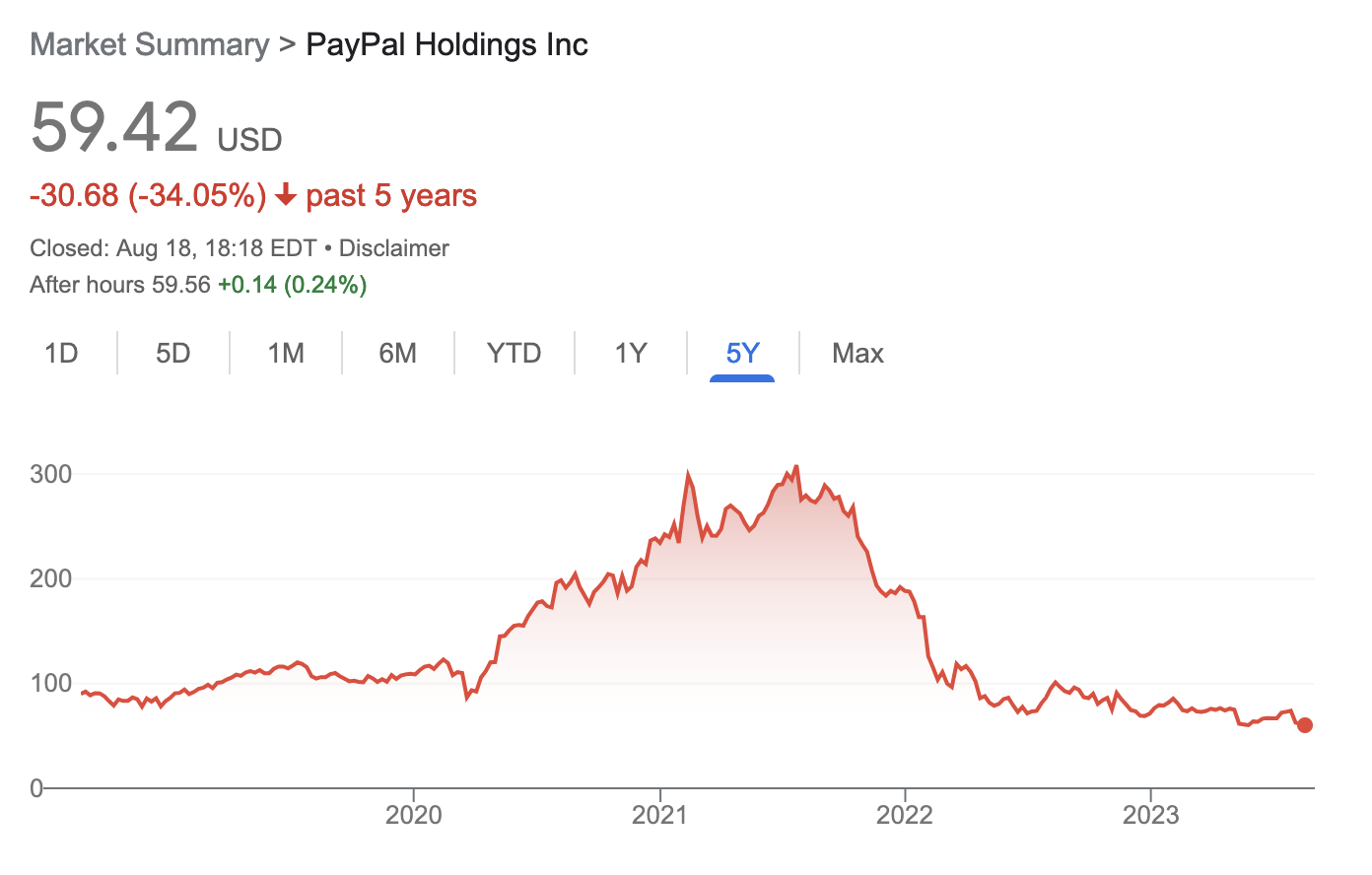
- The media all sang from the same hymn sheet when PayPal launched its own stablecoin two weeks ago. But I argued in an X (formerly known as Twitter) thread, that most of the coverage was misleading.
Firstly, a stablecoin is hardly an innovative move for the digital payments giant, given it has operated in that mode from its earliest days. In fact, Tether execs and start-up investors have told me on numerous occasions that Tether was modelled on PayPal. Talk of the company’s share price being boosted by the stablecoin move, meanwhile, was comical given the longer-term performance of the stock.
The true incentive for launching a stablecoin is likely to distract customers from the lack of interest it awards on balances. – IK
 .
. - Giorgia Meloni’s government backtracked from its decision to apply a 40 percent windfall taxes on bank profits, following a massive sell-off in Italian bank stocks unnerving investors and Italian bondholders. The government has since turned its attention to other less fragile industries, like state-concessions such as motorway tolls, bridges and airports.
The Italian bank profit raid was likely triggered by the government’s need to find new and creative ways to balance this year’s budget. In the end, however, it turned into a formidable lesson into why banks are currently choosing to reward shareholders over depositors: the former are far flightier.
As to the relationship between bank profits and sovereign stability, I was fascinated to learn via this Reuters factbox that Hungary’s government has decided its banks can reduce their 2024 windfall tax payments by up to 50 percent as long as they increase their Hungarian government bond purchases.
This ties in with what Russell Napier predicted might happen in the U.K. if and when debt monetisation became an unofficial policy. Before they become Argentina, governments have the power to create a captured market for their own bonds by forcing the domestic financial industry to buy and hold their own securities. — IK
- Eric Nuttall noted on Twitter that just as China was building up its Strategic Petroleum Reserves, the United States had largely depleted its own equivalent:
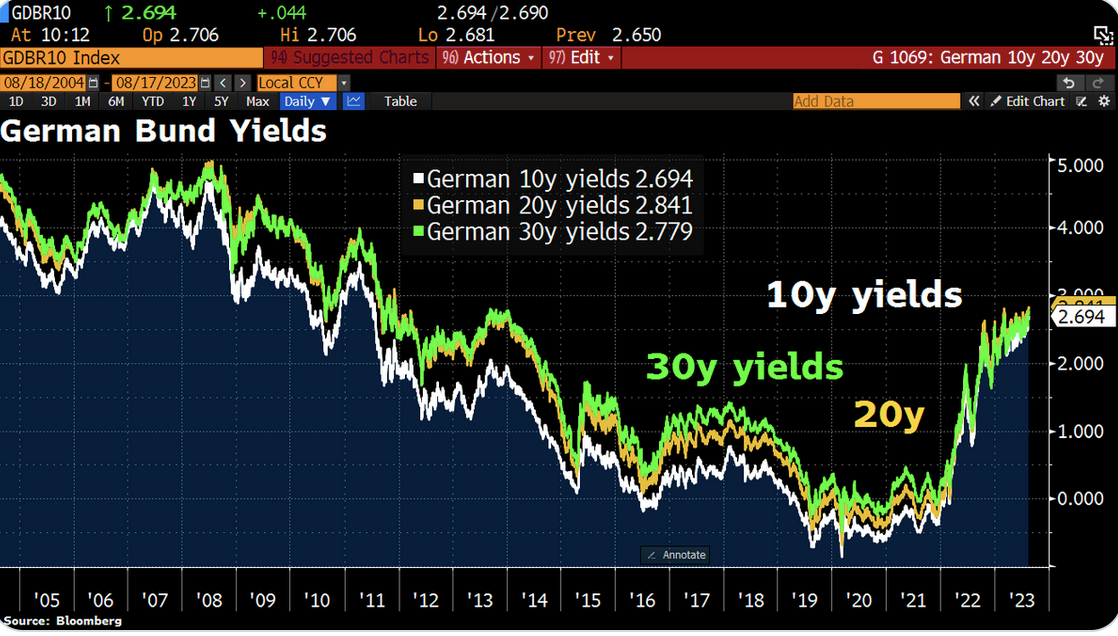
- Holger Zschaepitz noted on Twitter that 20-year German bund yields rose to their highest level since 2011 at 2.84 percent, while 30-year yields rose to their highest level since 2013. He added that 10-year yields are now on the verge of surpassing the March high of 2.75 per cent and climbing to their highest level since 2011.
 .
. - French 10yr bonds also hit their highest level since 2012:
- And not forgeting the US, where long-dated US Treasury yields hit a 10-month high on Thursday.
. - UPS workers negotiated one of the most eye-popping pay and benefit deals of the current economic cycle. When it was publicly revealed that full-time drivers would be making around $170,000 in annual pay and benefits, online job boards saw a 50 per cent increase in searches for “UPS” in the job title.
. - The Bank of England suffered a surprisingly longish RTGS outage on Monday, and wouldn’t tell us more than that it was “technical”. Something to keep an eye on.
. - Finteum, the intraday repo funding platform, hosted a trial of its system in which bank participants discussed the business case and market structure for intraday funding markets. “The banks integrating with Finteum are going live using existing Real Time Gross Settlement (RTGS) systems for intraday FX swaps. Following requests from banks, newly built “capacity” functionality helps bank teams to coordinate with each other regarding how much of each currency the bank should borrow or lend, and for which hours. Also, bank risk teams can now input intraday credit limits into the platform, to manage intraday counterparty credit risk,” the company reported.
Yes, it’s a self-promoting press release from Finteum, but the evolution of intraday funding markets is a big thing and something definitely worth keeping an eye on. As Finteum also notes “the Federal Reserve included intraday liquidity risk management as a supervisory priority for 2023, and recent bank failures have highlighted the need for banks to have access to multiple tools and sources of liquidity.” Totally agree. The big opportunity is if liquid intraday funding markets can come to replace the large buffers of HQLA that banks otherwise have to hold. — IK
- David Adler dived into the origins of the Mont Pelerin society for the American Affairs Journal by setting off on a pilgrimage to the Mont Pelerin hotel which had hosted the original troupe of economists, among them F.A. Hayek, Milton Friedman, Ludwig von Mises, and Karl Popper, responsible for forging modern-day neoliberalism.
. - Fitch reported on August 15 that it was prepared to downgrade multiple banks, including JP Morgan, leading to a large sell-off in US banking stocks.
. - Japanese banks upped their loan loss provisions by up to 70 percent in some cases on rising defaults due to labour shortages and rising prices.


BRICS, BRICS, BRICS:
- Investor Jim Rickards isn’t everyone’s cup of tea, but he provided a worthwhile overview of what’s at stake at this week’s BRICS meeting in Johannesburg, including the chances of a new currency modeled on the Keynesian idea of the bancor coming about. What goes on at the 15th BRICS summit is likely to set at least some of the agenda for Jackson Hole next weekend.
Crypto evangelism:
- A Bank of Canada research paper studying the effects of CBDCs has found they would not improve financial inclusion. “Most consumers face few payment gaps or frictions and therefore might have relatively weak incentives to adopt and – especially – to use CBDC at scale”, the authors wrote.
. - The Kenyan Office of the Data Protection Commissioner warned Kenyans against sharing their private details with cryptocurrency WorldCoin, owing to data privacy concerns.
Media matters:
- Linda Yaccarino, X CEO told a Spaces chat: “We’ve introduced a new policy called Freedom of speech, not reach” and that “If you’re going to post something that is lawful but is awful, you get labeled. You get de-amplified, which means it cannot be shared. And it is certainly demonetised”, prompting further accusations that Elon is the new boss who is the same as the old boss.
. - Over on the left-wing fringes of the internet, firebrand anti-establishment subversive Whitney Webb of Unlimited Hangout claimed she would never get verified on X since the whole Elon takeover was nothing more than a bait and switch to get people hooked on an “everything app” that rivals China’s Wechat. She thinks Elon is mostly a proxy for the military industrial complex, which he owes most of his wealth to. And the cage fights, etc. are all a distraction from the fact that highly sophisticated “pre-crime” mechanisms are being instituted on his watch. “Disappointed in the anti-digital id/cbdc types who are subscribing to be part of Twitter’s new revenue model for “creators.” You are helping create the everything app + turning this site into a dystopian bank,” she Tweeted.
.
- The Facebook files revealed the FBI lied about meeting with social media giants to suppress the Hunter Biden laptop story.
. - Michael Shellenberger’s news organisation, Public discovered that the White House’s aggressive calls to Facebook, for vaccine censorship, actually arose from pressure from mainstream news media organisations like the New York Times.
. - In January, Special Counsel Jack Smith obtained a search warrant for Donald Trump’s Twitter account. A delay by Twitter in complying with this request meant the social media giant was fined $350,000.
. - British police arrested and dragged away an autistic minor for saying a female police officer “looked like her lesbian nana”.
. - An unprecedented police raid against a Kansas newspaper publication allegedly took the life of newspaper co-owner Joan Meyer, 98, due to being “stressed beyond her limits and overwhelmed by hours of shock and grief.” The raid was carried out after the newspaper obtained damaging information about a local businesswoman, which the paper declined to publish.
Don’t cry for the dollar Argentina:
De-dollarisation may be what everyone is talking about, but in Argentina the collapsing peso and rampant inflation are cultivating presidential candidates who want to dollarise the system as quickly as possible. Though Javier Milei, a man with a coiffure not to be forgotten, is also apparently not opposed to bitcoin.
- Argentinian presidential candidate Javier Milei told reporters that he would get rid of the central bank if elected to aid with his dollarisation plan to curb inflation, which is currently running at 113 percent.
Echoing a staple libertarian argument (as well as the recent thoughts of former BoE economist Andy Haldane), Milei argued “stealing is wrong and seigniorage is nothing more or less than a swindle by politicians against good people…if we consider that stealing is wrong, one of the greatest thieves in the history of mankind is the Central Bank.” Milei continued that in the case of Argentina, where the peso has no demand and thus has a price of zero, “the counterpart is that the price level is infinite” meaning whatever amount of money a central bank wants to impose “the flipside is that the price level has “infinity”. Under Milei’s plan the central bank would be scrapped, and operate only on a marginal level regulating the banks until the banking system could be transformed into a “free banking system” that ran on the dollar. — IK
- Unfortunately for Milei, Argentina’s central bank also officially ran out of dollars this week. The shortage was so acute that Argentina was forced to use the yuan instead of dollars to pay an outstanding $1.4bn of the $2.7bn it owed the IMF a few weeks ago.

Politics, politics, politics:
- German politicians discussed banning the far-right Alternative for Germany (AfD) after it surged to 21 per cent in the polls, amid warnings from intelligence officials that its members are becoming increasingly extreme.
Is Germany set to ban the far-right Alternative for Germany party? In recent weeks, several influential Germans, including the Federal Chairwoman of the governing SPD, have argued in favour. But it’s a little bit more complicated than that.
The power to ban a political party in Germany is governed by its quasi-constitutional document, the Basic Law, and determined by the Federal Constitutional Court.
The decision on which such a ban would rest is twofold. The first would ascertain whether the party in question challenges the “free democratic order”. Summarised, this means “The guarantee of human dignity, the equal participation of all citizens in the formation of democratic political will, as well as the independence of the courts and the state monopoly on the legal use of force, Art. 20 III GG.” The party would have to actively work towards the abolition and replacement of these essential elements aggressively. The second key element is potentiality — whether the key party’s problematic objectives can be carried out to fruition. This is why the quasi-Nazi NPD in 2017 was found unconstitutional, but was not banned — its potentiality was seen as in-existent — and it was simply excluded from party funding.
Whether the AfD fulfills this criteria is questionable. But at least one wing of the party, in the eyes of some German jurists, does fulfill it; the AfD wing of Thuringia. The Thuringian State Office for the Protection of the Constitution classified the AfD in Thuringia as a “proven right wing extremist effort against the free democratic order”. The federal party has only been observed by the Federal Office for the Protection of the Constitution as a “suspected” case. And though a local State Office would be entitled to ban the party in their state, only the Federal Office can determine its unconstitutionality.
And we’re no strangers to the extreme nature of the AfD wing in Thuringia, whose dog-whistles in calling the German government illegitimate are certainly radical.
But — beyond the questionable political desirability of such a ban — some are certain a ban of any kind will not come to pass. Constitutional lawyer Boehme-Neßler was interviewed by Der Westen, and called the ban “without a chance”. Though the lawyer criticises much of the AfD’s behaviour, he labels the legal requirements defined above as likely too stringent for a party ban on the AfD.
The most concerning part of this entire endeavour, however, is not the potential unconstitutionality of the AfD — or whether it will be banned or not. The problem should be that a major Western democracy is allowing a political decision of extreme consequences to be carried out by technocrats …. against a party that, among their many unforgivable beliefs, contend that their country is run by… technocrats. And that is without considering why other extreme parties such as Sinn Feinn, or organisations like Extinction Rebellion, whose temporary suspension of democracy is their explicit policy, don’t attract the same calls for a ban.
What is striking with the question of the AfD ban is, thus, not about this radical party’s extremity. It should be about the unquestioned extremity of the supposedly tepid middle. — DGG
- Contrary to the FBI’s claims that its targeting of Catholics as domestic terrorists were limited to a “single field office”, subpoenaed documents revealed the FBI organised this through several field offices across the United States. Zerohedge went deeper into the story.
. - Top Democrats on the House Oversight Committee conceded that Hunter Biden did “wrong things”, including unlawful behaviour and drug consumption.
. - Speaker Kevin McCarthy called out the Biden Administration for weaponising the Justice Department against Donald Trump.
. - Donald Trump announced that he plans to release “A Large, Complex, Detailed but irrefutable REPORT on the Presidential Election Fraud which took place in Georgia is almost complete & will be presented by me at a major News Conference at 11:00 A.M. on Monday of next week in Bedminster, New Jersey,” hours after being indicted in Georgia on charges accusing him of a conspiracy to subvert the 2020 election, according to the New York Times.
. - Additional discoveries in the Biden case show President Biden used a pseudonym, Robert L. Peters, when corresponding with Hunter’s business associates and used it to schedule calls with the Ukrainian President.
. - Meanwhile, as the Biden investigations intensify, Biden’s top White House lawyer said he was departing his position.
Geopolitical hot spots:
- A German citizen and army employee was arrested for allegedly offering to pass on professional information to Russian intelligence services.
.
- Leaked Pakistani documents revealed significant American pressure on Pakistani authorities to remove Imran Khan from his position as Prime Minister of Pakistan over his neutrality on the Russian invasion of Ukraine. Former British diplomat turned outspoken critic of the establishment Craig Murray conducted a deep dive into Khan’s overthrow and jailing, questioning the dearth of coverage in Western media, and suspected that Khan’s radical moves against American meddling in Pakistani affairs were also to blame.
. - Russia’s statal space agency Roscosmos launched the country’s first lunar mission in half a century in the renewed “scramble for the moon“.
. - Three Bulgarian nationals and suspected spies for Russia in the United Kingdom were arrested and charged since February under suspicion of an offence under the Official Secrets Act.
.
- Poland hosted its largest military parade yet. The parade included 92 aeroplanes, M1A1 Abrams and K2 tanks, HIMARS launchers, Bayraktar’s, and around 200 vehicles.
.
- Republican Congressman Kevin Kiley publicly asked why the Newsom Administration had kept news of a secret Chinese bioengineering lab in California under wraps for nine months. Recent revelations showed Newsom’s Administration offered the laboratory $360,000 in funding and told local officials to keep quiet after discovering the lab, which was found to have nearly 1,000 mice “genetically engineered to catch and carry the COVID-19 virus.”
Rubble of rubles:
- The Russian ruble collapsed below 100 to the dollar this week, triggering an emergency meeting by the central bank in which a decision was made to raise interest rates to 12 percent from 8.5 percent. By Friday, the move had bolstered the Russian currency to 94 to the dollar, but not everyone was convinced the rates could be meaningfully traded.
. - Russia also said it was considering the imposition of partial capital controls in order to stem its ruble troubles, but then backtracked on the announcement.
. - Moscow went live with its ruble central bank digital currency pilot this week. France24 interviewed a crypto founder about it who noted that “digitising the ruble would give authorities ‘immense control’ over Russians” and that “it could be used as ‘the ultimate social control tool'” … “giving the government the power to issue fines or freeze assets with ‘the click of a button’.” He added that “in Russia, it is the FSB security service that oversees the safety of the digital ruble’s financial architecture.”
Strangely, when the same is pointed out about Western equivalents, it’s often dubbed to be a conspiracy theory ¯\_(ツ)_/¯ – IK
What goes on in Diego Garcia stays in Diego Garcia:
- ICYMI, The British promised to protect US military operations on Diego Garcia in the Indian Ocean during talks to hand the islands back to the Mauritius amid fears the handover could invite Chinese influence over what is sometimes dubbed America’s unsinkable aircraft carrier. The island chain is a UK overseas territory, which the British leased to the US Navy in the 1960s. It is home to some 1,700 military personnel and 1,500 civilian contractors, radar facilities and US Space Operations Command.
The road to hell is paved with good intentions:
- An audit of one of a handful of western solar panel producers, First Solar, unearthed evidence of forced labour at a Malaysian facility.
As the Blind Spot’s collaboration with Public/Environmental Progress showed, First Solar is one of a handful of solar companies that happily shares data about its energy mix with researchers and data compilers who provide lifecycle analysis for the IPCC, upon which all sorts of net zero targets are based. The problem for the “transition” is that this Western data — not the Chinese equivalent, which is likely far more carbon intensive — sets the standard for the industry and for IPCC projections. Given that up to 80-90 percent of the sector is dominated by far more opaque Chinese companies, official assumptions about the carbon intensity of solar panels are likely to be way off.
If it’s also true that Western panels must rely on forced labour to make them cost competitive, this scuppers the possibility that they are truly a viable contender to fossil fuels. — IK.
- The Wall Street Journal reported that consistent increases in the price of renewable power are creating headaches for some utilities and companies after years of decreasing prices. The rising cost of renewables is being pushed by everything from “macroeconomic forces to countries’ attempts to take control of their energy-supply chains” it noted. According to the paper, the cost of large-scale solar and wind power was up 20 percent on the year.
The rising cost of renewables is indicative of somebody in the field having not properly assessed the relative viability of renewables to fossil fuels. It also implies that for some strange reason variable financing costs may not have been factored into the overall viability calculations. After years of being told that wind and solar were now cost competitive with fossil, one has to wonder if those asserting such things really had any idea about what they were talking about. If renewables truly were cost effective with fossil fuels, they wouldn’t be getting more expensive to develop in the context of fossil fuels only getting cheaper to develop. As it stands the only reason fossil fuels are more expensive is entirely policy driven and thus synthetic. — IK
- Stuart Kirk, the man who dared to quibble with the ESG mantra at HSBC and got cancelled for it, ain’t sorry. He argued in the Financial Times last week that “rebranding ESG won’t save it from its internal contradictions.”.
You’re either in prison, or in power, or speaking your mind?
- Former French President Nicolas Sarkozy told France’s Le Figaro that Europe needs to “clarify its strategy” and seek a compromise with Russia rather than pursue its “strange idea” of funding a war without waging it.
Weather extremism:
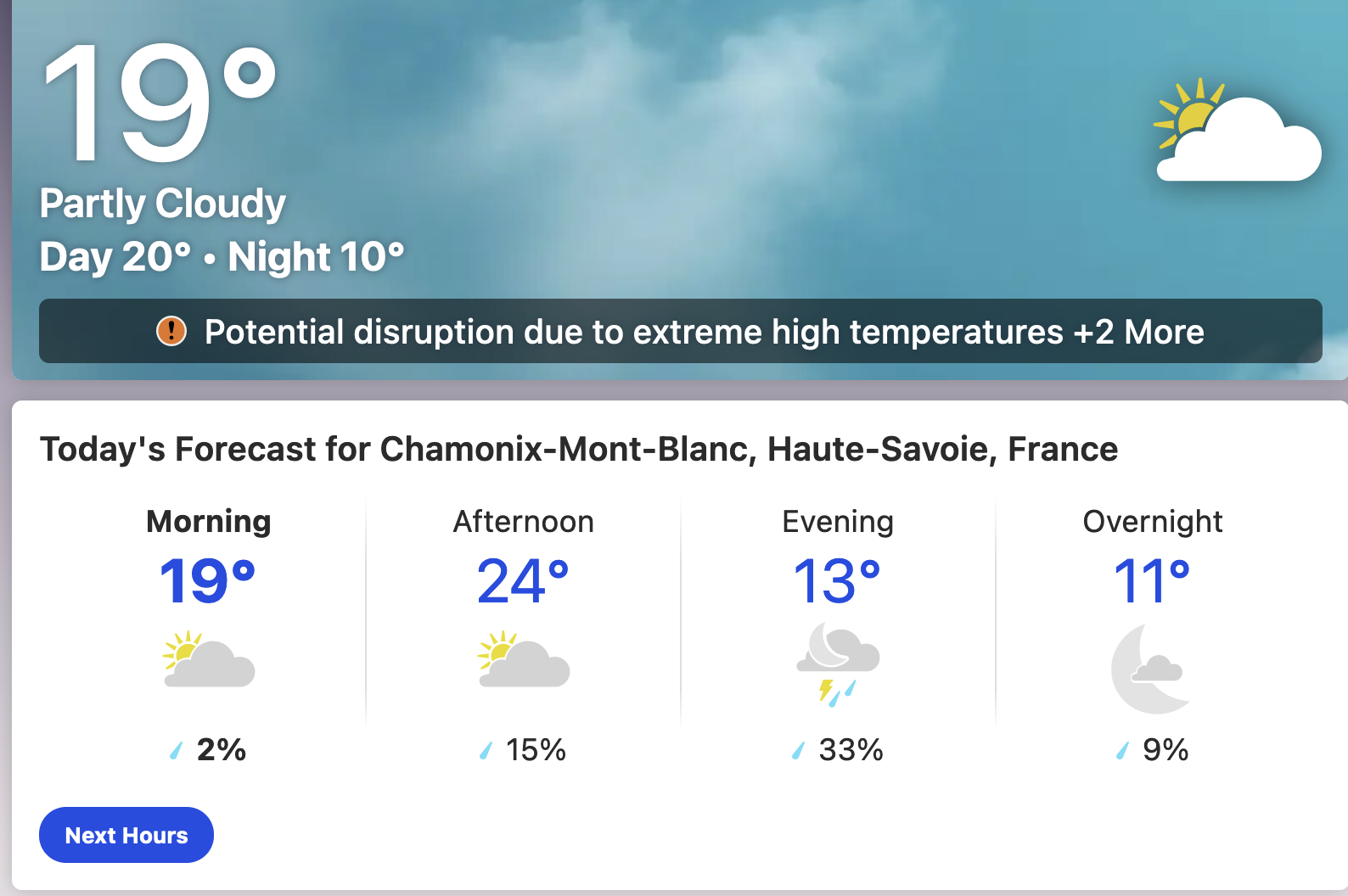
- Is 24°C really cause to issue an “extreme high temperature” warning? Weather apps have lost all sense of proportionality.
Scientific developments:
- British scientists at Porton Down laboratory have started developing “insurance” vaccines against an unknown “Disease X“, in anticipation of additional pandemics caused by novel viruses.
For those not in the know, Porton Down, just down the road from Salisbury, was home to some of the most heinous experiments carried out by the British state on their populace.
Porton Down’s scientists have drawn strong condemnation in the United Kingdom for their reiterated use of human “guinea pigs”, which have resulted in the deaths of some military personnel. From 1945 to 1989 the facility officially exposed over 3,400 people to nerve gas, for example. But other tests are worse still.
From 1953 to 1976 the facility conducted secret aerial trials of chemical warfare. This means exactly what it sounds like — spraying dubious chemicals on the unsuspecting British population. For instance, the areas from Yeovil to Guildford were secretly sprayed with “marker” chemicals, supposedly harmless mixtures to test how a Russian chemical attack would behave. A similar test with germs was carried out in the tube in the 1960s.
The chemicals were supposed to be harmless. But science advances. We now know the chemicals used in tonnes for the aerial spraying — zinc cadmium sulphide — was probably carcinogenic, and the germs spread on the tube — Bacillus globigii bacteria — are today regarded as a cause of food poisoning, eye infections, and even septicaemia.
And who knows about the near misses. A large canister of plague bacteria (yes, the actual plague) was sprayed just west of Scotland in 1952. Had the prevailing winds blown west rather than east, the population of the Isle of Lewis may have been infected.
That we’re developing an ‘insurance’ vaccine against an unknown disease at the laboratory historically known for intentionally spraying chemicals on the British population is far from reassuring. — DGG
These days Porton Down shares its facilities with a multitude of biotech start-ups in a bid to cultivate a Silicon Valley campus type of feel.
Other notable things that have occurred in the Salisbury environs: The poisoning of the Skripals. — IK
- Sorry, everyone. There will be no levitating cars. Scientists concluded LK-99 is not a superconductor after all.