

Dear Subscribers,
Welcome to the weekend, and hopefully — for the first time in a while — a relatively timely (but, no doubt, format-muddled) send-out. Sadly, until we find an alternative newsletter management system, we are stuck with the clunky and format-limited Mailchimp service, which seems to ensure that almost every week something looks awful. Sigh.
Newsflow-wise, France burns (again), while Poland prepares (possibly) to take advantage of the situation to gain even more power in Europe.
At The Blind Spot, we’ve finally processed another Leaked Lunch podcast — this time with Guy Standing, about the exploitation of the Blue Commons.
But it’s also been a central bank-heavy week due to the European equivalent of Jackson Hole, aka the “Sintra” gathering in Portugal. Word on the ground has it that the cbankers are mostly frustrated and perplexed as to why their policy actions are not having more of an impact. My colleague, Ben Munster, summed up the mood nicely in this piece for Politico. But that was nothing compared to what he deduced from shaking the hands of central bankers directly. I strongly recommend this piece — his attempt to quantify his findings in some sort of “indicator” model. The involuntary LOLs upon reading the original draft nearly gave me a seizure. We will no doubt never be invited to anything managed by the ECB again.
Other than that, news reaches me of secret meetings and gatherings in the media space focused on pushing back against the “industrial censorship complex”. Whether any of these efforts will make a difference is yet to be determined. Any significant anti-censorship alliance is likely to come under the attack of the pro-censorship complex with the usual arguments and/or direct sabotage. Journalists adding their names publicly to any such movement will also risk being cancelled, and potentially one day even unbanked (just like Nigel Farage — though his predicament could also be linked to his recent crypto shilling). Given this is the week that the European Commission decided to go all in on the digital euro by drafting the legislation that can make it happen, it all seems pretty relevant.
Finally, this is also the week that journalists Matt Taibbi and Michael Shellenberger decided to go on the record that they were behind all efforts to free Julian Assange. The Wikileaks founder faces extradition to the United States potentially as soon as mid-July, according to his wife Stella. The Blind Spot echoes that sentiment and continues to follow the case. It’s notable that even the Pope has given an implicit endorsement of Julian’s cause by receiving Stella for an audience this Friday.
Taibbi has already said it best, but I have one additional thing to add. I had the opportunity, over a year ago, to participate in an on-the-record podcast recording with Kathleen Cordelia Bailey. For those unfamiliar, Kathleen was formerly the head of America’s original Office of Disinformation, Analysis and Response, which was created under Ronald Reagan in 1985. It was in that role that she chaired the “Interagency Active Measures Working Group” and can, thus, be considered a true disinformation expert (as opposed to the gazillions of self-declared “disinfo experts” popping up all over the place now).
The interview, which also featured Ross Coulthart (of recent non-human-intelligence exposé fame), was never published. But it was on the record. So I think it’s a waste not to report what she told me about what she believes differentiates democracies from authoritarian states:
“There is a kind of a safety valve built into democracy vis-a-vis no safety valve built into a communist system or an authoritarian one. Because, in the case of democracies — take the Pentagon Papers, take so many leaks — people have values and consciousness of issues built into them when they are raised in a democracy. And if they see something terribly amiss, they leak it, and it gets out. Democracy is like that. And so governments that are democratic have to take that into consideration when they try to keep something secret.
Whereas in a communist or authoritarian system, if there is a leak, first of all, the leaker gets killed, usually.
And second of all, people see that and it teaches them not to leak. I remember — just to illustrate this to younger people in this audience that might not believe that — there was just a couple of years ago, a Chinese spy who was spying for the United States discovered. He was in a company. They took the individual to the company, got all the employees of the company, assembled them, and let them watch the man being executed. You know, that’s a pretty strong lesson to take away. And I’m sure that it had its effect. Now, imagine something like that happening in a democracy. No way.”
To which I said:
“I’m playing devil’s advocate, but people would say that Julian Assange is an excellent example of someone who has tried to facilitate leaks and is obviously currently still in prison and in dire circumstances, and it looks like he’s not going to be coming out anytime soon. So, yes, he hasn’t necessarily been killed, but it’s not a good look for the US government in that context.”
Before she had a chance to reply, Ross Coulthart edged in saying he had a dim view of the idea that Julian Assange was a journalist, because journalists wouldn’t handle secret leaked material the way he did. But he also said he thought it was interesting that the story that the CIA had been plotting to assassinate Assange — which he assumed was a lie — was never formally debunked, which he believed was a bad look for the agency.
Kathleen never responded directly to my Assange point, but she did say that it was possible that on this occasion the CIA may have considered the assassination story, even if it was a lie, a “useful lie” — in terms of the message it sent to future leakers.
And herein lies the problem. Not only does it seem that “we” are comfortable with lies if they suit our agenda, our tactics to dissuade future leakers aren’t that different to those of authoritarian regimes. Assange may not have filtered the data in a “responsible” way. I do have some sympathy for this point. But what has been insufficiently discussed is how, in a data-driven world, most datasets are bigger than any individual’s capacity to filter them. Thus, the old journalistic techniques don’t stand a chance of holding power to account the way they used to.
In a world where the government and the “system” routinely stockpile everyone’s data (irrespective of whether they have broken the law or not) just in case it might prove useful in the future — and do God-knows-what with it — it stands to reason that leakers must operate in similarly blunt ways. The issue isn’t responsible or irresponsible filtering. The issue is our overall dependence on big data sets and imperfect taxonomies, which ensure there is always going to be informational collateral damage one way or the other. Julian’s leaks may have exposed secret assets, but government dragnets routinely expose innocent people to unnecessary surveillance, too.
The only pushback against governments sweeping up the data and information of the innocent into their systems, and figuring out if people are being fairly assessed and their human rights respected, is the periodic sweeping of large government-owned datasets by third parties focused on holding power to account.
Unfortunately, as the Twitter files themselves show, data files are now so large, that job is beyond the capacity of even a large group of “trusted” journalists. That’s not to say the Twitter files should be made publicly accessible … (not least because they represent a repository of private consumer data, not just government data), but it is to say that the inclination to fight fire with fire is not irrational. Public scrutiny is hugely disadvantaged if it lacks the capacity to tap the very same open-source intelligence practices that are routinely used against the public. And, remember, it’s not us who started the dragnet practices or the fire.
On that note, here’s what you might have missed over the past two weeks. This edition of the Blind Spot newsletter was, as usual, compiled by Izabella Kaminska and Dario Garcia Giner.
Economics, finance, and more:
- CEO of BlackRock Larry Fink ditched the term ESG due to its political weaponisation. Fink claimed he was “ashamed” to have become part of the politicisation of ESG by both the right and the left.
. - But Elon Musk continued to describe ESG as evil masquerading as good.
. - The German bond yield curve became the most inverted it has been in 31 years, as Germany’s 10-year yield rose 6bps to 2.36 percent. This left the gap between the 10-year yield and the 2-year yield at -88.3 bps, the most inverted since September 1992.
. - German economists defied an increasingly grim reality by taking a victory lap over their measures to contain energy price shocks, which they claimed distorted prices less than other eurozone members.
German “counter-propaganda” attempts to turn a bad story into a good story don’t end there, as I learned when I interviewed Jörg Kukies, Chancellor Olaf Scholz’s state secretary for economic, financial and European affairs, at POLITICO’s Competitive Europe Summit on Tuesday.
Seen from Berlin, Germany’s technical recession is, supposedly, not as bad as it looks, because the country performed better than expected and remains an attractive investment destination, Kukies argued. The key message being: Don’t be surprised that Germany will have to go backwards before it can go forward. This is all part of the plan and to be expected as part of the great energy transition.
In that vein, Kukies referenced (as reported in Politico’s newsletters) a recent decision by U.S. chipmaker Intel to invest €30 billion into the country — in exchange for €10 billion of German state subsidies. Kukies said that “We could never be happy at a slight recession, and we’re not, but when I see the recent decisions by some very large companies to locate in Germany and to increase their investment in Germany, [that] shows that the attractiveness of our country and to foreign direct investment is still very strong.”
I’m not personally convinced by any of this. The bull-headed belief that if we throw enough money at the green transition it will definitely inject growth, seems a little naive to me. But, who knows? I’ve been wrong before. If green technology manufacturing can genuinely be reshored to Europe and we can out-innovate China, then maybe we stand a chance. But, as yet, the known tech we have simply isn’t up for the task. The complexity of the system we’re creating, meanwhile, not to mention the related bureaucracy, seems more likely to stifle growth than to support it. We’re very much stitching the parachute together having already jumped out of the plane. — IK
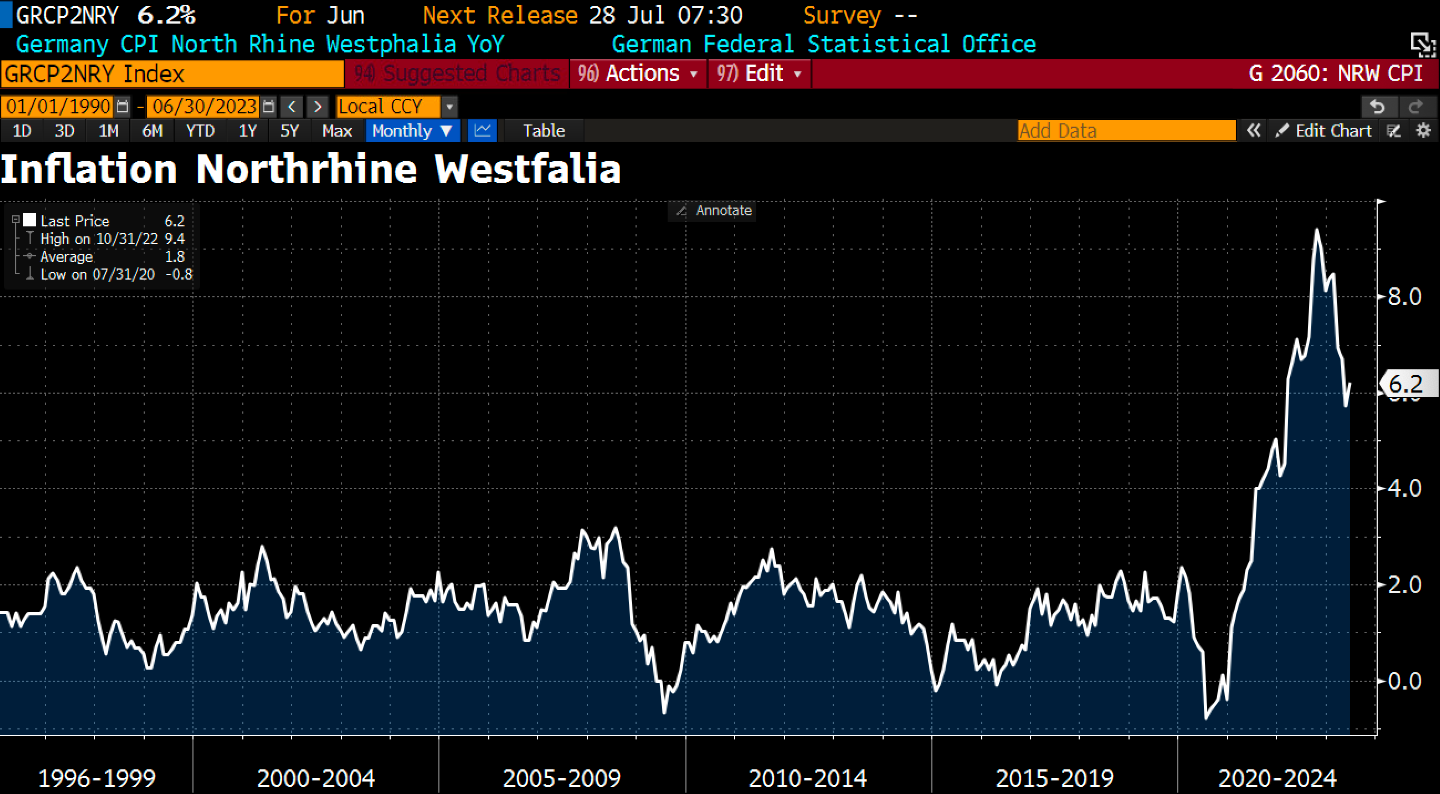
- Meanwhile, German inflation accelerated yet again. North Rhine Westphalia, Germany’s largest regional state, saw inflation rise by 6.2 percent in May YoY.
- A group of finance academics released a paper titled Phantom of the Opera: ETF Shorting and Shareholder Voting. The paper reviewed the role of short-selling ETFs in creating “phantom” ETF shares, arguing the practice sidelines underlying shares from proxy voting, distorting markets and corporate control.
The paper also gives a good overview of how ETF shorting works. It reveals that at least two-thirds of ETF shorts are operational for liquidity market-making purposes (and sometimes even naked, though potentially hedged in other more exotic ways). “Operational shorting is an important component of the overall short interest in ETFs and is an essential component of ETF liquidity provision,” the authors note, adding the process creates phantom shares in the system that distort voting rights.
Regulations currently allow de facto naked short-selling, and even failing to deliver the short-sold shares, “for bona fide market making purposes and market makers typically enjoy three more settlement days than typical investors”. The question is whether these exemptions are routinely exploited in riskier ways than appreciated.
The academics don’t answer that question but they do note the practice generates inefficiencies that are likely to be exacerbated for the firms with large proportions of phantom shares — particularly during times when markets are bearish and/or when the votes are critical.
“The sidelining of underlying shares from the proxy voting process due to ETF liquidity provision and market making activities creates inefficiencies in the exercise of control rights, and in turn the corporate governance and market for corporate control,” they noted.
These sorts of opaque and complex ETF practices, as well as their potential second-order effects, are much under-appreciated, and could even pose systemic risks.
Relatedly, I was invited to the IMPower Fund Management conference in Monte Carlo this week to debate this exact point with Pasquale Capasso, Head of ETF Capital Markets, Southern Europe & LatAm at Invesco Ltd.
Sadly, our debate clashed with a speaking appearance from superstar fund manager Cathie Wood, so was only attended by diehard ETF fans. But those who did make it to the session heard me drawing on a number of points made by Blonde Money’s Helen Thomas, among them the fact that the Fed’s direct intervention in the ETF market in 2020 already proves the products are systemically risky.
Pasquale disagreed, arguing that the issue in 2020 related to the bond market, not ETFs. The ETFs, he said, offered the Fed a useful mechanism to intervene in the bond markets with. He added that the incident proved the superior liquidity of ETFs because they were able to provide tradable prices (even if massively discounted ones) when bond markets couldn’t.
My counterpoint was that this was misleading. One of the issues with ETFs is that their “heightened liquidity” tends to overvalue securities relative to their fundamental value in good times, and undervalue them in crisis times. If we were to value all securities at their maximum redemption point, the whole system would be revealed to be bankrupt. It is not necessarily a good thing that ETFs were able to automatically deliver a firesale price on demand. What’s more, the view underappreciates the outsized effect balance sheet troubles at a particular market maker or Authorized Participant (stemming from potentially other factors) can have on the fundamentals of any specific ETF. Were the troubles with the bond market, or with the liability management of some major broker-dealers? — IK.
- Twitter account Shanghai Macro Strategist uploaded a summary of Richard Koo’s macro thoughts on China’s “Japanification” risk. Koo believes that China may face similar issues that triggered Japan’s 20th-century deflationary spiral, and why it could in many ways be worse off than Japan.
. - Former Credit Suisse wunderkind and liquidity guru Zoltan Pozsar said he was going it alone at a shop he’s named Ex Uno Plures (look at the dollar bill if you want to figure out what the name means).
. - Memestock trading darling, Robinhood, reported it is set to cut some full-time jobs, as it described a slow-down in retail trading on its platform.
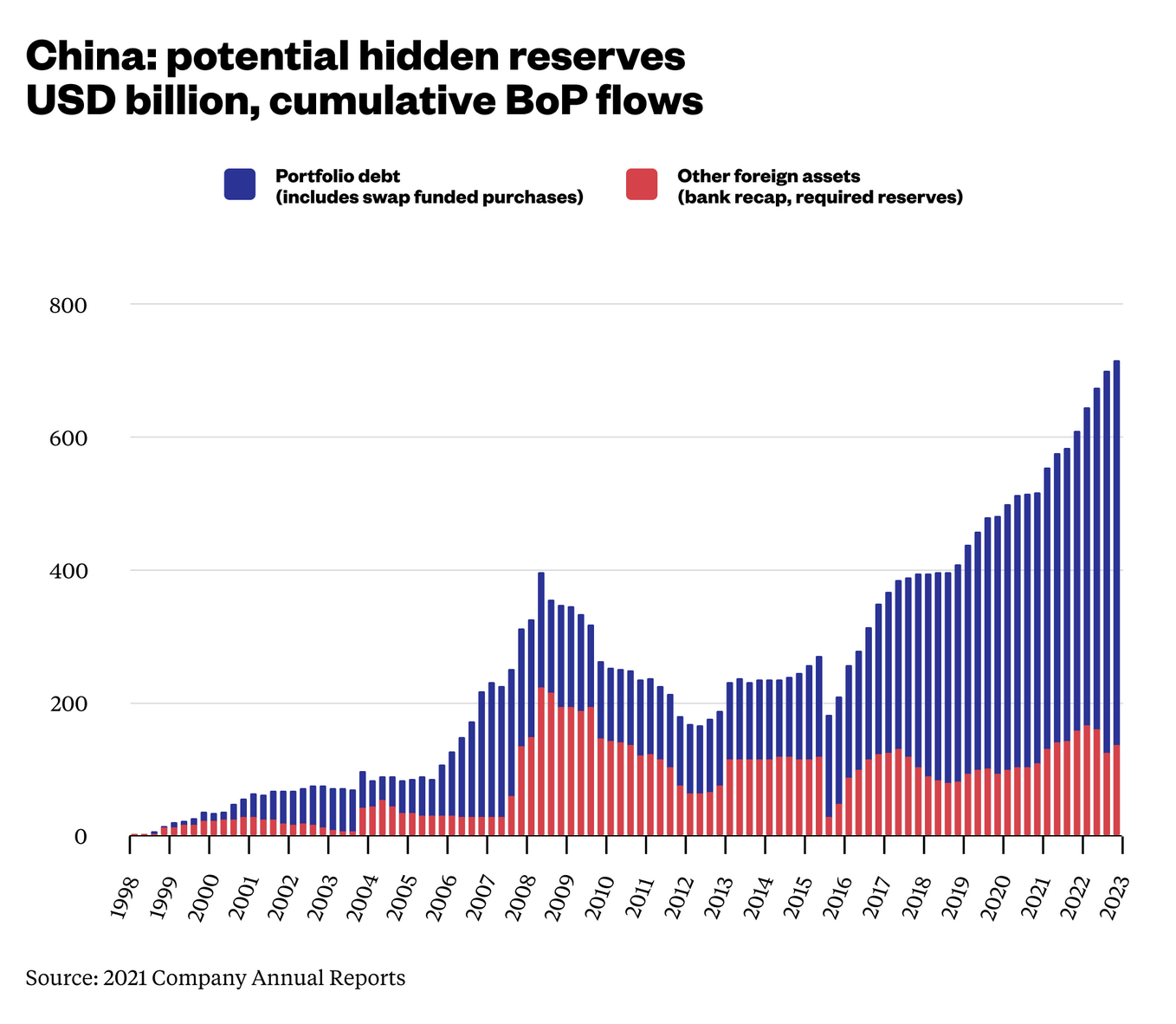
. - Brad Setser penned a piece arguing that China’s foreign exchange reserves are larger than appreciated because a huge chunk of them do not show up on the official books of the People’s Bank of China, and are instead hidden on the balance sheets of state banks, escaping scrutiny.
 .
. - The mining of battery-grade lithium carbonate, a key component of electric vehicles, started in Cornwall. The joint venture between British Lithium and Chinese clay company Imerys aims to become the UK’s “leading lithium hub” within five years.
. - Shahar Hameiri, a professor in the School of Political Science and International Studies at University of Queensland, argued in Unherd that PwC had captured Australia, by taking advantage of governments’ desire to shift accountability away from themselves. “Governments’ increasing usage of external consultants is the erosion of democratic accountability,” he noted. “Outsourcing to the private sector is one of several measures designed to provide governments with plausible deniability by distancing themselves from policymaking and implementation processes.”
. - China appeared to be buying dollars hand over fist this week in efforts to stabilise its offshore currency, heightening concerns that China is losing control over its currency.

- China’s central bank also asked foreign banks in the past week about their dollar reserves, as signs grow that Chinese authorities are stepping up efforts to slow down the yuan’s rapid depreciation.
. - Argentina’s central bank allowed its banks to open accounts denominated in yuan as it sought to address its own acute shortage of dollars.
.
- Bank of America was seen doing a Silicon Valley Bank as it faced up to $100bn in paper losses in bond markets according to the Financial Times, reportedly due to interest rate increases.
As we’ve noted frequently on The Blind Spot, unrealised losses on bond securities impact most of the banking sector. And even the BIS has belatedly realised that the related one-way risk could be systemic, and requires a radical rethink of how collateral markets are managed. — IK
- Where did the famous Sriracha hot sauce go? Prices for the raw materials that produce Sriracha have skyrocketed, leaving disappointed consumers with the prospect of buying a 17-ounce bottle for almost $40 dollars. Dim Sum just won’t be the same again.
One ledger to rule them all:
- Mairead McGuiness, European Commissioner for financial services, financial stability, and the Capital Markets Union, wrote a piece for the FT arguing in favour of the digital euro. She claimed that among the advantages of the digital euro were ease of payment, privacy, and accessibility.
.
- Fabio Panetta, Member of the Executive Board of the ECB and Valdis Dombrovskis, Executive VP of the European Commission, echoed the sentiment in a paper titled Why Europe needs a digital euro, arguing the digital euro’s positives are that it is essentially akin to digital cash.
. - Nigel Farage revealed he had been unbanked by the institution he had banked with since 1980, and that, so far, no other banks — other than a second tier fintech with limited services — were prepared to take his custom. He blamed the unbanking on being classified as a Politically Exposed Person and/or false media assertions he had been paid large sums of cash by the Russian government.
Regardless of what you think of him, there are many concerning issues with Farage’s unbanking.
The first relates to the PEP claim. If this is true, it’s somewhat extraordinary that the banks should be taking action now, when Farage is not in power, rather than years ago, when he had much more influence. The only possible justification relates to a fear that he may use his influence over Trump in some way in the upcoming elections. But that, we think, is hardly a justification and amounts to “Minority Report”-style pre-crime in action. Nonetheless, as one Baroness shared in a group chat this week, Farage is not alone in facing such challenges. She was surprised herself at how readily banks discriminated against her when she became a member of the House of Lords.
Should public service be coupled with this sort of financial exclusion? Should all our public servants live like Jedis and denounce all monetary goods? Maybe this is where it’s going?
On Farage himself, it cannot be excluded that his recent high-profile crypto shilling may also have played a role in his unbanking. Though, as one industry expert put it to me, “the next possibility is what the banks call ‘negative media’ screening, which basically means looking out for info about their clients that indicates heightened risk.” This, however, connects far too uneasily to the idea of being unbanked because of your political opinions. Not good.
But the second important takeaway is what the affair means for CBDCs. A key political selling point is that CBDCs will operate as a public good meaning everyone will always have access to digital means of payment. In theory, that means Farage can rest easy. By 2026, if he still can’t get a bank account, he will be able to use the digital euro instead. Except, of course, it’s not that easy. In a CBDC framework, financial inclusion may be widespread but it comes at a cost. Since banks can no longer make money from seigniorage or credit evaluation in the usual way, they will be forced to enter the personal data trading economy instead. Yes in theory you will “own your data” and have control over what bank you give it to or not. But, in reality, the regime will turn all financial institutions into de facto informants to the state (even more so than they already are).
If you’re someone like Farage, yes, you might be able to bank your CBDCs at a bank, and even get a mortgage, but only if you agree to conditionality, like, I don’t know, linking your CBDC wallet to an app that evaluates how many times you tweet wrongthink or which pre-screens your Tweets. That, dare I say, is the risk associated with “programmable money”. — IK
Media matters:
- Michael Schellenberger’s latest post on Public highlighted the secret efforts by the American government and some of its contractors to regulate media platforms through thought control. Schellenberger outlined that these institutions believed “it was their job to protect ‘cognitive infrastructure'”.
.
- The European Union said it would approve the use of spyware to unmask the confidential sources of journalists “in the name of national security”. This legislation would allow the EU to approve laws that effectively allow for legal spying on journalists.
. - DARPA, America’s premier military research agency, released a podcast series, which dives into how the agency’s Semantic Forensics programme is designed to analyse manipulated or synthesised media (aka deep fakes).
Commodities cornered:
- Gilad Myerson, Executive Chairman of Ithaca Energy, informed the BBC that the Labour Party’s proposed 35 percent windfall tax on the North Sea oil and gas industry risks starving Britain of energy supply.
. - A surge in UK electricity prices meant that gasoline and diesel cars were now cheaper to use than electrical vehicles charged at rapid public chargers.
Military developments:
- At the Paris Air Show, European weapons manufacturer MBDA unveiled its suite of partner products dedicated to anti-drone warfare.
When I showed up at the MBDA’s anti-drone section of their stand, I was expecting to be blown away by smart anti-drone equipment. What I saw was surprising.
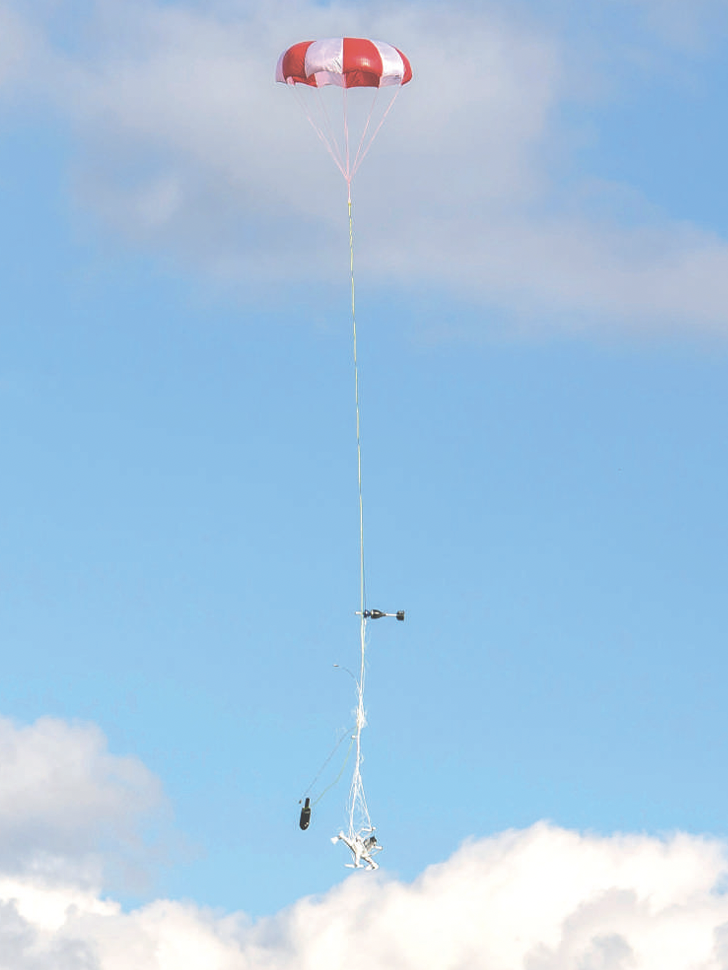
The panel exhibitors were quite excited to showcase the suite of products by their partners, like the pictured Skywall Patrol anti-drone gun designed for police and security forces below.

But reading between the lines of the technology on display, I noticed a starker reality: that a bloated Western military industrial complex may have geared Europe towards the wrong economics of warfare.Take the anti-drone gun above. Sure, it’s really for police use — even if it could also belong to Inspector Gadget. The Skywall shoots a large dart that opens up into a net at close proximity to a drone to capture it. One of the Skywall’s main features is that a groundbreaking dart deploys a parachute so the drone can be recovered undamaged for forensic examination. If you think the high parabolic curve of the dart is a problem, worry not — Skywall has a sophisticated optical sight that will automatically tell the soldier how to point his device.
Or see this carbon-fibre anti-drone racer drone, which is guided to target and rams its objective:

My mind boggled at the sci-fi-ness of these machines. I shuddered at their price — and couldn’t help but think of the practicalities of a shotgun instead. What simpler way for an infantryman to defend himself?
And so I kept looking around at the extent of high-tech, expensively designed apparatuses — the majority of which, unlike the Skywall, were designed for actual warfare. I couldn’t help but think of the Russia-Ukraine conflict, where I was reminded of the losses of tons of high-tech equipment has been easily shot from the sky. Or how the Leopard tanks or Bradley Fighting Vehicles naturally proved little less vulnerable than other widely mocked Russian-designed tanks that are being used by both sides in the conflict.
Of course, no simple shotgun could counter the range of aerial capabilities fielded in such a scenario. But the current conflict in question raises a problem.
Could the Western military industrial complex have grown disconnected from the logic of modern peer-to-peer warfare? Has an extended period of peacetime led us to depend on this overtechnologisation?
Russia-Ukraine suggests the Western desire for technological dominance may be economically unsustainable — especially in cash-strapped Europe.
The determinant factor in who can win the next war will not be about who can field the next high-tech gamechanger — but on who can field the most disposable and mass produceable unit of offence or defence. Weapons like the Iranian Shaheed drones — basically, a cheap aerial motorbike — and quadrocopter drones are proving the great winners of the conflict. For every cheap drone shot down, tens if not hundreds of thousands in munitions are expended defending against it. And they explode just as powerfully as multi-million alternatives — even if their cheapness means they are ultimately harder to get to target.
That is not to say that high-tech weapons of war will become secondary to modern war. Not at all. The issue is every potential problem on the battlefield has been met with a high-tech, extremely expensive and impractical solution in the West. This works just fine during an insurgency, where equipment losses are relatively low. Or when you have the economic and industrial might of the United States.
But I fear not much thought has gone into how the economics of a drawn out peer-to-peer conflict necessitate high-volume, low quality disposable assets. Western European militaries in particular will be in for a ruder than expected awakening should the worst occur. — DGG
Mis-education:
- The American Supreme Court outlawed affirmative action in college admissions in a 6-3 ruling.
In a victory for justice, the Supreme Court has finally eliminated race as a factor in university decisions.
The decision is sure to draw ire from swathes of the left-wing political body that fundamentally misunderstand what is needed to bring greater equality to society.
Think about it this way — if VCs were forced to value black-owned companies at 30 percent above their white-owned competitors, would this harm or benefit black-owned companies? Sure, eye-popping valuations would reap generous cash dividends for the founders. But looking forward, these overvalued companies would struggle to continue gaining funding at their overpriced valuations, and will remain uncompetitive in comparison to their more fairly valued competitors.
The same applies to education. Positive discrimination has, ironically, resulted in higher African American drop out rates and lower average grades, as university admissions overvalue their CVs. This has nothing to do with race — if white applicants were overvalued, their averages would similarly struggle if a larger number of relatively normal performers got sucked into relatively higher-performing universities. Is it better to graduate with a 4.0 from Georgetown, or a 1.0 from Harvard? The answer is obvious.
Robert Kennedy Jr has, however, made a good and classical argument in favour of affirmative action. He stated: ‘”Color-blind” admissions tend to favour those who are already in the circle of privilege. It favours those who grew up in affluent, educated households. Wouldn’t you like to invite in those who have been left out in the cold?”
To criticise the slow demise of meritocracy as exemplified by the decades-long policy of affirmative action, like I am doing here, is not to suggest that longstanding racially discriminatory policies against African Americans in the US haven’t harmed their social and economic standing.
But, likewise, white communities are among the most impoverished in America — they make up around 42 percent of America’s poor, versus black people’s 28 percent. Should we positively discriminate in favour of poor whites? Of course not.
But there are far more critical and granular issues to admittance at universities than income or race. When speaking of university admittance, applicants should not be defined by their race or income — but by their minds.
Something must certainly be done to encourage a fairer and more equal society at the university admittance level. But race-based discrimination isn’t the answer — DGG.
UAP news:
- Izzy and Dario appeared on the Traders Unplugged podcast for a Galactic Macro edition with hedge fund manager David Dorr to discuss, among other things, how financial markets can price UAP risk.
. - The Fukushima-based International UFO Lab organisation announced they had collected at least six images of round and triangular flying objects.
One of the most unfortunate tendencies of anyone discussing the ‘Phenomenon’ is the outsized importance given to photographic evidence.
The evidence is well-liked. A photograph or a video is something you can physically show someone — “a picture speaks more than a thousand words” and all.
But it displays a critical misunderstanding of the UFO problem. And so long as our media and society continues to obsess over our need to get “THE” UFO picture, we will continue to.
We understood that black holes existed for decades before its first picture. Sure, you could argue, a black hole can be proven, mathematically at least — hence we had grounds to treat it as a reality.
But the same goes for UFOs. UFOs are merely things we don’t understand in the skies. And incredible whistleblower revelations like Dave Grusch’s are forcing us to consider a sinister possibility: that behind the “real” UFOs stand one or many non-human intelligences, and that they may have been among us for quite some time. Or that there are people in the government who want us to think this.
Now think about the language we have used for such difficult-to-understand things in the skies over generations. Much like the not inconsequential number of UFO “experiencers” which have always suggested that what is behind the UFO phenomenon is walking among us. Similar medieval tales abounded — both whimsically folkloric such as trolls, faeries, elves, to canonised Marian apparitions heavenly hue. Recall how royal lineages effectively claimed consanguinuity with heavenly beings?
When we obsess over finding THE picture that can prove UFOs exist, we are automatically excluding the best evidence we hold — that many pillars of our society could be resting on a long-standing, but differently worded, appreciation of the mysterious and all-powerful UFO phenomenon.
Until we realise we may be sleeping on a mountaintop of evidence, no picture will ever be good enough to prove a potentially obvious reality. In the meantime, we are losing valuable time to analyse a dangerous Phenomenon that may have been ever-present. — DGG
Covid collateral damage:
- The Biden Administration released a declassified portion of its report on COVID-19’s origins, which states: “All [Intelligence Community] agencies continue to assess that both a natural and laboratory-associated origin remain plausible hypotheses to explain the first human infection.” It goes on to say that five IC members believe the first human infection occurred via “natural exposure”, while two agencies (including the FBI) support “a laboratory-associated incident” as “the most likely cause”. Two others (including the CIA) “are unable to determine the precise origin of SARS-CoV-2”.
. - The Inspector General of the Small Business Administration found the United States government may have lost over $200bn to potential fraud through two COVID-19 relief programs; the Paycheck Protection Program and the COVID-19 Economic Injury Disaster Program. The watchdog identified approximately 17 percent of those funds may have gone to potentially fraudulent actors.
