
This week’s Blind Spot newsletter was compiled by me, Izabella Kaminska, with the help of my own human version of ChatGPT, Dario Garcia Giner.
I had the pleasure this week of taking part in a Cyber Salon event organised by entrepreneur Eva Pascoe at the House of Commons under the auspices of former shadow chancellor John McDonnell. It was about the virtues, or not, of central bank digital currencies (CBDCs). The high proportion of Marxists in the room did unnerve me a little bit — especially when they reflected on my Polish background by saying “yeah, I used to know people who worked for Solidarnosc, they were basically Polish Catholic fascists weren’t they?”. Nice! But, hey, at least there were some things we all agreed on, the first being that every effort should be taken to protect society’s access to tangible cash. The second being that a renewed postal bank or Giro bank would probably be far more useful for society than a CBDC.
In other news, I’m excited to report that I have imported a new font onto the website because “roboto” — the font we were using — was getting me down. So hello Georgia everyone.
If you enjoyed this week’s newsletter and feel like sharing snippets around, that’s fine by me if it’s fine by you. I am always thankful for the word-of-mouth promotion.
Business, econ and finance etc:
- Argentina raised interest rates to 97 per cent in a dramatic bid to halt the devaluation of its currency and to preserve its forex reserves amid a slew of other measures designed to encourage imports into the country.
. - China’s renminbi appeared “significantly weaker than implied by historical correlations with other currencies”, according to Goldman Sachs research. Reuters, meanwhile, reported that it dropped to multi-month lows on Friday despite its heavily managed status:

- The Federal Reserve Bank of New York published a thought piece on banks’ balance sheet costs and the Fed’s Overnight Reverse Repo Facility (ON RRP). It noted these costs had encouraged money market fund flows into the Fed’s ON RRP facility.
Do not underestimate the importance of the Fed’s overnight reverse repo facility as the United States heads into “will-it, won’t-it raise the debt ceiling in time?” panic this week. As Morgan Stanley’s analysts explained in a note last weekend, the facility, which now stands at about $2.25 trillion, did not exist last time we came this close to a default.
“As short-term interest rates have risen, depositors have taken cash and shifted it to money funds, and money funds have been putting the proceeds at the Fed. This transaction by itself reduces reserves in the banking system. As we get closer to the X-date, T-bills have been falling in yield, giving money funds an incentive to shift their holdings away from T-bills and into the RRP, further draining reserves. Because the starting point for bill yields is much higher now than in 2011 or 2013 (literally 100 times higher when measured in basis points), the scope for yield differentials is much higher now, increasing the incentive for money funds to shift. At a time of volatility in the banking system, this further drain of reserves could amplify the risks.”
This means it could be a very choppy ride for money markets ahead of X date, at least relative to last time.
“Our strategists have highlighted that the magnitude of the yield movements for bills could be much larger this time, given the higher starting level. And while it may be fashionable to speculate about what happens to markets if the Treasury misses a payment on its obligations, it is worth recalling that, even in the more benign scenario where we have a repeat of previous episodes, funding market volatility magnifies the risk.” — IK
- Japanese core consumer inflation stayed well above the BoJ’s 2 per cent target as it hit a four-decade high.
JP Morgan equity analysts argued the country was heading towards a new inflationary era, where corporates with pricing power would make for increasingly promising investments. “Japan’s inflation has maintained strong momentum, and results continue to exceed the expectations. Wages are also rising at a faster pace than expected. We believe companies with pricing power are promising,” they noted. — IK
- JP Morgan highlighted that household consumption has collapsed in Sweden:

- Green MEPs tabled a question for the European Central Bank attacking the ECB’s deposit facility, arguing the increased interest the central bank was paying to commercial banks because of higher rates amounted to a windfall profit. Given that, they wanted to know whether “the ECB plans to limit the amount each bank can hold in the deposit facility or to limit the remuneration of such deposits. If not, why not?” And “Does the ECB have any information to suggest that limiting the remuneration of the deposit facility could endanger financial stability?”
A prominent former British central banker I spoke with a few months ago was arguing for something similar for UK banks. And things like this can certainly happen.
As we pointed out a few newsletters ago, central banks don’t all target the same rate with their monetary policy; they vary from jurisdiction to jurisdiction, as well as over time. The BoE’s main reference rate is currently the Bank rate (now at 4.5 per cent). This too is a deposit rate. But this was not always so. In 1972, another high inflation era, the Bank adopted a “Minimum Lending Rate” along with a reserve ratio requirement to better influence the monetary system. This stayed in place until 1980, when it was replaced by an even more complicated system before reverting to the Bank rate in 2006. — IK
- We clocked that a group of academics, including one Ida Claudia Panetta of the Digital Euro Association published a study last February on the development and future of digital payment systems, past, present and future.
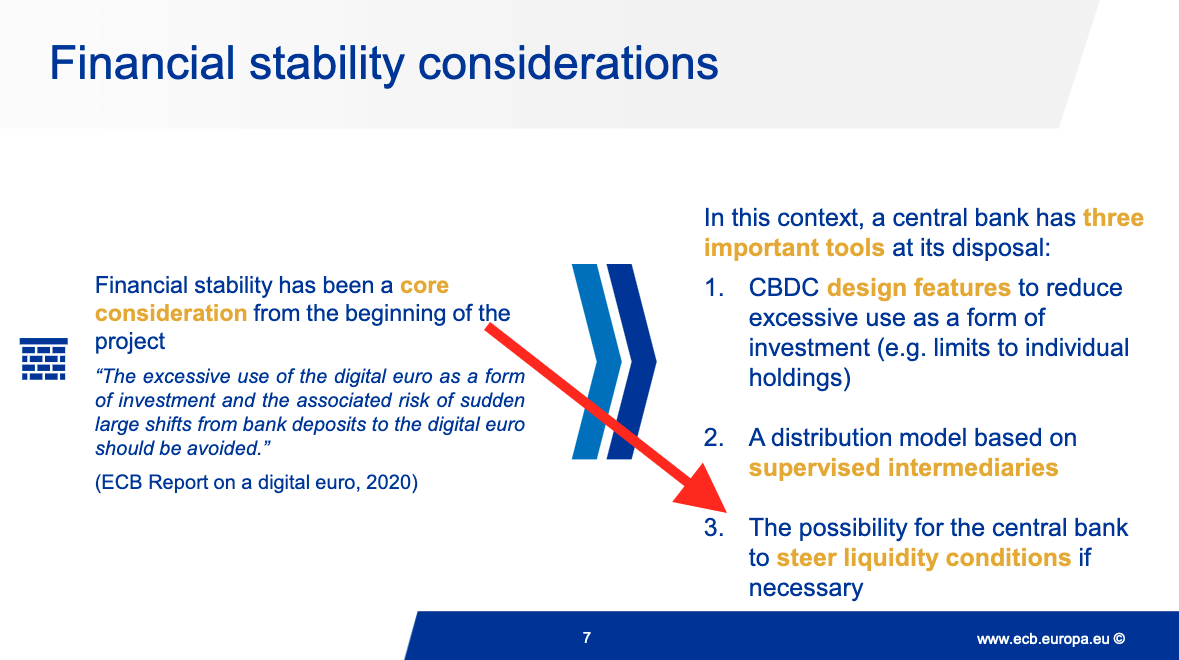
We have been assured that Ms. Panetta is no relation of ECB executive board member and digital euro champion Fabio Panetta, who this week took part in a Kangaroo Group virtual debate during which he shared the following slide (the red arrow is our highlight) —IK
 .
. - DRW’s chief executive, Don Wilson, argued intraday repo using blockchain could mitigate the ugly tail risks of around-the-clock trading, adding that disaster may loom if the market’s plumbing was not upgraded.
To quote myself from a Bloomberg article I penned in August 2022: “The world of “intraday” funding — i.e., cash borrowed during the day as opposed to overnight — remains highly dependent on excess liquidity from central banks, even as Federal Reserve officials move to accelerate the rate at which this is to be withdrawn over September and October. Once this de facto free liquidity is retracted, funding shortages could easily appear again, potentially toppling over into overnight and longer-term markets. If they do, market participants will have to come up with their own solution — or go cap in hand to the Fed and risk stigmatization.”
In reality, whether it’s intraday repo or intraday swaps, perpetual future funding contracts or anything else — doesn’t matter.
The point is the formal financial system needs a mechanism for trading intraday funds that compliments the real-time nature of trade and commerce and reflects the 24-hour nature of digital markets. I’ve compared what we need to an Uber surge pricing mechanism for liquidity and argued that the crytpo world has ironically already developed many of the systems that could help to make it happen. Ironically, when I put this proposal to interest-rate trading specialists over a year ago, arguing that if they worked on creating a contract and a platform they could profit handsomely because the world was going to go that way one way or another, they expressed zero interest. But now that Don Wilson, CEO of one of the most successful market-makers in the world is saying it too, we think maybe they’ll start to think differently.
But do feel free to give a poor journo some credit for the idea. — IK..
- The Climateer blog directed readers to a Nature study that found the world’s agricultural area could feed ~8–20 billion people under unconstrained industrial fertilization but only 3–14 billion under organic fertilization. This neatly explains how and why a government-directed organic-farming shift in Sri Lanka left farmers penniless and unable to afford inputs for the next crop, leading to a major financial crisis in 2022.
. - Czech liberal MEP Ondřej Kovařík told POLITICO’s Morning Financial Services newsletter that “of the loans issued in the Czech Republic in the first quarter, the amount issued in euros were higher than the Czech koruna, for the first time in history, to escape interest rates of 7 percent.”]
. - The Bilderberg group announced it was meeting in Lisbon this week. The participants are all very predictable.
. - Goldman Sachs put the bank crisis down to three key components:
 They also observed that one of the fundamental problems behind the trouble was that loan growth could not keep up with liquidity since 2020, forcing banks to deploy funds into securities that are now yielding on average 350 basis points less than they were when they bought them:
- Ursula von der Leyen urged European leaders to tackle the unsustainability of the fossil fuel industry with the European Green Deal.
VDL’s speech occurred in the environs of the “Beyond Growth” conference that was held in Brussels this week — a gathering which had a distinct “Limits to Growth” 2.0 feel to it. Sessions were even themed “Limits to Growth: where do we stand and where do go from here” and “Changing the goal: from GDP growth to social prosperity”. Speakers, meanwhile, included famed scientist, defense system developer and traitor to all of humanity Dr. Gaius Baltar of Battlestar Galactica:

Okay, that’s just a doppelgänger. But come on. It’s uncanny!
That VDL felt inclined to reference the Club of Rome and a European shift to a German-style social market economy in that context, is hardly surprising. My colleagues at POLITICO, however, had a cynical view on the whole thing, arguing she had no real intention of walking away from growth or GDP as a measure of success. As VDL noted, “The European Green Deal is not only our plan to fight climate change and become the first climate-neutral continent. It is also our new European growth model for a prosperous, responsible and resilient economy. It is our blueprint for a systematic modernisation of Europe’s industry. Because in the long run, only a sustainable economy can be a strong economy.”
These are not the words of someone intending to give up GDP as a measure of everything that is good in the world. Instead, what VDL seems to be saying is that green growth is still growth. It’s just socially-minded growth. And yes, we can have it all.
I have some sympathy for the idea that there are some things that simply can’t be measured by GDP and that the market economy as defined by pure monetary metrics shouldn’t aspire to be the be-all and end-all of any social system. There’s definitely more to life than pure materialism. This is evidenced by Ukraine’s fight to maintain independence at any cost. On a purely economic level, it’s clear their decision not to give in to Russia equates to a far greater self-harm for their country in the short term than Brexit ever did for Britain. What Ukraine’s struggle shows so well is that there is so much more to prosperity than just economic wellbeing. Identity, community and culture all matter far more than most economists acknowledge. A similar message, by the way, came out this week from the much derided National Conservatism conference. [Though whoever thought of the branding deserves to be err… taken through a history book.]
The problem is, I’m just not convinced VDL or anyone else in the European Union actually believes in socially-minded growth. If they did, they wouldn’t be so excited about throwing mass taxpayer subsidies at China, where, of course, the vast majority of the renewables we are hoping to switch into are made and where there is little to no transparency about how green (or not green) their production processes are. But hey, at least VDL had the chance to cite Robert Kennedy senior’s famous quote that GDP ‘measures everything, except that which makes life worthwhile: the health of our children, or the joy of their play’. — IK
- We spotted a paper by Lihong McPhail, Philipp Schnabl and Bruce Tuckman asking “Do banks hedge using interest rate swaps?”. Spoiler alert: the answer is no. The co-authors actually conclude that “swap positions are not economically significant in hedging the interest rate risk of bank assets.”
These are significant findings derived from meticulous assessments of proprietary CFTC data. They’re also highly relevant given the type of banking crisis we’ve just emerged from. After Silicon Valley Bank collapsed due to unrealised losses on long duration safe assets, many began wondering how much more risk like it is out there in the market? Aren’t banks supposed to specialise in hedging their maturity mismatches? Surely, SVB was only an anomaly because interest-rate hedging is the norm for financial institutions worldwide?
Well, not so, say the authors of this paper. The data instead suggests that once swap positions at 250 of the largest banks in the United States are netted out, the average US bank has essentially no exposure to interest rate risk. This means most long duration assets on banks’ books have no offsetting interest-rate swap hedge. The paper finds instead that banks treat customer deposits — and their deposit franchise as a whole — as a type of offsetting duration hedge instead. Citing work by Drechsler et al (2021) the authors note that “while the deposit franchise is difficult to analyse”… “from January 2022 to March 2023, as interest rates increased, the value of the banking sector’s deposit franchise increased by around $1.7 trillion, which is the same order of magnitude as the losses on bank assets over that period.”
The final insight being that “the deposit franchise functions like swap positions in hedging the interest rate risk of banks”.
This fits perfectly with what I’ve heard from interest rate traders about how they handle hold-to-maturity exposures at their institutions. Most had little to no understanding of how these positions — which they suspected were probably looked after by their treasury departments — were managed. The hedges certainly didn’t go through their desks.
I reached out to Bruce Tuckman to make sure my understanding of his conclusions was correct. He assured me that it was. — IK
- Benjamin Norton highlighted the surprising fall in real GDP rates of many former Soviet countries like Ukraine and Georgia since the collapse of the Soviet Union. Norton pointed out the irony that, outside of Poland’s exceptional EU-funded growth, the only country that performed better since 1991 was Belarus, which did not impose neoliberal economic reforms.

- This chart from JP Morgan seemed to indicate that ‘greedflation’ might be coming to an end in Europe, as companies continued to pullback from plans to raise prices in the next 3 months:

- Aaron Hector outlined the fascinating story of an individual’s purchase of a car at a dealership in Calgary. A prospective cash-buyer was urged by the dealership to pay for his car as a loan, which he could pay off up to 87.5 per cent immediately, just so that the dealership could package his loan along with those of other credit-poor individuals so that those who would otherwise not qualify for a similar loan could get cars. The garage was prepared to refund him any other related costs.
. - As fears of a US debt default rose, the price of Credit Default Swaps jumped despite low VIX levels.

- The Taiwanese central bank opposed a proposal to amend central bank laws that would create a Taiwanese sovereign wealth fund partially funded by 10 per cent of its foreign reserves.
The Taipei Times argued that the lawmakers proposing to task the central bank with creating a sovereign wealth fund had clearly conflated the monetary regulatory’s job with that of a fund manager. The same week, the world’s most prominent crypto stablecoin, Tether, announced it would be reinvesting at least 15 percent of the $1.4bn worth of profits generated by investment returns from its holdings into bitcoin. — IK
- The Securities and Exchange Commission weighed giving clearing firms new powers to make intraday margin calls in response to the wild meme stock trades of early 2021.
This is yet another example of intraday funding exposures becoming a thing that markets will increasingly be tasked with pricing and trading. Under the new framework, clearinghouses will be asked to set up systems to monitor intraday margin exposure. They will also be asked to designate “other ways” to calculate margin if their primary means to do so become unavailable. Will they turn to some sort of market mechanism rather than a calculation is the question? — IK
- On April 28, Swiss National Bank Chief claimed the collapse of Credit Suisse displayed a need for new regulations that would force banks to hold sufficient disposable assets at any time…
…but, the accompanying Bloomberg story also offered this detail: “The central bank agreed to provide a maximum of 200 billion francs ($224 billion) — the equivalent of about a quarter of Swiss annual economic output — in liquidity assistance without collateral. Half of that was guaranteed by the government, while the SNB received privileged creditor status for the rest.”
Now, we knew that UBS had been assured a liquidity line of CHF100bn to keep the combined unit ticking over once everything fell apart. What we had entirely missed was that the decaying carcass of Credit Suisse has been given a further CHF100bn of unsecured funding guaranteed by the government under the deal too! As the SNB’s press release noted at the time: “The structure of the loan is based on the Public Liquidity Backstop (PLB), the key parameters of which were already decided by the Federal Council in 2022.”
What that means is that all the theatre about Credit Suisse having been within its regulatory capital and liquidity requirements was a deflection from a far more serious issue: the regulatory measures themselves were entirely insufficient to deal with the stress. The key problem Credit Suisse faced was that despite all the HQLA it had on its books, when it came to the crunch it did not have enough collateral to pledge for liquidity.
As my colleague Hannah Brenton at POLITICO has been reporting, all of the above is leading to a belated recognition in bank resolution circles that “the cash needs of a collapsing global lender could exhaust the financial backstops available within the bloc.” Dominique Laboureix, chair of the Single Resolution Board, has even described a liquidity crunch in resolution as “the elephant in the room” — the fear being that depositors could pull money from a struggling bank while it was in resolution, making it impossible for it to raise other money or post collateral. — IK.