

This week’s Blind Spot wrap was compiled by me, Izabella Kaminska, and Dario Garcia Giner. It comes to you (at least in part) by way of the business class lounge at Prague airport, where I find myself late Friday evening on the way back from a CBDC-themed conference attended by some fascinating Czech and Slovak central banking types. The food here scores about 6/10.
I say fascinating, by the way, because it’s not often that my warnings about the gosbanky tendencies of CBDCs are met with the response: “Well, yes, it’s not the sort of thing anyone who experienced totalitarianism is going to be all that keen on” and swiftly followed with the remark, “I would know about it because I grew up in North Korea, as my dad was posted there during communism.” So there you go.
De-dollarisation:
- Brad Setser, senior Fellow at the Council on Foreign Relations, questioned whether the impetus behind de-dollarisation was linked to dwindling USD-denominated reserves in countries looking to start using the Chinese yuan to settle trades.
. - The South African Foreign Minister confirmed that BRICS nations were exploring the creation of a currency that could counter the US dollar.
.
- Responding to a 13-year-old’s question at Berkshire Hathaway’s annual shareholder meeting, Warren Buffet stated that the United States cannot just print money indefinitely. Though Buffet doubted that any other currency would be able to replace the dollar as a global reserve currency, he stated that growing global doubts about the safety of the dollar’s status may be impossible to stop.
Business, econ and finance, etc:
- RWE drew up plans to exit a controversial floating German LNG project as gas prices fell to multi-year lows on record US output.
Henry Hub natural gas prices (as illustrated in the chart below from Ycharts) have been getting totally slammed this month. Many naturally see this as vindication for Western sanctions against Russian gas imports. “Not only did we get through the winter, we now have way more gas than we need!”
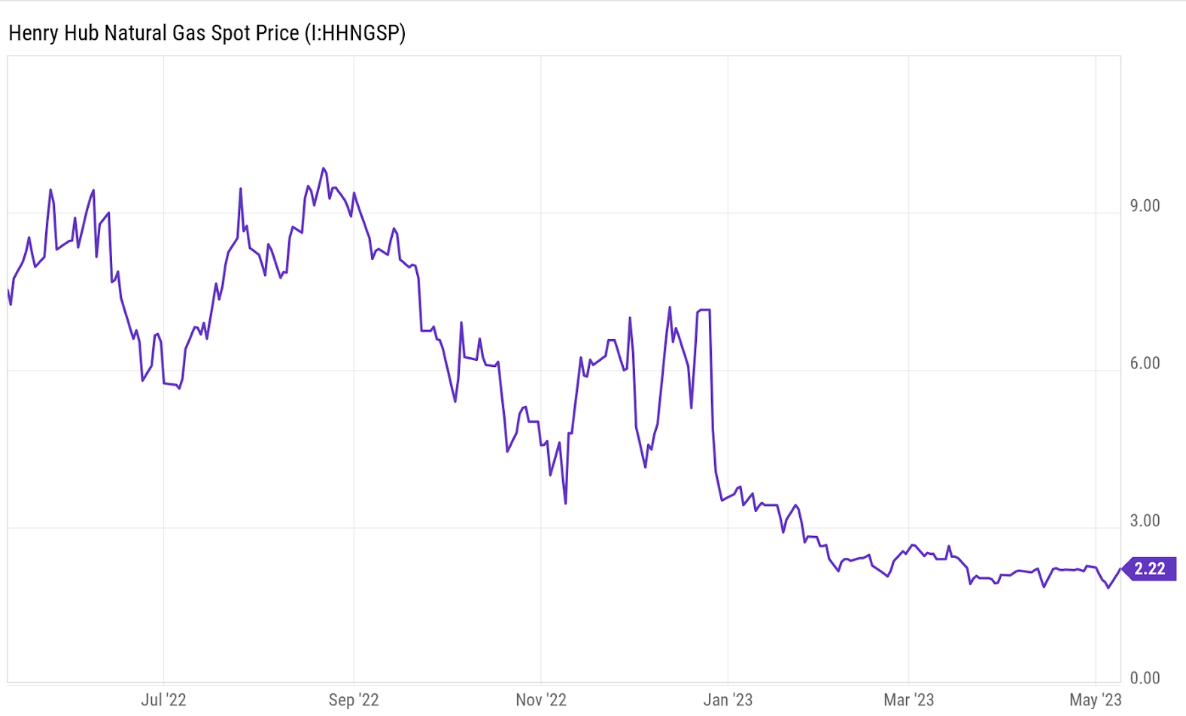
Except, there’s a strong case to be made that this isn’t down to oversupply, but insufficient storage to carry over volumes from the low-demand summer period to the high-demand winter period. With nowhere to put gas in the summer, short-term prices have to keep going lower for the system to balance (possibly, even, to negative rates). And this, understandably, is having a big impact on the futures curve, with January 2024 futures on the CME trading at $3.7 per therm, relative to $2.1 per therm for June delivery.
Germany nonetheless is making a Eurovision-scale song and dance about how the doomsayers were all wrong and the country happily managed to get through the winter unscathed. Except, again, this is very misleading.
There are four main reasons why the country got through the winter without blackouts.
1) German consumption fell by 4.7 percent year-on-year to the lowest level since its reunification.
2) The country took to burning coal instead, with Reuters noting that coal-to-power generation output rose by 13.3 percent year-on-year to 42.9 terawatt hours (TWh) in the three months of July-September, during a period when overall German power output fell.
3) Because a number of heavy industrial users quit, notably BASF, and are very unlikely to come back.
4) The 2022/23 winter was unexpectedly mild.
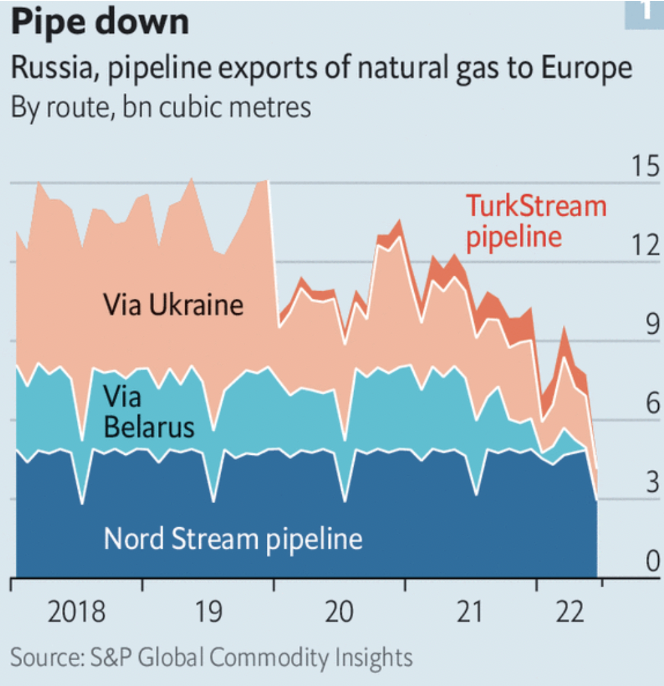
But it’s also important to stress that gas sanctions didn’t really take effect until midway through last year. That means for at least half the year Europe continued to benefit from piped supply. Here’s a chart from the Economist depicting the lag between sanctions rhetoric and sanctions effect:
The missing volumes, as we all know, were made up with imported liquefied natural gas:
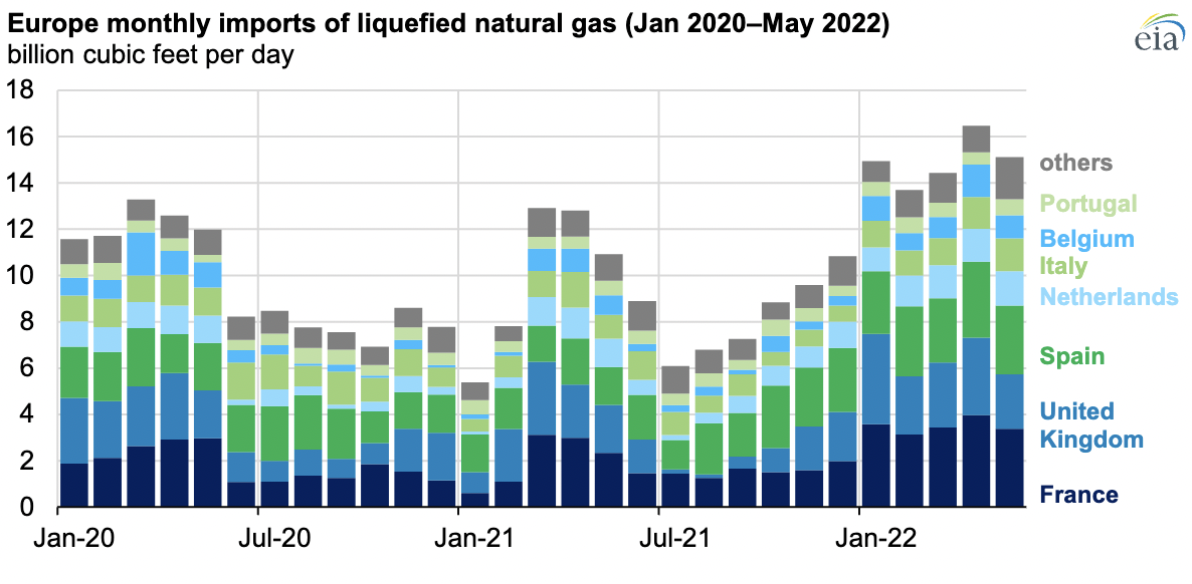
Except, if you look carefully, you’ll notice that Germany is missing from the importers list. Why? Because they were so confident in their piped supply from Russia they never bothered building any LNG terminals.
This oversight led to a frantic rush last year to build floating storage and regasification units (FSRUs), which they did, to be fair, manage to bring online at record speed. Nonetheless, none of these facilities are long-term solutions. Germany either needs a proper permanent facility or investment in more floating units. Alas, even the latter is encountering political resistance from environmental groups who don’t want the government to invest in “stranded assets”. This has seen RWE, the German gas giant that was contracted to deliver the terminals, threatening to walk away from any further projects. — IK
- The United States Commodity Funds (USCF) group launched an absolute return ETF linked to energy commodities.
Strange things are afoot in commodity ETFs (again).
Long-time readers will be familiar with my historic coverage of gas and oil ETF-related anomalies whenever commodity prices crater.
For those who are not, the quick explanation is that there is a very bizarre, but dependable, pattern that manifests among derivative-backed commodity ETFs — specifically the United States Commodity Funds group of funds — when prices weaken severely. The funds themselves begin to grow at a disproportionate rate in terms of shares outstanding and assets under management. Anyway, the breaking news is that it’s happening again. This time in the gas funds.
Here, for example, is the recent price performance of the main natural gas fund, known as UNG
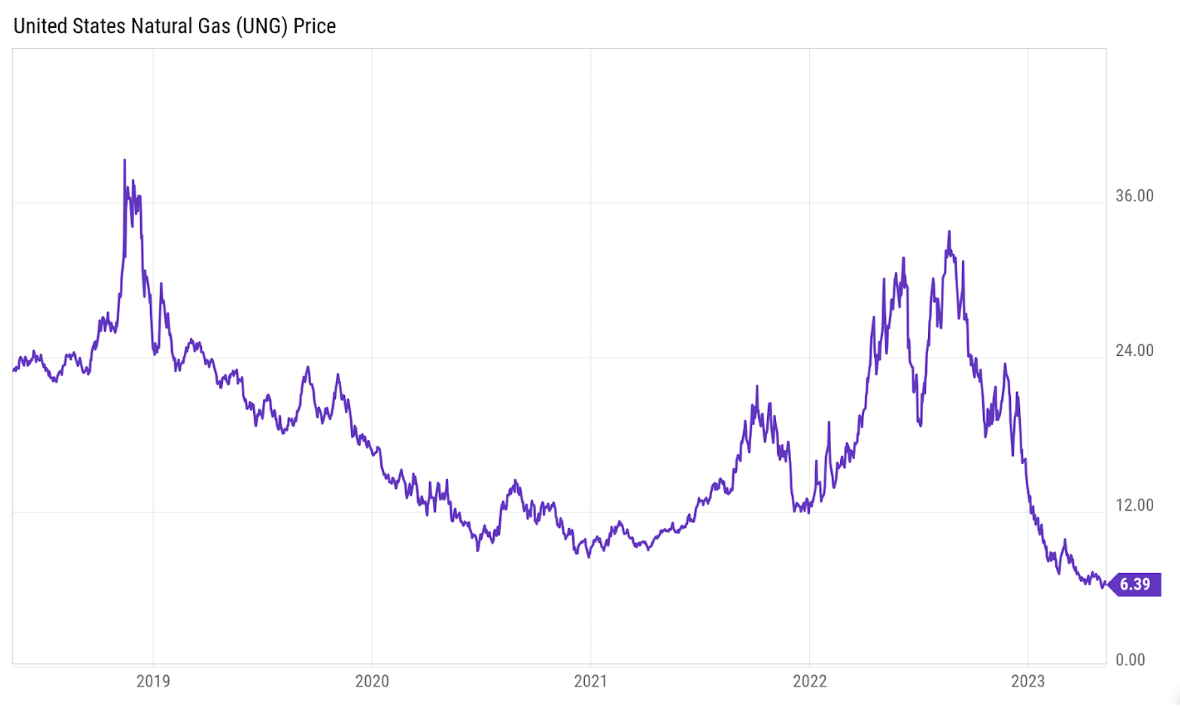 Compare and contrast with its assets under management: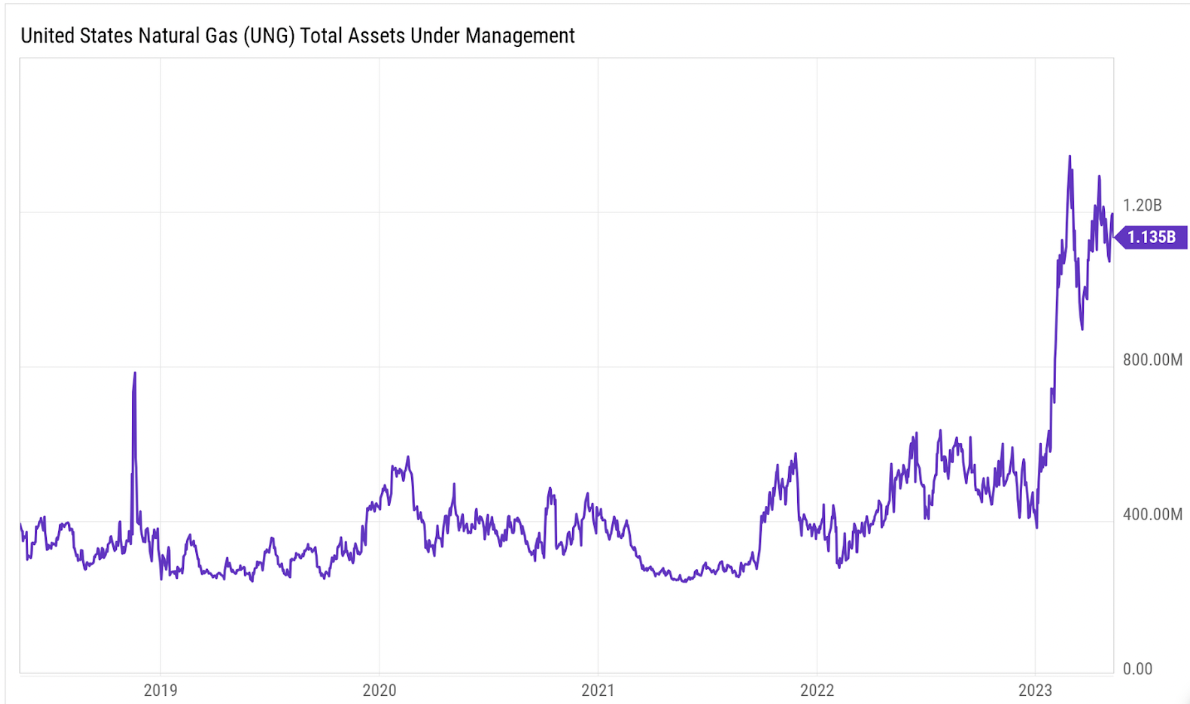
A similar pattern is also observable in the Proshares leveraged natgas fund BOIL.
The usual explainer from the “ETFs can do no wrong” crowd, is that this reflects the “smartness” of retail investors who see price drops as great buying opportunities. The money flows in accordingly.
But as I have long catalogued, this is unlikely to be true — not least because the most active users of ETFs are often hedge funds and market makers (not retail users) who use them for shorting or hedging purposes more so than for simple long exposure.
I’ve concluded that whenever commodity curves steepen and short-term contracts become significantly discounted relative to forward ones, arbitrages open up, which incentivise smart money to position itself in a way that can benefit from the predictability of outsized forward rolls. The bigger the roll, the greater the return from being pre-positioned in the forward contract that the fund has to roll into. But there’s more to it…
The catalyst for the fund growth appears to be the closing out of shorts enabled by the create-to-lend ETF creation process. This is a very mysterious and closely guarded mechanism, which some academics have come to describe as “operational shorting”. Others suggest it is more akin to naked shorting. And everyone disagrees on how risky it is and whether it breaks the spirit of the Volcker rule. In practice, the process allows specially contracted market-makers, known in the industry as “authorised participants”, to lend ETF shares they haven’t yet created to hedge funds and which they may never have to create if the hedge funds sell them straight back to the same market-makers. The shares exists only as an entry on a market maker’s ledger.
Some allege the process contributes to market-recognised long positions in some ETFs (as counted by 13F filings) far outnumbering shares outstanding of those ETFs.
Either way, hedge funds taking profits on these shorts by buying back shares to close out positions is, in my opinion, what tends to force these “phantom shares” into visibility. This is because the buying influences the price in such a way that it finally pays for market-makers to create the shares to prevent the occurence of a major deviation between the price and NAV.
The end effect is that the assets under management of the fund balloon and, with that, the financial instruments the fund is contracted to hold. In the case of derivative-backed commodity funds, this translates into a significant and very visible increase in long futures positions, which can be gamed immediately by other derivative players. (It’s worth noting commodity funds often use the very same market-makers to buy and sell their derivatives positions that they use for creations and redemptions — which some might say gives them an information advantage).
The important point is that, as the AUM grows and the market footprint of the fund becomes ever more obvious, other participants are encouraged to jump on the informal “front-running” bandwagon, by buying month-ahead futures so they can benefit from the mechanistic rolls the fund is obliged to engage in to keep its positions open. This only amplifies the distortions.
The pattern is very reliable and consistent.
If we look at the UNG fund specifically, it is positioned almost fully in the front-month contract, with the position representing some 20 percent of open interest already. If the fund were to become even more dominant in the contract, chances are the CFTC would be forced to intervene to limit the position. At that point, the fund’s ability to fulfill its price-tracking mandate would be seriously challenged. Its only options would be 1) spreading the entirety of its positions across multiple contracts on the curve or 2) entering into OTC bilateral swaps with counterparts. In the worst case scenario the fund might be forced to suspend new creations at the cost of serious price-to-NAV stability. Whatever option it chose, it would have to forecast it in a regulatory filing to the entire market ahead of time, meaning the market could easily preempt it.
If you think all of this sounds mad and/or unlikely, be assured it’s all happened before, most recently with the USO fund when oil prices went negative in 2020.
Indeed, the last time I wrote about such matters was in 2020 when I was still at the FT: How hedge fund shorting triggered the USO’s epic AUM growth.
Other related content throughout the years can be found here, here and here. — IK..
- Bloomberg reported that commodity traders were following in the footsteps of their Swiss counterparts and fleeing to Dubai, as the emirate continues to position itself as a refuge for traders constrained by sanctions and regulatory limits in the West. London commodity traders, most recently those at Freepoint, in particular are being attracted by the lack of Russian sanctions and its low tax status.
Swiss traders and investment bankers in exile, will soon become all sorts of traders in exile, with Dubai increasingly operating like the Mos Eisley cantina in Star Wars. The question is: Is Dubai really appealing enough to risk being permanently barred from re-entry into Europe or America? — IK
- Zimbabwe backed a new digital currency with 140 kilograms of gold, in a drastic bid by the government to support its still-worthless currency, as the IMF warned the policy could lead Zimbabwe to deplete its gold reserves.
. - We stumbled across the following graph of the top American banks ranked by their number of uninsured deposits:

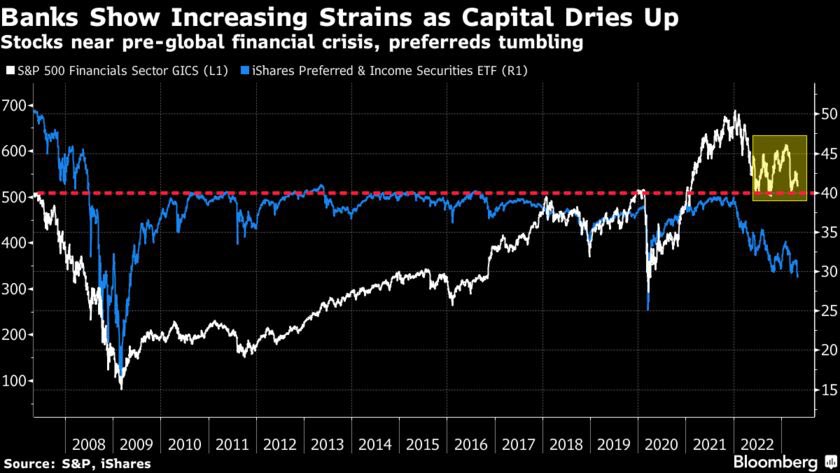
- Bloomberg pointed out, banks’ preferred shares have been underperforming ordinary shares, and are themselves threatening to drop below pre-2008 crisis highs. This comes in the context of banks having used preferred shares as a key way of meeting capital requirements without diluting shareholders for many years.
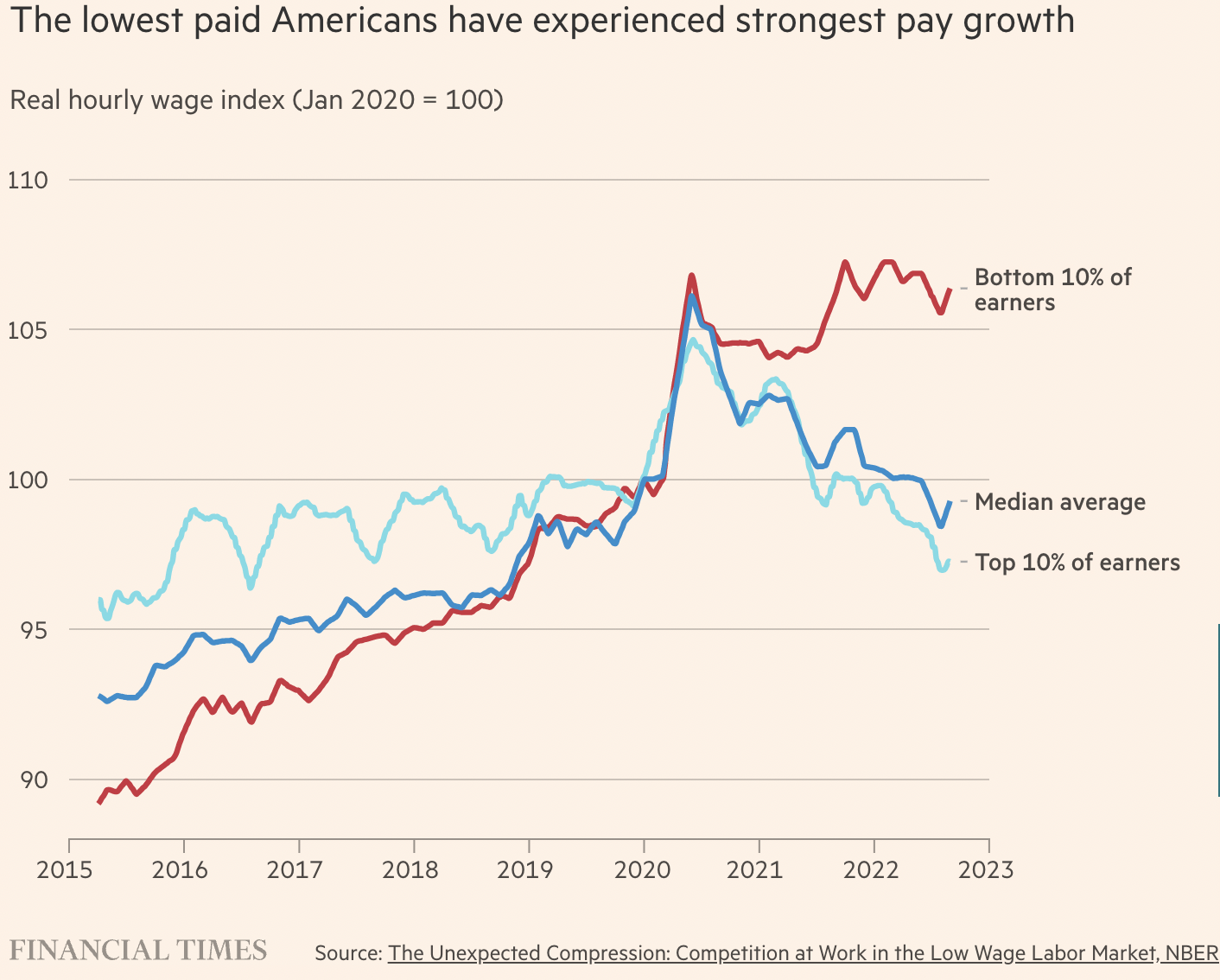
- The Financial Times clocked that the strongest pay growth over the past seven years took place among the United States’ bottom 10 per cent of earners.
A further indicator that inflation could, in the long run, be re-calibrating the system in a healthy way. — IK
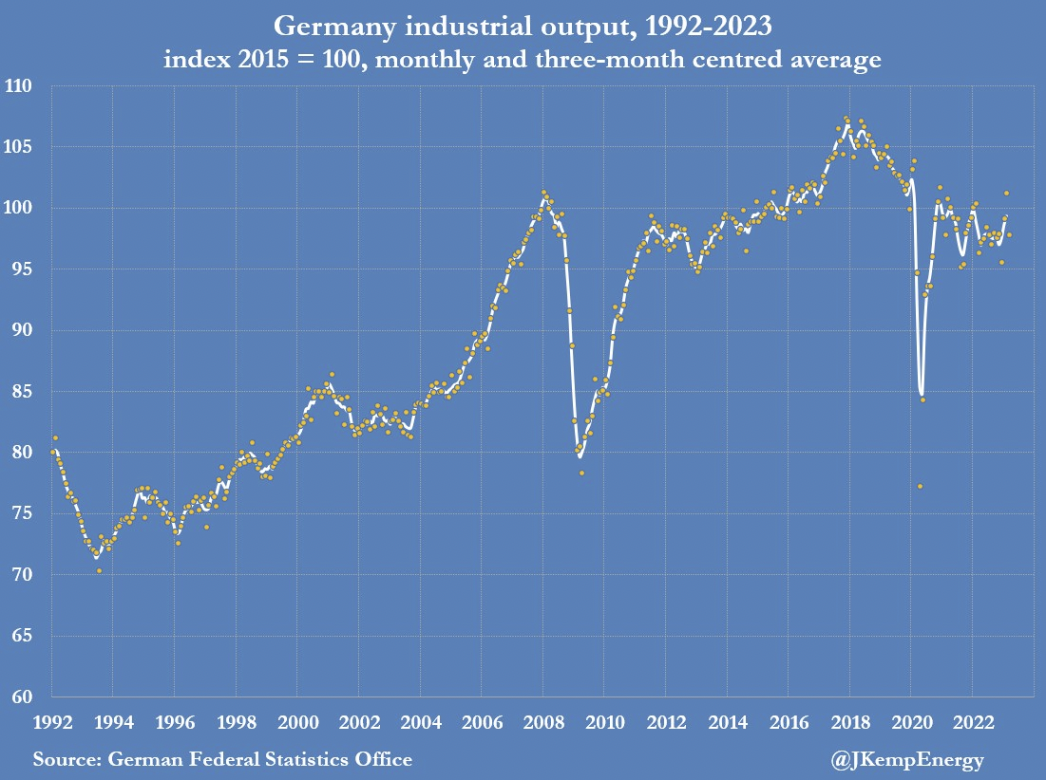
- Etienne Schreider, of the University of Vienna, argued that Germany was on the verge of de-industrialisation due to the Russia-Ukraine energy crisis triggering a profound paradigm shift in Germany’s industrial and competition policy.
. - Germany’s manufacturing production flat-lined as weak demand for durable goods and continually high energy prices weighed on manufacturing businesses.
- Regulators refused to bless the Canadian Toronto-Dominion Bank’s $13.4bn bid to purchase First Horizon due to TD Bank’s past handling of suspicious customer transactions.
I was contacted late last year, via my business partner’s whistleblowing app Haya, by someone alleging there had been longstanding irregularities at TD Bank related to their acquisition of Albert Fried. There were also, apparently, some ongoing spillover effects from connections to the Allen Stanford ponzi story of 2009. Unfortunately, the story required a lot more resources to verify and report out than I had access to. But I dare say this is one to watch.
Some related but overlooked news is that TD Bank agreed to pay more than $1.2 billion in March 2023 to settle a lawsuit by investors claiming it had aided R. Allen Stanford’s $7 billion Ponzi scheme more than a decade ago. Allen himself continues to deny any wrongdoing. — IK
- Sector-wide layoffs in the tech sector continued as LinkedIn cut 716 jobs out of a workforce of 20,000 while phasing out its local jobs app in China.
.
- French food consumption collapsed back to 2007 levels.

- Paul Krugman’s latest column for the New York Times defended two “tricks” the Biden White House could deploy to circumvent the GOP’s use of debt ceiling extension negotiations to extract policy concessions: platinum coins and premium bonds.
Everyone’s heard of the platinum coin idea (the Treasury could mint a platinum coin valued at $1tn, and deposit it with the Federal Reserve, which would add $1tn to the Treasury’s account) but not so much the premium bond concept. The latter involves issuing bonds with outsized coupons relative to current market rates, say at 10 per cent or more, so that investors are forced by market forces to pay over the par value of the bond.
For as long as there is no need for the Treasury to mark the liability to market on its books, this delivers additional cashflow it can do whatever it wants with. It’s a concept that seems too good to be true and intuitively all wrong, but I’ve been struggling to find a hole in the theory. — IK
- Former President Donald Trump suggested a US default might be better than “what we’re doing right now, because we’re spending money like drunken sailors” noting, the Republicans shouldn’t cave unless Democrats agree to ‘massive spending cuts.’
One other factor to consider in the US Debt ceiling standoff is the possible emergence of an “odious debt” angle, which some countries have used in the past to argue they have a right to not recognise or payout debt-issued by previous illegitimate or overly profligate regimes.
It’s not yet worked in a court of law, but it has worked in practice, most famously with the Chinese Communist party refusing to recognise the debts of the former Imperial Chinese government. Bondholders, however, have not been able to pursue claims against the remaining representatives of that order, now in Taiwan, because they can legitimately argue that the assets underpinning the bonds were stripped from them.
In the event that Trump did come to power again, his longstanding refusal to recognise the legitimacy of the Biden administration, could in a similar way play into the idea that much of the debt issued by the Treasury during that period was odious and, thus, illegitimate. In that case, it would be nothing but a conventional default. The debt never had a right to exist in the first place. The Republicans were coerced into agreeing the deals.
Sounds crazy, right? Well, stranger things have happened. Chinese imperial bearer bonds are currently considered to be collectibles only. And yet, the UK government under Margaret Thatcher managed to negotiate a final settlement for the sterling component of them that raised £20m for British holders of the bonds. Her leverage was that China wanted to enter the London capital markets and there were active negotiations over the return of Hong Kong to China. A quid pro quo arrangement involving mutual recognition or cancellation of the outstanding debt on both sides between the United States and China in the context of a deal over Taiwan might not be as much of a long shot as people imagine. Especially, if Trump returns to power. — IK
- Around 700,000 UK households missed or defaulted on a rent or mortgage payment last month. This 7.3 percent missed payment rate was higher than last year’s rate but remains lower than the 8.8 percent missed payment rate for March.
. - The idea of Gosplan 2.0 made a comeback after JPMorgan’s CEO Jamie Dimon claimed regulators should look into a short-selling ban on bank stocks.
. - A new paper by the Bank of International Settlements‘ Nordic Hub flagged a number of operational risks associated with launching a CBDC product. The paper highlighted that “perhaps the most important lesson from these early systems is the need for a sound commercial model and the importance of user experience.”
. - PayPal shares continued their year-long drop after the company posted its latest quarterly filing, slumping 12 per cent on Tuesday and nearing multi-year lows for the online digital payments provider.
Analysts have been struggling to pinpoint what specifically is spooking investors about PayPal, most attributing it to adjusted margin forecasts. But half a billion dollars of unrealised losses on investments and bond portfolios alongside continuing confirmation that the company does not plan to pay interest on customer balances may also have something to do with it. — IK
- Hedge funds FourSixThree and Diameter Capital piled into Credit Suisse credit-default swaps linked to junior debt, in the belief that the derivatives panel, which oversees the market, will determine that a credit event has occurred. Chart courtesy of Bloomberg:
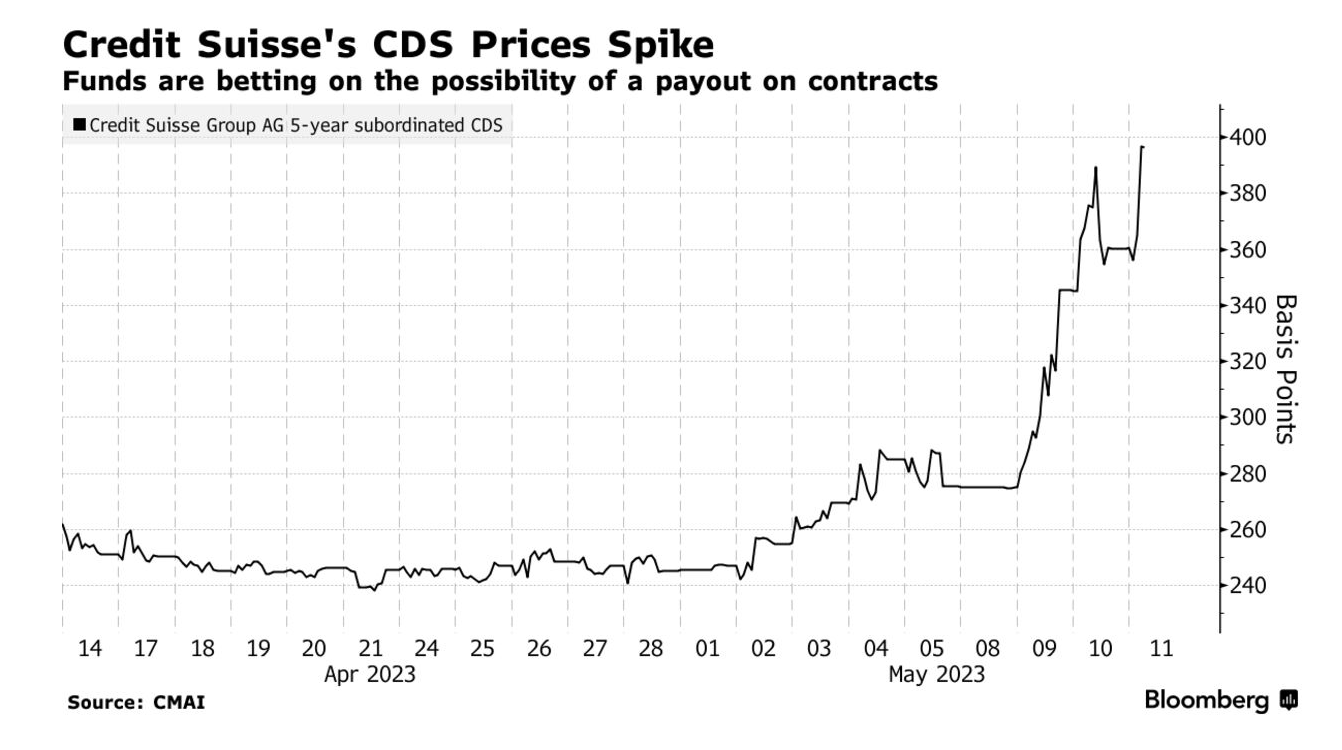
- One-month Treasury bill yields surged well above the rest of the US Government bond price curve as the X-date on the debt ceiling drew ever closer (chart courtesy of the Daily Shot).
.
- The cost of overnight borrowing in Hong Kong shot to a 16-year high, as tightening liquidity conditions in the city continue amidst authorities’ desperate attempts to defend the HKD/$ peg, having now spent $7bn since February defending it.
- The South African rand fell past 19 per dollar for the first time in three years.
.
- BNP Paribas announced it will no longer provide financing for any new oil and gas fields, citing a desire to meet its target to cut 80 per cent of its oil exploration financing by 2030.
. - Rumours that fired Fox News anchor Tucker Carlson was set to join Rumble, the Peter Thiel-backed alternative to YouTube, backfired after Carlson unveiled his new show would be aired on Twitter. The move erased $235m in value from Rumble. This was after rumours of Carlson joining the platform had initially sent its shares skyward.

- Euroclear benefited handsomely from the Russian funds stuck in its system. The FT reported in late April that the group’s balance sheet “had swelled by €88bn to €140bn at the end of March as the coupon and fund redemption payments the company normally moves to and from Russian bank accounts were frozen and locked in its accounts.”
Cryptocurrency evangelism:
- CEO of Ripple, Brad Garlinghouse, revealed he cryptocurrency company has spent $200m fighting its lawsuit with the Securities and Exchanges Commission. The SEC has accused Ripple, their CEO and co-founder of breaching securities laws by selling XRP without registering it with the SEC first, though Garlinghouse claimed the SEC’s position on XRP being a security is contested.
Geopolitical hot spots:
- Legendary geopolitical expert Henry Kissinger predicted that China’s involvement in the Russia-Ukraine war will lead to peace talks: “Now that China has entered the negotiation, it will come to a head, I think, by the end of the year.”
. - The Telegraph’s Daniel Johnson argued Poland was rapidly becoming a European superpower, as its GDP continued to outperform the rest of Europe. The country is set to become wealthier per capita than Britain by 2030, and its growing defence budget, more than twice that of the largest continental NATO members, is making it a security force to be reckoned with.
There’s a Paul Einzig book I’m reading, “Hitler’s New Order in Europe”, which makes the interesting point that the Nazi economic plan was heavily focused on not allowing any conquered territories from investing in or operating arms factories. This would remain the exclusive domain of the Germans. Which does make you wonder if the ultimate reserve asset is actually weapons manufacturing capability.
The book also made the interesting point that the plan was largely predicated on the Nazis stealing wealth from acquired territories and then lending it back out to them, with all sorts of conditionality. – IK
- A Taiwanese fighter pilot unveiled a new patch, showing a Taiwanese bear punching a figure of Winnie the Pooh, a cartoon figure that bears an uncanny resemblance to Chinese President Xi Jinping.

- The Gray Zone highlighted how a Ukrainian media group — while partnered with the BBC, Der Spiegel and others — published a Telegram poll that asked its readers which Russian journalist should be assassinated next. This comes after the news agency, UNIAN, showed its support for a recent extra-territorial assassination attempt against another pro-Russian intellectual, novelist Zakhar Prilepin.
. - Michael Pettis, professor of finance at Peking University, shared his thoughts on why the Chinese investment-driven economic growth model faces severe challenges.
.
- In a rare interview with CNN, Donald Trump refused to specify whether he wanted Ukraine or Russia to win the conflict saying instead that, “I don’t think about it in terms of winning and losing, I think in terms of getting it settled so we stop killing all these people.”
. - Pakistan’s Supreme Court ruled the arrest warrant issued for former Prime Minister Imran Khan was invalid but stopped short of ordering his release as the incident continues to trigger violent protests in the country.
American politics:
- One of the signatories of the Hunter Biden laptop letter of October 2020, aimed at discrediting the New York Post stories on the laptops’ contents, admitted he only signed the document at the instigation of an active CIA employee.
. - Robert F. Kennedy Jr. dispelled any speculation that he would join Donald Trump on an electoral ticket: “Our positions on certain fundamental issues, our approaches to governance, and our philosophies of leadership could not be further apart,” he tweeted.
. - Dr. Lawrence Sellin used his Twitter account to claim that Chinese military operatives work in concord with Mexican drug cartels to bring illegal migrants into the United States.
Dr. Lawrence Sellin, the American Colonel famously fired from his command job in Afghanistan for publicly criticising the International Security Assistance Force’s (ISAF) organisation for using too much Powerpoint, and who is also a longstanding Wuhan lab truther, has now turned his attention to exposing the Chinese underbelly to the Mexican-American border fiasco.
As he notes things are indeed still boiling in the Mexican-American border. But the Chinese element to all this is still relatively unknown.
Friday May 12 saw the lifting of the coronavirus border restrictions, named Title 42, which had until now enabled border officials to quickly return asylum seekers over the borders on grounds of preventing the spread of Covid-19. Despite this facilitation on deportation, the measure carried no legal consequences, meaning migrants were free to make repeated attempts. From Friday, however, migrants face being barred from entering the United States for five years or even criminal prosecution. Inevitably, this caused a short-term massive rush for the American border.
So why are the GOP and other right-wing activists thinking about China in this context? Well, it has to do with land purchases and dirty money. Are you that surprised?
American legislators are worried about a number of simultaneous developments, both past and present. Firstly, Chinese billionaires have been purchasing large amounts of land all over the United States for decades now. One particularly secretive billionaire, Sun Guanxing, for instance, purchased 140,000 acres of land in Texas in 2021 near the Mexico border. The buyer tried to re-qualify the land, which is called the Morning Star Ranch, into a large wind farm. If this sounds innocent, don’t be fooled; Sun Guanxing is rumoured to have been a former military official with ties to the CCP. And tomorrow’s hybrid warfare will be as much about access to your enemies’ power grid as to their submarine lairs.
Secondly, deepening ties between Chinese crime organisations and Mexican drug cartels have caused significant worry in Congress — particularly the GOP. So it’s no surprise they are concerned by statistics showing a growing number of Chinese migrants are opting to enter the United States illegally and without papers. Particularly considering that, as more and more legal methods for the Chinese to penetrate, infiltrate, and spy on American individuals and technologies become restricted by increasing tensions and associated sanctions, sending your spies through illegally and embedded with criminal organisations becomes an increasingly appealing prospect.
The paranoid worry that the combination of strategic land purchases and illegal entries of talent can easily contribute to a Chinese ‘fifth column’ within the United States. Particularly if the land is so conveniently placed next to the point of (illegal) entry.
In response, Texas Governor Greg Abbott signed the “Lone State Infrastructure Protection Act” in 2021 that would prevent “hostile nations” from accessing the Texan electricity grid and other pieces of critical infrastructure. This week saw the measure copied by Florida Governor Ron DeSantis.
It does make strategic sense for the United States to put significant barriers for the legal operations of any Chinese nationals in their country. But once the sort-of-legal-but-not-really route for geopolitical one-upmanship is obfuscated, the illegal route becomes extremely appealing.
As China and America’s geopolitical conflict heats up, expect the sneaky methods of Chinese industrial espionage or talent-hunting to morph into something darker altogether. — DGG
Scientific papers crisis:
- Former US Presidential adviser Pippa Malmgren highlighted the findings of microbiologist Elizabeth Bik, noting: “The microbiologist @ElisabethBik has an extraordinary ability to spot duplicated or faked images in scientific journals: She has spotted hundreds over the years. But she told Nature that even five years after she’d reported the fakes to the journals, most of them had not been dealt with”.
It’s time we admit our scientific/academic establishment is rotten.
Elizabeth Bik’s new paper (that is yet to be peer-reviewed) found that about 24 per cent of studies in medical journals are either “made up or plagiarised”.
Bik’s findings were produced by creating an automated detection system that looked for papers whose authors were registered with a personal (rather than institutional) email address, and if the author listed their affiliation as a hospital. These papers were then flagged and checked by humans, of which 1,500 were fraudulent, according to Bik’s team.
The fraudulent nature of many scientific papers occurs because of the “publish or perish” mindset of the academic community. As the article states:
“If scientists don’t publish lots of widely cited studies, they won’t progress. Therefore, they are incentivised to get their names on as many published papers as possible, and to make sure those studies get citations, not to find true facts. The paper mill industry has arisen as a result of that incentive.”
This echoes talks of the “replication crisis”, which won’t surprise anyone with an understanding of our current so-called academic environment, as conversations on the topic have been popular since the 90s. This crisis was brought on by the discovery that many scientific papers could not be replicated in laboratory conditions.
However, most discussions on the topic fall very short of real criticism: most focus on the high replication failures of soft-science papers like sociology and psychology, with failure rates often higher than 50 percent.
But a key feature of comparative analysis for the testing of hypotheses is to focus on the unlikeliest scenario within which a hypothesis should be found.
Let’s say our hypothesis is that most academic papers are bullshit.
We understand the scientific method as one that can repeatedly test for similar results in laboratory conditions to verify the predictability of hypotheses.
A soft science like psychology or sociology immediately falls into the “likely bullshit” category — it is difficult to create laboratory conditions for a human psyche. The same goes for quantitative political “science”, which is more about creating arbitrary definitions and throwing numbers at an excel sheet like a game of darts to get whatever curve on a graph supports your hypothesis. One of our more cheeky (but replication-aware) LSE professors enjoyed proving the falseness of political science papers before revealing they were written by fellow tenured LSE professors.
What should withstand this hypothesis, logically speaking, should be top-shelf academic papers in the hard sciences — the “unlikely bullshit” category.
Which is why John P.A. Ioannidis’ research was so critical, as he almost solely focused on the alarmingly high prevalence of false-positives and erroneous results within the medical and bioclinical research communities — even within “gold” and “silver” standard medical research.
PhD students, too, are occasionally sequestered by lab managers who, desperate for additional funding, force them to manipulate or modify the results of younger PhD students to “make look nice”. They are also heavily encouraged to focus on results that will attract additional funding – rather than focusing on conducting good research.
Poor results, however, are not necessarily detrimental to science. The entire point of the scientific method is to test, re-test, and to test again. A bad or flawed result is good if it then leads to a better one. The problem is we now find ourselves in an academic Mexican standoff, where nobody wants to start disproving other researchers’ results, lest their own results get disparaged, too. — DGG
Spooky curiosities:
- Seymour Hersh wrote a new Substack piece coming clean on his part in the sacking of legendary counter-intelligence chief James Jesus Angleton, the US spy who famously succumbed to the madness of the wilderness of mirrors.
. - Uri Geller opened up about his eventful life, sharing details of his past work for the Israeli Mossad, and how he started bending spoons.
Whatever you may think of Uri Geller, whether an incredible illusionist, talented psychic, or shameless fraudster, he’s quite the performer.
In the article, Geller opens up about his infamous appearance on The Tonight Show with Johnny Carson. Carson phoned friend and fellow mentalist James Randi, a longtime skeptic of such psychic claims. Randi instructed Carlson how to set up objects in the room, and to forbid Geller or any of his people from handling them. Geller nervously rambled through the interview and hardly managed to bend a single spoon.
Ironically, despite this seeming failure, the show would eventually become the starting point of his career as a supposed spoon-bending sorcerer.
So why would Mossad or any other intelligence service hire someone like Geller? Beyond his claimed role with the Mossad at age 13, Geller consistently spread rumours about his (dubious) involvement in all manner of high-stakes military operations — including the famous Israeli Entebbe raid and the hunt for Osama Bin Laden.
But it’s not as fake as you’d think. We found a document from the Stanford Research Institute from 1973 — an institution that fronted for the CIA’s more exotic research projects and would become the ground for CIA’s Stargate psychic intelligence program — which reviewed Geller’s abilities and judged him to possess some psychic powers. Curiously, they wrote that Geller performed better when surrounded by open-minded observers — “Good experiments were obtained on the four days when there was no openly skeptical observer”.
Vikram Jayanti’s balanced documentary: “The Secret Life of Uri Geller — Psychic Spy?” also reviewed some of Geller’s other claims of relationships with intelligence services, finding the occasional surprising fact in his many dubious-sounding stories.
Now, if Geller is somehow the spoon-bending psychic he claims to be, his use by 3-letter agencies shouldn’t be surprising.
However, one can’t help but wonder: Is Uri Geller’s true utility to intelligence agencies his supposed psychic abilities, or his ability to mesmerise people?
- During King Charles’ coronation this weekend, royal fans spotted a Grim Reaper lookalike — a hooded figure in a black outfit — passing by Westminster Abbey’s door.
Covid collateral damage:
- Robin Brooks, the Chief Economist of the Institute of International Finance, revealed that a surge of Italian exports to China can be attributed to the importing of a generic liver drug made in Italy that is rumoured to prevent Covid.
. - Scientists from Northwestern University’s Feinberg School of Medicine debunked the popular cytokine storm theory of Covid deterioration by running a machine-learning algo through their medical records, and finding that ventilator-associated bacterial pneumonia, which affected half of COVID-19 patients in the ICU, was responsible for more deaths in the ICU than COVID-19.
. - EcoHealth Alliance’s research into the spread of bat-borne coronaviruses in China, initially halted by an order from former President Trump, has been greenlit once more.
. - Allysia Finley at the WSJ journal broke the omerta on writing about vaccine injuries in the mainstream press, arguing that officials were ignoring the subject.
