

Trust Zoltan Pozsar of Credit Suisse to drop not one but two mega thought pieces on the future of the financial system in the Betwixmas period.
The latest, dubbed War and Currency Statecraft, is particularly thought-provoking and resonates with my own thinking a lot. To explain the parallels I penned a Twitter thread earlier today, which I’m reposting for subscribers below (*cleaned-up with a few supplemental comments).
But before we get to it, I wanted to highlight something curious that’s been going on with respect to how Zoltan’s pieces are being received of late. The serious folk of Fintwit, for example, appear to be getting increasingly triggered by the Credit Suisse analyst’s overarching Bretton Woods III thesis. Rather than challenge the substance of the argument, however, their go-to response has been to dismiss Zoltan’s views as irrelevant (“you can’t take Zoltan seriously these days, his ideas are not tradeable”) or to attack him outright with brazen ad hominem slurs. Some have even suggested he could be acting in tandem with Russian/Chinese interests.
To me, it all feels like the makings of a smear campaign by people who would rather bunker down in a state of denial than admit the severity of the West’s current financial predicament. The emotional reaction may also be explained by the fact that those who benefited handsomely from the old regime may struggle to deliver returns as easily in a bifurcated multipolar system. It is all highly regrettable.
At the end of the day, Zoltan is what I would call a systems thinker. The fact that he is currently observing a bifurcation in the financial system is not a function of him being an anti-Western agent, it’s a function of him being able to join the dots in a way that those with pre-existing biases about dollar supremacy and the superiority of the Western systems cannot. It might be a bitter pill to swallow but if you’re going to argue against his logic, you need firmer arguments than “he’s just echoing Russian propaganda”.
What those smearing Zoltan the most seem to miss is that he is also not endorsing the bifurcation or wishing it upon the system. He is merely highlighting that it is happening, and explaining why it is happening. The kneejerk assumption that Zoltan thinks that the BRICS will succeed where the West will fail is also wrong. All Zoltan is saying, as far as I can see, is that a challenge to the status quo is coming, and given the financial headwinds the West is now facing, it’s going to be a serious one.
I would add that the crucial point here is that if we just choose to ignore the coming challenge, or fail to respond to it in the right way (because we can’t even acknowledge it is coming due to our vested interests) the chances of us defending our supremacy successfully will grow ever smaller. Rather than be complacent, the West needs to up its game. That’s the point to take away from Zoltan’s analysis. Don’t shoot the messenger.
With that said, here’s my related Twitter thread.

🧵1/ In his latest piece, Zoltan Pozsar compares the international money system to Jean-Claude Van Damme’s epic split, arguing “The world is splitting in two. So is the monetary system. The dollar is at a crossroads.”

3/ And yet, he notes, G7 policymakers, rates traders, and strategists are still ignoring the fact that the unipolar model is slowly evolving into a “one world, two systems” framework.
4/ He argues that we “should stop pretending that this means nothing for the U.S. dollar or demand for Treasury securities.”
5/ Zoltan also makes an interesting observation about the difference between the PBoC’s use of swap lines and that of the Fed’s. This is a distinction that @choyleva [Diana Choyleva of Enodo Economics] has also flagged (I wrote about it here the-blindspot.com/in-the-blind-s…)
6/ Choyleva had noted that while the Fed mainly keeps its swap lines with high-grade G7 counterparts, China has extended its swaps to poorer credit quality developing nations in a way that poses risk.
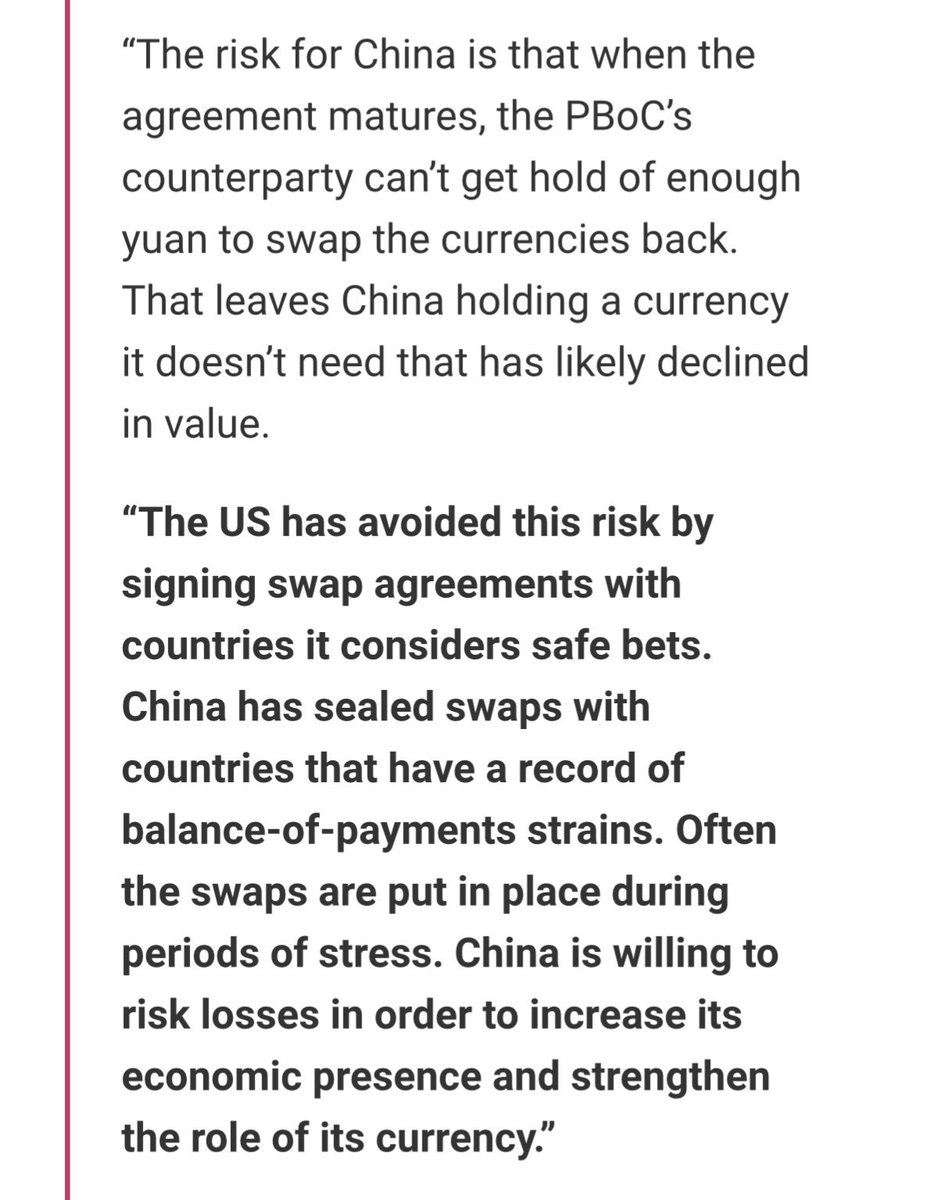
8/ at the time I compared this to an export financing loop, and argued it was akin to the US lending emerging markets the dollars they need to buy US exports – very different to the relationship that supports dollar supremacy.
9/ Zoltan acknowledges the structural difference but uses a different comparison. “For the Fed, the swap lines are about backstopping the past (past surpluses). For the PBoC, the swap lines are about underwriting the future (“Lend-Lease”).”
10/ This “lend-lease” framework is a useful one because if we go back to the era just before US dollar exorbitant privilege became defined by its ability to pay for Chinese exports with its own currency, we find the Marshall Plan fund dollar flows which helped forge the US golden age.
12/ Here are some screen shots from my paywalled piece:


13/ My lend-lease analogy focused on the fact that the US would have to return to similar structures (this time with commodities and LNG) to help support Europe in its sanctions standoff with Russia. That this would once again check Europe’s global power aspiration.
14/ But I also noted that this would not be the lend-lease of the 40s because America’s own dependency on cheap Chinese goods complicated matters this time around (at least until it could reshore entirely and handle the inflationary transition that came with doing that).

15/ What I had missed, but which Zoltan rightly picks up on, is that China’s Belt and Road Initiative is akin to its own lend-lease programme, and its BRICS m-bridge cbdc project is akin to the formation of a similar eyuan-based “euroyuan” system to that created by the Marshall Plan (i.e. the eurodollar system).
16/ In the West, we have become used to viewing the Belt & Road Initiative and related CBDC as a colonial-style power grab that seeks to enforce Chinese values/control over Brzezinski’s “grand chess board” (specifically Eurasia/Africa).
17/ But another way to view it is as China making long-term “Marshall Plan”-style development investments in emerging markets that the West is simply not prepared to make on similar terms. But also that these “subjugating” investments are highly welcomed by the recipients.
18/ Last and not least, with respect to the role CBDCs play in this challenger system, we have to understand that they risk doing to the West with bearer e-payments what dollar banknotes did to the USSR in the 80s. Notably, Infiltrate and undermine the domestic currency.
19/ Whether they succeed at doing so is another matter, but this is the clearcut fear that is driving Western central banks to experiment with floating their own CBDC equivalents. They don’t want people flocking to yuan CBDCs in their domestic economies just because they’re easier to use.
20/ But Zoltan suggests the “if you can’t beat them without a CBDC you have to join them with a CBDC” mentality is wrongheaded. I agree. What will attract people to the eyuan won’t be its digital/frictionless nature, but its relative performance as a stable store of value vis-a-vis the dollar competition. [It is soft default via debt monetisation that dollar users fear most.]
21/ As Zoltan rightly notes, the only reason BRICS are forging a CBDC-based system that allows for direct exchange between cbanks instead of going through networks of intermediaries is because they don’t control the international correspondent system.
22/ As he specifically notes “CBDCs are interweaving BRICS central banks to replicate the global correspondent banking system that the U.S. dollar system runs on, with potentially lethal consequences for the dollar’s supremacy.”
23/ But he also notes the existing decentralised but hierarchal dollar banking system – which is already digital – brings its own virtues. Giving up on it does little to guarantee success in the “Two systems” war. If anything it blurs the lines between those systems further.
Addendum: Sometimes I think of it as the world splitting itself into two complementary parts. The Western part in that case is representative of decentralised individualism — defined by creativity, chaos and innovation — while the BRICS part is representative of centralised collectivism — defined by logic, order and consistency. The division in that way could be said to emulate the physiology of human intelligence itself.


4 Responses
Great synopsis of my fellow Magyar’s thinking. Bravo
Thanks for giving me 2 seconds of internet “fame”! I am sending you an article by Wolf Richter (a smart perma bear based in San Francisco) About the state of major currencies world wide. Yes the dollar has slipped in dominance and is likely to continue to do so. The Renminbi is nowhere. Who can trust China? Just look at their Covid intervention and the destruction of their large corporations. Longer term Zoltan’s arguments hold.
China as a model of logic, order and consistency which will be followed (that is imposed) by such logical actors as Russia, India and Brazil? Order imposed dictatorship style is hardly rational. It replaces real reasoning with will. The idiotic Chinese lock down system now suddenly reversed is not exactly a positive expression of logic, order and consistency. But it is clear that the West has become weak and decadent which always invites the “barbarian hordes” now technologically well equipped, to take over. Russia invaded Ukraine from weakness not strength. The world is a mess , west and east. Perhaps the Russian invasion is the beginning of a long war which will unfold in may unknowable ways. Better for everyone if the west regains some normalcy and moral self-confidence.
I don’t disagree. Both systems have their weaknesses. A lack of creativity and individualism tends to see the logical turned into “if this then that” rule followers. Computers end up concluding equally dumb things because of their lack of emotional intelligence.