In case you didn’t know (and I didn’t) – US profit margins have been expanding sharply ever since Covid. Some central bankers, like Fed vice chair Brainard, have suggested this could be having a meaningful impact on inflation, meaning a narrowing in margins should do the opposite.
The widening has cooled off a bit recently, giving Brainard some hope of disinflationary effects to come.
But some aren’t so sure this is going to be a long term trend.
In a note out this week, Steve Englander, head of Global G10 FX research at Standard Chartered, charted the metric as follows:
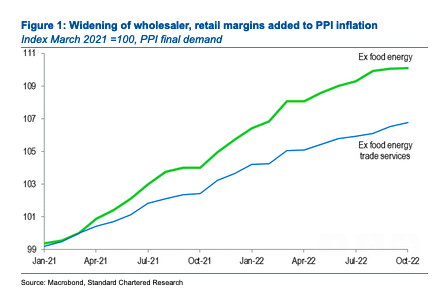
Englander also observed the following (TSB emphasis):
Our question is whether pressures to expand margins have become structural rather than cyclical. Many tech-based companies competed on market share in the pre-COVID period and were rewarded by valuations based on top-line revenue. With market expansion questionable and financing costs rising, the pressure may be to show bottom-line growth by widening profit margins. Businesses may show more resistance to narrowing them than consumers did in permitting their widening when they were flush with COVID-relief cash. Business efforts to maintain and widen margins could turn out to be structural.
This idea of a structural shift to much wider profit margins struck me as particularly interesting. I definitely think it might be true.
There’s no doubt that the era of hyper-growth-oriented, low-profit (or zero profit) unicorns is coming to an end. A proven capacity to generate profits from the earliest days is going to become increasingly crucial for successful venture investing.
Mature unicorns that haven’t yet proven themselves on profitability are probably going to struggle more than most. A day of reckoning may be upon many digital business models that depend on these.
I daresay this could be the moment we discover if we have taken these overly capital-subsidized services far too much for granted. Are they really as cheap and dependable as we think they are? What happens if they prove not to be? Might the realisation that these are not sustainable models trigger mass business restructuring in western economies? It’s possible, I think, that we built far too many services that depend on the rudimentary principle that core digital services are cheap when they might not be.
This is not a new theory. I’ve had a hunch this sort of reckoning might come for a long time. I termed the risk of such a transition a potential “perestrokia” moment for the internet – because it really would be equivalent to the unwinding of the original Gosplan planned economy of the USSR. The difference this time round would be that it’s not state subsidisation of unprofitable business practice that gets us into trouble but that by private sector investors and VCs. The latter’s inclination to forgo profitable returns in exchange for outsized capital appreciation and a chance at monopoly rents does de facto equate to an ambition to become a state.
The outcome thus won’t necessarily be very different. Whether the orientation towards a totalitarian and centralised system comes as a result of a communist planned economy or a private sector Amazon, doesn’t really make much of a difference. In both cases ponzification creeps in due to the misinformed presumption that growth at any cost is always good. But this is rarely true. When growth comes with increasing bureaucracy, corruption and inequality, it’s not real growth. It’s fake growth.
Not all businesses will be plagued by these factors. But I think Amazon is definitely one to watch. The platform is facing headwinds on two fronts. First, its rarely profitable retail business is going to be strained by any consumer slowdown. Second, Amazon Web Services risks collapsing under the weight of its own capital and energy intensity. This I think is a risk even if it pushes for wider cost savings in the economy drives more businesses to take up AWS services to take advantage of cloud-related cost savings.
I couldn’t help but notice the similarity between the Enron price chart and that of Amazon’s the other day:
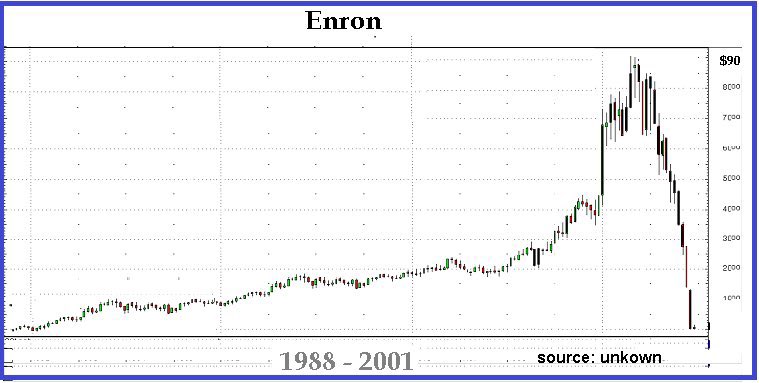
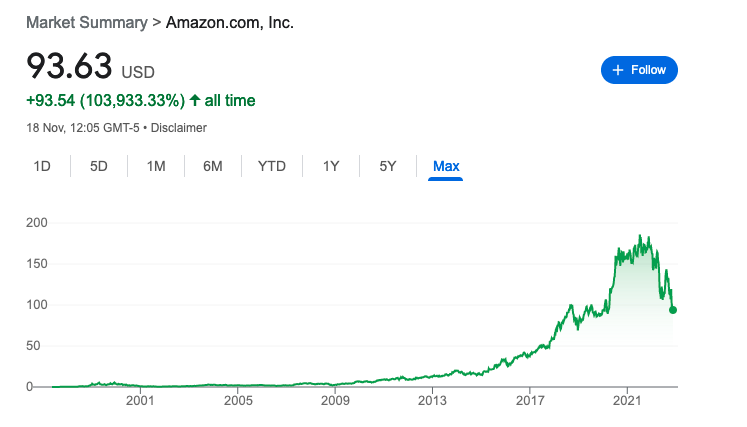
Though it’s important to note the formation extends beyond Amazon to the tech sector more widely.
We’re not there yet, but it seems rational to me that Amazon’s net income could go either way:
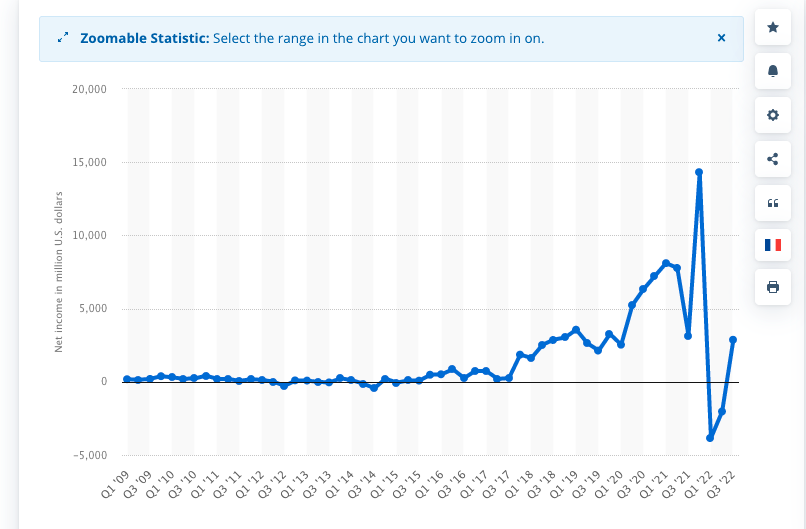
Mass lay offs certainly seem indicative of trouble on the horizon.
At a minimum, I suspect, we should all get familiar with Brian Olsavsky, Amazon’s CFO.

Let’s leave the piece with some choice quotes from Olsavsky during Amazon’s QE earnings call on October 27:
“And your first question about cost optimization, first, there are some industries that have lower demand that’s showing up in our volumes as probably like other companies as well, things like financial services, the mortgage business being down, cryptocurrencies being down. We’re very strong in some of those industries, and that’s part of it.”
“So, I think just like in 2020, these time periods are good for long-term adoption on cloud computing. But the offset in the short run is that some companies have demand that drops. I think what was different in 2020 was there were companies that went down and there’s companies that went up quite a bit that were servicing high volumes during the pandemic. So, that dynamic is not in place right now, and I think everyone is just cautious and they want to, again, watch their spend. And as CFO, I appreciate that, and we’re doing the same thing here at Amazon.”
“We are seeing signs all around that, again, people’s budgets are tight, inflation is still high, energy costs are an additional layer on top of that caused by other issues.”
Worth pondering.
Related links:
The price of unfounded news hints at the true cost of the web – FT Alphaville