*Update to the update at 1920 UK Time*
Last week we brought you news of the possible return of a London whale in the European credit markets. As highlighted at the time this was based on unverified market talk. You could call it double-sourced gossip.
Since then talk has widened. It’s hard to know at this point how much of the “new” talk is organic rather than feedback generated. Or even wishful thinking. Potentially quite a lot.
What we can tell you is that the five-year iTraxx crossover crossed 600 on Tuesday, which is (as they say) a key psychological level of resistance. It has since reverted.
Market participants say they have been feeling the presence of a significant risk-on player (or players) selling protection in “bespokes” since late last year. That footprint has been picking up since March/April. The position is perceived to be invested in a steepener trade, which is a type of partially hedged trade that loses value if the relative pricing of short-term versus longer-term default protection changes.
But this is very much the perception from the outside.
How distressed any of these positions really are is much harder to gauge. The exposure may only become a problem if any of the legs are margin-called to reflect the changing risk dynamic in the market or are traded out of entirely. The other factor which could have a bearing on the pnl is growing default risk in a cohort of the constituent companies that make up the relevant index, prompting a dislocation between the cost of five-year protection and shorter-term protection.
This doesn’t seem implausible. But until there are material and confirmed losses it all remains highly speculative. Wider reporting in any case implies this is no Bruno Iksil situation. The proportions, for now, are more Flipper-esque.
Update 19:00 BST: Bloomberg’s Nishant Kumar et al reports late on Friday that Selwood Asset Management’s has told investors that “its flagship credit strategy has been hit by ‘extreme’ market volatility, but that the firm is sticking with its bets because it sees the rest of this year being less painful than a key European swaps index is anticipating.”
According to Bloomberg, Selwood’s $776m Liquid Credit Strategy was down 15 per cent in the first half of this year on the back of the largest monthly jump ever in short-term credit spreads. The index in question, the iTraxx December 2023, widened to 71 basis points in June, they noted.
The fund was founded by former Chenavari Financial Group partner Sofiane Gharred in 2015.
Selwood’s investor letter specified that:
“We do not intend to crystallize any losses on our long book, which means that the realization of the long book will happen with time in absence of defaults.”
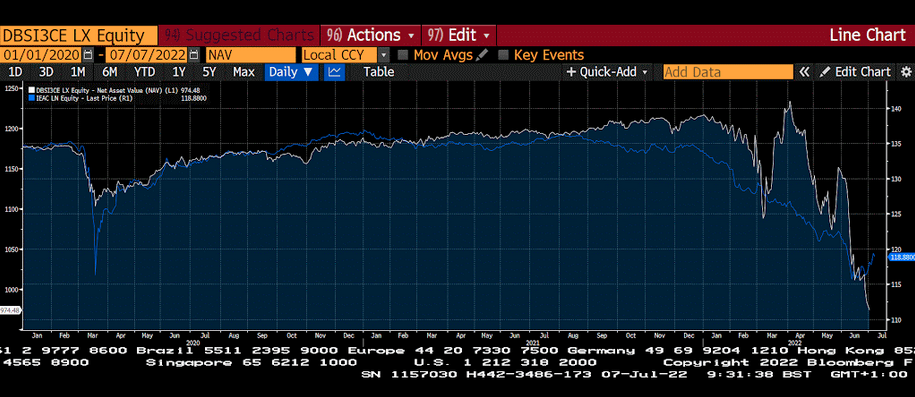
Selwood operates a number of listed UCITs funds whose performance record is available on Bloomberg. While the performance of these funds is in-line with peers in the credit market, the Selwood strategy, according to market sources, aims at being market neutral. That means it should profit in both increasing and decreasing markets.
Here is the performance of one of the listed funds compared to the investment-grade cash bond ETF benchmark:
Selwood Asset Management offered no feedback to The Blind Spot regarding the market-neutrality of its strategy. It also declined to comment about its exposure to market volatility.