
When Boris Johnson cheekily suggested this week that Emmanuel Macron’s European Political Community proposal would allow for the creation of a modern Roman Empire he missed one crucial thing.
We have already rebuilt a Roman Empire in Europe – it’s just not the Roman Empire you’re thinking of.
It is instead the Holy Roman Empire (HRE), that funny political entity founded in 962 AD that at one point dominated Western, Central, and Southern Europe, and then mostly limped along until its dissolution in 1806.
You see, sometimes, the most obvious historical metaphors are not the most appropriate. Centuries since the final passing of the original Roman Empire, we forget what the classical polity’s expanding principle was founded on; military dominance. From a Greek or Carthaginian perspective, the old Romans were total smooth brains (which is meme-talk for a small brain surface area). They used their muscle, not their nous. Remember how their pantheon is basically a ctrl-c ctrl-v of the Greeks? The Greeks certainly do.
The European Union’s lack of a common military thus undermines any comparison to the classical Roman Empire.
But stretching through Central, Western, and Eastern Europe, from Rome to modern-day Poland, with an elective system of leadership chosen by shockingly different member polities, a leadership based primarily on consensus-keeping and internal stability, and a top-down system of laws that flowed from this leading institution… wait a second! Are we still talking about the Holy Roman Empire, or did we just unconsciously describe the European Union?
Neither Holy, nor Roman, nor an Empire by textbook definitions, the new one based in Brussels bears uncanny similarities to the old papal-based one.
In fact, for its empire credentials, you needn’t look too far beyond its structural foundations.
Some, for example, have traced the root of some of the EU’s core institutions to Hitlerian sources. The late Paul Einzig, economic and political columnist at the Financial News, which later became the Financial Times, was one of those who noted in 1971 that Europe’s common market could link itself to Hitler’s plan for political and economic integration in Europe; a.k.a Hitler’s New Economic Order. In his book, The Case Against Joining the Common Market, he explained how the structure was actually the brainchild of Dr Walter Funk, Minister of National Economy of the Third Reich. It was based, he said, on the idea of offering a system of stabilising agricultural prices for European agriculture to remain competitive against the wider world.
The scheme was praised by economist Mr C. W. Guillebaud in the British Economic Journal in 1940, and it was even noted positively by the then already eminent John Maynard Keynes: “I am sure this is a view… which deserves ventilation. We shall make a bad peace if we disregard the sort of things which Guillebaud is emphasising.”
As Einzig noted:
On the basis of the above evidence, I feel justified in describing the common market – the economic integration of the continent, based on Professor Hallstein’s common agricultural policy — as an idea inherited from the Hitler regime. Of course, this fact by itself would not justify its rejection. But it is a matter of historic truth which should be placed on record, if only to prove that the common market can have no pride of ancestry.
Regardless of origin, the new Common Market would emerge out of something undeniably positive; uniting each other in business to stave off the powers of division.
Therefore, the European Union, this barely-Holy somewhat-Roman but-maybe-Empire has its central goal, peace, which it strives towards via the mechanism of prosperity, to be achieved through shared rules and incentives.
We hear you say: the European Union as an Empire?? That pathetically disunited, inefficient series of mostly secondary institutions, manned by an oyster-guzzling group of enthusiastic apparatchiks?
It certainly stretches our credulity too.
But there’s a reason why comparisons between Europe and its antecessors hold weight and are relevant even today — as Johnson has so enthusiastically confirmed.
What if, in a world filled with global states trying their hardest to loudly one-up each other with political, military influence, and grand designs, fragmenting the global rules-based order (if it ever existed), one globe-encompassing blob was quietly thriving? What if this blob, far from just holding monetary and regulatory power, is in the process of expanding economic and security objectives far beyond its borders too?
Maybe this is because it thinks power projection based on consensus and shared commitments is the best way forward in a fragmenting world, which makes it ideally suited for our times.
Or that in a world of chess players, it’s better to be playing scrabble.
How will the EU fare in a fragmenting political world?
In the latest Spot Markets Live, Marc Ostwald of ADM Investor Services commented on the novel imposition of a forced default on Russia, ‘it seems this is another part of a fracturing global payments system’.
Russia-related events have shone a spotlight on global questions surrounding fragmentation. Notably, they have highlighted the weakening of the US-dollar hegemony, and the brutal impact of rising multipolarity on our 90s-era globalised trade norms.
Considering that such events are taking place with Europe as centre-stage, and with Ukraine’s admission into the Western camp as the central ring, the question of Europe’s future in a fragmented world rises inevitably.
Many try to answer how the European Union and its member-states will fare; how will they face off against the rising power of China and the military impositions of Russia, while not being too dependent on the United States’ non-stop global adventurism. Surprisingly, most inevitably fail.
One cannot compare the EU and its member states to China, Russia, or the United States.
If countries are flocks of geese, a tight geese pack cautiously leads China’s flock. A quarrelling, strong and heavy-set pack of geese lead the United States. One scruffy, mischievous, and aggressive goose seems to lead Russia’s.
These flocks are what academics would call ‘Westphalian states’; states with a monopoly on the legitimate use of force, a low degree of economic, cultural, legal, and military divergence together with a strong set of functional and territorially defined borders. Essentially, we know they are geese, they know they are geese, they fly like geese, towards what geese like.
The EU is certainly a flock – but it is a flock of geese, cocks, mallards, pigeons (and more), chaotically flying on different wind streams.
Nobody seems to be leading; nobody really knows the destination. Nobody really knows the goal.
But mysteriously, the pack holds together. And most surrounding geese eye this muddled flock with envy.
The EU is in many ways the opposite of a Westphalian state. Despite calls for a European army, despite its having a centralised currency, despite having a Parliament, and a Council, it fulfils almost none of the conditions for a modern nation-state. The EU has no monopoly on legitimate means of coercion, no real centre of authority, and consistently fluctuating borders.
It is composed of Westphalian states, spoken of as if it were a proto-Westphalian state, but it is no Westphalian state.
Any seeking to place the EU and its geopolitical rivals in the same analytical basket are therefore comparing apples to oranges.
And yet, the EU is a competitive geopolitical rival.
Despite the cries of nativists concerned at the erosion of national member-state sovereignty and critical of its liberalising softness, the Union’s sole focus, making friends, means it plods along, adding new members every decade – new deals, new rules, and new borders.
Its simple mission means those beyond its borders, or only partially inside, yearn for entry.
We’ve also seen how admission into this Union essentially tore Ukrainian politics apart, split between its Russophile and Europhile elites, having neared collapse in the Euromaidan protests. Choosing between an undefined blob and a defined state, Ukrainians chose the former.
The mainstream seem reticent to accurately qualify the power projection capabilities of the European Union because they seem so soft. But what if they are anything but?
Our imagining of the EU as an empire would typically flow from a European army, perhaps, or a fiscal union… but what if that were impossible. What if we needed to see the European Union’s power as coming from a completely different source?
What if, contrary to conventional political instinct, EU member-states have unwittingly found themselves as members of one of history’s largest and most confusingly powerful empires? One that is perhaps well-suited to the fragmentation of the unipolar, globalised world?
Why we’re looking at the EU the wrong way
In a system that is constantly in flux, the flux itself will define the nature of that system.
Out of the original creation of the European Coal and Steel Community has come a series of institutions under the umbrella of the European Union whose defining priority – peace in Europe – has been defined by an ever-constant expansion.
Jan Zielonka, a Professor of European Politics at the University of Oxford, believes just that; the expansion and integration of the European Union, forces which he calls European Expansion (EE) and European Integration (EI), have made the polity’s development extremely path-dependent. That means processes where past events and decisions constrain later events and decisions. The failure to understand the deep changes imposed by the forces of EI and EE, particularly those carried out since the end of the Cold War, bleeds into a failure of many to understand the true nature of the EU, Zielonka has claimed.
Essentially, because the EU’s primary goal is one of peace through unification, this leads the system to seek expansion as its very raison d’etre.
Such expansion, however, did not necessarily exempt the possibility that the EU might have become a type of Westphalian state when its members only encompassed Central and Western Europe.
Near misses in history attest to this possibility. France and Britain debated uniting their countries not once but twice – in 1940 and in 1956. A Westphalian European Union could have fixed its borders somewhat, led to a common government and diplomacy, established a joint command-and-control of militaries, and a shared currency. Their similar geopolitical contexts, purchasing powers, and cultural closeness of these original members may have led to a classic super-state like the United States.
However, the collapse of the Soviet Union changed this prospective paradigm definitively. This collapse gave the original members of the Union a problem and a solution. When faced with the economic, political, and security issues of the poorer countries to its East, the EU coped with this threat to European peace by exporting its laws, regulations, and incentives eastwards.
For Zielonka, this move has forced the European Union to become (and remain) a neo-medieval empire.
By medieval, we understand this to mean vague and undefined borders, with layered and decentralised legal and political frameworks. For example, a commercial dispute in a city-state would be adjudicated by the sector’s guilds, each counting on its own set of courts and laws. Alternatively, any lord could have more than one vassal, every vassal often having more than one lord. Even the lords were in turn vassals to local Dukes or Kings. Each minor lord could have their own legal court, which depending on their vassalship’s agreements, were not necessarily answerable to their Kings’ laws.
To simplify in the extreme, the HRE was a tool primarily focused on internal stability and was composed of a patchwork of independent members. These polities were remarkably different; Kingdoms, Dukedoms, and Cities, each with their own governments, laws, militaries, and currencies. The system of a confederal elective monarchy meant some members, given the rank of Electors, would vote for an Emperor – an office later dominated by the House of Habsburg from Austria-Hungary.
From the Emperor flowed the ‘Reichgesetze’ or Imperial laws, which were administered first by the Hofgericht, and then by the Reichskammergericht, the Imperial Chamber of Justice.
Regardless of whether a king held the title of emperor, his personal court (the Kammergericht) was always jurisdictionally (though not always practically) distinguished from the imperial court. Indeed, imperial law could technically top royal law inside of its empire.
The imperial courts were based on Roman Law – covering breaches of the public peace, pleas concerning the treasury, violations of imperial decrees, property disputes between members, etc. The court’s influence meant the local courts in most imperial member polities gradually abandoned their own laws in favour of Roman law.
Jan Zielonka sees the EU in a similar way. The European Union is focused on internal peace, and its members are similarly unequal, just look at France versus Slovenia. Furthermore, the power of several individual constituent members, like the homes of the frogs and the krauts, means shared decision-making is a prerequisite. Therefore, to achieve its objective, it must rule over its subjects through layered ‘concentric circles’ of shared and mostly decentralised political, regulatory, and legal powers.
These concentric circles begin at the core, where old EU member states have integrated all the measures drawn by the EU. These circles slowly flow and are integrated with soon-to-be members, last exemplified by Croatia’s impressive reform drive prior to acquiring full member status in 2013. Finally, they also extend beyond its borders, such as the gradual integration of Moroccan industry into the EU goods and regulation circuit.
Most of this power is thinly spread over different institutions and affects individual member-states in different ways. The euro, not accepted by all EU members, is ruled by the European Central Bank, whereas European laws, which some non-EU countries are de-facto subject to, like Kosovo or Bosnia, are governed by the European Court of Justice.
The nature of these institutions and their basis in promoting European peace through unity and expansion means their influence is almost always augmenting (Brexit excepted). ‘European Expansion’: driving this influence outside of its borders , and ‘European Integration’: enmeshing these rules into a country’s legal, political, and economic systems.
In any case, none of this means much without some nice maps.
The EU as a neo-medieval empire in maps
I used to play an excellent real-time strategy game called Europa Universalis IV. Playing as any polity in the renaissance era, this complex game allowed you to run your states’ political, economic, and military developments – kind of like in Civilisation. The irony was that, despite the game’s complexity, it ultimately encouraged ‘map-painting’ (the cheap strategy of expanding your polities’ borders as far and wide as possible).
The problem with Zielonka’s thesis is that humans are often reticent to qualify something seemingly vague and academic for the same reason they like to play games like Europa Universalis, everyone likes a good map because it’s visible and concrete, so you ‘get’ it.
Zielonka’s thesis, however, is anything but vague (though it is very academic), and this realisation can be achieved by focusing on the most tangible aspect of EU power projection: its security objectives. Everyone ‘gets’ boots on the ground. It’s like geopolitics for dummies; security objectives are tangible, visible, and look nice on a map.
To explain Zielonka’s thesis properly, let’s start at the beginning, with the most commonly shown map of the EU:

Looking at a map of our European Expansion, we could certainly deride the inter-dimensional player ruling the EU with the charge of blatant map-painting.
However, I find the above map to be one of the least informative.
That is because we’re rarely shown maps that dig at particular concentric circles of power from the EU, particularly in terms of European integration and security objectives. Let’s dive deeper and see how the neo-medieval paradigm functions geographically in a geopolitical sense.
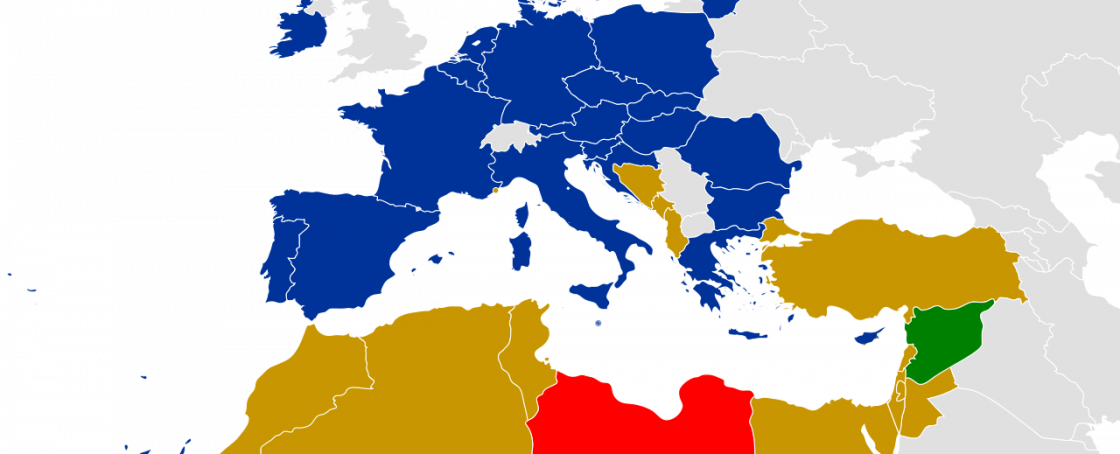
The Union for the Mediterranean is a Barcelona-based organisation that aims to promote stability in the Mediterranean by discussing regional interests. This is what it looks like:

The blue shows EU member states, the orange non-EU members, the green suspended members (Syria), and the red observers (Libya). This institution focuses, among other things, on fostering human and sustainable development, launching various mostly EU-based and funded regional initiatives and projects for this purpose in North African and Middle Eastern states. Therefore, a myriad group of organisations accountable to EU law are integrating into these non-EU members’ economic, political, and infrastructure systems. And, while it is consensual, who do you think has the upper hand in such an arrangement?
We presume Macron’s recent proposal for a European Political Community would look much like the map above, with the addition of the Eastern European countries of Moldova and Ukraine.
Suddenly, the map above makes the EU look a lot more like an Empire, doesn’t it? We’re getting there.
Let’s look at the map below by the European Council on Foreign Relations, defining migrant routes into Europe, to which I have added two blue crescents:
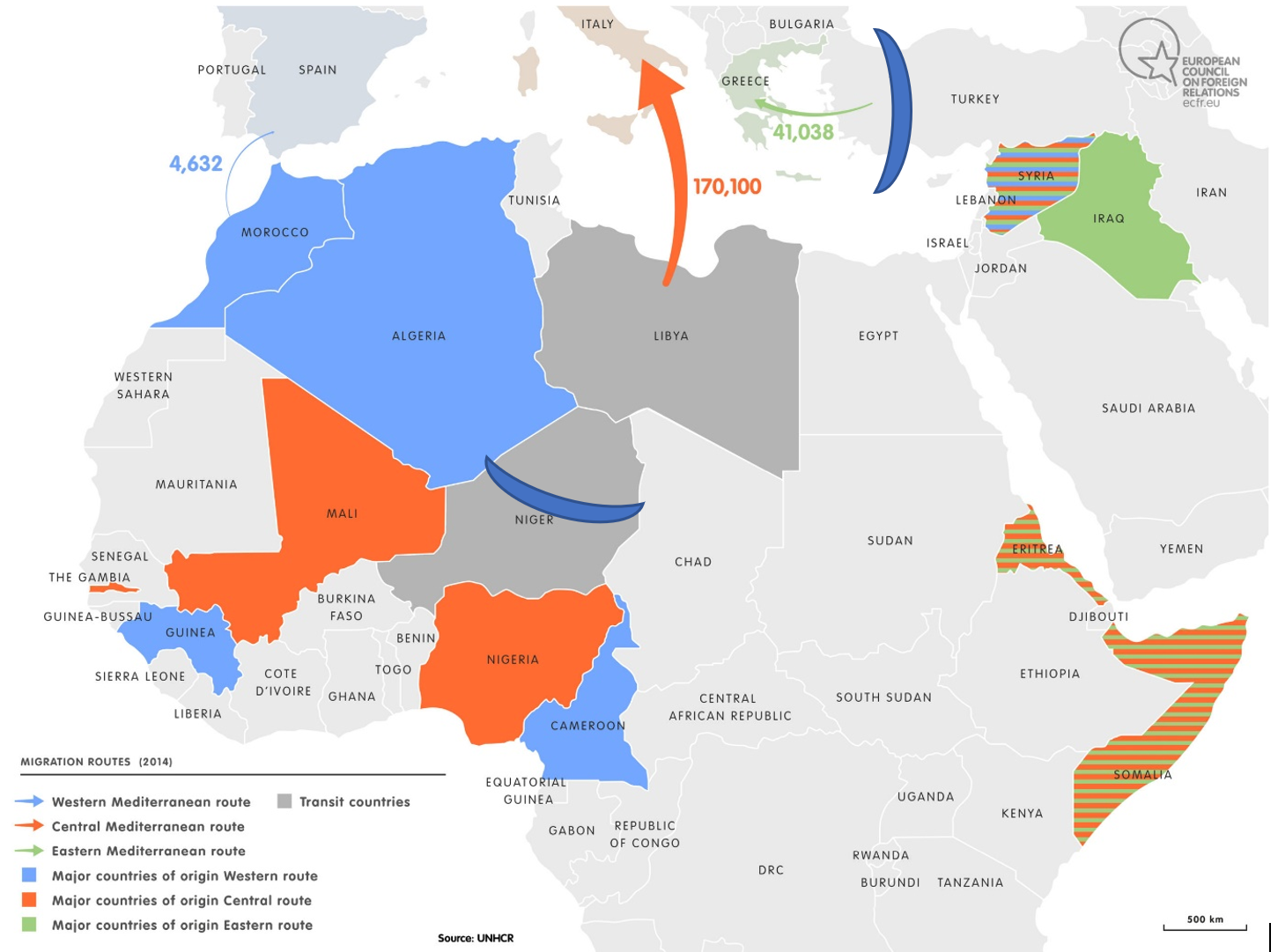
These blue crescents represent two of the EU’s funding agreements against the illegal flow of migrants into Europe.
The crescent in Niger represents a development in 2016 when, under EU pressure, Niger began implementing a law that criminalised migration – the EU disbursing over €1bn in development aid over four years if Niger began patrolling the desert and enforcing this law. Similarly, in 2016 Turkey signed a statement of cooperation with EU states, promising to stop people travelling from Turkey through to Greece – the EU would in turn provide €6bn to improve the situation faced by refugees in Turkey, and Turkish nationals would be granted visa-free travel in Europe.
The blue crescents effectively show some of the EU’s de-facto soft borders – these beginning far outside the European Union, and thus not technically enforced by member states. Notice also that Niger and Turkey are not being strong-armed into this border role – they were helpfully encouraged to provide it under the umbrella of their own sovereignty (and a lot of dosh).
This is a good place to note the curiosity of Wikipedia’s entry for ‘European Integration’ being ‘the process of industrial, economic, political, legal, social, and cultural integration of states wholly or partially in Europe or nearby.’
Let’s go further.
Below is a map of the sphere of operations of Frontex, the European Border and Coast Guard Agency:

Frontex is a European agency that focuses on the prevention of smuggling, human trafficking, terrorism, and other cross-border crimes – sharing relevant intelligence with national authorities and Europol. It deploys vessels, aircraft, patrol cars, heartbeat detectors, and other types of equipment to different Frontex operational zones.
Furthermore, it also operates outside of the EU. It trains and runs risk analysis cells in Ghana, Gambia, Niger, Nigeria, and Senegal – de-facto exporting Frontex (and thus EU) security objectives into Sub-Saharan Africa under the guise of the Africa-Frontex Intelligence Community (AFIC).
Let’s look at their maps:

We have gone from the first map, which shows the EU’s expansion in the traditional sense, to an understanding that the EU’s concentric circles of regulatory and security power extend well into different parts of Sub-Saharan Africa and the Middle East.
However, this does not even take into account other operations by member states under EU task forces. One is Operation Irini, an EU military naval task force that enforces the Libyan arms embargo. Another is Operation Atalanta, an EU naval force which counters piracy in the horn of Africa. Yet another is Operation Hera, set up to guard against illegal migration flows in Western Sahara.
I’ve added their naval operational zones in yellow, coloured the Union for the Mediterranean members in green, and labelled the AFIC analysis cells with little triangles.
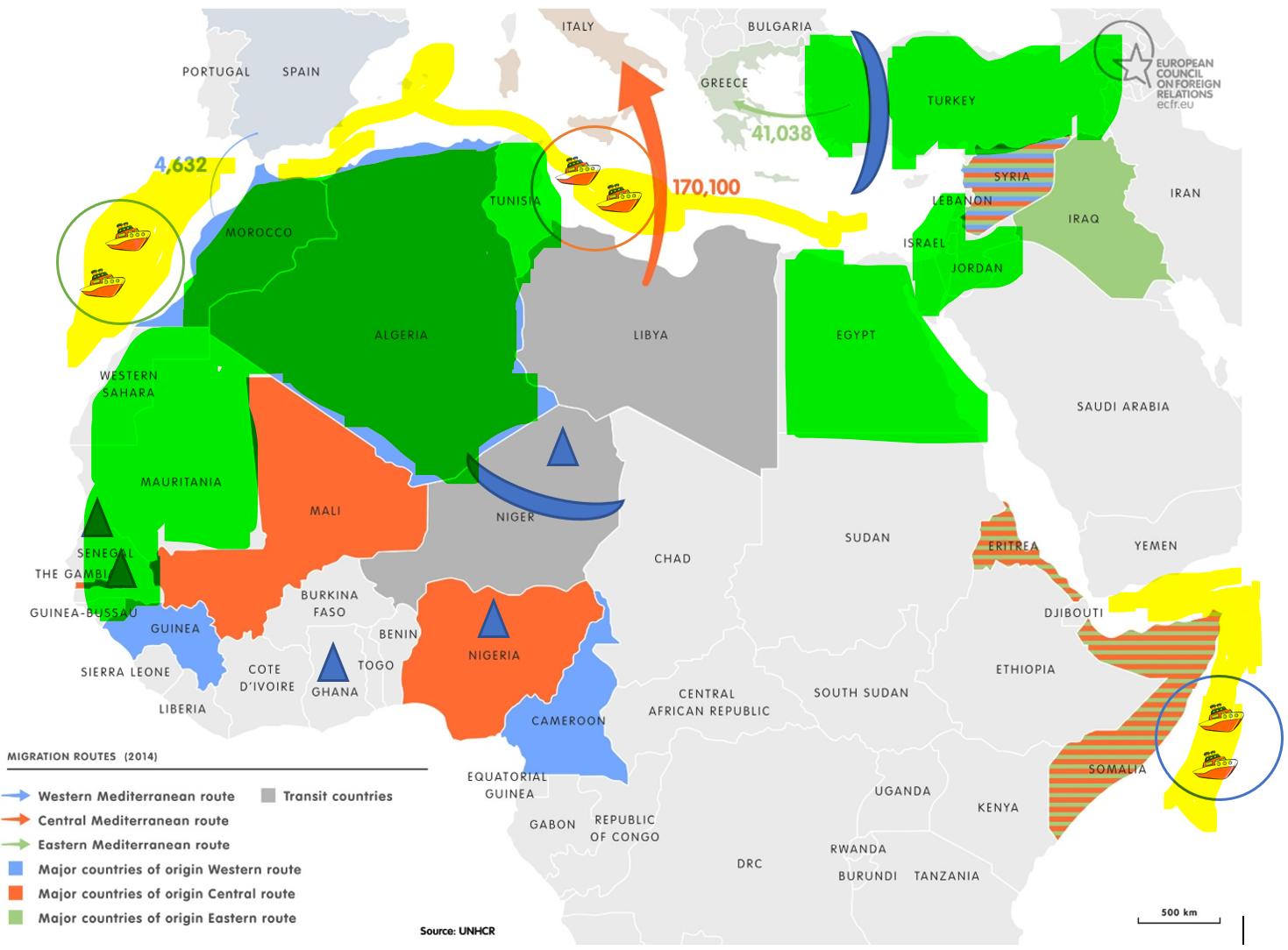
There’s a map even Holy Roman Emperor Frederick III could have been proud of, though I would hope he had better cartographers.
To defend ourselves from charges of hyperbole, we should emphasise that our analysis has been minimalistic. We have focused on just two concentric circles of EU power: the Union for the Mediterranean, and Frontex operations.
We did not consider the numerous other concentric security arrangements the EU effectively sides with, e.g. NATO deployments to secure its eastern borders or member-state deployments into Africa, like French operations in Mali and Burkina Faso. Considering the geographical extent of its member-states territories, like the French DOM/TOMs, and the alliances some of its member states belong to, such as NATO, the EU’s multilayered, concentric circles of power have a truly global reach.
As mentioned previously, it’s not just academics talking about this either. Emmanuel Macron has recently made statements regarding the creation of a ‘European Political Community spanning non-EU countries in Eastern Europe and the Maghreb. It’s no accident that Johnson made a comparison to the old Roman Empire – timeless historical truths of polities’ inner natures may sometimes unconsciously slip from the tongues of its distinguished members.
Global fragmentation: entry into a neo-medieval world
The relevance of these analyses to an understanding of financial markets is directly related to the slow fragmentation of the so-called rules-based, liberal international order so prominently highlighted during the 1990s, with the Cold War champion, the United States, as the good-hearted though surprisingly menacing primus inter pares.
Recent developments have placed an even greater light on global fragmentation. Sanctions which followed the Russian-Ukrainian war, and events like Russia’s imposition of rouble-denominated payments for its gas sales, have raised the potential of alternatives to US-dollar hegemony.
Similarly, the Covid crisis has shown that perhaps global supply chains were too interconnected for their own good. It is no surprise that arguments for national or regional self-sufficiency have grown in the wake of supply chain disruptions like the semiconductor crisis.
The increasing relevance of technological infrastructure for economic and national security purposes has also led to a dramatic expansion in the sphere of war. The expansion of social media means any one individual or group can dominate and further any preferred narrative. Nowadays, anyone can be a Goebbels.
In terms of trade, the decreasing competitiveness of countries that relied on WTO norms means the world is being increasingly intercut by different trade agreements, benefitting in-countries at the expense of out-countries.
The power vacuum left by the over-complication and over-burdening of the global rules-based order, together with significant technological developments, is effectively being filled at the local and regional levels.
Medieval echoes are already in the making
This development is remarkably similar to the emergence of the medieval world from the ashes of the Roman Empire. Too many obligations tied to too many taxes encouraged constituents to withhold tax payments to central authorities, disbursing them instead to local war-lords in order to better protect their communities from rival towns or barbarian hordes. Without a taxable base, the internal borders of Roman provinces collapsed, with external borders that counted high numbers of legions becoming essentially self-governing – legionnaires turning instead to local ‘protection payments’ to survive.
Therefore, in many ways, the analysis comparing the EU to a neo-medieval empire simply shows that perhaps the European Union was always ahead of this medievalising curve. What if all the legions are already sur place, and already paid for by the local inhabitants? What if nothing could crumble, because there was little that could crumble? What if the power of the European Union meshed primarily at the local and regional aspects of globalised economies – precisely the new power centres of the fragmenting world – encouraged forth by the rare virtues of agreements, power-sharing, and consensus?
In a world often menacingly competing for allegiance to their own power structures, a single blob has already been practising positive integration for decades.
Not all of these developments will be successful, however. We have seen how the EU’s focus on peace through expansion has come to the detriment of internal stability in its core states. Nativists and populists have (sometimes less unreasonably than others) decried the asphyxiating pressures of the EU’s power-sharing with third countries which differ in cultural similarities from the European centre. Similarly, the Union’s power remains untested by the new financial crisis, and its record in including average voter participation in decision-making is meagre, to say the least.
Regardless, it opens the question of how players in financial markets can use the knowledge of our entry into a neo-medieval system to gain an edge. From my perspective, that answer is quite clear.
A corporatist concord
Let’s not forget that the weakness of the English state led directly to the rise of the East India Company and Join-Stock Companies (JSCs) more broadly (though this was in the renaissance – we never claimed the neo-medieval label was a perfect metaphor).
Indeed, in times of state weakness, innovative private actors are allowed to participate in real power structures. That’s why these early JSCs could wield their own foreign policy; with diplomats, armies, and navies. It’s why the English royalty licensed pirates to hunt down Spanish ships, loot their gold, and butcher their crew. The innovations that moved together with England’s rise to power proper in the 18th century were the result of state weakness, which forced the inclusion of private capital into power-political agreements. There was always, in a sense, a military-industrial complex.
Therefore, when we see the coterie of private companies including themselves in political debates, such as the gender diversity debates, the abortion debates, or the Trump debates, it’s not just that we’re seeing the rise of a ‘woke’ corporatism. The daemon of corporations, hunting for the profit motive, may have already foreseen the rise of a neo-medieval world. Perhaps this daemon is showing a remarkably self-interested adaptation by integrating into states’ political sovereignty?
Nonetheless, even in a world of state weakness, the state’s hold over legal systems and regulatory authorisations will likely remain uncontested. Therefore, corporations that can adapt their local presence to local social contracts will find themselves in excellent positions to share in that sovereignty. Blackwater, for instance, sold itself as a moral crusader of American values. But it benefited even more greatly from understanding that a US reluctance to deploy too many ‘boots on the ground’ was also an opportunity, leading to this company’s infamous contracts in Iraq. Alternatively, a shadow force of shell corporations informally known as the Wagner Group is already wielding Russian diplomacy overseas.
How long before the power transferred to these shady actors, for now mostly of a military and administrative type, broadens? How soon until we see a JP Morgan assigned as an eques, tasked with shaking down taxpayers? Or an Amazon private militia force tasked with chasing down those who steal packages from the gated communities it services?
In a world that is seemingly becoming so unfamiliar, it only takes a historical glance to see this global fragmentation was not our first rodeo.
