
PayPal shares, which had suffered sharp declines this year, drew support after the payment processor disclosed in first quarter earnings that it would be cutting its medium-term outlook on a deteriorating macro environment. Most analysts had been anticipating a cut in forecasts.
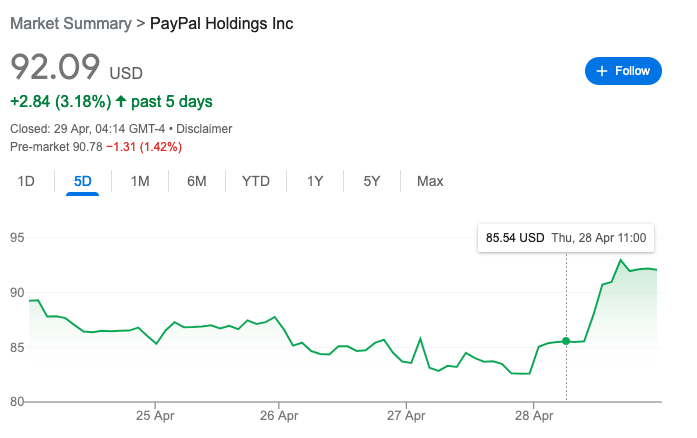
The company’s Q1 results, announced April 27, showed the payment processor posting revenues of $6.5bn in the quarter relative to $6bn a year earlier, in line with analyst forecasts. Net income came in at $509m vs $1.1bn the year before, also in line. And the company said it had 429m active accounts in March relative to 392m the previous year.
Over at The Blind Spot, however, we have been waiting for further insight into how the company sees itself coping with a rising interest rate environment.
PayPal, which was founded in 1998, is not entirely without experience in tightening cycles. At the same time, unlike other less experienced fintechs in such periods, it has a much larger portfolio of actively managed available-for-sale debt securities that bears significant fair value exposure when interest rates go up. This could have a bearing on PayPal’s liquidity status in the event of large customer withdrawals.
One motivating factor for withdrawals is that PayPal does not pay interest on amounts due to customers. In a rising interest rate environment, this poses a competitive disadvanatge over processors (or banks) who decide to share the interest they gain from holding deposits with customers. This could prompt defections.
The scope, variance and liquidity profile of PayPal’s investment portfolio, meanwhile, is mostly unknown.
Thanks to PayPal’s 10q, which was posted on Thursday, we now have a little more insight into the risks.
As the group notes (TBS emphasis):
We are exposed to interest-rate risk relating to our investment portfolio and from interest-rate sensitive assets underlying the customer balances we hold on our condensed consolidated balance sheets as customer accounts.
As of March 31, 2022 and December 31, 2021, approximately 41% and 40%, respectively, of our total cash, cash equivalents, and investment portfolio (excluding restricted cash and strategic investments) was held in cash and cash equivalents. The assets underlying the customer balances that we hold on our
condensed consolidated balance sheets as customer accounts are maintained in interest and non-interest bearing bank deposits, time deposits, and available-for-sale debt securities. We seek to preserve principal while holding eligible liquid assets, as defined by applicable regulatory requirements and commercial law in certain jurisdictions where we operate, equal to at least 100% of the aggregate amount of all customer balances. We do not pay interest on amounts due to
customers.
The proportion of total cash, cash equivalents and investment portfolio held in cash and cash equivalents was previously 40 and 30 per cent.
PayPal goes on:
If interest rates increased by 100 basis points, the fair value of our available-for-sale debt securities investment portfolio would have decreased by approximately $284 million and $272 million at March 31, 2022 and December 31, 2021, respectively.
This compares to $173m at December 31, 2020. There’s then some new wording (highlighted below) which explains very clearly how the sensitivity works:
Changes in the fair value of our available-for-sale debt securities resulting from such interest rate changes are reported as a component of accumulated other comprehensive income (“AOCI”) and are realized only if we sell the securities prior to their scheduled maturities or the declines in fair values are due to expected credit loss.
Here’s the relevant table:
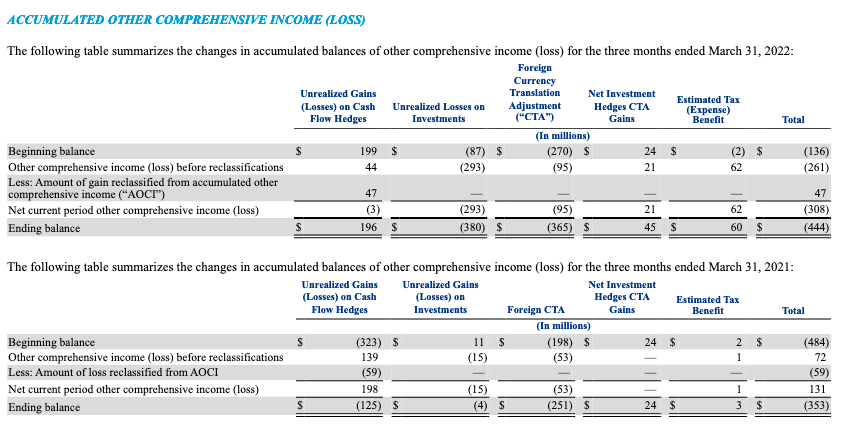
The wording also implies PayPal intends where it can to hold these assets to maturity, which some might say has a bearing on liquidity.
PayPal continues with more new wording relative to the previous filing (new wording is highlighted below):
As of March 31, 2022 and December 31, 2021, we had $9.0 billion in fixed rate debt with varying maturity dates. Since these notes bear interest at fixed rates, they do not result in any financial statement risk associated with changes in interest rates. However, the fair value of these notes fluctuates when interest rates change, increasing in periods of declining interest rates and declining in periods of increasing interest rates.
It’s interesting that the company feels obliged to explain the relative sensitivities so clearly.
PayPal continues (new wording highlighted):
As of March 31, 2022 and December 31, 2021, we also had revolving credit facilities of approximately $5.5 billion and $5.2 billion, respectively, available to us. We are obligated to pay interest on borrowings under these facilities as well as other customary fees, including an upfront fee and an unused commitment fee based on our debt rating.
Borrowings under these facilities, if any, bear interest at floating rates. As a result, we are exposed to the risk related to fluctuations in interest rate to the extent of our borrowings. As of March 31, 2022 and December 31, 2021, we had ¥32.8 billion (approximately $269 million) and ¥11.3 billion (approximately $98 million), respectively, outstanding under these credit facilities. A 100 basis points hypothetical adverse change in applicable market interest rates would not have resulted in a material impact to interest expense recorded in the period.
The insight about the credit facilities being yen denominated is a new detail, as is the fact that they have expanded by roughly the same amount as the fair value deterioration in the “other comprehensive loss”.
This, it turns out in the notes section, is connected to PayPal assuming a credit agreement through its acquisition of Paidy, a Japanese buy-now-pay-later solutions lender, which provided for a secured revolving credit facility of approximately $198m. The latest additions to the 10k, however, show that this facility was added to with a new one in February 2022 on the condition of PayPal meeting a new quarterly financial leverage ratio test (our emphasis):
Paidy credit agreement
In February 2022, we entered into a credit agreement (the “Paidy Credit Agreement”) with Paidy as co-borrower, which provides for an unsecured revolving credit facility of ¥60.0 billion (approximately $493 million as of March31, 2022). Borrowings under the Paidy Credit Agreement are for use by Paidy for
working capital, capital expenditures, and other permitted purposes. We are obligated to pay interest on loans under the Paidy Credit Agreement. Loans under the Paidy Credit Agreement bear interest at the Tokyo Interbank Offered Rate plus a margin (based on our public debt rating) ranging from 0.40 percent to 0.60 percent. The Paidy Credit Agreement will terminate and all amounts owed thereunder will be due and payable on February 8, 2027, unless the commitments are
terminated earlier. The Paidy Credit Agreement contains customary representations, warranties, affirmative and negative covenants, including a financial covenant, events of default, and indemnification provisions in favor of the lenders. The negative covenants include restrictions regarding the incurrence of liens
and subsidiary indebtedness, in each case subject to certain exceptions. The financial covenant requires us to meet a quarterly financial test with respect to a maximum consolidated leverage ratio. In March 2022, ¥32.8 billion (approximately $269 million) was drawn down under the Paidy Credit Agreement, which was recorded in long-term debt on our condensed consolidated balance sheet.Accordingly, at March 31, 2022, ¥27.2 billion (approximately $224 million) of borrowing capacity was available for the purposes permitted by the Paidy Credit Agreement, subject to customary conditions to borrowing. During the three months ended March 31, 2022, the total interest expense and fees we recorded related to the Paidy Credit Agreement were de minimis.
This seems a clever work-around to cover PayPal’s overall interest rate exposure gap. The acquisition of Paidy provides access to Japan’s funding market, still in negative rate territory, alongside a consumer loans business that has a lot of margin potential, even if it comes with greater risk. The negative rates in Japan, meanwhile, explain why even a hypothetical 100 basis point rise would have little bearing on PayPal’s interest rate exposure. For now.
The covenants on the deal, however, seem strict. And if Japanese interest rates were ever to move significantly into positive territory, the sensitivity to rate rises would change quite dramatically. The short story here is that PayPal is now fully engaged in a yen carry trade and has a matched book exposure that potentially only gets wider, especially if it is forced to start paying interest on customer balances.