This is an eclectic collection of blind spots from the past couple of weeks. This week, the them is ‘slowly then suddenly’.
Science is edging towards the conclusion that god exists after all:

A well-read but anonymous repo expert at the Conks substack believes we’re edging closer to the lowest comfortable level of reserves which could see daylight overdraft usgae spike:


Albert Edwards of Socgen has spotted some patterns in gold:

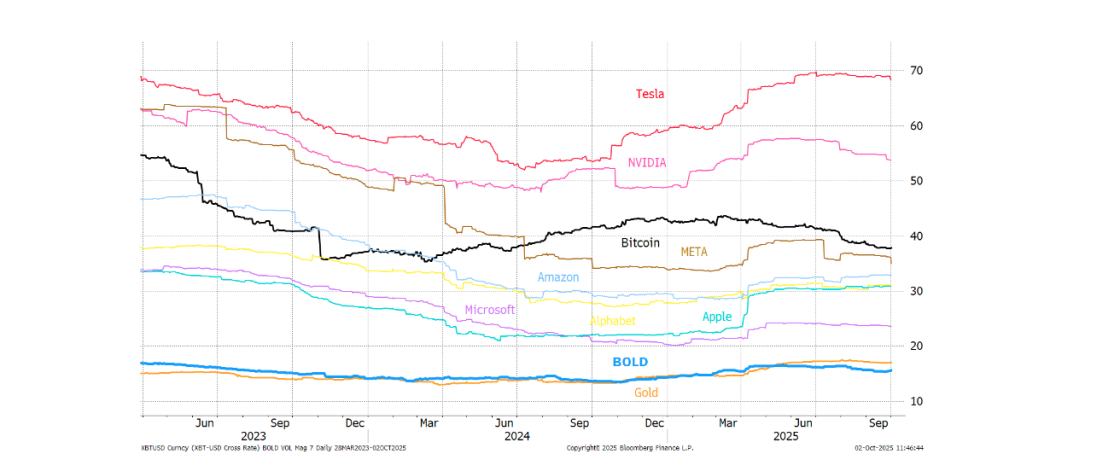
Deutsche Bank says Bitcoin isn’t actually that volatile these days:

Charlie Morris, CEO of ByteTree and issuer of the upcoming BOLD ETN, made the same observation:

Meanwhile, we discovered that October 7 was supposed to be the day London gave the all clear to crypto ETFs, but didn’t.

JP Morgan says MMFs are about to make a big comeback in Japan, and that they’re likely to use stablecoins:

The New York Times believes the U.S. rescue of Argentina was motivated by Scott Bessent’s personal interests:

CME Group chairman, Terry Duffy, told Odd Lots a couple of weeks ago that crypto perpetuals don’t make sense for commodities (and exposed he possibly doesn’t understand how they work).
Terry Duffy: There are certain markets that could never become perpetuals, and there’s a reason for that. So let’s talk about what those are. If you have a perpetual livestock or grain market, how in the world am I going to make or take delivery on something that never expires?
Tracy Alloway: Immortal cows, right?
Terry Duffy: How am I going to make or take delivery on the food markets of the United States, which is very integral into pricing of these. So deliverable products.
What else is delievable? The United States Treasury market is deliverable because they expire. So my point is a perpetual would not work in deliverable products. So you say, well, what about cash settled price. Terry, would that work? I don’t know if it would work. Thethe index would continue to go but again, it would not fit the definition under the law of a futures contract, because whether it’s cash settled or physical settled, the definition is exact same thing for a futures contract, and it’s not the perpetual definition.”
Economist and commodity derivative expert, Craig Pirrong, of the University of Houston, said he agreed with Duffy’s conclusion but not his reasoning.

(FYI, Pirrong’s full post is worth your time.)
The Fed’s vice chair for supervision, Michelle Bowman, made her case for going back to a scarce reserve regime:

Things we’re processing:
— Why is Tether buying gold streaming and royalty companies, and rumored to be sniffing around for more? [Call us speculative, but we suspect it has something to do with the fact that they manage a gold-backed stablecoin, that gold is zero-yielding, and that they don’t currently charge a management fee.]
— Why didn’t the U.S. simply push for official dollarization in Argentina? And how meaningful is it that the Fed is staying well clear of the dollar swap operation?
— Spain’s electricity grid is facing another crisis.
— First Brands is the first big collapse of the current liquidity suction cycle. But who will be next?
— Luxembourg is the first eurozone nation to invest in Bitcoin ETFs.
— We’re still trying to understand Peter Thiel’s anti-Christ obsession.
— Who exactly is the unkempt and secretive co-founder of Jane Street, the shadowy hedge fund that spawned SBF? Bloomberg says Rob Granieri is a reclusive who has spent his wealth on Burning Man boondoggles, casinos, and funding a coup in Africa — and also likes to sport a fedora.
But is what Eric Weinstein speculated about the true nature of some hedge funds applicable here? (i.e. that some are dual-use “fronts” for state business).
And why exactly were their New York offices jam-packed with wartime propaganda posters and an Engima machine when I toured the building
circa 2014? Intriguing.