

Salve Romani,
How often do you think about the Roman Empire?
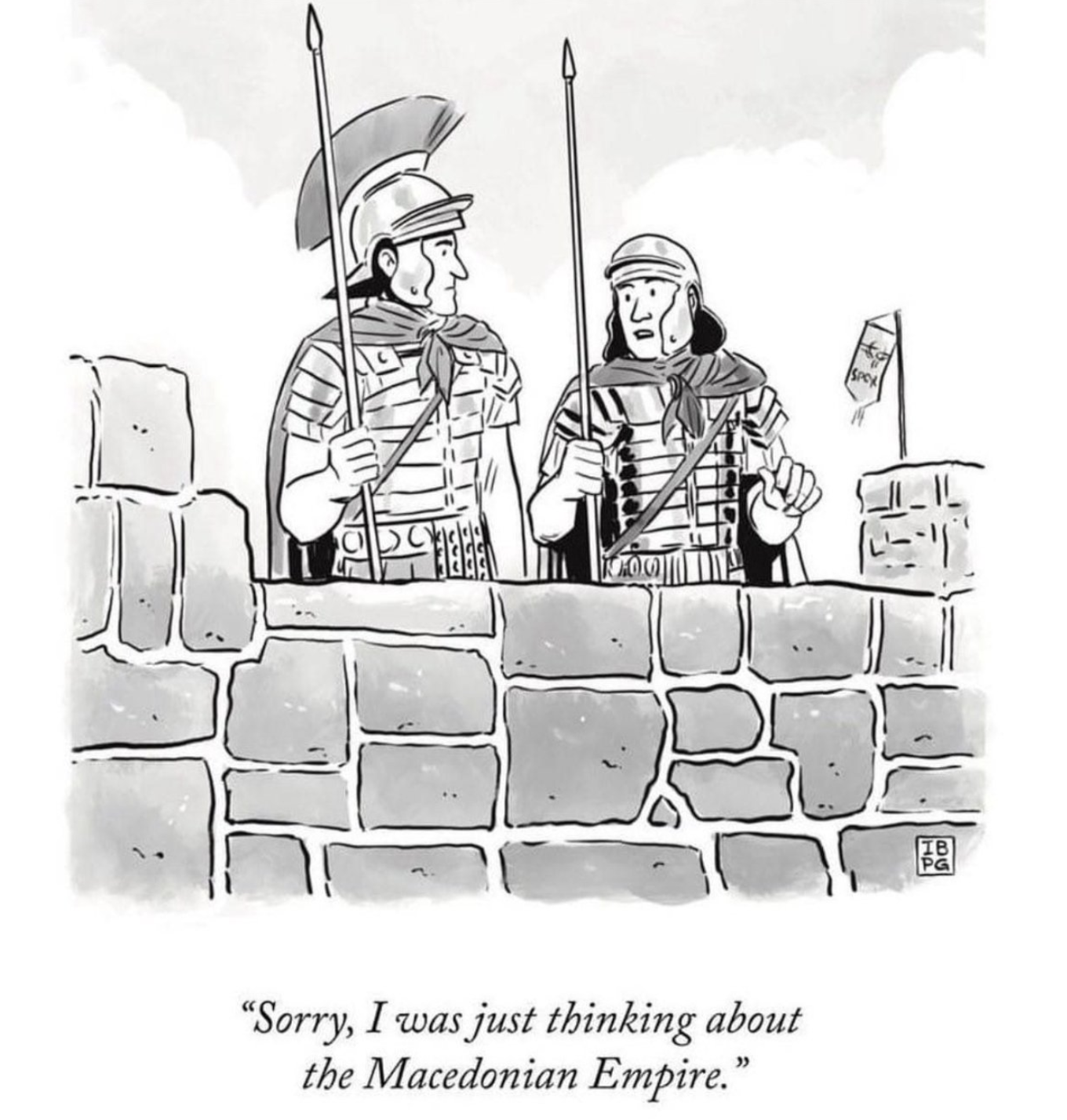
Because the answer for me and my fellow anacyclosis-minded buddy Tim Ferguson is, obviously, hourly. To honour the fact that everyone else is thinking about the Roman Empire at least a few times a week, too, I’ve added an SPQR channel to the Blind Spot Discord chat. If you’re that way inclined, join us. Come chat everything from Diocletian to I, Claudius in our dedicated safe space.
Over in the modern world, a slew of European inflation data came out this week, much of it corroborating the good news that every central banker and politically exposed person has wanted to hear for months.
Though nowhere, dear readers, were the ramifications of the CPI September print more political than in Poland, where — depending on the political prism you view the world through — the figures either vindicated NBP boss man Adam Glapiński’s decision to slash rates by 75 basis points this month or confirmed that the government is, in fact, embroiled in a multi-faceted fuel price conspiracy to curry favour with the electorate ahead of the national election on October 15. [PiS is the ruling Law and Justice party and is about as appreciated by the European establishment as a box of scorpions in a lingerie drawer.]
Here’s the story I wrote about it for Politico with Ben Munster. What I learned from digging into the tale is that PiS derangement syndrome is strong in Poland. So strong, in fact, it may be impeding professional economists from doing their job properly — something that likely presents smart investors with opportunities, as mispricings are likely to be ample.
For the Poles among my readers, I should stress I don’t have any skin in this game. Yes, my father went to school with the Kaczynskis, which influences his perspective. And yes, that influences mine to the extent it makes me reluctant to snub or patronise anyone just because they have sympathies for PiS. But if I did everything my father wanted me to do, I would have completed the Paris-Dakar rally by now. So no, I don’t see myself as partial. I just see myself as objective (which, sadly, in some quarters is considered a sin these days).
With that caveat away, what grates me about current coverage of Polish affairs is the prevailing bull-headed consensus that PiS, or anyone aligned with them, can never be right about anything. Even when the confirmational data is staring them brazenly in the face.
In this case, Glapinski told a story about inflation which might actually have been on the money, even if, I agree, he turned it into an unsavoury white propaganda spectacle. [Though, let’s face it, in terms of hubristic banner crimes, nothing beats George Bush’s “Mission Accomplished” episode.]
But his critics, having been proven spectacularly wrong about inflation — which indeed slowed to 8.2 percent in September from 10.1 percent in August just as Glapinski predicted it would — rather than just shut up and move on, doubled down and concocted a Qanon-level conspiracy theory about fuel price “market manipulation”.
It’s an absurd narrative for three reasons.
First, even if PiS had any control over wholesale prices, which they don’t, the Polish government would be no more guilty than any other European government that has tried to manipulate prices this year by resorting to energy price caps and subsidies to appease voters.
Second, because you just need to look at the data to see the argument is wrong. The fall in prices in September coincides with the annual switch from summer to winter-grade fuel, which is easier to make and is, thus, cheaper. Polish pump prices were down about 7 percent in the first two weeks of September, which was totally in line with the performance of wholesale eurobob prices. The 49 percent-state owned energy group PKN Orlen, has merely been passing those cuts on.
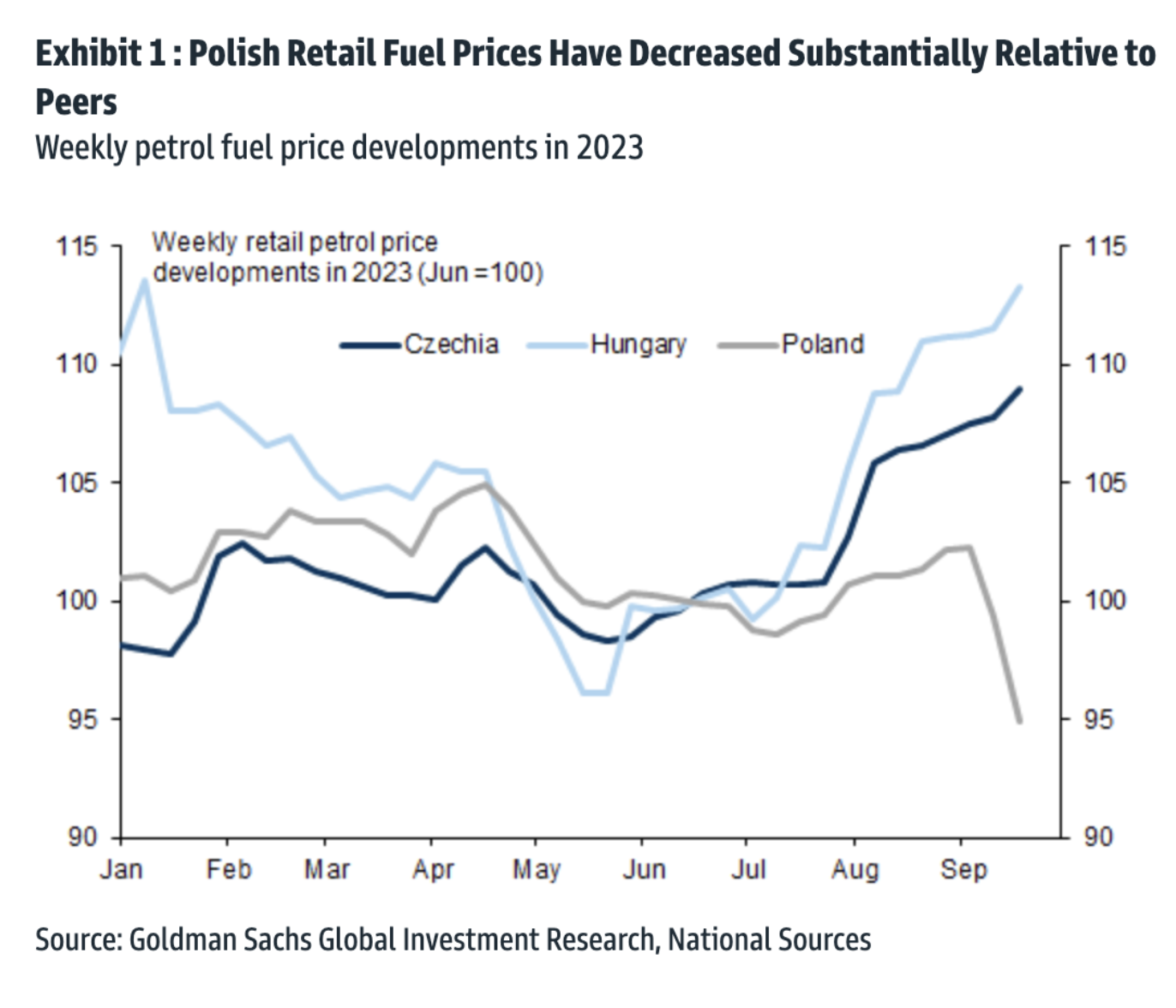 The real question to ask about the GS chart crime above is why the Czech Republic and Hungary’s prices have gone the other way despite the wholesale price drop. The answer is that CZ reintroduced fuel duties on August 1, while Hungary has been slammed with higher transit fees for the Russian crude it imports via Ukraine since the summer.
Third, because government-owned entities can’t be done for market manipulation. That’s part of the reason we frown on governments nationalising industries or conducting bailouts! The ownership distorts the free market by design. More so, governments engage in “market manipulation” all the time. From offering subsidised rail travel to public schooling. Also if they could be charged with market manipulation, then every central banker in the world would by now have joined the Libor traders in prison.
Lectures about the value of the market mechanism from opposition-aligned critics are rich in the context of green new deals, energy price caps, state buyouts and calls for the government intervention on interest rates! More on Poland below. (And there’s plenty this week).
The end of the unipolar system
In other news, I finally got my mitts on the new oeuvre by MCB reader and former Pimco boss, Mohamed El-Erian, courtesy of the online mega platform now facing antitrust charges in the U.S and which shan’t be named in this newsletter without a dedicated sponsorship deal. The book, co-authored with former British PM Gordon Brown and Nobel winner Michael Spence, is called “Permacrisis: A plan to fix a fractured world” and was officially released on Thursday.
My online order comes after I narrowly missed out on a chance to acquire an advance signed copy at a promotional convention of the authors at the London School of Economics on Wednesday, largely because Gordon Brown’s security detail rudely blocked everyone from leaving the upper auditorium until he had left.
Is it any good? Don’t know, haven’t read it yet. But if the trio had any single message for central bankers during the evening it was that getting the world through its “permacrisis” will require more than just coordinated fiscal and monetary policy. Alignment with industrial policy will be necessary too. (Where that leaves the free market, however, was not specified — a tad ironic given how passionately the establishment feels about preserving a functioning “market mechanism” in Poland.)
I managed to nip down in time to tell Mohamed I enjoyed his assessment of the Fed’s five big failures, one of the largest in his mind being its inclination to engage in groupthink. This, Mohamed worried, was now influencing the Fed’s official line on the 2 percent inflation target, which he himself believes may no longer be fit for purpose. “Central banks will never talk about this,” he told the audience, noting “when you’ve missed your inflation target, the last thing you want to do is change it.”
Gordon Brown later picked up the herd mentality baton, too. The global financial crisis-era prime minister — who sold off all the U.K’s gold at bargain basement prices — referenced institutional “blind spots” no less than six times during an appeal for global problems to be addressed by global solutions and multilateral institutions. (Ideally, he noted, in the form of a global burden-sharing mechanism focused on defence, humanitarian causes and the green transition.)
So, yeah, do check out the book if you can — it’s available at all good online monopolists.
As usual, this newsletter was compiled by myself, Izabella Kaminska, and Dario Garcia Giner. And the usual disclaimer about typos and other brain misfirings. (Please be forgiving).
China, China, China
CHINA said it was investigating hedge funds that use quantitative trading strategies to bet against its stock market and has reached out to major brokerages to inquire about some of their clients’ trading strategies.
Persecuting shortsellers is the last refuge of the incompetent. — IK
CHINA placed the billionaire Chairman of Evergrande Group, Hui Ka Yan, under police control, and he is now being monitored at a designated location.
LAOWHY’s latest YouTube video studied the Chinese housing blunder, how a decade’s worth of construction since 2008 of over 1 billion houses that have mostly sat empty.
Business, Econ, Finance etc…
THE CLIMATEER blog pointed out several potential energy bottlenecks coming in the decades ahead due to the high consumption of electrical vehicles and AI. For instance, Microsoft seems to be planning to power its data centres with nuclear reactors.
I believe we have discussed the insane energy cost of running ChatGPT on the Blind Spot before. This doesn’t bode well for mass use of the technology. — IK
AFTER a decade of pain, and contrary to most of Europe, Greece is still booming and has become one of Europe’s fastest-growing economies as investors and tourists continue to flock towards the Mediterranean country.
TARGET said it would close nine stores across major cities in the United States, citing widespread increases in violence and theft in these locations.
WITH the exception of the Google Pixel, the smartphone market saw its worst quarterly performance in over a decade worldwide.
THE New York Post reported Bernard Arnault, LVMH luxury magnate and second richest man in the world, was under investigation by authorities in his native France over suspicions that he laundered money by buying real estate through a Russian oligarch.
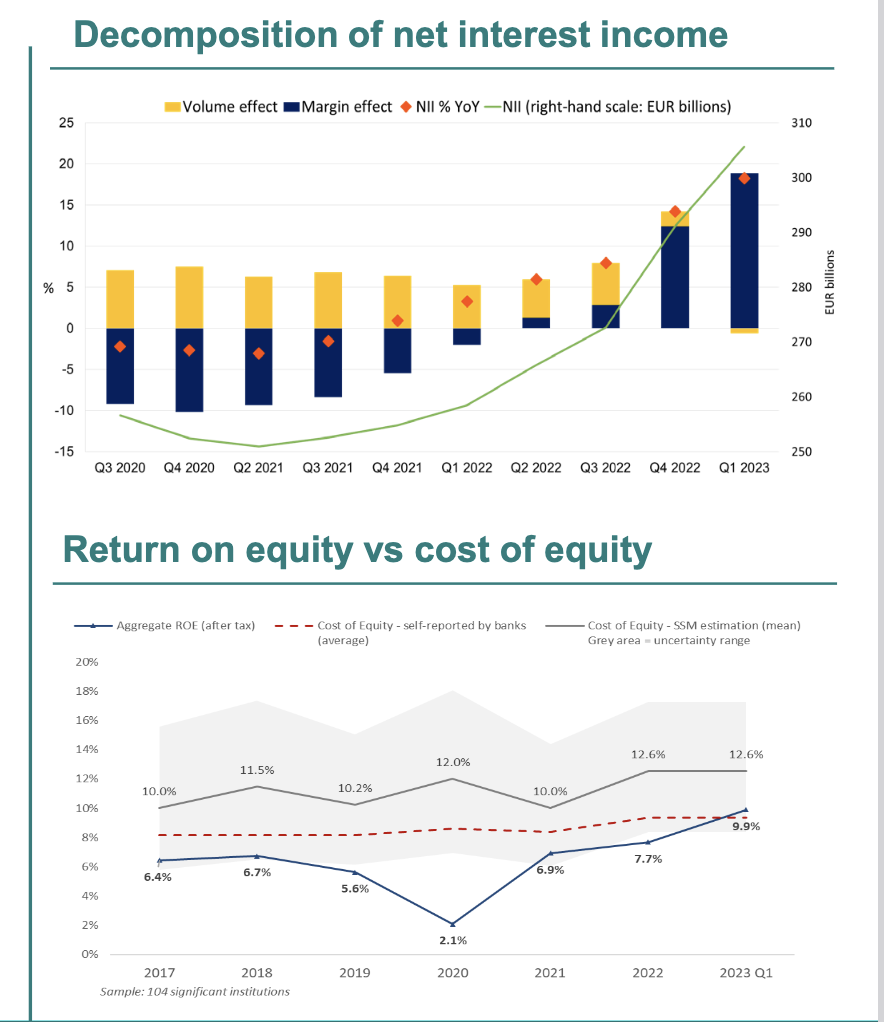
THE CHAIR of the European Central Bank’s Supervisory Board, Andrea Enria, said European banks have successfully tackled their legacy asset quality problems and there were no banks in the EU with business models like that of Silicon Valley Bank, in a presentation on Wednesday. But … he also flagged ongoing concerns about bank profitability and sub “one” price-to-book values.
Banks may have boosted their market valuations by passing a significant chunk of their profits back to shareholders in higher dividends or buybacks, but the efforts have thus far failed to bolster the all important “price-to-book” ratio. This is the difference between what the market thinks a bank’s value is and what the bank thinks it is worth. The higher the ratio the cheaper a bank’s cost of equity funding and the easier it is for the bank to maintain a highly capitalized state.
According to Enria, the average European bank ratio is still firmly below one, which means many are struggling to earn their cost of equity, while failing to convince the market they’re a good investment. In that context, unexpected windfall taxes threaten to destabilise the sector even further. “Addressing the slow pass-through of higher interest rates to depositors via price constraints and bank levies is potentially distortive, also on prudential grounds,” the presentation noted.The net interest income party, however, is unlikely to last forever. And once it ends there will be predictable profitability consequences for banks. “Competition for deposits and higher funding costs, falling lending volumes and higher cost of risk [are] expected to exercise downward pressure on net interest income,” Enria’s presentation noted, adding that “banks need to continue their efforts to stabilise profitability on a higher level and to enhance the sustainability of their business model.” — POLITICO Morning Central Banker
Yield-mageddon
FISCAL CONCERNS plus worries about the persistence of high interest rates, and a government shutdown in the U.S. saw bond yields blow out across the world. Everyone is now panicking about higher bond yields. Bloomberg noted that “yields that were almost unthinkable at the start of 2023 are now within reach” and that “the selloff has been so extreme it’s forced bullish investors to capitulate and Wall Street banks to tear up their forecasts.”
THE 1-YEAR American Treasury Bill has moved up to 5.49 percent, the highest level since December 2000:

OVER IN ITALY, the Italian government’s inability to balance the budget particularly spooked investors, with Italian yields blowing out despite the ECB’s anti-fragmentation tool still being a thing. France’s 10-year bond yield also jumped to more than 3.5 percent, its highest level since 2011, as Economy Minister Bruno Le Maire also failed to inspire hope in the French government’s ability to balance the numbers.
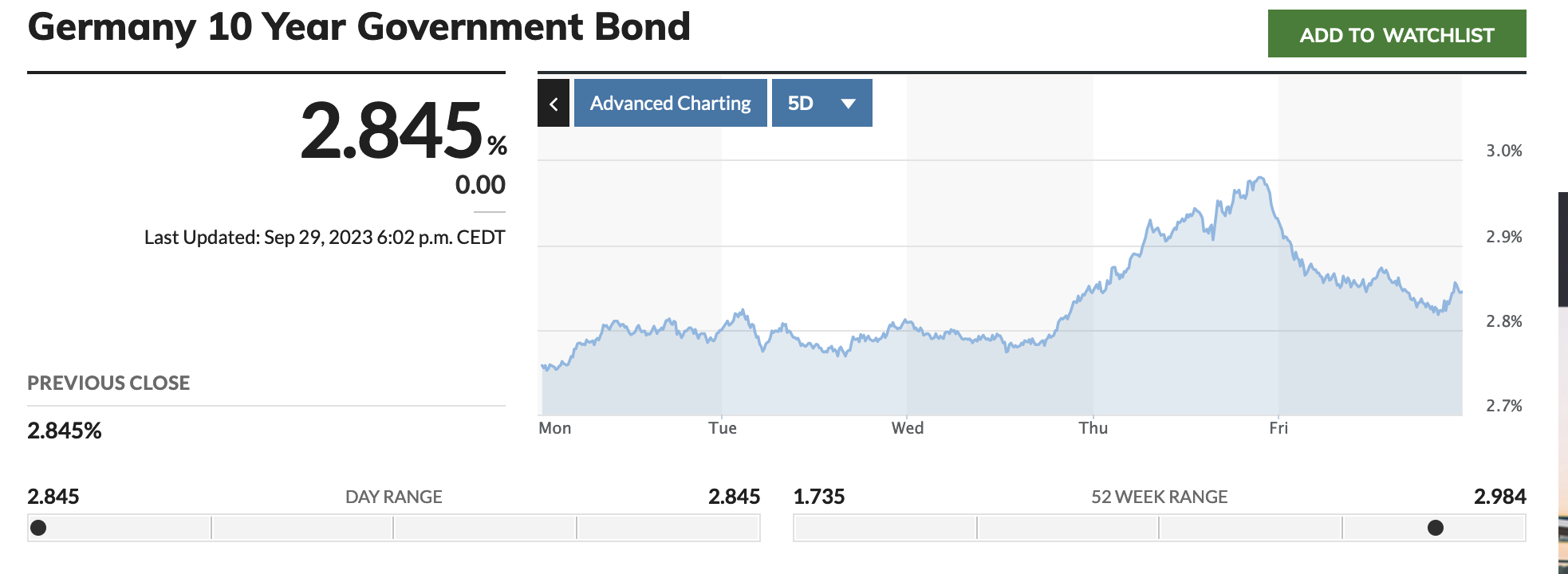
10-YEAR GERMAN Bund yields came close to touching 3 percent:
I’ve been saying, for nearly a year, it’s German bund yields in particular that are going to catch everyone by surprise. I stick by that narrative. — IK
BROADCASTER Andrew Neil relished the fact that the UK’s economy had actually outperformed France and Germany, following economic revisions.
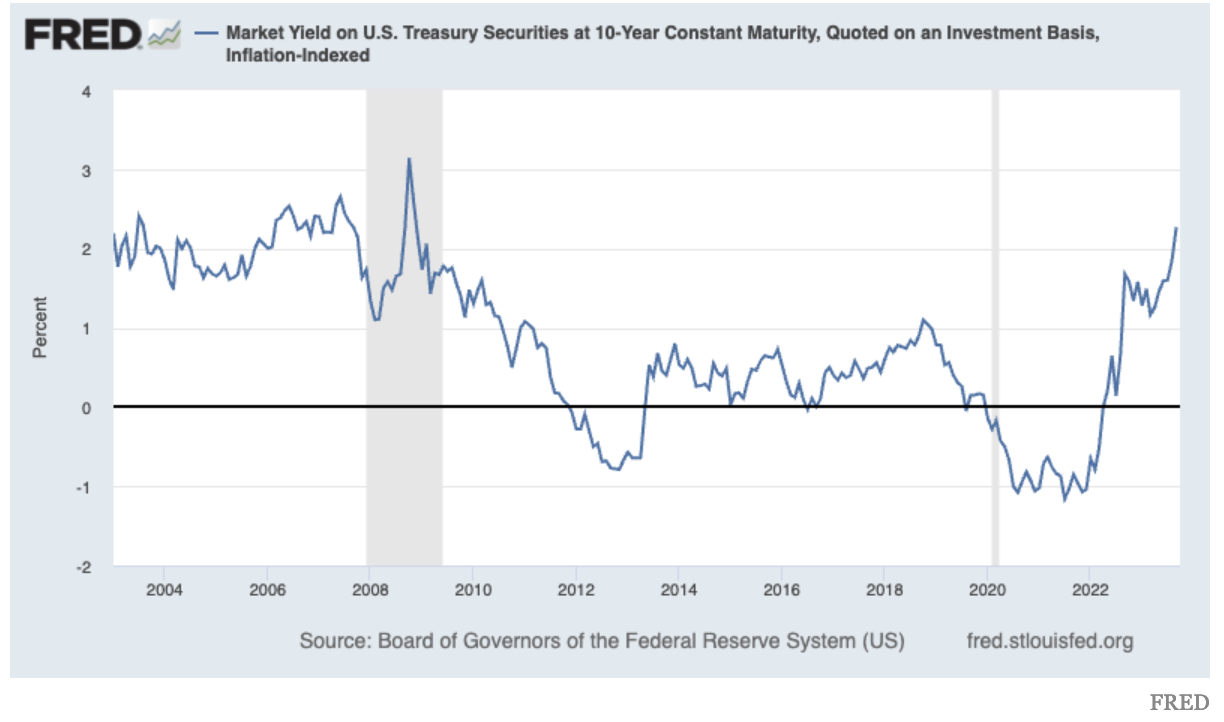
PAUL KRUGMAN reminded the world that it’s the rise in real yields that stands to be the problem for world governments since it diminishes their ability to service their debt costs.
Cryptocurrency evangelism and CBDCs
BINANCE was forced out of Russia.
PATRICK MCCONNELL questioned the validity behind the ECB’s Digital Euro project — and claimed the ECB couldn’t answer a basic question – “WHY is a Digital Euro needed?” Instead, McConnell stated, the ECB appeared determined to denigrate sceptical questions regarding the project, labelling such questions as “conspiracy theories.”
All that glitters
COSTCO began offering small bars of gold at their supermarkets, which sold out within a few hours. The news comes as the value of gold has risen over 15 percent in the past year, and 55 percent over the past five years.
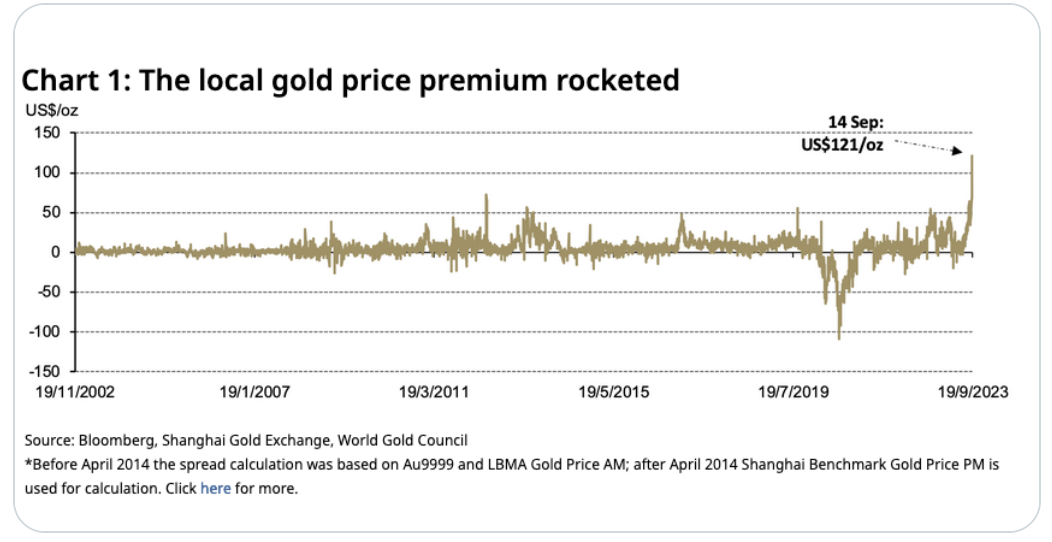
CHINA finally permitted more gold imports, which saw the record premium in the prices of gold in Shanghai relative to the rest of the world ease off a bit.
There is speculation that, as well as local Chinese using gold as a way to hedge against yuan weakness, the premium is being driven by Russian energy companies hedging yuan payments for oil on the Shanghai exchange with gold contracts settled in physical gold. Either way, the end effect is China sucking up the world’s free float of gold. [Chart via the World Gold Council] — IK
Polska ojczyzna moja!
GERMANY, Poland and the Czech Republic said they would establish a joint task force to crack down on “inhumane smuggling crime” and illegal immigration, German Interior Minister Nancy Faeser announced on Friday.
THIS CAME after Germany announced it would introduce more police patrols along its border with Poland and the Czech Republic as it seeks to prevent illegal migrants from entering the country.
THE BORDER tensions followed revelations earlier this month that Poland’s visa processing system was undermined by potentially corrupt practices by third-party agents.
See my X thread on how the problem may transcend Poland because it pertains to general Western government over-dependence on companies like VFSGlobal, which has become the near monopoly supplier of such services to the West. [A move that parallels the “special arranger” agency structures seen in Russia and China, and other countries not known for their resilience to corruption.]
This, I feel, is going to be a huge story. And, interestingly, within a few hours of posting the thread I got an unsolicited offer to interview the execs at VFSGlobal. Which I will definitely accept, not least because almost no other Western media are covering the story. — IK
POLISH PiS friendly press suggested the Ukrainian government was involved in a plot alongside Germany and France to change Poland’s ruling party ahead of its upcoming elections in exchange for a fast track to EU membership. The Ukrainian Foreign Ministry has denied these rumours, stating “it had no intention to interfere in Poland’s internal affairs.”
POLAND confirmed that the missile which killed two Polish citizens last year was a Ukrainian anti-air missile that went astray.
The road to hell is paved with good intentions (ESG)
NIKKEI reported that Japan’s electric vehicle infrastructure is aging, with increasing numbers of high-speed and standard EV chargers being closed across the island nation.
THAT CAME against a general pushback against EVs this week, led by Donald Trump. As my Politico colleagues reported, Trump’s months of broadsides against the Biden administration’s “draconian and indefensible” electric vehicle policies provided a major theme for his visit this week to Michigan, where he told a crowd at an auto parts plant near Detroit that abandoning the internal combustion engine would be “a transition to unemployment and inflation without end.”

THE EV PUSHBACK continued in Europe where, much like Trump, Italian Transport Minister Matteo Salvini denounced a proposed European Union ban on internal combustion engines as job-destroying “madness” that would benefit China, while Czech lawmaker Alexandr Vondra labeled supporters of tightened vehicle pollution limits the “gravediggers of the automotive industry in Europe.”
AND IN THE UK, Prime Minister Rishi Sunak changed course on plans to phase out petrol and diesel vehicles by 2030, extending the deadline to 2035 as he gears up for elections that will most likely occur next year. He’s also come out in support of motorists with a campaign that promises to “slam the brakes on anti-motorist measures”.
Rishi seems to be developing a real backbone, and finally putting his economic chops into action. What’s crazy is that this inevitable blowback sentiment wasn’t obvious to politicians from the get-go. It was to me. — IK
THE TELEGRAPH reported that Britain’s biggest motorway service station provider had brought in marshals to police “charge rage” among electric vehicle drivers battling for access to plug-in points.
THE FORMER Barclay-brother owned title also reported that John Lewis has stopped offering insurance to electric car drivers amid fears over the cost of repairs.
LEGO said it would not go ahead with a plan to make its plastic bricks out of recycled plastic bottles because two years of experiments found the “material didn’t reduce carbon emissions”.
I had the privilege of going to visit a recycling plant before Covid, and what I learned was that the energy expended in the recycling process is so great that often it doesn’t make any commercial sense to operate these plants unless they benefit from government subsidies or can sell the recycled material back to manufacturing Asias countries at positive prices.
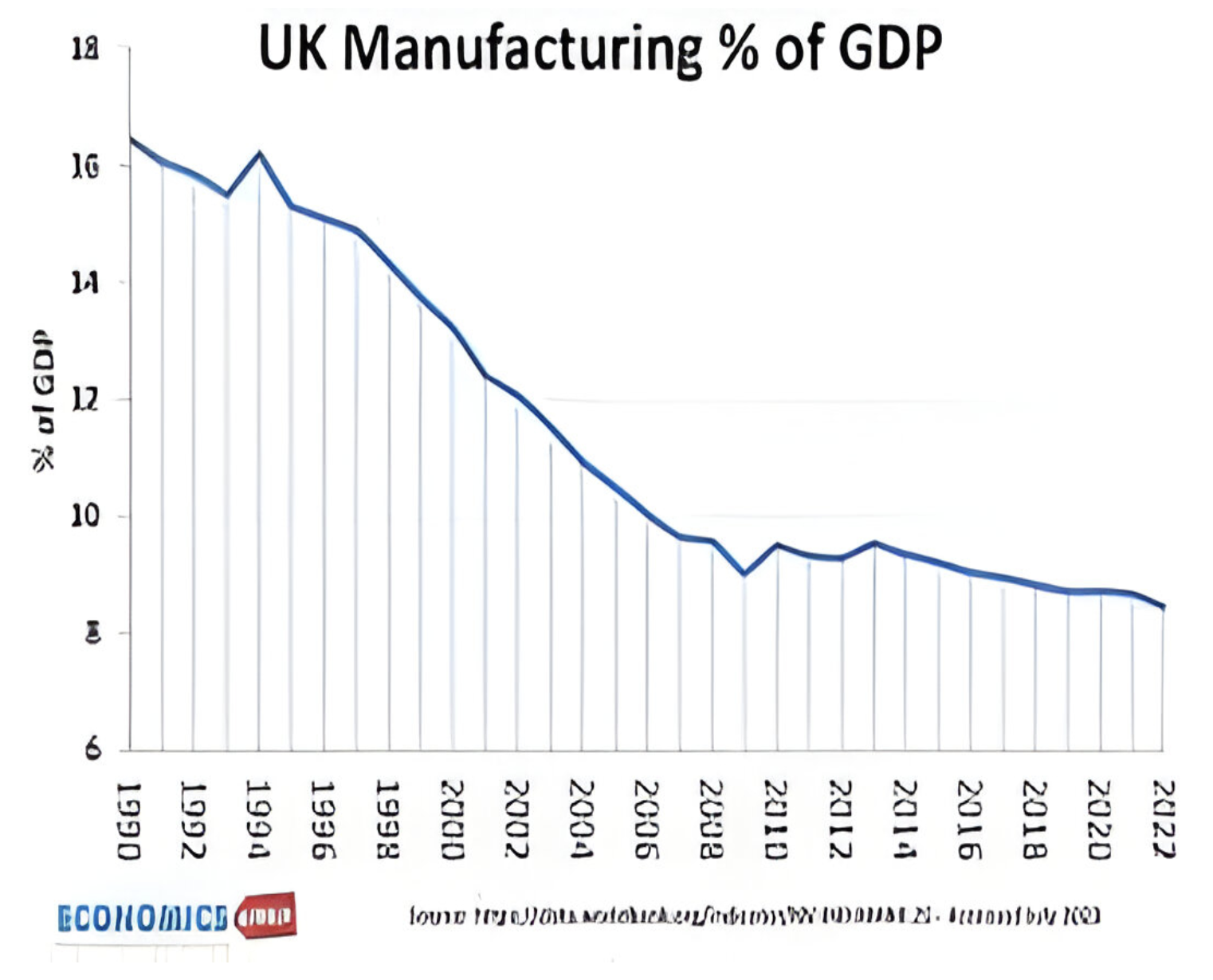
The problem in recent years is that positive prices are not guaranteed. This is because China has shut itself off from accepting our recycled materials. And since the UK has next to no manufacturing activity because energy here is now so expensive, that leaves the economics of recycling plants in major trouble. There’s simply no domestic demand for the end product. The main reason to engage in recycling is to avoid material plastic pollution in oceans and habitats, rather than to cut emissions.
There’s a reason why we used to send stuff to landfill. — IK
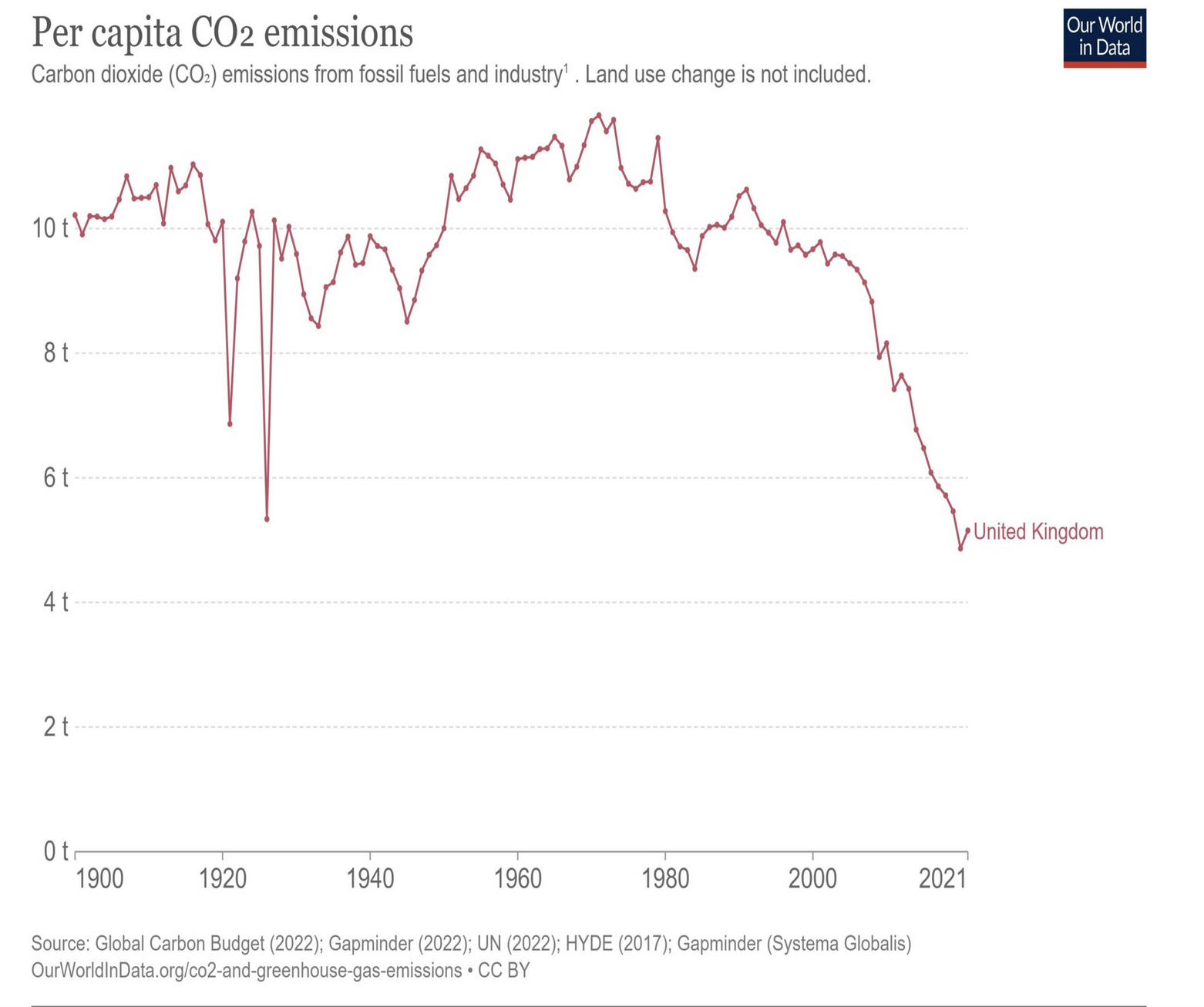
TOBY YOUNG’s The Daily Sceptic continued its defiant climate policy-questioning stance and hosted a piece by net zero sceptic David Craig arguing that Britain is now leading the way in economic suicide.
Just look at the numbers says Craig. And he has a point:
It’s possible to make a similar point about the close connection between global energy demand and global growth, as noted here. — IK
IN LOCKSTEP with the Treasury yield rise, the renewables segment since July has given up year-to-date outperformance versus the broad utility sector and has underperformed since.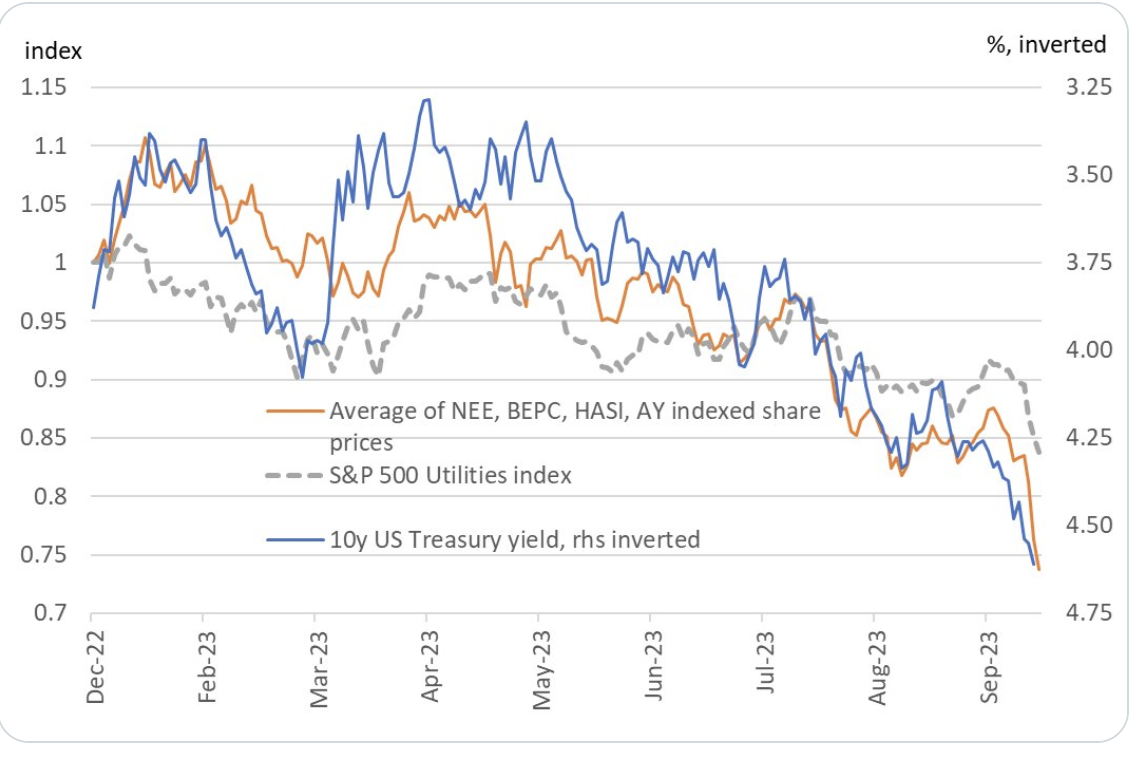
The reason this is happening is because all the very smart and virtuous people who calculate the comparative cost efficiency of renewables relative to fossil fuels have been engaged in wilful blindness and confirmation bias when crunching the numbers.
It looks increasingly likely that the decline in renewable prices was wrongly assumed to be the result of “efficiencies” and “innovation”, when really, it was the result of undercutting by China. And the only reason China still finds it economic to produce these things is because of their comparative advantage in using dirty energy and forced labour. That means every bit of the saving is not reproduceable in the West without tanking the expected profitability of investments or imposing an authoritarian structure. — IK
Media matters
THE FT REPORTED that Citadel founder, Ken Griffith, had joined a group of investors led by Paul Marshall to prepare a bid to purchase the Telegraph Group. The Group is expected to be purchased through Marshall’s UnHerd Ventures media group.
Rumours abound that Marshall is desperate to create an FT challenger, with a number of finance specialist journos being approached in the last few months to join forces on a new venture. The plan, either, seems to be to buy The Telegraph and double down on making its business section a politically neutral, firmly pro-capitalist publication — you know, like the FT used to be — or, to launch a dedicated finance section in Unherd.
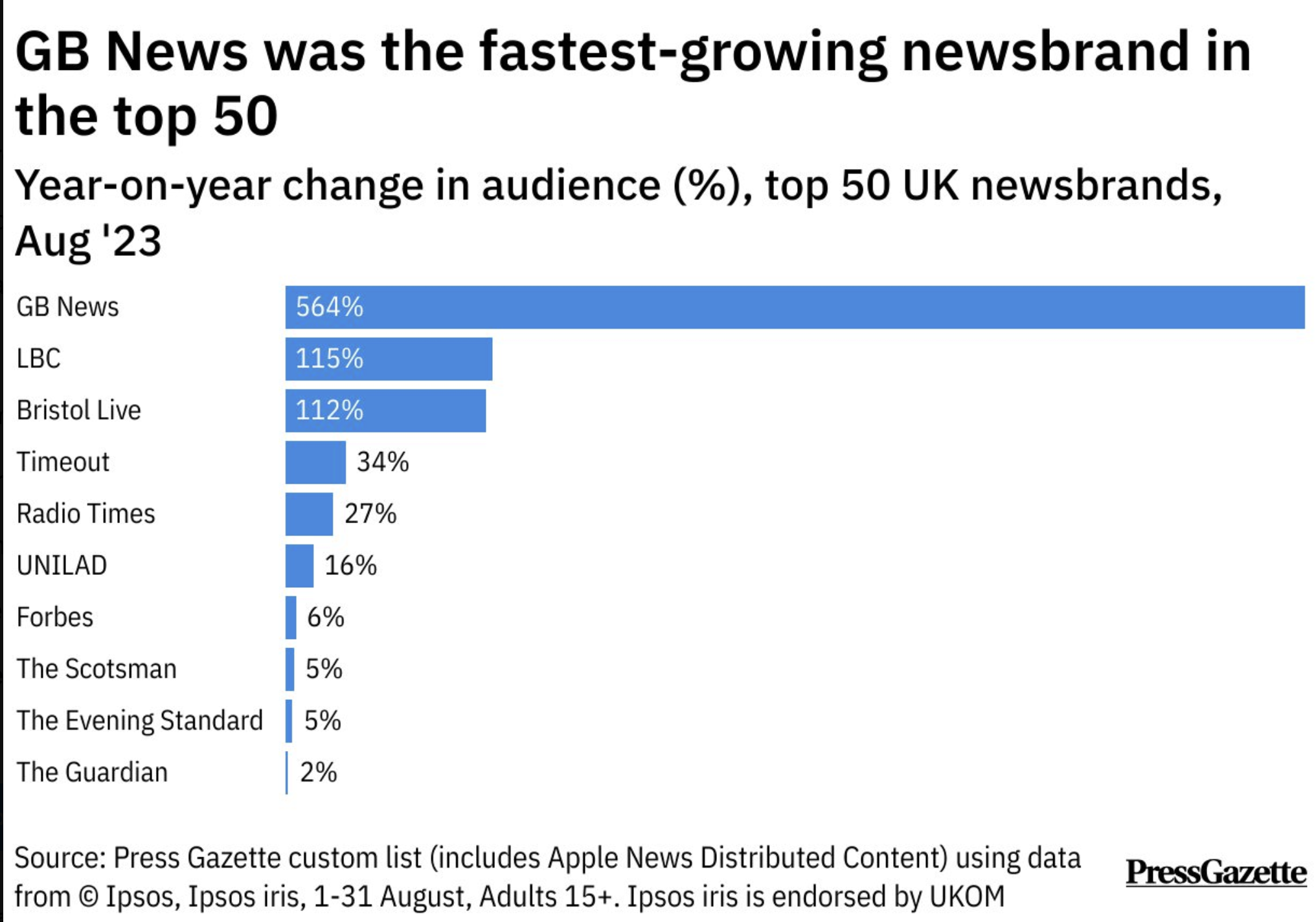
The news comes as Marhsall’s other venture, GB News, faces its biggest challenge yet, in a standoff between its presenters and Ofcom, following misogynistic live commentary by Billie Piper’s former husband. But who has the real power in that confrontation is the real question. Even the Press Gazette has admitted that “GB News has been the fastest-growing UK newsbrand in the top 50 every month since April when Ipsos began tracking its new .com URL”.
With Rupert Murdoch having bowed out with a very public call to push back against the establishment’s version of truth — he noted in his goodbye to Fox that “most of the media is in cahoots with those elites, peddling political narratives rather than pursuing the truth” — one has to wonder if Paul Marshsall is having a go at filling the void. — IK
THE EUROPEAN UNION issued a warning to Elon Musk, stating that X/Twitter must comply with sweeping new laws on fake news and Russian propaganda after finding the social network “to have the highest ratio of disinformation posts” of all significant social media platforms.
ELON MUSK responded to news that X/Twitter had cut its “Electoral Integrity” team, stating, “Oh you mean the “Election Integrity” team that was undermining election integrity? Yeah, they’re gone.”
CNN’s ratings plummeted to the lowest levels in its recorded history; just 55,000 viewers tuned in for its weekend slate of shows last week.
RUPERT MURDOCH’s biographer predicted the media mogul’s newspapers in the United Kingdom could switch their support in favour of Labour in the next election if Sir Keir Starmer is the “clear winner”.
ESTABLISHMENT antagonist Caitlin Johnstone penned a blogpost on X/Twitter that described why the controlled nature of contemporary journalists has little to do with their self-censoring. Johnstone argued that only those journalists who care enough to “dance to the agenda-setting task of the plutocratic media” climb the journalistic ladder — a “filtering system (…) that selects for obedience and subordination.”
MRC FREE SPEECH AMERICA found that Google’s search engine algorithm heavily prioritised President Joe Biden’s candidacy for the 2024 elections, and demoted results for most Republican candidates, bar anti-Trump Republican Will Hurd.
DOMINIC CUMMINGS questioned the hypocrisy of Western media regarding the presence of Nazis in Ukraine. Cummings pointed out how pre-war Western media would routinely call out Ukraine’s Nazi problem, which was then unilaterally declared a ‘myth’ once Putin’s ostensibly de-Nazifying invasion started.
Human rights in crisis
HUNGARY’s Viktor Orban claimed migrants had crossed the Rubicon by using automatic weapons on Hungarian border patrol.
I noted in an X thread that there seems to be a very broad but accelerating shift in public opinion questioning the viability of the Universal Declaration of Human Rights, from its asylum protections to freedom of speech and privacy articles. Are we at the point where the whole thing is going to be questioned and toppled? Are human rights only for good economic times? — IK
FORMER SUPREME COURT JUDGE Jonathan Sumption spelled out the case as to why the UK should leave the European Convention of Human Rights.
The weaponisation of everything
THE US MILITARY said it would reach out to legal migrants in the United States because it is having difficulty recruiting people. As part of that deal it will offer a fast track to American citizenship to those migrants who might consider joining. Oh the deep history parallels. — IK
COSTA RICA declared a state of emergency due to the surge of migrants moving through its territory on the way to the American border, where Elon Musk was hanging out observing the situation in a story that was largely ignored by the mainstream media.
BEJING promised it would provide support for Syria’s reconstruction as part of a strategic partnership deal struck during Syrian President Bashar al-Assad’s visit to China last week.
SEYMOUR HERSH penned a new piece on Substack, titled “A year of lying about Nord Stream” alleging that Biden’s decision to blow the Nord Stream pipeline, once the Nord Stream 1 pipeline’s gas flows had been halted and the war had commenced, was not related to deterring an already ongoing Russian offensive. Instead, Biden’s decision was an attempt to keep the Germans from getting “cold feet“, tying them irrevocably to the American position. This article coincided with China’s call for an “objective, fair and professional” investigation into the Nord Stream gas pipeline explosions this week.
FRENCH military staff were reticent about the prospect of leaving Africa, a popular destination among French troops.
ARMY WAR COLLEGE estimated a war with China would cause up to 3,600 casualties per day, and stated that “large-scale combat operations (…) may well require (…) a move toward partial conscription.”
PALANTIR TECHNOLOGIES won a $250mn contract with the U.S. Defense Department to research and develop artificial intelligence and machine learning technology.
SPACEX won its first Pentagon contract for the Starshield satellite network the company is building. According to the company, SpaceX was awarded a one-year contract with a value of $70mn for the satellite network, which forms a part of SpaceX’s civilian-oriented Starlink constellation.
FRANCE and Germany paved the way to Ukraine manufacturing its own arms.
THE LATEST talks over the highly controversial Ethiopian mega-dam on the Nile’s main tributary between Ethiopia, Sudan, and Egypt have broken up without agreement. The $4.6bn project which started in 2011 has been labelled a risk factor for conflict in the region, as both Sudan and Egypt rely on this tributary for most of their water supply, in a region where water scarcity is already a significant issue.
PRESIDENT TOAKAYEV of Kazakhstan announced that his country would follow the Western sanctions regime against Russia.
Is this the beginning of the end of Kazakhstan’s alliance with Russia? Not exactly.
The Caspian area has always been understood by Russia as a region where its influence can be more peacefully spread — conveniently beyond any NATO and EU border, Caspian-Western relations do not pose a threat to Russia’s territorial integrity. As a result, Caspian countries have always functioned as an easy go-between for Russia and the West.
This has now changed somewhat. Russia’s international isolation means it is placing an increasing burden on its Caspian allies to support it in international arenas like the United Nations, and it has significantly expanded its anti-Western propaganda in these countries.
At the same time, Caspian leaders are struggling to keep their relatively unhindered access to Western markets by cowtowing to some Western demands while appeasing their large, and ostensibly friendly, neighbour.
It is in this vein that Kazakhstan’s recent declaration should be understood. This is not much of a pivot. In 2022, Kazakhstan already declared its territory would not be used as a way for Russia to avoid sanctions — despite ample evidence to the contrary. It also emphasised its friendly attitudes towards Russia, and declared it did not feel threatened by Russian territorial claims. What has changed in that in 2022 Kazakhstan claimed it was opposed to the Western sanctions regime — while it is now claiming to be in favour.
All of this comes as other Caspian countries have openly balked at the prospect of a greater political alliance with Russia. Both Turkmenistan, Kazakhstan, and Uzbekistan refused to join a Russia-proposed “trilateral gas union” last November. But it should be noted that these countries only refused the political aspect of cooperation – all supported increasing their bilateral trade cooperation with Russia. Russia is still a most significant export market for the Caspian region.
So, though Kazakhstan’s declaration of support for Western sanctions is certainly a step towards the West, we should not harbour many illusions about a Caspian volte-face — at least not anytime soon. But the situation is certainly becoming interesting. — DGG
DOMINIC CUMMINGS posted data from Eurobarometer that parsed EU citizens‘ support for the Ukrainian war, which found that support for the war has now become a minority position.
English education remix
AHEAD OF NEXT month’s Conservative party conference, Rishi Sunak announced his government was exploring a radical reshaping of A-Levels into a new “British baccalaureate” that would require all 16-year-olds to study core subjects such as mathematics and English should they stay for Sixth Form.
In Sunak’s seeming desperation to rekindle a semblance of a competent Tory campaign, the British educational system has come under review. But someone should remind him that “if it ain’t broke, don’t fix it.”
Sunak’s favouring of an all-encompassing baccalaureate likely goes further than a skin-deep reforming instinct; the PM has been harping on about a British equivalent system for years.
Unfortunately, Sunak may have it all wrong.
There are several things that make a British Sixth Form education the best in the world — precisely those things Sunak wants to scrap.
The first is that it grants agency to 16 year olds to select and specialise into and away from subjects they have familiarised themselves with for over a decade. For all the criticism being aired by the pro-reform camp, I have never heard a single student complain about being forced to specialise into 3-4 subjects. Quite the opposite — most are delighted to finally drop their hated subjects and focus on their strong-suits.
Most students aren’t like Rishi Sunak, dexterous speakers and mathematicians. Mathematics has always terrified me, and I’ve seen highly gifted mathematicians collapse into tears when asked to analyse ‘Of Mice and Men’. It’s shockingly stereotypical – but mostly true. English is typically hated by STEM-oriented students, and mathematics by humanities/arts-oriented students.
Sixth Form is fundamentally a *choice* — it is the first time education is technically in the hands of the students. Allowing these volunteers to focus on their favourite subjects practically transforms school into a beautiful learning experience they can wake up looking forward to. This is something no other system does as well — neither the French Science — Economics and Science — Literature split, nor the horrendously monolithic Spanish baccalaureate, nor the International Baccalaureate.
The seething jealousy of my fellow IB students, as they observed their A-level colleagues smile through exam revisions while they were forced to churn through several compulsory subjects, is not something I’ll ever forget.
Why force students to waste their time struggling in a field they don’t feel suited for? Some would call it toxic paternalism.
We understand the logic. Sunak believes that Britain’s competence on the world stage depends on its training of technical-minded students who can both write and calculate. But Britain’s strength is precisely that its top companies have individuals who have bathed in the arts and humanities, who were granted the freedom to pursue their genuine interests in Sixth Form first, and then the universities, where the analysis-focused nature of Britain’s arts and humanities courses allows such specialisations to become professionally relevant.
It is this diversity through specialisation that gives a British education — and via that the British economy — that special flavour that sets it aside from all other educational and professional systems.
Some things should never change. Britain’s educational uniqueness is one of them. — DGG
American political drama
CONGRESSMAN James Comer subpoenaed two bank wires that revealed Hunter Biden received payments from Beijing in 2019 as President Joe Biden was running for President, where Joe Biden’s Delaware home featured as the beneficiary address for both wires.
Politico’s finest
NOT SO MUCH in readers’ blind spot as the story was all over social media, but an acute example of how institutional blind spots can play out. Also, it had to be noted for posterity. A Ukrainian veteran of Hitler’s 14th Waffen SS Galicia division was given a standing ovation in the Canadian Parliament last week during Zelensky’s visit. House Speaker Antony Rota took responsibility for the blunder that Trudeau has since labelled “deeply embarrassing”, and resigned shortly after.
Hilariously, following the incident, Trudeau reminded Canadians that it was more important than ever to “push back against Russian propaganda, Russian disinformation”, as Russian-aligned channels broadcasted the embarrassing incident over social media. Poland has since outlined its effort to carry out an extradition request for Yaroslav Hunka for his former membership with this criminal organisation, which carried out numerous war crimes against Poles and Jews, though Canada’s Minister of Justice has claimed “no extradition request” had been filed. — DGG
THIS BRILLIANT article by Anchal Vohra aptly summarised the recent week of Canadian-Indian accusations regarding the murder of Hardeep Singh Nijjar in Canada. Vohra reminded readers that should Canada produce a credible “smoking gun” regarding India’s links to the murder, it could force the Five Eyes countries, all of whom have significant Sikh populations and strong relations with India, to condemn the country for illegal activities overseas.
Trump’s Teflon coating
A NEW YORK JUDGE ruled that Donald Trump defrauded lenders and must dissolve businesses.
For those who wonder how it is that despite all the indictments, charges and legal losses Trump remains more popular than ever, I thought I would repost how a story like the above is processed by Trump supporters. Here’s how one Trump supporter I know responded (though I haven’t had time to fact check):
1) Trump is being accused of overstating the value of Mara Lago for the acquisition of loans.
2) Banks agreed with his valuation and used Mara Lago as collateral.
3) Trump paid the loans back so there was no one hurt.
4) The courts assessment is based on the difference between Trrump’s stated value of Mara Lago and West Palm County’s stated assessed value of Mara Lago. West Palm Beach has an assessed value of $18 million on the property.
5) Florida’s county assessed values have nothing to do with a property’s value and are mitigated by numerous rules, such as the Homestead exemption which requires that for homesteaded buildings, the government can not value a property more than 3 percent above the previous year’s assessment, though to the downside, the property can be assessed down to whatever it needs to be assessed down to.
6) The homes surrounding Mara Lago, on .28 acres averaging 6k square feet are all valued by Redfin and Zillow at between $8 million and $40 million.
7) Mara Lago is an historic property on 1.5 acres and 62,500 square feet. The idea that it might be worth a little bit more than the surrounding properties is obvious.
8) It’s worth noting that NY allows Chinese companies to own companies, but apparently not the former president of the United States.
— IK
Commodities cornered
RUSSIA SAID it plans to export almost no diesel to Europe next month.
Part of the rationale for this move is no doubt to lean into an already tight product market in Europe, where despite the price declines from the summer to winter spec shifts, overall supply dynamics are still tight. The other part is that Russia’s own market probably needs the fuel too. — IK
POLITICO’s BARBARA MOENS and Bartosz Brzezinski reported on the European Commission’s total failure in dealing with the Ukrainian grain glut crisis. The import bans on Ukrainian grain announced by Eastern European capitals were set to commence on September 15, a deadline the Commission let lapse, and these countries are now facing a lawsuit at the World Trade Organisation filed by Ukraine. And now, since trade policy is in the Commission’s remit, it will find itself representing Hungary, Slovakia and Poland at the global trade body — even though it disagrees with their stance.
To keen watchers of European politics, it is clear that something broke this week. Seemingly out of nowhere, for most observers, the Ukrainian grain glut went from a small crisis to a full-blown diplomatic meltdown in the space of a week — especially with Poland. But a close look reveals the grain-glut crisis speaks directly to greater tensions, lodged in the heart of the European model.
Since Russia pulled out of the Turkey-brokered grain deal in 2022 and began bombing Ukrainian grain depots and cargo ships in the Black Sea, Ukraine’s desperate search to offload its grain has led to a head-on collision with Europe’s eastern grain producers. Something the inauguration of a new grain corridor in the Black Sea that hugs the Western coast by Ukraine has done little to quell.
The limitation of its Black Sea route has damaged Ukraine’s ability to export to its natural purchasers — the Middle East — and it has been forced to seek far less profitable overland routes through Poland and Hungary into European markets. Unsurprisingly, this led to objections by Hungary, Poland, and Slovakia, whose grain farmers’ prices are significantly undercut by cheaper Ukrainian wheat, which threatened to flood their traditional export markets. It forced the European Union to protect its farmers, and led to an imposition of significant restrictions on Ukrainian grain exports by the EU that expired September 15.
But the continuing pressures of cheap Ukrainian grain were the reasons that underpinned these three countries’ unilateral imposition of an agricultural import ban on September 16 — openly flouting both EU and WTO trade rules.
International media have been keen to emphasise the role of upcoming Polish elections. The ruling PiS party is being squeezed from both sides —especially from the hard-right — and is, therefore, taking a harder stance to defend its primary constituency, farmers.
But Hungary and Slovakia are also dead-set against being flooded by Ukrainian grain.
More than Polish elections, as Dacian Ciolos, former agriculture commissioner and European lawmaker, told Politico’s Eddy Wax and Douglas Busvine, this crisis speaks to the European Union’s need to reform its Common Agricultural Policy.
This common market, designed to protect internal farmers from competition overseas, is looking at its destruction under the admission of Ukraine. Ukraine’s pre-war GDP is not only half the size of Bulgaria – which would shift most EU money currently being dispensed in its Eastern countries towards Ukraine — it also holds a quarter of Europe’s farmland, and the most fertile soil in the world.
The Center for European Policy Analysis agreed, stating a reform of the EU’s CAP is the clear “imperative” and major stumbling block of any Ukrainian admission. France and Poland, its largest beneficiaries, stand to lose significantly should this admission occur under current rules.
But at the same time, Hungary, Poland and Slovakia are still aligned behind the United States and Ukraine in the latters’ desperate fight against its eastern neighbour. Thursday saw Ukrainian and Polish leaders emit friendly tones, with Ukraine offering to create a batch-based verification mechanism for agricultural exports, that could only be exported with the approval of neighbouring countries like Poland. Poland, for its part, stated Ukrainian grain could foreseeably be exported through Poland but not remain in the country, and asked it to drop the lawsuit at the WTO in exchange.
The above clearly suggested the grain-glut crisis may soon come to a close, at least in its current iteration.
But it does nothing to stop the pertinent questions that arose, hidden, behind the conflict. The challenge to European enlargement does not stop at the CAP; it strikes at the heart of deadly tensions within the European project, and the fight between enlargement and integration.
Enlargement and integration worked wonders for the budding European project before the collapse of the Soviet Union, centred as it was on relatively similar Western European countries. It was the enlargement to its significantly poorer neighbours in the far East, such as Poland, Hungary, Romania, and Bulgaria, that created the first veritable challenges to its integration policy.
The goal of the European Union, lest we forget, is not just the creation of a common market and budget-sharing mechanisms. Its goal was to achieve ever-greater policy integration, creating a harmony between pan-European economic and institutional considerations. And it’s no secret that Europe’s new joiners struggled mightily to comply with many of these rules, especially regarding the separation of judicial-political powers — an ongoing thorny subject between the EU, Poland, and Hungary.
This gives colour to Polish media rumours [referenced above], which claimed Ukraine was granted a secret deal by France and Germany for faster EU accession should it help get rid of Poland’s PiS — this conservative Polish party has been a thorn in the side of European integrationists for almost a decade.
So isn’t it ironic that European integrationists are butting heads with Poland and Hungary, when Ukrainian admission (and its record levels of corruption) would foreseeably cause much greater integration headaches?
The grain crisis’ solution, therefore, opens the door to Europe’s next great bifurcation. Will a singleminded drive towards integration tear whatever sovereignty remains away from our new Eastern members, or will a pusillanimous focus on enlargement at all costs create an even more frozen European Union? Only time will tell. — DGG
FORMER SWEDISH PRIME MINISTER Magdalena Andersson claimed she wants the army sent to squash the rising trend of gang violence in the country. Her statement came after Thursday saw two men get shot in Stockholm and a 25-year-old woman get killed during an explosion in Uppsala. Sweden’s Prime Minister has agreed to these suggestions and summoned the head of the Swedish armed forces to help quell the surge in gang-related shootings and bombings.
Some people were questioning if this is why Sweden has decided to join Nato — IK
Covid collateral damage
MAJOR FLAWS in research may have prompted an overdiagnosis of the risk of contracting long COVID-19, a new study has suggested.
LEADING CHARITIES and experts drafted a damning report which condemned the British government’s lockdown policy, as it had a “long-lasting and era-defining impact” on children.
UNHERD’S FREDDIE SAYERS flagged that the UK Govt Health Security Agency quietly published its report this week into whether Covid lockdowns worked and concluded that … “There is a lack of strong evidence on the effectiveness of NPIs to reduce COVID-19 transmission.”
