

After 13 years of fighting, the Western hemisphere’s longest-running active conflict remains its most bizarre standoff. And yet, almost everything makes perfect sense.
French and American interests supported the rise of a former CIA-asset-turned-warlord, Khalifa Haftar, who battled on the Libyan streets alongside Wagner militias and Emirati Mirage jets against a UN-recognised government backed by Italian oil companies, Turkish boats and drones, and “Free Syrian” mercenaries.
…What? How could this counterintuitive web of alliances possibly make sense?
We hear you. To make this easier, let’s start with some history.
To most of us, Libya is much like the other North African states: countries with relatively long histories of more-or-less united Kingship, such as Morocco and Egypt. At least, that’s what I thought, too.
But no, I came to find out that Libya — unlike some of its neighbours — has rarely been a unified territory. Not only that, it is a surprisingly dis-unified territory alongside rather clear-cut lines:

For over 3,000 years the territories of Tripolitania and Cyrenaica had existed as separate and distinct entities, differences which have laid their mark on today’s conflict.
Both territories grew rapidly under the booming Mediterranean economy granted by Pax Romana, but their culture grew in different directions. While the character of Tripolitanian cities remained decidedly Punic due to lasting influence from the Carthaginian Empire from neighbouring Tunisia, Cyrenaica became a major Greek trading post. The differences were such that the border of the Eastern and Western Roman Empires in North Africa in 395 were cut alongside this border, with Cyrenaica going East and Tripolitania going West.
And although the doctrine of Christianity spread far and wide through these territories before Islam, their imprint was also different. Tripolitania was heavily influenced by the Pope, whereas Cyrenaica remained under the influence of the Coptic patriarch of Alexandria. Even under the Ottoman Empire, when most Libyan territory was split between the Ottoman regions of Ottoman Tripolitania and Egypt, Cyrenaica remained (sort of) administratively independent from the Tripolitanian wali.
Being “unified” under Italian rule, the first true experience of united self-government in Libya’s history was 1951 — when a Cyrenaican monarch reluctantly ruled over an untrusting Tripolitanian populace in the West. While Fezzan and southern Cyrenaica remained under the monarch, its extremely sparse population and the impassability of its borders means the region is more or less a permanent, inactive outback compared to the bustling commerce and conflict on the coastline.
Let’s have a broad look at a modern-day image of the current “civil war” in Libya, courtesy of:
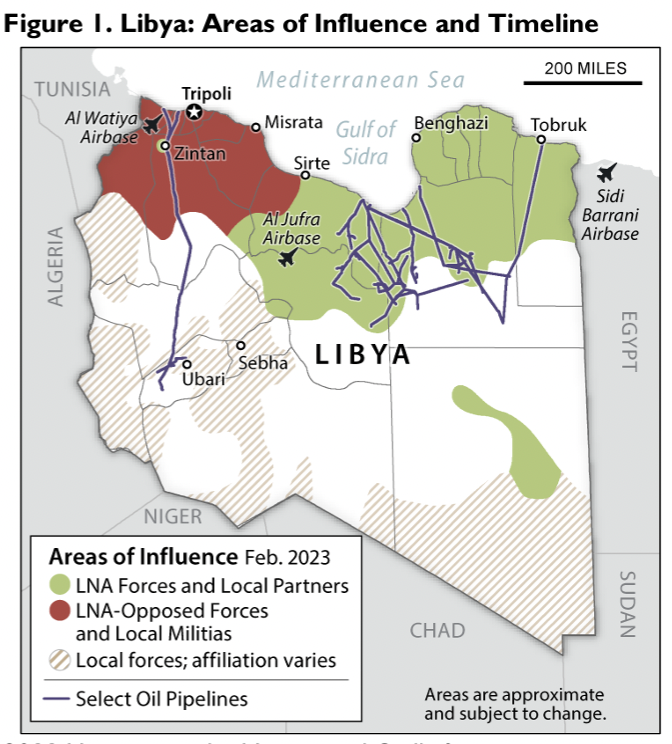
Notice anything? There’s a reason we put apostrophes next to “civil war”. To my mind, if two territories that have been administratively and culturally distinct over their entire history now find themselves at war, it’s simply a war — not a civil one. And the current Libyan “civil war” is just that — a fight between two historically similar neighbouring territories over each other’s resources.
As for the conflict, its basic components can be handily summarised. The zone is split into three broad regions:
- Western Libya/Tripolitania: Run by a series of governments — usually called the GNA — is a highly decentralised statelet that relies on groups of militias. While it has little control over oil and gas fields, it retains control of the only external gas pipeline, which goes to Italy, the Central Bank, and the internationally recognised parliament.
- Eastern Libya/Cyrenaica: Run by Khalifa Haftar — head of the Libyan National Army — and the Tobruk-based House of Representatives, is a relatively centralised statelet that has control over most oil and gas fields. The strongest of the three, but it suffers from a lack of international legitimacy and foreign exchange since almost all internationally recognised components of Libyan statehood and financial infrastructure are based in the West.
- Tribal areas/Fezzan: Under the nominal control of Cirenaica or Tripolitanial; however, the area is ungoverned by any central authority — despite what any map may claim — and relies on the local leadership of certain tribes that rarely stretch beyond a few dozen kilometres.
There is an additional actor that is non-regional, extremist IS militias, which nabbed several areas of Libya in the “Second Libyan Civil War” from 2014 to 2017, which have been mostly subdued since.
The second civil war itself can be handily summarised based on the following equation:
One side attacks the other. It is initially successful. After initial successes, the offensive withers after one side’s powerful allies steps up airstrikes and threats of war. Under international pressure, both sides reconcile to gain a window of time and recover oil money. After enough oil money is received, the conflict starts again.
The conflict was complicated by how the Tripolitanian and Cyrenaican divisions ran in the central bank. While it was unified until the Second Libyan Civil War in 2014, its Eastern and Western branches then became split along geographic lines. Mostly as a result of the stagnated fighting since 2020, the central banks have now reunified as of August 2023, which should technically enable them to enact monetary policy effectively. Whether they will, and whether any enactments will have any significant impact, is questionable — since much of the foreign fund flows in Libya have been effectively bypassing this institution since the split, even in the West. Critically, however, it has enabled the newly reunified central bank to lift the judicial seizures on its assets managed by Euroclear, which have been seized since the start of the Libyan conflict through its control of the Libyan Investment Authority.
Of course, there’s much more to it than that. But the best part is yet to come. How is the conflict split? Well…

Eastern Libya/ Cirenaica’s Khalifa Haftar’s government is supported by the following:
Main backers: Egypt, UAE.
- Egypt
Egypt’s support for Cyrenaica is more or less obvious. Not only is the region on its border, but Khalifa Haftar’s government is comfortably secular and militaristic, much like Egypt’s own. Egyptian governance is terrified of its internal Islamist opposition — which garners more strength every year — and particularly of the Muslim Brotherhood, which the current regime overthrew. Furthermore, should Haftar take control with Egypt’s help, Egypt could leverage its historic support to force Libyan gas claims to move further west and not intrude with Egypt’s own — and to allow for its export of Egyptian gas along an extension of a planned Israeli-Cypriot-Greek pipeline:

Egypt has proven to be Haftar’s most valuable ally, forcing the halting of a series of successful offensives in 2020 against Haftar — claiming that if the Tripolitanians took the city of Sirte it would commence a ground invasion of the West.
- UAE
The UAE’s long attempt to curb the role of Islamist parties — which it too views as a threat to its own Royalist government — means it is a natural ally of Haftar’s militaristic government. It also allows the tiny country a regional ally and foothold in the Mediterranean: It has controlled and refurbished an air base in Eastern Libya from which it flies out French-supplied jets that attack Tripolitanian forces.
While the UAE’s support is less central than Egypt’s, it is no less relevant. The UAE supplied Haftar with weaponry, fuel, and air support, while financially underwriting the involvement of Wagner Group forces. The UAE’s backing has also been key in mobilising French proxy support for Haftar.
Secondary backers: France, Israel, Russia, and the United States.
- France
French support for Haftar is similarly clear. Primarily occupied with countering political Islam, which is a major threat to its de-facto colonies in the Sahel, and with controlling migration flows to Europe and weapons flows to the Sahel, it sees a ready ally in Haftar’s centralised control. This explains why France has been supporting Haftar via the UAE and Egypt, selling these countries large amounts of French equipment which go on to be used in the conflict on Haftar’s side.
It must be noted, however, that since the fall of most Sahelian allies of France and Haftar’s failed offensive in 2020, French support for Haftar has withered and shifted to instilling the need for both sides to agree.
- Russia
Russia’s support for Haftar is less based on immediate geopolitical needs, and more long-term financial gain. By supporting Haftar early with the Wagner Group and supplying its liquidity-starved regime with banknotes, it is buying sway it hopes to leverage for tasty reconstruction funds if Haftar eventually takes control of the whole country.
Like France and the United States, however, Russian preference sways between support for the Cirenaicans and pushes for a ceasefire and mutual recognition.
- Israel
Israeli support for Haftar is limited to the exchange for weapons in return for eventual recognition. While it presumably hopes to limit Libyan gas claims which impede on its goals to furnish a Greek-Cypriot-Israeli gas pipeline into the EU, it is obviously keen on limiting the rise of an Islamist stronghold in the Mediterranean country.
- The United States
While the United States is, openly, only in favour of a mutually agreed government in Libya, it has clear preferences for the Eastern regime. Not only is Khalifa Haftar a former CIA asset who settled in Virginia after being exiled by Ghadaffi, but solid rumours suggest that Haftar has not been running in Libyan elections because he’s an American citizen.
America openly supported the Cyrenaican regime under Donald Trump as Haftar’s forces were on a temporarily successful offensive into Tripolitania, which included giving the green light for Erik Prince’s mercenaries to provide jets and other forms of weaponry to Haftar’s regime. These mercenaries were to fight alongside Wagner troops and even had plans to assassinate Libyan generals who were also EU citizens of Ireland. After the failure of Haftar to take Tripoli, however, the American position has returned to a brokering stance — at least, publicly, and Prince’s support came to little more than providing a few Gulfstream jets.
Western Libya/ Tripolitania’s UN-recognised government is supported by:
Main backers:
- Turkey
Above all, we suspect Turkey’s support for Tripolitania largely comes down to Western control over Libya’s internationally recognised maritime claims at the international level. This means Turkey can leverage its military support for Tripolitania to push on competing gas field claims by Greece in the Mediterranean:
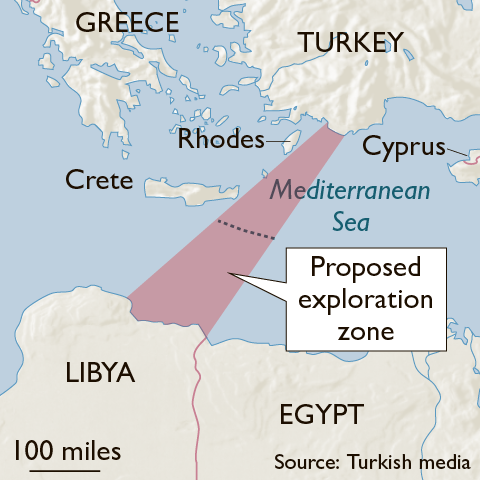
This proposed exploration zone, a red line in Libyan peace talks by the Tripolitanians and Turkey, directly cuts across a Greek/Cypriot/Israeli and Egyptian claim to move gas to the European Union from the Eastern Mediterranean.
Furthermore, Turkey’s Islamist government is far more comfortable dealing with a side that relies on relatively extremist militias and which has an active Muslim Brotherhood presence. The Turkish switch from secular to Islamist power has been most readily seen in its fighting in the Syrian conflict, where it expertly leverages Islamist militants alongside its own professional artillery and tanks to take on the Syrian regime and Kurdish allies of the United States. This was best seen when it flew in large numbers of Syrian fighters to bolster the Western regime’s forces and stalled Haftar’s advance into Tripoli.
- Qatar
Qatar, like Turkey, has an interest in supporting Islamist, Muslim Brotherhood-leaning factions, and was accused by the UAE of financing Al-Qaeda-linked militias in the region. As such, in supporting the fighting against the Egypt-backed East, it is furthering its own proxies quest for an increased powerbase in the Mediterranean.
Secondary backer: Italy
- Italy
Italy supports Tripolitania for obvious reasons. As the only European power directly plugged into its gas resources, it gets cheap gas from its Libyan neighbour:
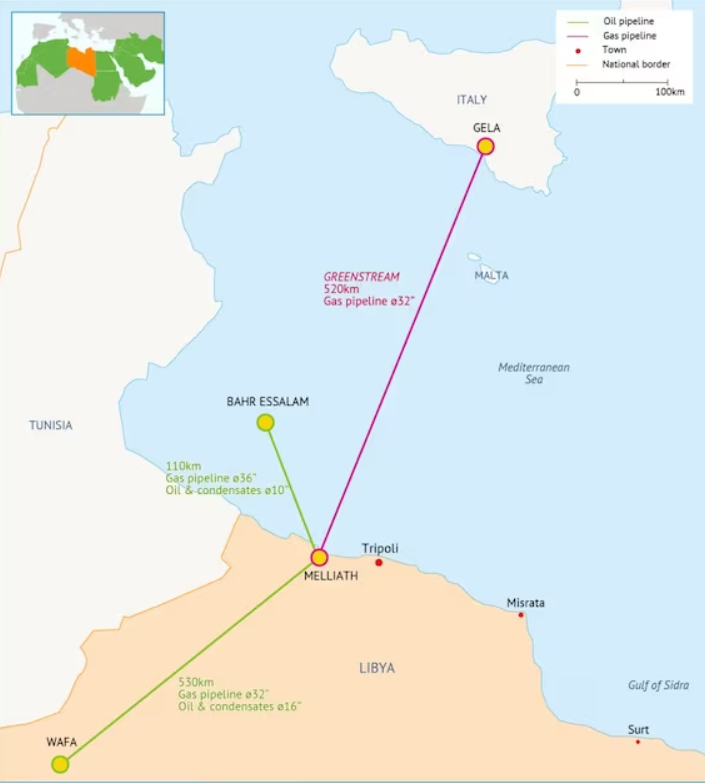
This also means Italy’s main oil and gas company Eni is a major player in the conflict, and hands out financing to Western Libya in return for claims on Libya’s vast offshore gas fields. Furthermore, in a country dominated by worries of migration flows, a handy relationship with the nearest port town (Tripoli) and largest transport area of migrants is a necessity.

Meanwhile, the European Union is supporting both sides — providing funds and boats to not only the Western-controlled Libyan Coast Guard but also the militia of Haftar’s son, which has been linked to serious human trafficking activities, to push back migrants being led to European shores by Libyan human traffickers.
While this is anything but a comprehensive understanding of the Libyan Civil War, we hope it provides a better insight into the historical and geopolitical dynamics of the conflict.
The last question you may have is: With all this support for Haftar, how come the disunited Western regime has held for so long? This is surely a question the United States and Russia might have. Both sides could presumably switch allegiances to the Western side — particularly the US. After all, both Turkey and Qatar are American allies, and it seems the preferences of these two geopolitical players were primarily based on the assumption Haftar could readily win, which he hasn’t.
I assume that the West’s readier access to foreign exchange currency through its gas deals means its militias — man-for-man — may be better equipped and paid than their Eastern counterparts. And a little Islamic ideological sprinkling surely goes a long way in maintaining an effective fighting spirit.

One Response