

| SNEAK PEEK |
— The FATF’s de-greylisting of the UAE provides Izzy with a good opportunity to take a closer look at how the shadowy finance body operates.
— William Hague says the quiet bit out loud with respect to why the West needs to seize Russian assets.
— Dario argues that the rise of Chinese state-owned company militias is not half as impressive as the rise of dual-use commercial infrastructure, especially in the marine sector.
Good morning subscribers! We are back from half term, and there’s lots to catch up on so let’s get cracking. As usual the newsletter is compiled and written by me, Izabella Kaminska and Dario Garcia Giner.
Send tips to [email protected] and [email protected].
| THE BIG BLIND SPOT THIS WEEK |
FATF HORSETRADING: The UAE was dropped off the FATF grey list after a long-running media campaign to improve its image seemed to have the impact intended. Whether the Emirates, which includes aspiring financial powerhouse Dubai, has genuinely improved its anti-money laundering practices is another matter entirely.
Political leverage: As POLITICO’s Matthew Karnitschnig reported, according to some of FATF’s own reviewers, the group’s push to remove UAE from the grey list was driven more by political considerations than any progress the country has made against money laundering. So the question everyone should be asking is: what does the United States get in return?
Catch me up: The FATF, aka the Financial Action Task Force, has its origins in international efforts first put in place to fight money laundering by America in the 1980s. It was Ronald Reagan who, under the pretenses of the “war on drugs”, introduced legislation that made the United States the first state to officially criminalize money laundering under the US Money Laundering Control Act of 1986. In 1988, the Basel Committee issued its own statement in support leading the UN to establish a money laundering definition. Even so, further international coordination was still flailing. To up the ante, in 1989 the US proposed a one-year, fact-finding task force to catalogue the state of AML laws on a sovereign level around the world. The effort eventually morphed into the creation of the 11-member Financial Action Task Force in 1989.
Shadowy operations: What most don’t appreciate is that the FATF never became a formal organisation. To this day the network operates as a “project” from a secretariat hosted by the OECD in Paris, staffed by only a couple of dozen people. FATF critics contend this is by design, because if the body were to set itself up as a formal organisation it would have to be held accountable to human rights legislation. Since it’s not accountable to human rights legislation it can instead use its influence (which ultimately flows from US financial dominance) to exert pressure on sovereign nations to adjust their legal statutes to comply with FATF objectives with little concern for habeas corpus or any other long-established civil liberty norms.
Inverted SPECTRE: As one academic put it, “ultimately, FATF looks much more like a transnational, multi-level network than a quasi-hierarchical international organization.” So a bit like that other well-known shadowy network that draws its power from threatening weaker counterparts with punitive measures if they don’t hand over the goods.
How does it work? FATF uses a system of “mutual evaluation” to determine which countries get to stay on the grey or black lists it constructs and which ones do not. In practice, however, there is often little rhyme or reason to how countries are categorised. Much of the ranking is determined by political power and/or via a country’s standing vis-a-vis the United States, meaning the listings tend to reflect who is in good relations with the US.
But is it a US data dragnet? Some say maybe. While FATF may have been born out of the 80s drug war, by 2001 it had expanded its reach across the world by reinventing itself as a tool to counter terrorism financing. That the US lost the so-called crypto wars around the same time and with it, the country’s control over encryption software via US-implemented backdoors, seems a notable coincidence. Thanks to the push to expand AML to CFT, the amount of economic data that could be gathered on global citizenry increased manyfold.
One man’s terrorist is another man’s freedom fighter: But there’s no doubt the regime also began to politicise the banking system and undermine a key economic principle that money in a capitalist system should be neutral if it is to maximise economic efficiency. This is because what qualifies as terrorism around the world can be highly subjective and politically motivated. And yet, under the FATF system, bank officials are the ones positioned to determine the difference between a Jan 6-style domestic/foreign terrorist and a Navalny-style revolutionary. Often the best determinant is which particular movement is favored by Nato and which isn’t.
How tax authorities hijacked the judicial system: An essential tenet protecting civil liberties in the so-called free world is the idea that everyone is innocent until proven guilty and that there should be no confiscation or seizure of assets without conviction. With FATF, however, these assumptions can no longer be assumed because the AML, CTF and sanctions-focused legislation brought in under the regime depends on the notion that bank authorities, not legal specialists, can deprive you from your assets on an assumed guilty until proven innocent basis whenever they subjectively deem you a risk.
Reputation management: Before FATF bank business models focused on banking those that were profitable to bank. While the poor were often frozen out there were significant cost savings associated with the fact banks didn’t have to trouble themselves with making moral or ethical judgments about who their clients were. These savings could be passed on to all customers. Nor did this system preclude the possibility of working with authorities, operating in line with legal “probable cause” norms, and handing over data or evidence when there was good reason (based on an actual criminal probe) to do so.
Establishing ‘pre-crime’ norms: Under the FATF regime, however, banks are forced to spend billions (largely wasted as it’s an impossible task) to determine how likely their customers are to be money-launderers, foreign or domestic terrorists, PEPs or sanctioned individuals. The problem with the system is not just that bank personnel are not equipped to make such judgments or that the regime subverts due legal process, it’s that the regime has been a total failure at achieving its official anti-crime aims. Over 35 years of FATF and illicit drug, arms or people trafficking is more than flourishing, terrorism is still a thing, and online fraud is at epidemic levels.
So what is it good for? FATF’s greatest triumph, if any, has been the routine debanking and exclusion of those deemed politically problematic by establishment forces, from populist politicians like Nigel Farage to crypto currency merchants and non-profits and charities.
Another shocker… The vast majority of bank fines rendered under the AML regime aren’t even distributed to banks for banking criminals or facilitating criminal transactions, but rather for failing to have the correct surveillance measures in place. This puts into question whether the regime has any chance of fighting real crime at all? Those on the frontline tell the Blind Spot it has not because Suspicious Activity Reports, known as SARS, are completely ignored by police authorities which continue to lack the resources or capability to investigate the majority of cases.
But it’s worse than that: As we learned from the Farage case, under the regime banks are frequently obliged (under the threat of fines if they fail to monitor clients) not to inform their own clients if they are being red flagged by their systems or being deemed politically-exposed-people. That fact alone transforms banks from their traditional role of being credit providers to de facto enforcement agents of the state, whose primary job is not lending but keeping active and secret reports on their clients akin to Stasi-style secret services.
AND THE AMLA PRIZE GOES TO … FRANKFURT: It feels apropos in that context that an EU vote late Thursday determined that the EU’s new anti-money laundering authority should be situated in Frankfurt, not quite the Berlin-based former home of the Stasi but close enough. It’s an extraordinary decision too in light of the German state’s complete failure (in large part due to capture) to track and neutralise one of the world’s biggest financial payment frauds,Wirecard. The authority is expected to draw thousands of well-heeled bureaucrats (who may or may not develop a penchant for wearing fedoras) “to improve the detection of suspicious transactions and activities, and close loopholes used by criminals to launder illicit proceeds or finance terrorist activities through the financial system.”
FARAGE WAS RIGHT! As my POLITICO colleagues noted in this week’s debut UK Financial Services newsletter, an investigation by MPs this week partly blamed the Financial Conduct Authority for an “unprecedented rise” in banks shutting customers’ accounts in the last 5-10 years. The regulator encouraged banks to prioritize reputation rather than serving a wide array of customers, according to the report by the All-Party Parliamentary Group on Fair Business Banking, in conjunction with law firm Humphries Kerstetter. You can read the report here.
In their own words: “If you are basing business decisions on something as amorphous and ephemeral as reputation the pitfalls are everywhere and bring into play politics, changing public opinion or just poor decision making.”
Farage exception: The report found that in Farage’s case the banks took a far more considered approach than they usually would to get rid of clients that don’t fit their image. The usual tools for ordinary people are much blunter.
Not just Nigel: MPs found data showing that hundreds of thousands of accounts are shuttered each year under the auspices of financial crime: “The case studies provided to us and many more reported in the press expose an awkward truth — that the financial, regulatory and reputational pressures facing banks are prompting more and more firms to decide that many clients, and some whole industry sectors, are simply not worth the candle.”
Awkward squad: Thousands of customers are debanked or having facilities refused every month, including cryptocurrency businesses, jewelers, bookies, politicians, sex workers, and yacht brokers, as they are problematic for banks. Even CryptoUK, a well-known industry trade body, has been refused banking services because of the word “crypto” in its name. A broad-brush, automated approach has been taken for individuals or businesses whose “perceived risk profile [is] outside the norm,” the lawmakers said.
| BUSINESS, ECON AND FINANCE |
BITCOIN RESERVES: Official filings from Reddit confirmed the social media platform “invested some of our excess cash reserves in Bitcoin and Ether.” Palantir, meanwhile, has been loading up on gold, according to its filings.
BIG TECH FRAUD LIABILITY: British banks clubbed together to argue that Big Tech should be held liable when people are scammed online, not banks alone. A similar proposition is being pushed through the European Parliament by Poland’s Marek Belka. If successful, it could shave billions off tech and telecom companies’ bottom lines, and provide an excuse for regular communication interception. [Apparently, investigating and punishing crime the good old-fashioned way, with police authorities and a functioning judicial system, hasn’t yet occurred to anyone in power — IK].
BEZOS SELLS AGAIN: Jeff Bezos sold another $2.5 billion of Amazon stock as part of his plan to sell 50 million shares this month this week, seeing his total cash take so far this month to $8.5 billion.
CHINA’S MEXICAN EMBRACE: The FT reported on how China is increasingly using Mexico as a proxy to bypass US tarrifs. The news comes as concerns grow that China might be forced to start dumping goods on Western markets to overcome its domestic overcapacity problem.
BANKS PILED INTO URANIUM TRADING: Reuters reported that Goldman and Macquarie are boosting trading in physical uranium and in Goldman’s case trading its options as well, five industry and hedge fund sources with knowledge of the deals said. Uranium prices are decade highs: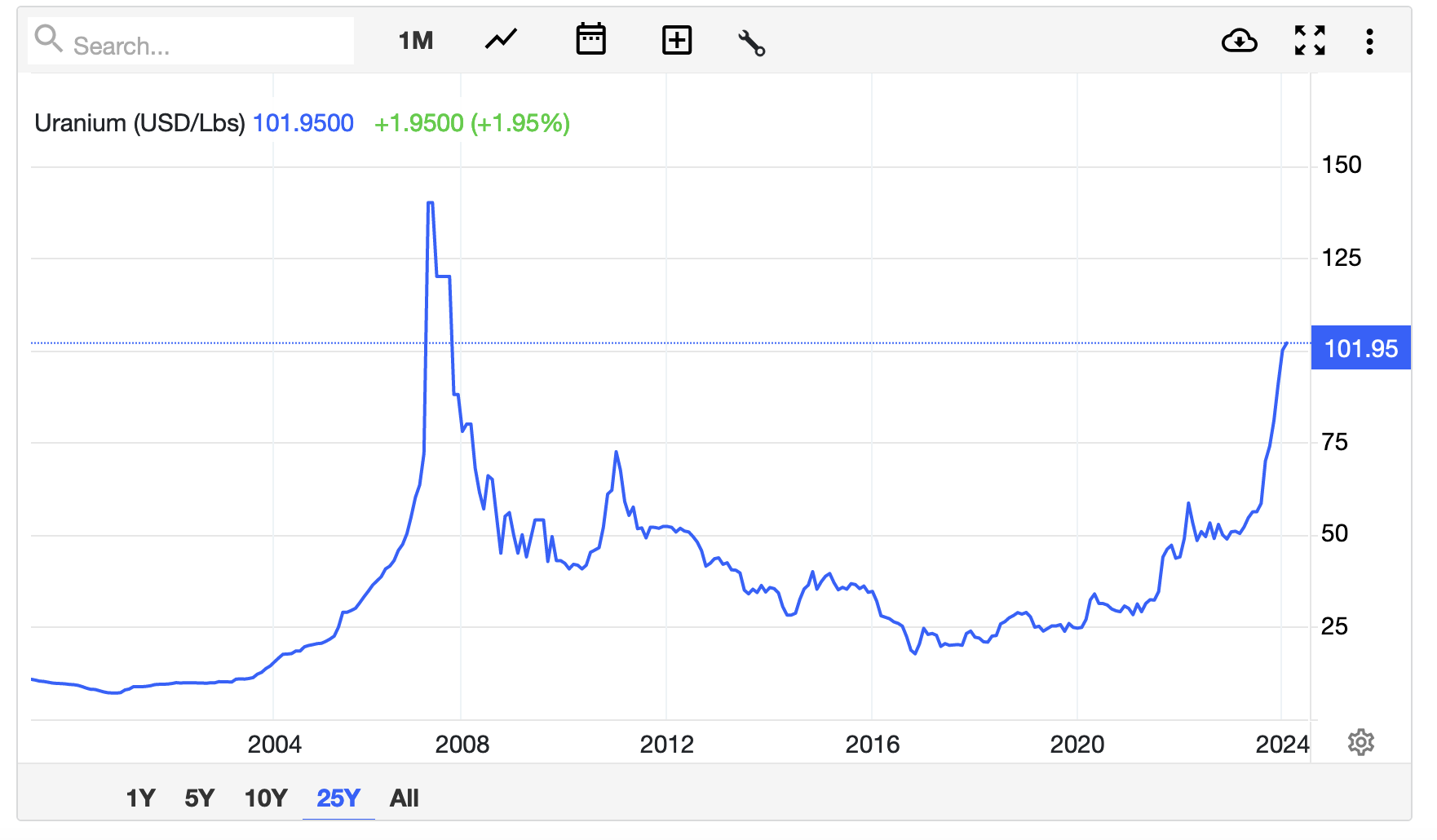
HAGUE PUSHES FOR RUSSIAN ASSET SEIZURE: Western democracies will be holding a virtual summit to mark the second anniversary of the Ukraine war on Saturday, and top of their agenda will be what to do about frozen Russian assets totalling about €260 billion. While the US, UK, Canada and Japan are now ready to tear up centuries’ worth of property rights norms, the majority of the assets sit in Europe’s Euroclear and, for now, the Europeans are more reticent.
The key case against: In an oped for the Times, former Tory leader William Hague noted leaders arguing the other way have good reason to do so: notably fear of freaking out investors by uprooting foundational capitalist society property right principles.
In his own words: “Freezing the assets of another country is one thing but permanently confiscating them, from a country with whom we are not ourselves at war, is clearly another. There could be protracted legal battles.”
The ‘officially at war’ factor: According to specialist lawyers we’ve spoken to, that “at war” bit is somewhat key. The only precedent for legal confiscation in Britain is the 1917 and 1934 ‘Trading with the Enemy Acts’ and as our lawyer said:
“Both of these define ‘enemy’ as someone with whom the relevant state is at war. No state other than Ukraine is, or will be, at war with Russia, and I do not believe that the states of the EU (specifically, Belgium) will declare war on Russia anytime soon. You could fiddle with the definitions, but as a matter of public international law, the concept of being ‘at war’ is a pretty formal one – ‘sort of but not really at war with’ isn’t really a thing.”
Saying the quiet bit out loud: the fact Hague dropped the war point into the piece speaks volumes about where authorities think we are going with Russia.
The case against: It’s the moral thing to do and there’s now no scenario wherein the assets will ever be unfrozen, says Hague.
They’re de-dollarising anyway! But the real mic drop moment was Hague’s admission that “efforts to de-dollarise or develop rival financial infrastructure outside the West are happening anyway.” This point can be interpreted in two ways. It’s either that the West thinks, we’re too big to fail, so have a go if you think you’re hard enough. Or, we’ve already broken enough precedents (as per the Iraq, Afghan and Venezuela examples) that the damage is done, so we would be idiots to not take what we can while we can.
BRUNO LE MAIRE GOES VIRAL: A rant by French finance minister Bruno Le Maire went viral online on Friday after his calls to accelerate the European capital markets union were largely misinterpreted as meaning the West is bust and is coming for people’s savings. He also reiterated the call to create a single European Union savings product, a la Giro bank, or, you know, a war bond. But hey, it’s all semantics.
SANCTIONS FAIL: POLITICO’s reporters committed 3,500 words to pondering why Russia sanctions have failed.
Knowing what we know now, it’s clear that the whole escapade amounted to a type of sanctions theatre instrumented on a sovereign level primarily for virtue signaling purposes. Being seen to be doing the right thing publicly, while allowing enough loopholes in the oil and gas sector to remain to ensure that we don’t actually starve our own system. In that sense the whole thing became a farce. We were on the backfoot from the very beginning, and all the US LNG in the world wasn’t going to make a difference.
As to why we didn’t have the upper hand? Personal opinion only, but I’m sure the fact that we spent the years post the invasion of Crimea doubling down on DEI, corporate virtue signalling and a net zero policy that is entirely dependent on cheap Chinese renewables rather than investing in strategic economic independence has a lot to do with it.
We’ve now engineered a global reshuffle where Russian commodities will power India and most of Asia, where Chinese overcapacity will be directed to Russia and German exports will either be crushed or have to head to American markets.
| CbANKING |
LOSSES GALORE: As POLITICO reported, the Deutsche Bundesbank joined the European Central Bank in posting a big loss in 2023, the result of a rising interest bill on excess liquidity generated by years of money printing. That means Frankfurt will once again not transfer any profit to the federal government, which could hurt because the government is struggling to keep its budget deficit within legal limits. Bundesbank President Joachim Nagel said the situation was likely to last “for a lengthy time,” but didn’t say precisely when he expects a return to profit.
KEEP THE DISCOUNT WINDOW OPEN 24/7: Central banks could keep their “discount windows” open 24-hours a day, seven days a week, 365 days a year to protect lenders against sudden deposit withdrawals at the click of a button. That’s one of the remedies to online bank runs that the eurozone bailout fund’s principal economist in the financial sector and market analysis, Juan Solé, pitched in a blog published this week.
Online bank runs aren’t new: Last year’s collapse of Silicon Valley Bank, which lost a quarter of its deposits in a single day, has put online bank runs at the front of supervisors’ minds. Part of the solution could be to modernize lender of last resort facilities at central banks. The problem is particularly acute in the US where the Fed’s discount window closes at 4 p.m. in New York, making it hard for banks on the west coast to make the necessary preparation in time to access the facility.
But the same goes for the European Central Bank, where banks can knock at Frankfurt’s window (known as the Marginal Lending Facility) only between 7 a.m. and 6:15 p.m during weekdays. “Extending the business hours of the central bank lending facility—e.g. to 24/7/365—may be necessary given the timeless nature of today’s instant payment systems,” Solé wrote, echoing a key conclusion from the G30’s report into last year’s mini-banking crisis in the U.S.
| GEOPOLITICAL HOT SPOTS |
NORDSTREAM: IT WAS THE BRITS! An investigation by the Nordic Times (of all outlets) concluded that a systematic analysis of the available evidence pointed to “elements of the British government” as the most likely perpetrators of the pipeline bombings. The news outlet also presented a photo of then
COD WAR 2.0: Vladimir Putin declared a fishing war on Britain after tearing up the rights of British vessels to fish in the Barents Sea that have existed since 1956, reported the Daily Mail. A large proportion of the cod and haddock sold in British fish and chip shops hails from Russian waters.
FRONTEX DEAL: The EU and UK came together in another unexpected post-Brexit collaboration. As POLITICO reported, the duo had negotiated a new “working arrangement” between European border agency Frontex and its British counterparts, mostly focused on information sharing.
MAO ZEDONG-ERA MILITIAS ARE BACK: The FT reported that “China’s state-owned enterprises have begun setting up in-house reserve military units, a legacy of the Mao Zedong era, in a sign of authorities’ increasing concern about social and political instability amid the country’s economic slowdown, according to analysts.”
Edward White’s article highlighted dozens of Chinese state-owned enterprises establishing “People’s Armed Forces”, which conduct civil defence activities and contribute to military recruitment, promotion and training.
China isn’t alone. We looked at a similar, though more explicitly offensive, development in the rise of private Russian militias — particularly the Gazprom militia — which gained publicity at the same time as Wagner’s star was starting to fade from the Russian military horizon.
But we shouldn’t be blindsided by the headline-grabbing capacity of such news. The truth and importance of hybrid warfare go far beyond the capabilities of private companies supporting their own militias. Its true strength lies in the ability of states to construct dual-use capabilities into their commercial sectors, and their flexibility in integrating off-the-shelf commercial tech for military purposes.
China, unsurprisingly, is emerging as the concept’s leader. As is often the case in history, the creative edge often emerges from necessity rather than strength: China’s naval deficit compared to the United States has made it a leader in naval dual-use capacities.
It’s emerged that most Chinese roll-on, roll-off ferries (RoRo’s) — ships which can quickly load and download wheeled transports through large doors — have been forced to adhere to Chinese military standards. This has been noted by Taiwanese observers, who remarked on the conversion of Chinese RoRo ships to hydraulic access ramps.
Most RoRo’s nowadays use a simple chain and piston setup for their access ramps, which resemble the system of a medieval castle bridge:

While chain and piston bridges can easily transport armoured vehicles into land, they run into difficulties when faced with a lack of solid surfaces on which to balance their heavy bridge ends.
Thus, eyebrows were raised when a Chinese RoRO called the Bang Chui Dao – which sported the chain and piston setup when constructed in 2014 – was spotted in 2020 PLA Navy exercises with a new system.
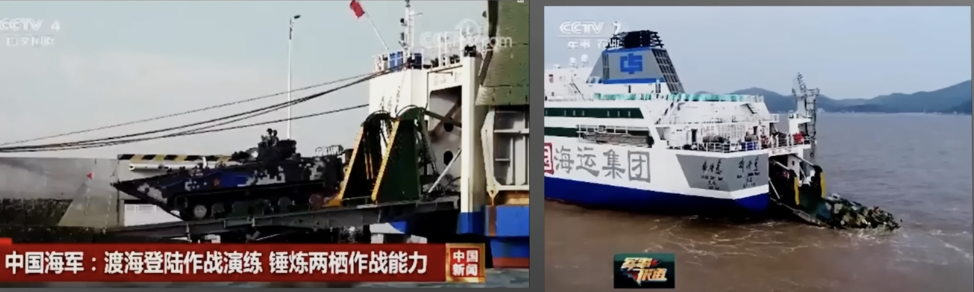
See those arms near the opening? These are hydraulic cylinders, which are capable of withstanding the weight of an armoured vehicle without the need for a solid surface on which to balance its bridge.
Thus, while most RoRos around the world could feasibly support militarised operations when drafted into service as part of a country’s merchant marine, only the Chinese forced adaptations to its commercial fleet means they can directly strengthen any military’s most complex operation: amphibious landings. And it doesn’t stretch the imagination to consider what contested coastal operation the Chinese Navy may have in mind.
These developments have spurred comments from American national security professionals that highlight the vulnerability and disorganisation in the American Merchant Marine, which has shrunk dramatically as American shipping companies are increasingly reliant on foreign ship-owners to transport their goods.
Other countries have also been making use of commercial vessels for military endeavours. A Blind Spot favourite is the Iranian Navy’s new drone-carrier ships. Instead of developing costly aircraft carriers that present easy targets to seaborne missiles, the Iranians have been cheaply converting commercial bulk carriers into drone launching ships:
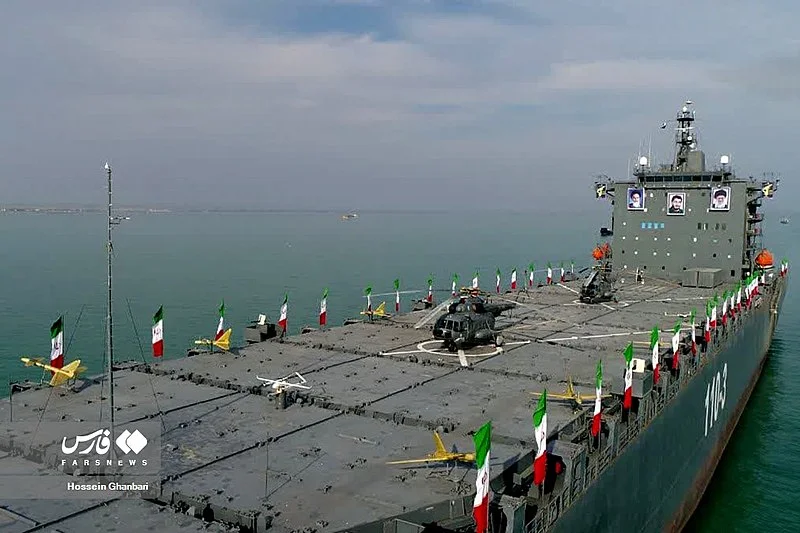
Furthermore, as we pointed out last week, the Iranians tend to launch most airborne ordinance using commercial containers, either land or sea-based:
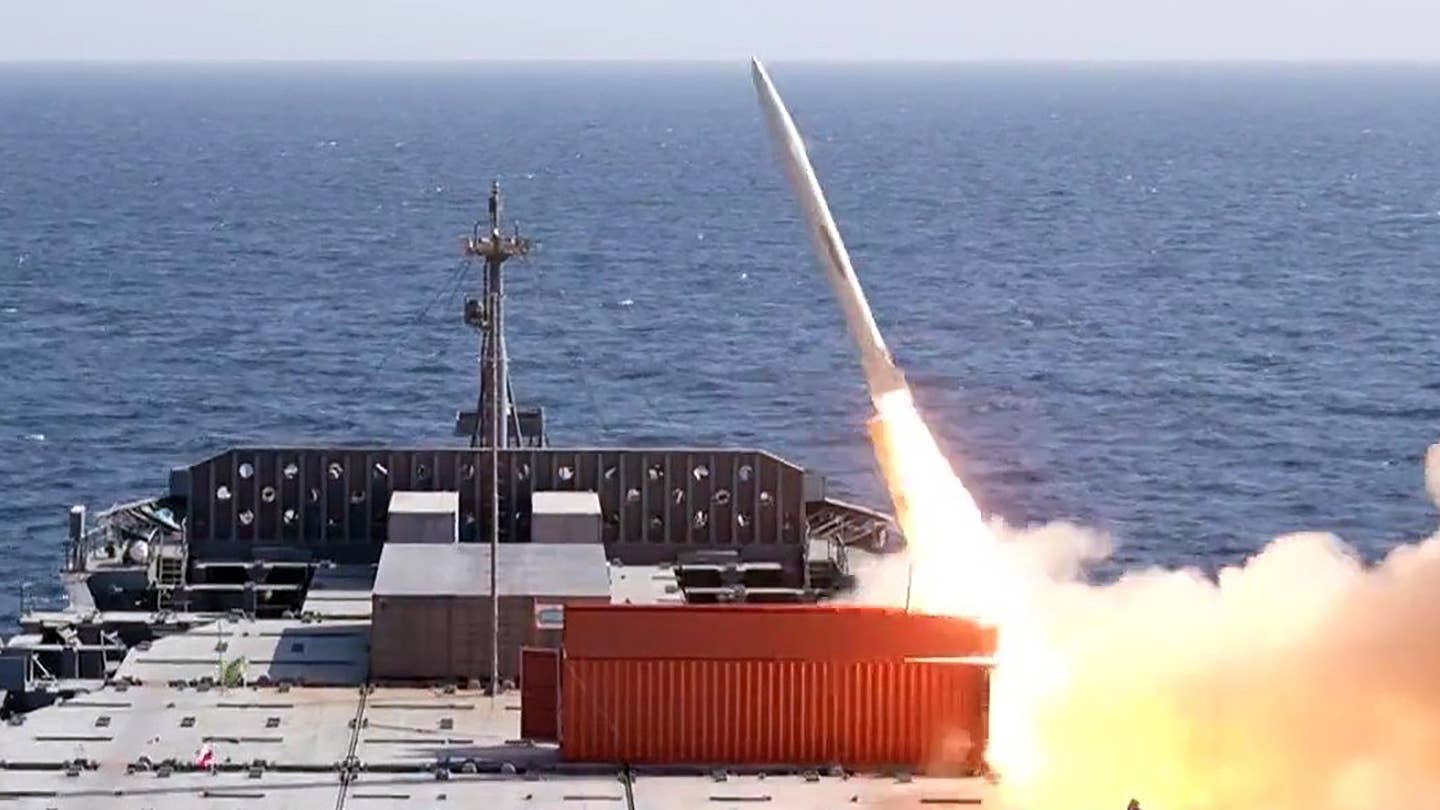

Going further than saving money in developing specialised launchers by using off-the-shelf commercial tech, it also allows Iranian power to be concealed in unassuming commercial fleets.
The power of using off-the-shelf technology is even being adopted by the United States. Their Expeditionary Sea Base, which has been gaining large amounts of promotion in international media, was cheaply converted from a standard bulk carrier:

The relative fuel efficiency of these ships, their incredible transport capacity, and the rapidity with which they can be converted, are in stark contrast to the ballooning costs of constructing, maintaining and operating purpose-built military carriers. That’s without mentioning the ease with which large structures at sea can be struck by widely prevalent, and increasingly cheap, anti-ship technology, as demonstrated by the Houthis. One need only look at the catastrophic British attempts at launching their two carrier ships, the Prince of Wales and the Princess Elizabeth, in 2024. When the Princess Elizabeth carrier was held back from NATO exercises due to an issue with its propeller shaft, the launch of the Prince of Wales, dispatched to replace her, was postponed soon after due to mechanical issues.
Similar developments can be observed in the Russo-Ukrainian War. While Russia benefits from a professionalised arms-building industry that is churning out scores of Lancet surface-to-surface drones, Ukraine has been able to keep pace with Russian drone forces, often outgunning them from the skies, thanks to off-the-shelf drones with a grenade strapped to them.
That’s not to say that civilian technology will be able to outgun purpose-built military tech. But, as a quote attributed to Stalin mentions, quantity has a quality all of its own. And with the Russo-Ukrainian war devolving into a WW1 mud-laced trench entanglement, we should be wary of a timeless historical truth that guides conflicts… it’s usually the guy with the most guns, not the best guns, who wins.
| STATE OF THE MEDIA |
HERRIDGE’S CONTROVERSIAL FIRING: A well-respected and award-winning CBS reporter, Catherine Herridge, previously at FOX News, was fired by the network as part of a wider company downsizing effort earlier this month. But reports started circulating this week that hers was no ordinary firing.
Biden exposure: According to the New York Post, Herridge was pursuing stories unpopular with the Biden administration including an investigation into the Hunter Biden laptop and last week’s Hur report which found that Joe Biden was a “well-meaning, elderly man with a poor”.
But that’s not even the issue: Herridge had arrived at CBS with an outstanding legal liability related to a 2017 story she’d published revealing an FBI counterintelligence probe into a Chinese-American scientist, Yanping Chen, who headed a US taxpayer-funded university in north Virginia that specialised in converting graduates into US military personnel in bases all around the world. But according to reports the probe soon got blocked further up the chain.
Chen’s revenge: The tables turned entirely on Herridge when Chen brought a case against the FBI under the Privacy Act, claiming her privacy rights had been breached. Last summer, a judge ruled that Herridge would have to reveal her sources as part of the deposition process. If Herridge does not cooperate she risks a contempt of court charge, that could make her personally liable for fines of as much as $5,000 per day.
Chilling effect: Campaigners worry a chilling effect will be had on press freedom if the protection of Herridge’s sources is not guaranteed. According to CNN, the case has now led to calls for Congress to pass legislation offering federal protections to journalists. Whether CBS felt overly exposed by the process and decided it was better to part ways with Herridge to avoid costs is unclear.
****
ASSANGE DECISION DUE: The Herridge case is not the only one that stands to permanently shift the Overton window on press freedom and how journalists handle confidential sources. Wikileaks founder Julian Assange faced his final appeal at the High Court this week to avoid extradition to the United States — where he faces 17 charges under the Espionage Act.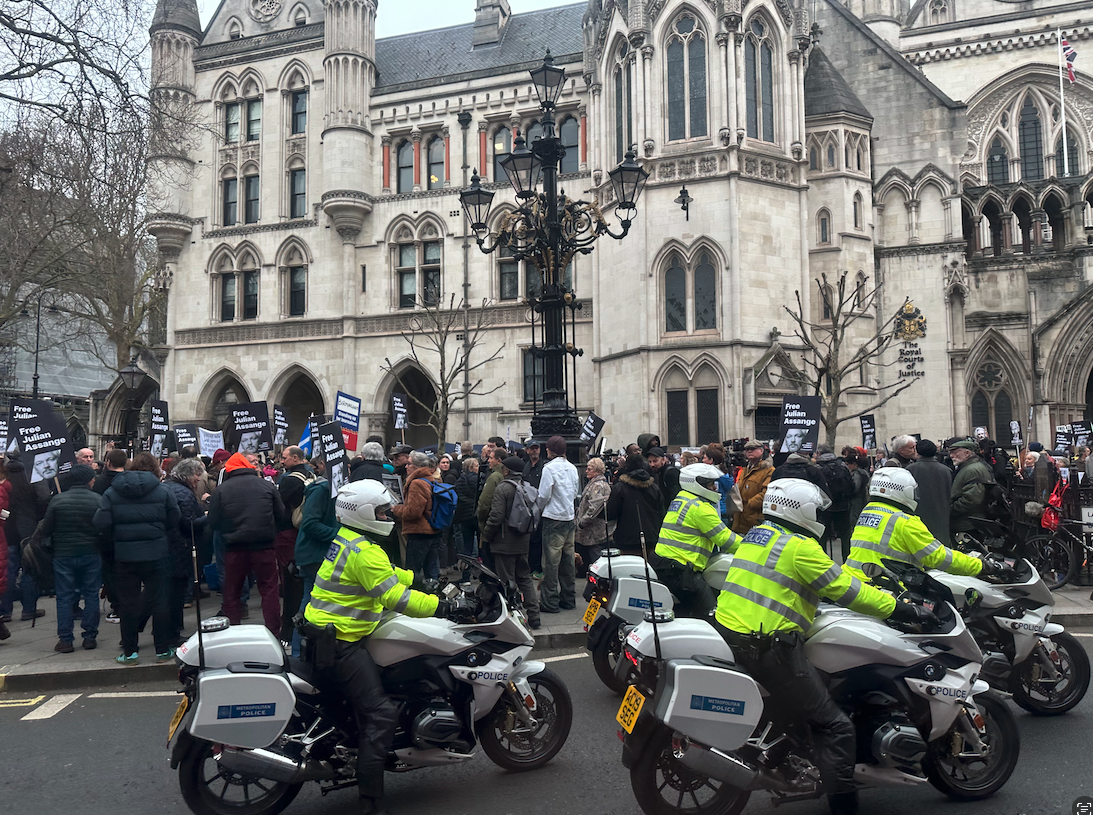
Journalism or espoignage? If extradited, campaigners say Assange could face a 175-year sentence or even the death penalty for publishing top secret cables handed to him by whistleblower Chelsea Manning in 2010 which exposed war crimes, systemic human rights abuses, rendition, as well as torture and other crimes and abuses. Campaigners also argue that it is unprecedented to punish a publisher or journalist, who was never bound by any secrecy laws, for publishing leaked information in the name of public interest.
What would Daniel Ellsberg say? The Pentagon Papers’ Daniel Ellsberg, who was also indicted under the Espionage Act for leaking public interest information, died last year. In one of his final interviews, he told one of my POLITICO colleagues that “The need for whistleblowing in my area of so-called national security is that we have a secret foreign policy, which has been very successfully kept secret and essentially mythical.” He added: “I’m saying there’s never been more need for whistleblowers … There’s always been a need for many more than we have. At the same time, it’s become more and more dangerous to be a whistleblower. There’s little doubt about that.”
Assange’s tribute to Ellsberg is worth a read: In his 2017 book, The WikiLeaks Files: The World According to US Empire, Assange features a long extract from Ellsberg recounting the advice he gave to statesman Henry Kissinger (who also died last year) when he sought to apply for his own top-secret clearance.
[I]t will … become very hard for you to learn from anybody who doesn’t have these clearances. Because you’ll be thinking as you listen to them: “What would this man be telling me if he knew what I know? Would he be giving me the same advice, or would it totally change his predictions and recommendations?” You will deal with a person who doesn’t have those clearances only from the point of view of what you want him to believe and what impression you want him to go away with, since you’ll have to lie carefully to him about what you know. In effect, you will have to manipulate him. You’ll give up trying to assess what he has to say. The danger is, you’ll become something like a moron. You’ll become incapable of learning from most people in the world, no matter how much experience they may have in their particular areas that may be much greater than yours.”
It’s a political case: Assange’s supporters claim the case is a politically motivated one, not least because similar disclosures were made by other leak-oriented publishers, among them Cryptome.org’s John Young, who faced no charges. Campaigners also claim there is no evidence that the publication of the cables ever imperiled any US assets and that considerable measures were taken by Assange to filter the data.
The US position? Lawyers representing the US argued that the case was not political, but rather was being brought because Assange’s publishing went “far beyond the acts of journalism who was merely gathering information” not least because he had conspired with and aided and abetted Chelsea Manning in stealing and disclosing the classified information. A decision is due in the next couple of weeks.
As a journalist, I can speak to the chilling effect the case is having on the media. Many journalists worry about publicly supporting Assange, even if they personally do back him, out of fear that being put on the establishment’s radar as an Assange supporter could cause them problems.
To be clear, I don’t believe in total transparency. I think the classification system has its place. But as Kathleen Cordelia Bailey, the former head of America’s original Office of Disinformation, Analysis and Response (which was created under Ronald Reagan in 1985), told me in a podcast a couple of years ago:
“There is a kind of a safety valve built into democracy vis-a-vis no safety valve built into a communist system or an authoritarian one. Because, in the case of democracies — take the Pentagon Papers, take so many leaks — people have values and consciousness of issues built into them when they are raised in a democracy. And if they see something terribly amiss, they leak it, and it gets out. Democracy is like that. And so governments that are democratic have to take that into consideration when they try to keep something secret.
Whereas in a communist or authoritarian system, if there is a leak, first of all, the leaker gets killed, usually.
And second of all, people see that and it teaches them not to leak. I remember — just to illustrate this to younger people in this audience that might not believe that — there was just a couple of years ago, a Chinese spy who was spying for the United States discovered. He was in a company. They took the individual to the company, got all the employees of the company, assembled them, and let them watch the man being executed. You know, that’s a pretty strong lesson to take away. And I’m sure that it had its effect. Now, imagine something like that happening in a democracy. No way.”
To which I said:
She was interrupted before she could answer.“I’m playing devil’s advocate, but people would say that Julian Assange is an excellent example of someone who has tried to facilitate leaks and is obviously currently still in prison and in dire circumstances, and it looks like he’s not going to be coming out anytime soon. So, yes, he hasn’t necessarily been killed, but it’s not a good look for the US government in that context.
| BIG TECH |
DAISY, DAISY: Chat GPT seemingly lost the plot this week when, to the eyes of many users the OpenAI generative artificial intelligence, it went berserk by posting incomprehensible gobbledygook that was wide-ranging in its nuttiness. You can view some of the weirdest examples here.
VIRTUAL GENOCIDE: By far the biggest tech fail this week was by Google’s Gemini AI. The internet giant’s attempt to win the AI race backfired splendiferously when Gemini seemingly refused to render requests for historical Caucasians as anything other than diverse figures. The Elon Musk entourage on X drew was quick to draw attention to the fact that the New York Times only picked up the story once the AI started spewing out minority figures dressed in Nazi uniforms.
| POLITICS, POLITICS, POLITICS |
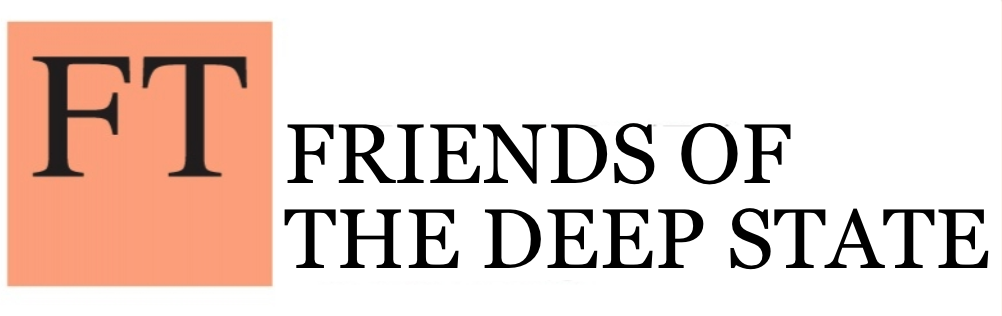
TRUSS, BUKELE AND TRUMP STORMED CPAC: Not a blind spot, but Liz Truss calling out the deep state for sabotaging her premiership and attacking the OBR, the Environmental Agency and the Judicial Appointments, is just too good not to include. “A quango is a quasi non-governmental organisation. In America you call it the administrative state or the deep state. But we have more than 500 of these quangos in Britain and they run everything,” she told the conservative summit. Even more memorable, however, was her interview with Steve Bannon, where she furiously waved a copy of the FT around asserting that “these are friends of the bureaucratic establishment and friends of the deep state.”
It’s a new branding opportunity for the FT at the very least:
Other choice quotes:
Truss: “If the Bank of England governor can’t be sacked and the Prime Minister can be sacked, then the BoE will have more power than the PM. That is a problem in a democracy.”
Truss: “There’s going to be a by-election in the next few weeks and there could be a radical Islamic party win in that byelection.”
Bannon: “You’re saying an Islamic radical party in a couple of weeks.. Is it one of these midland urban areas?”
Truss: “Rochdale.”
SPEAKING OF RIGHTWING CONSPIRACIES: An oped in the New York Post by Matt Palumbo argued billionaire hedge fund boss George Soros had over his career ploughed huge amounts of money into remaking the US legal system by supporting prosecutors who vowed not to prosecute. The result saw shoplifting and drug use decriminalised in some of the country’s most populous cities.
TWO-SIDED JOURNALISM: The world’s most famous pollster, Nate Silver, expressed shock at how many people think the New York Time’s objective should be to help Democrats win rather than do good journalism. Though others pointed out that the right-wing press has no qualms about trying to help Republicans.
COVERT REGIME CHANGE IN PAKISTAN: Academic Jeffrey Sachs, aka the man most desperate to beat Julian Assange to the global persona non grata list, argued there are strong reasons to believe that US actions led to the removal from power of Pakistan’s Prime Minister Imran Khan in April 2022, followed by his arrest on trumped-up charges of corruption and espionage, and sentencing this week to 10 years imprisonment on the espionage charge.
As Pakistani elections folded a few weeks ago with the surprise victory of Khan’s allies in Parliament, while the former Prime Minister remains in jail under several sentences, it’s time to assess what role the United States played, if any, in his overthrow.
Imran Khan set off a firestorm of accusations in the Muslim republic on April 2022 when he waved a confidential cypher at a rally that alleged a US envoy by the name of Donald Lu promised the Pakistani Ambassador to the United States that “all would be forgiven” if the Pakistani government encouraged a no-confidence vote in Khan. American pressure on the Pakistani government ostensibly came after Khan flew to meet with Putin in Russia on the day of the Ukrainian invasion.
Key leaks to The Intercept showed some time-related coincidences that back these assertions. Just a day before the meeting allegedly took place between Donald Lu and the Pakistani ambassador, Khan had addressed a rally that responded to European calls to push Pakistan to take an anti-Russian stance; “Are we your slaves? What do you think of us? That we are your slaves and that we will do whatever you ask of us? (…) We are not part of any alliance.” The day after the meeting took place, Khan’s opponents in Parliament moved forward with a key procedural step towards the no-confidence vote that ended Khan’s premiership.
Any quick scouring of Pakistani Reddit threads finds much the same thing. Most Redditors appear convinced the no-confidence vote was in one way or another caused by Khan’s rebuffing of American interests in Pakistan. They point to Khan’s “absolutely not” – his infamous reply to a US request for additional CIA bases and drone strikes from Pakistan into Afghanistan after their disastrous withdrawal. Redditors also highlight accusations by Khan’s allies regarding the bribing of his party members by the opposition, with claims the last-minute inflow of cash that turned key members of Pakistan’s congress against Khan was facilitated by the CIA.
This wouldn’t raise any informed observers’ eyebrows. The United States has a history of seeking to depose leaders who are contrary to their interests in key regions. Pakistan’s centrality to American policy in the Middle East is well-known, as is their reliance on Pakistan’s Inter-Service Intelligence unit, the infamous ISI, as American proxies in their “war on terror”.
But take a quick Google online and you’ll notice many Western-aligned outlets express harsh scepticism of Khan’s claims. In typical debunker language, they claim Khan provided no evidence his supposedly secret cypher was real. Pakistani officials also originally claimed the cable unveiled by Khan was inauthentic. While Pakistani officials now admit the leaked cypher was real, they allege it was either manipulated to suit Khan’s needs or that it did not confirm Khan’s claims the United States was seeking to depose him.
More confusingly still, it appears nigh-impossible to find out the real reasons for Khan’s ousting and imprisonment online. Some articles say it’s a corruption case involving Khan’s sale of gifted luxury watches. Others claimed it regards the leaking of classified information from 2018 to 2022. Still more say it was a classic political failure – a slowing economy, Khan’s wide-ranging promises for reform never taking place, rampant inflation, and a corresponding inability to keep together his fractured coalition. Apart from a few Western-critical voices like The Intercept that point to American meddling, you’d be hard-pressed to find any concrete reason for Khan’s departure in English-speaking media.
But this shouldn’t mean we can take Khan’s accusations at face value. We should bear in mind that Khan raised his voice on supposed American meddling just before the no-confidence vote would be held. Critically, there is a key piece of Pakistani law called Article 5, which allows the Court to annul a no-confidence motion if a foreign power is involved. Furthermore, what could be more politically shrewd for a Prime Minister in a deeply conservative Muslim country than to claim the United States is seeking to kick him out? The perspective that Khan was merely playing realpolitik is strengthened by his turnaround after his failure before the no-confidence vote, when in November 2022 he signalled his readiness to mend ties with the United States: “The Pakistan I want to lead must have good relationships with everyone, especially the United States.”
The answer may lie with the elephant in the room: the Pakistani military. Called the third rail of Pakistani politics, civil-military relations are often the central dynamics which govern the ruling class of Pakistan. While accusations by the opposition claimed it was precisely the Army’s backing which allowed for Khan’s rise against Nawaz Sharif in 2018, it appears this relationship soured during Khan’s Premiership. Reminiscent of US President Kennedy’s souring with his intelligence services, Khan started to deeply meddle in intra-military dynamics by forcefully picking favourites and denying the Pakistani military its traditional role of having its nominees rubber-stamped by the Premier. When viewed from this angle, Khan’s opposition to the United States gains more crucial relevance – Pakistan’s military enjoys a great deal of financial and intelligence backing from the US military and intelligence and would have been crucially weakened should Khan’s imposition of a neutral foreign policy have distanced its main backer.
It appears that in typically rambunctious Pakistani politics, where no Prime Minister has ever managed to serve out their term in office, there can never be a single concrete reason that underpins a leader’s ousting. But whatever the truth to Khan’s accusations of American meddling, America’s history of intervention in the region means it may as well be true from the perspective of his Pakistani voters.
| HEALTH |
VACCINE SIDE-EFFECTS: The largest Covid vaccine study found links to health conditions. “Myocarditis, or inflammation of the heart muscle, was consistently identified following a first, second and third dose of mRNA vaccines, the study found. The highest increase in the observed-to-expected ratio was seen after a second jab with the Moderna shot. A first and fourth dose of the same vaccine was also tied to an increase in pericarditis, or inflammation of the thin sac covering the heart,” according to Bloomberg.
| LONG READS: WHAT WE ARE READING |
WHY THE WEST IS LOSING UKRAINE: U.S. Republicans blocking aid. European right-wingers pushing to abandon Kyiv. Ultra-cautious leaders. What is the West’s real strategy? — POLITICO
A FORBIDDEN LOVE: How the French helped Britain keep euro-clearing in Brexit surprise.
