

PRE-POSITIONING IS NOW OFFICIALLY A THING: Not that this will be news to discerning readers of the Blind Spot (we’ve got at least seven posts under our hat since last October flagging that the regime shift was coming). But it’s nice to have the triple whammy of the Office of Comptroller of the Currency, the Fed (by way of a Bloomberg scoop) and the G30 all confirm that our reading of the regulatory mindset was correct. Not only is pre-positioning coming to central banks near you, the door is clearly being left open for the introduction of the ‘Pawnbroker For All Seasons” model championed by former BoE governor and deputy governor, Lord Mervyn King and Paul Tucker, respectively.
Why’s it important? If adopted, the regime could extinguish the need for a Liquidity Coverage Ratio or deposit insurance. It might also, however, have grave consequences for the dynamism of collateral and repo markets, since all assets pre-positioned at the central bank become de facto encumbered.
TBS Scooplet: While the idea first appeared in Mervyn King’s End of Alchemy, we understand the original inspiration for the thinking was David Rule (who has replaced Andrew Hauser as executive director for markets at the BoE on an interim basis.)
Where can I read more about this? Blind Spot subscribers can read my published Politico Pro story on these developments here. For the director’s cut (which includes all the wonk) premium subscribers can head here. As I note in the pieces, it’s the quiet revolution that is currently rocking central banking.
What’s next on this front? Going from T+1 to a near-real-time payment and settlement system, will demand not just pre-positioning but extensive pre-funding. If that funding is to be supported by the central bank under the PFAS system the cost of funding those float imbalances and daily swings will fall on the taxpayer because of the permanent swing financing capacity that has to be provided to the system. On the other hand, if an intraday funding market arises to compete with the central bank, there may be ample opportunities ahead for traders. There may also be ample opportunities for those prepared to develop platforms to catering to intraday funding markets.
Look to energy market imbalances for profit potential! One example of the profits to be had from matching short-term intraday supply and demand imbalances (in the style of an Uber surge-pricing opportunist) comes from the renewable markets. As my former FT colleague Javier Blas (now at Bloomberg) highlighted this week, a new breed of trader has emerged “smoothing out supply and demand on the grid by responding to oscillations in the weather, buying and selling power in advance, with consumers often paying the price.” 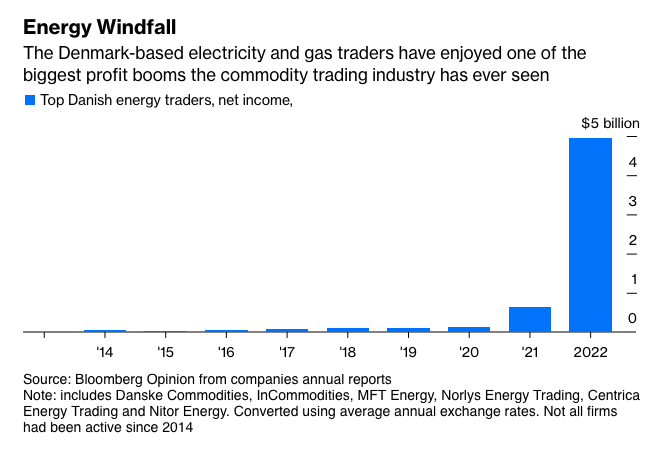
Arbitraging central banks: As funding markets become more real-time and ever more propped up by central bank “first resort” subsidised swing capacity, the more analogous their operations will become with short-term energy markets in which one side of the trade is de facto subsidised by the government. Here are some notable points from Blas illustrating how funding markets are beginning to mirror short-term electricity markets.
“The variability of wind and solar power required a new set of skills. The traders needed to work alongside meteorologists to anticipate the electricity supply-and-demand balance in real-time. Rather than selling or buying power for delivery months or even years in advance, as the utilities of yesteryear did, they specialised in the shortest of the short-term power market: the next 30 minutes.“
“This short-term electricity trading is a key part of Europe’s push toward renewable energy and fight against the climate crisis. But with governments spending billions on energy subsidies, essentially propping up demand and traders’ business, there’s a real danger of privatising the gains and socialising the losses — though the industry denies this.”
“Price swings can now be enormous, even in the space of an evening, creating short-term trading opportunities worth billions of dollars.”
| BUSINESS, ECON AND FINANCE |
THE CEO OF BLACKROCK LARRY FINK spoke on the tokenisation of everything: “financial assets and that means every stock, every bond…”
UK INFLATION FEARS MADE A COMEBACK after CPI failed to slow to 3.8 percent as expected in December and instead held tight at 4 percent. The greatest contributors were tobacco duty and alcohol. It won’t, however, be until February that the full impact of the Houthis Red Sea attacks on prices will become clear. For now, the commentariat space is divided between those, such as economist Philip Pilkington, who are convinced the attacks signal a major economic crisis to come, and the bulk of the energy market who say it’s not equivalent to a demand collapse, since the goods will get to market eventually.
IZZY (COMMENT): The main impact is likely to be via the additional financing costs that shippers will have to bear. But while an extra three-week timeframe is disruptive it’s probably fundable, albeit with enough of an inflationary impact to cause central bankers to think twice about initiating an easing cycle.
SWITZERLAND MOVED TO STRENGTHEN TRADE TIES WITH CHINA, triggering speculation about why the famously neutral state was cozying up to the People’s Republic when other European nations were distancing themselves.
CHINA’S POPULATION CONTINUED TO DECREASE by 2.08m in 2023, as Chinese fertility rates continued to drop calamitously. Concerns grew the trend was becoming reversible, and was likely to derail the country’s ascent to power.
SHELL SOLD ITS NIGERIAN ONSHORE OIL BUSINESS for $1.3bn, as the Dutch oil giant said goodbye to its traditional Niger Delta stomping ground.
PWC DROPPED DIVERSITY TARGETS after pressure from activists and a Supreme Court ruling against affirmative action prompted the consulting giant to open up a previously off-limit scholarship to white students. This coincided with a wider DEI rollback across the corporate and university world in America, as published by The Free Press.
A TALE OF TWO CANADAS, or how the dramatic increase in valuations of Canadian real estate have coincided with a drop in Canadians’ living standards relative to their southern neighbours: 
ELON MUSK CALLED ON TESLA SHAREHOLDERS to grant him another 12 percent of the company, bringing his ownership total to 25 percent, in order to continue growing Tesla to be a leader in AI and robotics.
SAM ALTMAN IS AIMING TO SET UP CHIP FACTORIES: According to Bloomberg, firms that have had discussions with Altman include Abu Dhabi-based G42, one of the relationships TBS was told was at the heart of OpenAI’s boardroom intrigue in December and the attempted Altman’s attempted sacking.
BRITISH HEAT PUMP USERS EXPRESSED DISSATISFACTION with the novel ‘eco-friendly’ technology. Heat pumps, widely encouraged by the British government to replace boilers, perform poorly in cold winter weather, and suffer from high noise levels and rapid wear and tear.
GOOGLE SAID IT WAS TO LAYOFF HUNDREDS OF EMPLOYEES in its sales units, as it attempted to use AI products to automate tasks on its advertising sales teams. The company claimed the layoffs were not related to Google’s investment in sales-related AI products.
REDDIT MAY LAUNCH AN IPO IN MARCH announced the social media company, having drawn up detailed plans to launch a listing it has been eyeing for over three years.
WILD GROWTH IN ADMINISTRATORS VS. PHYSICIANS in healthcare facilities may be to blame for high healthcare costs. Since the Federal Deposit Insurance Corporation Improvement Act passed the House, data from the Bureau of Labour Statistics show an increase of 2,500 percent in the number of administrators vis-a-vis physicians in healthcare facilities. But there were plenty of debunkers doing the rounds claiming the charts were an example of chart crime.
THE AMERICAN FEDERAL GOVERNMENT FLAGGED PRO-TRUMP TERMS to financial institutions like “MAGA” and “TRUMP” if Americans completed transactions using this term, according to Republican Jim Jordan. People purchasing bibles were also flagged, he said.
THE CHINA STOCK ROUT EXPOSED A MAJOR EXPOSURE TO ‘SNOWBALL DERIVATIVES’, according to the South China Morning Post. What the hell are ‘snowball derivatives’? Well, they’re funky structured products that pay bond-like coupons, typically around 10 per cent annually, but only for as long the products don’t breach a preset level. That’s known as knock-in. If breached holders risk losing their entire principal because they only pay the margin on the full value of the snowball products. “Such structured products, similar to put options issued by brokerages to wealthy investors with a typical maturity of two years, are estimated at 216 billion yuan (US$30 billion), according to Cinda Securities,” the SCMP reported.
| LENDERS OF ALL RESORT |
THE FEDERAL RESERVE REGISTERED ITS LARGEST-EVER OPERATING LOSS, according to preliminary unaudited results released on January 12. The WSJ said the losses had the potential to fuel new political attacks on the Fed.
BUNDESBANK GETS POLITICISED: Spiegel reported Bundesbank boss Joachim Nagel would be taking to the streets to protest against the return of right-wing extremism to Germany. According to the German publication Nagel was set to take part in what has developed into a wave of protests nationwide against the slow rehabilitation of far-right thinking, as embodied by the populist AfD party. Nagel told Spiegel that the rise of extremism worried him “both as Bundesbank president and as a private citizen.”
THE CURIOUS CASE OF THE MISSING NBP 6BN ZLOTY: Poland’s Constitutional Tribunal may have temporarily thwarted efforts by the country’s new coalition government to try NBP boss Adam Glapiński last week, but that hasn’t stopped Prime Minister Donald Tusk looking for new ways to hold the central banker to account.
IZZY (via Morning Central Banker): In a sweeping interview on Jan 12, which was broadcast simultaneously on Poland’s three largest networks — including on the newly reconfigured state broadcaster TVP — Tusk warned there were other ways of pursuing the outspoken head of the National Bank of Poland.
Context: Glapiński, an ally of the ousted former government, stands accused of having politicised the central bank during his tenure, notably by cutting interest rates by a full percentage point ahead of last year’s election in a bid to boost the then-ruling Law and Justice (PiS) party’s chances. The new government also blames Glapiński for allowing inflation to run unchecked and irregularities in the country’s Covid-era asset purchase programs. Glapiński, however, has made lengthy defences of his actions.
But there’s a new twist: During the interview Tusk alleged that the NBP was responsible for a 6-billion-zloty (€1.4 billion) shortfall in the national budget, due to a misdirection about the bank’s probable profitability over 2023. “I’m not impressed by this decision of Glapiński in the matter of the 6 billion zlotys,” he told reporters. “This is a bad decision from the point of view of the country’s interests.”
Plot thickens: The comments follow revelations in Polish media last December that the NBP wrote to the Finance Ministry in August outlining it was expecting to generate a 6 billion zloty profit for 2023 — a projection that was later used by the Finance Ministry to help balance its official budget.
FX volatility: A subsequent turn in the value of the zloty — which appreciated 7 percent versus the euro and 9.8 percent against the dollar in 2023 — has, however, forced the NBP to mark down its foreign exchange reserves significantly since then. Instead of a profit, economists now estimate the NBP could post a loss of as much as 20 billion zlotys. That would leave the NBP with no profit to transfer to the Finance Ministry, and the national books out of pocket by 6 billion zlotys. “It’s not something that will destabilise the budget,” Tusk said. “But it is a question of bad faith.”
Losses confirmed: The NBP confirmed on Monday it would be delivering a loss in 2023, but did not specify by how much. Some now think it could be as much as 26 billion zloty.
SCOOPLET: SOMETHING DOESN’T ADD UP! The Ministry of Finance confirmed to POLITICO this week that the losses pertain to a paper loss based on mark-to-market accounting. But they also pointed out that according to European budgetary accounting rules for central banks, FX profits and losses are not supposed to contribute to budgetary submissions. Only core operating profits or losses.
That suggests one of two things: Either Glapinski’s NBP flagrantly ignored the rules to help boost the Finance Ministry’s ability to balance its budget, registering an FX profit that should never have been registered. Or, something else was responsible for that 6 billion zloty figure, other than FX. One possible candidate for the second scenario is gold, which the NBP has been buying by the bucket load the last two years and which is trading at record highs.
While we need an accountant to confirm this, a preliminary reading of the budgetary rules suggests monetary gold is definitely accounted for differently to FX. In that case, Glapinski might still have the last laugh. The accounting may not have been wrong at all. It’s just that EU budgetary rules may have prevented the large portfolio losses from asset purchases and FX holdings from being registered at the time the budgets were being prepared. All will be revealed when the NBP publishes its annual report this quarter.
REMUNERATED RESERVES ARE NOT SUBSIDIES, OKAY? Former Fed and BIS man Robert McCauley, now a senior fellow at Boston University, upped the ante on the continuing debate over whether the ECB should or should not raise its minimum reserve requirement, which currently pays zero interest, by arguing that turning huge remunerated excess bank reserves into zero-yielding required reserves amounts to a tax on banks.
IZZY (via Morning Central Banker): In a two-part piece co-authored with Julien Pinter from the University of Alicante, McCauley argued that the push to make commercial banks shoulder the losses that central banks are currently taking would never have gotten started, had interest rates stayed low and had large-scale bond-buying produced gains for central banks.
The counter view, endorsed by among others the LSE’s Paul de Grauwe, asserts that reserve remuneration in an abundant reserve system amounts to a ‘subsidy to banks’ and is ‘nonsensical’.
Chesterton’s fence: But you’ve got to know your history, says McCauley. There’s a very good reason for the setup. The negotiations leading to the euro’s creation determined a small liquidity deficit would make banks more dependent on ECB financing. At the same time, financial centres that operated without required reserves (the BoE among them ironically), argued very forcefully that “a reserve requirement system was inconsistent with market principles.” Under that influence, it was determined that if required reserves had to be established, it shouldn’t be too costly for banks to hold them. The compromise was to offer remuneration on any required reserves.
Grave ramifications and a breach of contract: There’s bad faith involved in a sudden switch too, say McCauley and Pinter. When banks engaged with the ECB’s bond purchases, they did so on the understanding that those reserves would continue to be remunerated. The associated loss can, thus, be considered a type of default (albeit a legal one), comparable to a government not making its coupon payments.
“Instead of regarding the act of remunerating central bank reserves as a subsidy, one should thus see the act of ceasing to remunerate central bank reserves as the imposition of an unexpected tax on euro area banks,” wrote McCauley.
But that’s not the end of it! In the second part, McCauley predicts the tax would likely scare off businesses out of the euro area, and in such circumstances it wouldn’t be bank shareholders bearing the brunt of the tax but depositors.
The eurodollar precedent: The obvious corollary is that a similar arbitrage helped to fuel the rise of the eurodollar markets from 1970 to 1990 as a highly taxed dollar opened itself up to global competition. A similar effect would very likely be seen in euro markets, too. And while businesses and households could shift trillions of euro deposits to London and other offshore centres, the bulk of the burden would be felt by smaller and less wealthy depositors. Oh, and the overall governmental tax take would be diminished too.
Bottom line: Be careful what you wish for. The road to hell is paved with good intentions. And, er, there’s an academic war brewing between McCauley and DeGrauwe on the issue. And we hear DeGrauwe is planning a riposte as soon as next week.
DONALD TRUMP VOWED HE WOULD NEVER ALLOW CBDCs should he be elected, turning digital currency into a key MAGA talking point. While the Federal Reserve has not yet officially decided whether they sought to make a digital version of the U.S. dollar, Trump’s statement against is, nevertheless, a potential blow to its proponents, as highlighted PoliticoPro.
| DIRTY DAVOS |
WHO WILL BE DAVOS’ ‘DIRTY DOZEN’? Politico put together a list of “would-be autocrats, dictators, thugs, extortionists, misery merchants, spoilers and political pariahs on the Davos guest list.”
MILEI LECTURED THE DAVOS’ BUSINESS ELITE: “The state is not the solution, it is the problem.” But the real showstopper was the AI-enhanced version of his speech that magically turned Milei into a native English-speaker in his own voice.
JP MORGAN BOSS JAMIE DIMON SURPRISED DAVOS WITH A MAGA APPEAL: He told CNBC “People are hungry to grow — they’re innovating. But when people say MAGA, they’re actually looking at people voting for Trump and saying, ‘You are like him’. But I don’t think they’re voting for Trump because of his family values. Just take a step back and be honest. He was right about NATO, kinda like right about immigration, he grew the economy quite well, tariff reform worked, he was right about China, and I don’t like how he said things about Mexico, but he wasn’t wrong about some of these critical issues.”
| CIVILISATION |
IS IT FAR-RIGHT TO GROW FOOD? In which case, bring on “das tractor revolt” wrote Jeremy Clarkson for The Times. The legendary TV personality turned farmer defended national subsidies to agriculture and worried about the modern, green-induced propensity of Western media to dismiss farm workers’ concerns by labelling them as far-right.
DARIO (COMMENT): Sometimes I wonder whether Western media and elites are perversely seeking a full-blown right-wing revolution in Europe. The war on farmer subsidies is coming precisely when Europe can least afford it. We’ve had four years since the 2020 lockdowns, rising China tensions, and now the Houthi attacks on the Red Sea to realise the wisdom of onshoring and friendshoring critical supplies.
As inter-state and intra-state conflict continues to become a worrying normality in this de-globalising world, European elites seem more pressed in fulfilling abstract environmental and DEI targets than in securing our consumers’ right to decent prices and food security.
While agricultural subsidies represent an overwhelming amount of the EU budget, the outsized gains our continent gains from food security seems well worth the price of the Common Agricultural Policy (CAP). And that’s without getting into the argument of quality.
No other continent comes even close to the luxury of European produce. Foreigners waltz in joy through our supermarkets filled with all sorts of well-packaged, well-raised delights. While American agriculture remains ensnared in the production of low-quality, low-price foodstuffs, European consumers understand that quality must command a price. And there’s a reason for that: European food producers are the only ones worldwide who adhere to strict food regulations that ensure our products are mostly free of nasty pesticides and corn-syrup.
A Peruvian woman recently reminded me that Peru’s dishes are best consumed in Europe — nobody but the finest restaurants outside of Europe can afford to do anything but overcook their meats out of fear of intoxication.
Similarly, European bureaucrats have been gutting our own food production by liberally extending the equivalence of our ‘eco-friendly’ labels to countries such as those in Latin America, whose regulatory agencies are often captured by large food producers and who do anything but adhere to standards of safe food production. This enables sub-standard Brazilian bananas, for instance, still disinfected by aerially sprayed pesticides in contravention of Eco-friendly rules, to arrive on European shelves with the same Eco presentation, at a non-Eco cost, to the detriment of duped European consumers, and European farmers, whose production techniques have been adapted to meet European standards.
And yet, when European farmers take to the streets to protest, their concerns are dismissed out of hand by a media class seemingly disgusted by the rural world’s fierce independence and mistrust of central authority. Labelling them as far-right is the easiest cop-out, one which doesn’t require a hard look at the EU’s misguided focus on, ineffectively, saving the rest of the world at a price only European consumers and producers pay.
European voters don’t face such a hard choice. When met with seemingly absurd anti-farmer policies that mostly benefit wealthy and sub-par foreign producers, they will vote against the status quo in droves — as exemplified by the success of the Dutch Farmers Party following its own tractor revolt. This is a war Eurocrats can’t win, precisely because it goes against the EU’s founding pillars — a focus on good regulation, good quality produce, and strong national agriculture policies. And precisely at the time a de-globalising world is vindicating the wisdom of the CAP’s original approach.
THE U.K. SUCCESSFULLY TESTED ITS DRAGONFIRE LASER: While the range remains classified it is a weapon that can apparently “engage with any visible target”, and has “greater accuracy” and low long-term costs. The system’s accuracy was described as pinpoint — the weapon can hit a £1 coin from a kilometer’s distance. The DragonFire laser “cuts through” the target, destroying its structure and can hit them at the speed of light, noted Ukraine ministerial advisor Anton Gerashchenko.
| MEDIA MATTERS |
AMERICAN NEWS NETWORKS NBC, CNN, and MSNBC decided not to show Trump’s victory speech at the Iowa caucus.
YOUR FAVOURITE CLASSICAL LITERATURE MAY BE PROPAGANDA: The Economist showcased six classic books that were manipulated by Western intelligence agencies for wartime and Cold-war era propaganda purposes.
| GEOPOLITICAL HOT SPOTS |
THE LOPSIDED GAME THEORY BEHIND HOUTHI ATTACKS ON SHIPPING: The rebels may be taking advantage of voter sensitivities to inflation, a long Twitter thread by DryBulkETF, ahead of an election heavy 2024 in the Western World. This comes as Houthi strikes increased in the region, notably striking an American bulk carrier this week. “Straits, canals and waterways are going to play a much bigger role than even before in a world where inflicting economic pain in the Western world without real conflict is becoming much more difficult than ever before. Technology allows anyone to obtain RT information on vessel position, ownership and cargo details which makes it an easy game for bad actors with minimal resources. We are all about to become much better in oceanography and geography for the years to come…“
IZZY (COMMENT): Alas, it was ever so. Taking key transport routes hostage in a bid to threaten food supplies and exert pressure on dominant empires has been a predatory strategy since, err, at least Roman times, if not before. Both Pompei and Caesar’s rule had to contend with the piracy scourge in the Mediterranean, while the Barbary Wars became one of the biggest threats to the rise of America. In both cases peace was only assured at the high cost of dealmaking with the pirates (i.e. paying them off with tribute).
In the Barbary case, the United States found itself paying as much as a fifth of the government’s annual budget to the pirates by 1797. According to Wiki, Jefferson won the 1800 presidential election against incumbent second President John Adams, in part, by noting that the United States was “subjected to the spoliations of foreign cruisers” and was humiliated by paying “an enormous tribute to the petty tyrant of Algiers”.
As for the tech angle, it’s a great example of why mass transparency has its negatives, too. And why, sometimes, there’s real justification for state and corporate secrecy.
BRITISH AND AMERICAN SHIPS WERE TO BE EXCLUDED FROM INSURANCE POLICIES, according to Bloomberg, as Houthi retaliation for American and British strikes mounted the cost to insurers. Insurance covers have now reached 1 percent of a ship’s value.
DARIO (COMMENT): As time passes, it becomes clearer that the only solution against the Houthi attacks in the Red Sea must be diplomatic rather than military. American strikes on Houthi positions are akin to finding a needle in a densely mountainous haystack, long-prepared against such needle-finding activities.
Or as illustrated by Biden in a recent video:
“Are the strikes in Yemen working?” Biden: “Well, when you say they’re working – are they stopping the Houthi’s? No. Are they gonna continue? Yes.”
While one could argue that even if the airstrikes don’t effectively diminish the Houthi’s ability to project power — Western strikes are an anti-Western movement fund-raising, performance-enhancing drug — they are nevertheless a thorn in the side of logistics and governability in Houthi-controlled Yemen.
Once started, American and British strikes must continue until some sort of diplomatic postulation brings the Houthis or Iran to the negotiating table. But harried by the unceasing rise in inflation being compounded by the rise in carrier fees and insurance, I suspect the Brits and Americans are already sat by it.
SOMALIA WAS “READY FOR WAR” WITH ETHIOPIA claimed Somalia’s President on Saturday, as Ethiopia’s recognition of Somaliland in exchange for coastal lands dramatically increased tensions in the Horn of Africa.
LIZ TRUSS SECRETLY PUSHED FOR ARMS SALE TO CHINA, according to recent revelations shown by Politico. Truss messaged then Business and Trade Secretary Kemi Badenoch to intervene on behalf of Richmond Defence Systems, a defence firm based in Truss’ Norfolk constituency, to expedite the sale of landmine disposal equipment which had been blocked by U.K security officials.
TRUMP’S RETURN IS A THREAT TO EUROPE claimed Christine Lagarde, as she pointed out Trump’s “trade tariffs (…) commitment to NATO service (…) the fight against climate change” will become threats to Europe.
DARIO (COMMENT): A human is different from other animals – it’s the only one who can trip over the same stone twice.
Truth is, Trump’s staunch America First position is nothing less than an opportunity for Europe to finally get its sh*t together militarily. When Trump was first elected, he carried out a slew of policies that shocked Europe’s elite.
A trade war against China? Railing against Germany and Western Europe’s low military spending? My oh my.
Trump’s China policy was only vindicated later, as Huawei’s deep penetration of Europe’s communication networks was revealed, and its continued escalations towards Taiwan meaning Trumpian anti-China politics were silently continued post-Trump by Biden.
Similarly, a Russian attack on Ukraine clearly exposed the dismal levels of military preparedness amongst NATO allies in Europe – with the sole exception of Poland – and particularly in Germany.
It’s only now that Germany’s elites are waking up to the perils of maintaining a military policy ased on trauma and guilt. In other words, a non-military military policy.
There is nothing that could serve Europe better than to be semi-abandoned by our American allies. However lame, the saying “tough times create hard people” is certainly true — and living off the subsidy of American military expenditure has turned Europe into a defenceless continent that appears to depend on the wills and whims of Presidents elected on the other side of the Atlantic.
As Marc Rutte recently admitted:
This was exactly Trump’s main issue: That we were not spending enough. And he was right. He was right because America is 50% of NATO’s economy and spending about 70-75% of NATO’s budget (…) He was completely right in forcing us to live up to the 2% commitment.”
Furthermore, Trump’s America First policy is more than that: It’s a blessing to Europe.
The collapse of empires often occurs because their leadership insists on keeping them together no matter the cost — look at the Spanish Empire or the Ottomans. Those Empires that survived for generations often did so by splitting themselves apart into smaller, more manageable jurisdictions — like the Romans — or even the English and French empires, whose smartest moves were leaving their ex-colonies to declare independence in “good faith” but retaining significant economic control of them for decades to come.
America First also means Europe First (something only Emmanuel Macron seems to understand). A mock pulling out of Europe and showing the United States for what it is; not a helpful brother but a self-interested party — may open a window into putting our own interests first too.
As Bashir Al-Assad wisely said of Trump: What do we want more than a transparent foe?
The United States has been shielded by Western media and our European leaders as a friend of Europe for too long. As its profiteering on Russia’s invasion of Ukraine on the back of European consumers patently showed – as well as American intelligence’s incessant spying of our governments – the United States will naturally guard their own interests above Europe’s. Europe should take this brilliant opportunity to start doing the same.
RUSSIA’S DEFENCE INDUSTRY WAS TURNING THE WAR IN ITS FAVOUR argued The Economist, despite the combined resources of Ukraine’s allies being so great that it should have been able to emerge victorious in the Ukraine-Russia conflict.
IRANIAN-PAKISTANI CONFLICT HEATED UP this week, as Pakistan launched missile strikes into Iran in retaliation for Iranian strikes in Balochistan. Iranian strikes in Pakistan formed a part of its ostensible anti-Israeli and anti-ISIS attacks in Syria, and Iraq. It’s worthwhile to note the Jaish al-Adl group (formerly Jundallah) targeted by Iran in Pakistan was backed by Mossad agents disguised as CIA operatives according to a 2012 article by Foreign Policy. Following the latest strikes on Iranian territory, Pakistan has since sent a de-escalatory message to Iran, telling its neighbour it has ‘no interest’ in further escalation.
THE TALIBAN URGE IRAN AND PAKISTAN TO EXHIBIT RESTRAINT, as the Islamic Caliphate outlined their worry regarding recent escalations between their two Muslim neighbours.
EL SALVADOR BECAME THE SECOND SAFEST COUNTRY IN THE WEST, having incarcerated over 65,000 gang members — or almost 1 percent of its entire population. Unsurprisingly, Nayib Burkele now has a record approval rating of 90 percent in the country. Who knew jailing criminals worked?
| American political drama |
TRUMP IS SPARKING FEARS OF USING THE MILITARY IN DICTATORIAL WAYS, alleged a coterie of journalists for NBC News, with calls for mechanisms to disempower his command of the military if he does take office. (Though a commander-in-chief who is not in control of the army, is presumably not the commander-in-chief at all, but rather someone beholden to an unelected third party or actual military dictatorship?)
BIDEN ADMINISTRATION USED COUNTER-TERRORISM GRANT TO FUND ANTI-CONSERVATIVE PROPAGANDA, as revelations showed the Department of Homeland Security paid an activist group $700,000 to create self-described propaganda that attacked conservatives including Donald Trump from a grant program intended to combat terrorists.
HUNTER BIDEN’S LAPTOP IS REAL acknowledged the Department of Justice, as federal prosecutors filed court documents on Tuesday that urged a judge not to grant Hunter Biden’s request to dismiss the charges filed against him.
| technological quandaries |
WIMBLEDON’S ELECTRIC BUSES WERE WITHDRAWN from service after a double-decker electric bus caught fire, though TfL claimed the incident was “unrelated” to the decision.
FORD’S SELF DRIVING CARS may be designed to return themselves to Ford should the customer miss their car payments, a recent Ford patent filing revealed.
ELECTRIC VEHICLES SUFFERED IN COLD TEMPERATURES, as the vehicle’s ranges became diminished while charging times increased due to the high energy requirement of keeping the car’s heaters on.
DARIO (COMMENT): As the war on consumers rages by enforcing the uptake of EV’s over internal combustion engine cars, skeptics can be rewarded by laughing at the spate of debunking news regarding EVs performance in cold weather.
One brilliant article from Euronews is a case in point. Titled: “Was Oslo paralysed after all its electric buses broke down due to the cold?”, the newspaper committed the typical debunker’s sleight of hand — wildly exaggerating an original claim, and then reassuring readers that, no, the claim they wildly exaggerated was, in fact, wildly exaggerated.
This piece came on the back of news that Oslo’s new electric bus fleet was hamstrung by Norway’s cold — sharply reducing the electric buses range and forcing hefty costs on its transport network’s efficiency. The first morcel from the article touts EV’s greater efficiencies:
“Electric vehicles are more efficient than gas engines which means they can’t draw on heat produced by the motor to warm the inside of the car. They have to generate heat in other ways, hence using more energy from the battery which means losing in range.”
But worry not, dear EV fan, there are solutions — like spending more electricity charging the buses and installing diesel heaters:
“The buses need to stay plugged in, if possible, early on, before they start the route and stay plugged in overnight. When you do that, the battery can start and operate at this maximum range.” “Then the transit authorities have to either adjust their routes and notify passengers or equip the bus with diesel heaters for these few cold months to make up for the 30% loss in range if they want to maintain a full schedule and their usual routes,” explained the battery expert.”
That’s not to say EV’s don’t have their upsides. Their incredible acceleration and efficiency driving in (warm) cities (the start-stop nature of city traffic makes them more efficient there than internal combustion engines) means they’ve won over their fair share of consumers. The critical issue is the enforced adoption of EVs, and the unfair pressure this places on families that aren’t wealthy, by plastering a slew of restrictions on internal combustion cars that are generally cheaper to purchase, cheaper to maintain, and which have much longer lifetimes.
RECENT MICROSOFT PATENTS SHOWED UPCOMING SMARTGLASSES, as revealed by PatentlyApple. These smart glasses will be created by both Microsoft and Samsung based on a late 2021 agreement regarding mixed reality headsets and may be related to Samsung’s acquisition of DigiLens, a smartglasses company, in 2019.
OPENAI QUIETLY DELETED A BAN ON MILITARY USE, as the supposed not-for-profit AI developer erased language that explicitly prohibited the use of its technology for military and warfare purposes.
BLINKEN’S BOEING PLANE GROUNDED in Davos after a “critical failure” in the Boeing 737 left the U.S. Secretary for State stranded.
| pOLSKA |
FORMER POLISH DEPUTY FOREIGN MINISTER was arrested in connection with a visa fraud scandal that helped Tusks’ coalition win the October election.
| MEdical malpractice |
THE IDEA OF A LINK BETWEEN COVID-VACCINES AND LONG-COVID-LIKE SYMPTOMS started to gain acceptance among mainstream scientists, claimed Science. Termed “Long Vax”, the hypothesis postulates that persistent headaches, severe fatigue, and abnormal heart rate and blood pressure are linked to rare side effects of the Covid-19 vaccine.
A CHINESE LABORATORY CRAFTED MUTANT COVID-19 STRAIN with a 100 percent kill rate in “humanised” mice, which underwent a ‘surprisingly’ rapid death. WHY?
