

Dear Subscribers,
Before we commence, a little bit of housekeeping.
We are, as ever, eternally grateful to our subscribers for their support and patronage. We hope you have enjoyed our coverage and insights this year and plan to stick around next year.
It’s been great working with Dario Garcia Giner for another year. He has done a great job filling in my own blind spots and never ceases to surprise me with his geopolitical expertise and insight into stories I had no clue about. I’ve learned a lot from him this year, and I hope you have too.
Julian Rimmer was the latest addition to the Blind Spot team coming aboard in October, and we’ve been delighted to have him offer his daily take on markets. He’s done a sterling job keeping me abreast of goings on in Japanese bond markets as well as in the wine trade.
For those who haven’t been following, Julian and Dario have teamed up on the ultimate Boomer vs Zoomer take on markets with our daily Spot Markets Live chat on the Coodash platform.
The chat has emerged as the perfect mutually beneficial check on each other’s generational blind spots. This wasn’t something we intended when we kicked things off. In fact, it happened quite spontaneously. And yet, I for one am kicking myself for having not realised sooner that a cross-generational exchange of this sort would actually be so compelling.
Generational knowledge gaps are and always have been a problem in markets. As they say, your market perspective is born out of the first financial crisis you experience. That means the new stock of financial journos, traders and fintechers often have no clue about things taken for granted by the older generation. By the same measure, us dinosaurs are totally out of touch with the YOLO mentality of the meme stock generation and what drives their investing impulses. Thus, it’s been incredibly useful (and amusing!) to see the two of them fill in each other’s knowledge gaps. To view the live shows every morning (the best way to do so), sign up to Coodash here.
We continue to make improvements to the formatting, with the help of Graham Halliday at Coodash. (Any problems email us at [email protected]). But as you can imagine, as a teeny tiny start-up we can only go as quickly as funding allows. So bear with us.
This week will be the last week of SML before Christmas. We’re doing the final show on Friday Dec 15. Tune in to see the culmination of our villains and heroes roster of the year, plus Jules’ best wine picks of the year. And please do spread the word. We would love to keep it going. But we need more eyes on the product. Remember, transcripts are free to read.
In other news … this will be the last official newsletter before Xmas too, meaning Friday’s SML show will be our last big Xmas sign off. (There may, however, be some stand-alone pieces if the news justifies it.)
But, fear not, we will be back with regular filings from the weekend of January 6.
We hope you all have a wonderful holiday.
Izzy and the Blind Spot team.
| ECONOMICS, BUSINESS, FINANCE ETC… |
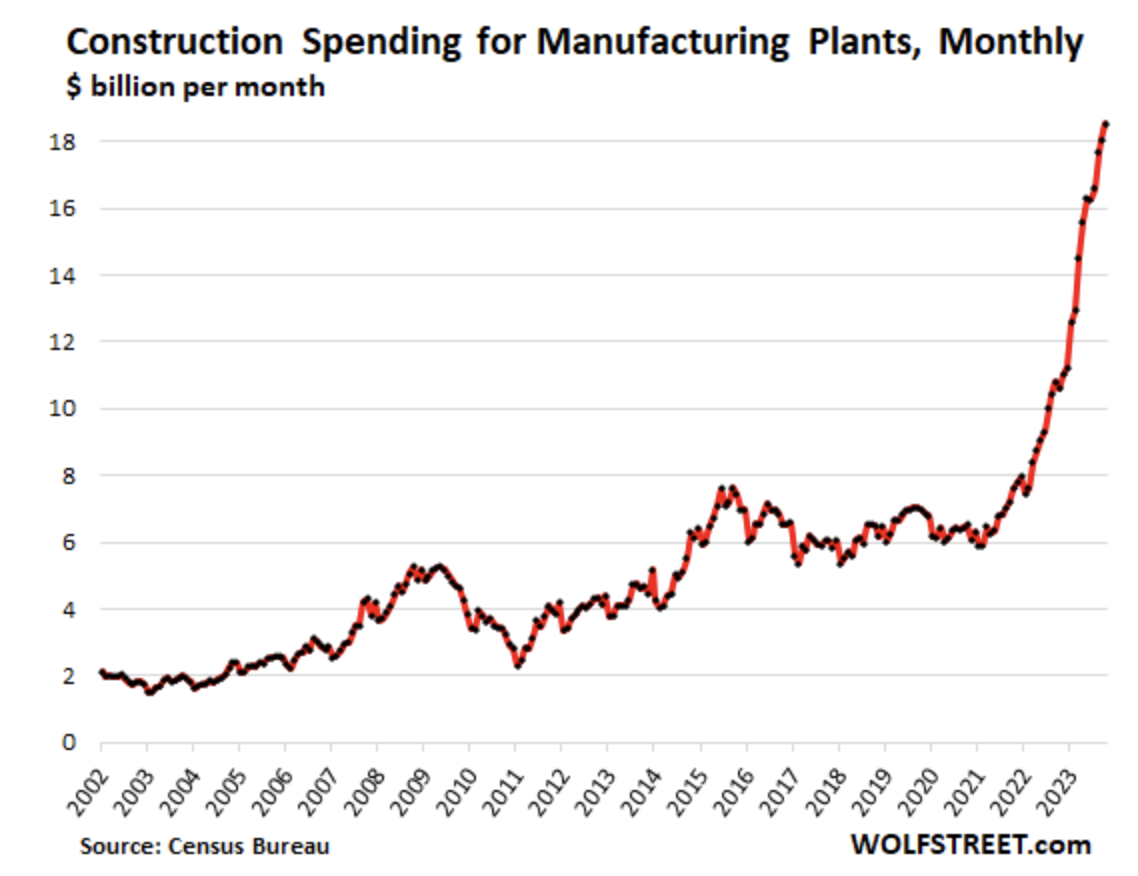
AN EYE POPPING FACTORY CONSTRUCTION boom in the United States has been triggered by the supply chain catastrophes of 2020-21, an edgy US-China relationship, and a worrying reliance on China, reported Wolf Street. Just this October over $18.5bn were invested into the construction of manufacturing plants in the United States, up 73 percent from last year.
SPOTIFY CUT 1,500 JOBS as CEO Daniel Ek claimed the music streamer must be “leaner”, citing its lack of immunity to dramatically slowing economic growth conditions.
CHRISTINE LAGARDE TOLD THE NBP’S ADAM GLAPINSKI in a letter that he had a case against the incoming government of Poland if it sought to put him in front of a state tribunal for his failure to keep inflation in check. “If the members of the former opposition parties were indeed to submit a preliminary motion to the Sejm, any measure affecting your ability to perform your duties as Governor of NBP may, if not lawful, affect your independence and by extension the independence of the General Council.”
What goes on at the National Bank of Poland might seem a periphery issue relative to affairs at the Fed, the ECB or the BoE, but the Glapinski affair strikes at the heart of what central independence really means in Europe and could have major implications for central banks elsewhere.
We doubt very much that anyone at the ECB is mourning the outgoing Law and Justice (PiS) government or that NBP President Adam Glapinski, a PiS appointee, is top of Christine Lagarde’s Christmas list.
But central banks protect their own. And in this case, the ECB’s decision to back Glapinski versus incoming Prime Minister Donald Tusk isn’t a huge surprise. Glapinski is hardly the only central banker to have dropped the ball on inflation in 2021-2022. Nor is Glapinski’s excuse — that inflation was driven by unpredictable externalities like the pandemic, the war on Ukraine and the energy price surge — unique in the central bank community.If Glapinski stands before a tribunal on those grounds, the precedent might be set for other central bankers to stand trial too. This would open the door to a major “you’re either in power or in prison” dynamic with the capacity to totally undermine central bank independence on a much larger scale.
But there is more intrigue at the heart of the NBP than that.
Glapinski has made no secret of his contempt for western media and western bank analysts. He has for a long time claimed that the NBP’s decisions — which are made by committee, as he frequently reminds — are treated unfairly by almost all western commentators, who hate Poland. The most controversial of these was September’s decision to cut rates by a surprise 75 basis points, even though inflation was still above the 10 percent threshold that Glapinski himself said needed to be surpassed for rates to start coming down.
Glapinski justified the move on grounds that NBP modelling was showing a sizeable slowdown in inflation for September, and the council didn’t want to act too slowly. Glapinski was in the end somewhat vindicated as inflation did indeed slow as predicted, but the optics of the move — coinciding as they did with the critical PiS pre-election campaign period — made the politicisation of the bank in the eyes of his critics self-evident.What was fascinating to watch thereafter was the thickness of Glapinski’s skin in the face of the inevitable media assault on his credibility. Trump-style, he stood defiantly, press conference after conference, filibustering for hours on end in a seemingly endless stream of consciousness that touched upon all sorts of random things.
Yet, it was only through the medium of the press conference that Glapinski really spoke at all. As far as wider press interviews went, the NBP remained totally shut off.
I can testify to this closedness because, for months, on behalf of POLITICO, I had tried to make inroads with the press office offering to hear their side of the story. But the whole thing was a black hole. There was no consistency to any of the replies. No formal point person. Often, nobody picked up the phone at all. Most surprising of all there appeared to be no such thing as a mailing list for press conferences or communiqués. [If there was one, we certainly couldn’t get ourselves on it.]
This week, however, something changed.First, I finally got POLITICO invited to a press conference. Despite it being a total mission to get to Warsaw, I figured, given the wider developments, it was too good an opportunity to miss.
Alas, a three-hour delay from Luton meant that at one point the 3 p.m conference start looked unmakeable. Would it all be for nothing?!
At the crunch moment of “do I get on the plane or not..?” I rationalised history was on my side. Even if I was a little late it wouldn’t matter as Glapinski would be unlikely to finish before 5.30 pm.How wrong I was!
Not only was this the week Glapinski decided to present for an uncharacteristically short 10 minutes, he then proceeded to take no more than three questions from press in the room (none of them me). Also, he remained guarded throughout the entire press conference, holding back from his usual tendency to publicly lambast those who he disagreed with. The whole thing was over in less than 30 minutes.
Luckily, by some miracle, circumstances conspired to ensure that it took less than 45 minutes from landing on the tarmac at Warsaw Airprot at 1.50pm to getting to the centre of Warsaw and the NBP building. So at least I made it for the show.So was the trip a waste of time? Despite the briefness of the affair, I would say no. The opportunity to listen in on the chatter in the press room provided me with a lot more insight than anything I could pick up from the internet. So here’s what I learned from my day at the NBP:
1 – The press room is a black hole for everyone, not just me. Seasoned wire reporters who attend every month complain of similar treatment and chaos.2 – All of them were gobsmacked by the shortness of this month’s address. It was entirely unexpected.
3 – There appears to be no formal press protocol. Reporters are routinely surprised by unscheduled announcements that are not properly communicated. A case in point was this week’s decision to appoint former vice finance minister Artur Sobon onto the remaining position on the NBP board.
3 – One of the reasons for the communication chaos according to the wire reporters is that, to my amazement, there has never been an official spokesperson at the NBP. The press office was made up of what were called “back office” types.
4 – This month, apparently for the first time, they had appointed an official spokesman in the shape of Wojciech Andrusiewicz, a former health ministry spokesman. He was so new to the role he didn’t even have any business cards when I met him (though seemed keen to be cooperative). Was he behind Glapinski’s newly guarded demeanour? Perhaps.
5 – Glapinski’s excuse for running off early from the conference was that he had to go and meet Sobon. But for a meeting with Sobon to take priority over a press conference seems a tall story.
6 – There were subtle signs of professionalisation beyond the appointment of an official spokesman. For the time ever the NBP had ordered simultaneous English translation for the press conference (seemingly on my behalf).
7 – The general perception in the press room was that the threat of the tribunal had led to a potential wind of change at the NBP. Or at least those were the hopes. Glapinski on his part mentioned a number of times that he was prepared to cooperate with the new government, reminding the audience he had worked with other governments in his 13-years at the NBP. His duty he said was to serve Poland, whoever was in charge. (Just like his father, he pointed out, who he said had also spent a lifetime working for the NBP.)
8 – In terms of the charges, the Polish press corps weren’t buying the idea that Glapinski’s track record was no worse than that of other western central banks. The explicit charge against him, they said, was that he had caused inflation by engaging in too much QE during the pandemic crisis.
9 – According to some members of the press corps the real sticking point (something I am yet to verify) is the way Polish Pandemic QE was initiated. The incoming government is likely to make the argument that the rule against direct monetisation of public debt may was broken, since a large chunk of the bonds bought by the NBP during that period were privately placed into the market via the state bank BGK. Moreover, the private placements were only revealed over a year later, suggesting there was an attempt to keep the whole thing under cover.
Even if that was the case, it seems a stretch to me to say the situation justifies a state tribunal. It is entirely normal for central banks to operate covertly in times of crisis, and I would imagine that countries with smaller bond markets all faced challenges in finding ways to inject liquidity into the system quickly without new public debt supply being processed into the market in a very direct way. It is, I think, defensible given the circumstances. But I shan’t commit to that view until I research the matter further.
In the interim, Donald Tusk and his coalition government are expected to gain power this week after the provisional PiS formed government (a matter of symbolic tradition) loses a confidence vote on Monday. Or at least that is what the pundits say should happen.— IK
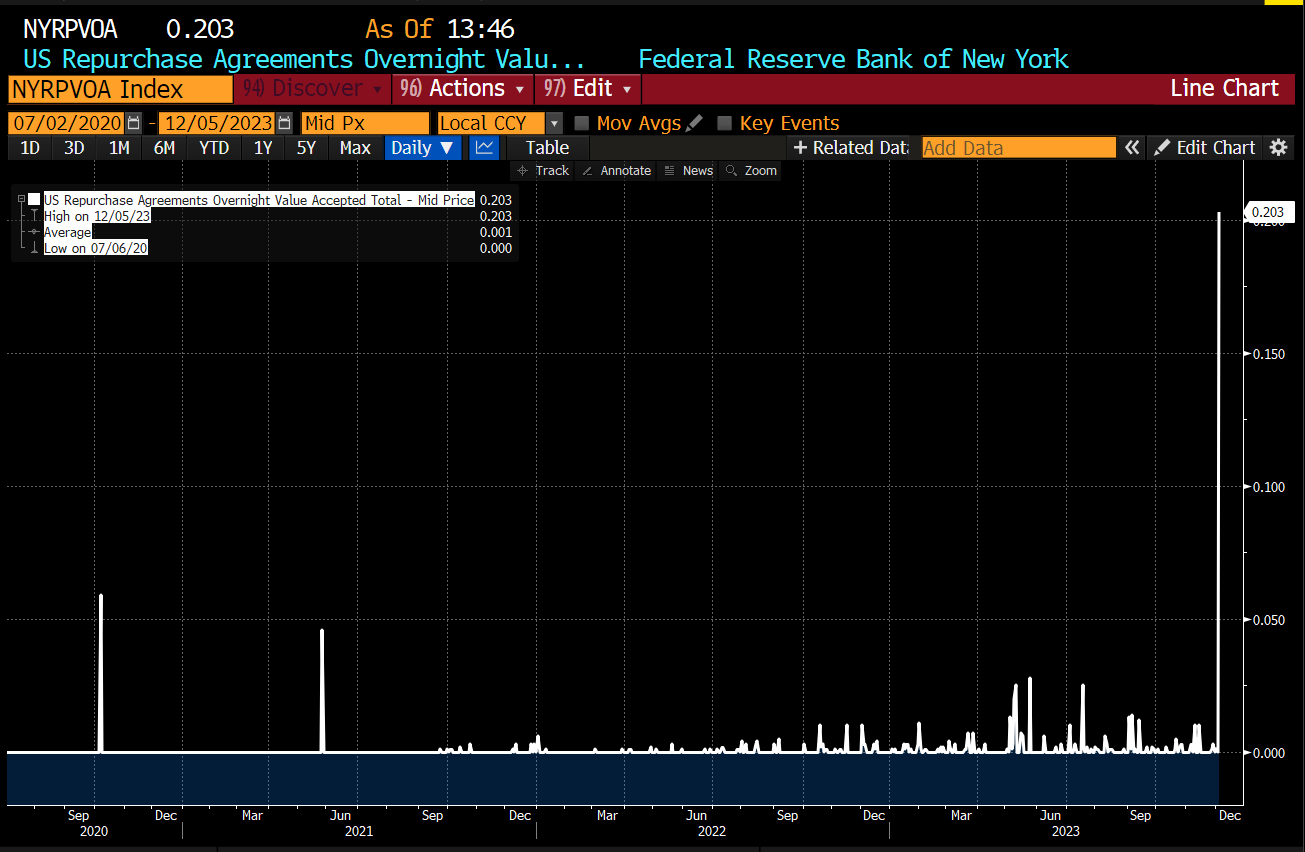
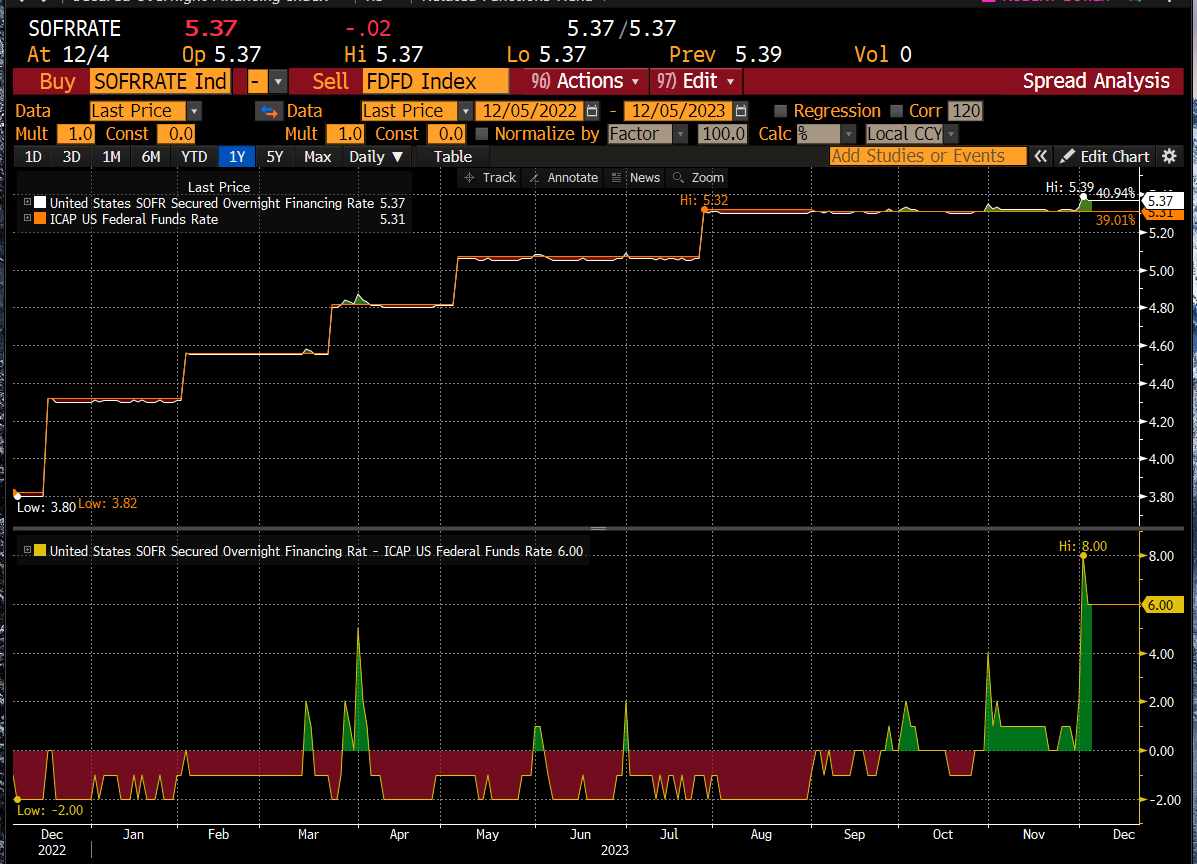
THE SOFR RATE SPOOKED REPO MARKETS after it hit its highest level since the ‘repocalypse‘ of September 2019.
Blink and you may have missed it, but a key short-term interest rate hit a record high last Friday, briefly freaking out the world of repo traders and all those who specialise in pricing liquidity. The move to 5.39 percent at the month’s end prompted comparisons to the great repo spike of 2019, which at the time forced the Fed to abandon its first real attempt to reduce its balance sheet.
The so-called secured overnight financing rate, or SOFR, has become a key indicator of liquidity stress now that Libor has been phased out [all liquidity indicators are now secured or collateralised rates by design]. By Wednesday the rate had subsided to the Fed funds level of 5.33 percent, with general collateral (GC) rates also falling back to 5.398 percent.
Why it matters: As repo watcher Scott Skyrm of Curvature Securities told clients, the market is used to overnight repo ‘general collateral’ (GC) rates spiking without the SOFR rate following with it. This time, however, SOFR had followed with gusto.
Not an ideal benchmark: “The problem with SOFR is the tri-party component,” said Skyrm, adding SOFR itself is made up of three indexes: the deliverable GC rate, the general financing collateral (GFC) rate, and the tri-party rate. While the former two are dealer-to-dealer numbers, the latter is a dealer-to-customer rate. That means SOFR should in theory always trade lower than the dealer rates, and ideally below the Fed Funds rate too.
Poor man’s Libor: “Though SOFR is the hedge for repo and financing, it’s far from perfect,” Skyrm explained. “When there’s funding pressure in the repo market, banks are slow to show their tri-party customers higher rates and thus the reason why SOFR is sticky on the upside”.
LCLoR eyed: Fears that the Fed’s so-called “lowest comfortable level of reserves” (LCLoR) may have been hit, or is about to be hit, is among factors causing jitters in the repo market. Nobody can be sure where the level lies, with estimates ranging from $3 trillion to $3.7 trillion.
What next? ING analysts warned on Wednesday that if SOFR continued to trade above the Fed funds level, balances in the Fed’s reverse repo facility would begin to decline. They further urged clients to keep an eye on the increased usage of the Fed’s standing repo facility, since “it shows that in some quarters there is at least some demand for liquidity.” — IK
MOODY’S ADVISED STAFF TO WFH ahead of China’s outlook cut, on fears over Beijing’s possible reaction to the move.
CHINESE STOCK TUMBLE LED BEIJING to purchase ETFs whose underlying assets are A-shares issues by state-owned enterprises in the domestic stock market Friday, causing a sharp rebound in Chinese stocks overall.
THE GERMANS GAVE UP ON FINALISING THE 2024 BUDGET YEAR: The ruling coalition will not manage to have a 2024 budget in place before the end of this year, Politico reported. The admission by Bundestag member Katja Mast underscores the degree to which Germany’s ruling coalition is struggling to deal with the consequences of a top court ruling last month that sparked a severe political and fiscal crisis.
THE YEN SURGED AFTER Japanese monetary authorities signalled they were prepared to shift policy. But the rally was short-lived, with the yen dropping once US nonfarm payrolls surprised to the upside on Friday.
AMERICAN CONSUMERS HAVE BEEN SPENDING more on prescription drugs than non-prescription drugs.

| AT THE COP-ACABANA |
JOHN KERRY SHRUGGED OFF controversial remarks by Sultan al-Jaber, the Chief host of this year’s COP28, in which he claimed there was “no science” backing a push to phase out fossil fuels.
JAPAN, FRANCE BACKED A PLAN to boost a climate lending scheme that would leverage IMF Special Drawing Rights to fund climate and development efforts in Africa.
| CRYPTO EVANGELISM |
THE ECB’S BLOG ON BITCOIN, which studied the cost bases of Bitcoin following the collapse of FTX, found that Bitcoin was rarely used for legal transactions.
CBDCS ARE STILL A SOLUTION LOOKING FOR A PROBLEM claimed Barry Eichengreen, professor of economics and political science at UC Berkeley, labelling them as “the bad idea that won’t go away”, and stating that “there are simpler, more straightforward ways of solving the problems that CBDCs are deemed to address.”
THE NEW BINANCE HEAD refused to disclose the precise location of the group’s global headquarters, as Richard Teng replaced former CEO Changpeng Zhao who recently pleaded guilty to US criminal charges.
| THE MEDIUM IS THE MASSAGE |
MATT TAIBBI TESTIFIED BEFORE CONGRESS on the findings regarding the censorship carried out by American agencies on social media networks, including the silencing of health professionals concerned with the much-too-rapid rollout of the Covid-19 vaccine.
COUNTERTERRORISM TACTICS WERE USED AGAINST AMERICANS by US military contractors, new documents show according to Public’s Alex Gutentag. Despite Democratic members of Congress’ insistence that censorship efforts of American agencies are benign and not a violation of the First Amendment, the findings from the CTIL filed suggest otherwise.
Gutentag named Rand Waltzman, formerly of IARPA and Rand Corp, as the inadvertent creator of the current digital-led censorship industrial complex. My understanding is that this is just half the story. Waltzman, who is now retired, has been seeking to publicise the abuse of the systems he helped to create. They were never intended to censor Americans.
Having spoken to him a number of times myself, I can tell you his concern is for the integrity of the information space as a whole. He sees the media landscape as so polluted with disinformation across the board (including by foreign state actors, private actors and domestic state actors) and so vulnerable to blowback that it is almost impossible to make heads or tails of who is or isn’t an authentic actor at the moment. — IK
SIGNAL FACED A COLLAPSE IN FUNDING after the CIA cut its support for the secretive messenger app. Kit Klarenberg’s Substack detailed the fascinating background of Signal, originally funded by the CIA-linked Open Technology Fund.
BELLINGCAT COLLUDED WITH WESTERN INTELLIGENCE revealed a Freedom of Information request filed by a Dutch researcher. What was long suspected by watchers of the ‘intelligence’ outfit has finally been confirmed; a Bellingcat investigation was shared, according to the anti-establishment Grayzone, with a Dutch intelligence agency before being published “to assist the Dutch spooks in shaping media strategies and messaging following its release.”
WHY ELON MUSK’S MISSTEPS ON X may be deliberate: gambling for resurrection. In other words, Musk has little left to lose. The hypothesis, explained by Eric Talley of Columbia Law School, claimed “Musk is trying to harm X in the short run to get the banks that have lent him money to accept that they will have to “restructure” what he owes them”.
US HOMELAND SECURITY PAID ALMOST $1MN to a counter-terrorism non-governmental organisation to “intercept and divert” Twitter/X traffic away from specific individuals in the so-called ‘manosphere.’
| GEOPOLITICAL HOT SPOTS |
MILITARY LEADERS WERE MAKING PEACE in Ukraine, notably Generals Valery Gerasimov of Russia and Valery Zaluzhny of Ukraine, according to Seymour Hersh’s latest piece.
DER SPIEGEL ADMITTED PUTIN WAS ON SOLID GROUND, as greater numbers of heretofore reality-resistant mainstream media have recanted on their claims that Ukraine may win the war.
A TRUMP-APPOINTED JUDGE IS SET TO OVERSEE HUNTER BIDEN’S TAX EVASION CASE: The case which alleges Hunter was involved in a four-year $1.4m tax evasion scheme, according to The Daily Mail. “All nine charges relate to tax, including two felony charges for filing a false return, a felony charge for tax evasion, four failure to pay charges, and a further two charges for failure to file. The charges span the 2016, 2017, 2018 and 2019 tax years.”
With even NPR going big on the story now, it looks like the strategy may be to move forward with the case quickly enough to ensure Hunter can receive a Biden pardon. — IK
APPLICANTS SEEKING TO BE NATURALISED IN SAXONY are now required to declare their support for Israel’s right to exist. In an interesting series of events, Germany’s support for Israel has been described as a ‘reason of state’.
The death of every wise Western philosopher, whether economic, psychological, or mystical, commences whenever they wade into politics. Milton Friedman, Jordan Peterson, all brilliant experts in their field who degraded their own credibility by the holding of partisan political positions. Not so Slavoj Zizek. The wily and chaotic philosopher made some interesting — and excruciatingly controversial — remarks which traced the Nazi origins of Germany’s support for the state of Israel.
“We must separate the Jews into two categories, the Zionists and the partisans of assimilation,” said Reinhard Heydrich, one of the architects of the Holocaust, in 1935. “The Zionists profess a strictly racial concept and, through emigration to Palestine, they help to build their own Jewish State.…[O]ur good wishes and our official goodwill go with them.” In Heydrich’s terms, the creation of the State of Israel thus represented the triumph of Zionism over assimilationism.
So begin one of Zizek’s articles on Israel, where he postulated the Zionist state is an ironic birthchild of anti-semitism. Zizek’s full view is just too controversial and too philosophical to be fully reprised on The Blind Spot.
But he hits the mark on a common Blind Spot topic: that while not all Germans were Nazi, most Nazis were German. I.e., most Nazi policy was just German policy – and there is thus a significant continuum of German policy that runs from the Weimar period, through the Nazis, and into its modern democratic period. Notably, the intention to create a free-market zone controlled by German industry, from the Pyrenees to the Urals – which led to John Maynard Keynes comparing the EU to former Nazi economic designs for Europe.
So when Germany described its support for Israel’s existence as a ‘reason of state’, the reader must bear in mind this official Zionist stance is not just comparable, but arguably evolved from, the proto-Zionist stance of Nazi Germany in Heydrich’s time. – DGG
SPAIN EXPELLED THREE AMERICAN SPIES, supposed U.S. embassy staff, who were found to have bribed a Spanish intelligence officer for secrets.
This story made headline news across Spanish networks: Spain ‘discreetly’ expels three American spies for infiltrating the CNI (the National Centre for Intelligence).
Where do I begin. The only thing weirder than American spies getting caught bribing and spying on a close Western ally is reports the CNI publicly denounced the move. The Spanish Defence minister, Margarita Robles, confirmed that last Monday a Madrid judge had been handed a dossier by the CNI which made him open an investigation into the matter. The infiltration was discovered this September, when two CNI agents were found to have accessed information that was not relevant to their tasks. A further investigation into the matter revealed these three Americans had bribed the two to get their hands on the Spanish intelligence in question.
One of the Spanish spies is still in prison, while the other was released on bail.
Though the quantities involved in the bribe are currently unknown, as well as the nature of the revealed intelligence, CNI sources revealed the American infiltration scheme had started at least a year ago.
The latest development is that a fourth American embassy employee’s expulsion is being requested by the CNI.
The nature of these revelations is strange for a variety of reasons. One would assume the United States would not need to make hostile moves to acquire an intelligence report from a close NATO ally.
In fact – they probably don’t. But intelligence agencies operate far more chaotically than most expect. Whoever it was, they didn’t want to ask for permission. A permission Spain’s CNI would almost certainly have given. Whoever they are – I suspect their career has suffered. One to watch. – DGG
‘HOW GERMANY BECAME MEAN‘ was the title of a New York Times piece on the current rightward lurch currently underway in Germany.
XI JINPING WAS GOING FULL STALIN as instability continued to swirl in Beijing’s top ranks, foreign policy and defence officials are vanishing from public eye as Xi roots out his perceived enemies from government. This was a Politico un-bylined piece.
| BLACK MARKETS AnD HACKS |
PROFILES OF 6.9 MILLION 23ANDME users were hacked in the latest large-scale hacking case. Though 23andMe have stated the stolen data did not include DNA records, personal information such as family trees, birth years, and geographic locations were confirmed stolen.
QUEEN MARY’S HACKED? In a Blind Spot exclusive, information reached us detailing a cyberhack that took place at Queen Mary University of London, specifically the Barts Cancer Institute, which is responsible for creating widespread headaches for researchers at the institute. The story is developing.
We heard information from a source that informed us QM IT personnel were working overtime to restore a loss in their IT systems after experiencing unidentified issues related to a cyberhack – and that their IT systems won’t be back until the New Year.
The Blind Spot was also told personnel in St. Barts were suffering from an almost total outage in their capacity to process laboratory data.
While their testing hardware is still functional, it remained impossible for researchers to transfer the testing data into workable models on the university’s computer systems.
But Queen Mary’s denied the extent of these cyber-related issues:
“We have experienced an issue involving an isolated network that supports the Barts Cancer Institute and related activities, including some research activities. We took all related systems offline as a precaution while we investigated the issue. Contingency plans are in place to enable research to continue.
“We have a team of network specialists working on understanding and resolving the issue as quickly as possible. None of the other University systems are affected.”
But in computer systems very little is ‘isolated’ – and it is questionable that having to shut down ‘related systems’ essentially brought down the St Barts IT infrastructure if the so-called issue is as isolated as they claimed.
The story is developing – we have reached out to QM again to confirm whether they have ruled out a cyberattack as the cause of these IT issues. – DGG
SWITZERLAND CHARGED TRAFIGURA over allegations of bribery in Angola and Brazil, which led the commodity trader to take out a $127mn provision.
THE NEW APOCALYPTIC NETFLIX DRAMA ‘LEAVE THE WORLD BEHIND’, starring Julia Roberts, which was released this week took a stab at Tesla autonomous security. In the drama, which follows a ‘Red Dawn‘ style plot involving a cyber attack opening the way to an invasion of America by hostile but unknown adversaries, Tesla cars are hijacked and programmed to collide into each other to create barricades that shut off access into and out of all major cities.
The reason the drama and the plotline are notable is because the film is the latest Michelle and Barack Obama production. Autonomous Tesla cars being a vector for a US attack seem something of a projection of real Chinese fears about the cars being used as US spying and attack devices in mainland China. So is it a veiled signal to China about what could come to pass?
As we’ve speculated before, the reason Elon’s cosy China business relations haven’t yet undermined his status as a US defence contractor (and possibly why he’s not been more outspoken about Chinese suppression of free speech) is probably because it suits “our side” to populate China with as many autonomous cars that we have the capacity to control as possible.
The question worth asking is whether Chinese autonomous EV cars will be as welcome on our side as Tesla cars have been there. Were MAD logic to be applied, then it would point to a new arms race in the rollout of backdoor-laden autonomous technology in eachother’s territories. — IK
| HAL9000 WATCH |
ELON MUSK’S AI STARTUP, X.AI, has filed to raise up to $1bn in an equity offering, having raised nearly $135m from four investors so far. According to Musk, the AI startup seeks to “understand the true nature of the universe.”
| RIP |
NIALL FERGUSON’S KISSINGER OBITUARY dwelt on the highly controversial foreign policy legend’s passing. Ferguson claimed the “late secretary of state knew that diplomacy inevitably boiled down to a choice between evils.” Oh and that he was a bit of a ladies man who snubbed the historian when he first met him for a chance to chat with model Elle McPherson.
MEDVEDEV REGRETTED KISSINGER’S PASSING, the Russian Prime Minister claimed, arguing that “he was a pragmatist who took realities into consideration, and not just followed the US foreign policy canons. Now, there aren’t even traces of the people like him in the US Administration and the western world.”
| Health |
A NEW ZEALAND WHISTLEBLOWER WAS JAILED for accessing and leaking New Zealand vaccine data from the Tw Whatu Ora health center, but has since been released on bail. The whistleblower had targeted information regarding Covid-19 MRNA vaccines, claiming it proved they were unsafe, and was interviewed by the infamous Alex Jones.
RISHI SUNAK BRACED FOR DEFEAT in the Commons over the creation of a new body to deliver compensation for people who were given contaminated blood products from the United States in the 1970s and 1980s in one of the worst scandals in NHS history. Rachel Reeves’ letter to Jeremy Hunt on the vote is available here.
A SYSTEMATIC REVIEW OF COVID-19 CHILD MASKING mandates by medical researchers found the masking mandates to have been ineffective, and claimed “the current body of scientific data does not support masking children for protection against COVID-19.”
PROTESTERS INTERRUPTED BORIS JOHNSON during the U.K.’s Covid-19 inquiry. After the interruption, the protesters were escorted out of the premises.

One Response