

Dear Subscribers,
Thank you for your patience while I was away. We’re back to normal programming this week. This edition of the Blind Spot newsletter was compiled as usual by me with the help of Dario Garcia Giner.
Economics, business, finance and more:
- Following the NatWest-Farage row, the heads of Britain’s largest banks committed to the principle of “non-discrimination based on lawful freedom of expression” in a meeting with financial services minister Andrew Griffith.
. - Nigel Farage also launched a campaign to help victims of de-banking, as banks continue to shut down the accounts of small businesses that refuse to go cashless. [I will have more to say about the FATF aspect to all this next week.]
. - Former Bank of England chief economist Andy Haldane argued that the real scandal of CBDCs was the stealth seigniorage tax they would impose on populations if they paid out zero interest rates. I had some longish thoughts about it on Twitter/X, though one prominent central banker, who shan’t be named, told me that the sums involved were hardly scandalous and amounted to about £8bn a year in the UK.
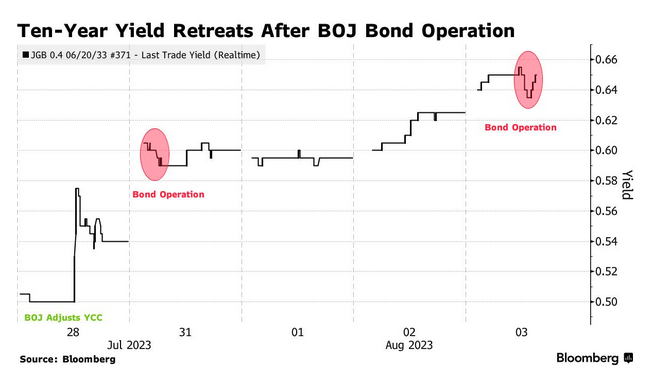
. - Japan’s 10-year bond yields reached a nine-year high following changes by the Bank of Japan to its yield curve control policy on July 28. But, on Wednesday, BoJ deputy governor Shinichi Uchida talked down the possibility conditions had got to a point that justified raising the short-term interest rate target from -0.1 percent.
The general market consensus seems to be that this isn’t the beginning of the end of ultra loose monetary policy or yield curve control just yet.
Rather, the moves from the BoJ — including this week’s two market interventions — are aimed at preventing yen weakness as the spread between JGBs and USTs widens. Most analysts agree the BoJ will need a lot more evidence that inflation is becoming entrenched before moving ahead decisively with any reversal to policy. And even then, easy does it.
What’s more, if economic weakness persists, there’s no guarantee that, even if the BoJ took its foot off the Yield Curve Control pedal, rates would rise splendiferously of their own accord thereafter.
So why the kerfuffle?
For those not in-the-know, Japan — due to its multi-decade deflationary woes — has been a protracted source of cheap funding for international capital markets for an extended period. This has seen the rise of the ‘yen carry trade’ in which traders in Western markets borrow yen cheaply and reinvest the proceeds in higher-yielding currencies, while hedging their FX exposure to achieve a near riskless arbitrage. Japanese investors in turn seek out higher-yielding foreign investments, sending oodles of Japanese capital abroad.
All that cheap liquidity plus a reliably consistent current account surplus has seen Japan accumulate more than $1 trillion in US government debt securities, displacing China as the top holder back in 2015.
But now, finally, inflation has begun to make a comeback in Japan — even if at a far more gentle and welcome pace than in the West.
The question perhaps is to what degree has BoJ liquidity helped to offset overall monetary tightening among other G7 central banks thus far? Some, such as former Federal Reserve central banker Kathleen Tyson, believe that it is thanks to the BoJ that overall global liquidity has remained neutral this year, reducing financial instability. But with Japanese inflation now at 3.3 percent, versus 3 percent in the US, and the BoJ tinkering with Yield Curve Control, traders are understandably becoming anxious that the BoJ could struggle to sustain the liquidity juggernaut it has created.
Any significant unravelling of established policy poses a threat to international capital markets, which were already under pressure due to US quantitative tightening and a Fitch downgrade this week.
It’s worth remembering that the BoJ was the first to unleash quantitative easing on the system long before the global financial crisis even occurred. The BoJ was also the first to move beyond standard government bond purchases to ETFs and other equity securities. And it was the first to formally apply an explicit rate target to the long end of its government bond curve, and to use purchases to achieve it. It makes sense, since it was the first man in, that it is also the last man out.
But where the BoJ goes on from there, potentially so do all of us. — IK
- Fitch downgraded US government debt, taking its rating to double A from triple A on the back of its near default two months ago due to its debt ceiling debacle. US Treasury yields have risen every day this week in response, with the 30-year yield hitting its highest since 2011.
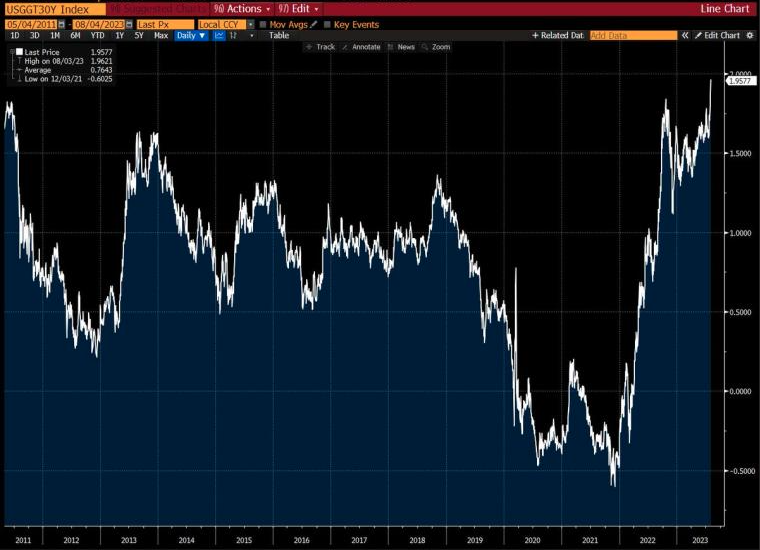
It wasn’t us guv’nor: The Biden administration complained that the decision was based on flawed methodology and, if anything, was not its fault but, instead, that of the previous Trump administration. Treasury Secretary Janet Yellen and former Treasury Secretary Larry Summers also claimed the decision made no sense.“This Trump downgrade is a direct result of an extreme MAGA Republican agenda defined by chaos, callousness, and recklessness that Americans continue to reject,” Biden’s campaign spokesman Kevin Munoz said, reminding journalists Trump had urged Republicans to “do the default”.
Adding insult to injury … The U.S. Treasury was already expected to confirm a veritable tsunami of new U.S. debt issuance on Wednesday with many market traders concerned about the capacity of the market to absorb the volume. The final schedule clocked in at $103 billion of longer-term securities to be sold next week, more than the market was expecting, adding further pressure to U.S. 10-year bond yields, which hit their highest level since November at 4.126 percent. — IK
- Amid the de-banking scandal, The Telegraph revealed a left-wing bias among staff at Monzo, who described the Conservatives as “evil” and celebrated Tory election losses.
. - Dutch e-bike maker VanMoof filed for UK insolvency but remained hopeful that Nasdaq-listed Micromobility.com may swoop in to acquire the bankrupt startup.
. - Swiss manufacturing PMI nosedived in July to its lowest since 2009:

- Ride-hailing app Uber supposedly made its first operating profit after $31.5 billion of losses, even as its surge-pricing policy left its own CEO in shock after Wired’s editor-at-large Steven Levy paid $51.69 for a 3-mile trip in New York City.
When it comes to Uber results I like to turn to mobility industry expert, Hubert Horan. And this time, Horan reassures me that all is, as ever, not as it seems.
“The $392 million GAAP profit was totally explained by $386 million in alleged appreciation in the non-tradable stocks it holds (Didi, Grab, Aurora, etc),” Horan told the Blind Spot.
Buried in footnotes, meanwhile, was the fact that Uber had pushed payment for their UK tax liability into July. While Horan acknowledges that losses have clearly been reduced, he notes Uber still refuses to give investors any idea as to how that’s been achieved, or why profitability versus Lyft has suddenly gotten much stronger. Gains instead are attributed solely to “growth”, which makes no sense since past growth obviously created huge losses.
Based on anecdotal evidence, margin improvement may stem from Uber finally having given up on its predatory pricing policy as well as its overly extended geographic reach. If so, that would mean profits come at the cost of fewer taxis on the ground when you need them (unless you’re prepared to pay over the odds) and far less presence outside of dense urban areas. There’s also a good chance that the company is using sophisticated data processing techniques to profile customers according to their willingness to pay more, and personalising prices accordingly.
Next time you find yourself in a large group hailing an Uber, it might be worth comparing and contrasting just how similar (or not) all your respective fare offers are. — IK
- Jay Newman, former senior portfolio manager at Elliott Management, explained why the lawsuit by AT1 bondholders against the Swiss National Bank and UBS stands a good chance of succeeding.
The whole piece is worth a read. I didn’t realise, for example, that files relating to the investigation will be embargoed for 50 years, rather than the usual 30, on national security grounds. — IK
The road to hell is paved in ESG:
- Secretary of State for the Department of Energy Grant Shapps announced hundreds of new oil and gas licenses for North Sea exploration deals. These new licenses will ostensibly support 213,000 jobs in the region.
. - US gasoline prices rose to October 2022 levels as the driving season got into full swing.
. - A Wall Street Journal op-ed by Bjorn Lomborg, president of the Copenhagen Consensus, argued worldwide fires have actually been declining since 2001. This contrasts sharply with the contemporary trope that global warming is leading to an increase in forest fires.
. - In a piece for the Telegraph, Sherelle Jacobs claimed that Labour leader Keir Starmer’s diehard defence of net-zero goals will end in his humiliation, as global geopolitical grounds shift away from these lofty goals.
. - Oil Price.com revealed there is a financial crisis brewing in offshore wind energy, as costs associated with US offshore wind projects have risen by 57 per cent since 2021 due to inflation in components and labour costs, and rising financing costs. This is leading to a large number of cancelled or renegotiated deals.
The bad news is that the green lobbyists have caught wind (pun intended) of the news and have begun campaigning the Bank of England to transform its Term Funding Scheme (initially brought in to support SMEs during Covid) into a green support package. They would like the scheme to offer green projects preferential rates on the basis they are expected to be deflationary once completed.
The somewhat poor logic from Green Alliance is that “When the Bank of England uses its main tool to reduce inflation – raising interest rates – this risks making renewables more expensive.” To avoid this ‘doom loop’, and ensure low financing costs for renewables, Green Alliance says policymakers need to encourage the Bank “to use its full range of tools for controlling inflation: such as targeted lending schemes.”
The policy, unsurprisingly, is the brainchild of the unorthodox New Economics Foundation.
And yet, if wind and solar really could compete with fossil fuels in terms of efficiency and inflationary effects, they wouldn’t be facing bankruptcy from higher financing costs just when oil and gas producers were suddenly finding themselves increasingly viable.
As my Politico colleague, Geoff Smith, recounted this week, “Rock-bottom rates have been the cardinal factor behind the astonishingly low prices that prospective wind-farm operators have been prepared to accept in recent tenders by the U.K. and other governments. That has allowed the green lobby to boast loudly that renewables are now the “cheapest” new form of energy to build.
“However, that boast comes with some serious T&Cs. Vattenfall last month said it would stop work on a U.K. wind-farm project and book a massive impairment charge because the economics had been wrecked by input price inflation and higher interest rates. Having comprehensively spoofed the auction system, it now wants the government to cut it a better deal. A bit like the 2008 edition of the Credit Suisse handbook on writing swaps, only with less public outrage.”
The learning here, perhaps, is that the figures the industry has been relying on to claim renewables are competitive with fossil fuels have been misleading due to their over-reliance on low financing costs. That was clearly never going to be sustainable. And even if low financing rates could be guaranteed, the assumption that renewables are always and forever disinflationary still isn’t right. Everything as usual depends on the balance of supply and demand in the context of investment cycles, as well as the full energy mix being used to make renewables in the first place. — IK
Cryptocurrency evangelism:
- KPMG published a research paper on Bitcoin’s role in the ESG framework. The paper studied how despite Bitcoin’s transition into a traditional asset class it is still misunderstood by investors and the mainstream media, especially with respect to its emission footprint.
Media matters:
- The co-founder of Wikipedia Larry Sanger told Glenn Greenwald he believed US intelligence authorities have been manipulating the online encyclopedia since at least 2006. This was when he first noticed that some pages — often ones dedicated to controversial issues — were increasingly aligning with particular political viewpoints.
. - Elon Musk’s X platform appeared triumphant in the face of Meta’s challenger, Threads,revealing that most of the over-100-million people who had signed up for the platform just weeks ago had already stopped using it..
. - India premiered the first AI newscaster. Named Lisa, the head of Odisha TV hailed her debut as a “milestone in broadcasting TV and digital journalism”, though her appearance garnered mixed reviews among viewers.
. - Sexy AI influencers who are totally fake were reportedly raking it in on platforms that allow content monetisation.
. - Culture wars commentator Caitlin Johnstone penned a long-form piece on the X platform arguing that most of today’s journalistic class stemmed from elite socio-economic upbringings, which contrasted with the historic norm that journalism was a working class profession. “Mainstream journalists are cloistered Ivy League-educated trust fund kids,” she noted.
. - Newly released subpoenaed notes detailed meetings between Facebook executives and Biden’s officials, which showed the lengths the White House had gone to control content posted on Facebook surrounding Covid-19.
. - An exclusive investigation from The Bureau’s showed that Beijing’s control over Canadian media had enabled it to carry out some degree of election interference.
.
- Republican senator Eric Schmitt argued in the Wall Street Journal that bureaucrats who attempt to stifle free speech online should face consequences for breaching the First Amendment.
. - Twitter/X said it would allow paid users hide their verification checkmarks. You know, so they wouldn’t have to be embarrassed about it.
. - Elon Musk said X Corp would be suing the Center for Countering Digital Hate over the latter’s suggestion that there had been a rise in hate speech and disinformation on Twitter since Musk took over the platform.
Geopolitical hot spots:
- Early days Wuhan lab-leak theorist, Dr. Lawrence Sellin, revealed that an extensive Chinese real estate network in California and Hawaii had purchased properties near strategic American military installations like Pearl Harbour.
. - Hedge fund manager Kyle Bass of Hayman Capital drew attention to the discovery of secret Chinese labs making Covid tests and pregnancy tests in Reedley California by city code enforcement officers.
. - Following a coup, the Niger Minister of Finance was given 48 hours by the Niger military to explain the country’s missing finances or face execution by firing squad.
. - ECOWAS, the neighbouring Economic Community of West African States, gave the Niger junta one week to cede power, threatening to use force and to impose financial sanctions if it didn’t.
. - While protesters in Niger burnt French flags, France condemned the recent coup attempt that threatens to engulf West Africa in a new inter-regional conflict.
It’s worth retracing how it all went down in Niger.
On 26 July 2023, the country’s presidential guard detained then-president Mohamed Bazoum, and General Abdourahamane Tchiani — the presidential guard — declared himself the leader of a new military Junta. The Junta immediately closed the country’s borders and declared a curfew.
The new Niger Junta then pitted itself against ECOWAS members — the primary alliance of West African countries — the African Union, as well as Western powers. The European Union, the United States, and France quickly announced the suspension of all cooperation with the Junta. Contrariwise, the Wagner Group quickly announced their support for the coup — though Russia has joined most countries in calling for Bazoum’s immediate release.
More worryingly, on the same day that the coup went down, the ECOWAS Chairman announced they “would not allow coup after coup in the West African sub-region.” The 15-nation regional block announced a week-long deadline for Bazoum to be reinstated as President, else it will take “all measures” to restore constitutional order. For now, Nigeria, Senegal and Ivory Coast have all declared their readiness to invade the country. This clashed with declarations from Burkina Faso and Mali, which announced that any military intervention in Niger would be tantamount to a declaration of war against them. Algeria, despite condemning the coup, has also warned against foreign interference in Niger.
Alongside these events, planes carrying European citizens have been evacuating from the country since Wednesday. Nigeria has also cut power to Niger, causing country-wide blackouts, as the Junta has shut down French-aligned television stations.
The latest developments as of Friday revealed that Niger had scrapped its military agreement with France, and suspended the mandates of the American, French, Nigerian and Togo ambassadors. An ECOWAS delegation that flew to Niger just left the country without spending the night, as had been scheduled, and did not meet the leader of the Junta or Bazoum.
The geopolitical relevance of Niger for the West is two-fold. Firstly, the country is host to large uranium reserves, being the first exporter of the radioactive mineral to France. Secondly, Niger was the last remaining pro-French regime in the Sahel region following similar coups in Mali and Burkina Faso, which had allowed French forces to be stationed there for their regional anti-terrorist operations. However, significant Uranium reserves in France mean this restriction in supplies won’t be immediately catastrophic for the French nuclear sector.
Could this be the start of a new inter-regional war in West Africa? The jury is out. But one result is certain, the failure of France’s intelligence agencies to predict the coup d’etat, in what was one of France’s last remaining allies in Africa, goes a long way to exposing the increasing weakness of French power in the region. — DGG
- The leader of the Central African Republic asked voters to abolish term limits, as Wagner-backed leader Faustin-Archange Touadera sought to become leader for life.
. - Raytheon CEO Greg Hayes announced that pulling its supply chains out of China was “very impractical”, which struck most observers as highly problematic for a defence manufacturing company.
. - Poland rushed several thousand troops to its eastern border, as it denounced an airspace violation by two Belarusian helicopters.
.
- Taliban and United States officials met in the first official talks since their return to power two years ago in Qatar. The Taliban are seeking the unfreezing of the central bank’s assets, worth around $10bn.
.
- The Select Committee on the CCP initiated a Congressional investigation into Larry Fink and BlackRock for investments in at least 20 blacklisted Chinese companies. These include AVIC, a Chinese military aviation company, and BGI Genomics, a Chinese genomics company.
. - NATO officially closed its first $1bn fund to back startups focused on building strategic military tech, named the NATO innovation fund. The venture capital fund, modelled somewhat on the CIA’s In-Q-tel aims to make investments that support safety, freedom and human empowerment.
.
- New revelations into the role played by Russian oligarchs in Ukraine reveal the billions 60 individuals have received in defence contracts, despite their public distancing from Putin.
American political drama:
- Greg Price highlighted that every time a new revelation concerning Biden’s dodgy affairs comes to light, a new Trump indictment is announced.
. - Contradicting President Joe Biden’s statements, Hunter Biden’s former business associate Devon Archer claimed the current American President was on over 20 business calls with his son’s business partners.
Technological advancements:
- Nvidia chips became a type of financial collateral after specialised cloud provider CoreWeave raised $2.3 billion in a debt facility collateralized by semiconductors.
. - NASA and DARPA announced a collaboration with Lockheed Martin for a new nuclear propulsion demonstration for satellites, potentially revolutionising how we will travel to distant stars. The announcement on ‘nukes in space’ came the same day as the Congressional hearing into UAPs.
. - The co-founder of OceanGate, the submarine that recently sunk while taking high-paying tourists to see the wreckage of the Titanic, announced plans to send 1,000 people to a floating colony on Venus by 2050.
. - Scientists from Japan’s Chiba University developed a method that used lasers to create diamond wafers, which could soon power next-generation semiconductors.
Covid collateral damage:
- A new investigation by the Brownstone Institute into the differing quantities of toxicity in different Pfizer-BioNTech vaccine batches — the ‘blue‘, ‘green‘ and ‘yellow‘ batches, questioned why Germany’s Paul Ehrlich Institute did not subject the apparently harmless ‘yellow’ batches to QC testing. German chemistry professors, Gerald Dyker and Jorg Matsyik, questioned this lack of testing, leading the professors to conclude the absence of testing on yellow batches implied impropriety “as if it knew in advance that the batches were innocuous and, hence, did not need quality control”.
Unidentified flying objects:
- The Daily Mail showcased a new film which shone a light on the Collins Elite – a secret Pentagon group convinced UFOs are “spiritual” entities.
