
This edition of the Blind Spot Wrap was compiled by Izabella Kaminska, with help from Dario Garcia Giner. Subscriber note: No confidential whatsapp messages were revealed in the making of this wrap …
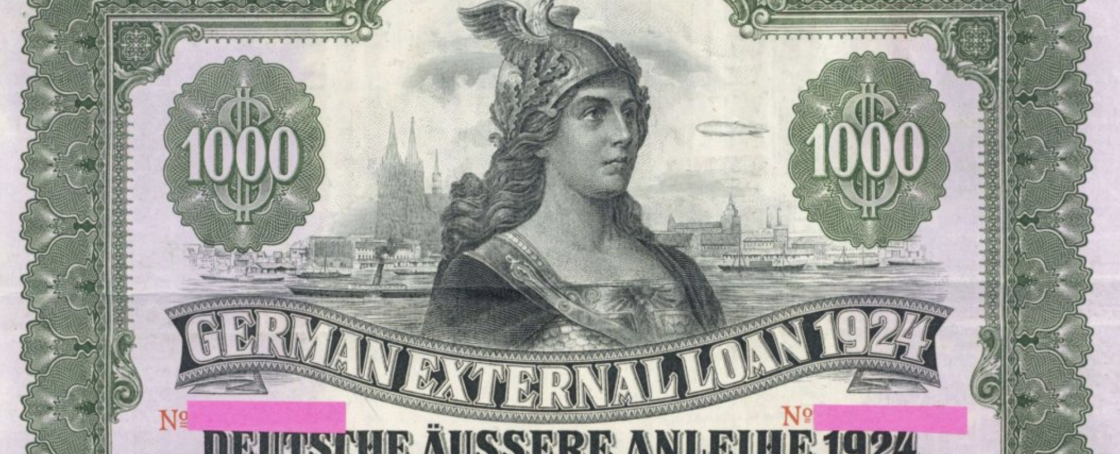
A quick note from collectable stocks and bond dealer, LaBarre Galleries, who wanted to draw your attention to this collectible vintage German bond. The bond was issued under the Dawes plan, which in 1924 sought to resolve Germany’s World War I reparations. You can read more about the bond’s intriguing history here.

Finance, business, econ, etc:.
- The price of rare bulbs tested Tulipmania levels after a single snow drop sold for £1,850 per bulb.
. - The CEO of Vanguard, Tim Buckley, challenged the ESG orthodoxy of the asset management industry by saying ESG investing “does not have any advantage over broad-based investing”.
. - The Bundesbank was forced to tap €1 billion worth of risk provisions after the central bank’s annual report revealed the institution’s largest loss in nearly two decades on “exceptional financial burdens”. Part of the pain related to the Buba having to pay out more to commercial banks depositing at the institution than what it earned from interest on its bond portfolio.
. - BitMex’s Arthur Hayes prepared for a comeback.
. - Amazon paused construction on its second headquarters in Arlington, Virginia.
. - A zero-day-to-expiration options boom was felt in the market. (Chart courtesy of Goldman)
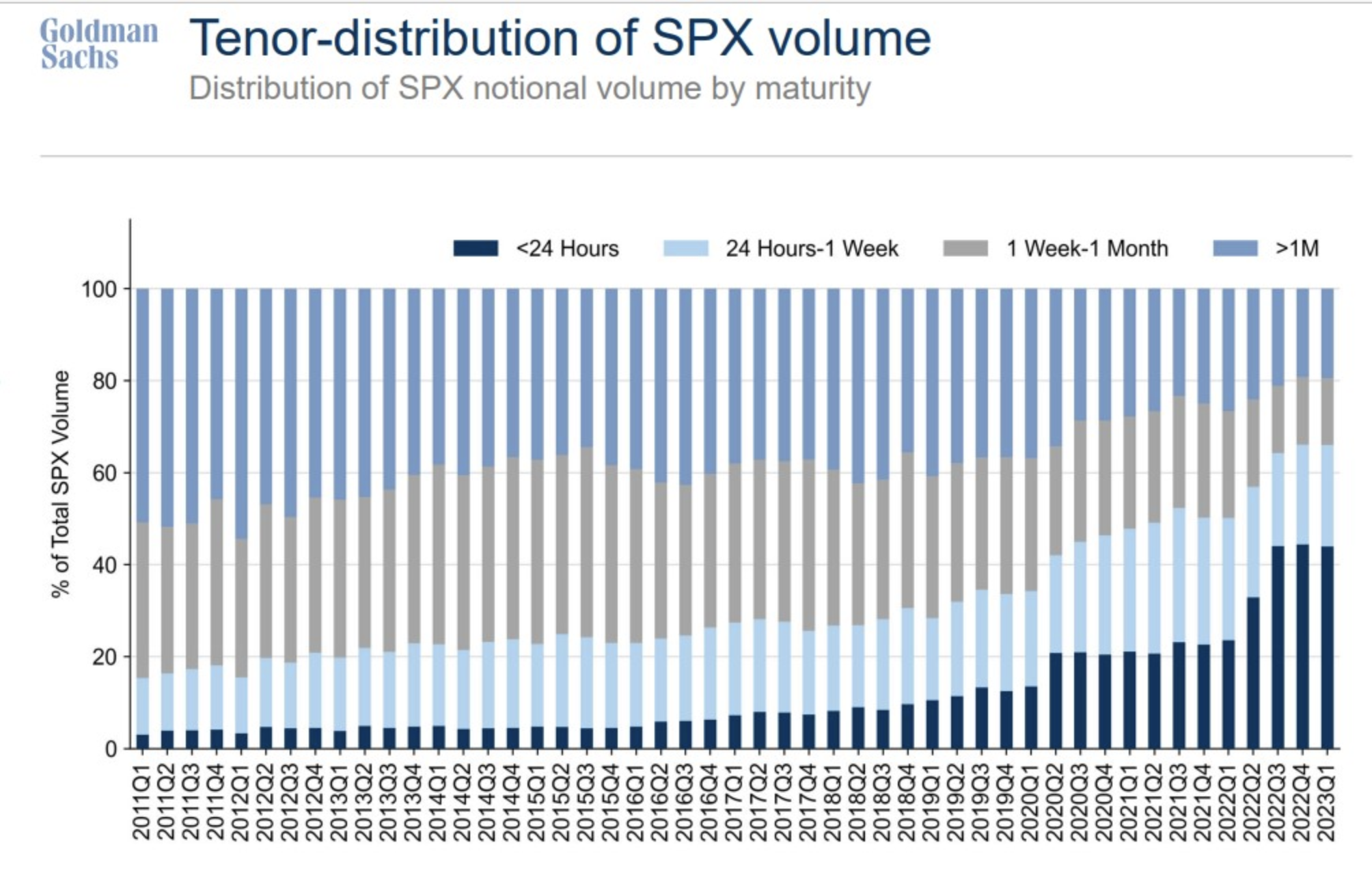
The buying and selling of contracts that have a shelf life of less than 24 hours seems indicative of a much bigger intraday liquidity phenomenon. The financial system is slowly synching itself with real-time intraday supply and demand in the real world. It started with BitMex’s perpeptual contracts which found a way to price intraday crypto liquidity. It’s now moved to the options market. The next step will be an actively traded intraday contract for dollar liquidity. – IK. - Blackstone defaulted on a €531 million euro bond backed by Finnish offices and stores owned by Sponda Oy.
. - There was even more trouble for crypto lender Silvergate.
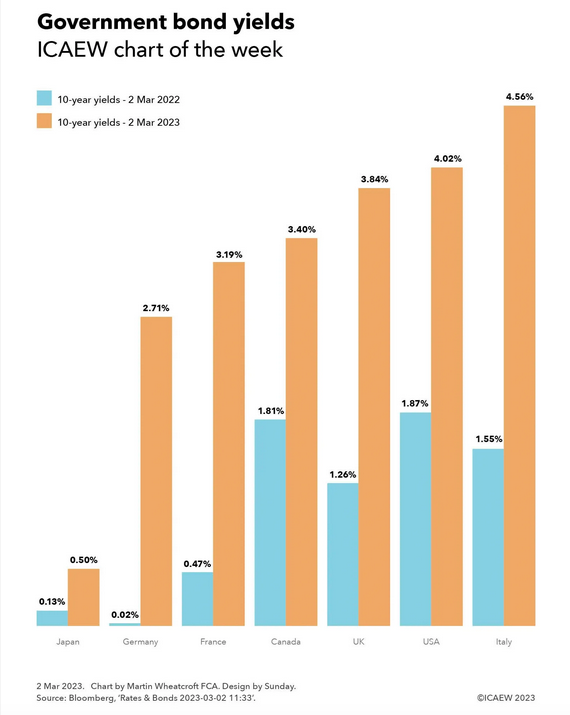
. - German 10-year bond yields rose to their highest level since 2011. French and Italian bond yields also rose sharply following disappointing Eurozone inflation news. Here’s a useful illustration of the current paradigm shift courtesy of ICAEW:
 .
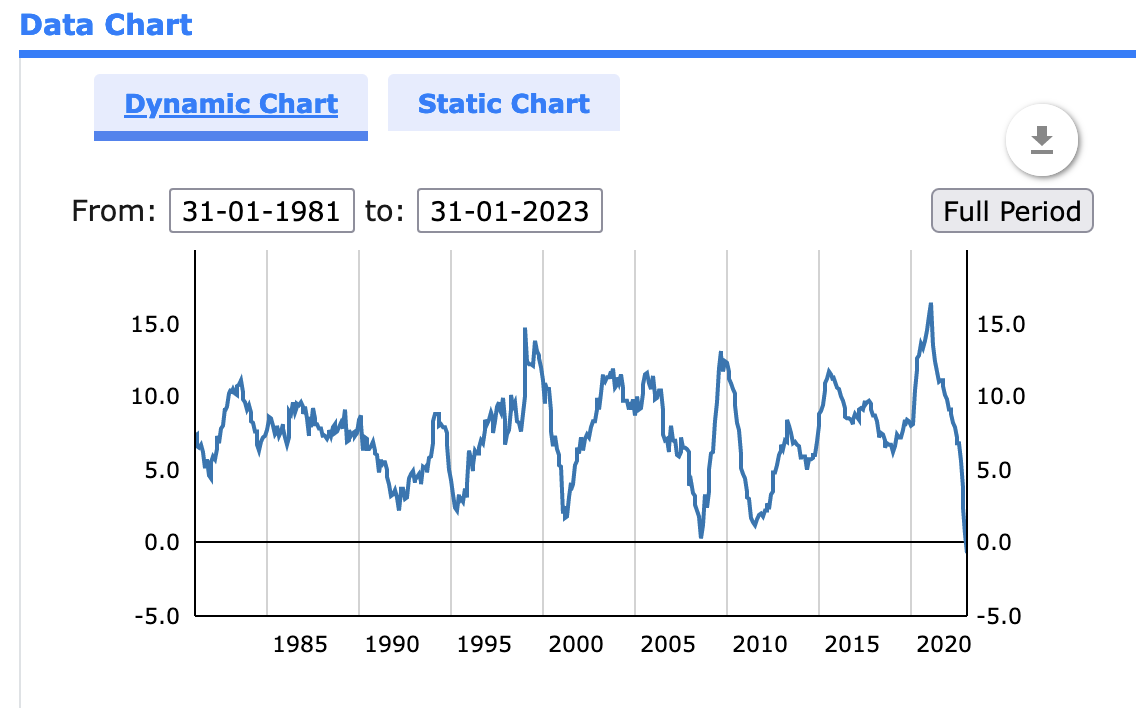
. - The Eurozone’s M1 money supply aggregate continued to collapse, as did US M2:
- Economist Marcello Minenna highlighted the growing lengths Germany’s debt finance agency, the little-known Finanzagentur, was taking to ensure bund markets stayed stable. He also advocated that other Eurozone countries like Italy create their own equivalent agencies.
The Blind Spot was one of few publications that covered the Finanzagentur’s rare intervention in bund markets in October last year — strange given the move indicated a possible BoJ-level dysfunction in the German debt markets.
As Minenna notes, the agency ended up tapping 18 outstanding bonds for a total of €54 billion for use in repo markets in a process that allowed the German government to raise additional cash without going back to auction, while also helping to unclog collateral shortages in the repo market.
Following the intervention, market conditions improved markedly and remained so until at least the end of January. But with bond yields and inflation on the rise again, keeping an eye on this esoteric corner of the market is going to be key. The Finanzagentur has already taken up the full allocation of two more bond issues.
For further context, see the overall growth in the agency’s retentions since the pandemic courtesy of Minenna’s graph here:
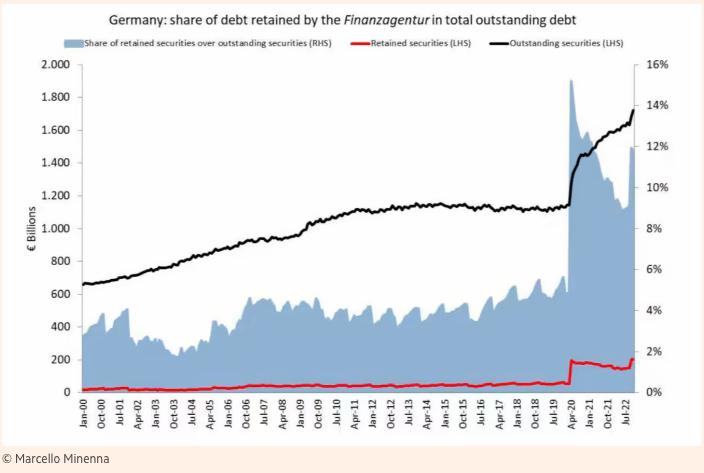
Most major economies have a mechanism that allows their Treasuries to generate temporary bond collateral to ease market imbalances. Even so, there is no standard approach. In Germany, the Finanzagentur operates under the retention principle meaning that up to 20 per cent (in normal times) of any bond issue is held back as a safeguard against collateral shortages. But holding back 100 per cent of a specific issue, as has been happening a lot recently, is not common practice.
Special Gilt Facility: In the UK, the debt management office – the DMO – operates a special gilt facility, which sees it issue a lookalike bond on a temporary basis for a punitive rate if and when it is ever needed. But the lending operations are handled by the Bank of England, and the money raised never hits government coffers.
Most recently, it was the BoE that stepped in to buy UK gilts via its open market operations arm to help stabilise collateral markets following the Truss market panic. Imagine how much weirder it might have been had it been the Treasury selling those bonds to itself?
Given it was trouble in the Greek repo markets that first triggered the bond price divergence that ended up drawing attention to Greek profligacy, spooking eurozone credit markets and bringing about the eurozone crisis, it’s probably worth getting to grips with how other eurozone countries’ Treasuries manage repo dysfunctions. If anyone has any insights, please do share. – IK
- The Treasury Select Committee pressed banks on why they have been so slow to pass on interest rate hikes to savers. Lloyds Banking Group, NatWest, HSBC and Barclays all grew in 2022, with some even boosting boardroom pay. Similar concerns have also been floated in the eurozone.
Net Interest Margin: The banks like to argue that they have a right to retain large windfalls having been deprived of a healthy net interest margin for so many years under Zirp policy. They also argue that it makes sense for them to set aside provisions ahead of potential write-downs on the back of deteriorating credit quality in future months.
Some everyone is convinced by the story. One former central banker told me that windfall taxes needn’t even be a matter for HMRC. The Bank of England could easily cut the amount of interest it pays to commercial banks with a simple policy change. It may even have an incentive to do so because like many other central banks it is expecting substantial losses on its balance sheet this year due to the impact of legacy asset purchases on revenues. (In a rising interest rate environment the amount the Bank has to pay out in interest to commercial banks exceeds the income it earns from its asset portfolio.)
In anticipation of such losses, the BoE asked Parliament this week to increase the government’s contingent liability for such shortfalls to £200bn.
The rules can always be changed: People forget that central banks have never had a consistent approach to paying interest on reserves, either on a jurisdictional or historical basis. Anything can change, at any time.
The Federal Reserve, for example, only introduced an interest-on-reserve policy after the global financial crisis of 2008 in a bid to set an interest rate floor (i.e. to prevent rates from falling into negative territory). It now sets monetary policy by targeting the Fed Funds rate – which is a market rate for interbank loans — within a band structure (currently 4.25-4.75 per cent), while using a discount rate (4.75 per cent) for its own loans to the market and paying 4.65 per cent interest on reserves. The ECB, meanwhile, was structured from inception to draw on three different rates to implement monetary policy: the main refinancing rate (now at 3 per cent), the marginal lending rate (now at 3.25 per cent) and the deposit interest rate (now at 2.5 per cent).
In the UK things are different. The BoE’s main reference rate is the Bank rate (currently at 4 per cent) and it sets the rate that commercial banks earn on their deposits at the central bank. But this has not always been the case.
The Bank switched from a Bank rate-based renumeration system to a “Minimum Lending Rate” system in 1972 (another high inflation era).
Here’s the FT write up about that surprise policy change from back then:
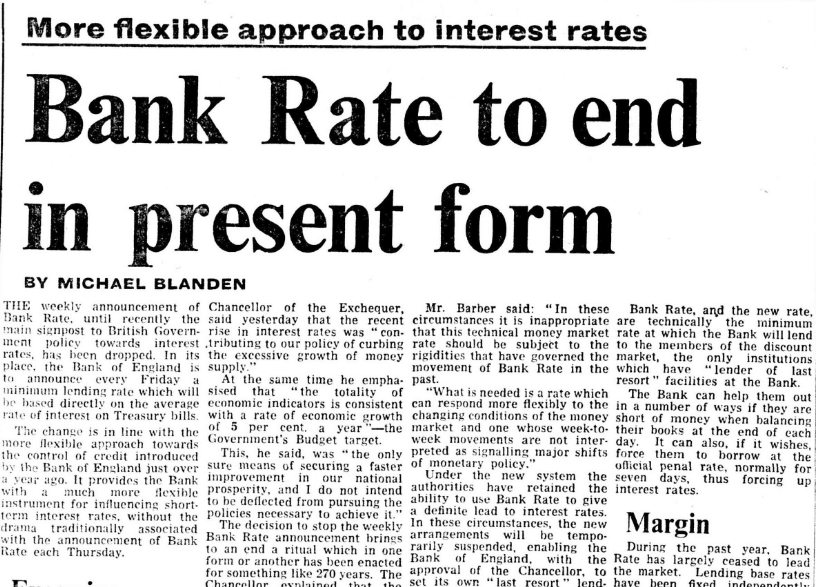
The MLR system stayed in place until 1980, when it once again came under review, eventually being suspended in 1981, along with the reserve ratio requirement which had accompanied it. A complicated dealer system featuring four different dealing bands at varying maturities replaced it. This eventually gave way to a repo rate system, involving the provision of overnight repo facilities and ongoing open market operations. The Bank Rate as we know it was eventually introduced in 2006. This new structure depended on commercial banks holding reserve accounts at the central bank and receiving interest on them. It also depended on the notion of giving banks the liquidity they need as assessed by regular maintenance periods.
As one notable financial plumbing expert remarked on Whatsapp to me: “Pre global financial crisis reserves were unremunerated. All excess cash was deployed in interbank markets. The lossmaking central bank is a totally post gfc/post interest-on-reserve problem.”
Hello Gosbanking? Based on all of the above, it stands to reason that in an excessive central-bank loss-making environment all these structures could come under review again. The significant work being done on digital dollars, euros and pounds — collectively known as central bank digital currencies — hints of a major shift coming to monetary policy as well as monetary frameworks. The bankers swear these digital innovations won’t be used as monetary policy tools, and yet somehow it’s hard to believe them. – IK
- Unherd’s John Masko wondered whether Larry Fink’s tyrannical ESG agenda had made him a threat to democracy, arguing that the BlackRock boss was using his outsized influence to “force the principles of ESG (…) down the throats of companies, investors and the public.”
. - Buy-now-pay-later lender Klarna announced an annual loss of $1bn in 2022 despite promising investors earlier this year that it was on its way to profitability.
. - Volkswagen hinted it was exploring a departure from its German manufacturing base as it set to discuss whether to build a factory in the United States at a supervisory meeting on Friday.
Bad Legal Practice:
- The American Department of Justice closed a contentious price-fixing loophole by reversing a series of decisions by the DOJ’s Antitrust Division between 1993 and 2011 which had provided flexibility around following the Sherman Antitrust Act. The loophole had allowed companies to de-facto cartelise by using third-party software to exchange information with competitors to keep salaries low and prices relatively high. Naked Capitalism has more.
. - Jeremy Clarkson’s planning troubles in the latest series of Clarkson’s Farm captured the hearts of the nation after the show revealed the degree to which Nimbyism was intruding on farming success.
Whether you are a Clarkson fan or not, the show is a worthwhile watch because of the way it documents the challenges, bureaucracy and costs facing British farming. It also highlights major deficiencies in the UK planning system. Popular support has since allowed Clarkson to appeal the local council’s decision to reject his application to build a restaurant on his farm. – IK
CON-sulting crisis:
- A new book by professor Mariana Mazzucato, an economist at the University College London, skewered the consulting classes and called out the likes of McKinsey and Deloitte for having “no expertise in the areas that they’re advising in.” Mazzucato told the Financial Times consultants could even be responsible for Western governments’ inability to govern effectively. [Hear, hear! – IK]
Power and Energy:
- Yanis Varoufakis posted a video on why the electricity market was a scam, doesn’t really exist and was fashioned by the government to extract additional monies from the general public. He also called for Russian sanctions to be ended because they were hurting democracies while empowering Russian oligarchs and should be ended immediately.
. - Scottish Power admitted that 71 of their windmills were being powered by diesel generators after they found faults with their own power supply.
. - Bloomberg estimated that Germany needed to build 43 soccer fields of solar power a day to plug its $1 trillion power gap.
Gosbankification:
- Russian news agency TASS announced that the Bank of Russia would launch a digital ruble CBDC pilot on April 1, 2023. The trial will involve person-to-person and merchant payments across 13 local banks and several merchants, with a view to expanding wallet access by 2024.
. - The Bank of Japan expanded its proof of concept work on the digital yen CBDC. However, it added that the proof of concept would not entail actual retail transactions.
. - The BoE’s Sir John Cunliffe said there was a 70 per chance the Treasury and Bank of England would implement a digital pound following its joint consultation.
. - The US Treasury announced a working group into the digital dollar.
. - Tom Emmer denounced the Biden White House for creating an “authoritarian-style” and “surveillance-style” CBDC through executive orders and launched a “CBDC Anti-Surveillance State Act” to shield American citizens’ right to financial privacy.
Media Matters:
- Woody Harrelson opened Saturday Night Live with an entirely fictional, and perfectly unbelievable, story;
“The biggest drug cartels in the world get together and buy up all the media and all the politicians and force all the people in the world to stay locked in their homes, and people can only come out if they take the cartel’s drugs and keep taking them over and over. I threw the script away. I mean, who is going to believe that crazy idea?” he quipped.
As pointed out by Joe Rogan, Harrelson’s gag was immediately vindicated by a number of hit pieces released by Fox News, Vanity Fair and other news outlets. These pieces called Harrelson a conspiracy theorist, anti-vaxxer, and all the typical names given to those who have criticised the
drug dealerpharmaceutical industry over the last three years.And yet nobody made the obvious connection. Woody Harrelson’s dad was himself a heavyweight hit man and organized crime figure who once claimed to have assassinated JFK. – DGG
- Harpers Magazine’s Andrew Cockburn came out in defence of Julian Assange, arguing that the media had failed the founder of Wikileaks. The piece attempted to dismantle some of the most common attacks penned by the media against Assange, such as the idea that he did not protect Wikileaks sources, or that he was careless with the sensitive nature of the information he was revealing.
. - Norway’s sovereign wealth fund placed Orlen, Poland’s state energy giant, under observation for potential human rights violations on concerns the energy giant’s acquisition of Polska Press, which owns dozens of regional Polish media outlets, had led to interference in editorial decisions and the appointment of government-friendly editors.
. - The Canadian House of Commons called on Google executives to testify regarding the censoring of news content by the American search engine in Canada. The move followed reports from The Canadian Press, which revealed that Google was blocking Canadian users from viewing some news content in “what the company says is a test run of a potential response to the Liberal government’s online news bill, Bill C-18.”
. - Caitlin Johnstone argued that Western mass media was institutionally geared towards suppressing anti-war movements.
. - Arron Banks won a partial victory in his appeal against a libel judgment that found in favour of Observer and Guardian journalist Carole Cadwalladr, who he said had libelled him in a 2020 Ted Talk. The journalist may now have to pay damages to the multi-millionaire. Whether this is in fact a victory or not, however, depends on the sources you read. Cadwalladr herself took to Twitter to claim she had still won the day.
. - Former Justice and anti-lockdowner Jonathan Sumption argued that today’s exhausting focus on viewing history and truth through the prism of race relations has warped our perception of the past and killed historical truth.
. - Semafor decided to rebuild trust in media by officially partnering with a CCP-aligned Chinese think tank. This after the media start-up said in January it was looking to buyback the stake that Sam Bankman-Fried, the disgraced former boss of collapsed crypto exchange FTX, had invested into the company.
. - The CCP warned Elon Musk from sharing the most recent report by the American Department of Energy that claimed the Coronavirus originated from the Wuhan lab.
. - A British government-affiliated disinformation group named the Global Disinformation Index drew fire for punishing outlets that pushed so-called coronavirus conspiracies about the Wuhan Institute of Virology.
. - The Daily Mail revealed that large numbers of former American intelligence personnel are now working across Silicon Valley in counter-misinformation centred roles.
. - Matt Taibbi published a series of Substack articles and a new Twitter Thread about how Obama’s attempt to curtail ISIS’ propaganda in American suburbs with the launch of the Global Engagement Center and state-sponsored blacklists was expanded to allow for easy governmental overreach.
Geopolitical hot spots:
- Kazakhstan signed a new strategic cooperation agreement with the United States, signalling a shift away from the Caspian oil behemoth’s alliance with Russia.
. - Following Seymour Hersh’s revelations regarding the authorship of the Nord Stream pipeline explosions, Peter Hitchens asked whether Germany is in fact owned by the United States?
Hitchens darts around the history of the later 20th century to show how recent events have undermined Germany’s European supremacy over its fellow member-states and points to its inevitable submission to American policy objectives. – DGG
- Russian crude and fuel was being switched miles off the coast of Greece as Russian and foreign merchants attempted to circumvent western sanctions.
The Blind Spot actually looked at the issue of sanctions circumvention shortly before it became clear that the United Kingdom had imported around £200mn worth of Russian oil from March to November 2022.
In our piece, ‘Is the West quietly initiating Russian sanctions theatre’?, we predicted that Russians would take a page out of the Iranian sanctions-avoidance book.
The technique isn’t too complex. To conceal the origin of petroleum, for instance, shippers must engage in at-sea ship-to-ship transfers to exchange their outbound oil. Then all you need is a fake origin destination for your goods on the bill of lading and voila, the oil is now without a sanctioned origin, and able to trade freely.
Identifying which ships are carrying the sanctioned oil isn’t too simple. Cargo vessels are notoriously jurisdictionally complex. Sanctioned countries can (and do) take advantage of this to hide the Ultimate Beneficial Owner of relevant trades. They also understand the benefits of registering with intentionally lax ship registeries and secrecy-friendly corporate jurisdictions.
You can sanction all you want, but economic reality will often get in the way – and get away with it. – DGG
- There was an awkward moment at the UN Security Council when Ukrainian and Russian diplomats disagreed on the scope of a proposed moment of silence for the lives lost in the Russian-Ukrainian war.
. - Paul D. Thacker revealed that years before the Covid-19 outbreak, American bioweapon researchers were “juicing up bugs to make them more deadly and contagious” — and that these endeavours may have “fueled the rise of patients with Lyme disease”.
. - Larry Summers, former Treasury Secretary, told CNN Russias sanctions weren’t effective. He now believes price caps on Russian energy should be ‘stiffened up to maximise the impact of these sanctions.
. - Urban transport realist (and friend of the Blind Spot) Hubert Horan undertook another painstaking analysis of Uber’s latest results to show how the ride-hailing app deliberately distorts them by using the made-up adjusted EBITDA measure. When you amend the figures back to normality, a $665 million profit turns into a cumulative loss from actual operations that amounts to over $33 billion. Nice.
Horan also cast an eye over this new paper by two former Uber employees and an MIT academic about the app’s supposedly successful attempt to restructure its fee system with up-front pricing. He wasn’t too impressed. What’s clear is that the pricing shift failed to increase welfare for anyone.
POLITICO’s Finest:
- Emmanuel Macron announced the start of a “new, balanced relationship” with Africa as France reduces its military presence in its former colonies. For instance, Macron claims future French bases there will be ‘co-administered’ with local troops.
. - The EU’s 2035 combustion engine ban plan was postponed due to stiff opposition from German delegates. Germany’s Transport Minister has warned that Berlin wants the European Commission to carve out a role for e-fuels after 2035, and will hold out their support until then.
. - The making and unmaking of Eva Kaili – from star-studded Greek celebrity politician to corrupt Europarliamentarian.
. - The mass leak of 100,000 messages from Matt Hancock by Isabel Oakeshotte has apparently instilled a well-deserved panic in Westminster.
. - Belgium ruled its strict COVID measures were constitutional and could be legally used in future pandemics.
Lockdown Files:
- Journalist Isabel Oakeshott leaked the entire cache of Whatsapp messages she obtained from former health secretary Matt Hancock under an NDA for the purposes of aiding her with the writing of his memoirs to the Telegraph. The nation remains divided over whether the move was really in the public interest.
. - Among the revelations is evidence of a cosy media relationship between Matt Hancock and former Chancellor-turned newspaper editor George Osborne. Osborne is revealed to have told Hancock to “give some exclusive words to the Standard and I’ll tell the team to splash it.”
. - Oakeshott set out the conversations that led to the ridiculous overreach by state and local authorities over Covid, such as banning people from walking solo in the countryside. She also revealed the degree to which scientists and experts weren’t fully on board with the government’s contentious school closure policy.
Another example of these overreaches has been recent news that a UK-wide cat cull was considered early in the Covid crisis.
But my favourite was definitely police dying the Lake Districts’ famous Blue Lagoon black to convince lockdown rule-breakers not to swim in its dangerously high-PH level waters – DGG
- How increasingly authoritarian powers made initially rational and cautious ministers “utterly contemptuous of criticism”.
. - Why Boris Johnson’s desire to end lockdown was opposed by surveys that apparently showed widespread public support for the measures.
- Swedish epidemiologist Martin Kulldorff drew laughs in a House of Congress roundtable on February 28:
“We knew about [infection-acquired immunity] since 430 BC, since the Athenian Plague, until 2020. Then we didn’t know about it for three years, and now we know about it again.”
- American troops that were forcefully discharged for refusing to take the Covid-19 vaccine may be able to rejoin the military.
. - Former Prime Minister of Italy Giuseppe Conte was facing a probe over his conduct during the Covid-19 outbreak in Lombardy.
UAP fever:
- Almost 125 miles of Russian airspace near Saint Petersburg were closed for an hour on February 28. This was reportedly due to reports of an unidentified flying object flying over the city, though the Kremlin claims they were simple military drills.
. - A previously classified National Reconnaissance Office satellite system, called ‘Sentient’, may have detected a ‘Tic-Tac’ UFO in 2021.
The Tic-Tac UFOs have been popularised over the last few years by Navy pilots ‘descriptions of ocean-going encounters with these strange, extraordinarily capable and somewhat aggressive objects.The article is significant for two reasons.
The first is that the NRO had to modify the capture settings for the Sentient to be able to even see objects like the Tic-Tac it appears to have detected. This suggests that aerial incursions by very slow-moving or unnaturally fast-moving UFOs may have been severely under-estimated even by operators of the most highly advanced observation platforms in the world.
The second reason regards the source of intelligence. One reason the American government finds real UFO transparency and disclosure so difficult is the nature of its sourcing for such intelligence. In the intelligence world, the classification or secrecy of a piece of information often comes down to the level of classification of the source of that information rather than the information itself.
This article, therefore, confirms that our most advanced platforms are indeed on the lookout for UFOs and may be partly responsible for the American government’s difficulty in sharing that information.More worryingly, however, it also suggests they didn’t really know what they were doing.
Unsurprising, especially considering the American UFO office only had three staffers until recently – DGG
- The reporting manual for the UFO section of the Spanish Air Ministry’s Intelligence bureau was leaked in 1992. The reporting procedure titled IG-40-5 is unique in many ways.
Unlike most Western countries, Spain is almost unique in openly admitting that a specialised Intelligence unit of its military is directly responsible for all reported UFO encounters in country.The only other country to do this is the French GEIPAN, an official government agency that has looked into this country’s UFO reports since the 60s. However, GEIPAN is not a section of France’s military, but of its space agency, CNES.
Though the Spanish military states front and centre that the UFO phenomenon is entirely mundane in origin, the reporting sheet suggests otherwise.
For example, the reporting document asks the observer of supposedly mundane things whether the shape of the objects are ‘egg-shaped, cigar-shaped, or spherical’ among a list of options. It also asks things like ‘how long did the observation of the beings last’, ‘what was their behaviour, what objects did they carry’ and whether the observer suffered from psychical effects like ‘memory loss, time dilation’ etc.Strange things to ask those who have merely observed misidentified swamp gas – DGG
